To Find Energy Efficient Protocol by using Minimum
Spanning Tree
Ankush Uppal
M.Tech Scholar, CSE Department Doaba Institute of Engg. & Technology, Kharar
Punjab, India
Ramanjot Kaur
Assistant Professor, CSE Department Doaba Institute of Engg. & Technology, Kharar
Punjab, India
ABSTRACT
Remote Sensor Networks (WSN) alludes to a gathering of moment, low power-driven sensor hubs that are spatially circulated to check the various environmental conditions. These sensor nodes are lightweight in nature, have constrained computational ability and correspondence transfer speed. These sensor hubs are little, savvy detecting and imparting gadgets that are modified for detecting the earth conditions (like fire, mugginess, and so forth), assembling the information and handling it to draw shifted expressive data. Vitality utilization is the significant outline issue which emerges while planning the directing conventions for WSNs. Since WSN conventions are subjected to the sort of use for which they are being set, so the routing conventions intended for the system ought to have the capacity to satisfy every one of the prerequisites of the application. The real issue identified with the outlining of the conventions is to draw out the lifetime of the system i.e. the sensor hubs in the system get by in the system for a more drawn out timeframe without depleting off their full energy. In this paper, a routing scheme based on minimum spanning tree generation along with partitioning the network into grids is proposed.
This methodology depends on the idea of Grid i.e. partitioning the network area into parts in view of isolating the nodes from each other and then in-turn generating Minimum Spanning Tree (MST) structure for communication among sensor nodes. Proposed scheme i.e. one MST at node level inside a grid and other at Grid head level between various grids so as to diminish the heap and increment the system lifetime of WSN.
Keywords
WSN, Routing, Minimum Spanning Tree, EnergyEfficiency
1.
INTRODUCTION
An expansion in the ubiquity of creations like workstations, PDAs, PDAs, GPS gadgets and other canny computational inventions has been seen in the everyday life. Late advances in the field of miniaturized scale sensors inventions have facilitated signs of progress in sensor arrange field which has eventually prompted the advancement of Wireless Sensor Networks (WSN) [1].
The advances in the innovation have speeded up the mass use of the sensor hubs, which despite their modest size, have compelling distinguishing, taking care of, transmitting and accepting potential [2]. The detecting hardware show on these gadgets measures the conditions related to the
surroundings going around the sensor hubs and believers them to electrical signs. The signals prepared further uncover a few properties related with the objects that are situated in the sensor nodes region [3].
Wireless sensor network is referred to as group of small, less power-driven sensor nodes which are geographically arranged to analyze the assorted environment phenomenon. The sensor nodes have less weight and limited computational capability. The communication bandwidth is also limited. These sensor nodes are small in size with smart sensing capability and interaction devices that are electronically instructed to judge the environment conditions like humidity, fire and much more. The collected data is then processed to draw diverse information. The processed information is then sent from node to node towards the base station where the whole data is collected, analyzed and monitored. These sensor nodes may be dynamically or statically located in random fashion. A small battery is attached with each sensor node which is not rechargeable. The environmental conditions do not allow the battery to be rechargeable. WSN performs well irrespective of the size of the network [4].
Despite the fact that the WSNs are comparable pretty much to alternate systems they confront certain imperatives and difficulties which makes them not the same as alternate systems. The different difficulties looked in WSNs are their Limited Energy of sensor nodes, Scalability of the network, robustness, high dynamicity of network reconfiguration etc.
Routing alludes to the way toward finding a way to send and also accepting the information between the communicating nodes. The most vital undertaking performed in WSNs is to send and in addition get the gathered data from the sensor field towards the BS. So the strategies that are utilized to exchange the information and data between source- target hubs turn into a critical worry that should be tended to in the headway of the WSNs.
a) Local Communication b) Point-to-Point c) Convergence
[image:2.595.211.473.67.224.2]
d) Aggregation e) Divergence Fig 1: The traffic patterns in WSNs [5]
2.
RELATED WORK
Broad research will enhance network lifetime for remote sensor networks. Lifetime can be enhanced by well outlining steering systems. Information dispersal is done in the network and same can be vitality effective by making the sink node mobile. As sink node moves around the outskirts, closest Grid will transmit the information to sink node. Mobility of sink will spare vitality of the nodes and can be controlled or uncontrolled. In controlled mobility [6-8], speed and bearing of the sink is overseen by outside onlooker or according to network progression. This paper thinks about controlled mobility of the sink with a specific speed around the outskirts. Resulting sections feature a portion of the current work done in the significant field.
Authors in [9] proposed first clustering approach where the network was divided in to clusters (5% of the total nodes). Each cluster was supposed to have a cluster head (CH) which receives data from the cluster, aggregates the data and transmits it to Base Station (BS). CH is rotated after each round to balance the load on all nodes of the network. Due to this rotation network achieves 8X improvement but selects CH on rotational basis only without checking node’s capability.
In [10] authors proposed TEEN protocol, based on the variation in the environmental factors. Sensor node transmits data only if change in the environment factor goes beyond the threshold. After crossing this threshold, sensor node continuously senses data and report for even a small change in the factor too. This leads to lesser message transmission to BS hence improvement in network lifetime.
Authors in [11] proposed routing protocol by forming a chain among the sensor nodes of the network. No criteria were defined while forming the chain among the nodes resulting in more transmission delay. Also if one node dies in between the functioning, data of the whole network is lost.
Tan et. al. proposed PEDAP [12], a minimum spanning tree-based protocol. This method was centralized algorithm governed by the BS. This technique was used for data gathering and also for computing routing information. All the computational tasks were done by BS and during the operation dead nodes were also discarded after certain number of rounds.
Authors in [13] proposed tiering scheme based on distance of nodes from BS. Nodes closer to the BS are in the higher grids and are preferred for data transmission to BS. These nodes aggregate data of the network and transfer data to BS on rotational basis.
Authors in [14] created minimum spanning tree among the sensor nodes to reduce transmission energy to its least level. This scheme was incorporating least cost of the network along with having some transmission delay in terms of number of nodes in the network.
Spine base virtual Infrastructure (BVI) proposed by gracious et al. [15] scatters information in multi bounces. It utilizes HEED [16] for grouping and an attempt to limit the quantity of bunches. One bunch head (CH) is utilized to keep track the area of mobile sink. Mobile sink registers itself to the CH by means of operator node. At whatever point mobile sink moves in the bunch; it is the duty of CH just to build up an association with the sink. Root node being every now and again utilized for course alteration depletes out considerably speedier contrasted and rest of the nodes.
HexDD[17] (Hexagonal cell-based Data Dissemination), makes hexagonal grid structure to transmit information to numerous mobile sinks. Sink information inquiry will be answered by the nodes in focal point of the cell. At the point when inquiry scopes to the cell with pertinent information, switch way is received for sending answer to the sink node. Sink development is educated to focus and also outskirt nodes alongside directing data. This data causes high vitality misfortune particularly when sink is moving at rapid.
Creators in [18] proposed a round group based directing procedure VCCSR (virtual circle joined straight steering) in which mobile sink courses in the sensor field. This mobile sink speaks with group head nodes introduce at the fringe driving short separation correspondence and transmission of network information to sink at bring down cost. In spite of the fact that this plan decreases course recreation cost yet unfit to appropriate load equitably on nodes of the network.
Chaos [19], depends on pacing heterogeneous nodes as far as capacity at break even with separations in the field of intrigue. Mobile sink passes a question message to the nodes in the network by flooding approach. Proper nodes containing the answer parcel to the inquiry return to mobile sink. Comparative methodologies were additionally characterized in [18, 19] for information accumulation by mobile sink. They were additionally depending on every now and again utilized nodes which thus deplete out significantly quicker.
as possible nodes so drains substantially quicker, bringing about shorter network lifetime.
TTDD [21] likewise builds virtual grid structure in which mobile sink disperses the question parcel and that is returned by the sensor node. GCA [22] proposed hexagonal cell based structure for taking care of sink mobility. It averts flooding of parcels for sink area data. Header nodes speak with mobile sink for question answer. Anyway because of expiry of time to live estimation of bundles there is increment in dormancy and number of dropped parcels.
VGDRA [23] was the Grid structure steering convention which separates the network in virtual grids in light of number of nodes in the network. CH in each bunch transmits information in affix based way to deal with mobile sink by means of another CH. It attempts to limit the bundle
transmission for sink area refresh by sending parcels to chosen CHs as it were.
VTGDRA [24] was proposed by dividing the network into different number of grids. Number of grids formed was based on nodes deployed in the field. This technique further creates tiers in every grid so as to achieve performance of flat based routing
3.
NETWORK MODEL
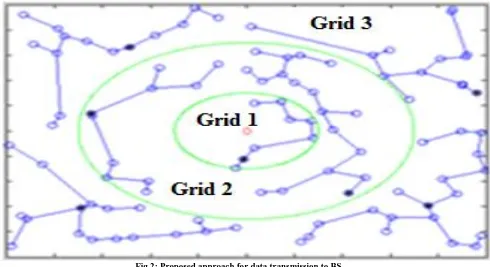
[image:3.595.59.549.247.514.2]The protocol assumes that all sensor nodes are distributed randomly in the network of area 100m×100m. If we add data aggregation, each node of the network has the capability to transmit data to other sensor nodes as well as to BS. The main aim is to transmit the aggregated data to base station with minimum loss of energy which in fact increase system lifetime in terms of round.
Fig 2: Proposed approach for data transmission to BS In this work the facts considered for sensor network:
• Each node periodically senses its nearby environment and likes to send this data to BS.
• BS is fixed and located far away from sensor nodes.
• Sensor nodes are homogeneous.
• Sensor nodes are stationary and are uniquely identified.
• Data fusion and aggregation is used to reduce the size of message in the network. It is assumed that combining n packets of size k results in a packet of size k instead of size nk.
3.1 RADIO MODEL
Energy of sensor nodes is key factors in WSN by pursue of which their circuitry will work. This one time energy of nodes is required to be utilized effectively. Major energy consuming factors are transmission ETx , receiving ERx of data and are calculated as
ETx(k, d) = Eelec*k+ Eamp*k,
Where Eamp is the amplification energy so total transmission cost is elaborated as:
Where are free space and multi path space coefficients
3.2 PROBLEM STATEMENT
In this work, the main consideration is wireless sensor networks where the sensors are randomly distributed over an area. The locations of sensors are fixed and the base station knows them all a priority. Now, The sensors are in direct communication range of each other and can transmit to and receive from the base station. The nodes continuously sense the environment and have always data to send in each round of communication. Each nodes aggregate the data they receive from others nodes with their own data, and produce only one packet regardless of how many packets they receive.
operate together is important, – since the quality of the system will be dramatically decreased after first node’s death. Lifetime is defined as the number of rounds until the first sensor is drained off its energy. In general, the time in rounds where the last node depletes all of its energy defines the lifetime of the overall sensor network. Taking these different possible requirements under consideration this work gives depletion time of all nodes and leaves the decision which one to choose to system designers.
4.
PROTOCOL DESCRIPTION
Proposed technique divides the nodes into three grids, as indicated by their distance from the BS. The system administers a level ID and bunch ID to each node amidst the instating stage. The sensor nodes that have the same level ID should be set in a similar grid. The sensor nodes having a place with a similar grid are put at same separate from the BS, and utilize a similar measure of vitality for exchanging data to the BS. Lower grid IDs are distributed to the nodes that are arranged nearer to the BS.
Every level contains diverse number of bunches. One bunch in the Grid 1, two groups in Grid 2 and four groups in Grid 3 is taken. The grid dividing is done in the accompanying way:
Grid1 = Distance of the node from BS is up to 15m
Grid2= Distance of the nodes from the BS is more from 15m to 35m
Grid3= Distance of the nodes from the BS is more than 35m
Groups are framed inside the level where part nodes are associated with the CHs with the assistance of Minimum Spanning Tree (MST). A Spanning Prim's Algorithm is utilized for the MST development between the nodes and CHs and in addition between CHs of various grids. A crossing tree of a chart is an associated sub-diagram in which there are no cycles. The least crossing tree for a given chart is a base cost spreading over tree for that diagram.
[image:4.595.312.549.85.277.2]The separation of one node from every one of the nodes in the network is figured. This separation is allocated as weights of the edges interfacing a node to every node in the network. Nearness framework is shaped containing the separation of one from alternate nodes in the field. This nearness framework is taken as contribution to the Prim's calculation for ascertaining the least weighted spreading over tree. MST is utilized for computing the cost acquired to send and also get the gathered data from the nodes to the BS and the other way around. The way built by MST is utilized for transmission of information to the BS with least cost and thus expanding the dependability time of the network.
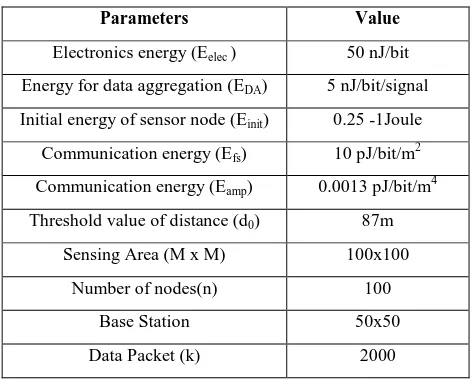
Table 1. Simulation Parameters
Parameters Value
Electronics energy (Eelec ) 50 nJ/bit
Energy for data aggregation (EDA) 5 nJ/bit/signal
Initial energy of sensor node (Einit) 0.25 -1Joule
Communication energy (Efs) 10 pJ/bit/m2
Communication energy (Eamp) 0.0013 pJ/bit/m4
Threshold value of distance (d0) 87m
Sensing Area (M x M) 100x100
Number of nodes(n) 100
Base Station 50x50
Data Packet (k) 2000
In proposed technique, every one of the sensor node progresses its gathered and amassed information to the CH to which it is associated in MST structure. At that point the CH of highest rank Grid will send the summative information of the nodes of the bunch to the closest CH in the following grid lastly to the BS. CH of the principal grid i.e Grid 1 will keep on sending the abridged data to the BS till every one of the nodes of first grid have the vitality which is higher than the limit grid characterized for the nodes.
At the point when the vitality of the nodes of the main grid goes underneath the limit grid then the CH of the second closest grid i.e Grid 2 will start to transmit the amassed information towards the BS and a similar strategy will be rehashed with the nodes of third grid i.e Grid 3 which is situated at a noteworthy separation from the BS. This system of moving the power to send the data from the nodes to the BS alternating is known as SHIFTING OF THE TOP GRID [25]. In this strategy when every one of the nodes of a solitary grid turns out to be dead then the nodes of the following closest grid start to transmit the amassed data to the BS [25]. At the point when every one of the nodes of the end grid i.e Grid 3 have their vitality not as much as the objective vitality grid then another objective grid of vitality is set. This procedure proceeds till the limit goes beneath the dead vitality. Now the entire network is thought to be dead as every one of the nodes shaping the network turn out to be dead.
5.
RESULT AND DISCUSSION
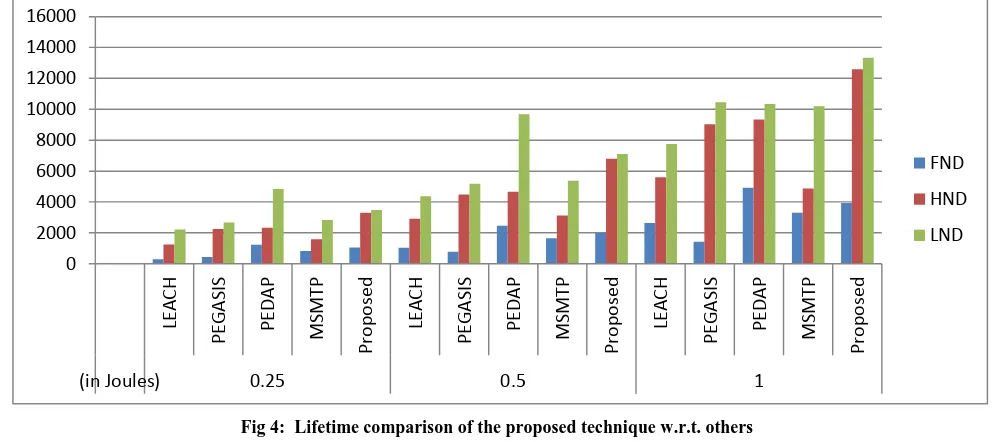
Fig3: Scenario during proposed network simulation Results obtained after simulation are depicted in the figure 4.
Table 2 provides the detailed values. As it is clear from the graph that proposed technique provides better lifetime as
[image:5.595.49.548.389.610.2]compared to other techniques in First Node Died (FND), Half Node Died (HND), Last Node Died (LND) scenario. This is due to even load distribution on the nodes of the network.
Fig 4: Lifetime comparison of the proposed technique w.r.t. others Table 2. Details of round in which a node dies
Ener gy (in Joule
s)
0.25 0.5 1
Proto col F N D H N D L N D F N D H N D L N D F N D HN D LN D LEA CH 30 2 12 46 22 26 10 37 29 23 43 66 26 32 55 98 77 50
PEG 44 22 26 77 44 51 14 90 10
44
ASIS 2 58 72 8 94 79 34 32 9
PED AP 12 32 23 30 48 39 24 57 46 64 96 78 49 17 93 32 10 34 6 MSM TP 82 4 15 89 28 31 16 45 31 18 53 74 33 06 48 80 10 19 4 Prop osed 10 49 33 06 34 80 20 06 67 93 71 06 39 34 12 58 9 13 34 3 0 2000 4000 6000 8000 10000 12000 14000 16000 LE AC H PE G ASIS PE DAP MSMT P Pro p o se d LE AC H PE G ASIS PE DAP MSMT P Pro p o se d LE AC H PE G ASIS PE DAP MSMT P Pro p o se d
(in Joules) 0.25 0.5 1
FND
HND
6.
CONCLUSION
In this paper another steering methodology has been proposed. This methodology depends on the idea of Grid i.e partitioning the network into zones and then creating Minimum Spanning Tree (MST) among the system. Through simulation and analysis of the proposed work it is shown that the framework's steady lifetime is enhanced than the current steering conventions. This convention contributes a part towards drawing out the network lifetime.
7.
REFERENCES
[1] Li, Changle, et al. "A survey on routing protocols forlarge-scale wireless sensor networks." Sensors 11.4 (2011): 3498-3526.
[2] Manjeshwar, Arati, and Dharma P. Agrawal. "TEEN: a routing protocol for enhanced efficiency in wireless sensor networks." In Parallel and Distributed Processing Symposium, International, vol. 3, pp. 30189a-30195a, IEEE Computer Society, 2001.
[3] Nikolidakis, Stefanos A., et al. "Energy efficient routing in wireless sensor networks through balanced clustering." Algorithms 6.1 (2013): 29-42.
[4] Nikolidakis, Stefanos A., et al. "Energy efficient routing in wireless sensor networks through balanced clustering." Algorithms 6.1 (2013): 29-42.
[5] Nikolidakis, Stefanos A., et al. "Energy efficient routing in wireless sensor networks through balanced clustering." Algorithms 6.1 (2013): 29-42.
[6] Nikolidakis, Stefanos A., et al. "Energy efficient routing in wireless sensor networks through balanced clustering." Algorithms 6.1 (2013): 29-42.
[7] kkaya, Kemal, and Mohamed Younis. "A survey on routing protocols for wireless sensor networks." Ad hoc networks 3.3 (2005): 325-349.
[8] Bathla Gaurav, Khan Gulista “Minimum Spanning Tree based Routing Strategy for Homogeneous WSN”, International Journal on Cloud Computing Services and Architecture (IJCCSA), vol.1, issue 2, pp. 22-29, August 2011.
[9] Bathla Gaurav, Khan Gulista “Minimum Spanning Tree based Routing Strategy for Homogeneous WSN”, International Journal on Cloud Computing Services and Architecture (IJCCSA), vol.1, issue 2, pp. 22-29, August 2011.
[10]Bathla Gaurav, Khan Gulista “Minimum Spanning Tree based Routing Strategy for Homogeneous WSN”, International Journal on Cloud Computing Services and Architecture (IJCCSA), vol.1, issue 2, pp. 22-29, August 2011.
[11]Bathla Gaurav, Khan Gulista “Minimum Spanning Tree based Routing Strategy for Homogeneous WSN”,
International Journal on Cloud Computing Services and Architecture (IJCCSA), vol.1, issue 2, pp. 22-29, August 2011.
[12]Khan, Abdul Waheed, Abdul Hanan Abdullah, Mohammad AbdurRazzaque, and Javed Iqbal Bangash. "VGDRA: a virtual grid-based dynamic routes adjustment scheme for mobile sink-based wireless sensor networks." IEEE sensors journal 15, no. 1 (2015): 526-534.
[13]Heinzelman, Wendi Rabiner, AnanthaChandrakasan, and Hari Balakrishnan. "Energy-efficient communication protocol for wireless microsensor networks." In System sciences, Proceedings of the 33rd annual Hawaii international conference, pp. 1-10, IEEE, 2000.
[14]Heinzelman, Wendi Rabiner, AnanthaChandrakasan, and Hari Balakrishnan. "Energy-efficient communication protocol for wireless microsensor networks." In System sciences, Proceedings of the 33rd annual Hawaii international conference, pp. 1-10, IEEE, 2000.
[15]Lindsey, Stephanie, and Cauligi S. Raghavendra. "PEGASIS: Power-efficient gathering in sensor information systems." In Aerospace conference proceedings, vol. 3, pp. 1125-1130, IEEE, 2002.
[16]B. Tang, J. Wang, X. Geng, Y. Zheng, and J.-U. Kim, “A novel data retrieving mechanism in wireless sensor networks with path-limited mobile sink,” nt. J. Grid Distrib. Comput., vol. 5, no. 3, pp. 133–140, 2012.
[17]B. Tang, J. Wang, X. Geng, Y. Zheng, and J.-U. Kim, “A novel data retrieving mechanism in wireless sensor networks with path-limited mobile sink,” nt. J. Grid Distrib. Comput., vol. 5, no. 3, pp. 133–140, 2012.
[18]B. Tang, J. Wang, X. Geng, Y. Zheng, and J.-U. Kim, “A novel data retrieving mechanism in wireless sensor networks with path-limited mobile sink,” nt. J. Grid Distrib. Comput., vol. 5, no. 3, pp. 133–140, 2012.
[19]B. Tang, J. Wang, X. Geng, Y. Zheng, and J.-U. Kim, “A novel data retrieving mechanism in wireless sensor networks with path-limited mobile sink,” nt. J. Grid Distrib. Comput., vol. 5, no. 3, pp. 133–140, 2012.
[20]Tan, HüseyinÖzgür, and Ibrahim Körpeoǧlu. "Power efficient data gathering and aggregation in wireless sensor networks." ACM Sigmod Record, vol. 32, issue 4, pp. 66-71, 2003.
![Fig 1: The traffic patterns in WSNs [5]](https://thumb-us.123doks.com/thumbv2/123dok_us/9300990.428903/2.595.211.473.67.224/fig-traffic-patterns-wsns.webp)