Parallel and Concurrent Security of the
HB and HB
+Protocols
Jonathan Katz∗† Ji Sun Shin∗‡
Abstract
Juels and Weis (building on prior work of Hopper and Blum) propose and analyze two shared-key authentication protocols — HB and HB+
— whose extremely low computational cost makes them attractive for low-cost devices such as radio-frequency identification (RFID) tags. Security of these protocols is based on the conjectured hardness of the “learning parity with noise” (LPN) problem: the HB protocol is proven secure against a passive (eavesdropping) adversary, while the HB+ protocol is proven secure against active attacks.
Juels and Weis prove security of these protocols only for the case of sequential executions, and explicitly leave open the question of whether security holds also in the case of parallel or concurrent executions. In addition to guaranteeing security against a stronger class of ad-versaries, a positive answer to this question would allow the HB+
protocol to be parallelized, thereby substantially reducing its round complexity.
Adapting a recent result by Regev, we answer the aforementioned question in the affirmative and prove security of the HB and HB+
protocols under parallel/concurrent executions. We also give what we believe to be substantiallysimpler security proofs for these protocols which are more complete in that they explicitly address the dependence of the soundness error on the number of iterations.
∗Dept. of Computer Science, University of Maryland. {
jkatz,sunny}@cs.umd.edu.
†This research was supported by NSF Trusted Computing grants #0310499 and #0310751, and NSF CAREER award #0447075.
1
Introduction
Low-cost, resource-constrained devices such as radio-frequency identification (RFID) tags or sensor nodes demand extremely efficient algorithms and protocols. Securing such devices is a challenge since, in many cases, “traditional” cryptographic protocols are simply too computationally-intensive to be utilized. With this motivation in mind, Juels and Weis [20] — building upon work of Hopper and Blum [18, 19] — investigate two highly-efficient, shared-key (unidirectional) authentication protocols suitable for an RFID tag identifying itself to a tag reader. (We will sometimes refer to the tag as a prover and the tag reader as a verifier.) These protocols are extremely lightweight, requiring both parties to perform only a relatively small number of primitive bit-wise operations such as “XOR” and “AND,” and can thus be implemented using fewer than the 5-10K gates required to implement even a block cipher such as DES or AES [20].
The two authentication protocols studied by Juels and Weis are both proven secure via reduction to the “learning parity with noise” (LPN) problem [4, 5, 6, 9, 17, 21, 18, 19, 25]; a formal definition of this problem as well as evidence for its difficulty are reviewed in Section 2.1. The first protocol (called the HB protocol [18, 19]) is proven secure against a passive (eavesdropping) adversary, while the second (called HB+) is proven secure against the stronger class of active adversaries. In each case, Juels and Weis focus on a single, “basic authentication step” of the protocol and prove that a computationally-bounded adversary cannot succeed in impersonating a tag in this case with probability noticeably better than 1/2; that is, a single iteration of the protocol has
soundness error 1/2. The implicit assumption (though see below) is that repeating these “basic authentication steps” sufficiently-many times yields a protocol with negligible soundness error.
Difficulties and limitations. There are, however, some subtle limitations of the security proofs
given by Juels and Weis. Most serious, perhaps, is a difficulty explicitly highlighted by Juels and Weis and regarded by them as a potential barrier to usage of the HB+ protocol in practice [20, Section 6]: the proof of security for HB+ requires that the adversary’s interactions with the tag (i.e., when the adversary is impersonating a tag reader) be sequential. Besides leaving in question the security of HB+ under concurrent executions, this also means that the HB+ protocol itself (which, recall, consists of sufficiently-many repetitions of an underlying basic authentication step) requires very high round complexity since the multiple iterations of the basic authentication step cannot beparallelized but must instead be performed sequentially. The difficulty and importance of proving security of various identification protocols under concurrent or parallel composition is well-understood, and many results are known: for example, the (black-box) zero-knowledge property of an identification protocol is not preserved under parallel [14] or concurrent [8] composition (though it is preserved under sequential composition [16]), whereas witness indistinguishabilityis preserved in these cases [11]. Unfortunately, the HB+ protocol is not known to satisfy either zero knowledge or witness indistinguishability and so such results are of no help here.
An additional difficulty, not explicitly mentioned in [20], is that it is unclear what is the exact relationship between the soundness error and the number of repetitions of the basic authentication step; this is true for both the HB and HB+ protocols, regardless of whether the repetitions are carried out in parallel or sequentially.1 This is related to the more general question of “when is solving multiple instances of a problem more difficult than solving a single instance?” (i.e., hardness amplification) which has been studied in many contexts [26, 15, 3, 13, 24, 7] and turns out to be surprisingly non-trivial to answer. Unfortunately, there does not seem to be any prior work that
1
Indeed, as we have noted earlier, Juels and Weis [20] only prove soundness 1/2 for a basic authentication step and never make any claims regarding the security of multiple iterations (for either HB or HB+
applies in our setting. Specifically:
• For the HB and HB+protocols it is not possible to efficiently verify whether a given transcript is “successful” without possession of the secret key; thus, Yao’s “XOR-lemma” [26, 15] and related techniques that require efficient verifiability do not apply.
• Work on hardness amplification for “weakly-verifiable puzzles” [7] does not apply either. Although the HB/HB+ protocols can be viewed as efficiently-verifiable puzzles, hardness amplification in [7] is only proved for completely independent instances of the “puzzle.” In particular, then, the work of [7] implies that running the basic authentication step of the HB protocolntimesusing n independent keys yields soundness (roughly) 1/2n, but says nothing about runningn iterations using thesame key (which is the case we are interested in).
• The HB/HB+ protocols are computationally-sound only, and thus known results [13, Ap-pendix C] [24] on soundness reduction for interactive proof systems (which apply only when soundness holds even against an all-powerful cheating prover) do not apply either.
• Bellare, et al. [3] study soundness reduction in computationally-sound protocols, and show a positive result [3, Sect. 4] for the case of protocols running in 3 rounds. Unfortunately, their result is specifically stated to apply only when the verifier does not hold a secret key (or, more generally, only when the verifier does not share state across different iterations). As in the case of weakly-verifiable puzzles, then, this result is of no help when the same secret key is used across all iterations.
An additional difficulty in our setting is that the verifier is supposed to accept even when some iterations have not been answered successfully; indeed, crucial to both the HB and HB+ protocols is that the honest prover injects “noise” into its answers and so even the honest prover does not succeed with probability 1. This was not explicitly addressed in the security proofs of [20], either, and introduces additional complications.
1.1 Our Contributions
In this work we address the difficulties and open questions mentioned above, and show the follow-ing results: (1) the HB+ protocol remains secure under arbitrary concurrent interactions of the adversary with the honest prover/tag, and so in particular the iterations of the HB+ protocol can be parallelized; furthermore, (2) our security proofs explicitly incorporate the dependence of the soundness error on the number of iterations as well as on the error introduced by the honest prover. Besides the results themselves, we expect that the techniques and proofs we give here will be of independent interest for future work on cryptographic applications of the LPN problem. Our main technical tool is a result due to Regev [25] (see also [5]) showing that the hardness of the LPN problem implies the pseudorandomness of a certain distribution. Using this, we give proofs which we believe are substantially simpler than those given in [20], and also more complete (in that, in contrast to [20], they explicitly deal with the dependence of soundness on the number of iterations and also the issues arising due to non-perfect completeness).
1.2 Additional Discussion
The problem of secure authentication using a shared, secret key is by now well-understood, and many widely-known solutions based on, e.g., block ciphers are available. We stress that the aim of the line of research considered here, as in [20], is to develop protocols which are exceptionally
are that 5,000–10,000+ gates are needed for block-cipher implementations, whereas a typical RFID tag may only have 2,000 gates that can be dedicated to security. Moore’s Law will not necessarily help here, either: as pointed out in [20], there is intense pressure to keep prices for RFID tags low; as computational power per fixed unit of currency increases, the trend has been to reduce the cost of tags and thus expand their application domain rather than to increase their computational power while keeping costs fixed. In short, there seems to be “little effective change in tag resources for some time to come, and thus a pressing need for new lightweight primitives” [20].
Gilbert, et al. [12] have recently shown a man-in-the-middle attack on the HB+ protocol. Al-though their attack would be debilitating if carried out successfully, the possibility of such an attack does not mean that it is now useless to explore the security of the HB/HB+ protocols in weaker attack models! (Indeed, only recently have man-in-the-middle attacks on identification protocols been formally considered in general [2], yet certainly research in the area conducted up to that point is not valueless.) There will always be some tradeoff between efficiency and security, and our work can be viewed as mapping out where the HB/HB+ protocols lie on this spectrum. Moreover, Juels and Weis [20, Appendix A] note that the man-in-the-middle attack of [12] does not apply in a detection-based system where numerous failed authentication attempts immediately raise an alarm. Furthermore, especially in the case of RFID (where communication is inherently short range), it appears much more difficult to mount a man-in-the-middle attack than an active attack.2 The reader is referred to the work of Wool, et al. [22, 23], for an illuminating discussion on the feasibility of man-in-the-middle attacks in RFID systems.
2
Definitions and Preliminaries
We formally define the LPN problem and state and prove the main technical lemma on which we rely. We also define our notion(s) of security for identification; these are standard, but some complications arise due to the fact that the HB/HB+ protocols do not have perfect completeness.
2.1 The LPN Problem
Viewk as a security parameter. Ifs,a1, . . . ,a` are binary vectors of lengthk, letzi =hs,aiidenote
the dot product of s and ai (modulo 2). Given the values a1, z1, . . . ,a`, z` for randomly-chosen
{ai}and`=O(k), it is possible to efficiently solve fors using standard linear-algebraic techniques.
However, in the presence of noise where each zi is flipped (independently) with probability ε, findings becomes much more difficult. We refer to the problem of learning s in this latter case as the LPN problem.
For the formal definition, let Berε be the Bernoulli distribution with parameterε∈(0, 12) (so if
ν ∼Berε then Pr[ν = 1] =εand Pr[ν= 0] = 1−ε), and letAs,ε be the distribution defined by:
n
a← {0,1}k;ν ←Berε: (a,hs,ai ⊕ν)o.
Also letAs,ε denote an oracle which outputs (independent) samples according to this distribution. Algorithm M is said to (t, q, δ)-solve the LPNε problem if
Prhs← {0,1}k:MAs,ε(1k) =si≥δ,
2
and furthermoreM runs in time at mosttand makes at mostqqueries to its oracle.3 In asymptotic terms, in the standard way, the LPNε problem is “hard” if every probabilistic polynomial-time algorithm solves theLPNεproblem with only negligible probability (where the algorithm’s running time and success probability are functions ofk).
Note that ε is usually taken to be a fixed constant independent of k, as will be the case here. The value of ε to use depends on a number of tradeoffs and design decisions: although, roughly speaking, theLPNε problem becomes “harder” asε increases, a larger value ofεalso implies that the honest prover is rejected more often (as will become clear when we describe the HB/HB+ protocols, below). In any case, our results are meaningful for all ε∈ (0, 14). For concreteness, the reader can think of ε≈ 18.
The hardness of the LPNε problem (for constantε∈(0, 12)) has been studied in many previous works. It can be formulated also as the problem of decoding a random linear code [4, 25], and is known to beN P-complete [4] as well as hard to approximate within a factor better than 2 (where the optimization problem is phrased as finding an s satisfying the most equations) [17]. These
worst-case hardness results are complemented by numerous studies of the average-case hardness of the problem [5, 6, 9, 21, 18, 19, 25]. Most relevant for our purposes is that the current best-known algorithm for solving the LPNε problem [6] requires t, q = 2Θ(k/logk). We refer the reader to [20, Appendix D] for more exact estimates of the running time of this algorithm, as well as suggested practical values for k.
2.2 A Technical Lemma
In this section we prove a key technical lemma: hardness of the LPNε problem implies “pseudo-randomness” of As,ε. Specifically, let Uk+1 denote the uniform distribution on (k+ 1)-bit strings.
The following lemma shows that oracle access to As,ε (for randomly-chosens) is indistinguishable from oracle access toUk+1. A proof of the following is essentially in [25, Sect. 4], although we have
fleshed out some of the details and worked out the concrete parameters of the reduction.
Lemma 1 Say there exists an algorithm D making q oracle queries, running in time t, and such that
Pr
h
s← {0,1}k :DAs,ε(1k) = 1
i
−PrhDUk+1(1k) = 1
i ≥δ.
Then there exists an algorithm M making q0 = O q·δ−2logk
oracle queries, running in time
t0 =O t·kδ−2logk
, and such that
Prhs← {0,1}k :MAs,ε(1k) =si≥δ/4.
(We remark that various tradeoffs are possible between the number of queries/running time ofM
and its success probability in solving LPNε; see [25, Sect. 4]. We aimed for simplicity in the proof rather than trying to optimize parameters.)
Proof Set N =O δ−2logk. AlgorithmMAs,ε(1k) proceeds as follows:
1. M chooses random coinsω forD and uses these for the remainder of its execution.
2. M runs DUk+1(1k;ω) for a total of N times to obtain an estimate p for the probability that D outputs 1 in this case. (The probability here is over the responses from the oracle.)
3
Our formulation of the LPN problem follows, e.g., [25]; the formulation in, e.g., [20] allows M to output any
s satisfying ≥ (1−ε) fraction of the equations returned by As,ε. It is easy to see that for q large enough these
3. M obtainsq·N samples{(a1,j, z1,j)}q
j=1, . . . ,{(aN,j, zN,j)}qj=1 fromAs,ε. Then for i∈[k]: (a) RunD(1k;ω) for a total ofN times, using a fresh set of samples {(aj, zj)}q
j=1 to answer
theq oracle queries ofD each time. Answer the jth oracle query of D in each iteration by choosing a random bit cj and returning (aj ⊕(cj ·ei), zj), where ei is the vector with 1 at positioniand 0s elsewhere. Obtain an estimate pi for the probability thatD outputs 1 in this case.
(b) If|pi−p| ≥δ/4 sets0i= 0; else set s0i = 1.
4. Outputs0= (s0
1, . . . , s0k).
Let us analyze the behavior of M. First note that, by standard averaging argument, with probability at least δ/2 over choice ofs and random coins ω it holds that
Pr
h
DAs,ε(1k;ω) = 1i−PrhDUk+1(1k;ω) = 1
i
≥δ/2, (1)
where the probabilities are taken over the answers D receives from its oracle. We restrict our attention to s, ω for which Eq. (1) holds and show that in this case M outputs s0 = s with
probability at least 1/2. The theorem follows. By our choice of N we have that
Pr
h
DUk+1(1k;ω) = 1
i
−p
≤δ/16 (2)
except with probability at mostO(1/k). Next focus on a particular iterationiof steps 3(a) and 3(b). Lettinghybi denote the distribution of the answers returned toD in this iteration, we again have
Pr
h
Dhybi(1k;ω) = 1
i
−pi
≤δ/16 (3)
except with probability at most O(1/k). Applying a union bound (and setting parameters appro-priately) we see that with probability at least 1/2 Eqs. (2) and (3) hold (the latter for all i∈[k]), and so we assume this to be the case for the rest of the proof.
We claim that if si = 0 thenhybi =As,ε, while ifsi= 1 thenhybi=Uk+1. To see this note that
when si = 0 the answer (aj ⊕(cj ·ei), zj) returned to D is distributed exactly according to As,ε since hs, aj⊕(cj ·ei)i=hs,aji=zj. On the other hand, ifsi = 1 thenzj =hs,ajiis independent
of aj⊕(cj·ei) since cj is random (and unknown toD).
It follows that if si = 0 then
Pr
h
Dhybi(1k;ω) = 1
i
−PrhDUk+1(1k;ω) = 1
i ≥δ/2
(by Eq. (1)), and so |pi−p| ≥ δ2−2· 16δ = 38δ (by Eqs. (2) and (3)) ands0i= 0 =si. When si= 1 then
PrhDhybi(1k;ω) = 1
i
= PrhDUk+1(1k;ω) = 1
i
,
and so |pi−p| ≤2· 16δ = δ8 (again using Eqs. (2) and (3)) ands0i= 1 =si. Since this holds for all
2.3 Overview of the HB/HB+ Protocols, and Security Definitions
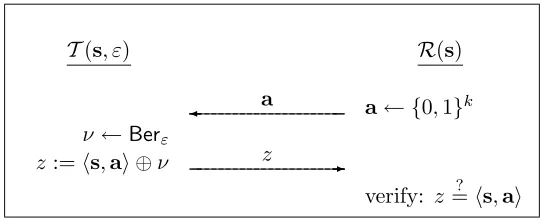
The HB and HB+ protocols as analyzed here consist ofnparallel iterations of a “basic authentica-tion step.” We describe the basic authenticaauthentica-tion step for the HB protocol, and defer a discussion of the HB+ protocol to Section 3.2. In the HB protocol, a tag T and a reader Rshare a random secret keys∈ {0,1}k; a basic authentication step consists of the reader sending a random challenge a∈ {0,1}k to the tag, which replies with z =hs,ai ⊕ν forν ∼ Berε. The reader can then verify
whether the responsezof the tag satisfies z =? hs,ai; we say the iteration is successful if this is the
case. See Figure 1.
T(s, ε) R(s)
a a
← {0,1}k
ν←Berε
z:=hs,ai ⊕ν z
-verify: z=? hs,ai
Figure 1: The basic authentication step of the HB protocol.
Even for an honest tag a basic iteration is unsuccessful with probability ε. For this reason, a reader accepts upon completion of allniterations of the basic authentication step as long as≈ε·n
of these iterations were unsuccessful. More precisely, let l,u be such that l ≤ε·n ≤u; then the reader accepts as long as the number of unsuccessful iterations lies in the range [l,u]. Since ε·n
is the expected number of unsuccessful iterations for an honest tag, the completeness errorεc(i.e., the probability that an honest tag is rejected) can be calculated via a Chernoff bound.4 Overall,
then, the entire HB protocol is parameterized byε,l,u, andn.
Observe that by sending random answers in each of the n iterations, an adversary trying to impersonate a valid tag succeeds with probability
δε,∗l,u,n def= 2−n·
u X
i=l
n i
;
that is, δ∗
ε,l,u,n is the best possible soundness error we can hope to achieve for the given setting of the parameters. Our definitions of security will be expressed in terms of the adversary’s ability to do better than this. Looking at asymptotic security (taking k as a security parameter), note that for any constantε <1/2 it is easy to find functionsl,u, nofk such thatn=O(k) and furthermore both the completeness errorεc and the “best achievable” soundness errorδε,∗l,u,n are negligible.
Let THB
s,ε,n denote the tag algorithm in the HB protocol when the tag holds secret key s (note
that the tag algorithm is independent ofl,u), and let RHB
s,ε,l,u,n similarly denote the algorithm run
by the tag reader. We denote a complete execution of the HB protocol between a party ˆT and the readerRby DTˆ,RHB
s,ε,l,u,n
E
and say this equals 1 iff the reader accepts.
For the case of a passive attack on the HB protocol, we imagine an adversary A running in
4Note in particular that if
two stages: in the first stage the adversary obtains q transcripts5 of (honest) executions of the protocol by interacting with an oracle transHBs,ε,n (this models eavesdropping); in the second stage,
the adversary interacts with the reader and tries to impersonate the tag. We define the adversary’s advantage as
AdvpassiveA,HB (ε,l,u, n) def= Prhs← {0,1}k;AtransHBs,ε,n(1k) :
D
A,RHB
s,ε,l,u,n
E
= 1i−δ∗ε,l,u,n.
As we will describe in Section 3.2, the HB+protocol uses two keyss1,s2. We letTHB+
s1,s2,ε,ndenote
the tag algorithm in this case, and letRHB+
s1,s2,ε,l,u,n denote the algorithm run by the tag reader. For
the case of an active attack on the HB+ protocol, we again imagine an adversary running in two stages: in the first stage the adversary interacts at most q times with the honest tag algorithm (with concurrent executions allowed), while in the second stage the adversary interacts only with the reader.6 The adversary’s advantage in this case is
AdvactiveA,HB+(ε,l,u, n)
def
= Pr
s1,s2 ← {0,1}k;ATHB
+
s1,s2,ε,n(1k) :
D
A,RHBs1,s+2,ε,l,u,n
E
= 1
−δ∗ε,l,u,n.
We remark that in both the HB and HB+ protocols, the tag reader’s actions are independent of the secret key(s) it holds except for its final decision whether or not to accept. So, allowing the adversary to interact with the reader multiple times (even concurrently) does not give the adversary much additional advantage (other than the fact that, as usual, the probability that the adversary succeeds in at least one impersonation attempt scales linearly with the number of attempts).
3
Proofs of Security for the HB and HB
+Protocols
3.1 Security of the HB Protocol against Passive Attacks
Recall from the previous section that we parameterize the HB protocol by ε (a measure of the noise introduced by the tag), l,u (which determine the completeness error εc as well as the best achievable soundnessδ∗), andn(the number of iterations of the basic authentication step given in
Figure 1). We stress that theseniterations are run in parallel, and so the entire protocol requires only two rounds.
The following result characterizes security of the HB protocol against passive attack. This can be compared to [20, Lemma 1], where Juels and Weis prove security for a single iteration of the HB protocol (i.e., they fix n= 1) and do not explicitly take the non-zero completeness error into account (this is taken into account in the following via the dependence onl,u).
Theorem 2 Say there exists an adversary A eavesdropping on at most q executions of the HB protocol, running in time t, and achievingAdvpassiveA,HB (ε,l,u, n)≥δ. Then there exists an algorithm
D making (q+ 1)·n oracle queries, running in time O(t), and such that
Pr
h
s← {0,1}k :DAs,ε(1k) = 1i−PrhDUk+1(1k) = 1
i
≥ δ+δ∗ε,l,u,n−εc−2−n·
2u X
i=0
n i
.
5Following [18, 19, 20], a transcript comprises only the messages exchanged between the parties and does not
include the reader’s decision of whether or not to accept. If the adversary is given this additional information, the adversary’s advantage may increase by (at most) an additive factor ofq·εc.
6
Asymptotically, for any ε < 14 and n= Θ(k) all terms of the above expression (other than δ) are negligible for appropriate choice of l,u. We thus conclude that the HB protocol is secure (for
n= Θ(k) and appropriate choice of l,u) assuming the hardness of the LPNε problem.
Proof D, given access to an oracle returning (k+ 1)-bit strings (a, z), proceeds as follows:
1. D runs the first phase of A. Each time A requests to view a transcript of the protocol, D
obtainsnsamples{(ai, zi)}n
i=1 from its oracle and returns these toA.
2. When A is ready for the second phase, D again obtains n samples {(¯ai,z¯i)}n
i=1 from its
oracle. D then sends the challenge (¯a1, . . . ,¯an) to A and receives in return a responseZ0 =
(z0
1, . . . , zn0).
3. D outputs 1 iff ¯Z= (¯z1, . . . ,z¯n) and Z0 differ in at most 2u entries.
When D’s oracle isUk+1, it is clear that D outputs 1 with probability exactly 2−n·P2i=0u ni
since ¯Z is in this case uniformly distributed and independent of everything else. On the other hand, when D’s oracle is As,ε then the transcripts D provides to A during the first phase of A’s execution are distributed identically to real transcripts in an execution of the HB protocol. Let
Z∗ def= (hs,¯a
1i, . . . ,hs,a¯ni) be the vector of “correct” answers to the challenge (¯a1, . . . ,¯an) sent by
D in the second phase. Then with probability at leastδ+δε,∗l,u,n it holds that Z0 and Z∗ differ in at mostuentries (since Asuccessfully impersonates the tag with this probability). Also, since ¯Z is distributed exactly as the answers of an honest tag, ¯Z and Z∗ differ in at most u positions except
with probability at most εc. It follows that with probability at leastδ+δ∗ε,l,u,n−εc the vectorsZ0 and ¯Z differ in at most 2u entries, and so D outputs 1 with at least this probability.
The above result provides a useful security guarantee only when ε <1/4, since when ε≥1/4 then 2u ≥ 2ε·n ≥ n/2 and so 2−n· P2u
i=0 ni
≥ 1/2. We also note that the concrete security reduction obtained above leaves much to be desired, and in particular it is not clear whether useful levels of security are achieved for reasonably-efficient settings of the parameters. On the other hand, it is unclear what can be said about the tightness of the security reductions obtained by Juels and Weis [20] since they do not explicitly handle multiple iterations of the protocol nor do they consider the effect that the acceptance criteria (i.e., in terms ofl,u) have on the soundness.
We believe that the security reduction can be improved by taking into account the distribution on ¯Z when D’s oracle isAs,ε (and modifying step 3 of D appropriately), as well as by focusing on protocols with perfect completeness. See Section 4 for some discussion of the latter possibility.
3.2 Security of the HB+ Protocol against Active Attacks
The HB protocol is insecure against an active attack, as an adversary can simply repeatedly query the tag with the same challenge vector (a1, . . . ,an) and thereby determine with high probability
the correct values of hs,a1i, . . . ,hs,ani (after which solving for s is easy). To combat such an
attack, Juels and Weis propose to modify the HB protocol by having the tag and reader sharetwo
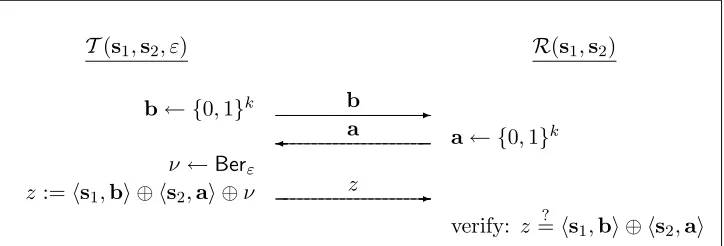
(independent) keyss1,s2 ∈ {0,1}k. A basic authentication step now consists of three rounds: first
the tag sends a random “blinding factor” b ∈ {0,1}k; the reader replies with a random challenge a ∈ {0,1}k as before; and finally the tag replies with z = hs1,bi ⊕ hs2,ai ⊕ν for ν ∼ Berε. As
in the HB protocol, the tag reader can then verify whether the response z of the tag satisfies
z=? hs1,bi ⊕ hs2,ai, and we again say the iteration issuccessful if this is the case. See Figure 2.
T(s1,s2, ε) R(s1,s2)
b← {0,1}k b
a a
← {0,1}k
ν←Berε
z:=hs1,bi ⊕ hs2,ai ⊕ν z
-verify: z=? hs1,bi ⊕ hs2,ai
Figure 2: The basic authentication step of the HB+ protocol.
The following result characterizes security of the HB+ protocol under active attacks. It can be compared to [20, Lemma 3], where Juels and Weis prove security for a single iteration of the HB+ protocol (i.e., they fix n= 1). Their proof requires rewinding of the adversary Ain order to simulate the first phase of A, and therefore their proof doesnot extend to the case of parallel or concurrent executions of the basic authentication step.
We remark that by combining the proofs of Theorem 3 and Lemma 1 (i.e., reducing the HB+ protocol directly to the LPN problem rather than relying on Lemma 1 as an intermediate step) we can improve the security reduction stated in the following theorem. By applying techniques from [25, Sect. 4], the parameters of the reduction can be improved further.
Theorem 3 Say there exists an adversary A interacting with the tag in at most q executions of the HB+ protocol (possibly concurrently), running in time t, and achievingAdvactiveA,HB+(ε,l,u, n)≥δ.
Then there exists an algorithm D making q·noracle queries, running in time O(t), and such that
Pr
h
s← {0,1}k :DAs,ε(1k) = 1i−PrhDUk+1(1k) = 1
i ≥
δ+δ∗ ε,l,u,n 2
3
− 2
n
2k −2 −n·
2u X
i=0
n i
.
Asymptotically, for any ε < 14 and appropriate choice of n,l,u the last two terms of the above expression (and also εc) are negligible. We thus conclude that the HB+ protocol is secure (for
appropriate choice of n,l,u) assuming the hardness of the LPNε problem.
Proof D, given access to an oracle returning (k+ 1)-bit strings (b,z¯), proceeds as follows:
1. D choosess2 ∈ {0,1}k uniformly at random. Then, it runs the first phase of A. To simulate
a basic authentication step, D does the following: it obtains a sample (b,z¯) from its oracle
and sendsb as the initial message. A replies with a challenge a, and then D responds with
z= ¯z⊕ hs2,ai. Note that sinceD does not rewindA here, there is no difficulty in simulating
parallel executions of the basic authentication step (i.e., as part of an execution of the “full” HB+ protocol) or concurrent executions of the HB+ protocol.
2. When A is ready for the second phase of the HB+ protocol, A sends an initial message
b1, . . . ,bn (we now explicitly look at the actual HB+ protocol rather than focusing on a
single basic authentication step). In response, D chooses random a1
1, . . . ,a1n∈ {0,1}k, sends these challenges to A, and records A’s response z11, . . . , zn1. Then D rewinds A, chooses randoma2
3. Let zi⊕ := z1i ⊕zi2 and set Z⊕ def= z⊕
1, . . . , zn⊕
. Let ˆai =a1
i ⊕a2i and ˆzi = hs2,ˆaii, and set ˆ
Z def= (ˆz1, . . . ,zˆn). D outputs 1 iffZ⊕ and ˆZ differ in at most 2u entries. Let us analyze the behavior ofD:
Case 1: SayD’s oracle isUk+1. In step 1, above, since ¯zis uniformly distributed and independent
of everything else, the answers z that D returns to A are uniformly distributed and independent of everything else. It follows thatA’s view throughout the entire experiment is independent of the secrets2 chosen byD.
The {aˆi}n
i=1 are uniformly and independently distributed, and so except with probability 2
n
2k
they are linearly independent and non-zero (cf. Claim 4, below). Assuming this to be the case, ˆZ
is uniformly distributed over {0,1}n from the point of view of A. But then the probability that
Z⊕ and ˆZ differ in at most 2u entries is exactly 2−n·P2u i=0
n i
. We conclude thatD outputs 1 in this case with probability at most 22nk + 2−n·
P2u i=0 ni
.
Case 2: SayD’s oracle isAs
1,εfor randomly-chosens1. In this case,Dprovides a perfect simulation
for the first phase ofA. By a standard averaging argument, with probability at least ˆδdef= δ+δ
∗
ε,l,u,n
2
over the randomness used in the first phase ofA(which includes the keyss1,s2, the randomness of
A, and the randomness used in responding toA’s queries) the probability (over random challenges
a1, . . . ,an sent by the tag reader in the second phase) thatA successfully impersonates the tag in
the second phase is at least ˆδ. Assume this is the case. Then the probability that A successfully responds to both sets of queries a1
1, . . . ,a1n and a12, . . . ,a2n is at least ˆδ2. But this means that (z11, . . . , z1n) differs in at most u entries from the “correct” answer
ans1 def= hs1,b1i ⊕s2,a11, . . . ,hs1,bni ⊕s2,a1n
and also (z12, . . . , zn2) differs in at mostu entries from the “correct” answer
ans2 def= hs1,b1i ⊕s2,a21, . . . ,hs1,bni ⊕s2,a2n.
But then (z11, . . . , zn1)⊕(z12, . . . , zn2) =Z⊕ differs in at most 2u entries from ans1⊕ans2 =
s2,a1
1
⊕ s2,a2
1
, . . . , s2,a1
n
⊕ s2,a2
n
=
s2,(a1
1⊕a21)
, . . . , s2,(a1
n⊕a2n)
= Z.ˆ
We conclude thatD outputs 1 in this case with probability at least ˆδ·ˆδ2. This completes the proof of the theorem.
The following technical claim, used in the above proof, is quite straightforward:
Claim 4 Assume n vectors a1, . . . ,an are chosen uniformly at random from {0,1}k. The proba-bility that these vectors are not linearly independent is less than 22nk.
Proof Say event Badi occurs ifai is linearly dependent on the previousi−1 vectors chosen (for
the case i= 1 this is the event a1 = 0k). Since the subspace spanned by i−1 vectors has size at
most 2i−1, the probability ofBad
i is at most 2
i−1
2k . Applying a union bound, we have:
Pr " n _ i=1 Badi #
≤2−k·
n−1
X
i=0
2i < 2
n
2k,
yielding the claim.
A typical range of parameters might bek ≈200 andn≈40–50, so the 22nk term above is truly
4
Conclusions and Open Questions
The main technical results of this paper are the first rigorous proofs of (1) security of the HB+ protocol against active attacks, even under parallel and concurrent executions; and (2) “hardness amplification” for the HB and HB+protocols as the number of iterations of the basic authentication step increases. Our proofs are also the first to explicitly take into account the non-zero completeness error and the impact this has on the security of the protocol as a whole.
We believe our proofs are remarkably simple, and view this as an additional contribution of this work (rather than as a drawback!). Indeed, we expect there will be further applications of Lemma 1 to the analysis of other cryptographic constructions based on the LPN problem, and hope this paper inspires and aids others in exploring such applications.
It would be nice to improve the analysis (or propose new protocols) so as to obtain meaningful security guarantees even in the case 14 ≤ε < 12. It would also be wonderful to improve the concrete security reductions obtained here, or to propose new protocols with tighter security reductions. (As we have mentioned, it is not clear whether the proofs provided here yield sufficiently-high security for practically-efficient settings of the parameters.) As one possible approach toward this goal, one can imagine changing the HB/HB+ protocols so that the tag always introduces at most ε·n
errors, rather than introducing errors in each of the n iterations with independent probabilityε.7 (A related idea, in a different context, was explored in [5]; their analysis does not seem to apply to our setting.) This would give protocols with perfect completeness, and would improve the concrete security bounds as well since the upper boundu could be set to exactly ε·n and the “problem” mentioned in footnote 5 would also go away. On the other hand it is not clear what can be said of the hardness of the natural variant of the LPN problem such protocols would be based on.
It would also be very interesting to see an efficient protocol based on the LPN problem that is provably resistant to man-in-the-middle attacks.
References
[1] Associated Press. “Geeks Flex Hacker Muscles at Defcon.” Article appearing Aug. 2, 2005 on CNN.com.
[2] M. Bellare, M. Fischlin, S. Goldwasser, and S. Micali. Identification Protocols Secure against Reset Attacks. Adv. in Cryptology — Eurocrypt 2001, LNCS vol. 2045, Springer-Verlag, pp. 495–511, 2001.
[3] M. Bellare, R. Impagliazzo, and M. Naor. Does Parallel Repetition Lower the Error in Computationally-Sound Protocols? 38th IEEE Symposium on Foundations of Computer Sci-ence, IEEE, pp. 374–383, 1997.
[4] E.R. Berlekamp, R.J. McEliece, and H.C.A. van Tilborg. On the Inherent Intractability of Certain Coding Problems.IEEE Trans. Info. Theory 24: 384–386, 1978.
[5] A. Blum, M. Furst, M. Kearns, and R. Lipton. Cryptographic Primitives Based on Hard Learn-ing Problems.Adv. in Cryptology — Crypto ’93, LNCS vol. 773, Springer-Verlag, pp. 278–291, 1994.
[6] A. Blum, A. Kalai, and H. Wasserman. Noise-Tolerant Learning, the Parity Problem, and the Statistical Query Model. J. ACM 50(4): 506–519, 2003.
7
[7] R. Canetti, S. Halevi, and M. Steiner. Hardness Amplification of Weakly Verifiable Puzzles.2nd Theory of Cryptography Conference (TCC 2005), LNCS vol. 3378, Springer-Verlag, pp. 17–33, 2005.
[8] R. Canetti, J. Kilian, E. Petrank, and A. Rosen. Black-Box Concurrent Zero-Knowledge Re-quires (Almost) Logarithmically Many Rounds.SIAM J. Computing 32(1): 1–47, 2002.
[9] F. Chabaud. On the Security of Some Cryptosystems Based on Error-Correcting Codes. Adv. in Cryptology — Eurocrypt ’94, LNCS vol. 950, Springer-Verlag, pp. 131–139, 1995.
[10] W. Diffie and M. Hellman. New Directions in Cryptography.IEEE Trans. Info. Theory 22(6): 644–654 (1976).
[11] U. Feige and A. Shamir. Witness Indistinguishability and Witness Hiding Protocols. 22nd ACM Symposium on Theory of Computing, ACM, pp. 416–426, 1990.
[12] H. Gilbert, M. Robshaw, and H. Silbert. An Active Attack against HB+— a Provably Secure Lightweight Authentication Protocol. Available at http://eprint.iacr.org/2005/237
[13] O. Goldreich. Modern Cryptography, Probabilistic Proofs, and Pseudorandomness. Springer-Verlag, 1998.
[14] O. Goldreich and H. Krawczyk. On the Composition of Zero-Knowledge Proof Systems.SIAM J. Computing 25(1): 169–192, 1996.
[15] O. Goldreich, N. Nisan, and A. Wigderson. On Yao’s XOR-Lemma. Available at http://eccc.uni-trier.de/eccc-reports/1995/TR95-050/
[16] O. Goldreich and Y. Oren. Definitions and Properties of Zero-Knowledge Proof Systems. J. Cryptology 7(1): 1–32, 1994.
[17] J. H˚astad. Some Optimal Inapproximability Results.J. ACM 48(4): 798–859, 2001.
[18] N. Hopper and M. Blum. A Secure Human-Computer Authentication Scheme. Technical Re-port CMU-CS-00-139, Carnegie Mellon University, 2000.
[19] N. Hopper and M. Blum. Secure Human Identification Protocols.Adv. in Cryptology — Asia-crypt 2001, LNCS vol. 2248, pp. 52–66, 2001.
[20] A. Juels and S. Weis. Authenticating Pervasive Devices with Human Protocols. Adv. in Cryp-tology — Crypto 2005, LNCS vol. 3621, Springer-Verlag, pp. 293–308, 2005. Updated version available at: http://www.rsasecurity.com/rsalabs/staff/bios/ajuels/publications/pdfs/lpn.pdf
[21] M. Kearns. Efficient Noise-Tolerant Learning from Statistical Queries. J. ACM 45(6): 983– 1006, 1998.
[22] Z. Kfir and A. Wool. Picking Virtual Pockets using Relay Attacks on Contactless Smartcard Systems. Available at http://eprint.iacr.org/2005/052
[23] I. Kirschenbaum and A. Wool. How to Build a Low-Cost, Extended-Range RFID Skimmer. Available at http://eprint.iacr.org/2006/054
[25] O. Regev. On Lattices, Learning with Errors, Random Linear Codes, and Cryptography.37th ACM Symposium on Theory of Computing, ACM, pp. 84–93, 2005.