A Monthly Double-Blind Peer Reviewed Refereed Open Access International e-Journal - Included in the International Serial Directories
International Journal in Physical & Applied Sciences
http://www.ijmr.net.in email id- [email protected] Page 75
Annu, Dr. Tamanna Rani
Department of Physics
1,2
OPJS University, Churu (Rajasthan), India
Abstract
This paper introduces the free space optics (FSO) and radio frequency (RF) remote communication. The paper explains the component of FSO and compares it with the as of now sent innovation of RF communication as far as information rate, effectiveness, limit and constraints. The information security is additionally talked about in the paper for ID of the framework to have the capacity to use in ordinary circumstances. These frameworks are additionally talked about in a way that they could effectively combine to form the single framework with more prominent throughput and higher unwavering quality.
Index Terms — Free Space Optics, Radio frequency, Wireless communication, Data security. 1. INTRODUCT ION
For remote communicate particle RF and FSO is both utilized as a part of the handy field. Free space optics is not the new innovation but rather has its profound root in the past to be utilized as a part of wars. Every innovation is utilized by it capacity and necessity in the specific part. It is modest innovation as far as its establishment and could be introduced in the ranges effectively where no vast setup for information communication could be introduced. RF is restricted to the transfer speed imperative however for the lower information rate RF is reasonable for the long separation communicate particle [1]. In free space optics the information rate Changes and could be utilized where the viewable pathway is not an issue for the communicate particle links. Also information security and execution are additionally the parameter on which frameworks are measured [2]. Free space optics innovation depends at stake of sight optical shaft for information communicate particle [3, 4]. It is the really the blend of both remote innovation and optical innovation. The center of innovation is undetectable light emission that gives optical transfer speed to transmission that incorporates the information of voice, in format particle and video transmission. Optical communication is extremely old
innovation utilized as a part of the past for flag communication yet on low information rates. Laser innovation upgraded the utilization of free space optics and is currently profoundly reliant on the laser innovation. The innovation has numerous shared characteristics with the fiber optics innovation yet carries on contrastingly in the field because of the strategy for transmission for both the advancements [5, 6].
A Monthly Double-Blind Peer Reviewed Refereed Open Access International e-Journal - Included in the International Serial Directories
International Journal in Physical & Applied Sciences
http://www.ijmr.net.in email id- [email protected] Page 76 was additionally expanded so as to reduce
the gadgets in wording o f reception apparatus length as length of radio wire is reliant on the frequency rate [8, 9].
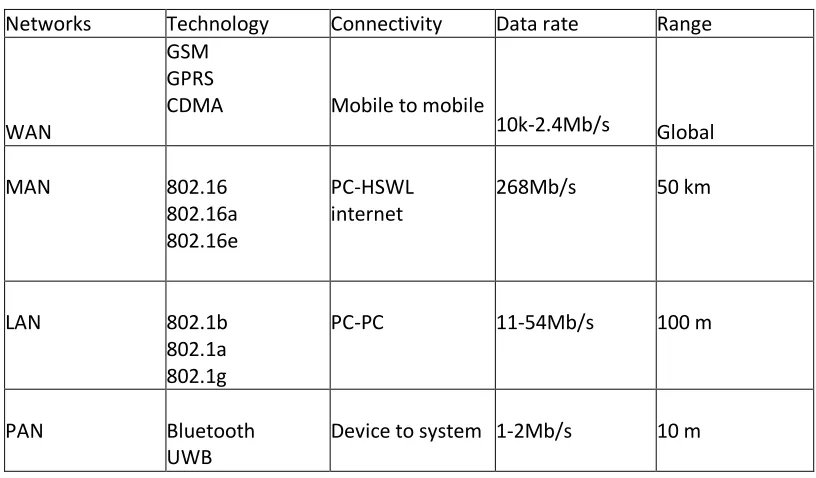
Distinctive RF connects systems are utilized as a part of the field and recorded in table 1as beneath:
Table 1: Radio Frequency Technologies
Networks Technology Connectivity Data rate Range
WAN
GSM GPRS
CDMA Mobile to mobile
10k-2.4Mb/s Global
MAN 802.16
802.16a 802.16e
PC-HSWL internet
268Mb/s 50 km
LAN 802.1b
802.1a 802.1g
PC-PC 11-54Mb/s 100 m
PAN Bluetooth
UWB
Device to system 1-2Mb/s 10 m
2. OVERVIEW OF FSO AND RF SYSTEM
The FSO framework depends on the remote connection between two remote units called optical transmitter and beneficiary for one way communication and optical handsets for both side communication for the most part utilized as a part of the field. The transmitter is comprised of an optical source which transmits light and a focal point that coordinates this light flag into the environment. The recipient is likewise associated with focal point to detect approaching information and steered utilizing fiber optic link [10]. The information heartbeats are transmitted from transmitter
as bars with tapered shape. The transmitter laser side ought to be in viewable pathway with the collector. ALL the link heads ought to be in observable pathway for the fruitful transmission. Fig. 1 demonstrates that the transmitter is in line to locate the collector and it is really the main necessity of effective information transmission in free space optical communication. In spite of the fact that if the observable pathway is bothered to the specific degree than flag information could in any case be sent over the connection yet for higher information rate accomplishment and low mistake rate viewable pathway is basic necessity.
Detector Fig.1. Transmitter receiver alignment
As appeared in Fig. 2 that diverse transmitters and beneficiaries are joined in the system all transmitter and recipient are in viewable pathway and in the wake of
A Monthly Double-Blind Peer Reviewed Refereed Open Access International e-Journal - Included in the International Serial Directories
International Journal in Physical & Applied Sciences
http://www.ijmr.net.in email id- [email protected] Page 77 administration media signs are passed on
from one nearby system to other utilizing free space optical preparation. Underneath specified square are indicating how information is passed from one basic piece of the framework to another and all these real subsystems are combined in one unit to make framework working. To start with the information is balanced on the high frequency motion with certain regulation plan after that adjusted information is
passed on to the driver area which is connected with the laser part creating laser light as indicated by the information gave after that flag is transmitted as laser from transmitting optic. On the accepting side flag is accumulated and same process happens backward to take information out from the tweaked flag. Different subsystems are introduced in the unit to control diverse parameters of such framework as course etc.
Fig.2: Atmospheric Laser communication
3. PERFORMANCE COMPARISION OF FSO AND RF
A. FSO Performance
To watch the execution of free space optical framework it is to watch parcel of parameters of pragmatic field. These parameters are isolated into two noteworthy areas one is the outer parameter and the second one is interior parameters of the framework. Inner parameters are totally related with the interior framework particulars which incorporates the working frequency of the framework, control utilized by the framework, divergence and edge of transmission. So also on the collector side the capacity of focal point, its survey ability and b it blunder rate [12]. Different parameters are outside and not identified with the framework. These parameters incorporate the ecological parameters and incorporate after parameters:
Weather condition
Alignment
Atmospheric attenuation
Scintillation
Window attenuation
A Monthly Double-Blind Peer Reviewed Refereed Open Access International e-Journal - Included in the International Serial Directories
International Journal in Physical & Applied Sciences
http://www.ijmr.net.in email id- [email protected] Page 78 Fig.3. Attenuation Vs Range
It is not thinkable that consistent structures are in nonstop movement because of specific components and can influence the adjustment and resultantly the execution of framework. These conditions are warm extension and vibration. On the off chance that the information rate is diminished the scope of transmission could be expanded at the specific piece mistake rate. Above diagram demonstrate that if information rate is diminished from 1250 - 100 Mb/s the separation could be expanded around 30 meters with constriction of 200d B/km. Amid
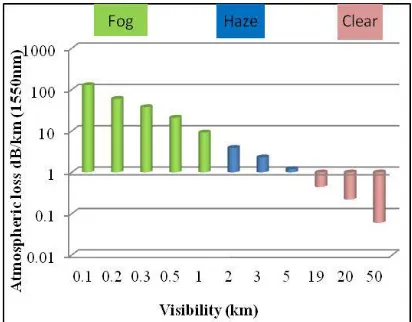
the day time the power of light ceaselessly changes and change in the light force additionally influence the execution of free FSO framework in a way that warm refract particle of air changes entire this time that influences collector affectability. Be that as it may, at the scope of not as much as a km these scintillate particle influences are less unsafe to framework execution. The visibility state of FSO framework as per climate condition and separation are appeared in Fig. 4.
Fig.4. Atmospheric loss Vs visibility
B. RF Performance
There are numerous dynamic parts of the radio frequency framework execution. Execution of RF shifts from framework to framework. There are numerous framework utilized as a part of the field like GSM, Bluetooth, GPRS etc. Their execution is
A Monthly Double-Blind Peer Reviewed Refereed Open Access International e-Journal - Included in the International Serial Directories
International Journal in Physical & Applied Sciences
http://www.ijmr.net.in email id- [email protected] Page 79 of clients expanded the information rate
goes low and when the quantity of client’s abatement in any purpose of time the entire data transfer capacity is shared between the clients utilizing the framework. Flag quality of radio frequency communicate particle framework is genuine quality of the framework as radio waves ventures long path for communication.
C. FSO Throughput
Free space optics innovation is turning into the best approach to get to broadband. Market is really hunting down the innovation that could give them maximum transmission capacity so the information could be transmitted on the higher rates.
Free space optics is fundamentally the same as the fiber optics regarding information rate [14]. As the innovation chips away at a similar rule of transmitter and recipient with just contrast of way where information is flown out from one indicate the other sparing the cost of fiber optic as well as competent to accomplish maximum productivity. Throughput of any free space optics frameworks is intensely reliant on the climate conditions. On the off chance that climate conditions are clear than with legitimate establishment of preparation maximum throughput could be accomplished.
Fig.5. Technologies Vs data rates
D. RF Throughput
Radio communication is the key innovation of all time and is currently g paddling in each field of life it is possible that it is communicating or portable communication etc. it could be part into various classifications relying on the utilization and information rate [15]. Likewise the getting hardware is reliant on the information rate that it could deal with. Bring down information rates guarantee better affectability towards the beneficiary side
A Monthly Double-Blind Peer Reviewed Refereed Open Access International e-Journal - Included in the International Serial Directories
International Journal in Physical & Applied Sciences
http://www.ijmr.net.in email id- [email protected] Page 80 Fig.6. through Vs range
E. FSO Limitations
FSO viewable pathway is awesome confinement for information transmission. So before installing particle of the gear site review is done by the specific prerequisite for viewable pathway. Climate conditions
create solid limitation particles on the execution of free space optics. If there should be an occurrence of overwhelming wind and mist in the environment influences the perceive ability and could diminish it immensely low [16].
Fig.7. Attenuation of Laser Vs wavelength
F. RF Limitation
RF communicate particle is the most renowned remote communicate particle strategy utilized everywhere throughout the world and as of now favored over the free space optical communicate particle. Both frameworks have their own particular confinements. On the off chance that we take optic communicate particle its transfer speed is unregulated though RF framework requires permitting in the majority of groups for its operation. Preparation of free space optics is less expensive than the RF
communication framework. RF framework requires immense space to introduce the preparation. Regarding separation and information rate RF preparation requires more power and space [17, 18]. Climate condition impacts signs of both RF and free space optical frameworks.
G. Frequency Band
A Monthly Double-Blind Peer Reviewed Refereed Open Access International e-Journal - Included in the International Serial Directories
International Journal in Physical & Applied Sciences
http://www.ijmr.net.in email id- [email protected] Page 81 This band of frequency was thought to be
thin band with restricted information rate. After that spread range accompanied improvement in the band of frequency shape 902MHz to 5.85GHz. This band of frequency allows marry the client to get effective information transmission and diminished impedance with other frequency groups [13]. Client could accomplish the information rate of very nearly 54Mb/s
inside the scope of just about 300 meters with right around 0.1 watts of energy. In optical communication wide band of frequency is accessible for the communicate particle and information rate could be accomplished up to the GB it/s. The range for FSO begins close to the obvious light and it works in the scope of 550n m to 1500n m wavelength. The frequency for this range
goes in THz.
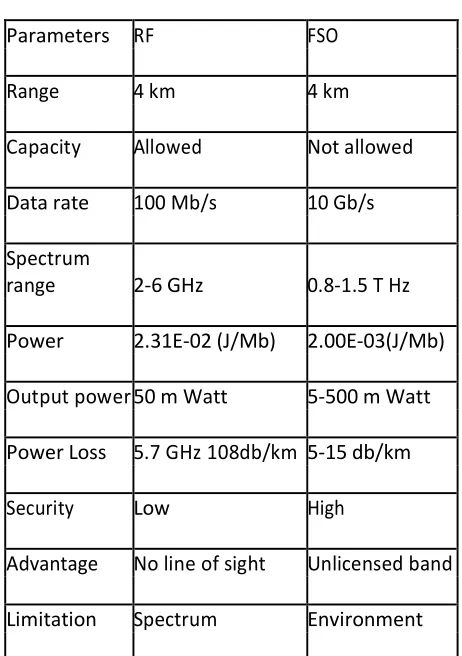
Table 2: RF Vs FSO
Parameters RF FSO
Range 4 km 4 km
Capacity Allowed Not allowed
Data rate 100 Mb/s 10 Gb/s
Spectrum
range 2-6 GHz 0.8-1.5 T Hz
Power 2.31E-02 (J/Mb) 2.00E-03(J/Mb)
Output power 50 m Watt 5-500 m Watt
Power Loss 5.7 GHz 108db/km 5-15 db/km
Security Low High
Advantage No line of sight Unlicensed band
Limitation Spectrum Environment
Rather than previously mentioned scope of radio frequency it additionally incorporates the scope of frequency that is unlicensed band of 2.4GHz. It fluctuates from nation to nation as in some different nations scope of 315MHz is utilized as unlicensed band of frequency. For unlicensed band the transmission turns out to be more delicate issue that it ought not irritate the transmission of other non - authorized band clients. So the clients are additionally
A Monthly Double-Blind Peer Reviewed Refereed Open Access International e-Journal - Included in the International Serial Directories
International Journal in Physical & Applied Sciences
http://www.ijmr.net.in email id- [email protected] Page 82 Fig.8. 802.11a Device data rate Vs received power
H. FSO Data Security
Free space optical innovation utilizes distinctive balance systems to transmit information in observable pathway. A few scientists are doing examination to transmit RF flag by means of free space optics keeping in mind the end goal to guarantee the security and reliability. What's more, there has been gigantic increment in the utilization of FSO innovation because of the reason that every one of the bottlenecks of information limit could be kept away from. Fast web is one of the significant fields that have improved the utilization of FSO because of its practically boundless space. In any case, this is no explanation behind any framework to get achievement in the market client is extremely hesitant to receive the innovation that can't guarantee his information security. The security level of any framework include from bringing down level to the larger amount of security. So in planning the arrangement of FSO security is kept up from physical layer to the systems administration convention [19]. The significant favorable position of free space optics frameworks is that it doesn't include any sort of broad casting which is its real leverage over the radio frequency broadcasting framework. So without being the physical interference of any interloper it is unrealistic to get the information going through this innovation. The preparation is conveyed over the level of encroaches like vehicles and other deterrent so this esteem
guarantees the security of framework. Fowls or some other interference can just momentarily harm the flag yet at the same time not extremely unsafe for the framework.
I. RF Data Security
It is of the most widely recognized enthusiasm of each communicate particle is that information ought to stay secure from being hacked. RF framework has expanded the versatility and is ending up plainly more prominent throughout the years. The regular normal for remote communication is communicating of information over the air interface. Although the information is legitimately encoded and scrambled so that nobody can breakout the data put away in it however the truth of the matter is that information is transmitted towards all the bearing and any recipient working and identifying this frequency can get the flag [11]. The example of this security breakout is in versatile communication any one can without much of a stretch track the area of portable number by simply catching the information which is his property. Any obsolete information encryption strategy can hurt the individual information security of the framework.
A Monthly Double-Blind Peer Reviewed Refereed Open Access International e-Journal - Included in the International Serial Directories
International Journal in Physical & Applied Sciences
http://www.ijmr.net.in email id- [email protected] Page 83 each layer of the frameworks. The tenets
are forced by the standard bodies and all telecommunication particle and radio frequency transmitting offices will undoubtedly take after these guidelines and conventions. So the principles presented in the RF field are specified beneath:
WEP 3DES AES EAP FI
Yet after pixie eliminating these measures some of these have been compromised in the field. W ireless identical protection is the sort of convention that utilizations propelled coding strategies to encode the information. It utilizes RC4 algorithm and now prohibited in USA that its security has been ruptured. This convention was produced for the remote neighborhood. Also, now they foundations have unmistakably given the direction of making encryption plans of remote neighborhood to be compliant with FIPS 140-2. An unbreakable encryption plan is 3DES yet stay in the utilization for short interim of time. It is progressed into the new frame as AES.
4. HYBRID RF/FSO SYST EM
Free space optical framework came as new remote innovation to transmit information. It is unquestionably replacement of fiber optic innovation regarding its high data transmission. Over the fiber optic innovation it is efficient and could be fast ly sent in the field. Another favorable position is cost that is incorporated into the fiber optic
framework is additionally decreased by this framework [20, 21]. RF innovation is additionally extremely valuable regarding long inaccessible communication particle where no viewable pathway is accessible. In some urban environment where there is long removed building, and it is impractical for FSO framework to be totally introduced in the system is sponsored by the radio frequency flagging. FSO link is irritated by the mist in the climate conditions. The framework is about unharmed with down-pouring environment. RF links are vigorously influenced by the rain so these two shared conditions built up the necessity of crossover framework. Half and half framework engineering is comprised of mostly three subsystems as takes after: Laser Link
Switch
RF link
A Monthly Double-Blind Peer Reviewed Refereed Open Access International e-Journal - Included in the International Serial Directories
International Journal in Physical & Applied Sciences
http://www.ijmr.net.in email id- [email protected] Page 84 Fig.9. Basic hybrid RF/FSO architecture
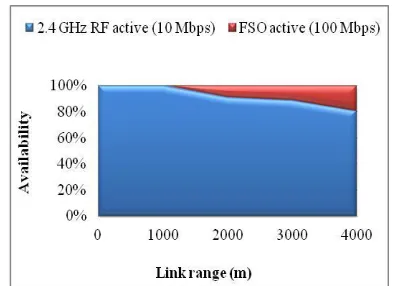
In the crossover framework it is the matter of awesome worry that both individual frameworks ought to work at a similar level for the more prominent throughput and higher proficiency. On the off chance that in the framework free space optics is working at 10 GHz and RF is just working at mega hertz. At that point the combined throughput would be constrained to the RF framework. So both frameworks ought to work at similar information rate for the half and half framework to work effectively. To meet the bearer class accessibility the connection ought to be accessible for
around 99.999% of the time as appeared in Fig. 10. FSO framework provides food all the necessity of communicate particle condition yet in just certain situations where long separation and brutal climate prerequisites have met it is RF that partakes into the communicate particle. The mixture framework guarantees the transporter class accessibility over the more drawn out extents. In many tests cross breed RF and FSO frameworks has been considered and talked about for the maximum throughput limit.
Fig.10. Hybrid system availability Vs link range
5. CONCLUSION
Free space innovation is new for the world yet developing at the rap id pace for the links that require higher information rate. The significant advantage of the innovation is non- obstruction with the RF connects so both frameworks could be utilized autonomously and in combination at certain place to expand the productivity of any
A Monthly Double-Blind Peer Reviewed Refereed Open Access International e-Journal - Included in the International Serial Directories
International Journal in Physical & Applied Sciences
http://www.ijmr.net.in email id- [email protected] Page 85 REFERENCES
1. B. Djordjevic and G. T. Djordjevic, "On the high-speed communication over hybrid free-space optical (FSO) - wireless fading channels," in LEOS Annual M eeting Conference Proceedings, 2009. LEOS '09. IEEE, 2009, pp . 833-834.
2. B. M o, et al., "Line width analysis of a tunable optical filter based on free-space optics," Optik - International Journal for Light and Electron Optics, vol. 125, pp . 6488-6490, 2014
3. Bakhsh, S. T., et al. "Self-Schedule and Self-Distributive MAC Scheduling Algorithms for Next -Generation Sensor Networks." International Journal of Distributed Sensor Networks, pp . 1-15, 2015. 4. C. Liu, et al., "Adaptive optics
for the free-space coherent optical communications," Optics Communications, vol. 361, pp . 21-24, 2016.
5. F. E. Zocchi, "A simple analytical model of adaptive optics for direct detection free-space optical communication," Optics Communications, vol. 248, pp . 359-374, 2005. 6. G. Aldabbagh, et al.,
"Distributed dynamic load balancing in a heterogeneous network using LTE and TV white spaces," Wireless Networks, pp . 1-12, 2015. 7. G. Aldabbagh, et al.,
"QoS-Aware Tethering in a Heterogeneous Wireless Network using LTE and TV White Spaces," Computer Networks, vol. 81, pp . 136-146, 2015.
8. H. A. Fadhil, et al., "Optimization of free space optics parameters: An
optimum solution for bad weather conditions," Optik - International Journal for Light and Electron Optics, vol. 124, pp . 3969-3973, 2013.
9. H. Zhou, et al., "Optical power allocation for adaptive transmissions in wavelength-division multiplexing free space optical networks," Digital Communications and Networks, vol. 1, pp . 171-180, 2015. 10. J. A. Lima, et al., "Analysis of
Relay Attacks on RFiD Systems," Latin America Transactions, IEEE (Revista IEEE America Latina), vol. 10, pp . 1274-1282, 2012.
11. J. B. Rosolem, et al., "Optical sensing in high voltage transmission lines using power over fiber and free space optics," Optical Fiber Technology, vol. 26, Part B, pp . 180-183, 2015.
12. K. Prabu, et al., "Spectrum analysis of radio over free space optical communications systems through different channel models," Optik - International Journal for Light and Electron Optics, vol. 126, pp . 1142-1145, 2015.
13. L. Hou, et al., "Radio frequency heating for postharvest control of pests in agricultural products: A review," Postharvest Biology and Technology, vol. 113, pp . 106-118, 2016.
14. M . Rincon and R. K. Singh, "Inactivation of Shiga toxin-producing and nonpathogenic Escherichia coli in non-intact steaks cooked in a radio frequency oven," Food Control, vol. 62, pp . 390-396, 2016. 15. M . Usman, et al.,
A Monthly Double-Blind Peer Reviewed Refereed Open Access International e-Journal - Included in the International Serial Directories
International Journal in Physical & Applied Sciences
http://www.ijmr.net.in email id- [email protected] Page 86 Technology Conference (VTC
Fall), 2014 IEEE 80th, 2014, pp . 1-5.
16. M itsuishi, et al., "Ray -tracing simulations for the ultra-lightweight X-ray optics toward a future jupiter exploration mission," Advances in Space Research, vol. 57, pp . 320-328, 2016.
17. N. Kumar and A. K. Rana, "Impact of various parameters on the performance of free space optics communication system," Optik - International Journal for Light and Electron Optics, vol. 124, pp . 5774-5776, 2013.
18. Nisar A. Lala, et al., “Novel Spectrum Handoff in Cognitive Radio Networks Using
Fuzzy Logic”,
19. Yu-Jiun, et al., "High performance multiband radio International Journal of Information Techno logy and antenna," in Antennas and Propagation & USNC/URSI
Computer Science (IJITCS), vol. 5, pp . 103-110, 2013. 20. Shi, et al., "A tumor-specific
cleavable nanosystem of PEG-modified C60@Au hybrid aggregates for radio frequency -controlled release, hyperthermia, photodynamic therapy and X-ray imaging," Acta Biomaterialia, vol. 29, pp . 282-297, 2016.
21. T. Aboufoul, et al., "Reconfiguring UWB M onopole Study”,
International Journal of Information Technology Antenna for Cognitive Radio Applications Using GaAs and Computer Science (IJITCS) , vol. 5, pp . 70-77, 2013.
22. Y. Davletbaev, et al., "M ulti-stage hydraulic fracturing and radio-frequency
electromagnetic radiation for heavy - oil production," Journal of Unconventional Oil and Gas Resources, vol. 12, pp . 15-22, 2015.
23. Z. Li, et al., "Combinational-deformable-mirror adaptive optics system for atmospheric compensation in free space communication," Optics Communications, vol. 320, pp . 162-168, 2014.