Vol. 4, Issue 2, February 2015
Improvement of Voltage Stability in Power
System by Using SVC and STATCOM
Sarita S. Bhole
1, Prateek Nigam
2PG Student [PE], Dept. of EE, RKDF Institute of science and Technology, Bhopal, India 1
Assistant Professor, Dept. of EE, RKDF Institute of science and Technology, Bhopal, India 2
ABSTRACT: The increase in power demand has forced the power system to operate closer to its stability limit. Voltage instability and line overloading have become challenging problems due to the strengthening of power system by various means. The nature of voltage stability can be analysed by the production, transmission and consumption of reactive power. One of the major causes of voltage instability is the reactive power unbalancing which occurs in stressed condition of power system. Flexible AC transmission system (FACTS) devices play an important role in improving the performance of a power system, but these devices are very costly and hence need to be placed optimally in power system. FACTS device like static var compensator (SVC) and thyristor controlled series compensator (TCSC) can be employed to reduce the flows in heavily loaded lines, resulting in a low system loss and improved stability of network. In this paper, a method based on line stability index, real power performance index and reduction of total system VAR power losses has been proposed to decide the optimal location of TCSC.
Now a day, Voltage Stability has become a major concern in power systems planning and operation. This problem has become very complex due to the continuous growing on system interconnections and demand for electricity and also due to economical and environmental constraints to properly expand the system. This has increased the importance of implementing suitable and efficient techniques for improving voltage stability of stressed power system. FACTS are one aspect of the power electronics revolution that is taking place in all areas of electric energy.
KEYWORDS: Flexible AC Transmission System (FACTS), Static Var Compensator (SVC), PSAT, Voltage Stability, Voltage Stability Index (VSI).
I.INTRODUCTION
Most of the large power system blackouts, which occurred worldwide over the last twenty years, which are caused by heavily stressed system with large amount of real and reactive power demand and low voltage condition. When the voltages at power system buses are low, the losses will also to be increased. This study is devoted to develop a technique for improving the voltage and eliminate voltage instability in a power system. Application of Flexible AC Transmission System (FACTS) devices are currently pursued very intensively to achieve better control over the transmission lines for manipulating power flows. They can provide direct and flexible control of power transfer and are very helpful in the operation of power network. The power system performance and the power system stability can be enhanced by using FACTS device [1].
This paper presents the method of the optimal location of SVC for enhancing the voltage stability of the power system using VSI. The SVC has been tested on the 9-Bus test System and the solution for optimal location of this device will obtain and discuss in this section.
Shravana Musunuri, Gholamreza Dehnavi [1], compares STATCOM, SVC, SSSC and TCSC devices for steady state voltage stability improvement. The choice of the location ,sizing and cost comparison of these FACTS devices with traditional reactive power/voltage stability devices are presented. Bhavin. M. Patel [2], explained the enhancement of steady state voltage stability using SVC and TCSC. The results presented in this paper clearly show how SVC and TCSC can be used to increase system stability in practical power systems with the use of simulink model. Rambabu, Y.P.Obulesu, Saibabu [3], aimed for improvement of voltage profile and reduce power system losses by using multi type FACTS devices. Their individual contribution towards the improvement of voltage profile and reduction of power losses has been tested on a 5-bus system. P. Ajay D. Vimal Raj, M. Sudhakaran [4], proposed optimum load shedding in power system strategies with voltage stability indicators. In this paper a fast method for determining the location and quantity of the load to be shed in order to avoid risk of voltage instability is presented. P. Kessel and H. Glavitsch [5], estimate the voltage stability of a power system. This method is based on the indicators of risk of voltage instability. This paper proposes a method to compute load curtailment evaluation, using optimal power flow computation, incorporating the steady state voltage stability margin constraints. N.Boonpirom and K.Paitoon Wattanakij [6], presented the static voltage stability enhancement using FACTS devices. With the insertion of SVC, enhancement in voltage at various buses, reduction in system power loss, improvement in power factor and power flow are the objectives of the study. Mehrdad Ahmad, Mostafa Alinezhad, [7] Compares SVC and STATCOM for the static voltage stability margin enhancement, The choice of the location and sizing of these devices is also presented and an analysis is made on the IEEE 14 bus system using Power System Analysis Toolkit (PSAT) software.
II. MATHEMATICAL MODEL OF SVC
In this paper steady state model of FACTS devices are developed for power flow studies. SVC modelled is incorporated into the bus as shunt element of transmission line. Mathematical model for SVC is implemented by MATLAB programming language.
Static VAR compensator (SVC)
The SVC uses conventional thyristor to achieve fast control of shunt-connected capacitors and reactors. The configuration of the SVC is shown in Fig.1, which basically consists of a fixed capacitor (C) and a thyristor controlled reactor (L). The firing angle control of the thyristor banks determines the equivalent shunt admittance presented to the power system.
A shunt connected static VAR generator or absorber whose output is adjusted to exchange capacitive or inductive current so as to maintain or control bus voltage of the electrical power system. Variable shunt susceptance model of SVC [2] is shown in Fig.1
Fig 1: Variable shunt susceptance model
Vol. 4, Issue 2, February 2015
assumption may be acceptable as long as the SVC is operating within the limits, but may lead to gross errors if the SVC is operating close to its reactive limits [3].
The current drawn by the SVC is,
I
SVC
jB
SVCV
KThe reactive power drawn by SVC, which is also the reactive power injected at bus k is,
.
2
SVC K K
SVC
Q
V
B
Q
Where, VK – voltage at bus k
SVCB
Susceptance
SVC
Q
Reactive power drawn by SVCIII. OPTIMAL LOCATION OF FACTS DEVICES
To improve the voltage profile and voltage stability of a power system an alternative solution is to locate an appropriate Flexible AC transmission system (FACTS) device [2]. FACTS devices are the solid state converters having capability of improving power transmission capacity, improving voltage profile, enhancing power system stability, minimizing transmission losses etc. In order to optimize and to obtain the maximum benefits from their use, the main issues to be considered are the type of FACTS devices, the settings of FACTS devices and optimal location of FACTS devices.
The optimal location of SVC has been selected on the basis of voltage stability index (VSI) for improvement of voltage stability of power system [6, 7]. Voltage stability index can be used for determining the weakest line in a power system. This voltage stability index considers both active and reactive powers to evaluate voltage stability, which provides information about the stability condition of the lines and also determines the weakest line in the system.
IV. VOLTAGE STABILITY INDEX
Voltage stability is becoming an increasing source of concern in secure operating of present-day power systems. The problem of voltage instability is mainly considered as the inability of the network to meet the load demand imposed in terms of inadequate reactive power support or active power transmission capability or both. It is mainly concerned with the analysis and the enhancement of steady state voltage stability based on L-index. This L-Index [3] determines how any system is close to its instability limit.
Consider, a simple system consisting of sending and receiving end buses as shown,
Fig 2: Single-line model of a simple system
Where: VS, VR = sending and receiving voltages at system buses δ1, δ2 = sending and receiving voltages angle at system bus 1 and 2 P, Q = real and reactive power at buses
R+ JX = line impedance between bus 1 and 2.
Current flowing through the branch,
jX
R
V
V
I
S r
1
2PjQVr*I
jX R jQP VsVr V r
V VVs r r
jX R jQ
P )( ) 1 2 2
(
The real term of above equation is,
cos
2
....
1 21
V
RP XQV
V
s r
r And imaginary part is, sin
......
22
1 XP RQ
V
VS S
Squaring and adding the above two terms, we get
2 2 2
2 2
2 2
02
4
V V P Q R X
Vr r RP XQ S
The above equation is a quadratic equation of
V
r 2
0 4 2
ac
b
, i.e.
2
4 2 2 2 2 02
2
XQ V P Q R X
RP S
After simplifying the above equation, we get the equation for the stability index can be written as,
2 2 2 ) . ( 4 S S U P V XQ RP V RQ PX L
Where L = stability index. For stable system, L< 1.
It can be seen that when a load bus approaches a steady state voltage collapse situation, the L-index approaches the numerical value 1.0. Hence for an overall system voltage stability condition, the index evaluated at any of the buses must be less than unity. Thus the index value L gives an indication of how far the system is from voltage collapse [6].
V. RESULT AND DISCUSSION
For the validation of the proposed FACT’s devices, SVC have been tested on the WSCC 9-Bus test System. A MATLAB code for both techniques was developed for simulation purpose.
An WSCC 9 bus test system and this test system including 9 buses ,3 generators ,6 lines ,3 transformers and 3 loads is simulated using PSAT .and used to try models and control strategies is presented. The generators are modelled as standard PV buses with both P and Q limits; loads are represented as constant PQ loads. The P and Q load powers are not voltage dependent and are assumed to change as follows
P
01P
L L
1
0
Q
Q
L LVol. 4, Issue 2, February 2015
Line Data
Line R (p.u.) X (p.u.) B (p.u.)
9-8 0.0119 0.1008 0.2090 7-8 0.0085 0.0720 0.1490 9-6 0.0390 0.1700 0.3580 7-5 0.0320 0.1610 0.3060
5-4 0.0100 0.0850 0.1760 6-4 0.0170 0.0920 0.1580 2-7 0.000 0.0625 0.0000 3-9 0.000 0.0586 0.0000
1-4 0.000 0.0576 0.0000
Table 1: Line data for 9-bus system Table 2: Power flow and Voltage Stability Index for 9bus test system
Location of SVC
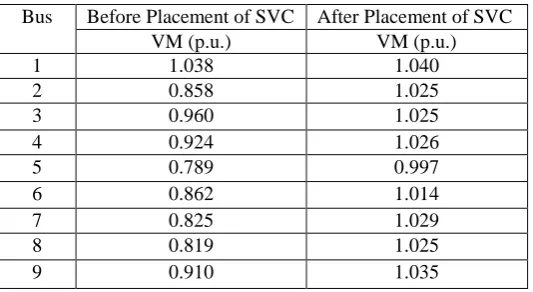
Voltage stability indices are calculated for the WSCC 9 bus system without SVC as shown in table 2.By considering the Voltage stability index (L-Index) value, it is observed that line 7-5 is more sensitive towards system security. Therefore it is more suitable location for SVC to improve power system security/stability. After placement of SVC voltage stability is improved, the analyses of voltage magnitudes for WSCC 9 bus test system without and with SVC as shown in table 3.
Table 3: Analysis of Voltage magnitudes for 9 bus test system without and with SVC
VI. SIMULATION RESULTS
Base case
The continuation power flow analysis using PSAT [12] is run for the test system and the voltage profile without SVC is obtained. The voltage profile and PV curve for the bus 5, bus 6and bus7. It can be seen from the figure 4 (a) that the maximum loading parameter
1.8708 p.u for the base case.Line P (p.u.) Q (p.u.) L-Index 9-8 0.24183 0.0312 0.02463 7-8 0.7638 -0.00797 0.03353 9-6 0.60817 -0.18075 0.01660 7-5 0.8662 -0.08381 0.12752 5-4 -0.4068 -0.38687 -0.1452 6-4 -0.3053 -0.16543 -0.0771 2-7 1.63 0.06654 0.0534 3-9 0.85 -0.1086 -0.0152
1-4 0.7164 0.27046 0.0634
Bus Before Placement of SVC After Placement of SVC VM (p.u.) VM (p.u.)
1 1.038 1.040
2 0.858 1.025
3 0.960 1.025
4 0.924 1.026
5 0.789 0.997
6 0.862 1.014
7 0.825 1.029
8 0.819 1.025
Fig 4: (a) Voltage profile for the base case without SVC Fig 4: (b) P-V Curve without SVC
With SVC
It is seen from Fig. 4(b) that the voltage collapse occurs at the maximum loading of
1
.
8708
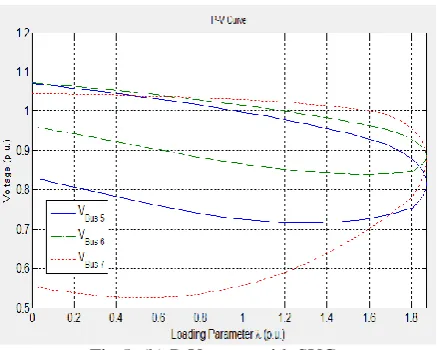
and line 7-5 is the best location for shunt compensation. As described in the earlier section, the SVC was placed in the weakest bus lines one at a time and it was found that for this system bus line 7-5 shunt compensation has better results. Fig.5 (a) gives the voltage profile for the system with SVC. It is seen that the maximum loading factor
1
.
9815
has increases when compared to the base case.
Fig 5: (a) Voltage profile with SVC Fig 5: (b) P-V curve with SVC
VII. CONCLUSION
In this paper, a new method for optimal placement and parameters settings of SVC has been proposed for improving voltage profile in a power system. The proposed approach has been implemented on WSCC 9-bus system. The criterion for selection of optimal placement of SVC was to maintain the voltage profile, minimize the voltage deviations and to reduce the power losses using VSI. Simulations performed on the test system shows that the optimally placed SVC maintains the voltage profile, improve the stability and effectively increases the efficiency of power system.
REFERENCES
1. P. Kundur, Power System Stability and Control, McGraw-Hill Inc., 1994.
Vol. 4, Issue 2, February 2015
3. K. Kuthadi, N. Suresh, “Enhancement of Voltage Stability through Optimal Placement of Facts Controllers in Power Systems” American Journal of Sustainable Cities and Society, vol. 1,July 2012.
4. R. A. Schlueter, “A Voltage Stability Security Assessment Method,” IEEE Trans. On Power Systems, Vol.13, No.4, pp. 1423-1434, Nov.1998. 5. F. A. Althowibi and M.W.Mustafa, “Voltage Stability Calculations in Power Transmission Lines: Indications and Allocations,” IEEE
International Conference on Power and Energy, pp. 390-395, Nov.2010.
6. Shravana Musunuri, G.Dehnavi, “Comparison STATCOM, SVC, SSSC and TCSC devices for voltage stability improvement.”North American Power Symposium (NAPS-2010), 26-28 Sept 2010
7. Bhavin. M.Patel, “Enhancement of steady state voltage stability using SVC and TCSC” National Conference on Recent Trends in Engineering and Technology, BVM Engineering College, Gujarat, India,13-14 May 2011.
8. C. A. Canlzares, Z. T. Faur, "Analysis SVC and TCSC Controllers in Voltage Collapse," IEEE Trans. Power Systems, Vol. 14, No. I, pp. 158-165, February 1999.
9. P.Kessel and H.Glavitsch, “Estimating the Voltage Stability of a Power System” IEEE Transactions on Power Delivery, Vol. 1, No. 3, pp. 346–354, 1986
10. Mehrdad Ahmad, Mostafa Alinezhad, “Comparison of SVC and STATCOM in static voltage stability margin enhancement”, Proceedings of World Academy of Science, Engineering and Technology, Vol. 38, Feb. 2009.