Fine-Grained Secure Computation
Matteo Campanelli and Rosario Gennaro
The City College of New York
[email protected]@ccny.cuny.edu
Abstract. This paper initiates a study of Fine Grained Secure Com-putation: i.e. the construction of secure computation primitivesagainst “moderately complex” adversaries. We present definitions and construc-tions forcompact Fully Homomorphic Encryption and Verifiable Com-putation secure against (non-uniform)NC1 adversaries. Our results do
not require the existence of one-way functions and hold under a widely believed separation assumption, namelyNC1
(⊕L/poly. We also present
two application scenarios for our model:(i) hardware chips that prove their own correctness, and(ii)protocols against rational adversaries po-tentially relevant to theVerifier’s Dilemmain smart-contracts transac-tions such as Ethereum.
1
Introduction
Historically, Cryptography has been used to protect information (either in tran-sit or stored) from unauthorized access. One of the most important developments in Cryptography in the last thirty years, has been the ability to protect not only information but also the computations that are performed on data that needs to be secure. Starting with the work on secure multiparty computation [Yao82], and continuing with ZK proofs [GMR89], and more recently Fully Homomor-phic Encryption [Gen09], verifiable outsourcing computation [GKR08,GGP10], SNARKs [GGPR13,BCI+13] and obfuscation [GGH+16] we now have crypto-graphic tools that protect the secrecy and integrity not only of data, but also of the programs which run on that data.
Another crucial development in Modern Cryptography has been the adoption of a more “fine-grained” notion of computational hardness and security. The traditional cryptographic approach modeled computational tasks as “easy” (for the honest parties to perform) and “hard” (infeasible for the adversary). Yet we have also seen a notion of moderately hard problems being used to attain certain security properties. The best example of this approach might be the use of moderately hard inversion problems used in blockchain protocols such as Bitcoin. Although present in many works since the inception of Modern Cryptography, this approach was first formalized in a work of Dwork and Naor [DN92].
In the second part of this work we consider the following model (which can be traced back to the seminal paper by Merkle [Mer78] on public key cryptography). Honest parties will run a protocol which will cost1 them C while an adversary
1
who wants to compromise the security of the protocol will incur aC0 =ω(C) cost. Note that while C0 is asymptotically larger than C, it might still be a feasible cost to incur – the only guarantee is that it is substantially larger than the work of the honest parties. For example in Merkle’s original proposal for public-key cryptography the honest parties can exchange a key in timeT but the adversary can only learn the key in timeT2. Other examples include primitives introduced by Cachin and Maurer [CM97] and Hastad [Has87] where the cost is the space and parallel time complexity of the parties, respectively.
Recently there has been renewed interest in this model. Degwekar et al. [DVV16] show how to construct certain cryptographic primitives inNC1 [resp.
AC0] which are secure against all adversaries inNC1[resp.AC0]. In conceptually related work Ball et al. [BRSV17] present computational problems which are “moderately hard” on average, if they are moderately hard in the worst case, a useful property for such problems to be used as cryptographic primitives.
The goal of this paper is to initiate a study ofFine Grained Secure Compu-tation. By doing so we connect these two major developments in Modern Cryp-tography. The question we ask is if it is possible to constructsecure computation primitivesthat are secure against “moderately complex” adversaries. We answer this question in the affirmative, by presenting definitions and constructions for the task of Fully Homomorphic Encryption and Verifiable Computation in the fine-grained model. In our constructions, our goal is to optimize at the same time (for the extent to which it is possible) in terms of depth, size, round and com-munication complexity. Our constructions rely on a widely believed complexity separation2. We also present two application scenarios for our model: i) hardware chips that prove their own correctness and ii) protocols against rational adver-saries including potential solutions to theVerifier’s Dilemmain smart-contracts transactions such as Ethereum.
1.1 Our Results
Our starting point is the work in [DVV16] and specifically their public-key en-cryption scheme secure against NC1 circuits. Recall that AC0[2] is the class of Boolean circuits with constant depth, unbounded fan-in, augmented with parity gates. If the number ofAND (andOR) gates of non constant fan-in is constant we say that the circuit belongs to the classAC0Q[2]⊂AC0[2].
Our results can be summarized as follows:
– We first show that the techniques in [DVV16] can be used to build a some-what homomorphic encryption (SHE) scheme. We note that because honest parties are limited toNC1 computations, the best we can hope is to have a scheme that is homomorphic for computations inNC1. However our scheme can only support computations that can be expressed inAC0Q[2].
– We then use our SHE scheme, in conjunction with protocols described in [GGP10,CKV10,AIK10], to construct verifiable computation protocols for
2
functions inAC0Q[2], secure and input/output private against any adversary inNC1.
Our somewhat homomorphic encryption also allows us to obtain the following protocols secure againstNC1adversaries:(i)constant-round 2PC, secure in the presence of semi-honest static adversaries for functions in AC0Q[2]; (ii) Private Function Evaluation in a two party setting for circuits of constantmultiplicative
depth without relying on universal circuits. These results stem from well-known folklore transformations and we do not prove them formally.
The class AC0Q[2] includes many natural and interesting problems such as: fixed precision arithmetic, evaluation of formulas in 3CNF (or kCNF for any constant k), a representative subset of SQL queries, and S-Boxes [BP11] for symmetric key encryption.
Our results (like [DVV16]) hold under the assumption thatNC1(⊕L/poly, a widely believed worst-case assumption on separation of complexity classes. Notice that this assumption does not imply the existence of one-way functions (or evenP6=NP). Thus, our work shows that it is possible to obtain “advanced” cryptographic schemes, such as somewhat homomorphic encryption and verifi-able computation, even if we do not live in Minicrypt34.
Comparison with other approaches.One important question is: on what features are our schemes better than “generic” cryptographic schemes that after all are secure againstany polynomial time adversary.
One such feature is the type of assumption one must make to prove secu-rity. As we said above, our schemes rely on a very mild worst-case complexity assumption, while cryptographic SHE and VC schemes rely on very specific as-sumptions, which are much stronger than the above.
For the case of Verifiable Computation, we also have information-theoretic protocols which are secure against any (possibly computationally unbounded) adversary. For example the “Muggles” protocol in [GKR08] which can compute any (log-space uniform)NCfunction, and is also reasonably efficient in practice [CMT12]. Or, the more recent work [GR18], which obtains efficient VC for func-tions in a subset of NC∩SC. Compared to these results, one aspect in which our protocol fares better is that our Prover/Verifier can be implemented with a constant-depth circuit in AC0[2] (see Section 4) which is not possible for the Prover/Verifier in [GKR08,GR18] as it needs5to be inTC0. Moreover our proto-col is non-interactive (while [GKR08,GR18] requiresΩ(1) rounds of interaction) and because our protocols work in the “pre-processing model” we do not require any uniformity or regularity condition on the circuit being outsourced (which are required by [GKR08] and [CMT12]). Finally, out verification scheme achieves input and output privacy.
3
This is a reference to Impagliazzo’s “five possible worlds” [Imp95].
4 Naturally the security guarantees of these schemes are more limited compared to
their standard definitions.
5 The techniques in [GKR08,GR18] are based on properties of finite fields. Arithmetic
Another approach to obtain information-theoretic security for Verifiable Com-putation is to use the framework of randomized encodings (RE) [IK00a,AIK04] (e.g. [GGH+07] which uses related techniques). In this work we build scheme with additional requirements: compact homomorphic encryption6 and overall
efficient verification for verifiable computation7. We do not see how to achieve these additional requirements via current RE-based approaches. We further dis-cuss these and other limitations of directly using RE in Appendix D.
1.2 Overview of our Techniques
Homomorphic Encryption. In [DVV16] the authors already point out that their scheme is linearly homomorphic. We make use of there-linearization tech-nique from [BV14] to construct a leveled homomorphic encryption.
Our scheme (as the one in [DVV16]) is secure against adversaries in the class of (non-uniform) NC1. This implies that we can only evaluate functions in NC1 otherwise the evaluator would be able to break the semantic security of the scheme. However we have to ensure that thewhole homomorphic evaluation stays in NC1. The problem is that homomorphically evaluating a function f
might increase the depth of the computation.
In terms of circuit depth, the main overhead will be (as usual) the compu-tation of multiplication gates. As we show in Section 3 a single homomorphic multiplication can be performed by a depth twoAC0[2] circuit, but this requires depth O(log(n)) with a circuit of fan-in two. Therefore, a circuit for f with
ω(1) multiplicative depth would require an evaluation ofω(log(n)) depth, which would be out ofNC1. Therefore our first scheme can only evaluate functions with constant multiplicative depth, as in that case the evaluation stays inAC0[2].
We then present a second scheme that extends the class of computable func-tions toAC0Q[2] by allowing for a negligible error in the correctness of the scheme. We use techniques from a work by Razborov [Raz87] on approximatingAC0[2] circuits with low-degree polynomials – the correctness of the approximation (ap-propriately amplified) will be the correctness of our scheme.
Reusable Verifiable Computation. The core of our approach is the con-struction in [CKV10], to derive Verifiable Computation from Homomorphic En-cryption. The details of this approach follow. Recall that we are working in a model with an expensive preprocessing phase (executed by the Client only once and before providing any inputs to the Server) and an inexpensive online phase. The online phase is in turn composed by two algorithms, an algorithm to encode the input for the Server and one to check its response. In the preprocessing phase in [CKV10], the Client selects a random input r, encrypts it as cr =E(r) and homomorphically computecf(r)an encryption off(r). During the online phase, the Client, on input x, computescx=E(x) and submits the ciphertexts cx, cr
6
Where the ciphertexts do not grow in size with each homomorphic operation.
7 Where not only the circuit depth is constant but also the size of the circuit is
in random order to the Server, who homomorphically computescf(r)=E(f(r)) andcf(x)=E(f(x)) and returns them to the Client. The Client, given the mes-sagec0, c1from the Server, checks thatcb =cf(r)(for the appropriate bitb) and if so acceptsy =D(cf(x)) asy =f(x). The semantic security ofE guarantees that this protocol has soundness error 1/2. This error can be reduce by “scaling” this approach replacing the two ciphertextscxandcrwith 2tciphertexts (t dis-tinct encryptions ofxandtencryptions of random valuesr1, . . . , rt) sent to the prover after being shuffled through a random permutation. The scheme as de-scribed is however one-time secure, since a malicious server can figure out which one is the test ciphertextcf(r) if it is used again. To make this scheme “many-times secure”, [CKV10] uses the paradigm introduced in [GGP10] of running the one-time scheme “under the hood” of a different homomorphic encryption key each time.
When applying these techniques in our fine-grained context the main techni-cal challenge is to guarantee that they would also work withinNC1. In particular, we needed to ensure that: (i)the constructions can be computed in low-depth;
(ii)the reductions in the security proofs can be carried out in low-depth. We rely on results from [MV91] to make sure a random permutation can be sampled by an appropriately low-depth scheme8 Moreover, we cannot simply make black-box use of the one-time construction in [CKV10]. In fact, their construction works only for homomorphic encryption schemes with deterministic evaluation, whereas the more expressive of our constructions (Section 3.3) is randomized9.
1.3 Application Scenarios
The applications described in this section refer to the problem of Verifying Com-putation, where a Client outsources an algorithmf and an inputxto a Server, who returns a valueyand a proof thaty=f(x). The security property is that it should be infeasible to convince the verifier to accepty06=f(x), and the crucial efficiency property is that verifying the proof should cost less than computingf
(since avoiding that cost was the reason the Client hired the Server to compute
f).
Hardware Chips That Prove Their Own CorrectnessVerifiable Com-putation (VC) can be used to verify the execution of hardware chips designed by untrusted manufacturers. One could envision chips that provide (efficient)
proofs of their correctness for every input-output computation they perform. These proofs must beefficiently verified in less time and energy than it takes to re-execute the computation itself.
When working in hardware, however, one may not need the full power of cryptographic protection against any malicious attacks since one could bound the computational power of the malicious chip. The bound could be obtained
8 More precisely, that a permutation statistically indistinguishable from a random one
can be sampled inAC0.
9
by making (reasonable and evidence-based) assumptions on how much compu-tational power can fit in a given chip area. For example one could safely assume that a malicious chip can perform at most a constant factor more work than the original function because of the basic physics of the size and power constraints. In other words, if C is the cost of the honest Server in a VC protocol, then in this model the adversary is limited toO(C)-cost computations, and therefore a protocol that guarantees that successful cheating strategies require ω(C) cost, will suffice. This is exactly the model in our paper. Our results will apply to the case in which we define the cost as the depth (i.e. the parallel time complexity) of the computation implemented in the chip.
Rational Proofs.The problem above is related to the notion of composable Rational Proofs defined in [CG15]. In a Rational Proof (introduced by Azar and Micali [AM12,AM13]), given a function f and an input x, the Server returns the value y = f(x), and (possibly) some auxiliary information, to the Client. The Client in turn pays the Server for its work with a reward based on the transcript exchanged with the server and some randomness chosen by the client. The crucial property is that this reward is maximized in expectation when the server returns the correct valuey. Clearly arationalprover who is only interested in maximizing his reward, will always answer correctly.
The authors of [CG15] show however that the definition of Rational Proofs in [AM12,AM13] does not satisfy a basic compositional property needed for the case in which many computations are outsourced to many servers who compete with each other for rewards (e.g. the case of volunteer computations [ACK+02]). A “rational proof” for the single-proof setting may no longer be rational when a large number of “computation problems” are outsourced. If one can produceT
“random guesses” to problems in the time it takes to solve 1 problem correctly, it may be preferable to guess! That’s because even if each individual reward for an incorrect answer is lower than the reward for a correct answer, the total reward ofT incorrect answers might be higher (and this is indeed the case for some of the protocols presented in [AM12,AM13]).
The question (only partially answered in [CG15,CG17] for a limited class of computations) is to design protocols where the reward is strictly connected, not just to the correctness of the result, but to the amount of work done by the prover. Consider for example a protocol where the prover collects the reward only if he produces a proof of correctness of the result. Assume that the cost to produce a valid proof for an incorrect result, is higher than just computing the correct result and the correct proof. Then obviously a rational prover will always answer correctly, because the above strategy of fast incorrect answers will not work anymore. While the application is different, the goal is the same as in the previous verifiable hardware scenario.
over a miner who does not verify it and accept it “uncritically” since the latter will produce a valid block faster and claim the reward. On the other hand if the transaction is invalid, accepting it without verifying it first will lead to the rejection of the entire block by the blockchain and a waste of work by the uncrit-ical miner. The solution is to require efficiently verifiable proofs of validity for transactions, an approach already pursued by various startups in the Ethereum ecosystem (e.g. TrueBit10). We note that it suffices for these proofs to satisfy the condition above: i.e. we do not need the full power of information-theoretic or cryptographic security but it is enough to guarantee that to produce a proof of correctness for a false transaction is more costly than producing a valid trans-action and its correct proof, which is exactly the model we are proposing.
1.4 Future Directions
Our work opens up many interesting future directions.
First of all, it would be nice to extend our results to the case where cost is the actual running time, rather than “parallel running time”/“circuit depth” as in our model. The techniques in [BRSV17] (which presents problems conjectured to have Ω(n2) complexity on the average), if not even the original work of Merkle [Mer78], might be useful in building a verifiable computation scheme where if computing the function takes timeT, then producing a false proof of correctness would have to takeΩ(T2).
For the specifics of our constructions it would be nice to “close the gap” between what we can achieve and the complexity assumption: our schemes can only compute AC0Q[2] against adversaries in NC1, and ideally we would like to be able to compute all ofNC1(or at the very least all ofAC0[2]).
Finally, to apply these schemes in practice it is important to have tight concrete security reductions and a proof-of-concept implementations.
2
Preliminaries
For a distribution D, we denote by x ← D the fact that x is being sampled according toD. We remind the reader that an ensembleX ={Xλ}λ∈Nis a family of probability distributions over a family of domainsD={Dλ}λ∈N. We say two ensemblesD={Dλ}λ∈NandD0={D0λ}λ∈Nare statistically indistinguishable if
1 2
X
x
|D(x)−D0(x)|<neg(λ). Finally, we note that all arithmetic computations
(such as sums, inner product, matrix products, etc.) in this work will be over GF(2) unless specified otherwise.
Definition 2.1 (Function Family).Afunction familyis a family of (possibly randomized) functions F ={fλ}λ∈N, where for each λ,fλ has domain D
f λ and
co-domain Rfλ. Aclass C is a collection of function families.
10
In most of our constructions Dλf = {0,1}dfλ and Rf
λ = {0,1}
rλf for sequences
{dfλ}λ,{d f λ}λ.
In the rest of the paper we will focus on the class ofC =NC1 of functions for which there is a polynomial p(·) and a constantc such that for each λ, the function fλ can be computed by a Boolean (randomized) fan-in 2, circuit of
size p(λ) and depth clog(λ). In the formal statements of our results we will also use the following classes:AC0, the class of functions of polynomial size and constant depth with AND,OR and NOT gates with unbounded fan-in;AC0[2], the class of functions of polynomial size and constant depth withAND,OR,NOT
andPARITY gates with unbounded fan-in.
Given a function f, we can think of its multiplicative depth as the degree of the lowest-degree polynomial in GF(2) that evaluates to f. We denote by
AC0CM[2] the class of circuits in AC0[2] with constant multiplicative depth. We say that a circuit has quasi-constant multiplicative depth if it has a constant number of gates with non-constant fan-in (an example is a circuit composed by a single AND of fan-in n). We denote the class of such circuits by AC0Q[2]. See Appendix A for a formal treatment.
Limited Adversaries. We define adversaries also as families of randomized algorithms {Aλ}λ, one for each security parameter (note that this is a
non-uniform notion of security). We denote the class of adversaries we consider as A, and in the rest of the paper we will also restrictAtoNC1.
Infinitely-Often Security.We now move to define security against all ad-versaries{Aλ}λthat belong to a classA. Our results achieve an “infinitely often”
notion of security, which states that for all adversaries outside of our permitted classAour security property holds infinitely often (i.e. for an infinite sequence of security parameters rather than for every sufficiently large security parameter). This limitation seems inherent to the techniques in this paper and in [DVV16]. We informally denote with X ∼Λ Y the fact that two ensembles X and Y are
indistinguishable by NC1 adversaries for an infinite sequence of parameters Λ. See also AppendixA.
3
Fine-Grained SHE
We start by recalling the public key encryption from [DVV16] which is secure against adversaries inNC1.
The scheme is described in Figure 1. Its security relies on the following result, implicit in [IK00a]11. We will also use this lemma when proving the security of our construction in Section 3.
Lemma 3.1 ([IK00a]). If NC1 ( ⊕L/poly then there exist distribution Dλkg
over{0,1}λ×λ, distribution Df
λ over matrices in{0,1}λ×λ of full rank, and
in-finite setΛ⊆Nsuch that
Mkg∼ΛMf 11
whereMf← Df
λ andM
kg← Dkg
λ.
The following result is central to the correctness of the schemePKEin Figure 1 and is implicit in [DVV16].
Lemma 3.2 ([DVV16]). There exists sampling algorithm KSample such that
(M,k) ← KSample(1λ), M is a matrix distributed according to Dkg
λ (as in
Lemma 3.1), kis a vector in the kernel of Mand has the form
k= (r1, r2, . . . , rλ−1,1)∈ {0,1}λ where ri-s are uniformly distributed bits.
– PKE.Keygensk(1λ) :
1. Sample (M,k)←KSample(1λ); 2. Output (pk=M,sk=k). – PKE.Encpk=M(µ) :
1. Sampler←${0,1}λ;
2. Lett|= (0 . . .0 1)∈ {0,1}λ
; 3. Outputc|=r|M+µt|. – PKE.Decsk=k(c) :
1. Outputhk,ci
Fig. 1.PKE construction [DVV16]
Theorem 3.1 ([DVV16]).AssumeNC1(⊕L/poly. Then, the schemePKE= (PKE.Keygen,PKE.Enc,PKE.Dec) defined in Figure 1 is a Public Key Encryp-tion scheme secure against NC1 adversaries. All algorithms in the scheme are computable in AC0[2].
3.1 Leveled Homomorphic Encryption for AC0CM[2] Functions Secure against NC1
We denote byx[i] the i-th bit of a vector of bitsx. Below, the schemePKE= (PKE.Keygen,PKE.Enc,PKE.Dec) is the one defined in Figure 1. Our SHE scheme is defined by the following four algorithms:
– HE.Keygensk(1λ, L) : For key generation, sample L + 1 key pairs
(M0,k0), . . . ,(ML,kL) ← PKE.Keygen(1λ), and compute, for all ` ∈
{0, . . . , L−1},i, j∈[λ], the value
a`,i,j ←PKE.EncM`+1(k`[i]·k`[j])∈ {0,1}
λ
We defineA:={a`,i,j}`,i,j to be the set of all these values. t then outputs
We point out a property that will be useful later: by the definition above, for all`∈ {0, . . . , L−1}we have
hk`+1,a`+1,i,ji=k`[i]·k`[j]. (1)
– HE.Encpk(µ)) : Recall that pk =M0. To encrypt a message µwe compute
v ← PKE.EncM0(µ). The output ciphertext contains v in addition to a
“level tag”, an index in {0, . . . , L} denoting the “multiplicative depth” of the generated ciphertext. The encryption algorithm outputsc:= (v,0).
– HE.DeckL(c) : To decrypt a ciphertext
12c= (v, L) computePKE.Dec
kL(v),
i.e.
hkL,vi
– HE.Evalevk(f, c1, . . . , cn) : where f : {0,1}n → {0,1}: We require that f is represented as an arithmetic circuit in GF(2) with addition gates of un-bounded fan-in and multiplication gates of fan-in 2. We also require the circuit to belayered, i.e. the set of gates can be partitioned in subsets (lay-ers) such that wires are always between adjacent layers. Each layer should be composed homogeneously either of addition or multiplication gates. Finally, we require that the number of multiplications layers (i.e. the multiplicative depth) off isL.
We homomorphically evaluatef gate by gate. We will show how to perform multiplication (resp. addition) of two (resp. many) ciphertexts. Carrying out this procedure recursively we can homomorphically compute any circuit f
of multiplicative depthL.
Ciphertext structure during evaluation. During the homomorphic evaluation a ciphertext will be of the formc= (v, `) where`is the “level tag” mentioned above. At any point of the evaluation we will have that` is be-tween 0 (for fresh ciphertexts at the input layer) andL(at the output layer). We define homomorphic evaluation only among ciphertexts at the same level. Since our circuit is layered we will not have to worry about homomorphic evaluation occurring among ciphertexts at different levels. Consistently with the fact a level tag represents the multiplicative depth of a ciphertext, ad-dition gates will keep the level of ciphertexts unchanged, whereas multipli-cation gates will increase it by one. Finally, we will keep the invariant that the output of each gate evaluationc= (v, `) is such that
hk`,vi=µ (2)
whereµis the correct plaintext output of the gate. We prove our construction satisfies this invariant in Appendix B.
12
Homomorphic Evaluation of gates:
• Addition gates.Homomorphic evaluation of an addition gates on inputs
c1, . . . , cn whereci= (vi, `) is performed by outputting
cadd= (vadd, `) :=
X
i
vi, `
• Multiplication gates.We show how to multiply ciphertextsc, c0wherec= (v, `) andc0= (v0, `) to obtain an output ciphertextcmult= (vmult, `+1). The homomorphic multiplication algorithm will set
vmult:=
X
i,j∈[λ]
hi,j·a`+1,i,j
wherehi,j=v[i]·v0[j] fori, j∈[λ]. The final output ciphertext will be
cmult:= (vmult, `+ 1).
The following theorem states the security of our scheme under our complexity assumption.
Theorem 3.2 (Security). The scheme HEis CPA secure against NC1 adver-saries (Definition A.5) under the assumption NC1(⊕L/poly.
3.2 Efficiency and Homomorphic Properties of Our Scheme
Our scheme is secure against adversaries in the class NC1. This implies that we can run HE.Evalonly on functions f that are in NC1, otherwise the evaluator would be able to break the semantic security of the scheme. However we have to ensure that thewholehomomorphic evaluation stays inNC1. The problem is that homomorphically evaluatingf has an overhead with respect to the “plain” evaluation off. Therefore, we need to determine for which functionsf, we can guarantee thatHE.Eval(F, . . .) will stay inNC1. The class of such functions turns out to be the class of functions implementable in constant multiplicative depth, i.e.AC0CM[2]13.
These observations, plus the fact that the invariant in Eq. 2 is preserved throughout homomorphic evaluation, imply the following result.
Theorem 3.3. The scheme HEis leveled AC0CM[2]-homomorphic. Key genera-tion, encrypgenera-tion, decryption and evaluation are all computable inAC0CM[2].
13
In terms of circuit depth, the main overhead when evaluatingfhomomorphically is given by the multiplication gates (addition, on the other hand, is “for free” — see definition ofHE.Evalabove). A single homomorphic multiplication can be performed by a depth two AC0[2] circuit, but this requires depthΩ(log(n)) with a circuit of fan-in two. Therefore, a circuit forfwithω(1) multiplicative depth would require an evaluation ofω(log(n)) depth, which would be out ofNC1. On the other hand, observe that for any functionfinAC0[2] with constant multiplicative depth, the evaluation
3.3 Beyond Constant Multiplicative Depth
In the previous section we saw how our scheme is homomorphic for a class of constant-depth, unbounded fan-in arithmetic circuits in GF(2) with constant multiplicative depth. We now show how to overcome this limitation by first ex-tending techniques from [Raz87] to approximateAC0[2] circuits with low-degree polynomials and then designing a construction that internally uses our scheme
HEfrom Section 3.1.
ApproximatingAC0Q[2] inAC0CM[2] Our approach to homomorphically
eval-uate a functionf ∈AC0Q[2] is as follows. Instead of evaluatingf we evaluatef∗, an approximate version of f that is computable in AC0CM[2]. The function f∗
is randomized and we will denote by n0 the number of random bits f∗ takes in input (in addition to the nbits of the input x). If xˆ=Enc(x) and rˆ=Enc(r) where r is uniformly random in {0,1}n0, then decrypting HE.Eval(f∗,xˆ,rˆ)14 yieldsf(x) with constant error probability. One way to reduce error could be to let evaluation computef∗ stimes withsrandom inputs. However, this requires particular care to avoid using majority gates in the decryption algorithm. With this goal in mind we extend the output of the approximating functionf∗. When performing evaluation we will then performsevaluations off0, the “extension” off∗ This additional information will be returned (encrypted) from the evalua-tion algorithm and will allow correct decrypevalua-tion with overwhelming probability and in low-depth (and without majority gates).
In the next constructions we will make use of the functionsGenApproxFun,
GenDecodeAuxand DecodeApprox, here only informally defined15. The function
GenApproxFun(f) returns the (extended) approximating functionf0; the function GenDecodeAux(f) returns a constant-size stringauxf used to decode (multiple)
output of f0(x); the function DecodeApprox(auxf,yout1 , . . . ,youts ) returns f(x)
w.h.p. if eachyout
s is an output off0(x;r) for randomr.
Homomorphic Evaluations of AC0Q[2] Circuits Below is our construction for a homomorphic scheme that can evaluate all circuits inAC0Q[2] inAC0[2]. This time, in order to evaluate circuitC, we perform several homomorphic evaluations of the randomized circuitC0 (as in Lemma B.2). To obtain the plaintext output of C we can decrypt all the ciphertext outputs and use DecodeApprox. Notice that this scheme is still compact. As we use a randomized approach to evaluate
f, the schemeHE0 will be implicitly parametrized by a soundness parameters. Intuitively, the probability of a function f being evaluated incorrectly will be upper bounded by 2−s.
For our new scheme we will use the following auxiliary functions:
Definition 3.1 (Auxiliary Functions for HE0).
14In the evaluation algorithm we ignore the distinction between deterministic and
random input.
15
Let f : {0,1}n → {0,1} be represented as an arithmetic circuit as in HE and pk a public key for the scheme HE that includes the evaluation key. Let s be a soundness parameter. We denote byf0 be as above; letn0=O(n)be the number of additional bitsf0 will take as random input.
– SampleAuxRandomnesss(pk, f0) :
1. Sample s·n0 random bits r1(1), . . . , r(1)n0 , . . . , r
(s) 1 , . . . , r
(s)
n0;
2. Computerˆaux:={ˆr
(i)
j | rˆ
(i)
j ←HE.Encpk(r
(i)
j ), i∈[s], j∈[n0]};
3. Outputrˆaux.
– EvalApproxs(pk, f0, c1, . . . , cn,rˆaux) :
1. Let rˆaux={rˆ
(i)
j |i∈[s], j∈[n0]}.
2. For i∈[s], computecout
i ←HE.Evalevk(f0, c1, . . . cn,rˆ (i) 1 , . . . ,ˆr
(i)
n0);
3. Outputc= (cout1 , . . . ,couts )16.
The new scheme HE0 with soundness parameter s follows. Notice that the evaluation function outputs an auxiliary string auxf together with the proper
ciphertextc. This is necessary to have a correct decoding in decryption phase.
– Key generation and encryption are the same as inHE.
– HE0.Evalpk(f, c1, . . . , cn):
1. Computef0←GenApproxFun(f);
2. Computerˆaux←SampleAuxRandomnesss(pk, f0);
3. auxf ←GenDecodeAux(f);
4. c←EvalApproxs(pk, f0, c1, . . . , cn,rˆaux); 5. Output (c,auxf).
– HE0.Decsk(c= (cout1 , . . . ,couts ),auxf):
1. Letyout
i ←HE.Decsk(couti ) fori∈[s];
2. OutputDecodeApproxf(auxf,yout1 , . . . ,y out
s ).
The following theorem summarizes the properties of this construction.
Theorem 3.4. The scheme HE0 above with soundness parameter s =Ω(λ) is leveledAC0Q[2]-homomorphic. Key generation, encryption and evaluation can be computed inAC0CM[2]. Decryption is computable in AC
0
Q[2].
4
Fine-Grained Verifiable Computation
In this section we describe our private verifiable computation scheme. Our con-structions are based on the techniques in [CKV10] to obtain (reusable) verifiable computation from fully homomorphic encryption; see Section 1.2 for a high-level description.
16
4.1 A One-time Verification Scheme
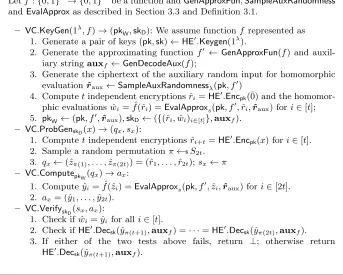
In Figure 2 we describe an adaptation of the one-time secure delegation scheme from [CKV10]. We make non-black box use of our homomorphic encryption scheme HE0 (Section 3.3) with soundness parameters=λ. Notice that. during
the preprocessing phase, we fix the “auxiliary randomness” forEvalApprox(and thus forHE0.Eval) once and for all. We will use that same randomness for all the input instances. This choice does not affect the security of the construction. We remind the reader that we will simplify notation by considering the evaluation key of our somewhat homomorphic encryption scheme as part of its public key. Ifxis a vector of bits x1, . . . , xn, below we will denote with HE0.Enc(x) the concatenation of the bit by bit ciphertexts HE0.Enc(x
1), . . . ,HE0.Enc(xn). We
denote byHE0.Enc(¯0) the concatenation ofnencryptions of 0,HE0.Enc(0).
Letf:{0,1}n→ {0,1}mbe a function andGenApproxFun,SampleAuxRandomness
andEvalApproxas described in Section 3.3 and Definition 3.1.
– VC.KeyGen(1λ, f)→(pkW,skD): We assume functionf represented as
1. Generate a pair of keys (pk,sk)←HE0.Keygen(1λ).
2. Generate the approximating functionf0 ←GenApproxFun(f) and auxil-iary stringauxf ←GenDecodeAux(f);
3. Generate the ciphertext of the auxiliary random input for homomorphic evaluationrˆaux←SampleAuxRandomnessλ(pk, f
0 )
4. Computetindependent encryptions ˆri=HE0.Encpk(¯0) and the
homomor-phic evaluations ˆwi= ˆf(ˆri) =EvalApproxs(pk, f
0
,rˆi,rˆaux) fori∈[t];
5. pkW←(pk, f
0
,rˆaux),skD←({(ˆri,wˆi)i∈[t]},auxf).
– VC.ProbGenskD(x)→(qx, sx):
1. Computetindependent encryptions ˆri+t=HE0.Encpk(x) fori∈[t].
2. Sample a random permutationπ←$S2t.
3. qx←(ˆzπ(1), . . . ,zˆπ(2t)) = (ˆr1, . . . ,ˆr2t);sx←π
– VC.ComputepkW(qx)→ax:
1. Compute ˆyi= ˆf(ˆzi) =EvalApproxs(pk, f
0
,ˆzi,rˆaux) fori∈[2t].
2. ax= (ˆy1, . . . ,yˆ2t).
– VC.VerifyskD(sx, ax):
1. Check if ˆwi= ˆyifor alli∈[t].
2. Check ifHE0.Decsk(ˆyπ(t+1),auxf) =· · ·=HE0.Decsk(ˆyπ(2t),auxf).
3. If either of the two tests above fails, return ⊥; otherwise return HE0.Decsk(ˆyπ(t+1),auxf).
Fig. 2.One-Time Delegation SchemeVC
Remark 4.1 (Efficiency of VC).In the following we consider the verifiable com-putation of a functionf :{0,1}n→ {0,1}mcomputable by anAC0
Q[2] circuit of sizeS.
– VC.KeyGenis computable by anAC0[2] circuit of sizeO(poly(λ)S);
– VC.ProbGenis computable by anAC0[2] circuit of sizeO(poly(λ)(m+n));
– VC.Computeis computable by anAC0[2] circuit of sizeO(poly(λ)S);
– VC.Verifyis computable by aAC0[2] circuit of sizeO(poly(λ)(m+n)).
The (constant) depth ofVC.ProbGenandVC.Verify is independent of the depth off17.
4.2 A Reusable Verification Scheme
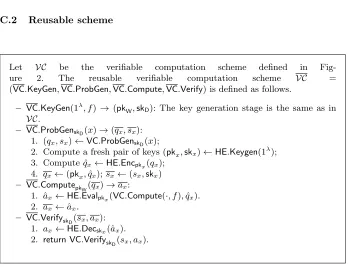
We obtain our reusable verification schemeVC applying the transformation in [CKV10] from one-time sound verification schemes through fully homomorphic encryption. The core idea behind this transformation is to encapsulate all the operations of a one-time verifiable computation scheme (such asVCin Figure 2) through homomorphic encryption. We instantiate this transformation with the simplest of our two somewhat homomorphic encryption schemes,HE(described in Section 3.1). The full construction ofVC is in Appendix C (Figure 3).
Remark 4.2 (Efficiency ofVC).The efficiency of VC is analogous to that ofVC with the exception of a circuit size overhead of a factor O(λ) on the problem generation and verification algorithms and ofO(λ2) for the computation algo-rithm. The (constant) depth ofVC.ProbGenandVC.Verifyis independent of the depth of f.
Theorem 4.1 (Completeness ofVC).The verifiable computation schemeVC
has overwhelming completeness (Definition A.10) for the class AC0Q[2].
Theorem 4.2 (Many-Times Soundness ofVC). Under the assumption that
NC1 ( ⊕L/poly the scheme VC is many-times secure against NC1 adversaries
whenevert is chosen to beω(log(λ))in the underlying schemeVC.
17
Further details on the complexity ofVCfollow. All the algorithms are inAC0CM[2],
ex-cept for the online stage. In fact,VC.VerifyandVC.ProbGenare inAC0[2]. Moreover,
they are not inAC0Q[2] as they perform in parallel a non-constant (polylogarithmic)
number of decryptions and permutations respectively, and these involve non-constant fan-in gates. Notice that even though the online stage is not inAC0
Q[2] we still have
a gain at verification time (although not in an asymptotic sense). This because of the specific structure of these circuits. Consider for example what happens when implementingVC.Verifyor VC.ProbGenwith a fan-in two circuit. Their depth will be c(log(n) + log(λ)) for a constantc. Contrast this with a circuitf inAC0
Q[2] of
References
[ACK+02] David P Anderson, Jeff Cobb, Eric Korpela, Matt Lebofsky, and Dan
Werthimer. SETI@home: an experiment in public-resource computing. Communications of the ACM, 45(11):56–61, 2002.
[AIK04] B Applebaum, Y Ishai, and E Kushilevitz. Cryptography in ncˆ 0. In Foundations of Computer Science, 2004. Proceedings. 45th Annual IEEE Symposium on, pages 166–175, 2004.
[AIK10] Benny Applebaum, Yuval Ishai, and Eyal Kushilevitz. From secrecy to soundness: Efficient verification via secure computation. In International Colloquium on Automata, Languages, and Programming, pages 152–163. Springer, 2010.
[AM12] Pablo Daniel Azar and Silvio Micali. Rational proofs. In Proceedings of the forty-fourth annual ACM symposium on Theory of computing, pages 1017–1028. ACM, 2012.
[AM13] Pablo Daniel Azar and Silvio Micali. Super-efficient rational proofs. In Pro-ceedings of the fourteenth ACM conference on Electronic commerce, pages 29–30. ACM, 2013.
[BCI+13] Nir Bitansky, Alessandro Chiesa, Yuval Ishai, Omer Paneth, and Rafail Os-trovsky. Succinct non-interactive arguments via linear interactive proofs. In Amit Sahai, editor,Theory of Cryptography, pages 315–333, Berlin, Heidel-berg, 2013. Springer Berlin Heidelberg.
[BP11] Joan Boyar and Rene C Peralta. A depth-16 circuit for the aes s-box. IACR Cryptology ePrint Archive, 2011(IACR Cryptology ePrint Archive), 2011. [BRSV17] Marshall Ball, Alon Rosen, Manuel Sabin, and Prashant Nalini Vasudevan.
Average-case fine-grained hardness. InElectronic Colloquium on Computa-tional Complexity (ECCC), volume 24, page 39, 2017.
[BV14] Zvika Brakerski and Vinod Vaikuntanathan. Efficient fully homomorphic encryption from (standard) lwe. SIAM Journal on Computing, 43(2):831– 871, 2014.
[CG15] Matteo Campanelli and Rosario Gennaro. Sequentially composable ratio-nal proofs. InInternational Conference on Decision and Game Theory for Security, pages 270–288. Springer, 2015.
[CG17] Matteo Campanelli and Rosario Gennaro. Efficient rational proofs for space bounded computations. InInternational Conference on Decision and Game Theory for Security, pages 53–73. Springer, 2017.
[CKV10] Kai-Min Chung, Yael Tauman Kalai, and Salil P Vadhan. Improved dele-gation of computation using fully homomorphic encryption. In CRYPTO, volume 6223, pages 483–501. Springer, 2010.
[CM97] Christian Cachin and Ueli Maurer. Unconditional security against memory-bounded adversaries. In Burton S. Kaliski, editor,Advances in Cryptology — CRYPTO ’97, pages 292–306, Berlin, Heidelberg, 1997. Springer Berlin Heidelberg.
[CMT12] Graham Cormode, Michael Mitzenmacher, and Justin Thaler. Practical verified computation with streaming interactive proofs. In Proceedings of the 3rd Innovations in Theoretical Computer Science Conference, pages 90– 112. ACM, 2012.
[DVV16] Akshay Degwekar, Vinod Vaikuntanathan, and Prashant Nalini Vasudevan. Fine-grained cryptography. In Annual Cryptology Conference, pages 533– 562. Springer, 2016.
[Gen09] Craig Gentry.A fully homomorphic encryption scheme. Stanford University, 2009.
[GGH+07] Shafi Goldwasser, Dan Gutfreund, Alexander Healy, Tali Kaufman, and Guy N Rothblum. Verifying and decoding in constant depth. InProceedings of the thirty-ninth annual ACM symposium on Theory of computing, pages 440–449. ACM, 2007.
[GGH+16] Sanjam Garg, Craig Gentry, Shai Halevi, Mariana Raykova, Amit Sahai, and Brent Waters. Candidate indistinguishability obfuscation and func-tional encryption for all circuits. SIAM Journal on Computing, 45(3):882– 929, 2016.
[GGP10] Rosario Gennaro, Craig Gentry, and Bryan Parno. Non-interactive verifiable computing: Outsourcing computation to untrusted workers. InAdvances in Cryptology–CRYPTO 2010, pages 465–482. Springer, 2010.
[GGPR13] Rosario Gennaro, Craig Gentry, Bryan Parno, and Mariana Raykova. Quadratic span programs and succinct nizks without pcps. In Annual In-ternational Conference on the Theory and Applications of Cryptographic Techniques, pages 626–645. Springer, 2013.
[GKR08] Shafi Goldwasser, Yael Tauman Kalai, and Guy N Rothblum. Delegating computation: interactive proofs for muggles. In Proceedings of the fortieth annual ACM symposium on Theory of computing, pages 113–122. ACM, 2008.
[GMR89] Shafi Goldwasser, Silvio Micali, and Charles Rackoff. The knowledge com-plexity of interactive proof systems.SIAM Journal on computing, 18(1):186– 208, 1989.
[Gol01] Oded Goldreich.Foundations of Cryptography: Volume 1, Basic Tools. Cam-bridge University Press, 2001.
[Gol09] Oded Goldreich. Foundations of Cryptography: Volume 2, Basic Applica-tions. Cambridge university press, 2009.
[GR18] Oded Goldreich and Guy N Rothblum. Simple doubly-efficient interac-tive proof systems for locally-characterizable sets. InLIPIcs-Leibniz Inter-national Proceedings in Informatics, volume 94. Schloss Dagstuhl-Leibniz-Zentrum fuer Informatik, 2018.
[Hag91] Torben Hagerup. Fast parallel generation of random permutations. In Proceedings of the 18th International Colloquium on Automata, Languages and Programming, pages 405–416, New York, NY, USA, 1991. Springer-Verlag New York, Inc.
[Has87] Johan Hastad. One-way permutations in nc0. Information Processing Let-ters, 26(3):153–155, 1987.
[IK00a] Yuval Ishai and Eyal Kushilevitz. Randomizing polynomials: A new repre-sentation with applications to round-efficient secure computation. In Foun-dations of Computer Science, 2000. Proceedings. 41st Annual Symposium on, pages 294–304. IEEE, 2000.
[IK02] Yuval Ishai and Eyal Kushilevitz. Perfect constant-round secure computa-tion via perfect randomizing polynomials. In International Colloquium on Automata, Languages, and Programming, pages 244–256. Springer, 2002. [Imp95] Russell Impagliazzo. A personal view of average-case complexity. In
Struc-ture in Complexity Theory Conference, 1995., Proceedings of Tenth Annual IEEE, pages 134–147. IEEE, 1995.
[LTKS15] Loi Luu, Jason Teutsch, Raghav Kulkarni, and Prateek Saxena. Demystify-ing incentives in the consensus computer. InProceedings of the 22nd ACM SIGSAC Conference on Computer and Communications Security, pages 706–719. ACM, 2015.
[Mer78] Ralph C Merkle. Secure communications over insecure channels. Commu-nications of the ACM, 21(4):294–299, 1978.
[MV91] Yossi Matias and Uzi Vishkin. Converting high probability into nearly-constant time - with applications to parallel hashing. InProceedings of the Twenty-third Annual ACM Symposium on Theory of Computing, STOC ’91, pages 307–316, New York, NY, USA, 1991. ACM.
[Raz87] Alexander A Razborov. Lower bounds on the size of bounded depth circuits over a complete basis with logical addition. Mathematical Notes of the Academy of Sciences of the USSR, 41(4):333–338, 1987.
[SYY99] Tomas Sander, Adam Young, and Moti Yung. Non-interactive cryptocom-puting for nc1. InProceedings of the 40th Annual Symposium on Founda-tions of Computer Science, page 554. IEEE Computer Society, 1999. [Yao82] Andrew C Yao. Protocols for secure computations. InFoundations of
Com-puter Science, 1982. SFCS’08. 23rd Annual Symposium on, pages 160–164. IEEE, 1982.
A
Additional Preliminaries
A.1 Infinitely-Often Computational Indistinguishability
Definition A.1 (Infinitely-Often Computational Indistinguishability).
Let X ={Xλ}λ∈NLet Y={Yλ}λ∈N be ensembles over the same domain family, A a class of adversaries, and Λ an infinite subset of N. We say that X and Y
are infinitely often computational indistinguishable with respect to setΛ and the class A, denoted by X ∼Λ,A Y if there exists a negligible function ν such that
for any λ∈Λand for any adversary A={Aλ}λ∈ A
|Pr[Aλ(Xλ) = 1]−Pr[Aλ(Yλ) = 1]|< ν(λ)
WhenA=NC1 we will keep it implicit and use the notationX ∼Λ Y and say
that X andY areΛ-computationally indistinguishable.
In our proofs we will use the following facts on infinitely-often computa-tionally indistinguishable ensembles. We skip their proof as, except for a few technicalities, it is analogous to the corresponding properties for standard com-putational indistinguishability18.
Lemma A.1 (Facts on Λ-Computational Indistinguishability).
18
– Transitivity:Let m=poly(λ)and X(j) withj ∈ {0, . . . , m} be ensembles.
If for allj ∈[m] X(j−1)∼
ΛX(j), thenX(0)∼ΛX(m).
– Weaker than statistical indistinguishability:Let X,Y be statistically indistinguishable ensembles. ThenX ∼ΛY for any infiniteΛ⊆N
– Closure underNC1:LetX,Y be ensembles and{fλ}λ∈N∈NC 1
. IfX ∼Λ Y
for someΛthen fλ(X)∼Λfλ(Y).
A.2 Circuit Classes
For a gate g we denote bytypeC(g) the type of the gateg in the circuit C and by parentsC(g) the list of gates of C whose output is an input to C (such list may potentially contain duplicates).
We define the multiplicative depth of a circuit as follows:
Definition A.2 (Multiplicative Depth). Let C be a circuit, we define the multiplicative depth ofC asmd(gout)wheregout is its output gate and the
func-tionmd, from the set of gates to the set of natural numbers is recursively defined as follows:
md(g) :=
1 if typeC(g) =input
max{md(g0) :g0∈parentsC(g)} if typeC(g) =XOR
X
g0∈parentsC(g)
md(g0) if typeC(g)∈ {AND,OR}
where the sum in the last case is over the integers.
The following two circuit classes will appear in several of our results.
Definition A.3 (Circuits with Constant Multiplicative Depth).We de-note by AC0CM[2]the class of circuit families in AC0[2]with constant multiplica-tive depth.
Definition A.4 (Circuits with Quasi-Constant Multiplicative Depth).
For a circuit C we denote bySω(1)(C)the set of AND andORgates inC with
non-constant fan-in. We say that a circuit family C ={Cλ} has quasi-constant
multiplicative depth if |Sω(1)(Cλ)|=O(1). We shall denote by AC0Q[2]the class
of circuit families in AC0[2] with quasi-constant multiplicative depth.
A.3 Public-Key Encryption
A public-key encryption scheme
PKE= (PKE.Keygen,PKE.Enc,PKE.Dec) is a triple of algorithms which operate as follow:
– Key Generation.The algorithm (pk,sk)←PKE.Keygen(1λ) takes a unary
– Encryption.The algorithmc←PKE.Encpk(µ) takes the public keypkand
a single bit message µ ∈ {0,1} and outputs a ciphertext c. The notation
PKE.Encpk(µ;r) will be used to represent the encryption of a bit µ using
randomnessr.
– Decryption.The algorithmµ∗←PKE.Decsk(c) takes the secret keyskand
a ciphertextcand outputs a messageµ∗∈ {0,1}.
Obviously we require thatµ=PKE.Decsk(PKE.Encpk(µ))
Definition A.5 (CPA Security for PKE). A scheme PKE is IND-CPA secure if for an infiniteΛ⊆Nwe have
(pk,PKE.Encpk(0))∼Λ(pk,PKE.Encpk(1))
where(pk,sk)←PKE.Keygen(1λ).
Remark A.1 (Security for Multiple Messages).Notice that by a standard hybrid argument and Lemma A.1 we can prove that any scheme secure according to Definition A.5 is also secure for multiple messages (i.e. the two sequences of encryptions bit by bit of two bit strings are computationally indistinguishable). We will use this fact in the constructions in Section 4, but we do not provide the formal definition for this type of security. We refer the reader to 5.4.2 in [Gol09].
Somewhat Homomorphic Encryption A public-key encryption scheme is said to be homomorphic if there is an additional algorithm Evalwhich takes a input the public keypk, the representation of a functionf :{0,1}l→ {0,1}and
a set ofl ciphertextsc1, . . . , cl, and outputs a ciphertextcf19.
We proceed to define the homomorphism property. The next notion of C-homomorphism is sometimes also referred to as “somewhat C-homomorphism”.
Definition A.6 (C-homomorphism). Let C be a class of functions (to-gether with their respective representations). An encryption scheme PKE is C -homomorphic (or, -homomorphic for the class C) if for every functionfλ where
fλ ∈ C and respective inputs µ1, . . . , µn∈ {0,1} (wheren=n(λ)), it holds that
if (pk,sk)←PKE.Keygen(1λ)andci←PKE.Enc
pk(µi)then
Pr[PKE.Decsk(Evalpk(fλ, c1, . . . , cn))6=fλ(µ1, . . . , µn)] =neg(λ),
As usual we require the scheme to be non-trivial by requiring that the output ofEvalis compact:
Definition A.7 (Compactness). A homomorphic encryption scheme PKEis compact if there exists a polynomialsinλsuch that the output length ofEvalis at mosts(λ)bits long (regardless of the functionf being computed or the number of inputs).
19Notice that the syntax ofEvalcan also be extended to return a sequence of
Definition A.8. Let C ={Cλ}λ∈N of arithmetic circuits in GF(2). A scheme
PKE is leveled C-homomorphic if it takes1L as additional input in key
genera-tion, and can only evaluate depth-L arithmetic circuits fromC. The bound s(λ)
on the ciphertext must remain independent ofL.
A.4 Verifiable Computation
In aVerifiable Computationscheme a Client uses an untrusted server to compute a functionf over an inputx. The goal is to prevent the Client from accepting an incorrect value y0 6=f(x). We require that the Client’s cost of running this protocol be smaller than the cost of computing the function on his own. The following definition is from [GGP10] which allows the client to run a possibly expensive pre-processing step.
Definition A.9 (Verifiable Computation Scheme). We define a
verifiable computation scheme as a quadruple of algorithms VC = (VC.KeyGen,VC.ProbGen,VC.Compute,VC.Verify)where:
1. VC.KeyGen(f,1λ)→(pkW,skD): Based on the security parameterλ, the
ran-domized key generation algorithm generates a public key that encodes the target function f, which is used by the Server to compute f. It also com-putes a matching secret key, which is kept private by the Client.
2. VC.ProbGenskD(x) → (qx, sx): The problem generation algorithm uses the
secret key skD to encode the function input x as a public query qx which
is given to the Server to compute with, and a secret valuesx which is kept
private by the Client. 3. VC.Computepk
W(qx) → ax: Using the Client’s public key and the encoded
input, the Server computesan encoded version of the function’s output y=
f(x).
4. VC.VerifyskD(sx, ax)→y ∪ {⊥}: Using the secret keyskDand the secret
“de-coding” sx, the verification algorithm converts the worker’s encoded output into the output of the function, e.g., y=f(x) or outputs ⊥indicating that
ax does not represent the valid output of f onx.
The scheme should be complete, i.e. an honest Server should (almost) always return the correct value.
Definition A.10 (Completeness). A delegation schemeVC, with
VC= (VC.KeyGen,VC.ProbGen,VC.Compute,VC.Verify), has overwhelming com-pleteness for a class of functions C if there is a function ν(n) = neg(λ) such that for infinitely many values of λ, for all fλ ∈ C and for all inputs xthe fol-lowing holds with probability at least 1−ν(n):(pkW,skD)←VC.KeyGen(fλ, λ),
(qx, sx) ← VC.ProbGenskD(x) and ax ← VC.ComputepkW(qx) then y =fλ(x) ← VC.Verifysk
D(sx, ax).
The adversary is allowed to run the protocol on inputs of her choice, i.e. see the
queriesqxi for adversarially chosenxi’s before picking an inputxand attempt
to cheat on that input. Because we are interested in the parallel complexity of the adversary we distinguish between two parameterslandm. The adversary is allowed to dol rounds of adaptive queries, and in each round she queriesm in-puts. Jumping ahead, because our adversaries are restricted toNC1circuits, we will have to boundlwith a constant, but we will be able to keepmpolynomially large.
ExperimentExpVerifA [VC, f, λ, l, m]
(pkW,skD)←VC.KeyGen(f, λ);
I ← ∅;
Fori= 1, . . . , i=l;
{x(i−1)m, . . . xim−1} ←Aλ(pkW,I);
{(qj, sj) : (qj, sj)←VC.ProbGenskD(xj), j∈ {(i−1)m, . . . , im}}
I ← I ∪ {x(i−1)m, . . . xim−1} ∪ {q(i−1)m, . . . qim−1}; ˆ
a←Aλ(pkW,I); ˆ
y←VC.VerifyskD(slm,ˆa)
If ˆy6=⊥and ˆy6=f(xlm), output 1, else 0.
Remark A.2. In the experiment above the adversary “tries to cheat” on the last input presented in the last round of queries (i.e. xlm). This is without loss of generality. In fact, assume the adversary aimed at cheating on an input presented before roundl, then with one additional round it could present that same input once more as the last of the batch in that round.
Definition A.11 (Soundness). We say that a verifiable computation scheme is(l, m)-sound against a classAof adversaries if there exists a negligible function
neg(λ), such that for allA={Aλ}λ∈ A, and for infinitely manyλwe have that
Pr[ExpVerifA [VC, f, λ, l, m] = 1]≤neg(λ)
Assume the functionf we are trying to compute belongs to a classC which is smaller than A. Then our definition guarantees that the ”cost” of cheating is higher than the cost of honestly computing f and engaging in the Verifiable Computation protocolVC. Jumping ahead, our scheme will allow us to compute the classC=AC0[2] against the class of adversariesA=NC1.
Efficiency The last thing to consider is the efficiency of a VC protocol. Here we focus on the time complexity of computing the function f. Let n be the number of input bits, andmbe the number of output bits, andS be the size of the circuit computingf.
– A verifiable computation scheme VC is client-efficient if circuit sizes of
VC.ProbGenandVC.Verifyareo(S). We say that it islinear-clientif those sizes areO(poly(λ)(n+m)).
– A verifiable computation schemeVC isserver-efficientif the circuit size of
We note that the key generation protocol VC.KeyGen can be expensive, and indeed in our protocol (as in [GGP10,CKV10,AIK10]) its cost is the same as computingf – this is OK asVC.KeyGen is only invoked once per function, and the cost can be amortized over several computations off.
B
Proofs for Homomorphic Encryption Constructions
B.1 Constant Multiplicative Depth
Lemma B.1. The construction ofHE(Section 3.1) satisfies Eq. 1 (ibid).
Proof. For homomorphic addition:
hk`,vaddi=hk`,
X
i vii=
X
i
hk`,vii=
X
i µi
whereµi is the plaintext corresponding to vi.
For homomorphic multiplication:
hk`+1,vmulti=hk`+1,
X
i,j∈[λ]
hi,j·a`+1,i,ji
=
X
i,j∈[λ]
(hi,j· hk`+1,a`+1,i,ji)
=
X
i,j∈[λ]
(hi,j·k`[i]·k`[j])
=
X
i,j∈[λ]
(v[i]·v0[j]·k`[i]·k`[j])
=
X
i∈[λ]
v[i]·k`[i]
·
X
j∈[λ]
v0[j]·k`[j]
=hk`,vi · hk`,v0i
=µ·µ0
where in the third and fourth equality we used respectively Eq. 1 and the definition ofhi,j, andµ, µ0 are the plaintexts corresponding tov v0respectively.
u t
Theorem B.1 (Security). The schemeHEis CPA secure againstNC1 adver-saries (Definition A.5) under the assumptionNC1(⊕L/poly whenever the key generation algorithm is invoked on(1λ,1L) withL=O(logλ).
When using the notationsMf andMkg we will always denote matrices dis-tributed respectively according toDf
λ andD
kg, whereDf
λ and D
kg are the dis-tributions defined in Lemma 3.1.
We will define the (randomized) encoding procedureE:{0,1}λ×λ→ {0,1}λ
defined as
E(M, b) =r|M+ (0 . . .0b)|,
where r is uniformly distributed in {0,1}λ. The functions we will pass to E
will be distributed either according toMkg orMf. Notice that:(i)E(Mkg, b) is distributed identically toHE.Encpk(b);(ii) E(Mf, b) corresponds to the uniform
distribution over {0,1}λ because (by Lemma 3.1) Mf has full rank and hence
r|Mfmust be uniformly random.
We will denote withMkg1 , . . . ,MkgL the matrices M1, . . . ,ML used to
con-struct the evaluation key inHE.Keygen(see definition). Recall these matrices are distributed according toDkg as in Lemma 3.1.
We will also define the following vectors:
αkg` :={E(M`kg+1,k`[i]·k`[j])|i, j∈[λ]} αf`:={E(M
f
`+1,k`[i]·k`[j])|i, j∈[λ]},
wherek` is defined as inHE.Keygenand the matrices in input toEwill be clear
from the context. Notice that all the elements ofαkg` are encryptions, whereas all the elements ofαf
` are uniformly distributed.
We will use a standard hybrid argument. Each of our hybrids is parametrized by a bit b. This bit informally marks whether the hybrid contains an element indistinguishable from an encryption ofb.
– Eb := (Mkg 0 ,E(M
kg 0 , b), α
kg 1 , . . . , α
kg
L) where M
kg
0 corresponds to the pub-lic key of our scheme. Notice that αkg` ≡ {a`,i,j | i, j ∈ [λ]} where a`,i,j
is as defined in HE.Keygen. This hybrid corresponds to the distribution (pk,evk,HE.Encpk(b)).
– Hb
0:= (M f 0,E(M
f, b), αkg 1 , . . . , α
kg
L). The only difference fromE is in the first
two components where we replaced the actual public key and ciphertext with a full rank matrix distributed according toDf
λ and a random vector of bits. – For`∈[L] we define
Hb `:= (M
f 0,E(M
f, b), αf 1, . . . , α
f
`, α
kg
`+1, . . . , α kg
L).
We will proceed proving that
E0∼
ΛH00∼Λ H01∼Λ. . .∼ΛH0L∼ΛH1L∼Λ . . .∼ΛH11∼Λ H10∼ΛE1
through a series of smaller claims. In the remainder of the proofΛrefers to the set in Lemma 3.1.
– E0∼
ΛH00: if this were not the case we would be able to distinguishM kg 0 from
Mf
– H0
`−1∼Λ H`0for`∈[L]: assume by contradiction this statement is false for
some`∈[L]. That is
(Mf0,E(Mf0, b), αf1, . . . , αf`−1, αkg` , . . . , αkgL)
6∼Λ
(Mf0,E(Mf0, b), αf1, . . . , αf`, αkg`+1, . . . , αkgL)
Recall that, by definition, the elements of αkg` are all encryptions whereas the elements ofαf
` are all randomly distributed values. This contradicts the
the semantic security of the schemePKE (by a standard hybrid argument on the number of ciphertexts).
– H0
L ∼Λ H1L: the distributions associated to these two hybrids are identical.
In fact, notice the only difference between these two hybrids is in the second component:E(Mf,0) inH0
LandE(M
f,1) inH1
L. As observed aboveE(M
f, b) is uniformly distributed, which proves the claim.
All the claims above can be proven analogously forE1,H1 0 andH
1
`-s. ut
B.2 Quasi-Constant Multiplicative Depth
Lemma B.2 ([Raz87]). Let C be an AC0Q[2] circuit of depth d. Then there exists a randomized circuit C0 ∈AC0CM[2] such that, for all x,
Pr[C0(x)6=C(x)]≤ ,
where = O(1). The circuit C0 uses O(n) random bits and its representation
can be computed inNC0 from a representation ofC.
Proof. Consider a circuitC∈AC0Q[2] and letK=O(1) be the total number of
AND andOR gates with non-constant fan-in. We can replace everyORgate of fan-inm =ω(1) with a randomized “gadget” that takes in input madditional random bits and computes the function
ˆ
gOR(x1, . . . , xm;r1, . . . , rm) :=
X
i∈[m]
xiri.
This function can be implemented in constant multiplicative depth with oneXOR
gate andmANDgates of fan-in two. Letx= (x1, . . . , xm) andr= (r1, . . . , rm). The probabilistic gadget ˆgOR has one-sided error. if xi = 0 (i.e. ifOR(x) = 0) then Pr[ˆgOR(x;r) = 0] = 1; otherwise Pr[ˆgOR(x;r) = 1] = 12.
In a similar fashion, we can replace every unbounded fan-inANDgate with a randomized gadget in computing
ˆ
gAND(x1, . . . , xm;r1, . . . , rm) := 1−
X
i∈[m]
(1−xi)ri.
Pr[C0(x)6=C(x)]≤for a constant, because we have only a constant number of gates to be replaced with gadgets for ˆgOR or ˆgAND.
We only provide the intuition for why the transformations above can be carried out in NC0. Assume the encoding of a circuit as a list of gates in the form (g, tg, in1, . . . , inm) whereg andtare respectively the index of the output wire of the gate and its type (possibly of the form “input” or “random input”) and the ini-s are the indices of the input wire ofg. The transformation from
C to C0 needs to simply copy all the items in the list except for the gates of unbounded fan-in. We will assume the encoding conventions of C always puts these gates at the end of the list20. For each of such gates the transformation circuit needs to: add appropriate r1, . . . , rm to the list, add m AND gates and oneXOR, possibly (if we are transforming anANDgate) add negation gates. All this can be carried out based on wire connections and the type of the gate (a
constant-size string) and thus inNC0. ut
In the construction above, we builtC0 by replacing every gate g∈S ω(1)(C) (as in Definition A.4) with a (randomized) gadget Gg. The output of each of
these gadgets will be useful in order to keep the low complexity of the decryp-tion algorithm in our next homomorphic encrypdecryp-tion scheme. We shall use an “expanded” version ofC0, the multi-output circuitCexp0 .
Definition B.1 (Expanded Approximating Function). Let C be a circuit in AC0Q[2] and let C0 be a circuit as in the proof of Lemma B.2. We denote by Gg(x;r) the output of the gadget Gg when C0 is evaluated on inputs (x;r). On input (x;r), the multi-output circuitCexp0 output C0(x;r) together with the outputs of the O(1) gadgets Gg for each g ∈Sω(1)(C). Finally, we denote with
GenApproxFun the algorithm computing a representation of Cexp0 from a repre-sentation of C.
Lemma B.3. There exists a deterministic algorithmDecodeApproxcomputable inAC0[2]with the following properties. For every circuitC inAC0Q[2]computing
the function f, there existsauxf ∈ {0,1}O(1) such that for all x∈ {0,1}n
Pr[DecodeApprox(auxf, Cexp0 (x;r
(1)), . . . , C0 exp(x;r
(s))) =C(x)]
≥1−neg(s),
where C0 is an approximating circuit as in Lemma B.2, the probability is taken over the uniformly distributed bit vectorsr(i)-s fori∈[s],C0
expis as in Definition
B.1. Finally, there exists a functionGenDecodeAux that computes auxf from a
representation ofC in NC0.
Proof. Before we provide a construction forDecodeApprox, let us observe how we can amplify the error ofC0. Consider for example a gadget ˆgOR constructed as in the proof of Lemma B.2, approximating an OR gate in C. If we repeat the execution of the gadget s times, every time using fresh random bit vec-tors r0(1), . . . ,r0(s), then we can correctly compute OR(x0) with overwhelming
20
probability. DefinehOR(x0;r0(1), . . . ,r0(s)) :=OR(ˆgOR(x;r0(1)), . . . ,ˆgOR(x0;r0(s))).
Clearly Pr[hOR(x0;r0(1), . . . ,r0(s)) =OR(x0)]≥1−2−s. In a similar fashion we
can define hAND(x0;r0(1), . . . ,r0(s)) :=AND(ˆgAND(x;r0(1)), . . . ,gˆAND(x0;r0(s))). It
holds that Pr[hAND(x0;r0(1), . . . ,r0(s)) =AND(x0)]≥1−2−s.
If C0 were composed by a single gadget ˆgOR (resp. ˆgAND) we could just let
DecodeApprox be the same ashOR (resp.hAND) and we would be done. To deal with multiple gadgets, however, we need a more general approach. Consider some ordering on the gates in Sω(1), i.e. let Sω(1) = {g1, . . . , gK}. For sake of presentation, assume there are only gadgets approximating OR gates and let us temporarily ignore auxf. We can write each of the Cexp0 (x;r
(j)) input to
DecodeApprox as (z(j), y(1j), . . . , y(Kj)) wherez(j) is the output ofC0(x,r(j)) and
yi(j) is the output of the gadget corresponding to gi when provided random bits from r(j). Define y∗
i as yi∗ := OR(y
(1)
i , . . . , y
(s)
i ). We then let the output
of DecodeApprox be zˆj where ˆj is such that for all i ∈ [K] it is the case that
yi(ˆj)=y∗i. We letDecodeApproxoutput an arbitrary value if such ˆjdoes not exist. However we can prove (Lemma B.4) that ˆjexists with overwhelming probability. Denote byVC,x(gi) the value of the output wire ofgiwhen evaluatingCon input
x. Clearly, by construction ofCexp0 , Pr[z(ˆj)=C(x)]≥Pr[∀i y(ˆj)
i =VC,x(gi)] and
by the proof of Lemma B.4 we can show that the right hand side probability is overwhelming.
To generalize this same approach to the scenario including both OR and
AND gadgets we let the string auxf include information on the type of gates
in Sω(1). This wayDecodeApprox can use ˆgOR or ˆgAND accordingly. Clearly the representation ofauxf can be computed by a representation ofC inNC0. ut
Lemma B.4. Pr[∃ˆj ∈[s]∀i∈[K] : y(ˆij)=y∗
i]≥1−neg(s).
Proof. LetSω(1)={g1, . . . , gK} andVC,x(gi) fori∈[K] defined as in the proof
of Lemma B.3. We have that
Pr[∃ˆj ∀i yi(ˆj)=y∗i]≥Pr[(∃ˆj ∀i yi(ˆj)=y∗i) ∧ ∀i yi∗=VC,x(gi)]
= Pr[∃ˆj ∀i y(ˆij)=VC,x(gi)] Pr[∀i y∗i =VC,x(gi)]
We now lower-bound each of the two probabilities in the last product. Denote byEi,j the event “y
(j)
i =VC,x(gi)” and byEi,j its negation. Observe that
Pr[∀j ∃i Ei,j] =
Y
j
Pr[∃iEi,j]
≤Y
j
X
i
Pr[Ei,j]
≤Y
j
(K∗j)
≤(K∗j)s
![Fig. 1. PKE construction [DVV16]](https://thumb-us.123doks.com/thumbv2/123dok_us/7983881.1324514/9.612.132.482.243.370/fig-pke-construction-dvv.webp)