PRESENT-80
Mohammad Hossein Faghihi Sereshgi, Mohammad Dakhilalian, and Mohsen Shakiba
Abstract In this paper we present the first biclique cryptanalysis of MIBS block ci-pher and a new biclique cryptanalysis of PRESENT block cici-pher. These attacks are performed on full-round 80 and full-round PRESENT-80. Attack on MIBS-80 uses matching without matrix method and has a data complexity upper bounded by 252chosen plaintext where it reduced security of this cipher about 1 bit. Attack on PRESENT-80 has a data complexity of at most 222chosen plaintexts and compu-tational complexity of 279.37encryptions that both complexities are lower than other cryptanalyses of PRESENT-80 so far.
1 INTRODUCTION
Along advances in low resource applications such as RFID tags and Internet of Things, lightweight cryptography became a popular field of study to find appropri-ate solutions to different purposes of security in low resource devices. So far, many block ciphers like MIBS [1], Lblock [2] and PRESENT [3] are introduced to sat-isfy conditions of constrained applications. Biclique cryptanalysis of block ciphers introduced by Andrey Bogdanov et al. [4]. After that, many studies have been done on security of different lightweight ciphers against biclique attack ([5], [6],[7],[8],). The best known attack on PRESENT-80 is also a biclique cryptanalysis which covers all rounds of PRESENT-80 and has data complexity equals to 225 cho-sen plaintext and computational complexity equals to 279.49 with success proba-bility equal to 100% [7]. Also there are other biclique cryptanalysis of PRESENT ([9],[7],[10]). The best known attack on MIBS-80 is a Multidimensional Linear
M.H. Faghihi Sereshgi and M.Dakhilalian
Isfahan University of Technology, Isfahan, Iran, e-mail: [email protected] ; [email protected]
Mohsen Shakiba
Jundi-Shapur University of Technology, Dezful , Iran e-mail: [email protected]
Cryptanalysis which covers 19 rounds of MIBS with data complexity equals to 257.87chosen plaintext and computational complexity equal to 274.23encryption of 19 rounds of MIBS with success probability equal to 90% [11]. There are also other cryptanalysis of MIBS([12],[11],[13]) . In this paper we will present the biclique cryptanalysis of MIBS-80 and PRESENT-80. These attacks are in single key mode. This paper is organized as follow. Section 2. provides description of MIBS-80 cipher. Section 3 shows the key recovery attack on full-round MIBS-80. A brief description of PRESENT-80 cipher is provided in section 4. Biclique Cryptanalysis of PRESENT-80 is presented in section 5. A conclusion of this paper is given in section 6.
2 DESCRIPTION OF MIBS
Block cipher MIBS uses a standard Feistel structure with 64-bit block length and supports user key of lengths 64-bit and 80-bit. Each round function of MIBS con-sists of a key addition layer, a nibble-wise S-box layer , and a mixing layer can be represented by a simple matrix production M :(GF(24)8)7−→(GF(24)8). In this paper we consider 80 bit key length version of MIBS (MIBS-80). So, if state0 is initialized by the 80-bit user key as state0=k79,k78, ...,k0 , then 32 round keys
,0≤i≤31 , are generated as follows:
state state
state Sbox state Sbox state
i i
i i
= >>>
=
19
79 76 7
( [ : ]) || ( [ 55 72 71 0
79 19 18 14
: ] [ : ]
[ : ] [ : ]
) ||
||
i i
i i i
state
state =state state ⊕RRound Counter state
K state state st
i
i i i
−
(
)
= + =
||
;
[ : ]
[ : ]
13 0
79 48
1 aatei
3 KEY RECOVERY FOR MIBS-80
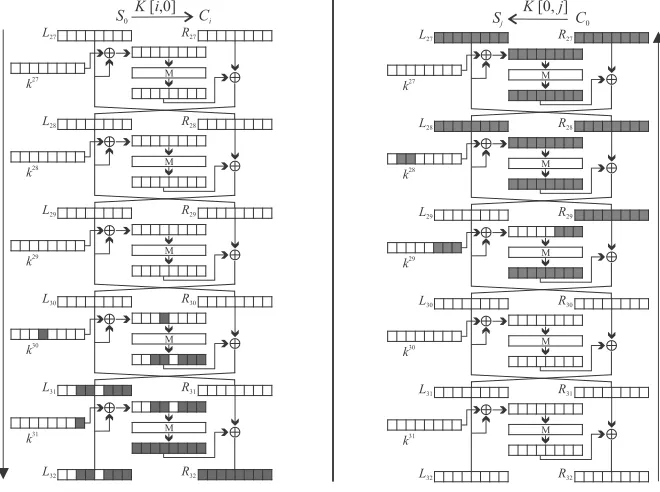
According to the key schedule of MIBS-80, the ’user key’ can be computed from each statei,0≤i≤31 . For mounting the biclique attack on MIBS-80, vector space of state28 is divided into 272 subsets each of them includes 28 values of state28. For this purpose, in each subset only bits in positions[44,43,42,41,11,10,9,8]are
varied and the rest remain unchanged.
An independent biclique of dimension 4, is placed in the five final rounds of cipher. For this purpose we consider two related-key differentials; the first one in the encryption path caused by 16 possible differences of four bits[44,43,42,41]of
state28 each of them represented by∆K[i] , 0≤i≤15 . The second related-key differential in the decryption path is also generated by 16 possible differences of four bits[11,10,9,8]of state
So they can be used to make an independent biclique, which covers 28 possible differences∆K[i,j] =∆K[i]⊕∆K[j], as it was expected.
L27 R27
27
k M
L28 R28
28
k M
L29 R29
29
k M
L30 R30
30
k M
L31 R31
31
k M
L32 R32
Ci S0
K [i,0]
L27 R27
27
k M
L28 R28
28
k M
L29 R29
29
k M
L30 R30
30
k M
L31 R31
31
k M
L32 R32
C0
Sj K [0, j]
Fig. 1 4-dimension Biclique for MIBS over rounds 28-32
3.1 Matching without Matrix
The Matching without matrix method presented in [14] could reduce the computa-tional complexity of the matching nibbles recomputation. According to the Feistel structure of MIBS cipher, we have
Li+1=M(S(Li⊕Ki))⊕Ri
, which M and S represent the operation of mix and substitution layer . Also, it could be easily derived that
Li+1=M(S(Ri+3⊕Ki+2))⊕Li+3
. So we have the equality
leads to the equality
S(Li⊕Ki)⊕M−1(Ri) =S(Ri+3⊕Ki+2)⊕M−1(Li+3)
.
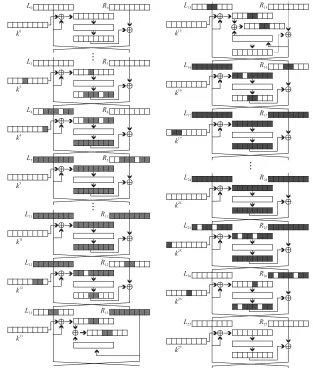
In our attack, we choose the L14 (left part of data register in round 15 that is the input of F-function in round 15) as matching point. So we can choose the data corresponding to the 4thand the 5thboxes in round 14 and their corresponding S-boxes in round 16 which mean the 4thand the 5thS-boxes in round 16 as matching variable
3.2 B. The attack procedure
Step 1: Constructing biclique. Set bits numbers[44,43,42,41,11,10,9,8]of state
28
to zero and choose a new value for the other 72 bits, assume it as K[0,0]and
con-struct a biclique as follows:
- choose C0=0(64)as ciphertext and decrypt it to round 28 using K[0,0]to obtain
S0, the data register in round 28 (i.e. L27and R27).
- Decrypt C0with keys K[0,0]⊕∆K[0,j], 1≤j≤15 , to obtain Sj(in the input
of round 28).
- Encrypt S0 with keys K[0,0]⊕∆K[i,0], 1≤i≤15 to obtain Ci. Also, get their
corresponding plaintexts Pi,0≤i≤15 .
Step 2: Matching. Encrypt Pi with K[i,0] to round 14 to obtain the matching
variable−v→i,0and store the process Pi K[i,0]
−→ −v→i,0. Then encrypt Pi with∆K[i,j], 1≤
j≤15 to obtain−v→i,j. Only compute those parts of these processes that differ from
the process Pi K[i,0]
−→ −v→i,0. Decrypt Sjwith∆K[0,j]to round 16 to obtain the matching variable←−v0,jand store the process
←−
v0,j K[i,0]
−→Sj. Then decrypt Sj with∆K[i,j],1≤
i≤15 to obtain←v−i,jand only compute those parts that differ from ←−
v0,j K[i,0] −→Sj. The procedure of matching is shown in Fig. 2 . A candidate key∆K[i,j]leads to
−→
vi,j= ←−
vi,j . While matching variables are 8 bits we anticipate 28−8=1 key candidate for each key set. Exhaustive search is needed to filter out wrong candidate keys.
Data complexity. According to Fig. 1, 3 nibbles of ciphertext is not effected by
key differences. So the data complexity will not exceed 264−12=252chosen plain-texts. Computational complexity. In step 1, 24×(19+6) +15=415 S-boxes, in step 2, 24×(34+24×(71)) =18720 S-boxes plus 24×(9+24×(80)) =20624 S-boxes are computed. In key schedule 24×(3+9) +52=244 S-boxes are com-puted. Also there is 1 candidate key per each key set in average. The MIBS-80 uses 320 S-boxes in a full round encryption, so the computational complexity is as fol-low:
Cf ull=272
39344+415+224
320 +1
Since we used all keys in this attack, its success probability is 100
L0 R0
0
k
L3 R3
3
k
L4 R4
4
k
L5 R5
5
k
L11 R11
11
k
L12 R12
12
k
L13 R13
13
k
L15 R15
15
k
L16 R16
16
k
L17 R17
17
k
L24 R24
24
k
L25 R25
25
k
L26 R26
26
k
L27 R27
27
k
..
.
..
.
..
.
Fig. 2 Matching over 27 rounds; left: Forward computation; right: Backward computation
4 DESCRIPTION OF PRESENT-80 CIPHER
PRESENT (PRESENT-80). So, if state0 is initialized by the 80-bit user key as
state0=k79k78. . .k0, then 31 round keys and the post whitening key K
i, 0≤i≤31 , are generated as follows:
K state
state state
state Sbox state
i i
i i
i
=
= >>>
=
[ : ]
[ : ]
(
79 16
79 76
19
ii i
i i i
state
state state state Round
) ||
||
[ : ]
[ : ] [ : ]
75 0
79 20 19 15
=
(
⊕ −−)
=
+
Counter state
state state
i
i i
|| [14 0: ];
1
5 KEY RECOVERY FOR PRESENT-80
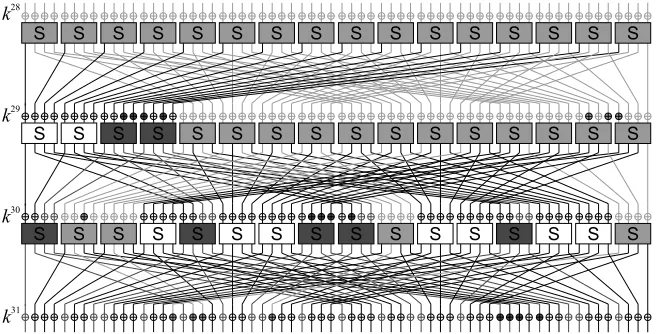
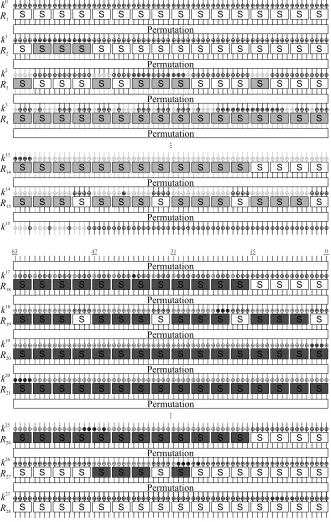
In case of PRESENT, the vector space of state28 is divided into 272subsets each of them includes 28values of state28. To construct an independent biclique of di-mension 4, we considered the four bits[8,7,6,4]of state
28 to cause 16 differences
∆K[i], 0≤i≤15 , and four bits[40,39,38,31]of state
28 to cause 16 differences
∆K[j], 0≤j≤15 , which according to Fig. 3 share no active S-boxes in differential trails in the last 3 rounds.
S S S S S S S S S S S S S S S S
29
k
30
k
31
k
28
k
S S S S S S S S S S S S S S S S
S S S S S S S S S S
S S S S S S
S S S S S S S S S S S S S S S S
29
k
0 15
31 47
63
S S S S S S S S S S
S S S S S S
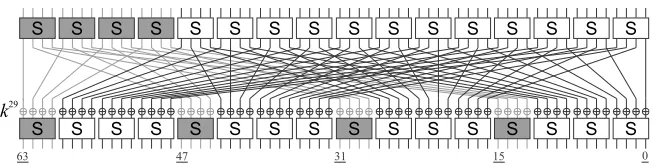
Fig. 4 Sieve over the steps SLPLAKSL for PRESENT.
5.1 Sieve-In-The-Middle
To cryptanalysis the PRESENT block cipher we use the Sieve-In-The-Middle at-tack [12] and we use the sieve introduced in [11]. In this sieve we choose 16 left most bits of input of a subcipher Es=SLPLAKSL for input, and bits in posi-tions (63,62,61,60,47,46,45,44,37,36,35,34,15,14,13,12) for the key and output, as is shown in Fig. 4. Prestored values of inputs and outputs of this superbox and their corresponding keys could be used as matching variables to filter out wrong keys.
5.2 The attack procedure
Step 1:Constructing biclique. Similar to step 1 of section 3.2 and by assuming C0= 0(64)and internal state S in round 28, we construct Sj,0≤j≤15 and Ci,0≤i≤15 and their corresponding Pi,0≤i≤15 .
Step 2: matching. We compute the value of −v→i,js which are 12 bits in posi-tions (63,62,61,59,58,57,55,54,53,51,50,49) of input of round 15 by encrypting
Pi with ∆K[i,j], 0≤ j ≤15 and values of
←−
vi,j which are 16 bits in positions (63,62,61,47,46,45,37, 36,35,15,14,13) of output of round 16 by decrypting each
Sjs using∆K[i,j],0≤i≤15.
So there are at most 24possible output values for←v−i,j. The possibility of a wrong key K[i,j]matches in all 12 known bits of
←−
vi,j is 24×2
−12=2−8. For a set of 28
keys, we will have 28−8=1 candidate key in average. We have to test each candidate key by exhaustive search to filter out wrong keys.
Data complexity. According to Fig. 3, 42 bits of ciphertext are not important.
So the data complexity will not exceed 264−42 =222 chosen plaintexts.
Com-putational complexity. In step 1, 24×(32+7) +9 =633 S-boxes, in step 2, 24×(39+24(193)) =50032 S-boxes plus 24×(32+24(136)) =35328 S-boxes are computed. 24×(3+4) +25=137 S-boxes are computed in key schedule. Also there is 1 candidate key per each key set in average. The PRESENT-80 uses 527 S-boxes in a full round encryption, so the computational complexity is as follow:
Cf ull=272
85360+633+137
527 +1
S S S S S S S S S S S S S S S
Permutation
S S S S S S S S S S S S S
Permutation Permutation
S S S S S S S S S S S S S S S S
Permutation
...
S S S S S S S S S S S S S S S
Permutation
S S S S S S S S S S S S S S S
Permutation 0 k R1 1 k R2 2 k R3 3 k R4 13 k R14 14 k R15 15 k S S S S S S
S S S S S S S S S S S S S S S
S S S S S S S S S S S S S S S
S S S S S S S S S S S S S S S
S S S S S S S S S S S S S S S
...
S S S S S S S S S S S S S S S S
S S S S S S S S S S S S S S
S S S S S S S S S S S S S S
17 k R18 18 k R19 19 k R20 20 k R21 25 k R26 26 k R27 27 k R28 S S S S S S S S 0 15 31 47 63
S S S S S S S S S S S S S S S S
Permutation Permutation Permutation Permutation Permutation Permutation Permutation
The success probability of this attack is 100
6 CONCLUSION AND DISCUSSION
In this paper we presented the first independent biclique attack on full-round MIBS-80 and a new independent biclique attack on PRESENT-MIBS-80. The attack on MIBS-MIBS-80 uses matching without matrix method with biclique cryptanalysis for the first time, and results in reduction of the ciphers security about 1 bit. The attack on PRESENT-80 uses advantages of Sieve-In-The-Middle attack and results data and computa-tional complexities better than other introduced attacks on full round PRESENT-80 so far.
References
[1] M. Izadi, B. Sadeghiyan, S. Sadeghian, and H. Khanooki. Mibs: A new lightweight block cipher. In J.A. Garay, A. Miyaji, and A. Otsuka, editors,
CANS 2009. LNCS, volume 5888, pages 334–348. Springer, Heidelberg, 2009.
[2] W. Wu and L. Zhang. Lblock: A lightweight block cipher. In J. Lopez and G Tsudik, editors, ACNS 2011. LNCS, volume 6517, pages 327–344. Springer, Heidelberg, 2011.
[3] A. Bogdanov, L.R. Knudsen, G. Leander, C. Paar, A. Poschmann, M.J.B. Rob-shaw, Y. Seurin, and C. Vikkelsoe. Present: An ultra-lightweight block cipher. In P. Paillier and I Verbauwhede, editors, CHES 2007. LNCS, volume 4727, pages 450–466. Springer, Heidelberg, 2007.
[4] A. Bogdanov, D. Khovratovich, and C. Rechberger. Biclique cryptanalysis of the full aes. In D.H. Lee, editor, ASIACRYPT 2011. LNCS, volume 7073, pages 344–371. Springer, Heidelberg, 2011. Full paper is availavle at Cryptology ePrint Archive, Report 2011/449, http://eprint.iacr.org/2011/449.
[5] Hong D., Koo B., and Kwon D. Biclique attack on the full hight. In H. Kim, editor, ICISC 2011. LNCS, volume 7259, pages 365–374. Springer, Berlin, (2012), 2011.
[6] M. Shakiba, M. Dakhilalian, and H. Mala. Cryptanalysis of mcrypton-64.
International Journal of Communication Systems, 2014. Published Online,
DOI: 10.1002/dac.2721. John Wiley & Sons, Ltd (2014).
[7] Abed F., Forler C., List E., Lucks S., and Wenzel J. Biclique cryptanalysis of present, led, and klein. Cryptology ePrint Archive: Report 2012/591. Revised
version 2013, 2012.
[8] S. Ahmadi, Z. Ahmadian, J. Mohajeri, and M.R. Aref. Low-data complexity biclique cryptanalysis of block ciphers with application to piccolo and hight.
IEEE Transactions on Information Forensics and Security, 9(10):1641–1652,
[9] Lee Ch. Biclique cryptanalysis of present-80 and present-128. The Journal of
Supercomputing, 2012. . Published online, DOI:
10.1007/s11227-014-1103-3,Springer US.
[10] A. Canteaut, M. Naya-Plasencia, and B. Vayssire. Sieve-in-the-middle: Improved mitm attacks (full version). Cryptology ePrint Archive, Report 2013/324 (2013), http://eprint.iacr.org/2013/324, 2013.
[11] A. Bay, J. Huang, and S. Vaudenay. Improved linear cryptanalysis of reduced-round mibs. In M. Yoshida and K. Mouri, editors, IWSEC 2014, LNCS, volume 8639, pages 204–220. Springer International Publishing Switzerland, 2014. [12] A. Bay, J. Nakahara Jr., and S. Vaudenay. Cryptanalysis of reduced-round
mibs block cipher. In S. H. Heng, R.N. Wright, and B. M. Goi, editors, CANS
2010. LNCS, volume 4727, pages 450–466. Springer, Heidelberg, 2010.
[13] X. Ma, L. Hu, S. Sun, K. Qiao, and J. Shan. Tighter security bound of mibs block cipher against differential attack. In M.H. et al Au, editor, NSS 2014,
LNCS, volume 8792, pages 518–525. Springer, 2014.