ISSN(Online): 2320-9801 ISSN (Print): 2320-9798
I
nternational
J
ournal of
I
nnovative
R
esearch in
C
omputer
and
C
ommunication
E
ngineering
(An ISO 3297: 2007 Certified Organization)
Vol. 3, Issue 4, April 2015
Systematic Approach of Knuckle System
Implementation for Human Identification
Prof.V.U.Kale1, Prof.R.A.Wakode2, Rinky L.Batra3
Professor, Dept. of Electronics & Telecommunication, PRMRIT & R, Badnera, Amravati, Maharashtra, India1
Assistant Professor, Dept. of Electronics & Telecommunication, PRMRIT & R, Badnera, Amravati, Maharashtra,
India2.
Teaching Assistant, Dept. of Electronics & Telecommunication, PRMRIT & R, Badnera, Amravati, Maharashtra,
India3
ABSTRACT: A new approach for personal authentication implementing finger back surface imaging is presented in this work. A distinctive biometric identifier surface texture pattern is produced by finger knuckle bending which is highly unique. There exists several hand features resulting from complex interaction among bones, muscles, skin and tissues (automatically these are unique from person to person) which remain relatively unexplored for their potential in biometric especially for forensic application. An independent biometric identifier patterns evolve from the major finger knuckle pattern (that are formed on the finger surface joining proximal phalanx and middle phalanx bones). A completely automated finger knuckle identification system is implemented using key steps such as region of interest segmentation, image normalization, enhancement, and robust matching. This proposed work on FKP for identifying the human with greater efficiency and higher security.
KEYWORDS: Biometrics, Finger knuckle biometrics, major finger knuckle, minor finger knuckle, knuckle segmentation, matching techniques.
I. INTRODUCTION
The automatic recognition of a person differentiated by characteristics or traits can be defined as Biometrics. Authentication and verification are two processes are used in biometric by which human recognition can be done. Authentication may be defined as, “Providing the right person with the right privileges the right access at the right time”. In a verification application, the biometric system requires input as password, token, or user name (or any combination of the three) from the user, to claim his identity.
The unique identification using fingerprint and two iris images is such difficult task to identify a billion populations. Finger knuckle biometrics is emerging as the full proof method of automated personal identification. Similar to fingerprint, these dermal patterns are formed at birth and they will not change throughout the life of a person. These line features are reliable and they can serve as unique personal identifier. Moreover, these line textures are clearly visible on the hand’s upper surface and they can be captured using relatively inexpensive low-resolution device. Accurate identification of finger knuckle patterns can be used in several applications including forensic and convert identification of suspects. There are forensic images in which the finger knuckle patterns are the only piece of evidence available to identify the suspects.There are some examples like kidnapping, sexual/physical assault where the cameras are unable to track the face/finger print of the suspect, in that case the finger knuckle pattern is the only or major source of information available to scientifically ascertain the identity of individuals.
1.1 Finger Knuckle Anatomy:
ISSN(Online): 2320-9801 ISSN (Print): 2320-9798
I
nternational
J
ournal of
I
nnovative
R
esearch in
C
omputer
and
C
ommunication
E
ngineering
(An ISO 3297: 2007 Certified Organization)
Vol. 3, Issue 4, April 2015
first join where the finger joins the hand. The proximal interphalangeal joint, or PIP joint is the second joint. The distal interphalangeal joint or DIP is the last joint of the finger as shown in fig.1.
In addition, the matching results from the finger knuckle matching can also be employed to improve the reliability and accuracy over conventionally used characteristics for biometric identification.
Fig.1: Finger Knuckle Anatomy 1.2 Need of FKP:
There are many different types of Biometrics, these are, IRIS Identification, Retinal Identification, Face Recognition, Speaker/Voice Recognition, Fingerprint, Hand/Finger Geometry, Signature verification, Keystroke Dynamics, and other esoteric biometrics. Hand-based biometrics, such as fingerprint and hand geometry, is the most prevalent biometric system in the marketplace.
However, fingerprint suffers from a major drawback, which is its proneness to anti-security threats, such as the reproduction of fingerprints left on surfaces to deceive the system. On the other hand, the hand geometry features are not descriptive enough for identification when the number of users grows larger. Problem related to other identifiers are as human voice and signature can be copied, duplicates are available so face recognition will not be foolproof identifier. Palm print and finger print can be simultaneous extracted from the palm side which can give better performance improvement, but size of finger knuckle is very small as compared to palm print and offers more attractive alternative as it requires less processing as compared to palm print. These biometric identifier systems can cause problem in children and adults.
Many concepts are proposed to explore an alternative way to utilize the major knuckle print for human identification. This biometric system implementation is contactless and peg-free and free from factors like tiredness etc. which causes problem in other biometric identifiers. There are some cases where only the knuckle portions are visible in forensic images. By considering this problem, we proposed to utilize the knuckle portions simultaneously for accurate and reliable biometric identification.
II. RELATED WORK
ISSN(Online): 2320-9801 ISSN (Print): 2320-9798
I
nternational
J
ournal of
I
nnovative
R
esearch in
C
omputer
and
C
ommunication
E
ngineering
(An ISO 3297: 2007 Certified Organization)
Vol. 3, Issue 4, April 2015
problem due to finger rings and black background. The disadvantage of this method is the speed of working is less as it uses scanner for imaging.[3]in this paper they work on a new approach to enhance the performance of finger vein identification System. The projected system at the same time acquires the finger vein and low resolution finger print images and combines these two evidences employing a novel score level combination strategy. . They developed and investigated two new score level combos, i.e., holistic and nonlinear fusion, and relatively assess them with additional well-liked score level fusion approaches to establish their effectiveness in their projected system. [5] in this paper they work on FKP recognition based on Band Limited Phase Only Correlation (BLPOC). POC is an imaging matching technique using the phase components in 2D DCT of given images. BLPOC is a modified version of POC which is dedicated to evaluate similarity between images, in order to handle the non-linear deformation of FKP images.[12]This paper details the development of a smart phone based online system to automatically identify a person by using their
finger knuckle image. This paper uses 1D log-Gabor filter to extract the finger knuckle templates which are matched
using Hamming distance. The limitation with this system is that for accurate finger knuckle detection, the acquire image background should be largely uniform as the background noise would influence the auto finger detect capability.
[13]Different edge detection methods, to detect edges in knuckle image, are employed in this system. Artificial neural network play a major role for classifying the knuckle surface.
III.PROPOSED SYSTEM
A. System Implication:
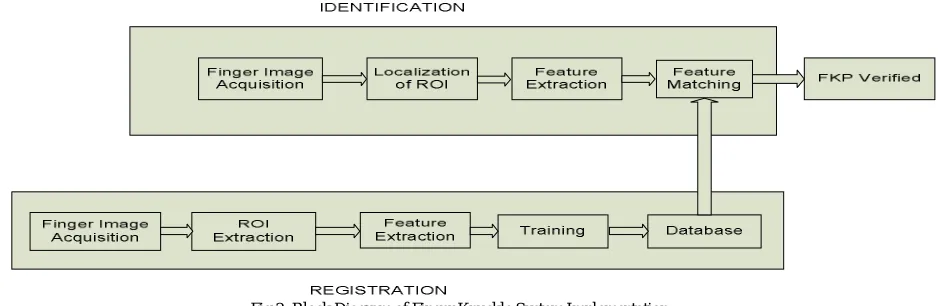
Fig 2: Block Diagram of Finger Knuckle System Implementation
ISSN(Online): 2320-9801 ISSN (Print): 2320-9798
I
nternational
J
ournal of
I
nnovative
R
esearch in
C
omputer
and
C
ommunication
E
ngineering
(An ISO 3297: 2007 Certified Organization)
Vol. 3, Issue 4, April 2015
B. Description of the Proposed Algorithm:
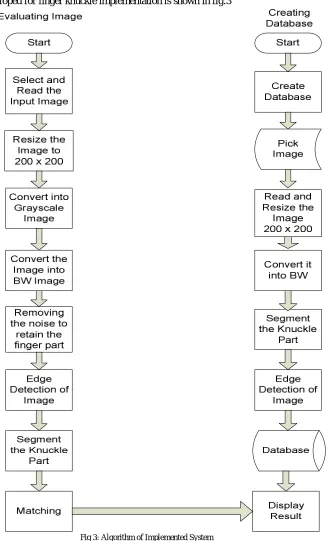
The algorithm developed for finger knuckle implementation is shown in fig.3
Fig 3: Algorithm of Implemented System
Creating Database:
ISSN(Online): 2320-9801 ISSN (Print): 2320-9798
I
nternational
J
ournal of
I
nnovative
R
esearch in
C
omputer
and
C
ommunication
E
ngineering
(An ISO 3297: 2007 Certified Organization)
Vol. 3, Issue 4, April 2015
2. Read and resize the image: Then the image is being read in MATLAB and resize to 200*200. To make the operations on image easy, the image compression/reduction is done. Another important advantage of image reduction is time for performing operation is less.
3. Convert it into BW Image: To convert the image into BW, thresholding process is done. Thresholding is a foreground separation technique. It uses histogram. A histogram is an image statistic while usually operates on an intensity image, i.e. pixels having a single value between 0-255. The range 0-255 is divided into bins, e.g. each intensity value may be given its own bin. Foreground is sufficiently bright/ dark compared to the background, i.e. the histogram has clear separation. The threshold value has been estimated using prior observations or can be computed automatically. This method is very sensitive to lightning conditions given these assumptions, set all pixels on the foreground side to 255(bright), and all other pixels to 0(dark).here the purpose of using thresholding is to separate the finger part from the non-uniform background.
4. Segment the knuckle part: The desired part/ region of interest is the major finger knuckle which is cropped from the original finger image.
5. Edge detection of Image: Edges are those places in an image that correspond to object boundaries. Edges are pixels where image brightness changes abruptly. An edge is a property attached to an individual pixel and is calculated from the image function behavior in a neighborhood of the pixel. If a gray-level value is similar to those around it, there is probably not an edge at that point. If a pixel’s has neighbors with widely varying gray levels, it may present an edge point. Edge detection is a type of image segmentation techniques which determines the presence of an edge or line in an image and outlines them in an appropriate way. The main purpose of edge detection is to simplify the image data in order to minimize the amount of data to be processed. Generally, an edge is defined as the boundary pixels that connect two separate regions with changing image amplitude attributes such as different constant luminance and tristimulus values in an each pixel element in an image. Amplitude, orientation, and location of a particular subarea in the image that is of interest are essentially important characteristics of possible edges. Based on these characteristics, the detector has to decide whether each of the examined pixels is an edge or not. By edge detection the features i.e. the lines or creases of the finger knuckle are extracted.
6. Database: The final segmented, feature extracted, and filtered finger knuckle image is saved with numbers and extension .jpg in dataset. The database of 31 images has been created.
Evaluating Images:
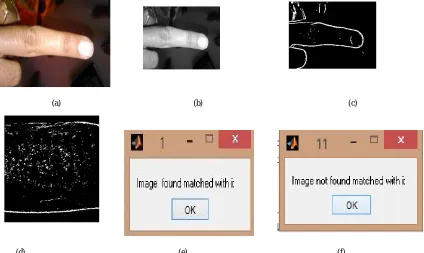
7. Select and Read the Image: The images taken by camera are stored in one of the drives present. While executing the algorithm the first step is to select the input from drive and read it. The selected input is shown in fig. 3.a
8. Resize the Image: Refer step 2
9. Convert the image to grayscale: This step is necessary for thresholding. Grayscale is related to brightness of a pixel. The value associated with a pixel representing its lightness from black to white. Usually defined as, a value from 0 to 255, with 0 being black and 255 being white. Thresholding is done using these pixel values from 0-255. The grayscale image of the input image is as shown in fig.3b
10. Convert grayscale image into BW image: Refer step 3.
11. Removing the noise to retain the finger part: The resulting image is cleaned (denoised) by automatically removing the isolated regions/ pixel (< 100 pixel) so that the longest object representing finger is only retained.
12. Edge Detection: Refer step 5. The edge detected image of input image is as shown in fig.3c
ISSN(Online): 2320-9801 ISSN (Print): 2320-9798
I
nternational
J
ournal of
I
nnovative
R
esearch in
C
omputer
and
C
ommunication
E
ngineering
(An ISO 3297: 2007 Certified Organization)
Vol. 3, Issue 4, April 2015
14. Matching: For matching, the features extracted of finger knuckle images are compared with the database images and results are displayed. Three matching algorithms are used in this work, these are:
a. Algorithm using Correlation: In this algorithm, pixel by pixel value comparison is done. The correlation/ similarity between the pixel values are calculated. The minimum value taken for matching is 0.86/ 86% (this value taken considering all conditions). The correlations basically found using mean.
b. Algorithm using mean square root values: In this algorithm, the sum of all pixels from image 1 is subtracted from the sum of all pixels from image2 and then normalized with image1 (Using the basic concept (x-y/x)). The resultant should be ideally zero for perfect matching; here the value taken is 0.3.
c. Algorithm using algebraic formula: The algorithm performs pixel by pixel operation based on expression (x-y/x+y), where x stands for input image and y stands for image in database with which the input image is to be compared. For perfect image the resultant should be zero, here resultant value is compared with 0.3.
15. Display Result: The input image whether matches with the image in dataset, the results are displayed by message in message box. If the input image is matched with image present in dataset it display with which numbered image the input image is matched using message box.
IV.SIMULATION RESULTS
The results of finger knuckle implementation system in image sequences implemented with MATLAB ,is shown in the following figures. The experimental results have attempted to ascertain uniqueness of finger knuckle pattern. The standard requires that any potential ‘biometric characteristic’ should be able to ensure ‘repeatable biometric features’ to be able to serve as useful biometric. In this dissertation, the study on finger knuckle biometric used images that are collected from individuals in two occasions, where the interval between two occasions is small about 7 months. Careful study of these finger knuckle patterns point towards stability in the curved creases and lines forming major knuckle patterns. Matching results are shown in fig in previous section. The verification accuracy between two images is around 86% (using correlation algorithm), error rate 5.67% (using mean square root algorithm), and error rate 5.67% (using algebraic formula). The error caused due to change in camera, background, different lightning conditions etc.
(a) (b) (c)
(d) (e) (f)
ISSN(Online): 2320-9801 ISSN (Print): 2320-9798
I
nternational
J
ournal of
I
nnovative
R
esearch in
C
omputer
and
C
ommunication
E
ngineering
(An ISO 3297: 2007 Certified Organization)
Vol. 3, Issue 4, April 2015
V. CONCLUSION AND FUTURE WORK
This work investigated the possibility of using major finger knuckle images for biometric identification. The
experimental results shown in previous section achieved a promising performance. This work ascertains stability of finger knuckle patterns around 7 months. From the results, the efficiency and security associated using the finger knuckle pattern is still high to be comparable from those modalities like finger print, iris recognition, palm print etc. Although much more has to be done, but presented results assures that the major finger knuckle images represents a biometrics security, especially for image forensics and surveillance applications.In this work, the finger knuckle biometric used images that are collected in two occasions. However the interval between these two sessions was quite small, and may not be adequate to serve as reliable biometric, especially for forensics application where the time interval for matching the suspects could be years. We can increase the number of images in dataset to check the efficiency of the system. Accurate segmentation of stable major knuckle regions is significantly important as it can control the achievable identification accuracy from the finger dorsal images. Therefore further efforts are required to develop accurate segmentation algorithms. In some humans the major knuckle is occluded by hairs that can create problem while extracting the features so more efforts are required to overcome these problems.
ACKNOWLEDGEMENT
I would like to express my sincere gratitude to Prof. V.U.Kale and Prof. Mrs. R.A.Wakode who guided and supported throughout the work.
REFERENCES
1. A. Kumar, “Importance of being unique from finger dorsal patterns: Exploring Minor Finger Knuckle Patterns in verifying Human Identities,” IEEE Trans. Inf. Forensics Security, vol.9, no.8, pp.98-110, Aug2014.
2. A. Kumar and C. Ravikanth, “Personal authentication using finger knuckle surface,” IEEE Trans. Inf. Forensics Security, vol. 4, no. 1, pp. 98– 110, Mar. 2009..
3. A. Kumar and Y. Zhou, “Human identification using finger images,” IEEE Trans. Image Process., vol. 21, no. 4, pp. 2228–2244, Apr. 2012.
4. L. Zhang, L. Zhang, D. Zhang, and H. Zhu, “Online finger-knuckle-print verification for personal authentication,” Pattern Recognit., vol. 43, no. 7, pp. 2560–2571, Jul. 2010.
5. S. Aoyama, K. Ito, and T. Aoki, “Finger-knuckle-print recognition using BLPOC-based local block matching,” in Proc. ACPR, Nov. 2011, pp. 525–529.
6. A. Kumar, “Can we use minor finger knuckle images to identify humans?” in Proc. IEEE 5th BTAS, Sep. 2012, pp. 55–60.
7. S. Aoyama, K. Ito, and T. Aoki, “Similarity measure using local phase features and its application to biometric recognition,” in Proc. CVPR, Jun. 2013, pp. 180–187.
8. Lin Zhang, Lei Zhang, David Zhang, “Finger-Knuckle-Print Verification Based on Band-Limited Phase-Only Correlation,” Biometrics Research center, Department of Computing, the Hong Kong polytechnic university[Online].
9. Mrs. S.S. Kulkarni, Dr. Mrs. R.D. Rout, “Secure Biometrics: Finger Knuckle Print” International Journal of Advanced Research in computer and communication Engineering vol. 1, Issue 10, Dec 2012.
10. Lin Zhanga, Lei Zhanga, David Zhanga and Hailong Zhub, Online:”Finger-Knuckle-Print Verification for Personal Authentication”, Biometrics Research Center, Department of Computing.
11. G .S.Badrinath, A.Nigam,Phalguni Gupta, “An Efficient Finger knuckle-print based Recognition System Fusing SIFT and SURF Matching Scores”.
12. KamYuen Cheng, Ajay Kumar, “Contactless Finger Knuckle Identification using Smartphones”, Hong Kong Polytechnic University,Hung
Hom, Kowloon, Hong Kong.
13. Kyi Pyar Zaw, Aung Soe Khaing, “ Implementation of Contactless Finger Knuckle Identification System”.