Named Entity Recognition and
Classification for Entity Extraction
J. Lavanya, S. Malarkodi, A. Mamta
U.G Students, Department of Information Technology, R.M.D Engineering College, R.S.M Nagar, Kavarapetti, Thiruvallur, India
ABSTRACT: Entity Extraction task of automatically extracting structured information from unstructured and/or semi-structured machine-readable documents.
Machine learning techniques used for annotating datasets and for training the algorithm to analyse the best algorithm by comparing with the various algorithms.
In most of the cases this activity concerns processing human language texts by means of natural language processing (NLP). Recent activities in multimedia document processing like automatic annotation and content extraction out of images/audio/video.
Recognition of known entity names (for people and organizations), place names, temporal expressions, and certain types of numerical expressions, by employing existing knowledge of the domain or information extracted from other sentences. Typically the recognition task involves assigning a unique identifier to the extracted entity.
KEYWORDS: entity, data annotation, machine learning, unstructured data, R programming.
I. INTRODUCTION
Text classification problems and algorithms have been around for a while now. The performance of a text classification model is heavily dependent upon the type of words used in the corpus and type of features created for classification.Text based data mining and information extraction systems that make use of of machine learning techniques required for annotating datasets for training the algorithm.This machine learning approach is to be done with R programming which is a powerful language for data analysis.
II. EASE OF USE
They are widely used for Email Spam Filtering by the likes of Google and Yahoo, for conducting sentiment analysis of twitter data and automatic news categorization in Google alerts and error analysis dentifier to the extracted entity.
III. EXISTING SYSTEM
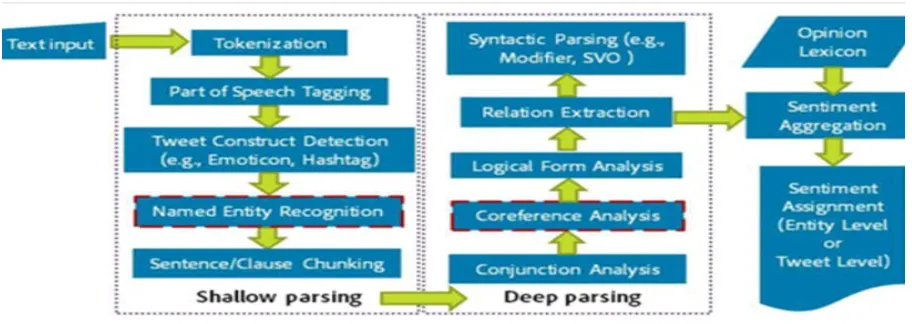
3. A. Named Entity Recognition in Tweets
People tweet more than 100 Million times daily, yielding a noisy, informal, but sometimes informative corpus of 140-character messages that mirrors the zeitgeist in an unprecedented manner
The performance of standard NLP tools is severely degraded on tweets. This paper addresses this issue by re-building the NLP pipeline beginning with part-of-speech tagging, through chunking, to named-entity recognition. Our novel T-NER system doubles F1 score compared with the Stanford T-NER system.
T-NER leverages the redundancy inherent in tweets to achieve this performance, using Labeled LDA to exploit Freebase dictionaries as a source of distant supervision
3. B. Proper Name Extraction from Non-Journalistic texts
This paper discusses the influence of the corpus on the automatic identification of proper names in texts. Techniques developed for the news-wire genre are generally not sufficient to deal with larger corpora containing texts that do not follow strict writing constraints (for example, e-mail messages, transcriptions of oral conversations, etc.).
After a brief review of the research performed on news texts, we present some of the problems involved in the analysis of two different corpora: e-mails and hand-transcribed telephone conversations. Once the sources of errors have been presented, we then describe an approach to adapt a proper name extraction system developed for newspaper texts to the analysis of e-mail messages.
IV. PROPOSED SYSTEM
4. A. Named Entity Recognition is an algorithm that extracts information from unstructured text data and classifies named entities in text into predefined categories such as the names of persons, organizations, locations, expressions of times, quantities, monetary values, percentages, etc.
Algorithm has two named entity recognition:
• Stanford CoreNLP
4. B. To select the correct algorithm for annotation
• True Negatives (TN): case was negative and predicted negative
• True Positives (TP): case was positive and predicted positive
• False Negatives (FN): case was positive but predicted negative
• False Positives (FP): case was negative but predicted positive Figure 2 gives the overall model performance
Fig.2 Performance metrics for entity extractors
V. METHODOLOGY
5. A Phase 1: Domain-specific data annotation for test processing. (Training data preparation for NLP algorithm)
The overwhelming amount of unstructured text data available today from traditional media sources as well as newer ones, like social media, provides a rich source of information if the data can be structured.
Named Entity Extraction forms a core subtask to build knowledge from semi-structured and unstructured text sources. Some of the first researchers working to extract information from unstructured texts recognized the importance of “units of information” like names (such as person, organization, and location names) and numeric expressions (such as time, date, money, and percent expressions).
5.B Phase 2: Machine learning approach for un-structured named entity recognition (NLP)
Entity Extraction task of automatically extracting structured information from unstructured and/or semi-structured machine-readable documents.
In most of the cases this activity concerns processing human language texts by means of natural language processing
• Tokenization
• Text corpus creation
• Annotating people and place
• Study of how to Training your system
• Train model with new entity annotation extract entity- name, location, money
• Using NLP algorithm
• Visualizing Your Results
VI. CONCLUSION
Machine learning model to simultaneously locate (named entity recognition) and identify (normalization) the entity type(s) of interest.
Based on the study of existing NLP algorithm , we have decide to solve the real world use case of log data analysis(unstructured data).
This algorithm trained with SQL error code, and it process and extract the same from few lines to thousands of lines.
REFERENCES
1. Elaine Marsh, Dennis Perzanowski, "MUC-7 Evaluation of IE Technology: Overview of Results", 29 April 1998
2. MUC-07 Proceedings (Named Entity Tasks)
3. Kripke, Saul (1971). M.K. Munitz, ed. Identity and Necessity. New York: New York University Press. pp. 135–64.
4. LaPorte, Joseph, Rigid Designators
5. Nadeau, David; Sekine, Satoshi (2007). A survey of named entity recognition
6. Carreras, Xavier; Màrquez, Lluís; Padró, Lluís (2003). A simple named entity extractor using AdaBoost. CoNLL.