ISSN(Online): 2320-9801
ISSN (Print): 2320-9798
I
nternational
J
ournal of
I
nnovative
R
esearch in
C
omputer
and
C
ommunication
E
ngineering
(An ISO 3297: 2007 Certified Organization)
Vol. 3, Issue 7, July 2015
Combining Cryptographic Primitives to Avert
Overcrowding Attacks in Wireless Networks
S.Rajasekaran 1, M.Geetha2
Research Scholar, Dept. of CS, Muthayammal College of Arts & Science, Rasipuram, Namakkal, India1
Associate Professor, Department of BCA, Muthayammal College of Arts & Science, Rasipuram, Namakkal, India2
ABSTRACT: The Open Nature of wireless medium leaves an intentional interference attack, typically referred to as jamming. This intentional interference with wireless transmission launch pad for mounting Denial-Of-Service attack on wireless networks. Typically, jamming has been addresses under an external threat model. However, adversaries with internal knowledge of protocol specification and network secrets can launch low-effort jamming attacks that are difficult to detect and counter. In this work we address the problem of jamming attacks and adversary is active for short period of time, selectively targeting the messages of high importance. We show that the selective jamming attacks can be launched by performing real-time packet classification at the physical layer. To mitigate these attacks, we develop three schemes that prevent real-time packet classification by combining cryptographic primitives with physical-layer attributes. They are Strong Hiding Commitment Schemes (SHCS), Cryptographic Puzzles Hiding Schemes (CPHS), All-Or-Nothing Transformation Hiding Schemes (AONTS-HS). Random key distribution methods are done along with three schemes to give more secured packet transmission in wireless networks.
KEYWORDS: Selective jamming, denial-of-service, wireless networks, packet classification.
I. INTRODUCTION
ISSN(Online): 2320-9801
ISSN (Print): 2320-9798
I
nternational
J
ournal of
I
nnovative
R
esearch in
C
omputer
and
C
ommunication
E
ngineering
(An ISO 3297: 2007 Certified Organization)
Vol. 3, Issue 7, July 2015
II. LITERATURE SURVEY
A Wireless networks are highly sensitive to denial of service attacks. The broadcast nature of wireless communication exposes the physical layer of the system to jamming. The traditional anti-jamming strategy has been extensively relying on spread spectrum technique. Very little work has been done from a system level to countermeasure jamming. In our previous work, we propose novel system architecture based on mechanism-hopping to increase the wireless network robustness against cross-layer jamming. Xu et al. study the effect and detection of jamming at MAC and PHY layer in wireless sensor networks. Resilience and identification of internal attackers is very difficult. To the best of our knowledge, we are the first to investigate the problem of control channel jamming by traitors. We use results from coding theory to assign keys in our approach that guarantees the resilience and identification of traitors. The rest of the paper is organized as follows.
In Section II, we present a scheme for a network with one traitor. In Section, we present a solution when there are up to traitors in the network. Section IV concludes the paper. We begin the paper in Section by providing an overview of our timing channel overlay. In Section, we show that detecting failed packet receptions is feasible, and thus our timing channel can be constructed. We next examine a simple single sender scenario in Section. Then we extend our timing channel to a multiple sender scenario, in Section. Finally, using our multi-sender timing channel, we explore the construction of an overlay link-layer in Section and discuss mechanisms that enhance the reliability of our over- lay. We wrap up the paper by discussing related work in Section, and provide concluding remarks.
(a)
Fig1. (a) Realization of a selective jamming attack. (b) A generic frame format for a wireless network.
III. EXISTINGSYSTEM
RF interference has traditionally been addressed at the physical layer through modulation approaches (such as spread spectrum) with sufficiently powerful anti-jam margins to make disruption difficult. Unfortunately, such physical layer approaches are typically representative of military wireless systems and, for reasons of cost, are generally not employed in commodity wireless platforms
Disadvantages of existing system:
Under this model, jamming strategies include the continuous or random transmission of high power interference signals. However, adopting an “always-on” strategy has several disadvantages.
First, the adversary has to expend a significant amount of energy to jam frequency bands of interest.
ISSN(Online): 2320-9801
ISSN (Print): 2320-9798
I
nternational
J
ournal of
I
nnovative
R
esearch in
C
omputer
and
C
ommunication
E
ngineering
(An ISO 3297: 2007 Certified Organization)
Vol. 3, Issue 7, July 2015
IV. PROPOSED SYSTEM
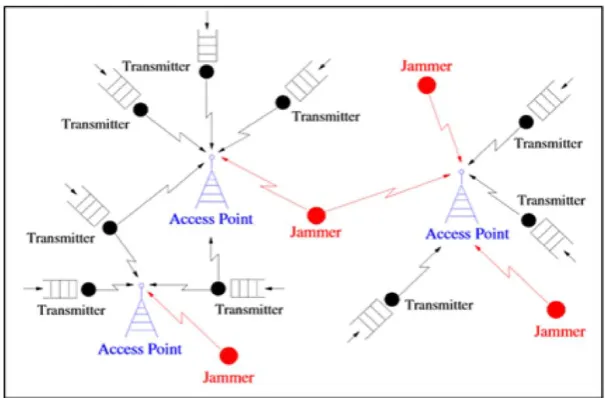
In this paper, we address the problem of jamming under an internal threat model. We consider a sophisticated adversary who is aware of network secrets and the implementation details of network protocols at any layer in the network stack. The adversary exploits his internal knowledge for launching selective jamming attacks in which specific messages of “high importance” are targeted. For example, a jammer can target route-request/route-reply messages at the routing layer to prevent route discovery, or target TCP acknowledgments in a TCP session to severely degrade the throughput of an end-to end flow.target TCP acknowledgments in a TCP session to severely degrade the throughput of an end-to end flow.
Fig 1.System Architecture
ADVANTAGES OF PROPOSED SYSTEM:
A random key distribution has been implemented to more secure the packet transmission in the wireless networks.
V. SYSTEM MODELS
NETWORK MODEL:
The network consists of a collection of nodes connected via wireless links. Nodes may communicate directly if they are within communication range, or indirectly via multiple hops. Nodes communicate both in unicast mode and broadcast mode. Communications can be either unencrypted or encrypted. Symmetric keys are shared among all intended receivers in broadcast communication. These keys are established using preshared pair wise keys or asymmetric cryptography.
COMMUNICATION MODEL:
ISSN(Online): 2320-9801
ISSN (Print): 2320-9798
I
nternational
J
ournal of
I
nnovative
R
esearch in
C
omputer
and
C
ommunication
E
ngineering
(An ISO 3297: 2007 Certified Organization)
Vol. 3, Issue 7, July 2015
RANDOM KEY DISTRIBUTION:
We propose the use of random key distribution to hide the location of control channels in time and/or frequency. We evaluate performance metrics of resilience to control channel jamming, identification of compromised users, and delay due to jamming as a function of the number of compromised users.
VI. ALGORITHM
BINARY ENCODING BASED KEY ASSIGNMENT (BBK)
In this section, we consider a system where there is only one traitor among N users. We present a 1-resilient scheme that requires 2 log N replications of control information. This scheme also allows us to uniquely identify the jammer. where f is a publically known cryptographic hashing function. User j knows the location of control signal at time slot f(k(i mod[log N]),i) by computing . The server computes a f table that stores the mapping of keys to channels at each timeslot. A legitimate user will succeed in accessing the control channel in a timeslot if no traitor jams that channel.
VII. COMPUTATION
Algorithm 1: BBK
Setup: N users, 1 traitor.
Result: distribution matrix K=(Kij)N*[log N]
Begin
F={k1,k2,….,k[log N],k1’,k2’,……,k’[log N]
,for j = 0 to N-1 do
j 0(j1,j2…………j[log N) // binary encoding
for i=1 to N-1do
Assign keys from row of to user
end _
Algorithm 2: Transmission for One Traitor Case
System Server For tiKmeslot i do
Channel-send1=f(k(i mod[log N]),i)
@ Channel-send 2= f(k(i mod[log N]),i)
_
Send control information on two channels i1
for timeslot i do
channel-listen= f(k(i mod[log N]),i) j listens to that channel
ISSN(Online): 2320-9801
ISSN (Print): 2320-9798
I
nternational
J
ournal of
I
nnovative
R
esearch in
C
omputer
and
C
ommunication
E
ngineering
(An ISO 3297: 2007 Certified Organization)
Vol. 3, Issue 7, July 2015
Fig 2.Detection time
VIII. RESULTANALYSIS
Figure the influence of our constant jammer on the communication between sensor nodes. The experiment focuses on the reception of messages. In the experiment, three nodes (a jammer, a receiver, and a sender) were placed in a straight line with a distance of 10 inches from each other. The receiver was placed in the middle. We carried out 100 trials with the receiver node being under attack and another 100 trials when the jammer is replaced with a normal node sending out messages continuously to simulate the signal collision that happens frequently in benign situations. In each trial, the sender sent out 100 packets while the receiver node kept track of the number of packets received. In the figure, the X-axis represents the index of the trial and the Y-axis represents the number of times the PDR was found to have that value in the corresponding trial. Note that PDR here is the packet reception rate for a receiver node. From the figure we can see that there is a clear distinction in the number of packets a node receives with and without jamming attacks.
Fig 4.Performance graph
IX. CONCLUSION AND FUTURE WORK
ISSN(Online): 2320-9801
ISSN (Print): 2320-9798
I
nternational
J
ournal of
I
nnovative
R
esearch in
C
omputer
and
C
ommunication
E
ngineering
(An ISO 3297: 2007 Certified Organization)
Vol. 3, Issue 7, July 2015
and quantified their computational and communication overhead. With these schemes a random key distribution has been implemented to more secure the packet transmission in the wireless networks.
REFERENCES
1. V. Hatzivassiloglou, J.L. Klavans, M.L. Holcombe, R. Barzilay, M. Kan, and K.R. McKeown, “SIMFINDER: A Flexible Clustering Tool for Summarization,” Proc. NAACL Workshop Automatic Summarization, pp. 41-49, 2001.
2. H. Zha, “Generic Summarization and Keyphrase Extraction Using Mutual Reinforcement Principle and Sentence Clustering,” Proc. 25th Ann. Int’l ACM SIGIR Conf. Research and Development in Information Retrieval, pp. 113-120, 2002.
3. D.R. Radev, H. Jing, M. Stys, and D. Tam, “Centroid-Based Summarization of Multiple Documents,” Information Processing and Management: An Int’l J., vol. 40, pp. 919-938, 2004.
4. R.M. Aliguyev, “A New Sentence Similarity Measure and Sentence Based Extractive Technique for Automatic Text Summarization,” Expert Systems with Applications, vol. 36, pp. 7764- 7772, 2009.
5. R. Kosala and H. Blockeel, “Web Mining Research: A Survey,” ACM SIGKDD Explorations Newsletter, vol. 2, no. 1, pp. 1-15, 2000. 6. G. Salton, Automatic Text Processing: The Transformation, Analysis, and Retrieval of Information by Computer. Addison-Wesley, 1989. 7. J.B MacQueen, “Some Methods for Classification and Analysis of Multivariate Observations,” Proc. Fifth Berkeley Symp. Math. Statistics
and Probability, pp. 281-297, 1967.
8. G. Ball and D. Hall, “A Clustering Technique for Summarizing Multivariate Data,” Behavioural Science, vol. 12, pp. 153-155, 1967. 9. J.C. Dunn, “A Fuzzy Relative of the ISODATA Process and its Use in Detecting Compact Well-Separated Clusters,” J.ybernetics, vol. 3,
no. 3, pp. 32-57, 1973.
10. J.C. Bezdek, Pattern Recognition with Fuzzy Objective Function Algorithms. Plenum Press, 1981. 11. R.O. Duda, P.E. Hart, and D.G. Stork, Pattern Classification, second ed. John Wiley & Sons, 2001.
12. U.V. Luxburg, “A Tutorial on Spectral Clustering,” Statistics and Computing, vol. 17, no. 4, pp. 395-416, 2007. 13. B.J. Frey and D. Dueck, “Clustering by Passing Messages between Data Points,” Science, vol. 315, pp. 972-976, 2007. 14. S. Theodoridis and K. Koutroumbas, Pattern Recognition, fourth ed. Academic Press, 2008.
15. C.D. Manning, P. Raghavan, and H. Schu¨ tze, Introduction to Information Retrieval. Cambridge Univ. Press, 2008.
BIOGRAPHY
S.RAJASEKARAN was born on 12-05-1991 in Tamilnadu, India. He received BCA in 2011 from Muthayammal college of Arts and Science, Rasipuram, Affiliated to Periyar University, Salem, Tamilnadu, India. He received MCA in 2013 fromMuthayammal College of Arts and Science, Rasipuram, Affiliated to Periyar University, Salem, Tamilnadu, India. He is Pursuing M.Phil (full time) degree from Muthayammal College of Arts & Science, in Periyar University Salem, Tamilnadu, India. His interested research area is Computer Networks.