Electronic Thesis and Dissertation Repository
2-16-2016 12:00 AM
Constant-Envelope Multi-Level Chirp Modulation: Properties,
Constant-Envelope Multi-Level Chirp Modulation: Properties,
Receivers, and Performance
Receivers, and Performance
Mohammad A. Alsharef The University of Western Ontario Supervisor
Dr. Rao, Raveendra
The University of Western Ontario
Graduate Program in Electrical and Computer Engineering
A thesis submitted in partial fulfillment of the requirements for the degree in Doctor of Philosophy
© Mohammad A. Alsharef 2016
Follow this and additional works at: https://ir.lib.uwo.ca/etd
Part of the Systems and Communications Commons
Recommended Citation Recommended Citation
Alsharef, Mohammad A., "Constant-Envelope Multi-Level Chirp Modulation: Properties, Receivers, and Performance" (2016). Electronic Thesis and Dissertation Repository. 3534.
https://ir.lib.uwo.ca/etd/3534
This Dissertation/Thesis is brought to you for free and open access by Scholarship@Western. It has been accepted for inclusion in Electronic Thesis and Dissertation Repository by an authorized administrator of
Constant envelope multi-level chirp modulations, with and without memory, are
con-sidered for data transmission. Specifically, three subclasses referred to as
symbol-by-symbol multi-level chirp modulation, full-response phase-continuous multi-level chirp
modulation and full-response multi-mode phase-continuous multi-level chirp
modula-tion are considered. These modulated signals are described, illustrated, and examined
for their properties. The ability of these signals to operate over AWGN is assessed
using upper bounds on minimum Euclidean distance as a function of modulation
pa-rameters. Coherent and non-coherent detection of multi-level chirp signals in AWGN
are considered and optimum and sub-optimum receiver structures are derived. The
performance of these receivers have been assessed using upper and lower bounds as
a function of SNR, modulation parameters, modulation levels, decision symbol
lo-cations, and observation length of receiver. Optimum multi-level chirp modulations
have been determined using numerical minimization of symbol error rate.
Closed-form expressions are derived for estimating the perClosed-formance of multi-level chirp
sig-nals over several practical fading channels. Finally, spectral characteristics of digital
chirp signals are presented and illustrated.
All praise be to Allah Almighty, the most merciful and most compassionate, for
bestowing upon me His countless bounties and for providing me the opportunity to
carry out my PhD degree. Without his guidance and blessings, nothing is possible.
I would like to express my sincerest gratitude and deep appreciation to my
su-pervisor Dr.Raveendra K. Rao who has supported me throughout my PhD study at
the University of Western Ontario. His extensive knowledge in the field of
commu-nications, encouragement, guidance, and constructive criticism have been valuable
resources. Also, I would like to thank the examination committee members for their
valuable remarks and considerable recommendations.
I am extremely grateful to my parents and my family for their support and
encouragement over the years. The role of my parents in my upbringing and their
prayers have played a major role in what I am today. I wish that I can compensate
them for the past years.
I can never thank enough all my friends and my colleagues with whom I have the
pleasure to work with in the same research lab for the unforgettable times we spent
together. I have benefited from discussing diverse subjects related to the research
and life in general.
Last but not least, I would like to thank Taif University for supporting me in
completing my PhD study. Also, I thank the Ministry of Education in Saudi Arabia
and the Saudi Cultural Bureau in Canada for their support.
Abstract . . . ii
Acknowledgements . . . iii
List of tables . . . vii
List of figures . . . ix
Acronyms . . . xiii
1 Introduction . . . 1
1.1 Introduction to Communications . . . 1
1.2 Wireless Communications . . . 1
1.3 Digital Communication System . . . 2
1.4 Simplified Model of Digital Communication System . . . 4
1.5 Literature Survey and Motivation . . . 7
1.6 Thesis Objectives . . . 11
1.7 Thesis Organization . . . 12
2 Memoryless Constant-Envelope Multi-Level Chirp Modulation: Co-herent and Non-CoCo-herent Detection . . . 14
2.1 Introduction . . . 14
2.2 Constant Envelope Multi-Level Chirp Modulated Signals . . . 15
2.2.1 2-level (2-ary) or Binary Chirp Modulation . . . 17
2.2.2 4-level (4-ary) or Quaternary Chirp Modulated Signals . . . . 18
2.3 Minimum Euclidean Distance Properties . . . 19
2.4 Coherent Detection and Performance of Multi-level (M-ary) Chirp Sig-nals . . . 27
2.4.1 Coherent Detection . . . 27
2.4.2 Error Rate Performance . . . 31
2.4.3 Numerical Results . . . 32
2.5 Non-Coherent Detection and Performance of Multi-level (M-ary) Chirp Signals . . . 41
2.5.1 Non-Coherent Detection . . . 41
2.5.2 Error Rate Analysis . . . 43
2.5.3 Numerical Results . . . 46
Signals and Distance Properties . . . 54
3.1 Introduction . . . 54
3.2 M-level Continuous Phase Chirp Modulation (M-CPCM) Signals . . 55
3.3 Minimum Euclidean Distance Properties . . . 59
3.4 Bounds on The Minimum Euclidean Distance . . . 64
3.5 Numerical Results and Discussion . . . 65
3.6 Conclusions . . . 76
4 Detection and Performance of M-CPCM in AWGN Channel . . . 77
4.1 Introduction . . . 77
4.2 Coherent Detection of M-CPCM . . . 77
4.2.1 Optimum Coherent Receiver . . . 78
4.2.2 Symbol Error Probability Analysis . . . 81
4.2.3 Numerical Results and Discussion . . . 88
4.3 Non-coherent Detection of M-CPCM in AWGN . . . 98
4.3.1 Optimum Non-coherent Receiver . . . 98
4.3.2 Symbol Error Probability Analysis . . . 100
4.3.3 Numerical Results and Discussion . . . 105
4.4 Conclusions . . . 111
5 Multi-Mode Multi-Level Continuous Phase Chirp Modulation: Co-herent Detection . . . 113
5.1 Introduction . . . 113
5.2 Multi-modeM-CPCM Signals . . . 113
5.3 Optimum Coherent Receiver and Performance Analysis . . . 117
5.4 Numerical Results and Discussion . . . 120
5.5 Conclusions . . . 127
6 Memoryless Multi-level Chirp Modulation over Fading Channels . 128 6.1 Introduction . . . 128
6.2 Fading Channel Models . . . 128
6.2.1 Rayleigh Fading Channel . . . 129
6.2.2 Nakagami-m Fading Channel . . . 129
6.2.3 Generalized-K Fading and Shadowing Channel . . . 130
6.3 Average Symbol Error Rate Expressions for Memoryless M-CPCM . 131 6.3.1 Rayleigh Fading Channel . . . 131
6.3.2 Performance analysis over Nakagami-m Fading Channel . . . . 132
6.3.3 Generalized-K Fading and Shadowing Channel . . . 133
6.4 Numerical Results and Discussion . . . 133
6.5 Conclusions . . . 140
7 Spectral Characteristics of M-CPCM Signals . . . 142
7.1 Introduction . . . 142
7.2 Spectral Calculation Methods . . . 142
7.3 Spectra of M-CPCM . . . 143
7.4 Spectra of Mono-modeM-CPCM Signals . . . 146
7.5 Conclusions . . . 150
8 Conclusion . . . 151
8.1 Introduction . . . 151
8.2 Summary of Contributions . . . 151
8.3 Suggestions for Future Work . . . 154
References . . . 155
Appendices A Squared Euclidean Distance for M-Level Chirp Signals . . . 160
B Complex Correlation for M-Level Chirp Signals . . . 164
Curriculum Vitae . . . 166
2.1 (q, w) maximizing d2min for M-level chirp modulated signals . . . 21
2.2 d2min forM-level chirp modulated signals, M-PSK, andM-FSK
mod-ulations . . . 22
2.3 Optimum modulation parameters (qopt, wopt) for M =2,4,8 and
16-chirp systems . . . 35
2.4 Bit Error Rate Comparison of Optimum 2-level chirp, BPSK and
bi-nary FSK . . . 36
2.5 Symbol Error Rate Performance of Optimum 4-level chirp, QPSK and
4-FSK . . . 39
2.6 Symbol Error Rate Performance of Optimum 8-level chirp, 8-PSK and
8-FSK . . . 39
2.7 Symbol Error Rate Performance of Optimum 16-level chirp, 16-PSK
and 16-FSK . . . 40
2.8 Symbol Error Rate Performance of Optimum Non-coherent 2-level chirp,
2-DPSK and 2-FSK . . . 50
2.9 Symbol Error Rate Performance of Optimum Non-coherent 4-level chirp,
4-DPSK and 4-FSK . . . 51
2.10 Symbol Error Rate Performance of Optimum Non-coherent 8-level chirp,
8-DPSK and 8-FSK . . . 52
3.1 (q, w) maximizing d2B,M for M-CPCM . . . 66
3.2 h maximizing d2B,M for M-CPFSK . . . 68
3.3 Optimum modulation parameters maximizingd2n and Gn for 2-CPCM
and 2-CPFSK . . . 70
3.4 Optimum modulation parameters maximizingd2n and Gn for 4-CPCM
and 4-CPFSK . . . 70
3.5 Optimum modulation parameters maximizingd2n and Gn for 8-CPCM
and 8-CPFSK . . . 71
4.1 Optimum (q, w) 2-CPCM systems as a function of observation intervals
n and SNR (Eb/N0) . . . 88
4.2 Optimum (q, w) 4-CPCM systems as a function of observation intervals
n and SNR (Eb/N0) . . . 89
4.3 Optimum (q, w) 8-CPCM systems as a function of observation intervals
n and SNR (Eb/N0) . . . 89
4.4 Error probabilities of 2-CPCM, BPSK, and 2-FSK atEb/N0=6, 8, and
10 dB . . . 91
4.5 Probability of error comparison of 2-CPCM and 2-CPFSK . . . 92
4.6 Error probabilities of 4-CPCM and QPSK at Eb/N0=6, 8, and 10 dB 94 4.7 Probability of error comparison of 4-CPCM and 4-CPFSK . . . 95
4.8 Error probabilities of 8-CPCM and 8-PSK . . . 96
4.9 Probability of error comparison of 8-CPCM and 8-CPFSK . . . 97
4.10 Optimum (q, w) sets for non-coherent 2-CPCM system as a function of n and . . . 106
4.11 Optimum (q, w) sets for non-coherent 4-CPCM system as a function of n and . . . 107
4.12 Optimum (q, w) sets for non-coherent 8-CPCM system as a function of n and . . . 107
4.13 Error probability of 2-CPCM and 2-CPFSK at SNR= 6, 8, and 10 dB 109 4.14 Error probabilities for non-coherent 4-CPCM and 4-CPFSK at Eb N0 = 6,8, and 10 dB . . . 111
5.1 Optimum dual-mode 2-CPCM modulation parameter sets . . . 121
5.2 Optimum dual-mode 4-CPCM modulation parameter sets . . . 121
5.3 Optimum dual-mode 8-CPCM modulation parameter sets . . . 122
5.4 Error probabilities of dual-mode and mono-mode 2-CPCM systems at Eb N0= 6, 8, 10 dB . . . 123
5.5 Error probabilities of dual-mode and mono-mode 4-CPCM at Eb N0= 6, 8, 10 dB . . . 125
5.6 Error probabilities of dual-mode and mono-mode 8-CPCM at Eb N0= 6, 8, 10 dB . . . 127
1.1 Model of point-to-point digital communication system . . . 3
1.2 Partial Block Diagram of DCS . . . 5
2.1 Schematic block diagram of M-level (M = 2k) chirp modulator . . . . 16
2.2 Phase (a) and frequency (b) as a function of time for arbitrary binary chirp signal . . . 17
2.3 Up-chirp (a) and down-chirp (b) Signals . . . 18
2.4 4-level chirp modulated signals as a function of time . . . 19
2.5 Contour plot of d2min for 2-level chirp signals . . . 23
2.6 Surface plot of d2min for 2-level chirp signals . . . 23
2.7 Surface plot of d2min for 2-level chirp signals . . . 23
2.8 Contour plot of d2min for 4-level chirp signals . . . 24
2.9 Surface plot of d2min for 4-level chirp signals . . . 24
2.10 Surface plot of d2min for 4-level chirp signals . . . 24
2.11 Contour plot of d2min for 8-level chirp signals . . . 25
2.12 Surface plot of d2min for 8-level chirp signals . . . 25
2.13 Surface plot of d2min for 8-level chirp signals . . . 25
2.14 Contour plot of d2min for 16-level chirp signals . . . 26
2.15 Surface plot of d2min for 16-level chirp signals . . . 26
2.16 Surface plot of d2min for 16-level chirp signals . . . 26
2.17 Optimum coherent receiver for M-level chirp modulation . . . 30
2.18 log10(P2(✏)/min{P2(✏)}) contour plot for coherent 2-level chirp re-ceiver at 6 dB SNR . . . 33
2.19 log10(P4(✏)/min{P4(✏)}) contour plot for coherent 4-level chirp re-ceiver at 6 dB SNR . . . 34
2.20 log10(P8(✏)/min{P8(✏)}) contour plot for coherent 8-level chirp re-ceiver at 6 dB SNR . . . 34
2.21 log10(P16(✏)/min{P16(✏)}) contour plot for coherent 16-level chirp re-ceiver at 6 dB SNR . . . 35
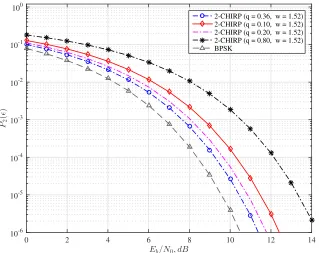
2.22 Error probability performance of optimum coherent binary chirp sys-tem (q= 0.36, w = 1.52) . . . 36
2.23 Error probability performance of coherent binary chirp system as a function ofw, for a fixed value of q= 0.36 . . . 37
2.24 Error probability performance of coherent binary chirp system as a function ofq, for a fixed value of w= 1.52 . . . 38
2.25 Error probability performance of coherent 4-level optimum chirp
sys-tem (q= 0.4, w = 2.4) . . . 38
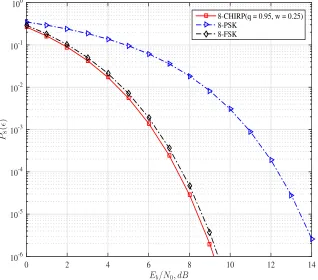
2.26 Error probability performance of coherent 8-level optimum chirp sys-tem (q= 0.95, w = 0.25) . . . 40
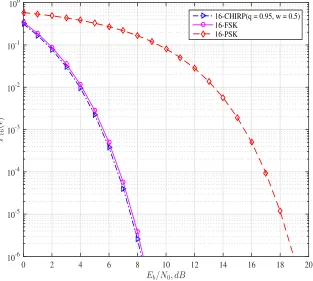
2.27 Error probability performance of coherent 16-level optimum chirp sys-tem (q= 0.95, w = 0.5) . . . 41
2.28 Optimum non-coherent receiver for M-level chirp signals . . . 43
2.29 log10(P2(✏)/min{P2(✏)}) contour plot for non-coherent 2-level chirp receiver at 6 dB SNR . . . 46
2.30 log10(P4(✏)/min{P4(✏)}) contour plot for non-coherent 4-level chirp receiver at 6 dB SNR . . . 47
2.31 log10(P8(✏)/min{P8(✏)}) contour plot for non-coherent 8-level chirp receiver at 6 dB SNR . . . 47
2.32 Error probability performance of optimum (q = 2.00, w = 0.05) non-coherent binary chirp system . . . 48
2.33 Error probability performance of non-coherent binary chirp system as a function ofw, for a fixed value of q = 2.00 . . . 49
2.34 Error probability performance of non-coherent binary chirp system as a function ofq, for a fixed value of w= 0.05 . . . 49
2.35 Error probability performance of (q = 2.00, w = 0.10) non-coherent 4-ary chirp system . . . 50
2.36 Error probability performance of (q = 3.00, w = 0.10) non-coherent 8-ary chirp system . . . 51
3.1 Phase tree for 2-CPCM signal . . . 57
3.2 Phase tree for 4-CPCM signal . . . 58
3.3 Phase trellis for 2-CPCM signal withq = 12 and arbitrary w . . . 59
3.4 Phase tree for 2-CPCM signal with merging point . . . 65
3.5 Phase tree for 4-CPCM signal with merging points . . . 66
3.6 Surface plot of d2B,2 as a function of q and wfor 2-CPCM . . . 67
3.7 Surface plot of d2B,4 as a function of q and wfor 4-CPCM . . . 67
3.8 Surface plot of d2B,8 as a function of q and wfor 8-CPCM . . . 68
3.9 d2B forM-CPFSK for (M=2, 4, 8) . . . 69
3.10 Surface plots of d2n as a function of q and w for (a) n = 2, (b) n = 3, and (c)n = 4 for 2-CPCM . . . 71
3.11 Surface plots of d2n as a function of q and w for (a) n = 2, (b) n = 3, and (c)n = 4 for 4-CPCM . . . 72
3.12 Surface plots of d2n as a function of q and w for (a) n = 2, (b) n = 3, and (c)n = 4 for 8-CPCM . . . 73
3.13 Squared Euclidean distance d22 as a function of w for 2-CPCM with (q= 0.2,0.3,0.4,0.5,0.8) . . . 74
(w= 1.6,1.9,1,2.2,3) . . . 74
3.15 Contour plots ofGn(q, w) for 2-CPCM signals for (a)n = 2, (b)n = 3,
and (c)n = 4 . . . 75
4.1 Optimum coherent M-CPCM receiver . . . 82
4.2 High-SNR sub-optimum coherentM-CPCM receiver . . . 84
4.3 Error probability performance of optimum 2-CPCM systems for n =
2,3,4 and 5 . . . 90
4.4 Error probability performance of optimum 2-CPCM systems as a
func-tion n at Eb
N0= 6, 8, 10 and 12 dB . . . 91
4.5 Error probability performance of 2-CPFSK (h= 0.715) for n = 2,3,4
and 5 . . . 92
4.6 Symbol error probability performance of optimum 4-CPCM systems
for n= 2,3,4 and 5 . . . 93
4.7 Error probability performance of optimum 4-CPCM systems as a
func-tion of n at NEb
0= 6, 8, 10, and 12 dB . . . 94
4.8 Error probability performance of 4-CPFSK for n= 2,3,4 and 5 . . . 95
4.9 Symbol error probability performance of 8-CPCM forn = 2 and 3 and
8-PSK . . . 96
4.10 Symbol error probability performance of 8-CPFSK for n= 2 and 3 . . 97
4.11 Optimum non-coherent M-CPCM receiver . . . 101
4.12 Sub-ptimum non-coherent M-CPCM receiver . . . 103
4.13 Error probability performance of non-coherent 2-CPCM for n = 3 and 5108
4.14 Error probability performance of non-coherent 2-CPFSK forn = 3 and
5) . . . 109 4.15 Error probability performance of non-coherent 4-CPCM systems for
n= 3 and 5 . . . 110
4.16 Error probability performance of non-coherent 4-CPFSK h= 0.715 for
n= 3 and 5 . . . 111
5.1 Phase (a) and instantaneous frequency (b) for a dual-mode 2-CPCM
system . . . 115
5.2 Phase tree for dual-mode 2-CPCM system . . . 116
5.3 Optimum coherent multi-mode M-CPCM receiver . . . 118
5.4 Error probability performance of dual-mode 2-CPCM for n = 2,3,4
and 5 and BPSK . . . 122
5.5 Error probability performance of dual-mode and mono-mode 2-CPCM
for n= 4 and 5 . . . 123
5.6 Error probability performance of dual-mode 4-CPCM forn = 2,3, and 4124
5.7 Error probability performance of dual-mode and mono-mode 4-CPCM
for n= 3 and 4 . . . 125
5.8 Error probability performance of dual-mode 8-CPCM for n = 2 and 3 126
5.9 Error probability performance of dual-mode and mono-mode 8-CPCM
for (n = 2 and 3) . . . 126
6.1 Average symbol error rate performance of optimum 2-level chirp system (q= 0.36, w = 1.52) over Rayleigh fading channel . . . 134
6.2 Average symbol error rate performance of 2-level chirp system over Rayleigh fading channel as a function ofw= 1.52(optimum), 1, 4, 7, for a fixed value of q= 0.36 . . . 134
6.3 Average symbol error rate performance of 2-level chirp system over Rayleigh fading channel as a function ofq=0.36 (optimum), 0.1, 0.2, 0.9, for a fixed value ofw= 1.52 . . . 135
6.4 Average symbol error rate performance of 4-level chirp system (q = 0.40, w = 2.40) over Rayleigh fading channel . . . 136
6.5 Average symbol error rate performance of 8-level chirp system (q = 0.95, w = 0.25) over Rayleigh fading channel . . . 136
6.6 Average symbol error rate performance of 2-level chirp system (q = 0.36, w = 1.52) over Nakagami-m fading channel as a function of m . 137 6.7 Average symbol error rate performance of 4-level chirp system (q = 0.40, w = 2.40) over Nakagami-m fading channel as a function of m . 137 6.8 Average symbol error rate performance of 8-level chirp system (q = 0.95, w = 0.25) over Nakagami-m fading channel as a function of m . 138 6.9 Average symbol error rate performance of 2-level chirp system (q = 0.36, w = 1.52) over KG fading channel as a function of c and m . . . 139
6.10 Average symbol error rate performance of 4-level chirp system (q = 0.40, w = 2.40) over KG fading channel as a function of c and m . . . 139
6.11 Average symbol error rate performance of 8-level chirp system (q = 0.95, w = 0.25) over KG fading channel as a function of c and m . . . 140
7.1 Power spectra of 2-CPCM (q= 0.5, w = 0.0) and MSK . . . 145
7.2 Power spectra of 2-CPCM system . . . 147
7.3 Power spectra of 2-CPCM system . . . 147
7.4 Power spectra of 2-CPCM system for a fixed value of w . . . 148
7.5 Power spectra of 4-CPCM system . . . 148
7.6 Power spectra of 4-CPCM system . . . 149
7.7 Power spectra of 8-CPCM system . . . 149
AWGN Additive White Gaussian Noise
BER Bit Error Rate
BOK Binary Orthogonal Keying
BPSK Binary Phase Shift Keying
CDMA Code Division Multiple Access
CPC Continuous Phase Chirp
CPFSK Continuous Phase Frequency Shift Keying
CPM Continuous Phase Modulation
CSS Chirp Spread Spectrum
DCS Digital Communication Systems
DS-BPSK Direct-Sequence Binary Phase Shift Keying
EM Electromagnetic Interference
FDMA Frequency Division Multiple Access
FH Frequency Hopping
FM Frequency Modulation
FSK Frequency Shift Keying
HF High Frequency
ISM Industrial Scientific and Medical
LFM Linear Frequency Modulation
LPI Low Probability of Intercept
MAN Metropolitan Area Network
MCM Matched Chirp Modulation
MCPCM M-level Continuous Phase Chirp Modulation
MFSK M-ary Frequency Shift Keying
MPSK M-ary Phase Shift Keying
MSK Minimum Shift Keying
OFDM Orthogonal Frequency Divivision Mlutplixing
PAM Pulse Amplitude Modulation
PAN Personal Area Network
PDF Probability Density Function
PSD Power Spectral Density
QPSK Quadrature Phase Shift Keying
RF Radio Frequency
SAW Surface Wave Acoustic
SER Symbol Error Rate
SNR Signal to Noise Ratio
TDMA Time Division Multiple Access
WLAN Wireless Local Area Network
Chapter 1
Introduction
1.1
Introduction to Communications
Communication has been one of the most important needs of humans throughout
recorded history. It is essential in forming social unions, in educating the young,
and in expressing a myriad of emotions and needs. Good communication is central to a civilized society. The host of communication disciplines in engineering have
the central purpose of providing technological aids to human communication. The
communication technology as one views it today became important with telegraphy, then telephony, then video, then computer communication and today the amazing
mixture of all these in inexpensive, small portable devices. Communication enters
daily lives in so many di↵erent ways. With telephones in hands, radios and televisions
in living rooms, and with desktop, laptop, and tablet computers providing access to
the Internet in offices and homes, one is able to communicate to every corner of the
globe. Communication provides information to ships on high seas, aircraft in flight,
and rockets and satellite in space. Indeed, the list of applications involving the use of communication in one way or another is almost endless.
1.2
Wireless Communications
In 1897, Guglielmo Marconi invented the first apparatus for transmitting radio waves
over longer distance which was used to enable communication with ships in the
En-glish channel [1]. Since then, wireless communications has become one of the most rapidly growing industries in the world, and its products are now exerting an impact
in our daily lives. Wireless communications today cover a very wide array of
with more than $ 1 trillion in annual revenues for service and equipment. The largest
and most noticeable part of telecommunications business is telephony. The principal
wireless component of telephony is mobile telephony. The worldwide growth rate in
cellular telephony is very aggressive, and reports suggest that the number of cellular telephony subscriptions worldwide has now surpassed the number of wired telephony
subscriptions. However, cellular telephony is only one of a very wide array of wireless
technologies that are being developed very rapidly at the present time. Among other technologies are wireless Internet and other Personal Area Network (PAN) systems,
Wireless Local Area Network (WLAN) systems, wireless Metropolitan Area Network
(MAN) systems, and a variety of satellite systems. These technologies are supported by a number of transmission and channel assignment technologies, including Time
Di-vision Multiple Access (TDMA), Code DiDi-vision Multiple Access (CDMA) and other
spread-spectrum systems, Orthogonal Frequency Division Multiplexing (OFDM) and other multi-carrier systems, and high-rate single-carrier systems. All these modern
technologies use the basic principles that underlie the design and analysis of Digital
Communication System (DCS) [2].
1.3
Digital Communication System
Modern society depends on electronic communication for most of its functioning.
Among the many possible ways of communicating, the class of techniques refereed to
as digital communications has become predominant in the 21st century, and indica-tions are that this trend will continue. Digital communication is simply the practice
of exchanging information by the use of finite sets of signals. Thus, most modern
communication systems now contain digital interface between source and channel (such as cable, twisted pair wire, optical fibers or electromagnetic radiation through
space). Digital interfaces are practical due to the availability of cheap, reliable, and
miniaturized digital hardware. Also, the digital interface simplifies implementation and understanding, since source coding/decoding can be done independently of the
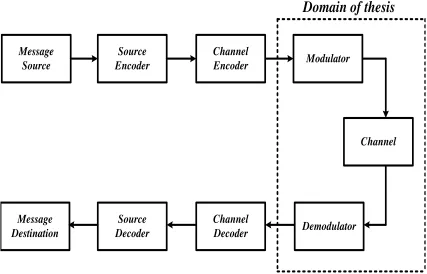
in Fig.1.1.
Message Source
Channel Modulator
Channel Encoder Source
Encoder
Demodulator Channel
Decoder Source
Decoder Message
Destination
Domain of thesis
Figure 1.1: Model of point-to-point digital communication system
The message source generates messages which are to be transmitted to the receiver. In a digital communication system, the messages produced by the source
are usually converted into a sequence of binary digits. The binary digits are almost
universally used for digital communication and storage as well. The purpose of the
source encoder is to provide an efficient representation of the source output that
re-sults in little or no redundancy [3]. The sequence of binary digits from the source
encoder is fed to the channel encoder which introduces in a controlled manner some redundancy to combat the noise and interferences over the channel. The sequence of
binary digits from the channel encoder is to be transmitted through the channel to the
intended receiver. The channel may be either a pair of wires, a coaxial cable, a radio channel, a satellite channel, an optical fiber channel or some combination of these
be used to transmit directly the sequence of binary digits. A device that converts the
digital information sequence into waveforms that are compatible with the
character-istics of the channel is called the digital modulator. The output of the modulator is
transmitted over the channel. At the receiving end of digital system, the digital
de-modulator processes the channel-corrupted transmitted waveforms and reduces them
to represent an estimate of the transmitted digital sequence. The channel decoder
uses this sequence in an attempt to reconstruct the original sequence from knowledge
of the code used by the channel encoder, which is then fed to the source decoder.
The source decoder attempts to reconstruct the original signal from the source. The
focus of this thesis is digital modulators and its mate digital demodulator over some
practical channels. Thus, in the next section, we present a simplified model of digital
communication system that is appropriate for the development of works presented in
this thesis.
1.4
Simplified Model of Digital Communication
System
The partial block diagram, which consists of information source and digital
modu-lators, of a typical digital communication system is shown in Fig. 1.2. The source
output may be either an analog signal, such as an audio or video signal, or digital signal such as the output of a computer. In a DCS, the message produced by the
source are assumed to be sequence of binary digits. This binary sequence is passed
to an accumulator which accumulatesK binary digits (and assigns unique amplitude
level) before presenting it to the digital modulator. When K = 1, the digital
mod-ulator simply maps binary digits 0 to a waveform S1(t) and the binary digit 1 to a
waveformS2(t), both over the bit interval of Tb sec. We call this binary modulation.
Alternatively, the modulator may transmit K information bits at a time by using
M = 2K distinct waveforms Si(t), i = 1,2, . . . , M, one waveform for each of the 2K
possible K bit sequence. We call this M-level orM-ary modulation (M > 2). IfR
available to transmit one of the M waveforms corresponding to a K bit sequence is
K times the time period in a system that uses binary modulation.
Figure 1.2: Partial Block Diagram of DCS
The communication channel is the medium that is used to send the signal from the transmitter to the receiver. Whatever the physical medium used for transmission
of information, the essential feature is that the transmitted signal is corrupted in
random manners by a variety of possible mechanisms. The simplest mathematical model for a communication channel is the additive noise channel. In this thesis, we
model the additive noise channel to be white and Gaussian, with two-sided power
spectral density of N0
2 watts/Hz. Because this channel model applies to a broad
class of physical communication channel and because of is mathematical tractability,
this is the predominant channel model used in our communication system design and
analysis.
At the receiver end of a digital communication system, the digital demodulator
processes the channel-corrupted transmitted waveform and reduce the waveforms to
a sequence of numbers that represent estimates of the data symbols which is
While the prime issue of concern in the study of DCS is the efficient use of power
and bandwidth, there exist situations where one sacrifices these efficiencies in order
to meet other design objectives such as to provide secure communication in a hostile
environment. A major advantage of such a system is its ability to reject interference, be it intentional or unintentional. The class of signals that cater to this
require-ment is referred to as spread-spectrum modulation. In recent years indoor wireless
communication has gained increasing attention and its market share is expected to grow rapidly in the coming years due to its advantages over cable networks such as
mobility of users, elimination of cabling and flexibility etc. Typical applications are
cordless phone systems, WLANs for home and office applications and flexible
mo-bile data transmission links between sensors, actuators, robots, and controller units
in industrial environments. Due to the hostile electromagnetic (EM) environment,
which includes severe EM emissions from other devices as well as distortions due to multi-path propagation, the robustness of the communication link is an extremely
im-portant feature in a wireless communication system. The spread-spectrum technology
is well suited to provide robust data transmission in these applications.
In a spread-spectrum system, the transmitted signal is spread over a wide
fre-quency band, often much wider than the minimum bandwidth required for conveying
the information. An instance of spectrum spreading may be seen in conventional
Frequency Modulation (FM), by employing frequency deviations greater than unity. The wide-band FM thus produced is often classified as a spread-spectrum system
because the RF spectrum produced is much wider than that of the transmitted
in-formation. While in FM, the transmitted bandwidth is a function of both informa-tion bandwidth and the amount modulainforma-tion, there are techniques in which spectrum
spreading is accomplished using some signal or operation other than the
informa-tion bearing signal that is transmitted. For example, in Direct Sequence (DS) and Frequency Hopping (FH) spread spectrum systems, the spreading and despreading
functions are used in the transmitter and receiver, respectively [3]. In these spread
spectrum systems, the synchronization of the despreading code is difficult and needs
high computational e↵ort. Linear Frequency Modulation (LFM) or chirp modulation
not necessarily employ coding and produces a transmitted bandwidth much greater
than the bandwidth of the information being transmitted. The growing interest in
chirp modulation is mainly due to the advances in Surface Wave Acoustic (SAW)
technology, which o↵ers a rapid close-to-optimum method for both generation and
correlation of wideband chirp pulses [6]. Chirp systems have found major
applica-tions in radar systems for reasons such as anti-eavesdropping, anti-interference and low-Doppler sensitivity. Among several applications of chirp signals in
communica-tion are radio telephony, cordless systems, air-ground communicacommunica-tion via satellite
repeaters [7], data communication in the High Frequency (HF) band and WLANs. In 2007, IEEE introduced Chirp Spread Spectrum (CSS) physical layer in the new
wireless standard 802.15.4a [8]. Additionally this standard uses chirp modulation
with no additional coding, whereas in 802.15.4 standard direct-sequence binary phase shift keying (DS-BPSK) and additional spreading code are used. This new standard
targets applications such as industrial and safety control, sensor actuator
network-ing, and medical and private communication devices. By applying CSS techniques to multidimensional multiple-access modulation, single-chip transceivers for wireless
communication in the industrial, scientific, and medical (ISM) band have been
devel-oped and are commercially available [9].
1.5
Literature Survey and Motivation
Chirp signals were first used in World War II in radar technology and because it is
easy to generate, they were used as a pulse compression techniques as well. In 1962,
Winkler [10], who was motivated by the anti-interference, anti-eavesdropping, and low-Doppler sensitivity properties of chirp signals, considered chirp modulation for
binary data transmission. In [10], two chirp signals were used, up-chirp (sinusoidal
signal whose frequency increases linearly with time) and down-chirp (sinusoidal signal whose frequency decreases linearly with time), to map binary data for transmission
of digital teletype, voice and telemetry signals. With the development of chirp
in terms of its probability of bit error rate and spectrum usage and compared them
with the performances of BPSK and binary FSK techniques. They concluded that
BPSK is superior in performance compared to binary FSK and binary chirp
mod-ulation. Another author examined the capabilities of linear FM spread-spectrum signals for communication systems. Cook [12] has provided a systematic basis in
or-der to choose appropriate modulation parameters by studying di↵erent factors such as
frequency-modulation indicies, time-bandwidth product and cross-talk criteria. Also, he has established criteria for performance bounds and suggested a further
com-parison with other conventional spread-spectrum techniques based on these criteria.
Gott and Newsome [13] proposed wide-band chirp signals for data transmission in the HF band and evaluated the performance of these signals experimentally. They
concluded that by using orthogonal signals and matched filter detection, both
narrow-band and wide-narrow-band systems o↵er equivalent performance for the same bit energy.
To combine the anti-interference property that chirp signals have and the bandwidth
efficiency that di↵erential phase-shift keying have, Gott and Karia [14] subsequently
applied the concept of di↵erential encoding technique for binary data transmission
using chirp signals. By using hardware devises, they have evaluated the performance
of the proposed system in white noise, in single carrier interference and under the
e↵ect of Doppler frequency shift. They have concluded that the proposed system
has a better performance than conventional chirp system in white noise and single carrier interference. In [15], Dayton has extended the concept of chirp modulation
for data transmission using satellites in the HF band. In [16], Kowatsch et. al.
inves-tigated the anti-jam performance of a combined PSK and chirp signal system. They have concluded that such a system can assure Low Probability of Intercept (LPI)
and hence better anti-jam performance. In [17], Kowatsch and La↵erl presented a
spread spectrum transmission system that uses a combination of chirp modulation and pseudo-random PSK. In [18], Elkhamy and Shaaban introduced a new class of
chirp modulation referred to as Matched Chirp Modulation (MCM), which is an
improved version of the conventional chirp modulation. They have analyzed the per-formance of MCM using optimum non-coherent and partially coherent receivers. It is
it is possible to achieve a substantial improvement in anti-jam performance. Such
a system is presented and analyzed in [19] by Elhakeem and Targi. In [20]. Wang,
Fei, and Li have proposed a structure for the chirp Binary Orthogonal Keying (BOK) system and have obtained an expression for the probability of bit error. It is shown
that chirp BOK performs better than traditional BOK modulation in Additive White
Gaussian Noise (AWGN) channel. In all the above chirp systems binary data trans-mission and receivers that are required to make independent bit-by-bit decisions are
considered. In [21], Hirt and Pasupathy consider binary chirp signals by introducing
phase continuity at bit transitions. They demonstrated that coherent binary phase
continuous chirp (CPC) modulation can o↵er, at most, 1.66 dB improvement over
BPSK. They have extended this work to non-coherent situation in [22]. In [23], Aulin
and Sundberg have investigated the performance and spectrum of M-ary CPM over
one symbol interval, the so-called full response systems. They have derived an
expres-sion for the probability of error in terms of the Euclidean distance. Also, they have
extended this work to partial response signalling in [24]. In [25], Raveendra considers binary phase continuous chirp modulation with time-varying modulation parameters
referred to as dual-mode binary chirp modulation and has shown that it can
outper-form binary CPC modulation. More recently, in [26] , Bhumi and Raveendra have
considered digital asymmetric phase continuous chirp signals for data transmission and have shown that it can outperform dual-mode chirp modulation considered in
[21]. In [27], Wilson and Gaus have presented a new procedure to calculate the power
spectrum of digital continuous-phase signals with multi-h phase codes. They have
generalized the method so that it can handle various frequency pulse shapes,
multi-level signalling and di↵erent sets of modulation indicies. It is well known that any
binary continuous phase modulated (CPM) signal can be decomposed exactly into sum of a few PAM signals. Mengali and Morelli in [28], have extended this idea to
M-ary CPM waveforms. They have found that the decomposition has so many terms
especially with a long memory signalling schemes. As a result, they have proposed an approximation with less number of terms. In recent years there have been a number
modulation in a variety of digital communication systems. The error performance of
chirp modulation over frequency-selective and non-selective fading channels such as
Rayleigh fading and Nakagami-m fading have been investigated in [35] and
closed-form error probabilities expressions were developed. The perclosed-formance analysis with closed-form bit error probability expressions for Chirp modulation in the maximum
ratio combining (MRC) diversity system has been investigated in [36]. Moreover,
various kinds of nonlinear chirp signals such as quadratic, exponential, trigonometric and hyperbolic, have been applied in multiuser chirp spread spectrum system in [37]
and in [38].
In digital communication, it is well known thatM-level signalling schemes can
be used for reducing the bandwidth requirements of baseband Pulse Amplitude
Mod-ulation (PAM) data transmission systems [3]. In some cases, M-level signalling is a
natural choice when the message signal is inherentlyM-level like the English alphabet.
In a typical M-level signalling technique, the output of a binary source is combined
into groups of k bits which will result in 2k di↵erent bit patterns. Each block of k
bits is a symbol that is mapped to a distinct signal that occupies Ts =kTb seconds.
Therefore, by using M-level signalling, there is bandwidth saving of 1/k or in other
words we can transmit data at a rate that is k times faster than the corresponding
binary case. In practice, we seldom find a channel that has the exact bandwidth
required for transmitting the output of source using binary signalling schemes. M
-level signalling may be used to utilize the additional bandwidth to provide increased
immunity to channel noise. However, this saving in bandwidth comes at the expense
of increased power requirements and at the expense of error performance. The
trans-mitted power must be increased by a factor ofM2/k compared to the binary case to
achieve same performance.
The research was motivated by applying the concept of M-level signalling to
the chirp signals. Also, because Continuous Phase Modulation (CPM) is an
attrac-tive modulation scheme due to its excellent power and bandwidth characteristics, a
new class of signal called M-level Continuous Phase Chirp Modulation (M-CPCM)
is proposed in this thesis. A comprehensive study of this class of signals in terms
chan-considered yet and will be accomplished in this thesis.
1.6
Thesis Objectives
The objectives of this thesis are mentioned below:
• Memoryless multi-level chirp modulation
General description of this modulation system is provided and its properties are
given and illustrated. Optimum algorithms for coherent and non-coherent detec-tion of these signals in AWGN are derived and structures of optimum receivers
are identified. Bounds on the symbol error rate performance of the optimum
receivers are illustrated as a function of Signal to Noise Ratio, and modulation
parametersh, peak-to-peak frequency deviation divided by the symbol rate, and
w, frequency sweep width divided by the symbol rate. Optimum memoryless
multi-level chirp systems are determined.
• Multi-level Continuous Phase Chirp Modulation (M-CPCM)
General description of M-CPCM signals are given and their properties are
il-lustrated. Coherent and non-coherent detection ofM-CPCM signals in AWGN
are considered. Structures of optimum receivers are derived and their
perfor-mance analysis are presented. Optimum coherent and non-coherent M-CPCM
systems have been determined and illustrated.
• Minimum Euclidean distance properties for M-CPCM signals as a function of
the modulation parameters (q,w) and observation intervals for the full response
signaling
M-CPCM with full response signaling is proposed and studied. The geometric
properties of this class of signals are analyzed using the criterion of minimum
Euclidean distance in the signal space and hence its ability to operate over
• Multi-mode Multi-level Continuous Phase Chirp (M-CPCM)
A new signaling technique called multi-mode M-CPCM is proposed. These
signals are described and their ability to perform over the coherent Gaussian
channel is investigated.
• Performance of multi-level chirp over fading channels
Closed-form expressions for symbol error rate performance bounds of the M
-level chirp modulation over Rayleigh, Nakagami-m and Generalized-K (KG)
fading channel, are derived. These bounds are illustrated as a function of energy
per bit to noise ratio, Eb/N o, channel fading parameters, observation length n
of the receiver and modulation parameters (q, w).
• Power spectra ofM-CPCM
A general method is presented for calculation of the power spectra ofM-CPCM
signals. The method can handle arbitraryM-level data and works for arbitrary
set of modulation parameters (q, w). Also, the method presented can be used to
calculate the power spectrum of arbitrary phase-continuous signals in general.
Numerical results are presented to illustrate power spectra of M-CPCM as
a function of modulation parameters. The technique can be used to study
power/bandwidth trade o↵s available with M-CPCM.
1.7
Thesis Organization
The thesis is organized as follows: In Chapter 2, the concept of utilizing chirp signals
for digital modulation is explained. The M-level chirp signals are described using
squared minimum Euclidean distance (d2min) criteria. Modulation parameters that
a↵ect Euclidean distance are described and optimum parameters sets (q, w) that
maximizes the distance are derived. Coherent and non-coherent optimum detection of these signals in AWGN is considered.
In Chapter 3, M-CPCM signals are proposed for data transmission and the
minimum Euclidean distance are derived which are used to evaluate the probability
of error of the maximum-likelihood detection. In addition, optimum values of the
modulation parameters (q, w) that maximizes (d2min) are obtained.
In Chapter 4, the problem of detection ofM-CPCM signals in additive, white,
Gaussian noise is addressed. The structures of optimum coherent and non-coherent
receivers are derived. Closed-form expressions for symbol error rates of these receivers are derived and illustrated as a function of modulation parameters. A comparison of
error rate performance ofM-level chirp modulations with other conventionalM-level
modulations is also provided.
In Chapter 5, the concept of varying the modulation parameters is introduced
inM-CPCM. These multi-mode signals are described and illustrated. The detection
and performance of multi-modeM-CPCM signals in AWGN is considered. Optimum
dual-model M-CPCM systems have been determined. A comparison of error rate
performance of these signals with the corresponding single mode is also provided.
Chapter 6 is devoted to the performance analysis of multi-level chirp modulation over fading channels. In particular, closed-form expressions for error rates bounds for
M-level chirp modulation over Rayleigh, Nakagami-mand Generalized-k(KG) fading
channels are derived. These bounds are illustrated as a function of energy per bit to
noise ratio, Eb/N o, channel fading parameters, and modulation parameters (q, w).
In Chapter 7, power spectra of M-CPCM signals are calculated and compared
with other modulation schemes. Numerical results for power spectra as a function of
modulation parameters (q, w) are presented.
In Chapter 8, the contributions of this thesis and the conclusions from the
results obtained are summarized. Also, areas for further research in the light of the
Chapter 2
Memoryless Constant-Envelope
Multi-Level Chirp Modulation: Coherent
and Non-Coherent Detection
2.1
Introduction
In this Chapter, memoryless constant-envelope multi-level chirp modulated signals are
proposed for data transmission. These signals are described, illustrated, and exam-ined for their properties. The ability of these signals to operate over AWGN channel
is assessed by using minimum Euclidean distance criteria. Next, coherent and
non-coherent detection of multi-level chirp modulated signals in AWGN are addressed with optimum detection algorithms, and hence optimum receiver structures are obtained.
The performances of these receivers are analyzed and closed-form expressions for
sym-bol error probabilities are derived. Optimum coherent and non-coherent multi-level chirp systems have been determined by minimizing the symbol error rate expressions
as a function of signal-to-noise ratio (Eb/N0),M, modulation level and the set of chirp
modulation parameters (q, w). A comparison of performance of multi-level chirp
Modulated Signals
The general expression for constant envelope multi-level chirp modulated signal is
given by [39]:
Si(t) =
r
2Es
Ts cos(wct+ i(t) +✓), 0t Ts, i= 1,2, . . . , M (2.1)
where Es is the symbol energy, Ts is the symbol duration, wc is the angular carrier
frequency, i(t) is the information carrying phase, and ✓ is the starting phase (at
t= 0).
The information carrying phase i(t), i= 1,2, . . . , M, is given by:
i(t) =di g(t) (2.2)
where
di =
(
+i, if i is odd
(i 1), if i is even (2.3)
represents one of theM input symbols or levels±1,±3, . . . ,±(M 1) applied to the
modulator. The phase function g(t) is given by:
g(t) =
8 > > > > < > > > > :
0, t0, t>Ts
2⇡ t
R
0
fd(⌧)d⌧, 0tTs
⇡q=⇡(h w), t=Ts
(2.4)
where ⇡q denotes the ending phase at t = Ts sec, and fd(t) is the instantaneous
frequency function as given by:
fd(t) =
8 > < > :
0, t0, t>Ts
⇣
h 2Ts
⌘ ✓
w Ts2
◆
t, 0tTs
Using (2.5) in (2.4), (2.2) can be written as:
i(t) =
8 > > > < > > > :
0, t 0, t>Ts
di⇡
⇢
h⇣Tts⌘ w⇣Tts⌘2 , 0tTs
di⇡q=di⇡(h w), t =Ts
(2.6)
In (2.6), h and w are dimensionless parameters: h represents the peak-to-peak
fre-quency deviation divided by the symbol rate T1s, and w represents the frequency
sweep width divided by the symbol rate T1s. Since h = (q +w), (q, w) are chosen
to be the set of independent signal modulation parameters. It is noted that in an
M-level (or M-ary) chirp modulation system, there exist M linear frequency sweeps
each uniquely corresponding to the input data ±1,±3, . . . ,±(M 1). For example,
in a 2-level (binary) system, the linear frequency sweep of the chirp signal assumes
a positive or a negative slope corresponding to one of the two information symbols
-1 or +1, respectively. A schematic block diagram of the M-level chirp modulation
system is shown in Fig. 2.1.
Binary
Data
Level
Shifter
FM Modulator
Accumulator
1 2
k
0
( )
td
f
d
2
c
f
(t)
i
S
Figure 2.1: Schematic block diagram ofM-level (M = 2k) chirp modulator
It is noted from (2.6) that the phase function is quadratic and hence the
t
0 0.2 0.4 0.6 0.8 1
φ ( t ) -2 -1 0 1 2
data = -1
q<0 q>0 q=0
t
0 0.2 0.4 0.6 0.8 1
fd ( t ) -1 -0.5 0 0.5
data = +1
q<0 q>0 q=0
t
0 0.2 0.4 0.6 0.8 1
φ ( t ) -2 -1 0 1 2
data = +1
q<0 q>0 q=0
t
0 0.2 0.4 0.6 0.8 1
fd ( t ) -0.5 0 0.5 1
data = -1
q<0 q>0 q=0
(b) (a)
Figure 2.2: Phase (a) and frequency (b) as a function of time for arbitrary binary chirp signal
2.2.1
2-level (2-ary) or Binary Chirp Modulation
In binary chirp modulation, the input to the modulator takes values ±1. The
mod-ulated binary chirp signals are plotted in Fig. 2.3, for arbitrary (q, w). The up-chirp
signal represents binary data ‘ 1’ which has increasing frequency with respect to time and similarly the down-chirp signal represents binary data ‘+1’ with decreasing
frequency. These signals are given by [39]:
+1 !S1(t) =
r
2Eb
Tb
cos
wct+⇡ ⇢
h⇣Tt
b ⌘
w⇣Tt
b ⌘2
-1 !S2(t) =
r
2Eb
Tb
cos
wct ⇡ ⇢
h⇣Tt
b ⌘
w⇣Tt
b ⌘2 9 > > > > > = > > > > > ;
0tTb (2.7)
respectively.
t(second)
0 0.5 1 1.5 2
S1 ( t ) -1 -0.8 -0.6 -0.4 -0.2 0 0.2 0.4 0.6 0.8 1
t(second)
0 0.5 1 1.5 2
S2 ( t ) -1 -0.8 -0.6 -0.4 -0.2 0 0.2 0.4 0.6 0.8 1 (b) (a)
Figure 2.3: Up-chirp (a) and down-chirp (b) Signals
2.2.2
4-level (4-ary) or Quaternary Chirp Modulated
Signals
In 4-level chirp modulation, the input to the modulator takes values±1,±3. Fig. 2.4
shows 4-level chirp modulated signals. The four possible modulated signals can be written as [39]:
+1 !S1(t) =
r
2Es
Ts
cos
2⇡fct+ 1⇡
⇢
h⇣Tts⌘ w⇣Tts⌘2
-1 !S2(t) =
r
2Es
Ts
cos
2⇡fct 1⇡
⇢ h⇣Tt
s ⌘
w⇣Tt
s ⌘2
+3 !S3(t) =
r
2Es
Ts
cos
2⇡fct+ 3⇡
⇢ h⇣Tt
s ⌘
w⇣Tt
s ⌘2
-3 !S4(t) =
r
2Es
Ts
cos
2⇡fct 3⇡
⇢
h⇣Tts⌘ w⇣Tts⌘2
9 > > > > > > > > > > > > > > > > > > > = > > > > > > > > > > > > > > > > > > > ;
0t(Ts= 2Tb)
(2.8)
t(second)
0 0.5 1 1.5 2
S1
(
t
)
-1 -0.5 0 0.5 1
t(second)
0 0.5 1 1.5 2
S2
(
t
)
-1 -0.5 0 0.5 1
t(second)
0 0.5 1 1.5 2
S3
(
t
)
-1 -0.5 0 0.5 1
t(seecond)
0 0.5 1 1.5 2
S4
(
t
)
-1 -0.5 0 0.5 1
data = ' +1 ' data = ' -1 '
data = ' +3 ' data = ' -3 '
Figure 2.4: 4-level chirp modulated signals as a function of time
2.3
Minimum Euclidean Distance Properties
The Euclidean distance between modulated waveforms in signal-space is a key concept
[40] in understanding the ultimate utility of arbitrary signaling technique in any digital communication system. With reference to the set of multi-level chirp modulated
waveforms given in (2.1), the squared Euclidean distance between signals Si(t) and
Sj(t) is given by:
D2(Si, Sj) = Ts Z
0
⇥
Si(t) Sj(t)⇤2 dt (2.9)
which can be simplified and is given by:
where di is the symbol associated with Si(t) and dj is the symbol associated with
Sj(t), and:
⇢(Si, Sj) = 1
Es Ts Z
0
Si(t)Sj(t) dt (2.11)
represents the normalized correlation between Si(t) and Sj(t). For sufficiently large SNR, the performance of the optimum maximum likelihood receiver [40] is dominated
by the minimum Euclidean distance [3] and is given by:
D2min = min
all i,j i6=j
{D2(Si, Sj)} (2.12)
and the performance of the optimum receiver is given by:
Pe 'Q
2 4
s
Dmin2
2N0
3
5 (2.13)
By using energy normalization d2 = 2ED2
b, it becomes easy to compare di↵erent M
-level modulation schemes on an equal NEb
0 basis. It is noted that d
2
min = 2 for BPSK
and QPSK modulations. Thus, an estimate of SNR gain relative to BPSK is given
by:
G= 10 log10
✓
d2
2
◆
(2.14)
ForM-level chirp modulation, a closed-form expression forD2(Si, Sj) can be obtained (derived in Appendix A) and is given by:
D2(Si, Sj) = 2Es(1 ⇢(Si, Sj)) (2.15)
where
⇢(Si, Sj) = p1
2 w[cos(⌦) C+ sin(⌦)S] (2.16)
C=C(uh) C(ul), S=S(uh) S(ul)
⌦= ⇡ h
2
4w , =|di dj|
uh=
r
2
(w q)
p
w , ul =
r
2
(w+q)
p
w
The value di (±1,±3, ...,±(M 1)) is the data associated with the signal Si(t) and
dj (±1,±3, ...,±(M 1)) is the data associated with the signal Sj(t). The function C(.) and S(.) are the Fresnel cosine and sine integrals [41] which are given by:
C(u) = u
Z
0
cos(⇡x 2
2 )dx (2.17)
S(u) = u
Z
0
sin(⇡x 2
2 )dx (2.18)
In order to estimate the limiting SNR gain G given by (2.14) for arbitrary
M-level chirp modulation, d2min(= Dmin2 /2Eb) needs to be computed using (2.12),
(2.15), and (2.16). Table 2.1 shows sets (q, w) that maximize the minimum distance,
d2min, for M = 2, 4, 8, and 16 chirp modulations. For M-level chirp, PSK, and FSK
modulations d2min are shown in Table 2.2.
Table 2.1: (q, w) maximizing d2min for M-level chirp modulated signals
M (q, w) max{d2min} G (dB)
2 (0.37, 1.50) 1.635 -0.875
4 (0.20,0.71) 3.263 2.126
8 (0.20,0.71) 4.895 3.887
Table 2.2: d2min for M-level chirp modulated signals, M-PSK, and M-FSK modulations
M M-ary Chirp M-PSK M-FSK
2 1.635 2.000 1.000
4 3.263 2.000 2.000
8 4.895 0.878 3.000
16 6.526 0.304 4.000
In arriving at the optimum (q, w) sets in Table 2.1, the range of modulation
param-eter space is bounded by (0,0) (q, w) (3,5). In Fig. 2.5 to 2.7 contour and
surface plots of d2min as a function of modulation parameters q and w are shown.
It is noted from Fig. 2.5 that the optimum or the best 2-level chirp modulation is
achieved for the set (q = 0.37, w = 1.5). For this optimum 2-level chirp modulation
d2min = 1.635 (Table 2.1) and thus the corresponding SNR gain relative to BPSK is
-0.875 dB. It is worthwhile to note that there exist multiple (q, w) sets that result
in the same d2min thereby suggesting that it is possible to design 2-level chirp
sys-tems with varying interference rejection capabilities and yet maintain the same bit
error rate performance. For example, in Fig. 2.5, 2-level (0.37,1.50) and (0.30,1.70)
chirp systems o↵er the same d2min of 1.635. These two systems, therefore have the
same bit error rate performance. However, their bandwidth are di↵erent and hence
di↵erent interference rejection capabilities. The surface plots in Figs. 2.6 and 2.7
show the variation of d2min as a function of q and w. These plots also confirm that
(q, w) = (0.37,1.50) and (q, w) = (0.30,1.70) achieve the best distance for 2-level chirp modulation. Table 2.1 also lists the achievable SNR gains relative to BPSK for
0.2 0.2 0.2 0.5 0.5 0.5 0.5 0.8 0.8 0.8 0.8 0.8 0.8 0.8 0.8 0.8 0.8 0.8 0.8 0.8 1 1 1 1 1 1 1 1 1 1 1 1 1 1 1 1 1 1 1.3 1.3 1.3 1.3 1.3 1.3 1.3 1.3 1.3 1.4 1.4 1.4 1.4 1.4 1.5 1.5 1.6 w
0 0.5 1 1.5 2 2.5 3 3.5 4 4.5 5
q 0 0.5 1 1.5 2 2.5 3
Figure 2.5: Contour plot of d2min for 2-level chirp signals
5 4 3 2 w 1 0 0 q 1 2 2 1.5 1 0.5 0 3 d 2mi n
Figure 2.6: Surface plot of d2min for 2-level chirp signals
5 4 3 2 w 1
Maximum = 1.6314
0 0 q 1 2 1.6 1.55 1.5 1.45 3 d 2 mi n
Figure 2.7: Surface plot ofd2min for 2-level chirp signals
Observation similar to those presented for 2-level chirp modulation can be made for
for d2min for the 4-level chirp signals. In Fig. 2.8, again it is observed that 4-level
chirp systems with same symbol error rate can be designed with di↵erent interference
rejection capabilities. It is noted that maximumd2min= 3.26 is achieved for two sets
of modulation parameters (q, w) = (0.40,1.40) and (q, w) = (0.30,1.70). Fig. 2.10
shows multiple peaks of max{d2min} at di↵erent sets of modulation parameters.
1 1 1 1.5 1.5 1.5 1.5 1.5 2 2 2 2 2 2 2 2 2 2 2 2 2 2 2 2 2 2 2 2.2 2.2 2.2 2.2 2.2 2.2 2.2 2.2 2.2 2.2 2.2 2.2 2.2 2.2 2.2 2.2 2.5 2.5 2.5 2.5 2.5 2.5 2.5 2.5 2.5 2.5 2.5 2.5 2.5 2.5 2.5 2.5 2.5 2.5 2.5 3 3 3 3 3.2 3.2 w
0 0.5 1 1.5 2 2.5 3 3.5 4 4.5 5
q 0 0.5 1 1.5 2 2.5 3
Figure 2.8: Contour plot of d2min for 4-level chirp signals
5 4 3 2 w 1 0 0 q 1 2 0 0.5 1 1.5 2 2.5 3 3.5 3 d 2mi n
Figure 2.9: Surface plot of d2min for 4-level chirp signals
5 4 3 2 w 1
Maximum = 3.2627
0 0 q 1 2 2.8627 3.0627 3.2627 3 d 2 mi n
For the 8-level chirp signals, Figs. 2.11 and 2.12, show the contour and surface plots for d2min. It is observed that max{d2min} = 4.89 can be achieved for multiple sets
of modulation parameters (q, w). Fig. 2.13 illustrates the maximum peaks of d2min
which can occur at (q, w) = (0.4,1.4) and (q, w) = (0.3,1.7).
1 1 1 1.5 1.5 1.5 2 2 2 2.5 2.5 2.5 2.5 3 3 3
3 33
3
3 3 3
3 3 3 3 3 3 3 3 3 3 3.2 3.2 3.2 3.2 3.2 3.2 3.2 3.2 3.2 3.2 3.2 3.2 3.2 3.2 3.2 3.2 3.2 3.2 3.5 3.5 3.5 3.5 3.5 3.5 3.5 3.5 3.5 3.5 3.5 3.5 3.5 3.5 3.5 3.5 3.5 4 4 4 4 4 4 4 4 4 4 4 4 4.8 4.8 w
0 0.5 1 1.5 2 2.5 3 3.5 4 4.5 5
q 0 0.5 1 1.5 2 2.5 3
Figure 2.11: Contour plot of d2min for
8-level chirp signals
5 4 3 2 w 1 0 0 q 1 2 5 4 3 2 1 0 3 d 2mi n
Figure 2.12: Surface plot of d2min for 8-level chirp signals
5 4 3 2 w 1
Maximum = 4.8941
0 0 q 1 2 4.8941 4.6941 4.4941 3 d 2 mi n
Figs. 2.14-2.16 show the contour and surface plots for 16-level chirp signals. max{d2min}= 6.53 occurs at di↵erent sets of modulation parameters (q, w) = (0.4,1.4) and (0.3,1.7).
4 4 4 4 4 4 4 4 4 4 4 4 4 4 4 4 4 4 4 4 4 4 4 4 4 4 4.5 4.5 4.5 4.5 4.5 4.5 4.5 4.5 4.5 4.5 4.5 4.5 4.5 4.5 4.5 4.5 5 5 5 5 5 5 5 5 5 5 5 5 5 5 5 5 5 5 5 6 6 6 6 6 6.2 6.2 6.2 6.4 6.4 w
0 0.5 1 1.5 2 2.5 3 3.5 4 4.5 5
q 0 0.5 1 1.5 2 2.5 3
Figure 2.14: Contour plot of d2min for
16-level chirp signals
5 4 3 2 w 1 0 0 q 1 2 0 1 2 3 4 5 6 7 3 d 2mi n
Figure 2.15: Surface plot of d2min for 16-level chirp signals
5 4 3 2 w 1
Maximum = 6.5254
0 0 q 1 2 6.5 6.45 6.4 6.35 6.3 6.25 6.2 6.15 3 d 2 mi n
In general, it is observed that M-level chirp systems provide very good flexibility in
terms of system design as a function of modulation parameters q and w. It is noted
that max{d2min}is an indication of the ultimate ability of a given signaling technique in AWGN. Also, this distance provides an upper bound on the achievable performance of the conceptual maximum likelihood receiver [42]. In the next Section, detection
of M-level chirp modulated signals in AWGN is addressed to obtain the structure
of the optimum receiver. Both coherent and non-coherent detection situations are
considered.
2.4
Coherent Detection and Performance of
Multi-level (
M
-ary) Chirp Signals
2.4.1
Coherent Detection
The detection of M-level chirp modulated signals can be stated as an M-hypotheses
testing problem [40] as given by:
H1 :r(t) = S1(t) +n(t)
H2 :r(t) = S2(t) +n(t) ...
HM :r(t) = SM(t) +n(t)
9 > > > > > = > > > > > ;
0tTs (2.19)
where Si(t), i = 1,2, . . . , M are the M chirp modulated signals given by (2.1), r(t)
is the received waveform, and n(t) is the AWGN with two-sided spectral density of
N0
2 watts/Hz. For coherent detection, ✓ in (2.1) is set equal to zero. The detection
problem is to observe the received waveformr(t) in (2.19), 0tTs, and to produce
an optimum decision as to which of theM equally likely chirp signals was transmitted.
It is noted that the M outputs of the chirp modulator are equally likely and hence
their a priori probabilities are given by:
and their symbol energies are the same and is given by:
Es = Ts Z
0
Si2(t) dt, i= 1,2, . . . , M (2.21)
The solution to the M-hypothesis testing problem stated in (2.19) is the Bayesian
receiver that performs the maximum Likelihood Ratio Test (LRT) [40]. Such a test
determines the M likelihood functions given by:
⇤(R|Hi) = pr|Hi(R|Hi), i= 1,2, . . . , M (2.22)
where
R =Si+N (2.23)
and
R= [r1, . . . , rN]T
Si= [si1, . . . , siN]T
N = [n1, . . . , nN]T
(2.24)
with
rj ,r(tj)
sij ,Si(tj)
nj ,n(tj)
9 > > = > > ;
j = 1,2, . . . , N (2.25)
Assuming the noise samples are i.i.d, (2.23) can be written as:
pr|Hi(R|Hi) = QN j=1
pn(rj sij) (2.26)
⇤(R|Hi) =pr|Hi(R|Hi) = QN j=1
1
p
⇡N0 e
(rj sij)2
which can be written as:
⇤(R|Hi) =
✓
1 ⇡N0
◆N/2 exp ( 1 N0 "
2 PN j=1
rjrij PN
j=1
r2j PN
j=1
rij2
#)
, i= 1,2, . . . , M
(2.28)
canceling the common terms and taking limit in the mean (l.i.m) as N ! 1, [40]
(2.28) can be written as:
⇤(R|Hi) = exp
2 6 4N2
0 Ts Z
0
r(t) Si(t) dt
3 7 5 (2.29) where Ts R 0
r(t)Si(t)dt is the correlation of the received waveform r(t) with the known signal Si(t), over 0tTs. Also, it is noted that:
l.i.m
N!1
N
X
j=1
r2j = Ts Z
0
r2(t)dt (2.30)
and l.i.m N!1 N X j=1
s2ij = Ts Z
0
Si2(t) dt, i= 1,2, . . . , M (2.31)
The optimum receiver just needs to determine theM likelihood functions⇤(R|Hi), i= 1,2, . . . , M, and choose the maximum of these for obtaining a decision on the data transmitted. By taking natural logarithm on both sides of (2.29), we get log likelihood functions given by:
´
li = ln
h
´
⇤(R|Hi)
i = 2 N0 Ts Z 0
r(t) Si(t) dt, i= 1,2, . . . , M (2.32)
Multiplying both sides by N0
as:
li = Ts Z
0
r(t) Si(t) dt, i= 1,2, . . . , M (2.33)
The optimum coherent receiver will determine M log likelihood functions li, i =
1,2, . . . , M, and produces an estimate of the transmitted data ˆdbased on the largest of these values. Thus, the decision rule is:
lk = max{l1, l2, . . . , lM} (2.34)
The receiver decides the transmitted data as:
ˆ
d=
(
+k, k odd
(k 1), k even (2.35)
The structure of the receiver that implements the decision rule of (2.34) is shown in
Fig. 2.17.
0
.
s
T
dt
0
.
s
T
dt
Decision ( )
r t
1( ) S t
2( )
S t
( ) M S t
0
.
s
T
dt
l12
l
M
l
d
12
{,
,
,
}
kM