BioMedCentral
Open Access
Research
PET probe-guided surgery: applications and clinical protocol
Seza A Gulec*, Erica Hoenie, Richard Hostetter and
Douglas Schwartzentruber
Address: Center for Cancer Care at Goshen Health System, Goshen, IN, USA
Email: Seza A Gulec* - [email protected]; Erica Hoenie - [email protected]; Richard Hostetter - [email protected]; Douglas Schwartzentruber - [email protected]
* Corresponding author
Abstract
Introduction: Parallel to the advances in diagnostic imaging using positron emission tomography (PET), and availability of new systemic treatment options, the treatment paradigm in oncology has shifted towards more aggressive therapeutic interventions to include cytoreductive techniques and metastasectomies. Intraoperative localization of PET positive recurrent/metastatic lesions can be facilitated using a hand-held PET probe.
Materials and methods: Records of patients who underwent PET probe-guided surgery were reviewed. Surgical indications and operative targets were determined based on diagnostic PET/ PET-CT images performed prior to probe-guided surgical planning. PET probe-guided surgery was performed on a separate day using a high-energy gamma probe (PET probe, Care Wise Medical, Morgan Hills CA) 2–6 hours post-injection of 5–15 mCi FDG. Probe count rates, target-to-background ratios, and lesion detection success were analyzed.
Results: Twenty-four patients underwent PET probe-guided surgery; one patient had two PET-probe guided surgeries resulting in a total of 25 cases (5 colorectal cancer cases, 4 thyroid cancer cases, 6 lymphoma cancer cases, and 10 other cancer cases). Surgical indication was diagnostic exploration in 6 cases with lymphoma and 1 case with head and neck cancer (28%). The remaining 18 cases (72%) underwent PET probe-guided surgery with a therapeutic intent in a recurrent or metastatic disease setting. All the lesions identified and targeted on a preoperative FDG-PET scan were detected by the PET probe with satisfactory in-vivo lesion count rates and a TBR of ≥ 1.5. PET probe allowed localization of lesions that were non-palpable and non-obvious at surgical exploration in 8 patients.
Conclusion: The use of the PET probe improves the success of surgical exploration in selected indications. Separate day protocol is clinically feasible allowing for flexible operating room scheduling.
Published: 7 June 2007
World Journal of Surgical Oncology 2007, 5:65 doi:10.1186/1477-7819-5-65
Received: 16 January 2007 Accepted: 7 June 2007
This article is available from: http://www.wjso.com/content/5/1/65
© 2007 Gulec et al; licensee BioMed Central Ltd.
World Journal of Surgical Oncology 2007, 5:65 http://www.wjso.com/content/5/1/65
Page 2 of 7 (page number not for citation purposes)
Background
Gamma probes have been used in medicine and surgery since the mid 1940s. There have been significant technical improvements in probe technology, including a number of clinical applications that have now become standard procedures in contemporary oncologic surgery [1-9]. The introduction of FDG-PET in functional imaging in recent years has markedly improved cancer detection and man-agement. The oncological applications of PET are rapidly expanding with development of new positron-emitting radiopharmaceuticals. Parallel to the advances in PET imaging, and availability of new systemic treatment options, the treatment paradigm in oncology has also shifted towards more aggressive therapeutic interventions including cytoreductive techniques and metastasecto-mies. This new strategy applies to a number of malignan-cies including, but not limited to thyroid cancer, neuroendocrine tumors, colorectal cancer (CRC), and melanoma [11-15].
Intraoperative localization of PET-positive recurrent/met-astatic lesions can be facilitated using a hand-held PET probe. PET probe essentially is a high energy gamma probe that is designed to process the 511 keV photons of PET tracers. Intraoperative gamma probe performance, as a general rule, is a function of radiopharmaceutical uptake, clearance kinetics, and probe engineering, all ulti-mately determining the target to background ratio (TBR) and detection threshold. A minimum TBR of 1.5:1 is needed in the operative field for the operating surgeon to be comfortable that the differences between tumor tissue and normal adjacent tissue are real [10]. Due to the high energy photon fluxes, achieving a satisfactory TBR intra-operatively is highly challenging. As such, the clinical use of PET probes has been limited to clinical trial settings, and no standard PET probe-guided surgery protocol has been developed.
PET probe is used routinely in the surgical oncology prac-tice at the Center for Cancer Care at Goshen Health Sys-tem. This paper discusses the indications and the clinical utility of the PET probe technique, and a PET probe-guided surgery protocol.
Materials and methods
Study design and conductThis study is a retrospective review of 25 cases collected over a period of 18 months. Clinical and operative reports, imaging data and pathology reports were reviewed. Chart review was conducted with the approval of Institutional Review Board and with adherence to HIPAA rules. The objectives of this study were to validate (establish) a clinical protocol for PET probe-guided sur-gery, and to assess the clinical utility of the technique.
PET probe-guided surgery protocol
All patients underwent an FDG-PET study either using a alone PET system or a PET-CT scanner under stand-ard clinical protocol. Images were obtained 60–90 min-utes after FDG administration. Images were reviewed by a nuclear physician and a surgical oncologist. Standard uptake values (SUV) of the target lesion(s) were meas-ured. The PET probe-guided surgery decision was made after careful review of the imaging information and the clinical indications at a multidisciplinary conference.
The patients received an intravenous injection of 5–15 mCi FDG the morning of planned surgery. Physical activ-ity was kept to a minimum with a quiet time of 60 min-utes post-injection. Patients were routinely hydrated with 100–150 ml/hr NS infusion. Surgical exploration was scheduled between 2–6 hours post injection of the radi-opharmaceutical. Higher FDG activity was chosen if the surgery was scheduled more than six hours post injection. No glucose containing IV fluids were allowed prior to and during the operation. Relevant images/views were made available for viewing in the operating room.
A high-energy gamma probe with a GSO crystal and 12.5 mm tungsten shielding (Care Wise Medical, Morgan Hills, CA) were used. The Analyzer was set for a photopeak of 511 keV, Window of 20%, and a threshold of 490 keV. Calibration of the system and appropriate settings were verified prior to each operation. The probe with its con-necting cord was placed in a plastic sleeve. Surgical explo-ration commenced with determining the probe survey field. Initial probe survey is performed using the count per second mode. A TBR of 1.5 and above was used for confir-mation of the target localization.
Results
Patient, disease and lesion characteristics
Records of 24 patients (10 women, 14 men) ages 21–82 years were reviewed. All patients had a whole body FDG-PET scan and a diagnostic CT imaging. A conformational surgical pathology report was available for each case.
20
07,
5
:6
5
http
://www.wjso.com/content/5/1/6
Page
(page number not for citation purposes)
Case # Diagnosis Operation Probe Utility Time (hrs) SUV TBR Count/Sec
1 Lymphoma Excisional Biopsy, Groin Localized the non-palpable target (A) 6 7.1 2.0 302
2 Recurrent non-Iodine avid Thyroid Cancer Anterior Neck Dissection Localized non-palpable metastatic lymph nodes (A) 6 6.4 1.5 166
3 Recurrent non-Iodine avid Thyroid Cancer Central Neck Dissection Localized the non-palpable target (A) 6 7.0 1.6 546
4 Adrenocortical Cancer Sternotomy/Laparatomy Lung/Liver Resection Localized difficult to access metastatic lymph nodes (A) 6 4.0 1.8 450
5 Ovarian Cancer Exploratory Laparatomy Metastasectomy Confirmatory (B) 4 39.8 1.5 297
6 Gastric Cancer Gastrectomy Extended Node dissection Localized surgically occult node (A) 4 6.1 1.8 150
7 Colon Cancer Exploratory Laparatomy Periaortic Dissection Localized difficult to access metastatic lymph nodes (A) 2 9.1 1.5 1067
8 Lung Thoracotomy Confirmatory (B) 4 4.0 1.5 1152
9 Lymphoma Axilla Lymph Node Excision Confirmatory (B) 6 4.4 1.8 125
10 Groin Lymphoma Excision Confirmatory (B) 4 4.9 2.2 172
11 GIST-Pertonial Implant Exploratory cytoreduction Confirmatory (B) 6 9.5 1.9 165
12 Recurrent non-iodine avid Thyroid Cancer Central Neck Dissection Localized non-palpable metastatic lymph nodes (A) 6 19.6 2.4 540
13 Lymphoma Excisional Biopsy, Neck Localized the non-palpable target (A) 6 7.7 3.8 173
14 Lymphoma Excisional Biopsy, Groin Localized the non-palpable target (A) 6 3.6 1.5 749
15 Gastrointestinal Stromal Tumor Exploratory Laparatomy Liver Resection Confirmatory (B) 6 4.3 1.5 690
16 Recurrent non-iodine avid Thyroid Cancer Neck and Mediastinal Node dissection Localized difficult to access metastatic lymph nodes (A) 6 7.7 1.7 361
17 Lymphoma Excisional Biopsy, Axilla Localized the non-palpable target (A) 6 3.3 1.8 828
18 Breast Cancer Axillary Dissection Confirmatory (B) 4 3.6 1.8 754
19 Colon Cancer Liver Resection Exploratory Laparatomy Confirmatory (B) 6 12.5 1.8 148
20 Branchial cancer Excision Localized the non-palpable target (A) 6 9.6 1.5 602
21 Colon Cancer Laparatomy Celiac Node Dissection Localized difficult to access metastatic lymph nodes (A) 4 6.1 2.0 127
22 Unknown Primary – Thigh Soft Tissue Excisional Biopsy Negative surgical exploration (C) 6 15.8 N/A N/A
23 Colon Cancer Liver Resection Exploratory Laparatomy Confirmatory (B) 6 5.2 3.8 150
24 Colon Cancer Exploratory Laparatomy Periaortic Dissection Localized difficult to access metastatic lesions (A) 6 4.5 2.1 894
World Journal of Surgical Oncology 2007, 5:65 http://www.wjso.com/content/5/1/65
Page 4 of 7 (page number not for citation purposes) Quantitative measurements and probe performance
PET probe-guided surgical exploration indications were based on the presence of at least one target lesion. All tar-get lesions had an SUV > 3 (Range: 3.2–39.8). PET probe detected all FDG-PET image positive lesions. None of the lesions were immediately apparent at the surgical explora-tion. The smallest detectable lesion was 0.8 cm. The probe did not identify any lesion(s) that were not seen in preop-erative imaging. Surgery was performed at 2 h injec-tion in 1 case, at 4 h injecinjec-tion in 7, and at 6 h post-injection in 17 cases. No compromise in probe sensitivity was noted up to 6 h post-injection with 15 mCi adminis-tered activity. A trend towards an increase in TBR was observed with increasing time interval between the injec-tion and surgical explorainjec-tion, however, this difference was not statistically significant.
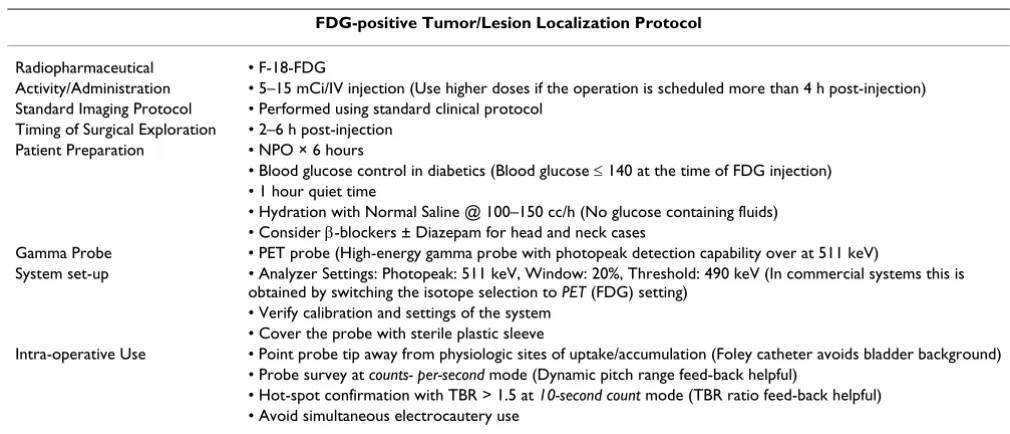
In patients with lymphoma the PET probe was used to locate a non-palpable lymph node during a diagnostic lymphadenectomy. The PET probe successfully located the target lymph nodes (neck, axilla and groin) in all cases. Figures 1, 2, 3 show a case of head and neck cancer where PET probe was used for diagnostic lymphadenec-tomy in the neck. In patients who underwent a metasta-sectomy procedure, surgical exploration was clearly facilitated by the use of the probe. It helped lead to the successful accomplishment of the surgical end-point (resection of the image-detected lesion). Probe-guided exploration was most rewarding in secondary explora-tions where the lesion(s) were obscured by the scar tissue. Manipulation of the probe in the surgical field was easy without any access difficulties. PET probe-guided surgery protocol is detailed in Table 2.
Discussion
The success of a PET probe-guided surgery depends on numerous factors including the FDG avidity of the tumor, timing of surgical exploration in reference to injection of FDG, anatomic location of the lesion, its relative proxim-ity to main sites of physiologic uptake/accumulation, and technical properties of the probe. The current study was performed to review the performance of the PET probe in surgical practice, and to validate/establish the optimal surgical protocol. Surgical performance was evaluated based on the probe's the ability to identify lesions seen on diagnostic imaging, and more importantly, actual contri-bution to the surgical exploration.
PET-probe guided excision of FDG-positive lymph node in the neck
Figure 3
PET-probe guided excision of FDG-positive lymph node in the neck. Final pathology confirmed metastatic squamous cell cancer.
FDG-PET/CT scan of a patient with nasopharyngeal cancer Figure 1
FDG-PET/CT scan of a patient with nasopharyngeal cancer. Transverse slice demonstrating FDG-positive primary site
Transverse slice demonstrating FDG-positive lymph node Figure 2
All the lesions identified on imaging studies were detected by the PET probe. The size of the lesions varied from 0.8 cm to 4 cm. The PET probe, however, was clearly most useful in detection of surgically occult lesions. Occult lesion was defined as a lesion that was not easily seen or palpated during routine surgical exploration. Some occult lesions included tumor masses measuring 2 cm or above. These were located in regions where the immediate surgi-cal access was difficult due to a barrier of adhesions or scar tissue. A posterior mediastinal exploration and two abdominal re-explorations for recurrent nodal disease involving periportal and celiac regions that were compli-cated with severe scarring were successfully completed using the PET probe. PET probe effectively directed the surgeon to the lesion(s) which were not found on initial visual and manual exploration. In a patient with meta-static gastric cancer, a N2 node was located using the probe and included in the resection which otherwise could have been retained following the planned gastrec-tomy. Locating a lesion that is expected to be masked under a scar tissue is probably the strongest indication for PET probe-guided exploration. In a diagnostic setting, we have found PET probe to be very useful in patients with lymphoma who require restaging or regrading of their dis-ease in follow-up. The patients most suitable for this approach are those presenting with non-palpable but FDG-PET positive lymph nodes in axilla, where a surgical dissection is relatively more challenging than that of the groin or neck.
The design of a probe that has the ability to process 511 keV photons, and its intraoperative use against significant background activity is technically challenging. We have previously demonstrated the efficacy and feasibility of PET probe-guided surgical exploration in different clinical
settings in a phase II diagnostic study [10]. The technical performance of a probe system is determined by detector sensitivity, spectral resolution, scatter rejection electron-ics, and shielding [11]. Optimum lesion detectability requires high counting efficiency, an adequate shielding method, and electronics capable of discriminating target signal from radiation noise. Our review of data revealed that there was a trend of TBR improving over time. Improved TBRs (although they were not statistically sig-nificant) were observed six hours after FDG administra-tion. There was satisfactory count rate and TBR for surgical detection up to 6 hours post-administration of 15 mCi activity, which makes this technique clinically feasible.
Detector material for the probe plays an important role in the sensitivity of the system. A GSO crystal is known to have a better stopping power than the NaI or CsI crystals and much better efficiency than the semiconductors used in medium energy gamma probes [16]. The PET probe also has to have heavier shielding. The profile, size and the weight of the probe and the ergonomics of the probe have to be non-restrictive to surgical exploration. The ana-lyzer of the probe system allows exclusion of scattered radiation which determines the specificity of the system. Therefore, analyzer electronics are equally (if not more) important in the overall performance of the probe system. Poor electronic suppression of scattered photons seriously degrades the TBR. This can cause small target lesions to be missed in the background. Effective electronic suppres-sion of scattered photons requires a precisely placed pho-ton energy acceptance window set atop a scatter rejecting threshold.
FDG avidity is determined by glycolytic activity of the tumor and the viable tumor concentration in a given
Table 2: PET probe-guided surgery protocol for F-18 FDG
FDG-positive Tumor/Lesion Localization Protocol
Radiopharmaceutical • F-18-FDG
Activity/Administration • 5–15 mCi/IV injection (Use higher doses if the operation is scheduled more than 4 h post-injection) Standard Imaging Protocol • Performed using standard clinical protocol
Timing of Surgical Exploration • 2–6 h post-injection Patient Preparation • NPO × 6 hours
• Blood glucose control in diabetics (Blood glucose ≤ 140 at the time of FDG injection) • 1 hour quiet time
• Hydration with Normal Saline @ 100–150 cc/h (No glucose containing fluids) • Consider β-blockers ± Diazepam for head and neck cases
Gamma Probe • PET probe (High-energy gamma probe with photopeak detection capability over at 511 keV)
System set-up • Analyzer Settings: Photopeak: 511 keV, Window: 20%, Threshold: 490 keV (In commercial systems this is obtained by switching the isotope selection to PET (FDG) setting)
• Verify calibration and settings of the system • Cover the probe with sterile plastic sleeve
Intra-operative Use • Point probe tip away from physiologic sites of uptake/accumulation (Foley catheter avoids bladder background) • Probe survey at counts- per-second mode (Dynamic pitch range feed-back helpful)
World Journal of Surgical Oncology 2007, 5:65 http://www.wjso.com/content/5/1/65
Page 6 of 7 (page number not for citation purposes)
lesion. This feature contributes to the success of probe detection; however, it has nothing to do with the specifi-city. Individual cancer types may also show significant variability in terms of FDG avidity. Even in the same patient, different lesions may have different degrees of FDG uptake. The probe detects any FDG avid lesion whether it is malignant or inflammatory.
FDG metabolism and clearance occurs at a much faster rate in normal tissues than tumor tissue, and thus TBR improves with time resulting in better lesion detection when imaging is delayed [17]. We have observed that tumor-to-non-tumor and tumor-to-organ rations were higher for the delayed images than for the 1.5-h routine images, and lesion detectability was improved in nodal and hepatic metastases. Our current study indicated that longer intervals accentuated the TBR, and resulted better lesion detection. The background radiation tends to decrease while the tumor uptake is retained. The in-situ TBR is also strongly affected by the areas of physiologic uptake or accumulation. The brain uptake in the head and neck region, cardiac uptake in the chest, kidney uptake and the accumulation inside the bladder in the abdomen and pelvis affect the in-situ TBR. Areas of physiologic uptake show attenuation over time, and use of an intraop-erative bladder catheterization minimizes interference from bladder accumulation of FDG.
The role of surgery in recurrent/metastatic cancer is being redefined. With the advance of tools or early diagnosis, and the improvements in systemic therapy, metastasec-tomy and cytoreductive surgical techniques in selected cases are considered viable management options. The clinical indications for metastasectomy and/or cytoreduc-tive resections are beyond the scope of this discussion. Parallel to the development of techniques to identify favo-rable tumor biology, and having the ability to select patients who are expected to have a more protracted dis-ease course (such as in differentiated thyroid cancer and neuroendocrine tumors) or tumors which are responsive to systemic therapies (such as colorectal cancer and breast cancer) more patients will be considered for metastasec-tomy. PET probe, with further refinements in the design and technical performance, might prove to be a very use-ful tool in surgical management of recurrent/metastatic disease. This study demonstrates the technical ability and feasibility of FDG-positive lesion detection using a PET probe.
Currently, with all recognized limitations, FDG imaging represents a new standard for functional/biologic imaging in oncology. Many more new PET radiopharmaceuticals are being developed for distinct tumor types and tumor phenotypes [18,19]. Peptide-based agents, kinetically and diagnostically, possess the most favorable radiochemistry.
Cu-64 and Ga-68 labeled octreotide are being increasingly utilized in detection of occult neuroendocrine tumors [20]. All PET radiopharmaceuticals have unique biodistri-bution characteristics defining different in-situ TBR pro-files, some clearly yielding much better TBR than that of FDG in a given lesion.
Conclusion
The clinical indications of the PET probe will individually be determined based on the tumor and patient character-istics as well as the biodistribution patterns of the selected PET radiopharmaceuticals. In carefully selected indica-tions, PET probe can be considered as a useful adjunct in surgical practice.
Competing interests
Research support from Care Wise Medical, Morgan Hills, CA
Authors' contributions
SG – Design, Acquisition, analysis and interpretation of data, drafting manuscript, critical revision
EH – Drafting and editing of manuscript, data analysis
RH – Acquisition of data, critical revision
DS – Critical revision
All authors read and approved the final manuscript
Acknowledgements
The study was supported by Spectron Cyclotron Facility, South Bend, IN and Care Wise Medical, Morgan Hills, CA).
References
1. Gulec SA, Moffat FL, Carroll RG: The expanding clinical role for intraoperative gamma probes. Nucl Med Ann 1997:209-237. 2. Moffat FL, Vargas-Cuba RD, Serafini AN, Jabir AM, Sfakianakis GN,
Sittler SY, Robinson DS, Crichton VZ, Subramanian R, Murray JH, Klein JL, Hanna MG Jr, DeJager RL: Preoperative scintigraphy and operative probe scintimetry of colorectal carcinoma using technetium-99m-88BV59. J Nucl Med 1995, 36:738-745. 3. Krag DN, Meijer SJ, Weaver DL, Loggie BW, Harlow SP, Tanabe KK,
Laughlin EH, Alex JC: Minimal-access surgery for staging of malignant melanoma. Arch Surg 1995, 130:654-660.
4. Gulec SA, Moffat FL, Carroll RG, Serafini AN, Sfakianakis GN, Allen L, Boggs J, Escobedo D, Livingstone AS, Krag DN: Sentinel node localization in early breast cancer. J Nucl Med 1998,
39:1388-1393.
5. Gulec SA, Moffat FL, Carroll RG, Krag DN: Gamma probe guided sentinel node biopsy in breast cancer. Quart J Nucl Med 1997,
41:251-261.
6. Bozkurt F, Ugur O, Hamaloglu E, Sayek I, Gulec SA: Optimization of gamma probe-guided parathyroidectomy. Am Surg 2003,
69:720-725.
7. Mariani G, Gulec SA, Rubello D, Boni G, Puccini M, Casara D, Manca G, Pelizzo MR, Sotti G, Erba P, Volterrani D, Giuliano AE: Preoper-ative localization and radioguided parathyroid surgery. J Nucl Med 2003, 44:1443-1458.
Publish with BioMed Central and every scientist can read your work free of charge "BioMed Central will be the most significant development for disseminating the results of biomedical researc h in our lifetime."
Sir Paul Nurse, Cancer Research UK
Your research papers will be:
available free of charge to the entire biomedical community
peer reviewed and published immediately upon acceptance
cited in PubMed and archived on PubMed Central
yours — you keep the copyright
Submit your manuscript here:
http://www.biomedcentral.com/info/publishing_adv.asp
BioMedcentral tumors with 125 I-TYR(3)-octreotide and a hand held
gamma-detecting probe. Surgery 1993, 114:745-752.
9. Ahlman H, Tisell L-E, Wangberg B, Fjalling M, Forssell-Aronsson E, Kolby L, Nilsson O: Somatostatin receptors on neuroendo-crine tumors – a way to intraoperative diagnosis and locali-zation. Yale J Biol Med 1995, 67:215-221.
10. Gulec SA, Daghighian F, Essner R: PET-PROBE: Evaluation of technical performance and clinical utility in oncologic sur-gery. Ann Surg Oncol in press. 2006 Jul 24
11. Gulec SA, Mountcastle TS, Frey D, Cundiff JD, Anthony L, O'Leary JP, Boudreaux JP: Cytoreductive surgery in patients with advanced stage carcinoid tumors. Am Surg 2002, 68:667-672. 12. Touzios JG, Kiely JM, Pitt SC, Rilling WS, Quebbeman EJ, Wilson SD,
Pitt HA: Neuroendocrine hepatic metastases: does aggressive management improve survival? Ann Surg Oncol 2005,
241:776-783.
13. Fuzun M, Terzi C, Sokmen S, Unek T, Haciyanli M: Potentially cur-ative resection for locoregional recurrence of colorectal can-cer. Surg Today 2004, 34:907-912.
14. Elias D, Liberale G, Vernerey D, Pocard M, Ducreux M, Boige V, Malka D, Pignon JP, Lasser P: Hepatic and extrahepatic colorec-tal metastases: when resectable, their localization does not matter, but their total number has a prognostic effect. Ann Surg Oncol 2005, 12:900-909.
15. Hsueh EC, Essner R, Foshag LJ, Ollila DW, Gammon G, O'Day SJ, Boasberg PD, Stern SL, Ye X, Morton DL: Prolonged survival after complete resection of disseminated melanoma and active immunotherapy with a therapeutic cancer vaccine. J Clin Oncol 2002, 20:4549-4554.
16. Muehllrhner G, Karp JS, Surti S: Design considerations for PET scanners. Quart J Nucl Med 2002, 46:16-23.
17. Boerner AR, Weckesser M, Herzog H, Schmitz T, Audretsch W, Nitz U, Bender HG, Mueller-Gaertner HW: Optimal scan time for flu-orine-18 fluorodeoxyglucose positron emission tomography in breast cancer. Eur J Nucl Med 1999, 26:226-230.
18. Cobben DC, Jager PL, Elsinga PH, Maas B, Suurmeijer AJ, Hoekstra HJ:
3'-18F-fluoro-3'-deoxy-L-thymidine: a new tracer for staging metastatic melanoma? J Nucl Med 2003, 44:1927-1932. 19. DeGrado TR, Baldwin SW, Wang S, Orr MD, Liao RP, Friedman HS,
Reiman R, Price DT, Coleman RE: Synthesis and evaluation of (18)F-labeled choline analogs as oncologic PET tracers. J Nucl Med 2001, 42:1805-1814.