EDGE FUNCTION METHOD APPLIED TO
THIN PLATES RESTING ON WINKLER FOUNDATION
Thesis by
Ignatius Po-cheung Lam
In Partial Fulfillment of the Requirements for the D-egree of
Civil Engineer
California Institute of Technology Pasadena, California
1976
The writer would like to express his appreciation for the guidance
and assistance offered by Professor R. Scott throughout the course of
this investigation.
The writer is also indebted to Professor G. W. Housner for
read-ing the first draft and valuable criticism;· to Mr. D. Dhar, currently a
physics graduate student at the California Institute of Technology for his
suggestions.
ABSTRACT
The Edge Function method formerly developed by Quinlan (ZS) is
applied to solve the problem of thin elastic plates resting on spring
supported foundations subjected to lateral loads the method can be
applied to plates of any convex polygonal shapes, however, since most
plates are rectangular in shape, this specific class is investigated in
this thesis. The method discussed can also be applied easily to other
kinds of foundation models (e. g. springs connected to each other by a
membrane) as long as the resulting differential equation is linear.
In chapter VII, solution of a specific problem is compared with a known
solution from literature. In chapter VIII, further comparisons are given.
The problems of concentrated load on an edge and later on a corner of a
plate as long as they are far away from other boundaries are also given
in the chapter and generalized to other loading intensities and/or plates
I
springs constants for Poisson s ratio equal to O. 2 •
CHAPTER
I
n
III
IV
v
VI
VII
VIII
IX
TITLE PAGE
HISTORICAL BACKGROUND ••••••••••..•••. 1
FORMULATION OF PROBLEM AND
PARTICULAR SOLUTION ADOPTED .•••••• 9
EDGE FUNCTION METHOD ••••••.•••••••••• 16
EDGE FUNCTION METHOD FOR
A RECTANGULAR PLATE ON
WINKLER FOUNDATION .•••••••••••••••• 21
CONVERGENCE ••.••.••.•.•••••••••••••••• 3 0
SYMMETRICAL PROPERTIES •••.•.•••••••• 35
CONCLUSION AND EXAMPLES •••.••••••.•• 44
ITERATIVE METHOD AND FURTHER
EXAMPLES . . . ·· . . . 55
COMPARISON WITH OTHElt
AVAILABLE METHODS ••••••••.••••••••• 74
APPENDICES . . . · . . . • . . . 80
REFERENCES . . . 107
-1-CHAPTER I. HISTORICAL BACKGROUND
The problem of deflection of an elastically supported elastic plate has become important since the introduction of concrete paving slabs for roads and aircraft runways. During World War II, consid-erable activity took place in northern Canada and Alaska so that the problem of transporting heavy equipment over frozen lakes became important. The above problems, as well as the necessity to design raft foundations for buildings, have resulted in a great deal of re-search activity on the problem of a loaded elastic plate on various kinds of supporting medium.
Soils are in general nonlinear, nonhomogeneous and aniso-tropic, but it is frequently assumed that a soil mass can be
repre-sented by a semi-infinite linearly elastic medium. However, even this model renders the problem too hard to solve in most cases. For the sake of mathematical expedience the simplest model, equiv -alent to a bed of springs, was suggested by Winkler (l) and many papers have been written on the plate problem using this model. The following is a brief review of the literature dealing with the problem of a loaded elastic plate on Winkler 1
s model of a supporting medium.
Later in this chapter a review will also be given concerning other models.
The problem of deflection of an elastic plate resting on some kind of medium was first discussed by Winkler. (l) He proposed the simplest relationship between the local reaction of the supporting medium p and the local deflection • . He suggested that the pressure,
s
equivalent to the condition of a buoyant plate resting on a liquid, as
in the case, for example, of a floating ice sheet. The only reaction
of the subgrade is an upward force proportional to the deflection.
This description of a foundation reaction is frequently called a
"Winkler Foundation." Winkler used this model to study the behavior
of railroad rails resting on ties. It was also used by Hertz (40) in a
study of a floating ice sheet.
Westergaard(Z, 3) solved approximately the problem of an
in-finite or semi-inin-finite elastic thin plate resting on a Winkler
Founda-tion when the load is uniformly distributed first over a circle and
later an ellipse. He also gave some formulas for the maximum
ten-sile stresses developed in the plate. In the infinite plate problem,
the loading can be distributed uniformly over any area having both
axes of x andy as axes of symmetry. Westergaard's investigation
of tensile stresses had immediate application to the design of
high-ways and airfield pavements.
Wyman (4) solved analytically the problem of a point load on
an infinite thin plate resting on Winkler Foundation. The solution
he obtained was expr essed in terms of Bessel's functions. The point
load solution can be generalized, as shown by Wyman, to obtain
solu-tions for arbitrary loading condition. However, the solution is ex
-pressed in integral form and,in most cases, the integral is too hard
to evaluate. Wyman, however, applied the idea to a uniform circular
loading condition and evaluated the deflections • .
R. K. Livesley(S) obtained solutions to the problem of
-3-a double Fourier transform and expressed the solution as an integral. When an edge or edges are simply supported, the solution can be ex-tended to semi-infinite plates or plates of the shape of an infinite
quadrant. He also obtained solutions for a semi-infinite plate on a Winkler Foundation loaded by prescribed moments and shear stress normally along the edge of the plate. Dynamical loading is also
dis-cussed in the paper.
Other than the above papers, Kerr(6) solved the problem of a simply suppo~ted wedge -shaped plate, not supported by any founda-tion, subjected to uniform tension in the plane of the plate and loaded transversely by concentrated forces. The behavior of a loaded corner of the plate can be obtained from the results of the paper. In another paper, written by Kerr,(?) he tackled the problem of simply supported plates on a Winkler Foundation subjected to concentrated loads and obtained solutions for the following shapes of plates: (1) wedge-shaped; (2) infinite strip; (3) semi-infinite strip; (4) rectangular plate.
S. Timoshenko and Woinowsky-Krieger(B) included a chapter on the topic of plates on a Winkler Foundation. In that chapter, there are solutions to several problems, a very interesting one being
that of a rectangular plate simply supported on all four edges and loaded by any arbit:rary lateral loads. The solution is expressed as a double sine series. This is one of the very few exact solutions obtained for a finite plate on a Winkler Foundation.
Other than the above mentioned papers, Hetenyi (l6) has
Many examples are given in the book. However, the book deals mainly with beam rather than plate problems.
The problems of plates on a Winkler Foundation that have
been solved are mainly those of infinite, semi-infinite plates or
those plates with the shape of an infinite quadrant and are listed in
Table 1. 1.
The problem of a finite plate on a Winkler Foundation is very
complicated. Ther e is only one solution in the literature (chapter 8).(8)
From it, the solution of any arbitrary lateral load on a simply
sup-ported (hinged) rectangular plate can be obtained.
In addition to plates on the Winkler Foundations, many workers
have proposed different kinds of models for the supporting medium. Hogg(9) solved the problem of a thin infinite plate, symmetrically
loaded and resting on an elastic half-space. Then, in a later paper,
Hogg (l O) solved a similar problem in which the elastic foundation was of finite depth.
However, to make the problem more manageable, most inves
-tigations on a better foundation model have been carried out in one-dimension (a beam, instead of a plate}. For example, most compar-isons with experimental results have been made using a theoretical
solution of an elastic beam on a variety of foundation models. The foundation pressure p (x} is very often assumed to be proportional
s
to the displacement and/or various derivatives of displacements. This model is popular because the Winkler's model of foundation is completely discontinuous. If other derivatives are taken into
TABLE
1.1
Solved
Problems
of
Plates
on
a
Winkler
Foundation
Shape
of
Plate
Loading
Condition
Boundary
Conditions
a)
Point
Load
Solution
approaches
zero
b)
Loads
with
Circular
Infinite
as
it
is
infinitely
far
away
Symmetry
from
the
load
c)
Arbitrary
a)
Elliptical
Shapes
b)
Circular
and
Elliptical
Free
Edge
Semi-Infinite
Shapes
Infinite
Quadrant
c)
Arbitrar
y
Simply
Supported
a)
Arbitrary
Simply
Supported
~---.
-·
-Reference
@
®
!G),
@,
®
@
,
(I
@,
(5\
'-·
(~),@G)
taken into consideration. As mentioned earlier, in the Winkler Model p (x) is assumed to be proportional to the displacement only. But
s
in the most general linear case, it can be assumed to be expressed
by the following equation:
p s
(x)
N
=
E
a w(n) (x)n=O n
(1. 1)
in which w(n)(x) denotes the nth derivative of the deflection w(x) with respect to the x-direction. An extensive review of the literature in
this area is given in refs. (1), (11), (12), (13), (14), {15) and (16).
For example: Pasternak{l3) suggested the model:
ps{x) = k
1w(x)-k2w
11(x), whereas
Hetenyi (l2) proposed the following model:
(1. 2)
(1. 3)
The Winkler Foundation(!) assumes complete lateral discon-tinuity in the elements in the foundation material, whereas the
half-space of Hogg( 9, 1 O) assumes complete continuity. Hetenyi' s (l ?)
equation (1. 3) and chapter 10(!6) used an arbitrary degree of
con-tinuity on the foundation and applied it successfully to the one-dimensional beam problem. However, it is doubtful whether this method could be applied to the two-dimensional plate equation. The reason for using this model, rather than the Winkler model, is that
it offers more parameters that one can choose to approximate the
actual elastic continuum. model.
-7-the parameters in their models. (for example, k
1 and k2 in the
Pasternak and Hetenyi Model described in eq. (1. 2) and (1. 3) ).
Fletcher and Hermann(lS) gave a systematic way to determine what
values of the parameters (constants) in the model represented by
eq. (1. 2) and (1. 3) should be used, if the elastic constants of the
(linearized isotropic) foundation material are known. Timoshenko
and Woinowsky-Krieger (p. 259)(8) give a table which gives engineers
the values of the Winkler constant that should be used for various
types of soil.
Other than the above -mentioned static models, Kerr (!5) has
suggested a time-dependent model in which a viscoelastic effect was
introduced. However, Kerr applied the model to a plate which can
only withstand transverse shear (a shear plate).
All of the solved problems involve a particular plate shape
and boundary conditions generally simply-supported at the edges.
For the general solution of slab problems even of moderate
com-plexity, numerical procedures have to be adopted. So far in the
literature, two methods have been used: the finite difference and
the finite element techniques. Allen, and Severn (19 ' 20) used the
finite difference method and reduced the solution to a system of
linear equation. However, in this formulation it is sometimes
dif-ficult to ini:-oduce the boundary conditions.
Zienkiewicz and Cheung(2l) and Severn (22) have applied the
finite element technique to the plate problem. The finite element
method is a versatile method that can deal with any boundary
usually uses a continuum model for foundation material, so it can
model any corn,bination of materials, layers, etc., but may be
ex-pensive.
Other investigators who have contributed to the problem are
I (23) (24)
Vlasov and Leont ev and Holl.
Among all the above -mentioned methods, only finite
differ-ence and finite element techniques can be used to handle the plate
problem with some generality. However, they are not without fault.
Their advantages and disadvantages will be compared and discussed
-9-CHAPTER II. FORMULATION OF THE PROBLEM
AND PARTICULAR SOLUTION ADOPTED
The foundation model that is adopted in this paper is the
Winkler Foundation. In view of all the uncertainty connected with
the soil property determination, it seems unjustifiable to use a more
sophisticated model which would make the problem much more
diffi-cult. However, if other models for the soil reaction are used, as
long as the differential equation involved is linear, the Edge Function
technique can still be applied.
(a) Formulation
When the plate is thin compared to other dimensions (e. g. the
radii of curvature of the sur face) of the plate and the deflection w of
the plate are small compared to the thickness of the plate, an approx
-imate theory of bending of the plate by lateral loads can be developed
by making the following assumptions:
1. There is no in-plane deformation in the middle surface
of the plate.
2. Points in the plate lying initially on a normal to middle
plane of the plate remain on the normal" after bending.
3. The normal strains in the direction transverse to the plate are negligibly small.
Using these assumptions, all stress components can be
ex-pressed in terms of the deflection w of the plate, which is a function
of the two coordinates in the plane of the plate. This function has to
satisfy a linear partial .differential equation, which, together with
solution of this equation gives all the information necessary for ca
l-culating stresses at any point of the plate. The equation of the plate
for any of the model foundation material is given by:
4 Ps (x, y)
'i1 w (x, y)
+
Dwhere
=
q(x, D y) (2. I)E and V are Young's modulus and Poisson's Ratio of the elastic plate.
h is the thickness of the plate.
q(~ y) is a function that describes the loading.
p s is the foundation pressure
+
Adopting the Winkler model for the foundation, ps is given by
the following equation
where K is a constant.
p (x, y) = Kw(x, y)
s {2. 2)
Substituting eq. (I. 5) into (1. 4) the differential equation of
the deflected sur face is obtained as follows:
4
K
'i1 w(x, y)
+
D w (x, y) = q(xD , y) (2. 3)The above assumption and differential equations are basically adopted
-11-(b) Boundary Conditions
To make the solution unique, boundary conditions have to be
specified. In most engineering problems, the properties of interest
are among the following: displacement; slope; moment and shear.
The boundary conditions include specifying any two of the
above properties along each boundary. To express the above
prop-erties mathematically involving derivatives of displacement w, the
derivation in chapter 2 of ref. 8 is adopted and the results are listed
as follows:
a)
b)
displacement is given by w
ow
slope in the n direction is given by
on
c)
2 2
moment per unit length in the n direction is -D (8 w
+
'V 0 w)an
2at
23 3
shear force per unit length in then direction is -D(0 '; +(2-'V) 0 w
on
onot
d)
(2. 4)
where the coordinates are as given in Fig. 2. 1.
To solve the problem, the equation is broken down into two
parts to obtain: (1) The non-homogeneous solution; (2) The homo
g-enous solution.
(1) The non-homogeneous solution (particular solution).
From eq. (2. 3) the particular solution is given by
+
K wD
p=
q(x, y)
(2) The homogeneous solution (complementary solution) has to satisfy the following equation:
,.,4 w K
v c
+
D w c=
0 (2. 6)w is adjusted such that together with the particular solution it will c
give a total solution, wt' that satisfies the loading and the boundary conditions. Details of the solution methods are given in the following chapters.
Then the total s elution is given by
w
=
w +wt p c
any ) \
__.--'7
nplane
~
Fig. 2. 1
~Boundary of
the Plate
(2. 7)
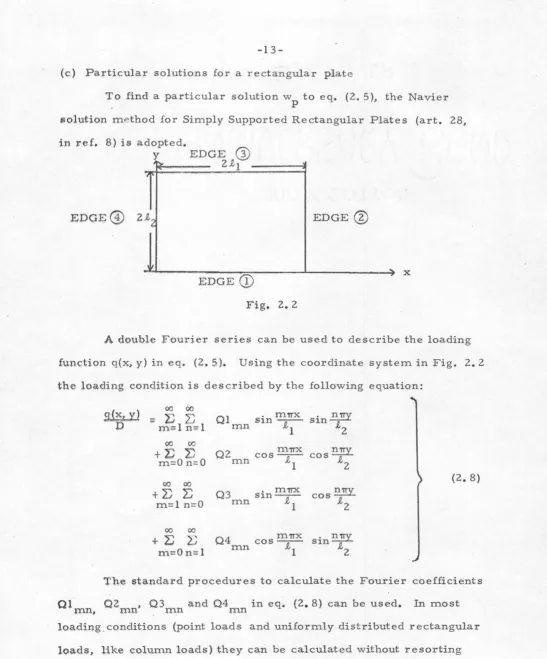
-13-(c) Particular solutions for a rectangular plate
To find a particular solution w to eq. (2. 5), the Navier
. p
solution m ethod for Simply Supported Rectangular Plates (art. 28,
in ref. 8) is adopted.
y EDGE
G)
'"l- 2.2.1,.
EDGE@ EDGE@
~~---~---~---~' X
EDGE
CD
Fig.
2.
2A
double Fourier series can be used to describe the loading function q(x, y) in eq. (2. 5). Using the coordinate system in Fig. 2. 2the
loading condition is described by the following equation:.six, y) D
00 6o
;;::
E
6
m=l n=l 00 00
+
ll
!)
m=O n=O
00 00
+
L) L)m=l n=O
00 00
Ql s t n - -. mnx mn .2.1 Q2
mn
mnx c o s
-t l
Q3 Sln-. mnx ~ -mn XJl
sin
..!!.!!.Y
.2.2 cos n'lry
.2.2
+
~ I; Q4 cos ~nx sin!!..!!Y.
m=On:;l mn 1 .2.2
(2. 8)
The etg.ndard procedures to calculate the Fourier coefficients
01..-v>
_
n
Ien
1 Q3 and Q4 in eq. (2. 8) can be USed.•• ~. mn tun mn In most
[image:17.570.14.561.28.687.2]to numerical integration. However • for the most general loading
conditions, numerical integration is needed.
The particular solution
w
p
also can be expressed in doubleFourier series.
w = L)
:E
Bl s 1 n -. m'TTX - sin~p
m=l n=l mn .R,l 1,2
+:E
I; B2 c o s - -m'!TX cos~m=On=O mn .R,l 1,2
(2. 9)
+~
:E
B3 sin -m'!TX - cos !!.!!Y.· m=l n=O mn .R,l 1,2
+:6 :E
B4 c o s -m'!TX - s1n . nny .R,m=On=l mn .R,l 2
Substituting eq. (2. 9) and (2. 8) in (2. 5). each of the Fourier
coefficients should be equated. The Fourier coefficients in eq. (2. 9)
can be calculated from the known Fourier coefficients in eq. (2. 8).
For the sake of clarity this is explicitly stated as follows:
QI
BI
=
mn
mn
(2. 1 0)
where I denotes 1, 2, 3 or 4 as in eq. (2. 9).
Several examples of particular soiutions have been worked
out in detail in Appendix D. They include:
(i) A point load inside the plate.
(ii) A point load on the corner of the plate
(iii) A point load on the edge of the plate.
(iv) A column load {uniformly distributed load over rectangular
-15-In (ii) and (iii) some manipulation is employed to arrive at
the correct answer.
Equation (2. 9) only expresses the displace1nent of the
par-ticular solution. Properties of engineering interest other than
dis-placement are: slope, moment and shear. Mathematical
expres-sions of these properties of the particular solution are given in
Appendix E. They are obtained by substituting wp (as expressed
in eq. (2. 9)) for w in eq. (2. 4).
Now, it is presumed that the particular solution has been
found satisfying the differential equation. However, this solution
generally does not meet the required boundary conditions and is
therefore not unique. (There are many solutions that will satisfy
eq. (2. 5) ). Thus, the complementary solution has to be evaluated
to give a total solution (eq. (2. 7) ), which will satisfy the differential
equation and the required boundary conditions. To arrive at the
necessary complementary solution, the Edge -Function Method
developed by Quinlan {25) can be used. Chapter 3 introduces this
concept and describes its application to the plate problem. Chapter
4 deals with the specific use obtained by applying the Edge-Function
method to the rectangular plate problem.
This Fourier series representation of loading function given
by eq. (2. 8) can be used to describe any number of point loads, or
distributed pres sure, or even a combination of both types of loads
CHAPTER III. EDGE FUNCTION METHOD
After studying the Edge-Function idea developed by Quinlan (ZS)
to solve some very general plane strain or plane stress problems, R. F. Scott suggested the possibility of using this method to
tackle the case of a slab on a Winkler Foundation loaded
perpen-dicular to its plane. This has been examined and the following
discussion describes the application of this method of solving the
plate problem.
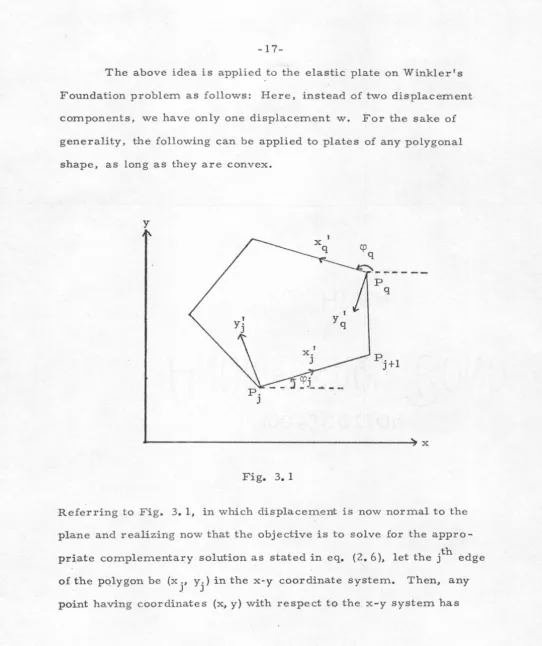
Quinlan's Edge Function idea is that, since the governing
differential equation is isotropic, (see Fig. 3. 1), its expression
in terms of the x-y coordinate system is of the same form as that
in terms of the x. ', y.' system or x ', y ' system. Therefore, a
J J q q
solution of the homogeneous equation in any coordinate system
(e.g. x. ', y. ') is also a solution to the differential equation with
J J
respect to other systems (e.g. x ', y '), providing the appropriate
q q
change of variable is performed. (In this case, x. ' , y. ' to x 1 , y ' . )
J J q q
Furthermore, since the equation is linear, the solutions with respect
to various coordinate systems can be superimposed and the final
solution will still satisfy the equation with respect to any coordinate
system. This superimposed solution can be chosen such that the
-17-The above idea is applied to the elastic plate on Winkler's
Foundation problem as follows: Here, instead of two displacement
components, we have only one displacement w. For the sake of
generality, the following can be applied to plates of any polygonal
shape, as long as they are convex.
y
p
q
~---~ x
Fig. 3. 1
Referring to Fig. 3. 1, in which displacement is now normal to the
plane and realizing now that the objective is to solve for the
appro-priate complementary solution as stated in eq. (2. 6 ), let the jth edge
of the pqlygon be (x j' yj) in the x-y coordinate system. Then, any
[image:21.575.18.560.33.679.2]coordinates (xj', yj'} with respect to the xj', yj' system and the
coordinates are related to each other by the transformation shown
by eq. {3. 1 ).
x
=
x.+
x. 1 co scp . - y. 1 sincp .J J J J J
(3. 1)
y
=
y.+
x. 1 sincp.+
y. 1 coscp.J J J J J
The differential equation with respect to the (x, y) coordinate
system is given by eq. (2. 6). If another coordinate system (x 1, y ')
is used, the differential equation has to be changed accordingly. To
find out what the differential equation will look like in the new system,
a coordinate transformation is performed on eq. (2. 6). From (3. 1)
a
ax
can be expressed in the xj1, yj' system.a
ox
a
Similarly
oy
=
=
ox.'
oy.'
a
__j_a
_:J__ax.' ax
+
oy.'
ox
J J
a
coscpj
ax.'
J.
a
s1ncp.
-J
ay.'
J
a
a
=
sincpj fu(."T+
coscpjay.
1J J
(3. 2)
Equation (3. 2) is applied successively in eq. (2. 6). Finally,
the transformed differ ential equation with respect to the new x 1 , y 1
system is
-::.4 j( I I) -::.4 j( I ' )
0 w X: ' Y· u w c X. ' Y· K .
+
2 c J J+
---~J~-=J'--+-
w J(x.', Y· ')a
,2a
,2a
,4o
c J Jxj , Yj Yj
-19-It can be observed that eq. (3. 3) is of the same form as
eq. (2. 6) if xj 1 and Yj 1 is substituted for x and y respectively. From
physical reasoning, since the plate and springs are isotropic and
homogeneous, the differential equation must be the same with respect
to any coordinate axes.
Furthermore, a solution wj(x. 1
, y. '). after changing x. ', y. 1
c J J J J
into any cartesian coordinate system (e. g. x '• y 1) using the
appro-q q
priate form of equation (3. 1 ), will also satisfy the differential equa
-tion with respe~t to the xq1
• Yq1 system.
In other words, wj(x-1, y .1) will satisfy the following equation:
c J J
4 .
a
wJ(X· I Y· ')c J • J
a
4 w j ( X j • I Yj I) K .+
c 4+
D wJ(x.', y.')ay
'
c J Jq
=
0 (3. 4)if xj'. y j' is changed into xq'• y q' appropriately following equation
(3. 1 ).
Because of the above property and since the equation (2. 6)
is linear, solutions with respect to different coordinate axes can be
superimposed and the total solution will still satisfy the differential
equation with respect to any particular set of axis. Thus, a very
general form of solution to the complementary equation (2. 6) can be
obtained as follows:
N
w (x, y) =
:B
c J= . 1
wj(x-1 y ·')
c J , J (3. 5)
where (x.!, y!) are related to (x, y) through eq. (3. 3), and are called
J J .
So far. the form of the co~plementary solution is known from
eq. (3. 5) and (3. 3). However. there are still sets of constants in
the complementary solution which remain unestablished. Applying
the boundary conditions on each edge. these constants are
deter-mined. In Chapter 4. an example will be given and the
complemen-tary solution to a rectangular plate solved in detail.
Other research applying the Edge Function idea is given
-21-CHAPTER IV. EDGE FUNCTION METHOD FOR A RECTANGULAR PLATE ON WINKLER FOUNDATION
The following chapter deals with finding the complementary solution that will satisfy the proper boundary conditions to a problem of a rectangular plate on a Winkler Foundation. The differential equation for the homogeneous problem is, from Chapter II
4
\] w
c +K D w c = 0 (2. 6)
For all rotated and translated coordinate systems, it will have the same form, as discussed in Chapter 3. One has to obtain solutions that satisfy the differential equation (3. 3). Using the particular
solution obtained in Chapter 2, the boundary conditions which arise from the particular solution will be easily given as a Fourier series. Thus, it is convenient to use Fourier series (sine and cosine) in the complementary solutions as well. First, let
. co mlTX.1 wJ = ~ sin J
c m=l .tj
. co
fJ{y.')+~
m J m=O
mlTX.1
COS ----:.t.,-j-"-
g~
( Y j I) ( 4. 1)Substituting equation (4. 1) into equation (3. 3) two differential equa-tions arise as follows:
4 . 2 . " j (IV) +
K f j
}
( ~) f J- 2(mTr) fJ +f 0
.t. m .t. m m D m =
J J (4. 2)
(mTr )4 j 2 (m1r)2 j"+ j(IV) K .
- g -
t.
gm gm + - g J = 0t.
m D mJ J
There are four independent solutions for each of equations (4. 2): g j and f j can both be expressed as linear combinations of the
m m
.,. j y. 1
e m J sin 9 j y. '
m J
'Y j Y· 1
e m J cos 9 j y. 1
m J
-y
j y.le m J sin 9 j y. 1
m J
-y
j Y· Ie m J cos 9 j y .1
m J
·where 9 j and ')I j have to satisfy the following equation:
m m
. 2 . 2
(mTT) 2
(y~)
-(9~
=
I. . J2(')1 j) ( 9 j)
=
J~
m m
'Y j y.l
One can neglect the part involving em J in the solution
for each Edge Function with respect to a particular coordinate
(4. 3)
(4. 4}
' ) l l y l
system (e. g. e m 1 (sin
9~
y1•
+
cos9~
y 11) with respect to the
coordinate system (x11, y
1'). as can be seen from the following
discussion. The Edge Function method is basically a method of
superposition. Each of the superimposed elements has some property
which is governed by the boundary conditions. Their presence in
the solution is to introduce the boundary conditions at each edge of
the plate. Each of these elements has a particular form and a
par-ticular position. The different coordinate axes are set up in such
a way that the bases (y ·1 = 0) are located along the edges of the
. J .
plate. (e. g. for a rectangular plate, the coordinate axes are set
up as shown in Fig. 4. 2.) From Fig. 4. 1, one can see that the Edge
Function w ~(x
1
•. y1
1
-23-conditions on edge
(D.
When yJ. ::= 0 is substituted into the solution, w c' (x1•, y J.
=
0) should constitute that part of the solution that makes the general solution behave according to the prescribed boundary conditions on edge(D.
The function wc'(x1•, y1') should become smaller with distance from edge
Q)
(y1• getting bigger). At a point infinitely far away from the edge, the contribution from w c'(x
1•, y1') to the general solution should be zero. In effect, one is looking at a semi-infinite strip. When y
1•
=
0 certain propertief! are prescribed y J y.'and as y 1
1
- oo, .the solution- 0. So, obviously thee m J part of the solution should be omitted from each Edge Function. The same
con-side ration holds for all the edges.
INFINITE STRIP
yl'
=
0ASE OF EDGE
CD
PLATE UNDER CONSIDERATION
X, X 1
1
y
II\
EDGE
G)
,
21,3 ....
L
·"
I
!\
/ ...':'-y4 x3
j = 3
II
x4
.. I;
y3
21,4 j=4 j = 2 21-2 EDGE@
' " yl
X I
1'-2
j = 1
,I/ xl ' Y2 / 'It __.!\,
,.
21-1 .... ,
"
X
EDGE
CD
Fig. 4. 2
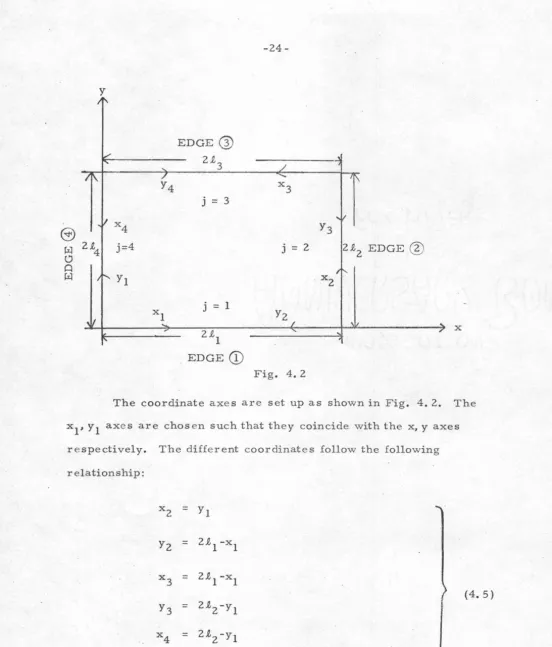
The coordinate axes are set up as shown in Fig. 4. 2. The
x
1• y 1 axes are chosen such that they coincide with the x, y axes
r espectively. The different coordinates follow the following
relationship:
x2 = yl
Y2 = 21-1-xl
x3 = 21-1-xl
y3 = 2 1,2-yl
x4
=
2 1,2-ylY4 = xl
[image:28.578.10.562.33.680.2]
-25-With the axes set up as shown in Fig. 4. 2, the most general
form of the complementary solution in the rectangular plate resting
on a Winkler Foundation is as follows:
where
4
00=
~:E
j=l m=l
4
00+
6 6
j=l m=l
4
00+
6
6
j=l m=O
4
00+
6
6
j=l m=O
. m'!T"X. -y j Y· .
A J sin--,-"""- e m J sin 8 J y.
m f.. m J
J
- j
. m'!T"X. 'Y m YJ·
B J sin~ e
m
t.
J
. m 'IT"X.
-y
j y·.C J cos~ e m J
m
t.
J
cos 8 j y·.
m J
sin 8 j y.
m J
. m '!T"X. -y y.
D J cos ___J_ e m J cos 8 j y.
m 1. m J
J
(yrl)2 - (8 j )2 = (miT )2
m
t.
J
2(y j) (8 j ) =
J~
m m
In equation (4. 6) the only unknowns are the A j
m'
B
m' jc
m j(4. 6)
and D j • m
These coefficients are determined from the boundary conditions.
With these calculated, the exact complementary solution is known.
The particular solution is obtained from eq. (2. 9) and the total
solution can be calculated from eq. (2. 7 ). Mathematical
expres-sions of the complementary solution for slope, moment, and
shear force are given in Appendix E.
The remaining part of Chapter 4 will be used mainly to
illus-trate how the A j, B j, C j and D j are chosen so that the boundary
m m m m
Recalling eq. (2. 7), taking w p to the left -hand side of the . equation, the following is obtained:
. 4 .
wt(x, y) - w (x, y) = ~ wJ (x., Y;)
p j=l c J J (4. 7)
Changing coordinates of the above equation into any coordinate axes (e. g. x
1, y 1) and introducing the coordinate of that edge
Q) ,
the equation is reduced to that involving only one independent variable(x
1, since y1 = 0 is the coordinate of edge
(D).
The following equa-tion is obtained:4
=
~
w1
(all coordinates changed to x 1)j=l
(4. 8)
The function wt(x
1) in the above equation is the prescribed boundary
condition on edge(!). It can easily be represented by a Fourier
series. The displacement wp(x
1) is represented as a Fourier series
also. As a result the left -hand side is reduced to a single Fourier series. (A sine and a cosine series involving x
1). The right-hand
side of the equation, however, is more complicated. Referring to eq. (4. 6), after changing all the (xj, Yj) to (x
1, y1) and then after
substituting the coordinates of edge
Q)
(y1
=
0), the following equation is obtained:-2
7-00
w (on edge
Q)
)
=c
6
1 . mmc1 oo 1 mmc1
B s1.n - - + 6 D cos
-m .tl m=O m .tl j=l
m=l
2 2
-y (2.t -x ) oo
2 -y (2.t -x )
m l 1 sin9 2(2.£1-xl)+ 6 D e m 1 1
00
+
6
c
2m=O me m m=l m
cos 9
~
(2.t1 -x1) j=2
-Y.3(2L) -/3(2L)
00 m TT'X]_ m ·-z oo 3 m "TTXl m ·-z 3
+6 A 3(-sin-.t-) sin9 3(2lz)+6 B (-sin-..e-) cos9 (21z)
m=l m 3 [e 3
~
m=l m 3(2: ) e Jmoo mmcl 3 -yrJ2--z) 3 3 -ym 2 3
+ 6 cos
.t
C sin9~f2.t2
)+D cos9 (2.t 2 )m=O 3 m e ni m e m
j=3
4 co
+
6
m=O
-y X 00
4 m 1 . 9 4 ""
Cm e Sl.n mXl + LJ
j=4
m=O
(4. 9)
In equation (4. 9) the part where j = 1 and j = 3 is a simple
Fourier series. However, when j = 2 and j = 4, the part involving
x
1 is not a Fourier series. In order to match the Fourier series,
on the left-hand side of eq. (4. 8), the part involving x
1 has to be
reduced to a Fourier series as well.
Letting
2
-y m (2 .tl -xl) 2 ~ . n"TTXl oo n"TTXl
e cos9m(2.t
1 -x1) = n=l n LJ A s1.n-.t--1 + 6 n=O T] n cos - n -"'1
4
-y X
. 9 4 00 . nmc1 00 n"TTXl
m 1 6 6
s
e s1.n m x 1 = pn s1.n
-.t-
+ c o s-n=l 1 n=O n .tl
4 -y X
4 00 nmc1 00 nmc1
m l
6 6 (4. 1 0)
e cos9mxl =
a
sin-..e- + w cos~
n=l n 1 n=O n
where Tn' ~n' An' T]n' pn' r;n'
a
n
andwn
are Fourie.r coefficients.Substituting eq. (4. 1 0) into eq. (4. 9), the following equation m'TTXl ·m'TTXl
involving only sin and cos is obtained •
..e1 ..el
w (on edge
CD
).
coo
1 . m'TTX1oo
1 m'TTX = 2:; Bm Sl.n -..e-+
2:; D cos 1m=1 1 m=O m ..el
+
23
[23
c!J
Tm sin~'TTX
1
+
23
I
23
c!]
13m cos -m--='TTX-1m=l n=O 1 m=O Ln=O ..el
+
23
[-E
n
2J
A sin~'TTXl
+
I;
I
23
n
2J
11 cosm=l n=O n m 1
m=OL~=O
n m3
~ -ym (2 .t2)
+
2..j-m=1 e
3 3 m'TTXl
sin 9 (2.t ) A sin
--:--==-m 2 m ..e
1
00
+
2:;m=1
+
I;
-Y~
.
(
2
.t2) sine~
(2.t2)c
3 cos m..e'TTX1e m 1
m=O
Y
3(2.t ) 3 3 m'TTX1 ~ - m 2 cos 9 (2.t2) D cos----.-::..
+
LJ e . m m11
1
m=O
00
Goo
4J
m'TTX1+
2:; 2:; C p sin -..e-m=1 n=O n m 100
[00
4]
+
:6
:6
c
s
cosm=O n=O n m
00
[00
J
+
6
6
D4 crm=1 n=O n m
oo
[
oo
4] m'TTX+
:6
:6
Dn wm cos ..e 1m=O n=O 1 ( 4. 11)
Equation (4. 11) is simply a Fourier series, in which the only unknowns are the A j B j C j and D j 1s. Equating this Fourier
m' m' m m
series with that from the left-hand side of eq. (4. 8) (the coefficients
of the sine series with the sine series, and the coefficients of the
-29-linear equations in the unknowns A j 1 Bmj 1 C j and D j is
. rr1 m m
obtained.
For practical purposes, the index min eqs. (4. 9)1 (4. 10)1
and (4. 11) is truncated at m
=
N. Coefficients for m>
N are neglected. So there are 4 X N A j 1 4 X N B j , and 4X (N+l)C j ,m m m
and 4 X (N+l)D j• As a result there are 16N+8 unknown A j, B j,
m m m
C j and D j and the size of the matrix that has to be solved is
m m
(16N+8) by (16N+8). There are four edges and on each edge there
are two bounda_ry conditions. For each boundary condition there are N sine series and N+l cosine series coefficients. Therefore, there are 8 X (2N+l) equations that can be formed. Thus, there are
equal nmnbers of unknowns and equations and the matrix is well-defined. For boundary conditions other than displacements, the various deriv;;ttive of eqs. (2. 9) and (4. 6) have to be used. (See
eq. (2. 4) ). After solving for the A j, B j, C j and D j from the
m m m m
CHAPTER V. CONVERGENCE
The convergence of the solution by the Edge -Function method to the correct solution depends mainly on two conditions:
the smoothness of the prescribed boundary conditions and the
smoothness of the boundary condition contribution from the par-ticular solution. The parpar-ticular solution is given by a double sine, cosine series (eq. 2.9 ). After inserting the coordinates of the
edges in the particular solution, the function that describes the boundary contribution from the particular solution becomes simply a single sum Fourier series. Therefore, to simplify the problem, the Fourier transform of the prescribed boundary conditions from
the total solution (eq. 2. 7) is represented by a Fourier series
(a sine and a cosine). Thus, the convergence of the solution depends
mainly on the humber of terms required to represent adequately the particular solution as well as the prescribed boundary conditions.
The displacement in the particular solution is represented by eq. (2.
9).
On substituting the coordinates of the edges of theplate into eq. (2. 9), w (x
* *
• y ). where (x ,* *
y ) represents theco-p
ordinates of an edge, the double sum series which originally has
two independent variables can be reduced to a single sum Fourier
series involving one independent variable if the coordinate system
with respect to that particular edge is used. To be more specific
-31-y
EDGE
Q)
.I ...
I
EDGE@)
2~
yl EDGE@
II
xl
' X
'
2 .£,1
,
,_
EDGE
CD
Fig. 5.1
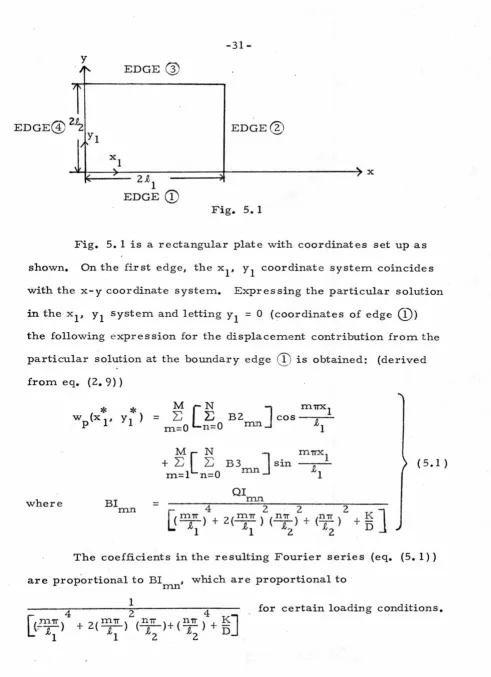
Fig. 5. 1 is a rectangular plate with coordinates set up as
shown. On the first edge, the x
1, y 1 coordinate system coincides
with the x-y coordinate system. Expressing the particular solution
in the xl' y1 system and letting y1 = 0 (c;:oordinates of edge
(D)
the following expression for the displacement contribution from the
particular solution at the boundary edge
Q)
is obtained: (derivedfrom eq. (2. 9))
where BI
mn
M [N
J
m'T!Xl=
~E
B2cos--.--m=O n=O mn .£,1
( 5.1 )
=
The coefficients in the resulting Fourier series (eq. (5. 1))
are proportional to BI , which are proportional to mn
1
[image:35.570.45.536.38.715.2]Thus, the particular solution for displacement on the boundary (Edge
Q)
in the example) converges like_!_
4•
N
Similarly, using the slope equation for the particular solution in Appendix ~ the slope contribution of the particular solution on Edge
Q)
is given by the following:*
y*)a
w (x •p on edge(!)
ayl
M [ N
1 .
n 'ITXl"" "" B 1 ( n 'IT )
=
L.J L.JJ
Sl.n-~--m=l n=l mn /-2 1
where the BI again behave like
~
•mn
N
(5. 2)
The (¥_) factor which appears on differentiating the series
2
makes the coefficients in the Fourier series in eq. (5. 2) converge
slower and the slope in the particular solution converges as
~
• NSimilarly, (see eq. (1. 7)), we ca~ apply the same procedures to the moment and shear expressions in the particular solution given
in Appendix E. Since the moment basically involves the second
derivatives and the shear involves the third derivatives, the moment
1 1
converges as
z
and the shear converges as N NTo summarize: Displacement converges
1 Moment converges as N 2
in the particular solution.
as 1
N4 Slope converges 1 Shear converges as N
as 1
-33;..
Thus. displacement converges very quickly. but convergence
is less rapid as higher derivatives are considered. In an actual
case, the double Fourier series have to be truncated at some term
N. Depending on the degree of accuracy desired and which
combi-nation of displacement slope. moment or shear is of interest, one
·can decide on where the series should be truncated. If the behavior
of the plate in terms of lower derivatives is desired, a smaller
number of terms is needed in the series.
The convergence of the complete solution, other than
depend-ing on the convergence of the particular solution, also depends to a
certain degree on the complementary solution. Referring back to
Chapter IV. on trying to choose the correct coefficients to use in
eq. (4. 6) such that the complementary solution w (x, y) will have the
c
desired value on the boundaries of the plate, eq. (4. 9) was derived.
This equation has to be matched with the left-hand side of eq. (4. 8)
which is given as a single sum Fourier series. If eq. (4. 9) is a
single sum Fourier series. the coefficients can simply be matched
term by term and the matrix is set up easily. However, eq. (4. 9)
is not a simple Fourier series, but involves some other functions.
That is why, in eq. (4. 9), the various functions have to be changed
to a Fourier series. These functions vary as the 9 j and y j which
m m
depend on the shape and dimension of the plate, soil spring constant
K and p!a.te constant D (the last two equations of eq. (4. 6) ). All of
these considerations will affect the smoothness of the various
functions in eq. (4. 9). Then, as these functions have to be
solution has to be large enough such that these functions can be
represented adequately in eq. (4. 10) by a Fourier series.
In general, it takes both a sine and a cosine series to expand
any general function. In solving the matrix, the Fourier coefficients
of all terms are coupled in each equation in the most general case.
Thus, if one wants to include terms as high as those involving
. N 'ITX N '7TX
s1n(-t-) and cos( ---:e-) terms, there are (16N+8) unknowns and
-35-CHAPTER VI. SYMMETRICAL PROPERTIES
In the course of this research, a computer program has
been set up to solve the rectangular plate problem; the matrix
that is solved in the program is arranged as shown in Fig. 6. 1.
As discussed in Chapter 5, in general a matrix of size
(16N+8) by (16N+8) has to be solved, N being the term where the
indices min the series given in eq. (4. 6) are terminated.
Symmetry in the problem of a thin plate on a Winkler
Foundation as solved by the Edge Function method is basically of
two types: (a) symmetrical boundary conditions, (b) symmetrical
boundary and loading conditions. The remainder of this chapter
deals with the two types of symmetries and how they can be used
to reduce the computer time needed to solve the problems:
(a) Boundary condition symmetries:
The boundary. conditions can be of four types: prescribed
displacement, slope, moment or shear. Any two of the above can
be prescribed on each edge. However, if the same type of
proper-ties is prescribed on each edge (e. g. displacement and moment are
prescribed on all edges) the matrix that has to be solved can be
reduced to one-fourth the size. This reduction can be made later
i f different functions of the same property (e. g. displacement) are
prescribed on each edge. If the same type of boundary conditions
are prescribed on all edges, the matrix as arranged ~n Fig. 6. 2
will be cyclic. A cyclic matrix is one which has submatrices [AJ,
[B ]. [C] and [D
J
arranged cyclically in the original matrix [M] as1st B.
c.
N EQ.SIN
I
IE. F.
CD
I
•
cos
II
'
t
A 1 ; B 1
1c
1:D
1m m . m 1. m
I ' ~'1 _T / '
N COE1 N COE N+l I N+l
:
I
COE : COEED
CD
- - - -- -
-
-- -
--:----1---:---
• I2nd B. C.
N EQ.
1 • I
:
I
I.
-
.
I~·-·r-·
tI
...!..
.
-- · -- ·
.. SIN
J.
II\
ED.@,
G);~@,
Analogousto
CD
(6N EQ.)1st B.
c.
N+lEQ.I
I
I
I
I
I ED.
CD
---
-
- - - -1--I I I I
I I
I
'
'
tI t
.
I
I
I
I I I I I I I
I
•
I
• I
- L
----I
-
1---•
II
t
I
•
II
E.
F
.
@,@,@
Analogous to
CD
'
12N + 6 COE
-
-
---.
- ·
_
_,_1
2nd B. C.GOS- .
~+.lEQ
•• - •r--•-•1--•
I
_j_ . -.
.
J__.._ , _ , _
·-·
ED
.
@,
Q)
@
,
Analogousto
(D,
(6N+6EQ.)I
;
• I I
I
I
I
I
I
l
Abbreviations: E. F. -Edge Function, E. D. -Edge,
B. C. - Boundary Condition, COE. - Coefficients
Fig. 6. 1
[image:40.578.9.561.24.682.2]
-37-From Fig. 6. 1 one can shift the equations and partition the matrix into the form shown in Fig. 6. 2;
1st EDGE 2nd EDGE 3rd EDGE 4th EDGE
A 1 B 1 C 1 D 1
Analogous Analogous Analogous
EDGE B. C. m m m m to 1st to 1st to 1st
1st SIN
CD
2nd SINAll Al2 Al3 Al4
1st
cos
2nd
cos
1st SIN
.
2nd SIN
@
1stcos
A21 A22 A23 A242nd
cos
1st SIN
2nd SIN
Q)
1stcos
A31 A32 A33 A342nd I
cos
1st SIN
2nd SIN
@
1stcos
A41 A42 A43 A442nd
cos
Fig. 6. 2
The big matrix can be partitioned into 16 submatrices. Each of the
submatrices is now (4N+2) by (4N+2) or one -fourth the size of the
[image:41.570.22.554.21.690.2]A B
c
D. [M]
=
D A Bc
c
D A BB
c
D AThe original matrix that has been set up. If it is cyclic as shown
in the figure, computing time can be reduced.
Fig. 6. 3
Therefore, the following equation with unknown vector x has
to be solved.
[MJ
CeJ
=
(g} (6. 1)Vector
E
is the right-hand vector and can be derived from the left-hand side of eq. (4. 8) which is the known function describing the
reduced boundary condition which the complementary solution has
to satisfy on the boundaries.
If the matrix [M] in eq. (6. 1) is not cyclic, the original
matrix [M] of size 16N
+
8 by 16N+
8 ha·s to be inv.erted. However,when [M] is cyclic, the following can be done.
Suppose
[~J
=
(6. 2) [image:42.573.16.569.33.681.2]-39-and [M] in eq. (6. 1) is cyclic as shown in Fig. 6. 3, then the
following equation has to be solved.
[M] [~}
[
_B.
}
.j. ~ .j.
A B
c
D xl RlD A B
c
xz Rz= (6. 4)
c
D A B x3 R3B
c
D A x4 R4A transformation matrix [S] can be chosen to transform
eq. (6. 4}. Pre -multiplying and pro -multiplying the cyclic matrix
[M] in eq. (6. 4) by [S] -l [S] (as shown in eq. 6. 4}, the equation
should still be the same since [S] -l [S] = [I],
S should be chosen such that SMS -l in equation (6. 5) is a
matrix where there are only non-zero elements along the diagonal
of the matrix. In other words
[E] 0 0 0
SMS-l = 0 [F] 0 0
[MD] = (6. 6)
0 0
[G]
00 0 0
[H]
where [E], [F], [G] and [H] are submatrices. L etting [MD] =SMS1
in eq. (6. 5) the following is obtained:
Thus =
s-
1 M -ls
[g}
D
(6. 7)
Since MD is a matrix which has non-zero submatrices only
along the diagonal and each sub-matrix is only one -fourth the size
of the original matrix, the problem is reduced to just inverting four matrices each one -fourth the size of the original matrix. The cost of solving the matrix is proportional to N2 where N is the size of the matrix. Thus, the computer time is only one-fourth of the original in this cas e.
Now, the matrix S and S-l which diagonalizes [M] has to be
dis covered.
Let S be divided into 16 submatrices
soo SOl S02 S03
(S]
=
SIO s u s12 sl3(6. 9)
s2o s21 s22 s23 s30 s31 s32 s 33
The sub matrix s
=
[I] 1 exp (21TmniN )rnn
.jN
(6.
1 0)where i is an imaginary number. N is the number of submatrices
to a cycle, in this case, 4.
Thus, S
-1
=
[
I] _..!_
exp ( -21TNi mn )mn
,;r:f
( 6. 11}
As indicated by the equation, the matrix S related to our problem
is
(S] -- .!. 2
[I] [I] [I] [I]
[I] i[I]
::-[
I] -i
[
I]
[I] - [I] [I] -[I]
[I]
-i
[
I] -[I]
i[I]
-41-[Ij
[I]
[I][I]
[S]-1 1
[I]
-i[I]
-[I]
i [I]
(6.
13)=
2[I]
-[I]
[I]
-[I]
[I]
[i]
-[I] -i
[I]
After performing the operation shown on eq. (6. 6) using (6. 12) and (6.13). the following is obtained (i being the imaginary number):
[A+B+C+D] 0 0 0
0 [A-C+iB-iD] 0 0
[MD]
=
(6.15)0 0 [A-B+C-D] 0
0 0 0 [A-C-iB+iD]
From the notation used in eq. (6. 6)
[E]
=
[A] + [B] + [C] + [D][F] = [A] - [C] +i [B] -i [D]
(6.
14)[G]
=
[A]+
[C] - [B] - [D][H]
=
[A]- [C]-i [B]+i[D]Since [MD] is a complex matrix, [MD] -l is complex also.
since [F] and [H] are complex, some manipulation is needed to
evaluate the inverse. The operation in inverting a complex matrix
is well-known.
Suppose [a +if3]-l
=
[P + iQ]
JThen [P]
=
[a+ f3 a-1 f3]-l(6. 16)
and
[Q]
=
-
[a-l f3 P]Thus, if one has to invert a complex matrix. (say [a+i f3]).
one has to evaluate [P] (the real part of the inverse) and then
[Q],
the imaginary part of the inverse) by eq. (6. 16 ).
From equation (6.15), [E]-l and [G]-l can be evaluated
easily since they are both real matrices. [F]-l and [H]-l can be
calculated using eq. (6. 1 6). To be more explicit let
a
=
[A]+ [C]f3
=
[B] - [D][A]. [B]. [C]. [D]
being submatrices from the original matrix asshown in Fig. 6. 3.
so.
= [a+if3]-l = [P+iQ]and noting that from eq. (6. 15) the real part of [H] and [F] are the
same and their imaginary part are of opposite sign.
=
=
[P - i Q][P] and [Q] can be calculated from eq.
(6. 16).
[P]
[Q]
=
=
[ a+f3a -1
!3
r-1
-43-Thus, inversion of [F] and [H] is reduced (from above equation)
into calculating [a -l
J
and [a +13
a -ll3] -l, both matrices being only one -fourth the size of the original matrix.Since each inversion of matrix is only one -fourth of the
original size and there are four inversions, computer time in
in-verting the matrices is only one -fourth of that required to solve the
. original matrix.
After solving [MD] -l eq. (6. 8) can be applied to solve for [x}.
(b) Symmetry in boundary conditions as well as loading condition:
Other than the above -mentioned symmetrical properties .that
give rise to a cyclic matrix, another course of symmetry can arise
from boundary and loading conditions. If the prescribed boundary
conditions as well as loading conditions are symmetrical with respect
to all edges, then other than resulting in a cyclic matrix as
dis-cussed earlier in this chapter, the right-hand vectors
R.
1, ~
2
,R.
3and R
4 in eq. (6. 4) are identical to each other. So, obviously
~l,
_e
2, x3 and
,.e
4 must also be equal to each other. Lettingi
=
.,e1
=
2£.2=
~3
=
~ and ~=
~l=
~2
=
~3
=
R4, then the following equation has to be solved[[A]+ [B] +
[cJ
+[nJ]
?k
=R.
(6. 1 7)Thus, all that needs to be done is to solve a matrix
[[A] + [B] + [C] + [D]
J,
which is one -fourth the original size andCHAPTER VII. CONCLUSION AND EXAMPLES a) Conclusion ·
The previous chapters illustrate the application of the Edge
Function method on plate problems on a Winkler Foundation. A computer program has been set up such that it can be used to solve the problem of a thin rectangular plate on a Winkler Foundation. To
~tilize the program, the following has to be done:
1) Using numerical process or otherwise, evaluate the Fourier coefficients of the series expressing the loading conditions as discussed in Chapter II (b).
2) On each of the edges, evaluate the Fourier coefficients
of the series expressing the boundary conditions.
3) The Fourier coefficients evaluated in steps (I) and (2) are used as input data in the program already set up and the output will be the coefficients of Edge Functions on each edge (see eq. 4. 6 ).
Total solutions of displacements as well as slope, moment and shear
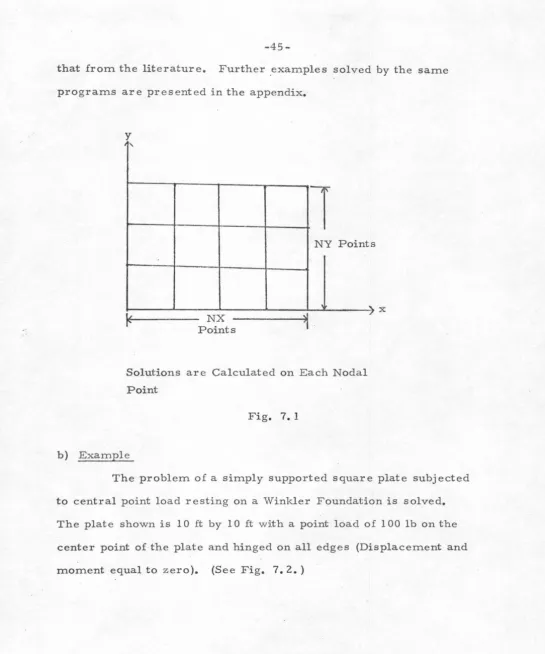
in both x and y directions at points shown in Fig. 7. I are also calcu-lated and presented as computer output.
The program can easily be modified for point loads and column loads such that step (1) can be incorporated into the main
program. The program can also be modified easily so that solutions
on any points in the plate can be calculated instead of following the
pattern shown in Fig. 7. I. A number of problems have been solved
as examples. An example which has been solved using the computer
-45-that from the literature. Further _examples solved by the same
programs are presented in the appendix.
y
'
1
NY Points
NX
Points
Solutions are Calculated on Each Nodal
Point
Fig. 7.1
b) Example
'-/ X
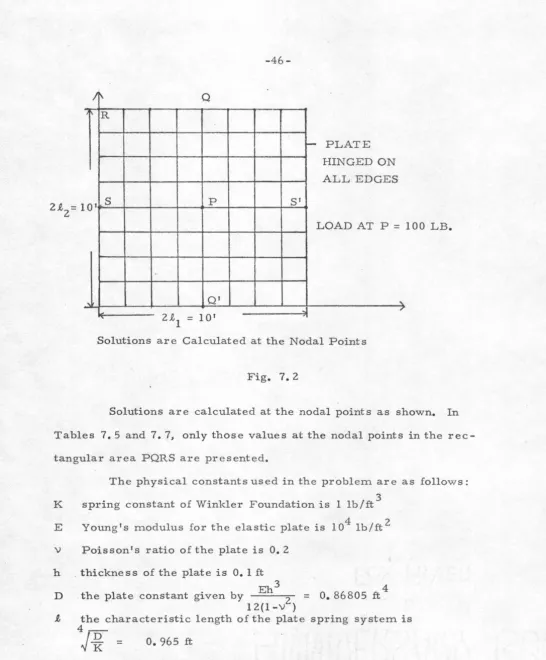
The problem of a simply supported square plate subjected
to central point load resting on a Winkler Foundation is solved.
The plate shown is 10 ft by 10 fi with a point load of 100 lb on the
center point of the plate and hinged on all edges (Displacement and
[image:49.572.11.556.35.689.2]/":'- Q
'I' R
- PLATE HINGED ON
ALL EDGES
0'
s
p S'LOAD AT P
=
100 LB.Q'
'
"
,
=
I2.R,l 10
Solutions are Calculated at the Nodal Points
Fig. 7. 2
Solutions are calculated at the nodal points as shown. In
Tables 7. 5 and 7. 7, only those values at the nodal points in the
rec-tangular area PQRS are presented.
K
E
\)
h
D
p
The physical constants used in the problem are as follows:
spring constant of Winkler Foundation is 1 lb/£t3
Young's modulus for the elastic plate is 104 lb/£t2
Poisson's ratio ofthe plate is 0.2
. thickness of the plate is 0. 1 ft
Eh3 4
the plate constant given by 2
=
0. 86805 £t12(1-\1)
the characteristic length of the plate spring system is 4 ,.-rs-K ...J
K
=
o.
965 £t [image:50.572.12.558.22.681.2]
-47-.t
1
i
length of the plate is 5 ft in the x-direction.t
2
i
length of the plate is 5 ft in the y-dir ectionTables 7. 1, 7. 3, 7. 5 and 7. 7 contain solutions calculated
from Timoshenko 1 s (8) solution (chapter 8). Tables 7. 2, 7. 4, 7. 6
and 7. 8 contain solutions calculated by the Edge Function method.
For equilibrium consideration for the Edge Function method
as well as the Timoshenko solution, the total upward force is
con-tributed from the spring force as well as the shearing force on the
boundary. The following table gives the values of the upward force
calculated. They are supposed to be equal to 100 lb when the total
downward load is applied. The spring force was calculated from the
displacements of the plate at each point and the shearing force
cal-culated from the shearing force in the normal direction on each edge
obtained from the 3rd derivative of the displacement along the edge.
COMPARISON OF EQUILIBRIUM
Edge Function Timoshenko
1 s
Solution
Force from springs 90. 5 lb 87. 5 lb
Shear force on the edges 2. 3 lb 1
o.
6 lbTotal upward force 92. 8 lb 98. 1 lb
\
From Tables 7. 1 and 7. 2 the values of displacement agree
very closely (the maximum deflection is 13. 368 in Timoshenko 1 s
solution and 13. 384 in the Edge Function method; 3 significant
figure of accuracy is achieved with 20 terms}. The slope results
Tables 7. 5 to 7. 8, the moment from both solutions does not agree
so well and shearing forces differ even more. As higher degrees
of differentiation are considered, the results from the Edge Function
method diverge more from Timoshenko 1 s solution. This is because
the convergence in the Edge Function method deteriorates. To get
a better solution more terms would have to be taken.
Solutions on axis SPS' (see Fig. 7. 2). a line on the
mid-plate, are given on Fig. 7. 3 through Fig. 7. 5. Shear on Q 'PQ,
a line on the mid-plate parallel to Y axis, is plotted and given on
Fig. 7. 6, as shear in the Y direction is calculated instead of shear
0
~ 15
d
Cl>
s
10 Cl>() n!
P..s
Ill...
t::l 0
4
3
2
1 CD
s:::
n!
e
0Cl> p..
0 -1
...-i (/)
-2
-3
-4
-49-I
x:xx .Ti.moshenko s solution
Edge F·.mction solution
Length of Plate= 10 ft.
'
.Fig. 7. 3 Plotting of Displacement along li"n~ SPS in Fig. 7. 2
I
[image:53.576.5.562.30.678.2]~
[image:54.571.9.564.18.679.2]0
... ..., 30
I
Timoshenko s Soluti