748 | P a g e
“TWO FACTOR (2F) DATA ACCESS ON OPEN
GLOOM STORAGE IN NETWORK SECURITY”
Prof. Swati T. Ghorsad
1, Prof. Thamraj N. Ghorsad
2, Prof. R.V Wasu
31,2
Assistant Professor Department of Computer Science & Engineering
Dr. SauKamaltai Gawai Institute of Engineering& Technology, Darapur, Amravati, (India)
3
Professor Department of Electronics & Telecommunication Engineering,
V.Y.W.S Polytechnic, Badnera, Amravati, (India)
ABSTRACT
Attribute-based encryption, especially for cipher-text-policy attribute-based encryption, can fulfill the
functionality of ne-grained access control in open Gloom storage systems. Since users' attributes may be issued
by multiple attribute authorities, multi-authority cipher-text-policy attribute-based encryption is an emerging
cryptographic primitive for enforcing attribute-based access control on outsourced data. However, most of the
existing multi-authority attribute-based systems are either insecure in attribute-level revocation or lack of
efficiency in communication overhead and computation cost. In this paper, we propose an attribute-based
access control scheme with two-factor(2F) protection for openGloom storage systems. In our proposed scheme,
any user can recover the outsourced data if and only if this user holds sufficient attribute secret keys with
respect to the access policy and Endorsement key in regard to the outsourced data. In addition, the proposed
scheme enjoys the properties of constant-size cipher-text and small computation cost. Besides supporting the
attribute-level revocation, our proposed scheme allows data owner to carry out the user-level revocation.
Keywords
:
Attribute-based encryption, openGloomstorage, two-factor protection, attribute-level
revocation, user-level revocation.
INTRODUCTION
Gloom storage is one of the most fundamental services, which enables the data owners to host their data in the
Gloom and through Gloom servers to provide the data access to the data consumers (users). However, it is the
semi-trusted Gloom service providers (CSPs) that maintain and operate the outsourced data in this storage
pattern.To prevent the unauthorized entities from accessing the sensitive data, an intuitional solution is to
encrypt data and then upload the encrypted data into the Gloom. In an ABE i.e. Attribute based encryption
system, each user is ascribed by a set of descriptive attributes. The user's secret key and cipher-text are
associated with an access policy or a set of attributes. Decryption is possible if and only if the attributes of
cipher-text or secret key satisfy the access policy. Such an advantage makes ABE simultaneously fulfill the data
confidentiality andCoarse-grainedaccess control in Gloom storage systems. However, there remain several
challenges to the application of CP-ABE in Gloom-based data access control. On one hand, there is only one
attribute authority (AA) in the system responsible for attribute management and key distribution. This
precondition cannot satisfy the practical requirements once users' attributes are issued by multiple AAs. On the
749 | P a g e
involved in the access policy, which may incur a large communication overhead and computation cost. This will
limit the usage of resource-constrained users. Last but not the least; the attribute-level abrogation is very
difficult since each attribute is conceivably shared by multiple users. A number of CP-ABE schemes with
respect to data access control for multi-authority Gloom storage systems have been proposed. In order to
achieve the abrogation functionality, the proposed schemes need secure communication channels to update the
attribute secret keys for the non-revoked users. But, Yang et al's DAC-MACS scheme cannot guarantee the
backward security in active attack model. The reason is that any revoked user still retrieves his/her ability to
decrypt some confidential data as a non-revoked user when he/she intercepts the cipher-text update keys
delivered from the involved AA. In some schemes Data Owners are voiceless in the permission abrogation.Our
proposed TFDAC-MACS can provide two-factor data encryption protection for multi-authority Gloom storage
systems. Each user needs to satisfy two requirements when recovering the outsourced data. One is the attributes
of this user satisfy the access policy, and the other is this user has the Endorsement key.
II. EXPERIMENTAL VIEWS
Two Factor Authentications enable users to secure their logins and transactions. The two-factor system of
authentication provides a much greater security shield against phishing and identifies theft. There are many
two-factor authentication solutions on the market today, but for thousands of organizations worldwide.
III. SYSTEM DESIGN
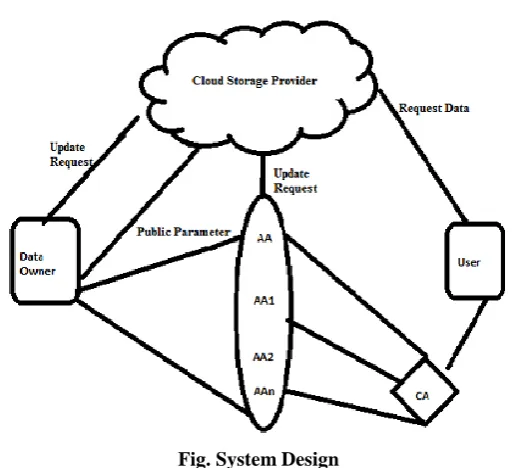
Fig. System Design
The CA sets up the system and responses the registration requests from all the AAs and users. However, the CA
is not involved into any attribute-related management. Each AA administers a distinct attribute domain and
generates a pair of public/secret key for each attribute in this attribute domain. Without any doubt, each attribute
is only managed by a single AA. Once receiving the request of attribute registration from a user, the AA
750 | P a g e
the attribute abrogation of users. Before uploading a shared data to the Gloom storage servers, the data owner
defines an access policy and encrypts the data under this access policy. After that, the data owner sends the
cipher-text and its corresponding access policy to the CSP. Meanwhile, the data owner is responsible for issuing
and revoking the user's Endorsement. Each user is labeled with a set of attributes, besides a global unique
identifier. In order to obtain the shared data, each user needs to request the attribute secret keys and
Endorsement from AAs and data owner, respectively. Any user can download the cipher-text from the CSP.
Only the authorized user who has the specific attributes can successfully recover the outsourced data. It becomes
obvious that the CSP provides data storage service and enforces the process of text update. The
cipher-text update occurs in the following two cases:
(1) Any of AAs revokes users' one or moreattributes;
(2) The data owner revokes one or more authorized users.
IV. IMPLEMENTATION
The proposed framework has been implemented using JSP and java class libraries. It acts as a middleware to
connect with public Gloom system to store and retrieve files. It uses drivehq.com free storage service to upload
and download the file. The following are the modules of the framework.
V. SYSTEM INITIALIZATION
First, the CA generates some global public parameters for the system, and accepts both the AA registration and
user registration. Then, each AAand data owner respectivelygenerates the public parameters and secret
information used throughout the execution of system.Then, each AA and data owner respectively generates the
public parameters and secret information used throughout the execution of system.
VI. SECRET KEY AND ENDORSEMENTGENERATION:
When a user submits a request of attribute registration to AA,the AA distributes the corresponding attribute
secret keys to this user if his/her certificate is true. When a user submits an Endorsement request to data owner,
the data owner generates the corresponding Endorsement key and delivers it to this user.
VII. DATA ENCRYPTION
For each shared data, the data owner first defines an access policy, and then encrypts the data under this
specified access policy. Thereafter, the data owner outsources this cipher-text to the CSP. The encryption
operation will use a set of public keys from the involved AAs and the data owner's Endorsement secret key.
VIII. DATA DECRYPTION
All the users in the system are allowed to query and download any interested cipher-texts from the CSP. A user
is able to recover the outsourced data, only if this user holds the sufficient attribute secret keys with respect to
751 | P a g e
IX. ATTRIBUTE-LEVEL ABROGATION
For attribute-level abrogation, the AA who manages the revoked attribute, issues a new public key to this
revoked attribute, and generates attribute update keys for non-revoked users and a set of cipher-text update
components for CSP. Each non-revoked user who holds the revoked attribute will update the corresponding
attribute secret key upon receiving the attribute update key. Based on the set of cipher-text update components,
the cipher-texts associated with the revoked attribute will be updated by the CSP.
X. USER-LEVEL ABROGATION
In order to revoke a user's access privilege, the data owner generates a new Endorsement secret key used for
Endorsement; a set of Endorsement update keys for non-revoked users and a set of cipher-text update
components for cipher-text update. When receiving the Endorsement update key, eachnon-revoked user updates
the Endorsement key and obtains the new version. All the involved cipher-texts will be updated by the CSP
based on the set of cipher-text update components.
XI. CONCLUSION
In this paper, we proposed a revocable multi-authority (CPABE) Cipher text Policy - Attribute Based
Encryptionscheme that can support efficient attribute abrogation. Then, we constructed an effective data access
control scheme for multi-authority Gloom storage systems. The experimental results show the proposed scheme
solves the user abrogation and collusion attack problem. The revocable multi-authority CPABE is a promising
technique, which can be applied in any remote storage systems and online social networks etc.
REFERENCES
[1] M. Armbrustet al., ``A view of Cloud computing,'' Common. ACM, vol. 53, no. 4, pp. 50_58, 2010.
[2] K. Yang, X. Jia, K. Ren, B. Zhang, and R. Xie, ``DAC-MACS:Effective data access control for
multiauthority Gloom storage systems,'' IEEE Trans.Inf. Forensics Security, vol. 8, no. 11, pp. 1790_1801,
Nov. 2013.
[3] X. Chen, J. Li, X. Huang, J. Ma, and W. Lou, ``New publicly variabledatabases with efficient updates,''
IEEE Trans. Dependable Secure Com-put., vol. 12, no. 5, pp. 546_556, Sep. 2015.
[4] K. Ren, C.Wang, and Q.Wang, ``Security challenges for the public Gloom,''IEEE InternetCompute., vol. 16,
no. 1, pp. 69_73, Jan./Feb. 2012.
[5] S. Kavitha and S. Subashini, ``A survey on security issues in servicedelivery models of cloud computing,'' J.
Newt. Compute. Appl., vol. 34, no. 1, pp. 1_11, Jan. 2011.
[6] S. Kamara and K. Lauter, ``Cryptographic cloud storage,'' in Proc. 1stWorkshop Real-Life Cryptograph.
Protocols Standardization (RLCPS), vol. 6054. 2010, pp. 136_149.
[7] X. Chen, J. Li, J. Ma, Q. Tang, and W. Lou, ``New algorithms for secureoutsourcing of modular
exponentiations,'' IEEE Trans. Parallel Distribute.Syst., vol. 25, no. 9, pp. 2386_2396, Sep. 2014.
[8] D. Boneh and M. Franklin, ``Identity-based encryption from the Weilpairing,'' in Proc. CRYPTO, vol. 2139.
752 | P a g e
[9] A. Sahai and B. Waters, ``Fuzzy identity-based encryption,'' in Advances in CryptologyEUROCRYPT
(Lecture Notes in Computer Science),vol. 3494. Heidelberg, Germany: Springer-Verlag, 2005, pp. 457_473.
[10] V. Goyal, O. Pandey, A. Sahai, and Bowater’s, ``Attribute-based encryption for _ne-grained access control
of encrypted data,'' in Proc. 13th ACMConf.Compute. Common.Secure. (CCS), Oct./Nov. 2006, pp. 89_98.
[11] J. Hur and D. K. Noh, ``Attribute-based access control with efficientabrogation in data outsourcing systems,''
IEEE Trans. Parallel DistributedSyst., vol. 22, no. 7, pp. 1214_1221, Nov. 2011.
[12] J. Lai, R. H. Deng, C. Guan, and J.Weng, ``Attribute-based encryption with variable outsourced decryption,''
IEEE Trans. Inf. Forensics Security,vol. 8, no. 8, pp. 1343_1354, Aug. 2013.
[13] K. Yang, X. Jia, and K. Ren, ``Attribute-based _ne-grained access controlwith efficient abrogation in cloud
storage systems,'' in Proc. 8th ACMSIGSAC Symp. Inf., Compute.Common.Secure. (ASIACCS), New York,
NY,USA, 2013, pp. 523_528.
[14] S. Yu, C. Wang, K. Ren, and W. Lou, ``Attribute based data sharing withattribute abrogation,'' in Proc. 5th
ACM Symp. Inf., Compute Common. Secure (ASIACCS), New York, NY, USA, 2010, pp. 261_270.
[15] J. Bethencourt, A. Sahai, and B. Waters, ``Ciphertext-policy attributebasedencryption,'' in Proc. IEEE
Symp.Secure. Privacy (SP), May 2007,pp. 321_334.
[16] L. Cheung and C. Newport, ``provably securecipher text policy ABE,''inProc. 14th ACM Conf. Compute.
Commun.Secur. (CCS), Oct. 2007,pp. 456_465.
[17] F. Guo, Y. Mu, W. Susilo, D. S. Wong, and V. Varadharajan,``CP-ABE with constant-size keys for
lightweight devices,'' IEEE Trans.Inf. Forensics Security, vol. 9, no. 5, pp. 763_771, May 2014.
[18] J. Li et al., ``Fine-grained data access control systems with user accountability in cloud computing,'' in Proc.
IEEE 2nd Int. Conf. Cloud Compute.Technol. Sci. (CloudCom), Nov./Dec. 2010, pp. 89_96.
[19] R. Ostrovsky, A. Sahai, and B. Waters, ``Attribute-based encryption with on-monotonic access structures,''
in Proc. 14th ACM Conf. Compute .Commuication. Secure.(CCS), New York, NY, USA, 2007, pp.
195_203.
[20] B. Waters, ``Cipher text-policy attribute-based encryption: An expressive, efficient, and provably secure
realization,'' in Proc. 14th Int. Conf. Pract.Theory Public Key Cryptograph. (PKC), vol. 6571.2011, pp.
321_334.
[21] A. Lewko and Bowater’s, ``New proof methods for attribute-based encryption: Achieving full security
through selective techniques,'' in Advances in Cryptology, vol. 7417. Berlin, Heidelberg: Springer-Verilog,
2012,pp. 180_198.
[22] M. Chase, ``Multi-authority attribute based encryption,'' in Proc. 4th IACRTheoryCryptograph. Conf. (TCC),