Elliptic Curves made practical
Application to a previously unreachable curve over
F
p6Antoine Joux1and Vanessa Vitse2
1 DGA and Universit´e de Versailles Saint-Quentin, Laboratoire PRISM, 45 avenue
des ´Etats-Unis, F-78035 Versailles cedex, France [email protected]
2 Universit´e de Versailles Saint-Quentin, Laboratoire PRISM, 45 avenue des
´
Etats-Unis, F-78035 Versailles cedex, France [email protected]
Abstract. We present a new “cover and decomposition” attack on the elliptic curve discrete logarithm problem, that combines Weil descent and decomposition-based index calculus into a single discrete logarithm algorithm. This attack applies, at least theoretically, to all composite degree extension fields, and is particularly well-suited for curves defined overFp6. We give a real-size example3of discrete logarithm computations on a curve over a 151-bit degree 6 extension field, which would not have been practically attackable using previously known algorithms.
Key words: elliptic curve, discrete logarithm, index calculus, Weil descent, decomposition attack
1
Introduction
Elliptic curves are used in cryptography to provide groups where the discrete logarithm problem is thought to be difficult. We recall that given a finite groupG
(written additively) and two elementsP, Q∈G, the discrete logarithm problem (DLP) consists in computing, when it exists, an integer xsuch that Q = xP. When elliptic curves are used in cryptographic applications, the DLP is usually considered to be as difficult as in a generic group of the same size [31]. As a consequence, for a given security level, the key size is much smaller than for other popular cryptosystems based on factorization or discrete logarithms in finite fields. The first elliptic curves considered in cryptography were defined over either binary or prime fields [20, 24]. But to speed up arithmetic computations, it has been proposed to use various forms of extension fields. In particular, Optimal Extension Fields have been proposed in [4] to offer high performance
3
in hardware implementations. They are of the form Fpd where p is a pseudo-Mersenne prime anddis such that there exists an irreducible polynomial of the formXd−ω∈
Fp[X]. In most examples, the degreedof the extension is rather
small. However, when curves defined over extension fields are considered, some non-generic attacks, such as the Weil descent or decomposition attacks, can be applied. The first one aims at transferring the DLP fromE(Fqn) to the Jacobian of a curve C defined over Fq and then uses index calculus on this Jacobian [2,
12, 15] to compute the logarithm; it works well when the genus of the curve
C is small, ideally equal to n, but this occurs quite infrequently in practice. Many articles have studied the scope of this technique (cf. [7, 10, 11, 14, 16]), but even on vulnerable curves, the Weil descent approach is often just a little more efficient than generic attacks on the DLP. Decomposition-based index calculus, or decomposition attack, is a more recent algorithm (see [9, 13, 18, 26]), which applies equally well to all (hyper-)elliptic curves defined over an extension field. Its asymptotic complexity is promising, but in practice, due to large hidden constants in the complexity, it becomes better than generic attacks for group sizes too large to be threatened anyway.
In this article, we combine both techniques into a cover and decomposition attack, which applies as soon as the extension degree is composite. The idea is to first transfer the DLP to the Jacobian of a curve defined on an intermediate field, then use the decomposition method on this sub-extension instead of the classical index calculus. This new attack is not a mere theoretical possibility: we give concrete examples of curves defined overFp6 that are practically secure
against all other attacks, but for which our method allows to solve the DLP in a reasonable time. In particular, we have been able to compute logarithms on a 149-bit elliptic curve group defined over a degree 6 extension field in about a month real-time, using approximately 110 000 CPU.hours.
The paper is organized as follows: first we briefly recall in Section 2 the prin-ciples of Weil descent and of the decomposition method. We then give an explicit description of our attack in Section 3, introducing a useful variant of the decom-position step that can be of independent interest. In particular, we study the case of elliptic curves defined over Fp6 orFp4, list all the potentially vulnerable
curves and give a complexity analysis and a comparison with previously known attacks. Finally, in Section 6, we describe in details the computations on our 149-bit example.
2
Survey of previous work
2.1 Weil descent and cover attacks
Weil descent has been first introduced in cryptography by Frey [10]; the idea is to view an abelian variety A of dimension d defined over an extension field
K/k as an abelian varietyWK/k of dimension d·[K:k] overk. If WK/k turns
out to be the Jacobian of a curve C|k or can be mapped into such a Jacobian,
When the genus of C is small relative to the cardinalitypof k, the complexity is in O((g2log3p)g!p+ (g2logp)p2) as p grows to infinity [12]; the first term
comes from the relation search and the second from the sparse linear algebra. Following [15], it is possible to rebalance these two terms by using a double large prime variation. In this variant, only a small numberpαofprime divisors4
are considered as genuine, while the rest of the prime divisors are viewed as “large primes”. The optimal value of αdepends of the cost of the two phases; asymptotically the choice that minimizes the total running time is 1−1/g, yielding a complexity in ˜O(p2−2/g) for fixedg aspgoes to infinity.
The main difficulty of this Weil descent method is to find the curve C. This problem was first addressed for binary fields by Gaudry, Hess and Smart (GHS [14]) and further generalized by Diem [7] in odd characteristic. To attack an elliptic curveEdefined overFpn(pa prime power), the GHS algorithm builds a curve Cdefined overFp such that there exists a cover mapπ:C →E defined
over Fpn. The construction is more easily explained in terms of function fields: the Frobenius automorphism σFpn/Fp can be extended to the composite field
F0 =Qni=0−1Fpn(Eσ i
), and the function field F =Fp(C) is defined as the
sub-field ofF0 fixed byσ. The GHS algorithm then uses the so-called conorm-norm map NF0/F ◦ConF0/
Fpn(E) to transfer the discrete logarithm from E(Fpn) to JacC(Fp). An important condition is that the kernel of this map must not
inter-sect the subgroup in which the discrete logarithm takes place, but as remarked in [7, 16], this is not a problem in most cryptographically relevant situations. This technique is efficient when the genusg ofC is close ton. In particular, for some specific finite fields most elliptic curves are “weak” in the sense that Weil descent algorithms are better, if only by a small margin, than generic attacks [23]. Indeed, when the GHS method does not provide any low genus cover forE, it may be possible to find a sequence of low degree isogenies (a.k.a. an isogeny walk) from E to another, more vulnerable elliptic curve E0 [11]. Nevertheless, we emphasize that the security loss is quite small for a random curve, and for most curves on most fields Fpn, gis of the order of 2n which means that index calculus in the Jacobian ofC is slower than generic attacks onE(Fpn).
2.2 Decomposition attack
Index calculus has become ubiquitous in the last decades for the DLP resolu-tion. However its direct application to elliptic curves faces two major challenges: contrarily to finite fields or hyperelliptic curves, there is no natural choice of factor base and no equivalent of the notion of factorization of group elements. The first main breakthrough was achieved in 2004 by Semaev [30] when he sug-gested to replace factorization by decomposition into a fixed number of points; for that purpose, he introduced the summation polynomials which give an alge-braic expression of the fact that a given point decomposes into a sum of factor base elements. But for a lack of an adequate factor base, this approach fails
4
in the general case. Then Gaudry and Diem [9, 13] independently proposed to use Semaev’s idea to attack all curves defined over small degree extension fields
Fpn/Fp. Their method shares the basic outline of index calculus, but to distin-guish it from what has been presented in the previous subsection, we follow [26] and call it the decomposition attack. On E(Fpn), a convenient choice of fac-tor base is the set of rational points of the curve having their abscissae in the base fieldFp. By combining Semaev’s summation polynomials and restriction of
scalars, the relation search then becomes a resolution of a multivariate polyno-mial system over Fp. The complexity of this approach can be estimated using
double large prime variation by ˜O p2−2/n
for fixed n as p grows to infinity. Unfortunately, the hidden constants in this complexity become very large as n
grows, and the resolution of the systems is intractable as soon asn≥4 (orn≥5 with the variant of [18]).
The decomposition attacks can also be applied to higher genus curves. How-ever, Semaev’s polynomials are no longer available in this case and the algebraic expression of the group law is more complicated. In [26], Nagao proposes an ele-gant way to circumvent this problem, using divisors and Riemann-Roch spaces. For hyperelliptic curves, the decomposition search then amounts to solving a quadratic multivariate polynomial system. This approach is less efficient than Semaev’s in the elliptic case, but is the simplest otherwise. For fixed extension degreenand genusg, the complexity of a decomposition attack is in ˜O p2−2/ng
with a double large prime variation. Again, the resolution of the polynomial sys-tem is the main technical difficulty, and is easily feasible for only very few couples (n, g), namely (2,2), (2,3) and (3,2).
3
Cover and Decomposition attack
Let Fqd/Fp be an extension of finite fields, where q is a power of p (in most
applicationspdenotes a large prime but in general, it can be any prime power), and letEbe an elliptic curve defined overFqdof cryptographic interest, i.e. con-taining a subgroup G of large prime order. As E is defined over an extension field, it is subject to the attacks presented above. But if the degree [Fqd:Fp] of
the extension is larger than 5, then we have seen thatEis practically immune to decomposition attacks. In the following, we assume that the potential reduction provided by the GHS attack or its variants is not significant enough to threaten the security of the DLP on the chosen curve E.
Whenqis a strict power ofp, we have a tower of extensions given byFqd/Fq
and Fq/Fp. In this context, it becomes possible to combine both cover and
de-composition methods and obtain an efficient attack of the DLP onE. The idea is to use Weil descent on the first extensionFqd/Fq to get a cover defined overFq,
with small enough5 genusg. Then we can apply a decomposition attack on the curve thus obtained, making use of the second extensionFq/Fp. As thiscover and
5
decompositionattack is more efficient when Weil descent provides a hyperelliptic cover over the intermediate field, we focus on this case in the following.
3.1 Description of the attack
We now explicitly detail this cover and decomposition approach. We suppose first that there exists an imaginary hyperelliptic curveHof small genusg with equation y2=h(x), defined over
Fq, together with a covering mapπ:H →E
defined overFqd. This can be obtained by the GHS attack or its variants, possibly preceded by an isogeny walk. This cover classically allows to transfer the DLP from Gto a subgroup G0 ⊂JacH(Fq) via the conorm-norm map NF
qd/Fq◦π ∗ :
E(Fqd)'JacE(Fqd)→JacH(Fq), assuming that ker(NFqd/Fq◦π
∗)∩G={O
E}.
The decomposition part of the attack is adapted from Gaudry and Nagao; since it is quite recent, we detail the method. As in all index calculus based approaches, there are two time-consuming steps: first we have to collect relations between factor base elements, then we compute discrete logarithms by using linear algebra on the matrix of relations. We consider the same factor base as [13, 26]
F={DQ∈JacH(Fq) : DQ ∼(Q)−(OH), Q∈ H(Fq), x(Q)∈Fp},
which contains approximatelypelements. As usual, we can use the hyperelliptic involutionιto reduce the size ofF by a factor 2, so that aboutp/2 relations are needed.
Letn be the extension degree [Fq :Fp]. In Nagao’s decomposition method,
one tries to decompose an arbitrary divisorD(typically obtained by considering a large multiple of some element in F) into a sum of ng divisors in the factor base
D∼
ng X
i=1
((Qi)−(OH)). (1)
Heuristically, there exist approximately png/(ng)! distinct sums ofng elements
ofF, so the probability that a given divisorDis decomposable can be estimated by 1/(ng)!. To check ifDcan be decomposed, one considers the Riemann-Roch
Fq-vector space
L(ng(OH)−D) ={f ∈Fq(H)∗: div(f)≥D−ng(OH)} ∪ {0}.
We can assume that the divisor D is reduced and has Mumford representa-tion (u(x), v(x)) with degu = g, so that this Fq-vector space is spanned by
u(x), u(x)x, . . . , u(x)xm1,(y−v(x)), x(y−v(x)), . . . , xm2(y−v(x)), wherem
1=
b(n−1)g/2candm2=b((n−1)g−1)/2c. A functionf =λ0u(x) +λ1u(x)x+
. . .+λm1u(x)xm1+µ0(y−v(x)) +µ1x(y−v(x)) +. . .+µm2xm2(y−v(x))
van-ishes on the support ofDand exactlyngother points (counted with multiplicity and possibly defined on the algebraic closure ofFq) if its top-degree coefficient
is not zero. We are looking for a condition on λ0, . . . , λm1, µ0, . . . , µm2 ∈ Fq
in Fp; this event yields a relation as in (1). Therefore, we consider the
polyno-mialF(x) =f(x, y)f(x,−y)/u(x) wherey2has been replaced byh(x). Without
loss of generality, we can fix either λm1 = 1 or µm2 = 1 in order to have F
monic of degree ng. The roots ofF are exactly thex-coordinates of the zeroes of f distinct from Supp(D), thus we are looking for the values of λand µ for which F splits in linear factors over Fp. A first necessary condition is that all
of its coefficients, which are quadratic polynomials in λandµ, belong to Fp; a
scalar restriction on these coefficients then yields a quadratic polynomial system of (n−1)ng equations and variables coming from the components of the vari-ables λ and µ. The corresponding ideal is generically of dimension 0, and the solutions of the system can be found using e.g. a Gr¨obner basis computation. Since the number of systems to solve is huge (on average (ng)!·p/2, or more if a large prime variation is applied), techniques such as the F4 variant of [19] should be preferred. Once the solutions in Fq are obtained, it remains to check
if the resulting polynomialF splits inFp[x], and if it is the case, to compute the
corresponding decomposition ofD.
In this article, we also consider a somewhat different approach to the relation search that offers some similarity with the method used in the number field and function field sieves [1, 22]. More precisely, we no longer have a divisor D to decompose, but instead search for sums of factor base elements equal to 0:
m X
i=1
((Qi)−(OH))∼0. (2)
Heuristically, the expected number of relations of the form (2) involvingmpoints of the factor base is approximately pmm−!ng. Since we need to collect at least aboutp/2 relations, we look for sums ofm=ng+ 2 points (assuming that p≥
(ng+2)!/2, which will always be the case in practice). As before, we work with the
Fq-vector space L(m(OH)), which is spanned by 1, x, . . . , xm1, y, xy, . . . , xm2y, where m1 =bm/2cand m2 =b(m+ 1)/2c −g. We consider the function f =
λ0+λ1x+. . .+λm1x m1+µ
0y+µ1xy+. . .+µm2x
m2y: it vanishes in exactly
m points if its top-degree coefficient is not zero, and the abscissae of its zeroes are the roots of
F(x) =f(x, y)f(x,−y) = (λ0+λ1x+. . .+λm1x
m1)2−h(x)(µ
0+µ1x+. . .+µm2x m2)2.
Again, we fixλm1 = 1 ifmis even orµm2 = 1 otherwise, so thatF is monic. In
order to obtain a relation of the form (2), we look for values ofλandµfor which
F splits over Fp. The first condition is that F belongs to Fp[x]; after a scalar
Once enough relations of the form (2) have been collected, and possibly af-ter a structured Gaussian elimination or a large prime variation, we can deduce with linear algebra the logarithms of all elements in F (up to a multiplicative constant, since we have not specified the logarithm base). To compute the dis-crete logarithm of an arbitrary divisor D, we proceed to a descent phase: we need to decompose this arbitrary divisor as a sum of factor base elements. This decomposition search can be done using the first method described above. Note that, if D does not decompose as a sum, it suffices to try small multiples 2D, 3D . . . until we find one correct decomposition. Thanks to this descent step, it is possible to compute many discrete logarithms in the same group for negligible additional cost.
When the cover of E is not hyperelliptic, one can still use the Riemann-Roch based approach. It is not difficult to compute a basis of the vector spaces
L(ng(OH)−D) orL(m(OH)) and to consider a functionf(x, y) (depending of parameters λandµ) in these spaces. Getting rid of they-variable can be done quite easily by computing the resultant in y off and the equation of the curve (or multiresultant if the curve is not planar); however, the resulting polynomial
F(x) no longer depends quadratically of the parametersλandµ. Consequently, the system obtained by scalar restriction still has the same number of equations and variables but its degree is greater than 2, so that the resolution is more complicated.
3.2 Sieving for quadratic extensions
This new decomposition technique is already faster than Nagao’s when the lexi-cographic Gr¨obner basis of the system coming from (2) is efficiently computable, but it can still be further improved. Indeed, checking thatF is split has a non-negligible cost, since we need to factor a polynomial of degreeng+ 2 into linear terms. To avoid this, it is possible to modify the search for relations of the form (2) using a sieving technique when the extension degree [Fq :Fp] is equal
to 2 in the odd characteristic case. Lett be an element such thatFp2 =Fp(t);
we assume wlog thatt2=ω∈
Fp. In this case,f =λ0+· · ·+λgxg+µy and the
polynomialF is of the form
F(x) = (λ0x+· · ·+λgxg+xg+1)2−µ2h(x).
In particular, when the parameterµequals 0,f is independent of they variable; the corresponding relation of type (2) is thus necessarily of the form (P1) +
(ι(P1)) +. . .+ (Pg+1) + (ι(Pg+1))−(2g+ 2)OH∼0,whereι(P) is the image ofP by the hyperelliptic involution. To avoid these trivial relations, we look only for solutions (λ0,0, . . . , λg,0, λ0,1, . . . , λg,1, µ0, µ1)∈VFp(I: (µ0, µ1)∞),whereIis the
ideal corresponding to the 2(g+ 1) quadratic polynomials in 2(g+ 2) variables arising from the scalar restriction on F ∈Fp2[x], setting λi = λi,0+tλi,1 and
µ2 =µ
0+tµ1. More precisely, with the type of extension considered here, the
idealIis given by the equations corresponding to the vanishing of the coefficients of theFp[x]-polynomial
where h(x) =h0(x) +th1(x),h0, h1 ∈Fp[x]. This idealI is not 2-dimensional,
but its saturation is.
An easy but crucial remark is that the ideal is multi-homogeneous, generated by polynomials of bi-degree (1,1) in the variables (1 : λ0,0 : . . . : λg,0),(λ0,1 :
. . . : λg,1 : µ0 : µ1). This additional structure has two major consequences.
First, the lexicographic Gr¨obner basis computation is much faster than for a generic quadratic system of the same size. Second, if we denote byπ1 the
pro-jection on the first block of variables (λ0,0, . . . , λg,0), then the imageπ1(VFp(I: (µ0, µ1)∞)) = π1(VFp(I)\VFp(µ0, µ1)) is a dimension 1 variety (whose
equa-tions are easily deduced from the lex Gr¨obner basis of I), and each fiber is a 1-dimensional vector space.
From this, we can simplify the relation search. Rather than evaluating a first variable, we choose a point (λ0,0, . . . , λg,0) ∈ π1(VFp(I: (µ0, µ1)∞)) and
express the remaining variables linearly in terms ofλ0,1, so that nowF belongs
toFp[x, λ0,1] and has degree 2g+ 2 inxand 2 inλ0,1. Instead of trying to factor
F for many values ofλ0,1, the key idea is to compute for eachx∈Fp the values
ofλ0,1 such thatF(x, λ0,1) = 0. SinceF has degree 2 inλ0,1, this can be done
very efficiently by computing the square root of the discriminant. In fact, we can speed the process even more by tabulating the square roots ofFp. Our sieving
process consists, for each rootλ0,1, to increment a counter corresponding to this
value of λ0,1; when one of these counters reaches 2g+ 2, then the polynomial
F evaluated at the corresponding value ofλ0,1 splits into 2g+ 2 distinct linear
terms, yielding a relation. This technique not only allows to skip the factorization of a degree 2g+ 2 polynomial, but is also well-suited to the double large prime variation, as explained in next section.
3.3 Complexity analysis
Constructing the coverH|Fq of an elliptic curveE|Fqd with the GHS method and transferring the DLP from G⊂E(Fqd) toG0⊂JacH(Fq) has essentially a unit
cost, which is negligible compared to the rest of the attack. The complexity of the decomposition phase is divided between the relation search and the linear algebra steps. In order to collect aboutp/2 relations using Nagao’s decomposition method, we need to solve on average (ng)!·p/2 quadratic polynomial systems. The resolution cost of this kind of system using e.g. Gr¨obner bases is hard to estimate precisely, but is at least polynomial in the degree 2(n−1)ng of the corresponding zero-dimensional ideal. The linear algebra step then costsO(ngp2) operations modulo #G, using sparse linear algebra techniques. With the second decomposition method, we need to compute first the lexicographic Gr¨obner basis of an ideal generated byn(n−1)g+ 2n−2 quadratic equations inn(n−1)g+ 2n
variables. This cost is also at least exponential in n2g, but the Gr¨obner basis
computation has to be done only once. Afterwards, we have to solve on average (ng+ 2)!·p/2 “easy” systems. The complexity of the linear algebra step is the same (the cost of the descent is negligible compared to the sieving phase).
Indeed, collecting extra relations can speed up the logarithm computations; this is the idea behind structured Gaussian elimination [21] and double large prime variation. The analysis of [15] shows that with the latter, the asymptotic com-plexity of our cover and decomposition attack becomes either ˜O(p2−2/ng) or
˜
O(p2−2/(ng+2)) with the decomposition variant, aspgrows to infinity for fixedn
andg. Although the complexity of the variant is asymptotically higher, the much smaller hidden constant means that it is actually faster for accessible values of
p. Note that it is straightforward to parallelize the relation search phase; this is also possible, but much less efficiently, for the linear algebra step. In particular, the optimal choice of the balance depends not only of the implementation but also of the computing power available.
Whenn = 2, it is possible to improve the double large prime variation by sieving only among the values of x corresponding to the abscissae of points of the “small primes” factor base. As soon as 2g values of x are associated to one value of λ0,1, we obtain a relation involving at most 2 large primes (if
the remaining degree 2 factor is split, which occurs with probability close to 1/2). This speeds up the relation search and decreases the overall complexity from ˜O(p2−2/(2g+2)) to ˜O(p2−2/(2g+1)) aspgrows to infinity, thus reducing the
asymptotic gap between the two decomposition methods without degrading the practical performances.
Obviously, our approach outperforms generic algorithms only if the genus of the intermediate cover is not too large. Otherwise, it may be possible to transfer the DLP from E to a more vulnerable isogenous curve E0. There exist two “isogeny walk” strategies to findE0(if it exists) [17]: one can sample the isogeny class of E via low-degree isogenies until a weak curve is found, or one can try all the weak curves until a curve isogenous toE is found. The best strategy to use depends on the size of the isogeny class, on the number of weak curves and on the availability of an efficient algorithm for constructing these weak curves. For the cases we have considered, this isogeny walk can become the dominating part in the overall complexity (see below for details).
4
Application to elliptic curves defined over
F
p6For an elliptic curve E defined over an extension field Fp6, we can apply our
cover and decomposition attack either with the tower Fp6—Fp2—Fp or with
the towerFp6—Fp3—Fp. We have seen in Section 2.2 that in practice, we can
compute decompositions only for a very limited number of values of (n, g). In particular, our attack is feasible only ifEadmits a genus 3 (resp. 2) cover; we give examples of such curves below. Of course, this attack needs to be compared with the classic cover attacks or decomposition attacks using the base field Fp3,Fp2
orFp, as recalled in Section 2.
4.1 Using a genus 3 cover
char-acteristic, we know that the only elliptic curves defined over Fq3 (in our case,
q =p2) for which the GHS attack yields a cover by a hyperelliptic curveH of
genus 3 defined overFq, are of the form
y2=h(x)(x−α)(x−σ(α)) (3)
whereσis the Frobenius automorphism ofFq3/Fq,α∈Fq3\Fq andh∈Fq[x] is of
degree 1 or 2. Similar results are also available in characteristic 2 (see [27]), thus our attack is also applicable in characteristic 2; we give details of the construction of the cover in both cases in Appendix A. The number of curves admitting an equation of the form (3) is Θ(q2), thus only a small proportion of curves is
directly vulnerable to the cover and decomposition attack using this extension tower. However, since this number of weak curves is much larger than the number of isogeny classes (which is aboutq3/2), a rough reasoning would conclude that
essentially all curves should be insecure using an isogeny walk strategy. Assuming that the probability for a curve to be weak is independent from its isogeny class, we obtain that the average number of steps before reaching a weak isogenous curve should be about q = p2 steps. It is thus the dominating phase of the
algorithm, but is still better than the ˜O(p3)-generic attacks. Nevertheless, all
the curves of the form (3) have a cardinality divisible by 4, so obviously not all curves are vulnerable to this isogeny walk (we recall that two curves are isogenous if and only if they have the same cardinality). Still, we conjecture that all curves with cardinality divisible by 4 are vulnerable to this cover and decomposition attack using an isogeny walk.
We can also consider non-hyperelliptic genus 3 covers. In this case, weak curves have equation
y2=c(x−α)(x−σ(α))(x−β)(x−σ(β)) (4)
wherec∈Fq3 and eitherα, β∈Fq3\Fq orα∈Fq6\ Fq2∪Fq3andβ=σ3(α).
This targets much more curves: actually, about half of the curves having their full 2-torsion defined overFq3 admit an equation of this form [25].
For a genus 3 hyperelliptic cover overFp2, the quadratic polynomial systems
to solve overFp are composed of 6 variables and 6 equations, or 8 equations and
10 variables with our variant. Such systems can be solved very quickly by any computational algebra system. Unfortunately, with non-hyperelliptic covers, the systems of equations are much more complicated, and we have not been able to compute decompositions with available Gr¨obner basis implementations.
4.2 Using a genus 2 cover
We now consider the tower Fp6—Fp3—Fp. The existence of genus 2 covers
(which are necessarily hyperelliptic) defined over Fq, where q = p3, has been
studied in [3, 29]. In odd characteristic, vulnerable curves admit an equation in so-called Scholten form
where a, b ∈ Fq2 and σ is the Frobenius automorphism of Fq2/Fq. An elliptic
curve E can be transformed into Scholten form as soon as its full 2-torsion is defined overFq2 [29] or its cardinality is odd andj(E)∈/Fq [3]. Consequently, a
large proportion of curves are vulnerable to our cover and decomposition attack. Moreover, any curve without full 2-torsion but still with a cardinality divisible by 4, is 2-isogenous to a curve with full 2-torsion.
In this setting, the quadratic polynomial systems to solve overFp are
com-posed of 12 variables and 12 equations, or 16 equations and 18 variables with the decomposition variant. Solving such systems is still feasible on current personal computers, but is much lower than in the case of hyperelliptic genus 3 cover defined overFp2.
4.3 Complexity and comparison with other attacks
Apart from the square-root generic algorithms, the existing ECDLP attacks over sextic extensions are either Gaudry’s decomposition method [13] or the GHS at-tack followed by Gaudry’s or Diem’s index calculus [15, 8], with base field Fp
or Fp2 (usingFp3 as base field does not provide any advantage in this context).
When the base field is Fp2, the asymptotic complexity is in ˜O p8/3 for both
decomposition and GHS (assuming a genus 3 cover), or even in ˜O p2 with a degree 4 planar cover. But in all cases, the memory requirement is then very large, in ˜O(p2). When the base field is
Fp, computing direct decompositions is
completely out of reach, and the GHS attack very rarely provides low genus covers: the smallest possible genus is actually 9 (with corresponding degree 10 plane model), but this occurs for at mostp3curves, see Appendix C. The
result-ing genus is much higher for most curves [5], implyresult-ing that this attack is rarely practical.
We give in Table 1 a summary of the performances of the presented ap-proaches. In order to obtain actual (and not just asymptotic) comparisons, we also consider the cryptographically significant example of a curveE|Fp6 wherep
is a prime close to 227, whose cardinality is divisible by a 160-bit prime number.
The values given are obviously just estimates relying on extrapolations of rela-tion searches done on Magma V2-17-5 [6] with an Intel Core 2 Duo processor; in particular, the two last estimates are greater than what could be expected from the results obtained with optimized implementation presented in Section 6. Details of the computations are provided in Appendix D.
5
Application to elliptic curves defined over
F
p4IfE is an elliptic curve defined overFp4, we can use our attack with the tower Fp4—Fp2—Fp. Whenpis odd, we have seen thatEadmits a genus 2 cover over Fp2 as soon as the cardinality ofE is either odd (andj(E)∈/ Fp2) or divisible
by 4. Thus, approximately 3/4 of the elliptic curves defined overFp4 are directly
Attack Asymptotic complexity
Memory complexity
Time estimates (years)
Pollard onE(Fp6) [28] O˜(p3) O˜(1) 5×10¹³
Ind. calc. on JacH(Fp2),g= 3 [15] O˜(p8/3) O˜(p2) 6×10¹⁰†
Ind. calc. on JacC(Fp2),d= 4 [8] O˜(p2) O˜(p2) 700 000
Decompositions onE((Fp2)3) [13] O˜(p8/3) O˜(p2) 1012
Ind. calc. on JacC(Fp),d= 10 [8] O˜(p7/4) O˜(p) 1 500(∗)
Decomp. on JacH(Fp3),g= 2 [this work] O˜(p5/3) O˜(p) 4×10⁶
Decomp. on JacH(Fp2),g= 3 [this work] O˜(p5/3) O˜(p) 750†
Sieving on JacH(Fp2),g= 3 [this work] O˜(p12/7) O˜(p) 300†
†: only forΘ(p4) curves before isogeny walk (∗): only forO(p3) curves
Table 1.Comparison of the complexity of various attacks onE(Fp6), log2p≈27.
3.2 can be applied. In particular, we can solve the DLP onE with a complexity of ˜O(p2−2/5), where the hidden constant is rather small. With a Nagao-style decomposition, the asymptotic complexity becomes ˜O(p2−2/4), but with a larger constant corresponding to the resolution cost of a quadratic system composed of 4 equations in 4 variables. If we directly apply the decomposition attack of Gaudry and Diem to E, the asymptotic complexity is still in ˜O(p2−2/4), but
the constant is much larger: the systems are also composed of 4 equations in 4 variables, but with total degree 8. For cover attacks, the case of quartic ex-tensions has been studied in [3]; the result is that most elliptic curves defined overFp4 admit a cover by a non-hyperelliptic genus 9 curve. Using this cover to
solve the DLP with an index calculus method yields an asymptotic complexity in ˜O(p2−2/9), or potentially ˜O(p2−2/8) with the approach of [8]. All these
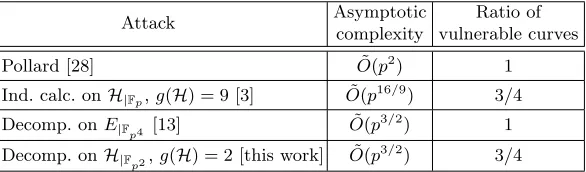
at-tacks are asymptotically better than generic algorithms, but the improvement is smaller than for elliptic curves defined overFp6. Nevertheless, a much larger
pro-portion of curves is directly vulnerable to our attack, and does not necessitate a preliminary isogeny walk. We summarize in Table 2 the asymptotic complexities of the different attacks.
Attack Asymptotic complexity
Ratio of vulnerable curves
Pollard [28] O˜(p2) 1
Ind. calc. onH|Fp,g(H) = 9 [3] O˜(p16/9) 3/4
Decomp. onE|F
p4 [13] O˜(p
3/2
) 1
Decomp. onH|F
p2,g(H) = 2 [this work] O˜(p
3/2
) 3/4
6
A 149-bit example
In this section, we give a practical example of the cover and decomposition attack for an elliptic curve defined over the Optimal Extension FieldFp6, where
p= 33 554 467 = 225+ 35 is the smallest 26-bit prime. We define
Fp2 as Fp[t]
where t2 = 2 and
Fp6 as Fp2[θ] where θ3 =t. The elliptic curve E is given by
the following Weierstrass equation:
y2=x(x−α)(x−σ(α))
whereσ:x7→xp2
andα= 9 819 275+31 072 607θ+17 686 237θ2+31 518 659θ3+
22 546 098θ4+ 17 001 125θ5. It has a genus 3 cover by the hyperelliptic curve
Hdefined overFp2 byy2=
x+φ(x) +φσ(x) +φσ2(x)N(x)2, withN(x) the
minimal polynomial of αover Fp2 and φ: x7→
(α−σ2(α))(σ(α)−σ2(α)) x−σ2(α) +σ
2(α).
The cover mapπis given by:
π(x, y) =
x+φ(x)+φσ(x)+φσ2(x)
4 ,
y(x−φσ(x))(x−φσ2(x))
8N(x)(x−σ2(α))
.
The common cardinality ofE overFp6 and of the Jacobian ofHoverFp2 is four
times the 149-bit prime`= 356814156285346166966901450449051336101786213, and the number of elements in the factor base is 16 775 441.
For best performances, we use the sieving approach described in Section 3.2. As a first step, we compute a lexicographic Gr¨obner basis of the system composed of 10 quadratic equations in 8 variables in about 3 s on a 2.6 GHz Intel Core 2 Duo processor with Magma V2.16-12. Instead of the double large prime variation, we execute a structured Gaussian elimination. During the sieving phase, we used 1 024 cores of quadri-core Intel Xeon 5570 processors at 2.93 GHz6. After 62 h,
we had collected about 1.4×10¹⁰'p2/(2·8!) relations, that is all the possible
relations of the form (2). For comparison, we also tested Nagao-style decompo-sitions on the same type of processors. We obtained that one decomposition test takes about 22 ms on a single core, thus showing that our decomposition variant is about 960 times faster.
Thanks to the large number of extra relations, structured Gaussian elimina-tion performed quite well and, after 25.5 h on 32 cores, it reduces the number of unknowns to 3 092 914 (a fivefold reduction). For safety, the output system con-tains 15 000 more equations than this number of unknowns, and each equation involves between 8 and 182 basis elements. The total number of non-zero entries in all the equations is 191 098 665 and all these entries are equal to±1. The most time-consuming step is the iterative linear algebra, which is done with a MPI implementation of the Lanczos algorithm. It took about 28.5 days on 64 cores of the same Intel Xeon processors. A large fraction of this time was taken by the MPI communications, since at each round 200 MB of data had to be broad-cast between the 2 involved machines (32 cores/machine). This linear algebra
6
phase produced discrete logarithms for all the basis elements that remained af-ter structured Gaussian elimination. Substituting these values back in the initial linear system, we recovered, in less than 12 h using 32 cores, the discrete loga-rithms modulo `of all elements in the basis (given by their coordinates onH):
log(5,1 646 475+19 046 912t) = 324090233616618447788899446283862317783046006 log(6,2 062 691+792 228t) = 134424987842262695486611476989769052152832441 log(7,3 868 228+21 035 932t) = 229073181595667785229146623058011111735286961
.. .
log(33 554 465,4 471 075+14 598 628t) = 340713467460900419473167933722631654111145151
With the results of the above precomputation, computing logarithm of ar-bitrary points on the elliptic curve becomes easy. To demonstrate this, we con-structed points onE with the following process and computed their logarithms. First, we let X0=P5
j=0(bπ·p
j+1emodp)θj=4 751 066+748 974θ+8 367 234θ2+24 696 290θ3+
1 372 315θ4+7 397 713θ5. We then constructed points on E with abscissa X0+δ
for small offsets δ. Let P1, P2,P3, P4, P5 and P6 be the points corresponding
to offsets 3, 4, 11, 14, 15 and 16. We lift each of these points to the Jacobian ofHusing the conorm-norm map, which takes negligible time in Magma. After that, we apply the descent method of Section 3.1 to small multiples of the lifted element, until we find a multiple that decomposes as a sum of elements from the smoothness basis. Looking up the corresponding logarithms (and dividing back by the small multiples that have been included) yields the logarithm of each point. On average, we expect to try 6! = 720 multiples before finding a decom-position. To actually decompose the six considered points, we needed 72.5 s. As a consequence, each individual logarithm on E can be performed in less than one minute. We give details in Table 3: the points involved in the decomposi-tion are described by their abscissa together with a + or−sign that indicates whether the “real” part of the ordinate has a positive or negative representative in (−p/2, p/2). Similarly, we indicate the choice of the points onE with a + or a −depending on the representative of the constant term in the ordinate7.
Points Mult. Nagao Points in decomposition
(X0+ 3)+ 97 2844007+ 3819744− 5618276− 8396644− 11841629−23771773−
(X0+ 4)− 36 4673075−11272201+12937918−13869464− 14428213+21399158−
(X0+ 11)+ 742 4884810− 6230068− 8411592+12188294+20118618+20945232−
(X0+ 14)− 956 3660673− 4314732−20180301+22563519+26157093−27107773−
(X0+ 15)− 682 780652+ 8444164+10116987+11070139− 14566563− 32232816+ (X0+ 16)− 19 13089639−19783194−23921581−28500971+30393573+30478839+
Table 3.Details of individual logarithm computations.
7
The group structure of E is Z/2Z×Z/(2`)Z and all the logarithms are computed mod `. Thus, in order to obtain points of order `, we multiply each of the points Pj by 2. To obtain the discrete logarithms in baseP1, we simply
divide the results by the logarithm ofP1. Finally, we obtain:
2·P2= 44853429456306375520883685722551142750204929·2·P1
2·P3= 245828744177202642167186866655188704860309093·2·P1
2·P4= 241773698573992897197261454348760406499325884·2·P1
2·P5= 47914434731086497860980273327037833732109767·2·P1
2·P6= 164437442681856563836816034418873153945805017·2·P1
7
Conclusion and perspectives
In this paper, we have proposed a new index calculus algorithm to compute discrete logarithms on elliptic curves defined over extension fields of composite degree. In particular, sextic extensions are very well-suited to this method, as we have practically demonstrated on a 149-bit example.
This combination of cover and decomposition techniques raises many ques-tions. For example, it would be interesting to know if elliptic curves of prime cardinality defined over a degree 6 extension field can be efficiently attacked. A related problem is how to target more curves easily: this requires either an improvement of the isogeny walk, or an efficient use of non-hyperelliptic covers. Finally, whether our method applies to different extension degrees is an impor-tant issue; clearly, degree 4 extensions are also susceptible, but the advantage over generic methods is then less significant.
Acknowledgements.We acknowledge that the results in this paper have been achieved using the PRACE Research Infrastructure resource Curie based in France at TGCC, Bruy`eres-le-Chatel.
References
1. L. M. Adleman. The function field sieve. InAlgorithmic number theory (Ithaca, NY, 1994), volume 877 ofLecture Notes in Comput. Sci., pages 108–121. Springer, Berlin, 1994.
2. L. M. Adleman, J. DeMarrais, and M.-D. Huang. A subexponential algorithm for discrete logarithms over the rational subgroup of the Jacobians of large genus hyperelliptic curves over finite fields. InAlgorithmic number theory (Ithaca, NY, 1994), volume 877 ofLecture Notes in Comput. Sci., pages 28–40. Springer, Berlin, 1994.
3. S. Arita, K. Matsuo, K.-I. Nagao, and M. Shimura. A Weil descent attack against elliptic curve cryptosystems over quartic extension fields. IEICE Trans. Fundam. Electron. Commun. Comput. Sci., E89-A:1246–1254, May 2006.
5. I. F. Blake, G. Seroussi, and N. P. Smart, editors. Advances in elliptic curve cryptography, volume 317 of London Mathematical Society Lecture Note Series. Cambridge University Press, Cambridge, 2005.
6. W. Bosma, J. Cannon, and C. Playoust. The Magma algebra system. I. The user language. J. Symbolic Comput., 24(3-4):235–265, 1997. Computational algebra and number theory (London, 1993).
7. C. Diem. The GHS attack in odd characteristic.J. Ramanujan Math. Soc., 18(1):1– 32, 2003.
8. C. Diem. An index calculus algorithm for plane curves of small degree. In Algorith-mic number theory, volume 4076 ofLecture Notes in Comput. Sci., pages 543–557. Springer, Berlin, 2006.
9. C. Diem. On the discrete logarithm problem in elliptic curves. Compos. Math., 147(1):75–104, 2011.
10. G. Frey. How to disguise an elliptic curve (Weil descent). Talk at the 2nd Elliptic Curve Cryptography Workshop (ECC), 1998. Preprint, available athttp://www. cacr.math.uwaterloo.ca/conferences/1998/ecc98/frey.ps.
11. S. D. Galbraith, F. Hess, and N. P. Smart. Extending the GHS Weil descent attack. InAdvances in cryptology—EUROCRYPT 2002, volume 2332 ofLecture Notes in Comput. Sci., pages 29–44. Springer, Berlin, 2002.
12. P. Gaudry. An algorithm for solving the discrete log problem on hyperelliptic curves. InAdvances in cryptology—EUROCRYPT 2000, volume 1807 ofLecture Notes in Comput. Sci., pages 19–34. Springer, Berlin, 2000.
13. P. Gaudry. Index calculus for abelian varieties of small dimension and the elliptic curve discrete logarithm problem. J. Symbolic Comput., 44(12):1690–1702, 2008. 14. P. Gaudry, F. Hess, and N. P. Smart. Constructive and destructive facets of Weil
descent on elliptic curves. J. Cryptology, 15(1):19–46, 2002.
15. P. Gaudry, E. Thom´e, N. Th´eriault, and C. Diem. A double large prime variation for small genus hyperelliptic index calculus. Math. Comp., 76:475–492, 2007. 16. F. Hess. Generalising the GHS attack on the elliptic curve discrete logarithm
problem. LMS J. Comput. Math., 7:167–192 (electronic), 2004.
17. F. Hess. Weil descent attacks. InAdvances in elliptic curve cryptography, volume 317 of London Math. Soc. Lecture Note Ser., pages 151–180. Cambridge Univ. Press, Cambridge, 2005.
18. A. Joux and V. Vitse. Elliptic curve discrete logarithm problem over small degree extension fields.J. Cryptology, pages 1–25, 2011. DOI: 10.1007/s00145-011-9116-z. 19. A. Joux and V. Vitse. A variant of the F4 algorithm. In A. Kiayias, editor,Topics in cryptology—CT-RSA 2011, volume 6558 ofLecture Notes in Comput. Sci., pages 356–375, Berlin, 2011. Springer.
20. N. Koblitz. Elliptic curve cryptosystems. Math. Comp., 48(177):203–209, 1987. 21. B. A. LaMacchia and A. M. Odlyzko. Computation of discrete logarithms in prime
fields. Des. Codes Cryptogr., 1(1):47–62, 1991.
22. A. K. Lenstra and H. W. Lenstra, Jr., editors. The development of the number field sieve, volume 1554 ofLecture Notes in Mathematics. Springer-Verlag, Berlin, 1993.
23. A. Menezes, E. Teske, and A. Weng. Weak fields for ECC. In T. Okamoto, editor, Topics in cryptology—CT-RSA 2004, volume 2964 of Lecture Notes in Comput. Sci., pages 366–386. Springer, Berlin, 2004.
25. F. Momose and J. Chao. Scholten forms and elliptic/hyperelliptic curves with weak Weil restrictions. Cryptology ePrint Archive, Report 2005/277, 2005.
26. K. Nagao. Decomposition attack for the Jacobian of a hyperelliptic curve over an extension field. In Algorithmic Number Theory – ANTS-IX, volume 6197 of Lecture Notes in Comput. Sci., pages 285–300. Springer, Berlin, 2010.
27. E. Nart and C. Ritzenthaler. Genus 3 curves with many involutions and application to maximal curves in characteristic 2, 2009. To appear in the proceedings of AGCT-12.
28. J. M. Pollard. Monte Carlo methods for index computation (modp).Math. Comp., 32(143):918–924, 1978.
29. J. Scholten. Weil restriction of an elliptic curve over a quadratic extension. Preprint, available athttp://homes.esat.kuleuven.be/~jscholte/weilres.pdf, 2003.
30. I. A. Semaev. Summation polynomials and the discrete logarithm problem on elliptic curves. Cryptology ePrint Archive, Report 2004/031, 2004.
31. V. Shoup. Lower bounds for discrete logarithms and related problems. InAdvances in cryptology—EUROCRYPT 1997, volume 1233 ofLecture Notes in Comput. Sci., pages 256–266. Springer, Berlin, 1997.
32. N. Th´eriault. Weil descent attack for Kummer extensions. J. Ramanujan Math. Soc., 18(3):281–312, 2003.
A
Genus 3 cover
A.1 Odd characteristic
We consider elliptic curves defined overFq3 of the form
y2=h(x)(x−α)(x−σ(α)) (6)
where σis the Frobenius automorphism of Fq3/Fq, α∈Fq3\Fq and h∈Fq[x]
of degree 1 or 2. Such elliptic curves were studied by [7, 32]; they are the only elliptic curves for which the GHS attack yields a cover by a hyperelliptic curve
Hof genus 3 defined overFq.
We give now an explicit description of the coverπ:H →E; following [25], we express this cover as a quotient by a bi-elliptic involution, instead of using the GHS approach. For simplicity, we will assume thath(x) =x(this can always be achieved by an appropriate change of coordinates ifhhas a root inFq).
Let φ : x 7→ D x−σ2(α) +σ
2(α) be the unique involution of
P1(Fq) sending
σ2(α) to∞andαtoσ(α), so thatD= α−σ2(α)
σ(α)−σ2(α)
. Ifφlifts to an involution of a hyperelliptic curveH|Fq, then necessarily φ
σ andφσ2
will be
also involutions ofH. Observing that {Id, φ, φσ, φσ2}forms a group, this leads us to consider the curve of equation y2 = x+φ(x) +φσ(x) +φσ2(x); a more usual form for this equation is
H: y2=F(x)N(x) (7)
where N(x) = (x−α) (x−σ(α)) x−σ2(α)
is the minimal polynomial of α
F(x) = N(x)x+φ(x) +φσ(x) +φσ2(x) ∈ Fq[x]. It is clear that φ gives an
involution ofH, still denoted byφ: (x, y)7→ D
x−σ2(α)+σ2(α), y D2
(x−σ2(α))4
.
The quotient of this genus 3 hyperelliptic curveHbyφis the elliptic curve
E0: y2= (x−α−σ(α)) x2−4ασ(α)
and the quotient mapπ0:H →E0satisfiesπ0(x, y) = x+φ(x), y/(x−σ2(α))2. The curve E0 is 2-isogenous to the original curveE :y2 =x(x−α)(x−σ(α)) via the map:
(x, y)7→
x2−4ασ(α)
4(x−α−σ(α)), y
(x−2α)(x−2σ(α)) 8(x−α−σ(α))2
.
Finally, the cover mapπ:H →E has the expression
π(x, y) = F(x) 4N(x),
y(x−φσ(x))(x−φσ2(x)) 8N(x)(x−σ2(α))
!
. (8)
In the general case, whenEhas equation (6), the cover (8) remains the same and the corresponding hyperelliptic curve Hof genus 3 defined overFq has the
following equation:
H: y2= 4N(x)2h
F(x)
4N(x)
.
A.2 Characteristic 2
LetEbe an ordinary curve defined over a binary fieldFq3; it admits an equation
of the form
E: y2+xy=x3+ax2+b (9) whereb= 1/j(E). As already apparent in [14], the GHS attack produces a genus 3 hyperelliptic cover ofEwhen TrFq3/Fq(b) = 0, so thatΘ(q
2) curves are directly
vulnerable. To describe this cover, we slightly adapt the description of [25, 27], already used in the previous subsection.
Letσ:x7→xq be the Frobenius automorphism and letv=√4
b; by assump-tion its trace over Fq is zero. As in the case of odd characteristic, we consider
the involution φ : x7→ σ(vx)+σ2v(v)+v of P1(
Fq) sending v to infinity andσ(v)
to σ2(v). We denote byN the minimal polynomial of v over
Fq and by F the
productN(x)x+φ(x) +φσ(x) +φσ2(x)∈
Fq[x]. Then,φlifts to a bi-elliptic
involution of the hyperelliptic curveH|Fq defined by
H: y2+N(x)y=F(x)N(x) +aN(x)2. (10)
The curveE is up to a change of variable the quotient ofH byφ and the cover map fromHtoE is given by:
π: (x, y)7→
x+φ(x) +v,y(x+φ(x) +v) N(x) +v
2
B
Genus 2 cover
LetE be an elliptic curve defined overFq2 (whereqis odd) in Scholten form:
y2=ax3+bx2+σ(b)x+σ(a)
One can observe that the mapx7→1/σ(x) permutes the roots off(x) =ax3+
bx2+σ(b)x+σ(a). An easy consequence is thatf is either irreducible or split in
linear factors overFq2. In particular,Ehas either no 2-torsion or its full 2-torsion
defined over Fq2. Note that in the latter case, f admits at least one root with Fq2/Fq-norm equal to 1. The elliptic curveE admits a cover by the hyperelliptic
genus 2 curveHdefined overFq, of equation
H: y2=a(x−c)6+b(x−c)4(x−σ(c))2+σ(b)(x−c)2(x−σ(c))4+σ(a)(x−σ(c))6
wherec∈Fq2\Fq. The cover map is given by
π: (x, y)7→
x−c x−σ(c)
2
, y
(x−σ(c))3
!
The curve Hadmits an imaginary model if and only if the polynomial h(x) =
a(x−c)6+b(x−c)4(x−σ(c))2+σ(b)(x−c)2(x−σ(c))4+σ(a)(x−σ(c))6has aFq
-rational rootα. This implies thatβ= (α−c)2/(α−σ(c))2is aFq2-rational root
off. Hence a necessary condition forHto have an imaginary model is thatEhas full 2-torsion. Now,α∈Fqif and only if theFq2/Fq-norm of (α−c)/(α−σ(c)) is
equal to 1. From this, we deduce easily that a sufficient condition for the existence of an imaginary model ofHis thatf admits a rootβ such thatNF
q2/Fq(β) = 1 (this implies thatβ is a square inFq2) andNFq2/Fq(
√
β) = 1.
C
Genus 9 cover
Let E be an elliptic curve defined over a degree 6 extension field Fq6 of odd
characteristic; we assume thatj(E)∈/ Fq3∪Fq2. Using techniques as in [7, 32],
it is possible to show that the minimum genus of theFq-cover obtained by the
GHS method is 9, which happens only in one of the following cases:
1. Eadmits an equation of the form
Eα: y2=c(x−α)(x−σ(α))(x−σ2(α))(x−σ3(α)) (12)
whereσis the Frobenius automorphism ofFq6/Fq,α∈Fq6\(Fq2∪Fq3), and
c∈Fq6.
2. Eadmits an equation of the form
Eα,β: y2=c(x−α)(x−σ(α))(x−β)) (13)
whereσis the Frobenius automorphism ofFq6/Fq,α∈Fq3\Fq,β ∈Fq2\Fq,
We can give an upper bound on the number of (isomorphism classes of) such curves. It is clear that two curves Eα and Eα0 are isomorphic (or twists) if
α and α0 lie in the same P GL2(Fq)-orbit; since the number of such orbits in Fq6 \(Fq2 ∪Fq3) is q3+q−1, there are at most O(q3) curves of type (12).
For those of type (13), we can use the transivity of the action ofP GL2(Fq) on Fq3\Fq to fix the value ofα; the number of these curves is thus at mostO(q2).
This shows that the proportion of curves defined over Fq6 for which the GHS
method yields a genus 9 Fq-cover is at most 1/q3.
D
Complexity comparisons of different attacks on
E
(
F
p6)
with log
2p
≈
27
The basis of comparison for all attacks on the ECDLP comes from generic algo-rithms, i.e. algorithms that do not use any information about the actual group structure and only consider the group law, such as Pollard’s Rho [28]. Using Floyd’s cycle-finding algorithm, the expected number of iterations is approxi-mately 0.94√`≈1.14×1024where`is the 160-bit prime dividing the cardinality
ofE(Fp6). Using Magma V2-17-5 on Intel Core 2 Duo 2.6 GHz, it takes 13.91 s
to compute 10 000 iterations, corresponding to 5×10¹³ years for the complete
DLP resolution.
The main difficulty with the index calculus methods is the estimation of the linear algebra cost, which is needed to find the optimal balance in the large primes variation. We base our extrapolations on the experiment of Sec-tion 6, where the resoluSec-tion of a sparse system of size 3×10⁶ took about 44 000 h·CPU. Thus we assume that for a factor base of size n, the linear al-gebra costs (n/3 000 000)2·44 000·160/148 h, or n2·2×10−5s. On the other
hand, all the relation timings are obtained with Magma as we did not implement optimized versions of all the different attacks.
We first consider index calculus methods for which the size of the factor base is inp2/2. The memory complexity associated to this size is clearly problematic
for any real implementation, since the sole storage of the factor base elements requires about 260bits, which compares to the world’s largest databases. In the
case where E admits a hyperelliptic genus 3 cover H|Fp2, we can apply index
calculus after transfer to its Jacobian. Our experiment takes 13.27 s to complete 10 000 tests, yielding 1 689 relations; the complete relation search thus requires 2×10⁶ years. With our assumption, the linear algebra step (memory issues
notwithstanding) takes 5×10¹⁹ years, a much more larger time. To rebalance
the two phases using double large primes, we need to divide the size of factor base by about 40 000; the total computation time then becomes 6×10¹⁰years.
If E admits a non-hyperelliptic genus 3 coverC|Fp2, this cover admits a degree
4 plane model on which we can apply Diem’s index calculus [8]. It then takes 11.74 s to complete 10 000 tests, yielding 4 972 relations. This means that 700 000 years are necessary to collectp2/2 relations. With the adapted double large prime
apply directly Gaudry’s attack [13] to E with base field Fp2. Our experiment
needs 22.35 s for 100 tests, yielding 36 relations. In other words, finding such a decomposition is 80 times slower than with the genus 3 hyperelliptic cover, and the optimal balances are different. We find that the size of the factor base should be divided by 9 000, for an overall computation time of 1012 years.
Now, we consider the index calculus method for which the size of the factor base is inp/2. We recall that it is not possible to use Gaudry’s decomposition at-tack with base fieldFp. In the very rare case whereEadmits a non-hyperelliptic
genus 9 cover (see Appendix C), it is possible to use the attack of [8] on a degree 10 plane model and obtain after 200 000 tests 5 relations in 123 s. An extrapola-tion gives a time of 50 years for the relaextrapola-tion step. With our assumpextrapola-tion, the linear algebra costs 3 000 years. With the adapted double large prime variation, the optimal size of the factor base corresponds to a twofold reduction, for an overall computation time of 1 500 years. IfEadmits a genus 3 hyperelliptic coverH|Fp2,
we can apply the techniques presented in this article and search for decomposi-tions in JacH(Fp2) either with Nagao’s method or our sieving variant. In the first
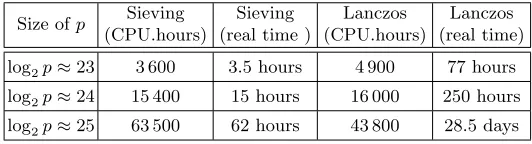
case, it takes 126 sec to run 5 000 tests yielding 9 relations. This means that the relation search would need 30 years, the linear algebra still lasting 3 000 years. The optimal balance corresponds to a reduction by a factor 2.7 of the size of the factor base, for a total computation time of 750 years. In the second case, using the sieving technique we obtained 3 300 relations in 1 800 s, which is 25 times faster than with Nagao’s technique (in practice, we have seen in Section 6 that with optimized implementation, the ratio is rather of the order of 900). With the adapted double large prime variation, the optimal size of the factor base corresponds to a factor 4.4 reduction, for an overall computation time of 300 years. Note that for this sieving method, we have more accurate experimental data obtained with an optimized implementation in C instead of Magma. We detail in Table 4 the timings obtained for curves defined over OEF of sizes 138, 144 and 150 bits; the sieving times are given for the collection of allp2/(2·8!)
relations, and the linear algebra is done after a structured Gaussian elimination. Based on these figures, we estimate more accurately that breaking the DLP over a 160-bit elliptic curve group would take about 200 years on a single core.
Size ofp Sieving
(CPU.hours)
Sieving (real time )
Lanczos (CPU.hours)
Lanczos (real time)
log2p≈23 3 600 3.5 hours 4 900 77 hours
log2p≈24 15 400 15 hours 16 000 250 hours
log2p≈25 63 500 62 hours 43 800 28.5 days
Table 4.Scaling data for our implementation
improve-ment. On this curve, our experiment takes 3 780 s for a single decomposition test, which is 150 000 times slower than with the same method on a genus 3 cover defined overFp2. In particular, no rebalance is needed since the relation search