Flaws in Differential Cryptanalysis of Reduced
Round PRESENT
Manoj Kumar*, Pratibha Yadav, Meena Kumari SAG, DRDO, Metcalfe House, Delhi-110054, India
Abstract: In this paper, we have presented flaws in differential cryptanalysis of reduced round
variant of PRESENT given by M.Wang in [3] [4] for 80 bits key length and we have shown that it is not possible to recover 32 subkey bits by differential cryptanalysis of 16-round PRESENT as claimed in [3] [4].We have also shown that at the most 30 subkey bits can be recovered by the attack given in [4] after some modifications in the algorithm presented in [3][4].
Keywords: block ciphers, differential cryptanalysis, PRESENT
1. Introduction
PRESENT [2] was proposed by A.Bogdanov et al. in CHES 2007 for extremely constrained environments such as RFID tags and sensor networks. In [3] [4], M. Wang has attacked 16-round PRESENT using 264 chosen plaintexts, 232 6-bit counters and 264 memory accesses. M.Wang has presented the differential characteristics for r-rounds (5 ≤
r ≤ 15) and she has given differential cryptanalysis of reduced round variant of PRESENT. In this paper, we consider the actual implementation of differential attack against reduced round variant of PRESENT with key length 80 bits and show that the attack can not be implemented practically to recover 32 subkey bits of 80 bit master key. We also show that at the most 30 subkey bits of the 80 bit master key can be recovered after some modifications in the algorithm given in [4].
In this paper, section 2 gives a brief description of PRESENT with key length 80 bits and key schedule for key length 80 bits is also described. In section 3, the differential attack on 16 round PRESENT given by M.Wang [3] [4] is discussed. In section 4, the flaws in differential attack given by M.Wang [3] [4] are presented and it is shown that 32 bits of round subkey can not be recovered practically as claimed in [4] but after some modification in algorithm at the most 30 subkey bits can be recovered by this attack and finally section 5 concludes the paper.
2. Description of PRESENT
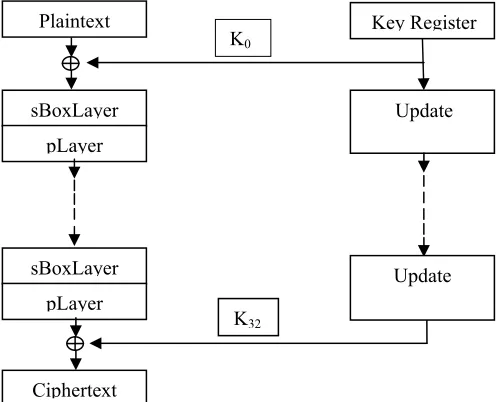
PRESENT is an Ultra-Lightweight block cipher. It consists of 31 rounds. It takes plaintext block of length 64 bits and produced ciphertext block of the same length. It supports two key sizes of length 80 bits and 120 bits. Based on the key sizes there are two variants of PRESENT, one is PRESEST-80 with 80-bits key length and other is PRESENT-128 with 128-bits key length. The cipher is described in Figure 1.
2.1 The Encryption Process
Each round of the PRESENT has three layers of operations: addRoundKey, sBoxLayer, and pLayer. The first layer of operations is addRoundKey described as follows,
j i, j
j b k
b → ⊕
where bj, 0≤ j ≤ 63 is the current state and ki,j , 0 ≤ i ≤ 32, 0 ≤ j ≤ 63 is the j-th subkey bit
of round key Ki.
The second layer of operations is sBoxLayer. PRESENT uses only one S-box S of length 4-bit which is applied 16 times in parallel in each round. This is given in Table 1.
Figure 1: 31-round PRESENT Encryption Algorithm
Plaintext
Table 1: Table of S-box
x 0 1 2 3 4 5 6 7 8 9 A B C D E F
S[x] C 5 6 B 9 0 A D 3 E F 8 4 7 1 2
The third layer of operations is player, the pLayer is a bit-by-bit permutation given by Table 2. Bit i of a stage is moved to bit position P(i).
Table 2: Table of pLayer
i P(i) 0 0 1 16 2 32 3 48 4 1 5 17 6 33 7 49 8 2 9 18 10 34 11 50 12 3 13 19 14 35 15 51 i P(i) 16 4 17 20 18 38 19 52 20 5 21 21 22 37 23 53 24 6 25 22 26 38 27 54 28 7 29 23 30 39 31 55 i
P(i) 32 8 33 24 34 40 35 56 369 3725 3841 5739 4010 4126 4242 5843 44 11 45 27 46 43 4759 i
2.2 Key Schedule for Key Length 80 bits
Key register stores the 80 bit key K supplied by the user denoted as K = k79k78…….k0. At
round i the 64-bit round subkey Kiconsist of the 64 leftmost bits of the current contents of register K, extracted as follows
Ki = ki63 ki62……ki0 = k79k78…….k16
Then key register K= k79k78…….k0 is updated in the following three steps,
1. [ k79k78…….k0 ] = [ k18k17……….k20k19 ] left Rotation by 61 bits
2. [ k79k78k77k76 ] = S[ k79k78k77k76 ] 4x4 S-box substitution
3. [ k19k18k17k16k15 ] = [ k19k18k17k16k15 ] ⊕ round_counter
3. Differential Cryptanalysis of Reduced Round PRESENT [4]
M.Wang [3][4] has given differential cryptanalysis for reduced round variant of PRESENT with key length 80 bits with best probability 2-62 for 14 rounds differential characteristics.
3.1 Difference pairs of the S-box
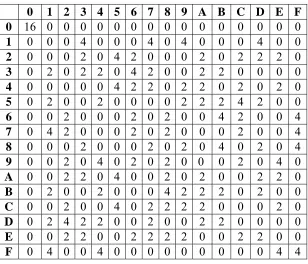
The difference distribution table for the S-box of PRESENT is given in Table 3, in which the rows represent ΔX value (in hexadecimal) and columns represent ΔY values (in hexadecimal). Each element of the table represents the number of occurrences of the corresponding output difference ΔY value given the input difference ΔX, besides the special case of both input and output values being 0, the largest value in the table is 4.The smallest value in the table is 0 and occurs for many difference pairs. From table 3, we see that the maximum differential probability is 1/4.
Table 3: Difference distribution table of S-box
0 1 2 3 4 5 6 7 8 9 A B C D E F
0 16 0 0 0 0 0 0 0 0 0 0 0 0 0 0 0 1 0 0 0 4 0 0 0 4 0 4 0 0 0 4 0 0 2 0 0 0 2 0 4 2 0 0 0 2 0 2 2 2 0 3 0 2 0 2 2 0 4 2 0 0 2 2 0 0 0 0 4 0 0 0 0 0 4 2 2 0 2 2 0 2 0 2 0 5 0 2 0 0 2 0 0 0 0 2 2 2 4 2 0 0 6 0 0 2 0 0 0 2 0 2 0 0 4 2 0 0 4 7 0 4 2 0 0 0 2 0 2 0 0 0 2 0 0 4 8 0 0 0 2 0 0 0 2 0 2 0 4 0 2 0 4 9 0 0 2 0 4 0 2 0 2 0 0 0 2 0 4 0 A 0 0 2 2 0 4 0 0 2 0 2 0 0 2 2 0 B 0 2 0 0 2 0 0 0 4 2 2 2 0 2 0 0 C 0 0 2 0 0 4 0 2 2 2 2 0 0 0 2 0 D 0 2 4 2 2 0 0 2 0 0 2 2 0 0 0 0 E 0 0 2 2 0 0 2 2 2 2 0 0 2 2 0 0 F 0 4 0 0 4 0 0 0 0 0 0 0 0 0 4 4
3.2 Differential Characteristics [4]
M.Wang [3][4] attacked 16-round PRESENT using 14-round differential characteristics. She found 24 14-round differential characteristics. All the characteristics have the same probability 2-62. Out of the 24 differential characteristics, 20 differential characteristics
have different input differences but same output difference [5] and 4 pairs of differential characteristics have same input difference but different difference from the output of round 2 to the input of round 8. All the characteristics have the same difference after 8th round. All of the 24 differential characteristics have 2 active S-boxes located in the position 0,1,2,12,13 &14, so the S-boxes in position from 3 to 11 and 15 are all non-active. According to the output difference of 14-round differential characteristics, there are two active S-boxes in round 15 which are x0 and x8, whose input difference is 9 and
output differences will be 2, 4, 6, 8, 12 or 14. In all possible output differences the least significant bit of their output differences is zero, so at most 6 bits are non zero for the output difference of S-boxes in round 15. After pLayer of round 15, the maximum number of active S-boxes for round 16 is 6 and minimum number of active S-boxes is 2. Considering 6 S-boxes in round 16 namely x4, x6, x8, x10, x12 and x14, Wang[3][4] has
claimed to recover 24 bits of round subkey K17 namely k17,4, k17,20, k17,36, k17,52, k17,6,
k17,22, k17,38, k17,54, k17,8, k17,24, k17,40, k17,56, k17,10, k17,26, k17,42, k17,58, k17,12, k17,28, k17,44,
k17,60, k17,14, k17,30, k17,46, k17,62 and 8 bits of round subkey K16namely k16,0, k16,8, k16,16,
k16,24, k16,32, k16,40, k16,48, k16,56 taking one set of differential characteristic and taking
another set of differential characteristics it has been claimed to recover additional 8 subkey bits k16,2, k16,10, k16,18, k16,26, k16,34, k16,42, k16,50, k16,58 of round subkey K16. In total,
it has been claimed to recover 57 bits of 80-bit master key on the basis of these 40 bits of subkey K16 and K17.
For getting right pairs for cryptanalysis, xor of ciphertext bits corresponding to non-active S-boxes x0, x1, x2, x3, x5, x7, x9, x11, x13, x15 should be zero. After finding right
pairs, ciphertext bits of right pairs corresponding to active S-boxes in the last two rounds will be decrypted. 24 bits of round subkey K17 and 8 bits of round subkey K16 will be
involved during decryption from round 16 to round 14.
4. Flaws in Differential Cryptanalysis
We have found that 32 subkey bits as claimed in [4] can not be recovered by the attack described in [4]. We can recover 24 bits of round subkey K17 and 6 bits of round subkey K16. At the most 30 subkey bits can be recovered by this attack given in [4].
4.1 Recovery of 32 Subkey bits-an impossible task
In round 16, 24 ciphertext bits corresponding to 24 bits of round subkey K17 are extracted
and x-ored with all possible values of 24 bits of round subkey K17, after that inverse
pLayer is applied.
After applying inverse pLayer, the intermediate 24 ciphertext bits are namely C16,C17,C18,C19, C24,C25,C26,C27, C32,C33,C34,C35, C40,C41,C42,C43, C48,C49,C50,C51, C56,C57,
C58,C59, which will be passed through inverse S-box .
In round 15, we can extract at the most 6 intermediate ciphertext bits corresponding to 6 bits of round subkey K16 after getting 24 intermediate ciphertext bits from previous
round. Extract the 6 ciphertext bits and x-or these with all possible values of 6 bits of round subkey K16 and apply inverse pLayer.
After applying inverse pLayer, only 6 intermediate ciphertext bits namely C'1, C'2, C'3,
C'33, C'34, C'35 are available to be passed through inverse S-box. But in practice, we need 4
bits to pass through one S-box because PRESENT uses one 4 bit to 4 bit S-box 16 times in parallel, which take 4 bits as input and produces 4 bits as output. These 6 bits can not be grouped together to pass through inverse S-box.
We need bits at position C'0 and C'36 to complete the 4 bits set to pass through inverse
S-box. For getting these two bits, we need to decrypt additional 8 bits from 16th round. But this is not possible due to output of S-box in 15th round; the possible outputs of 15th round
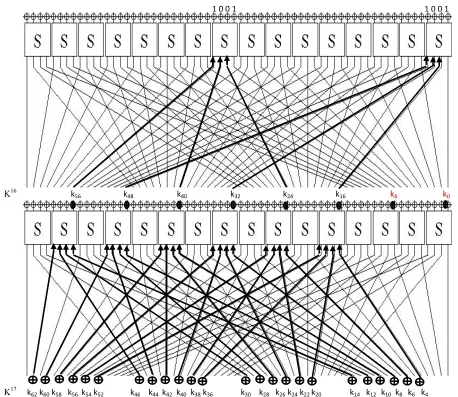
for input difference 1001 are all even with at the most 6 non zero bits, which leads to only 6 active S-boxes in 16th round in place of our requirement of 8 active S-boxes in 16th round. This is shown graphically in figure 3.
Figure 3: Flaws in differential attack on 16 reduced round PRESENT (Computational Graph)
1 0 0 1 1 0 0 1
K16
k56 k48 k40 k32 k24 k16 k8 k0
K17
k62 k60 k58 k56 k54 k52 k46 k44 k42 k40 k38 k36 k30 k28 k26 k24 k22 k20 k14 k12 k10 k8 k6 k4
4.2 Recovering 30 Subkey bits
For recovering 30 subkey bits, decrypt from round 16 to round 14 as follows:
Extract 24 bits of ciphertext corresponding to 24 bits of round subkey K17 namely
k17,4, k17,20, k17,36, k17,52, k17,6, k17,22, k17,38, k17,54, k17,8, k17,24, k17,40, k17,56, k17,10, k17,26,
k17,42, k17,58, k17,12, k17,28, k17,44, k17,60, k17,14, k17,30, k17,46, k17,62 and xor these with all
possible values of 24 subkey bits, and then apply inverse permutation layer and inverse S-box. After that extract 6 intermediate ciphertext bits corresponding to 6 bits of round subkey K16 namely k16,16, k16,24, k16,32, k16,40, k16,48, k16,56 and xor these with all possible
values of 6 subkey bits and then apply inverse permutation layer. Now for each intermediate ciphertext pair assume the values of additional two bits as 00 and 11 one by one, to complete set of 4 bits to be passed through inverse S-box. After that apply inverse S-box and find out xor of the two decrypted pairs then check whether it is the same xor as suggested by the characteristics. If it is the same xor value then increase the counter of the corresponding key value by 1 and the key giving the desired xor value maximum number of times will be our correct value of the 30 subkey bits.
4.3 Computational Complexity
As given in [4], 240 structures of 224chosen plaintext each are required in this attack. 240 possible values can be taken as inputs to 10 non-active S-boxes in each structure and the inputs to any two active S-boxes in each structure characteristic among the six S-boxes have 224 possible values. The number of pairs for each possible characteristic is 240*216*27=263. The number of pairs satisfying 24 characteristics is 263*20 = 267.32. Since each characteristic has the same probability 2-62, so there are 263*2-62 *24 = 48 right pairs satisfying any one characteristic. For each structure, there is (224)2/2 = 247 possible pairs,
thus we have to consider total 247.240=287 pairs of plaintext.
For each structure, each pair should have 10 non-active S-boxes in round 16 satisfying each characteristic. After discarding wrong pairs, 247 *2-40 =27 candidates for right pair
remain for each structure.
Among 16 S-boxes in round 16, 10 S-boxes must be non-active. Among the remaining 6 S-boxes in round 16, we will consider 6 cases according to the output of the S-box in round 15. As input to round 15 S-box is 9, so the possible outputs will be 2, 4, 6, 8, C, E according to S-box difference distribution table.
- If output is 2, the active S-boxes in round 16 will be x4 and x6.
- If output is 4, so the active S-boxes in round 16 will be x8 and x10.
- If output is 8, so the active S-boxes in round 16 will be x12 and x14.
- If output is 6, so the active S-boxes in round 16 will be x4, x6, x8 and x10.
- If output is C, so the active S-boxes in round 16 will be x8, x10, x12 and x14.
- If output is E, so the active S-boxes in round 16 will be x4, x6, x8, x10, x12 and x14.
In first three cases, there are 2 active S-boxes and 4 non-active S-boxes. In next two cases, there are 4 active S-boxes and 2 non-active S-boxes and in last case all 6 S-boxes are active. If an S-box is active, the input difference to this S-box should be 1 and output
difference will be 3, 7, 9 or 13 and if S-box is non-active then input and output differences will be 0. Using this filter, discard any pair with a wrong output difference. So the numbers of remaining pairs for each structure are about:
27*{3*(4/16)2(1/16)4 +2*(4/16)4 (1/16)2+ (4/16)6} = 27*2-11.81 = 2-4.81
For each structure, it is checked that if the remaining pair satisfy one of the 24 possible plaintext differences corresponding to 24 characteristic. Number of remaining pairs is a fraction of about 2-24*20 = 2-19.68 out of the 224 possible plaintext differences. So the expected number of remaining pairs in all 240 structures is 240*2-4.81*2-19.68 = 215.5.
We guess the 24 bits of round subkey K17 and 6 bits of round subkey K16 and decrypt the remaining ciphertext pairs from round 16 to round 14. There are at most 4 pairs of occurrences for the input difference and output difference, according to the difference distribution table of PRESENT. Average count per counted pair of the subkey is 4, corresponding to one active S-box. There can be 2, 4 or 6 active S-boxes in round 16. We denote number of active S-boxes in round 16 by t and consider 3 cases according to the value of t:
- If t = 2, the number of ciphertext pairs satisfying the condition of two active S-boxes is 215.5*2-16 = 2-0.5, so the total counted times of subkey for the remaining pairs are about 2-0.5*44 = 27.5
- If t = 4, the number of ciphertext pairs satisfying the condition of two active S-boxes is 215.5*(2-8-2-12) = 27.41, so the total counted times of subkey for the remaining pairs are about 27.41*46 = 219.41
- If t = 6, the number of ciphertext pairs satisfying the condition of two active S-boxes is 215.5*(1-2-4) = 215.41, so the total counted times of subkey for the remaining pairs are about 215.41*48 = 231.41
The total counted times of subkey are 27.5 + 219.41 + 231.41 = 231.4104, on average wrong subkey will hit about 231.4104/230= 2.66 times, but the right key can be easily identified because it is counted for the right pairs about 48 times. We can retrieve 30 subkey bits using at most 233.18 times 2-round PRESENT encryptions and 230 6-bit counters.
We can find out 80 bit master key by exhaustively searching the remaining 50 bits of master key and the time complexity in this step will be 250 16 round PRESENT encryptions.
In modified attack, the signal to noise ratio will be [1]
S/N = (p*2k) / (a*b) = 2-62*230 / (231.41 -15.5*215.5-67.32) = 15.03
For the number of right pairs µ = p N = 2-62*263*24 = 48 which can be obtained and k=30
subkey bits involved in decryption from round 16 to round 14, the success probability[1] is:
Ps = 0.999999904397237
We can obtain 30 subkey bits with the probability 0.999999904. Time complexity is almost same as in [4], except the time complexity of 250 16-round PRESENT encryptions in step 3 of the algorithm presented in [4].
8 5.Conclusion
In this paper, we have shown that practical implementation of differential cryptanalysis of reduced round PRESENT to recover 32 subkey bits of 80 bit master key, as claimed in[3][4] is not possible. We have also shown that we can recover at the most 30 subkey bits by the attack proposed in [4] after some modification in the key recovery algorithm given in [4].
Acknowledgments: Authors are grateful to Dr. PK Saxena for his valuable guidance and support. Authors are also thankful to Ms. Noopur Shrotriya for her support in implementation. Special thanks are due for Mr. Dhananjoy Dey for giving his valuable time in fruitful discussions and Mr. N. Rajesh Pillai for his valuable suggestions to improve the paper.
References
[1] A.A. Selcuk and A. Bicak, On Probability of Success in Linear and Differential Cryptanalysis, SCN 2002, LNCS2576, pp.174-185, Springer, 2003.
[2] A. Bogdanov, L. Knudsen, G. Leander, C. Paar, A. Poschmann, M. Robshaw, Y.Seurin, C. Vikkelsoe, PRESENT: An Ultra-Lightweight Block Cipher, in the proceedings of CHES 2007, Lecture Notes in Computer Science, vol 4727, pp 450-466,Vienna, Austria, September 2007.
[3] M. Wang, Differential cryptanalysis of PRESENT, Cryptology ePrint Archive, Report 2007/408, 2007. http://eprint.iacr.org/2007/408.
[4] M. Wang, Differential Cryptanalysis of Reduced-Round PRESENT, in the proceedings of AFRICACRYPT 2008, Lecture Notes in Computer Science, vol. 5023, pp 40-49, Casablanca, Morocco, June 2008.