© 2015, IJCSMC All Rights Reserved 259
Available Online atwww.ijcsmc.com
International Journal of Computer Science and Mobile Computing
A Monthly Journal of Computer Science and Information Technology
ISSN 2320–088X
IJCSMC, Vol. 4, Issue. 8, August 2015, pg.259 – 263
RESEARCH ARTICLE
Biometric Authentication of an
Individual Using Multilayer Perceptron
and Support Vector Machine
Prashant Shriram Gawande
1, Siddharth A. Ladhake
2¹
Department of Electronics, Rajarshi Shahu College of Engg, Buldana, India²
Sipna College of Engineering, Amravati, India1 [email protected]; 2 [email protected]
Abstract— The proposed method uses multi layered perceptron neural network and support vector machine to classify the normal subjects. Data used for training, testing and cross validation was recorded from normal persons (without any heart disease) within thirty six months, in the interval of 10/15 days. Ten hybrid features were extracted from the recorded signals by using wavelet transform. The classification performance is evaluated based on percent average classification accuracy and mean squared error. During analysis the optimum results were observed using SVM classifier. An accuracy of 98.86 percent is achieved and mean squared error is found to be 0.0080.
Keywords— Classification, Discrete wavelet transform, ECG, Multilayer Perceptron, Support Vector Machines.
I. INTRODUCTION
Now a days security is a major concern. The conventional methods of authentication can be easily shared, stolen or forgotten. However, a possible alternative in determining the identity of users is to use biometrics, it can be used to increase the security level. Biometrics is identification of an individual based on the physiological and/or behavioral characteristics [1]. In biometrics different physiological parameters such as fingerprint, palm veins, face recognition, DNA, palm print, hand geometry, iris, retina etc and behavioral parameters such as typing rhythm, gait, signature etc. are used as a biometric treats. Many biometrics suffer from the disadvantages like an imposter can capture the biometric data, as in the case of fingerprint, which is left on the surface the user touches and later use it to authenticate to the system as a legitimate user, and once the biometric data is lost by the genuine user it is highly impossible to change it even for him. While using ECG as a biometric, recognition is possible only in the case when the person is alive and he is present over there personally at the time of recognition.
II. LITERATURESYRVEY
© 2015, IJCSMC All Rights Reserved 260
Shen et al. (2002) reported an ECG based recognition method. Using template matching and decision based neural network and achieved an accuracy of 85% and 100% respectively. Later in 2005 Shen and Tompkin have used correlation analysis and linear regression method for the analysis [3,4].
Steven Israel et. al. (2004), have used Wilks’ Lamda method for feature selection and linear discriminant analysis (LDA) for classification. The system achieved 100% subject recognition for a total of 29 subjects [5].
Wang et al. (2006), showed that the classification performance though amplitude features have discriminative ability. Classification was conducted on the extraction of appearance related characteristics with the help of either the principal component or LDA. With the use of two types of features accuracy of 100% is achieved for recognition [6].
Yongbo Wan et. al. (2008) after preprocessing using filters to remove artifacts, have used wavelet transform for signal decomposition. Wavelet coefficients were then applied to a 3 layered feed forward neural network to identify human subjects. Multilayer Backpropagation neural network is established for the same [7].
Silva et. al. have used Nearest Neighbour and Support Vector Machine produced promising recognition results for data collected with several months apart [8].
Chan et al. (2008) collected ECG signal by placing electrode between thumb and index finger. They have also used percent residual difference, correlation coefficient and wavelet distance measure and showed accuracy of 70% and 80% and 95% respectively. [9].
Odinaka et. al. have showed a classification accuracy of 93.5% during their analysis. They have applied Short Term Fourier Transform to ECG signals for biometric recognition incorporating heartbeats from 84 days [10]. Sufi et. al. (2008) have used distance measurement techniques to obtain better results on smaller template size [11].
Tawfik et. al. (2010) used the coefficients of Discrete Cosine Transform of ECG signal as an input to a neural network classifier. The identification rate of up to 99.09% was achieved when normalized QRS complexes were applied [12].
The results presented by all the methods have shown the uniqueness of ECG among humans and therefore can be used for biometric applications. Though ECG as a biometric is not a new topic for research, still it is in infant stage and there is much scope for its analysis considering HRV. Based on the limitations of the literature reviewed we have identified the problem to check the authenticity of using an electrocardiogram for longer duration of time.
III.METHODOLOGY
A. Multilayer Perceptron (MLP)
MLP is the network used to overcome the linear separability limitation of the perceptrons. It is a layered feed forward network typically trained with static back propagation algorithm. The main advantage is that MLP is its stability and ease of use. It can approximate any input/output mapping. An MLP consists of an input layer, at least one hidden layer, and one output layer. The complexity of an MLP network depends on number of hidden layers and number of neurons in each hidden layer. The neurons from each layer may be being fully or partially connected to the next layer.
B.Support Vector Machine (SVM)
SVM is supervised of learning algorithm introduced by Vapnik in 1992 for classification. SVM simultaneously minimize the classification error and maximize the geometric margin hence called maximum margin classifiers. Two parallel hyperplanes are constructed on each side of the hyperplane that separate the data. The separating or central hyperplane is the hyperplane that maximize the distance between the two parallel hyperplanes. An assumption is made that the larger the margin or distance between these parallel hyperplanes the better is the generalization error of the classifier. Consider the problem of separating the input vectors set belonging to two separate categories:
(1)
© 2015, IJCSMC All Rights Reserved 261
IV.DATAUSED
We have recorded data from group of people10 clinically normal persons in the regular interval of 10-15 days within the period of 36 months during resting condition. Signals were recorded by using 12 lead ECG recorder “Samvid”, manufactured by Schiller Health Care India Pvt. Ltd. The signals were transmitted to a PC by using software iECG (version 1.2) via USB cable. The sampling rate of recorder is 500 s/s. Out of the 12 leads recorded, signal from lead-II, a single lead was considered as a signal for raw database. Ten hybrid features were extracted from these data base and were applied as input to the networks.
V. RESULTS
A. MLP Results
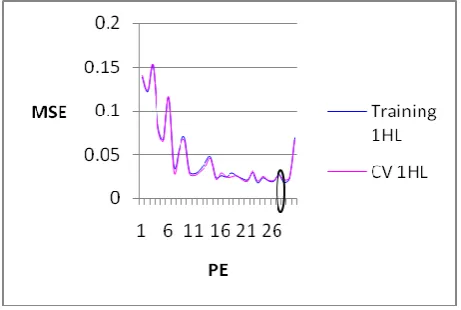
Single layered MLP NN trained with Tanh activation function, Levenberg Marquer learning rule and the processing elements in hidden layer were varied from 2 to 50. The percent average classification accuracy (PACA) and mean squared error were observed. It is learned that the error has reduced uniformly as the number of neurons in the hidden layer has increased, the MSE is minimum i.e. performance is better when the number of neurons in the first hidden layer were equal to 28. The graph of average MSE versus processing elements is plotted and is shown in figure 1, where the MSE was found to be least, also the PACA, specificity and sensitivity were found to be optimum, it is shown in figure 2. The training and CV errors were observed with the increase in processing elements (PEs). As the error on validation is increased after 28 epochs we have stopped training to prevent the problem of overgeneralization.
Figure 1: Processing Element Vs MSE for single hidden layer MLP NN
Figure 2: PACA during training, testing and CV
B. SVM Results
© 2015, IJCSMC All Rights Reserved 262
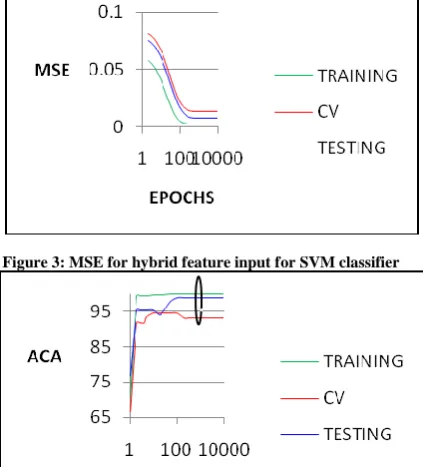
Figure 3: MSE for hybrid feature input for SVM classifier
Figure 4: PACA of SVM for hybrid feature input
VI.CONCLUSION
Both SVM and ANN classifiers have their ability to classify the signals correctly and can be formulated in terms of learning machines. For SVM and MLP NN training hybrid feature set were applied as input.
In comparison with the analysis of data by using SVM and MLP NN the solutions obtained by SVM training seems to be more robust with a smaller errors and yielded slightly higher prediction accuracy compared to MLP NN during training testing as well as CV. The performance of these two methods is compared with size of training data set and different feature sets. For the hybrid feature set the percentage average classification accuracy during testing yielded 98.86% where MLP NN reached 98.05%. The training accuracy using SVM received as 100% as it was 98.77% by using MLP NN. The results of SVM are superior to MLP NN during training testing and CV.
REFERENCES
1. A.K. Jain,A. Ross, S. Prabhakar, “An introduction to biometric recognition,” IEEE Trans. Circuits. Syst. Video 14(0), 4–20 (2004).
2. L. Biel, O. Petersson, L.P. PhilipsonWide,“ECG Analysis: a new approach in human identification,” IEEE Trans. on Instrumentation and Measurement,Vol. 50(3), pp.808–812 (2001).
3. T.W. Shen,W.J. Tompkins, Y.H. Hu, “One-lead ECG for identity verification,” In Second Joint EMBS/BMES Conference Housten, TX USA (2002) pp. 62–63.
4. T. W. Shen, W. J. Tompkins , “Biometric Statistical Study of One-Lead ECG Features and Body Mass Index (BMI)”, Proceedings of the 2005 IEEE Engineering in Medicine and Biology 27th Annual Conference Shanghai, China, September 1-4, 2005, pp. 1162-1165.
5. S. A. Israel, J. M. Irvine, A. Cheng, M. D. Wiederhold, and B. K. Wiederhold, “ECG to identify individuals,” Pattern Recognit., vol. 38, pp. 133–142, 2005.
6. Y.Wang, F. Agrafioti, D. Hatzinakos, and K. N. Plataniotis, “Analysis of human electrocardiogram for biometric recognition,” EURASIP J. Adv. Signal Process., vol. 2008, no. 19, pp. 19:1–19:11, 2008. 7. J. Yao and Y. Wan, “A wavelet method for biometric identification using wearable ECG sensors,” in Proc.
© 2015, IJCSMC All Rights Reserved 263
8. H. Silva, H. Gamboa, and A. Fred, “One lead ECG based personal identification with feature subspace ensembles,” in Proc. 5th Int. Conf. Machine Learning and Data Mining in Pattern Recognition, Leipzig, Germany, 2007, pp. 770–783.
9. A. D. C. Chan, M. M. Hamdy, A. Badre, and V. Badee, “Wavelet distance measure for person identification using electrocardiograms,” IEEE Trans. Instrum. Meas., vol. 57, no. 2, pp. 248–253, Feb. 2008.
10. I. Odinaka, P.-H. Lai, A. D. Kaplan, J. A. O’Sullivan, E. J. Sirevaag, S. D. Kristjansson, A. K. Sheffield, and J. W. Rohrbaugh, “ECG biometrics: A robust short-time frequency analysis,” in Proc. 2010 IEEE Int.
Workshop Information Forensics and Security (WIFS), Dec. 2010, pp. 1–6.
11. F. Sufi, L. Khalil, and J. Hu, “ECG-based authentication,” in Handbook of Information and
Communication Security, P. Stavroulakis and M. Stamp, Eds. New York: Springer, 2010, pp. 309–331.
12. M. M. Tawfik and H. S. T. Kamal, “Human identification using QT signal and QRS complex of the ECG,”