ISSN(Online): 2319-8753 ISSN (Print): 2347-6710
I
nternational
J
ournal of
I
nnovative
R
esearch in
S
cience,
E
ngineering and
T
echnology
(A High Impact Factor, Monthly, Peer Reviewed Journal) Visit: www.ijirset.com
Vol. 6, Issue 12, December 2017
Wireless Networks Range of Node
Communication Is Equal to Radius of Node at
Centred Disk
M.Sudha, B.Saravanan
Assistant Professor, Department of Computer Science, Muthayammal College of Arts & science, Rasipuram,
Namakkal DT, India
Department of Computer Science, Muthayammal College of Arts & science, Rasipuram, Namakkal DT, India
ABSTRACT: Graph theory is one of the basic tool for analysing computer networks such as wireless mesh network, Adhoc network, sensor networks. Conventional graph theory is not accurately describe the node and link of wireless network so it is not used for modern complex wireless networks and also the random graph and weighted graph theory not clearly illustrate the properties of wireless networks. To overcome these problem a new idea is developed, that is called Polychromatic set. In this paper, I introduced the concept of Polychromatic set theory for describing the node and link in wireless network for efficient routing scheme. The estimation result shows it is simple, effective. The
performance is better compare than any other conventional routing method. It can be achieved by ns-2 simulator.
KEYWORDS: weighted graph, Conventional graph, Polychromatic sets, Routing, wireless ad hoc networks.
I. INTRODUCTION
ISSN(Online): 2319-8753 ISSN (Print): 2347-6710
I
nternational
J
ournal of
I
nnovative
R
esearch in
S
cience,
E
ngineering and
T
echnology
(A High Impact Factor, Monthly, Peer Reviewed Journal) Visit: www.ijirset.com
Vol. 6, Issue 12, December 2017
II. RELATED WORK A. Random graph theory
In random graph, it’s used for study of reliability in communication networks [9] and large complex networks like social networks[8], wireless sensor networks, mobile ad hoc networks. It generated by random process. It lies at the intersection between graph theory and probability theory. A random graph is obtained by starting with a set of n isolated vertices and adding successive edges between them at random. The main aim is to determine the particular properties of the graph. The different random graph models produce different probability distributions on graph. The network probability matrix models random graphs through edge probabilities, which represent the probability that a given edge exists for a specified time period. It is extensible to model to directed and undirected, weighted and un weighted, static and dynamic. The colouring of random graph is, G of order n with the vertex V(G)={1,...,n} by the greedy algorithm on the number of colours, the vertices can be coloured with colours 1,2,....(vertex 1 is coloured 1, vertex 2 is coloured 1 if it is not adjacent to vertex 1, otherwise it is coloured 2, etc.,). Random graph not gives the details of network nodes and links such as capacity, location. It needs a some other advances better tool to model the real-time wireless networks [11]-[13].
B. Weighted graph theory
The weighted graph is defined as a graph where vertices have some weights or values [7]. A graph where edges have some weights or values or where edges and vertices have some weights or values. The graph where neither edges nor vertices have any weights or values. If the weight is placed on each edge between vertices in the graph. Weights are usually real numbers; it restricted to rational numbers integers. The weight of a path or weight of a tree is equal to the sum of the weights of the selected edges. Sometimes cost is also used as weight. It associates a label with every edge. Weighted graph covers the multipurpose properties of message links in computer networks. On the other hand it is silent outlying from the representation of synchronized wireless networks. In wired networks each bandwidth path is different, whereas in wireless networks each nodes have same capacity, speed of transmission and coverage range is same but signal-to-noise ratio is vary, so it differ in attenuation, fading, interferences from its individual networks. So it causes various transmission speeds. So it cannot be used for complex networks.
C. Unit disk graph
A collection of unit circles and the corresponding unit disk graph. A unit disk graph is the intersection graph of a family of unit disks in the Euclidean plane. It form vertex for each disk and connect two vertices by an edges whenever the corresponding disks have non-empty intersection. The intersection graph of equal - radius circles or of equal-radius disks. A unit disk graph formed from a collection of equal-radius circles in which two circles are connected by an edge if one circle consist the centre of the other circle. A graph consists of a collection of points in the Euclidean plane, in that two points are associated if their distances is below a permanent threshold. Every induce sub graph of a unit disk theory is also a unit disk graph. It is used to model the topology of ad hoc wireless communication networks. In this purpose, nodes are associated through a direct wireless connection through a direct wireless connection without a base station. It’s assumed that all nodes are homogeneous and equipped with unidirectional antennas. Nodes locations are modelled as Euclidean points and the area within a signal from one node can be received by another node are modelled as a circle. If all nodes transmitters of equal power, these circles are all equal communication range [5]. Random geometric graphs formed as unit disk graph with randomly generated disk centres. This graph is used for construct the various types of networks and develop various algorithm, such as connected dominating set [6]. A good research is found, it is distant away from many applications.
D. Conventional graph theory
In conventional graph theory, a set can be represented as a group of fundamentals [10], such as, S={s1,s2,s3,...,sn} (1)
ISSN(Online): 2319-8753 ISSN (Print): 2347-6710
I
nternational
J
ournal of
I
nnovative
R
esearch in
S
cience,
E
ngineering and
T
echnology
(A High Impact Factor, Monthly, Peer Reviewed Journal) Visit: www.ijirset.com
Vol. 6, Issue 12, December 2017
conventional graph theory is, for examples if I consider bitter guard, beetroot it comes under set s, but the properties of both vegetables is different. Beetroot comes under the sweetness taste vegetable whereas bitter guard comes under bitterness taste vegetable. The difference of these two vegetables is not notified in the set. So, the conventional set theory does not describe the properties of each element in the set. This leads to the development of Polychromatic sets in modelling wireless networks, which defines the each property in set.
III. PS-SETS THEORY
The drawbacks in random graph, unit disk graph, weighted graph, conventional graph theory, to overcome this PS-set theory is introduced. PS-PS-sets is defined as a collection of elements in PS-set B, it was initiated by George Cantor in 1894 [14], as
B={b1,...,bi,...,bn} (2)
Where B is a set, bi is an element of set B, n is the number of element. If bi is a element of set B, suppose bi is belong to B, bi € B, otherwise bi € B. PS-sets theory define the element and also the properties of each element in whole set. This property is called as colour. If all elements in the set is painted with various colours, with each element and the set having multiple of colours [15]-[17].
B = {b1,...,bi,...,bn}
(3)
F(B) F(b1) F(bi) F(bn)
Fig.1.Relation between element, set and coloured element and set.
It is possible to represent all other feature in the set. The colour set F(bi) corresponding to all element bi € B and the colour set F(B) corresponds to entity of B,
F(B)=(Fl,...,Fg,...,Fm) (4)
Pigmentation is defined as the colour constituent of its element F(bi), they are belong to combined colour set.
F ≥ F(B), F(bi), i=1,2,....,n (5)
PS-sets theory defines a colour set by F, if elements bi € B, then bi is denoted as,
F(bi)=(F1(bi),....,Fg(bi),....,Fm(bi)) (6)
Where m is overall amount of properties in element bi. The whole set can be coloured is denoted as,
F(B)=(F1(B),....,Fk(B),...,Fp(B)) (7)
Where p is the quantity of properties of set B.The equation (4) and (5) is represent by different colours. The colouring
set F(bi) which be in the right place to elements in set is called individual pigmentation sets, it can be represented by
ISSN(Online): 2319-8753 ISSN (Print): 2347-6710
I
nternational
J
ournal of
I
nnovative
R
esearch in
S
cience,
E
ngineering and
T
echnology
(A High Impact Factor, Monthly, Peer Reviewed Journal) Visit: www.ijirset.com
Vol. 6, Issue 12, December 2017
║Sw(j)║=[B×F(b)]
F1...Fg...Fm b1(1)....b1(g)....b1(m) b1
= bi(1)....bi(g)....bi(m) bi (8) bn(1)....bn(g)....bn(m) bn
If Sw(j)=1 then Fg € F(bi),
F(b) = ∑ F(bi) (9)
The relationship between F(b) and F(bi) as follows,
F(b) = ∑ F(ai) (10)
Where Sw(j) is reasonable variable, its defined by,
1, if Fg € F(bi)
Sw(j) = (11) 0, if Fg € F(bi)
Individual colour of polychromatic set is represent by Boolean matrix,
║Sl(j)║F(b),F(B)= [F(b)×F(B)] (12)
The correlated form this individual colour is,
║Sw(j)║=[B×F(B)] (13a)
║Sw(k)║=[B×F(B)] (13b)
Therefore, the six components representation in PS-sets is,
PCS={(B,F(b), F(B), [B×F(b)],
[B×F(B)], [B×B(F)]} (14) It is not included in all practical application.
IV. IMPLEMENTATION OF WIRELESS ADHOC NETWORKS
In wireless network, each node can be split into several numbers of clusters, in that each node cluster head (CH) it depends on its significance index. The new cluster is selected as a CH at a higher level from the lower level. By applying PS-set theory in hierarchical model, the element in the set F(b) can be defined as,
<bi,F(bi)>,i=1,2,....,n (15)
ISSN(Online): 2319-8753 ISSN (Print): 2347-6710
I
nternational
J
ournal of
I
nnovative
R
esearch in
S
cience,
E
ngineering and
T
echnology
(A High Impact Factor, Monthly, Peer Reviewed Journal) Visit: www.ijirset.com
Vol. 6, Issue 12, December 2017
Fig.2. Representation of hierarchical model in PS-sets.
It is represents as,
< b(0,0,0), F(b(0,0,0)) >= ∑ < b(1,ik,0), F(b(1,ik,0)) > (16)
Where < b(0,0,0), F(b(0,0,0)) > denotes the root node of this model. All the chid node of b(c,ic, jc-1) can be shown as,
<b(c,ic,jc-1),F(b(c,ic,jc-1))>= ∑
( )
( ) ( ) <b(c+1,ic+1,ic),F(b(c+1, ic+1,ic)) > (17)
The various colour set can be shown as,
F(B)={b,ki(b),kp(b),kc(b),kCH(b)} (18)
Where F(b) contains the element of set B, ki(b) is the node ic, kp(b) is the prior node of b, kc(b) represent the cluster ic, kCH(b) denotes the cluster head node in the cluster.
Finally the description of colour is,
F(B)={b,ki(b),kp(b),kc(b),kCH(b)} (19)
ISSN(Online): 2319-8753 ISSN (Print): 2347-6710
I
nternational
J
ournal of
I
nnovative
R
esearch in
S
cience,
E
ngineering and
T
echnology
(A High Impact Factor, Monthly, Peer Reviewed Journal) Visit: www.ijirset.com
Vol. 6, Issue 12, December 2017
B3 is a target node of a cluster 1. B6 is previous node to S1. kCH is used for child nodes calculation. B6 is the cluster head (CH). By the similar way the other cluster in the network area can be determine.
V. POLYCHROMATIC SET ROUTING SCHEME MODEL
In wireless sensor network, the flat routing scheme is taking as the hierarchical model [19]. Each node maintain universal routing information such as link status, sequence number, and it can exchange the routing information between nodes, which is used for reduce the equality and construct it as simple protocol. It can be classify into two types: 1. Dynamic hierarchical routing scheme, such as fisheye state routing and Inter-zone routing protocol. 2. Static hierarchical routing scheme, such as CH gateway switch routing. In flat routing scheme, large quantity of packet overhead is generate, swamped over along the network is occur. It is used for uncomplicated and minute networks. The cluster head acting an imperative role and its node selection is based on the link quality of the networks. In most of the application in polychromatic sets, hierarchical model is preferred. The new network topology can be modifying by accumulation or deleting a node.
Two significant key steps for hierarchical routing scheme, i). Partitioning and clustering of network
ii). Routing within the group and cross clusters
It develop the low-complexity and suitable for large scale WSNs.
A. Partitioning and clustering of network
Partitioning of network means splitting of node into multiple clusters, it was developed in the previous research work [18]. 1-hop neighbouring nodes ui,uj link weight can be calculated as,
Pl(ui,uj)= H(ui.uj)/∑ | |
I(ui,uj) (20)
If n-hop weight can be calculated by using this formula,
Pl(ui,uj)= ∏ui=1 Pl(ui,ui+1) (21)
B. Routing
The next important key is routing. It this, AODV [4] routing protocol is used for providing a better communication
ISSN(Online): 2319-8753 ISSN (Print): 2347-6710
I
nternational
J
ournal of
I
nnovative
R
esearch in
S
cience,
E
ngineering and
T
echnology
(A High Impact Factor, Monthly, Peer Reviewed Journal) Visit: www.ijirset.com
Vol. 6, Issue 12, December 2017
VI. PERFORMANCES EVALUATION
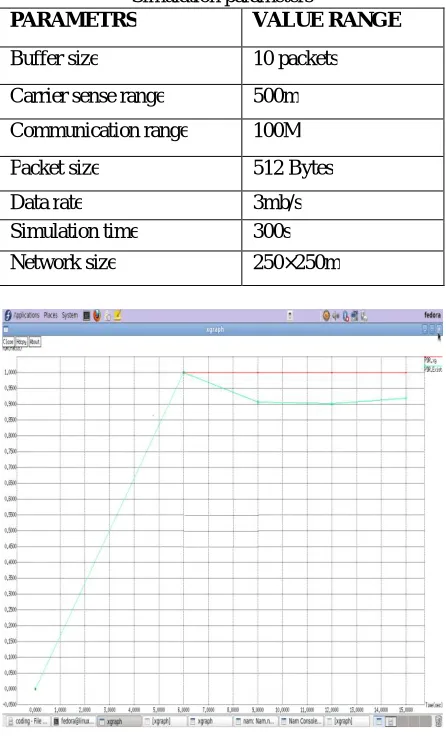
The simulation result of my proposed system is following the below, by using the ns-2 simulator environment. The various parameters are consider,
TABLE 1
Simulation parameters
PARAMETRS VALUE RANGE
Buffer size 10 packets
Carrier sense range 500m
Communication range 100M
Packet size 512 Bytes
Data rate 3mb/s
Simulation time 300s
Network size 250×250m
Fig.3. Packet delivery ratio
ISSN(Online): 2319-8753 ISSN (Print): 2347-6710
I
nternational
J
ournal of
I
nnovative
R
esearch in
S
cience,
E
ngineering and
T
echnology
(A High Impact Factor, Monthly, Peer Reviewed Journal) Visit: www.ijirset.com
Vol. 6, Issue 12, December 2017
Fig.4. Average Energy Consumption
In Fig.(4) I compare the result of AODV (Adhoc- On-demand Distance Vector routing), with FSR(Fisheye state
routing), the comparison result shows the energy remain constant for AODV over the FSR.
Fig.5. Packet Drop Ratio
ISSN(Online): 2319-8753 ISSN (Print): 2347-6710
I
nternational
J
ournal of
I
nnovative
R
esearch in
S
cience,
E
ngineering and
T
echnology
(A High Impact Factor, Monthly, Peer Reviewed Journal) Visit: www.ijirset.com
Vol. 6, Issue 12, December 2017
VII. CONCULSION
In this paper, a new scheme is I introduce that is polychromatic set in hierarchical model (PCHM).It is used for improving flexible routing in wireless network, since discovering the nodes in wireless sensor networks is an confused task. Simulation result shows validate that my proposed scheme outperforms hierarchical routing. In future I desired to implement in the large complex networks which comprise large number of levels and compare the polychromatic set routing with DSR.
REFERENCES
[1] M. Gadouleau and S. Riis, “Graph- theoretical constructions for graph entropy and network coding based communications,” IEEE Trans. Inform. Theory, vol. 57, no. 10, pp. 6703–6717, Oct. 2011.
[2] M.M. Zavlanos, M. B. Egerstedt, and G. J.Pappas, “Graph-theoretic connectivity control of mobile robot networks,” Proc. IEEE, vol. 99, no. 9, pp. 1525–1540, Sep. 2011.
[3] L.Levitin, M. Karpovsky, and M. Mustafa, “Minimal sets of turns for breaking cycles in graphs modeling networks,” IEEE Trans. Parallel Distrib. Syst., vol. 21, no. 9, pp. 1342–1352, Sep. 2010.
[4] S.Lee, E. M. Belding-Royer, and C. E. Perkins, “Scalability study of the ad-hoc on-demand distance vector routing protocol,” ACM/Wiley Int. J. Netw. Manag., vol. 13, no. 2, pp. 97–114, 2003.
[5] I. Norros and H. Reittu, “Network models with a ‘soft hierarchy’: A random graph construction with loglog scalability,” IEEE Netw., vol. 22, no. 2, pp. 40–46, Mar.–Apr. 2008.
[6] J. Blum, M. Ding, A. Thaeler, and X. Cheng, “Connected dominating set in sensor networks and MANETs,” in Handbook of Combinatorial Optimization. Norwell, MA: Kluwer, 2004, pp. 329–369.
[7] X. Li, X. Xu, F. Zou, H.Du, P.Wan, Y. Wang, and W. Wu,“A PTAS for node-weighted Steiner tree in unit disk graphs,” in Proc. 3rd Int. Conf. Combinat. Optimiz. Applicat., vol. 5573. 2009, pp. 36–48.
[8] M.Gjoka, C.T.Butts, M.Kurant, and A. Markopoulou,“Multigraph sampling of online social networks,” IEEE J. Sel. Areas Commun., vol. 29, no. 9, pp. 1893–1905, Sep. 2011.
[9] M.Newman, “The structure and function of complex networks,” SIAM Rev., vol. 45, no. 2, pp. 167–256, 2003.
[10] G. Cantor, “Uber eine Eigen schaft des Inbegriffes aller reellen algebrais-chen zahlen,” Crelles J. Mathematik, vol. 77, pp. 258–262, 1874. [11] J. Eriksson, M. Faloutsos, and S. V. Krishnamurthy, “DART: Dynamic address routing for scalable ad hoc and mesh networks,” IEEE/ACM
Trans. Netw., vol. 15, no. 1, pp. 119–132, Jan. 2009.
[12] Q.Chen, Q. Zhang, and Z. Niu, “A graph theory based opportunistic link scheduling for wireless ad hoc networks,” IEEE Trans. Wireless commun., vol. 8, no. 10, pp. 5075–5085, Oct. 2009.
[13] P.K. Biswas, “A formal framework for multicast communication,” IEEE Syst. J.,, vol. 4, no. 3, pp. 353–362, Sep. 2010.
[14] G. Cantor, “Uber eine Eigenschaft des Inbegriffes aller reellen algebrais- chen zahlen,” Crelles J. Mathematik, vol. 77, pp. 258–262, 1874. [15] S. Li and X. Wang, “Polychromatic set theory-based spectrum access in cognitive radios,” IET Commun., vol. 6, no. 8, pp. 909–916, 2012. 58
IEEE SYSTEMS JOURNAL, VOL. 7, NO. 1, MARCH 2013.
[16] S.Li, “The application of polychromatic sets in computer aided design,” M.S. thesis, Dept. Comput. Sci., Xi’an Jiaotong Univ., Suzhou, China, 2004.
[17] Z. Li and L. Xu, “Polychromatic sets and its application in simulating complex objects and systems,” Comput. Oper. Res., vol. 30, no. 6, pp. 851–860, 2003.
[18] S.Li, X.Wang, and S. Zhao, “Multipath routing for video streaming in wireless mesh networks,” Ad Hoc Sensor Wireless Netw., vol. 11, nos. 1–2, pp. 73–92, 2011.
[19] C. Lim, S.Bohacek, J.P. Hespanha, and K.Obraczka, “Hierarchical max-flow routing,” in Proc. IEEE Global Telecommun. Conf., vol. 1. Dec. 2005, pp. 545–550.