Android and ZIGBEE based Home
Automation with Voice Control
Meghna R. Sharma
P.G. Student, Department of Electronics &Telecommunication Engineering, Deogiri Institute of Engineering & Management Studies, Aurangabad, Maharashtra, India1
ABSTRACT: The progress of Voice controlled home automation system has great prospective in today’s era of technology. According to the Smart Home Energy, a smart home, or smart house, is a home that integrates advanced automation systems to provide the user with friendly monitoring and control over one’s appliances. This paper refers to controlling of household appliances using human voice, and it includes Android application, Bluetooth module and ZIGBEE as the main parts of the system, where as its purpose is to provide user friendliness to the customer with home appliances. This paper also discusses about wireless, voice control Smart Home System that allow people control their home devices by voice command at home..
KEYWORDS: Android app, ZIGBEE, microcontroller, Bluetooth.
I. INTRODUCTION
Various wireless technologies have been developed and executed from past few years, which are also used in home automation. Voice controlled home automation is not new to today’s world, it is grabbing user attention. In this present era everything is automized right from home to industrial area. A home automation system integrates electrical devices in a house with each other, as this project better suit for the physically challenged people .In order to do the regular activities without having others help. The most common thing that they need to do are switching ON/ OFF the loads of their rooms. In order to help such kind of persons this system is integrated which will allow them to control the appliances just with voice commands, and will not require anybody’s help for the same. This will bring confidence and happiness into them.
The proposed system consists of a pinch of devices as listed Android app, Bluetooth Module, ZIGBEE and the microcontroller. The use of these devices make it low cost and user friendly. As the android application will allow the user to control the devices from where he\she is and the ZIGBEE will allow to communicate over a long range.
II. NEED OF THE SYSTEM
The various systems available around the globe are made either using only android or only using ZIGBEE, where one offers compatibility and the other offers long distance. This system consists of both ZIGBEE as well as android which make the system user compatible and serves over a longer distance
III. OBJECTIVE
IV. LITERATURE SURVEY
The available systems in the market are either made from ZIGBEE or are made using Android. The system made using only ZIGBEE provide long distance communication but are not user friendly and the systems that use only android applications are compatible applications but are not distance friendly.the range of bluetooth is only 30 meters hence this system can be operated using android device within the bluetooth range.
The Wireless Home Automation System is an integrated system to facilitate elderly and disabled people with an easy-to-use home automation system that can be fully operated based on speech commands
One of the paper that referred was by Humaid AlShu’eili, Gourab Sen Gupta, Subhas Mukhopadhyay “Voice Recognition Based Wireless Home Automation System” 2011 4th International Conference on Mechatronics (ICOM), 17-19 May 2011, Kuala Lumpur, Malaysia
The system constructed using only ZIGBEE are used to provide long distance communication between two devices but this system is not more user friendly because the user needs to get up and walk to the transmitter setion and then give the commands.[1]
The paper that used android was by Dhawade Pooja, Lathkar Y., Date Purushottam “ Smart Home Using Andriod Application” IJRET: International Journal of Research in Engineering and Technology eISSN: 2319-1163 | pISSN: 2321-7308.
This system is constructed using only Android application and is connected to the system via Bluetooth, which will provide only a specified range of communication and won’t allow the user to communicate beyond that range. This will set a limit for the application and will not be used more.[2]
V. PROPOSED SYSTEM
This section consists of the actual proposed system using ZIGBEE, Android for voice control, Bluetooth module. Android is an emerging platform used for developing and organizing android based applications on mobile devices supporting it. This android application will help us to control our overall system with voice commands. Bluetooth has its own standard for wireless communication technologies for short range communication. The android application will connect with the main system with the help of this Bluetooth module. ZIGBEE is a technology based on wireless standards which was developed by ZIGBEE Alliance in 1990s and it is an open global standard technology to address the distinctive needs of low power, low cost, wireless networks
The entire system is distributed into two sections 1. The transmitter section 2. The receiver section
Transmitter section
The main four blocks of the transmitter section are as follows: 1. Android Application
2. Bluetooth Module 3. Microcontroller 4. ZIGBEE
Fig 1 Implemented Transmitter Section
thesignal and forwards to the transmitter ZIGBEE module. The ZIGBEE module is used in transmitter as well as receiver section, it acts as the transmitting and receiving agent between the two main sections of the entire system.
Receiver section
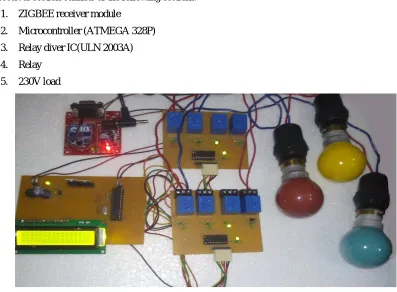
The receiver section consists of the following sections. 1. ZIGBEE receiver module
2. Microcontroller (ATMEGA 328P) 3. Relay diver IC(ULN 2003A) 4. Relay
5. 230V load
Once the data is received via ZIGBEE, it directly forwards it to the microcontroller, as soon as the microcontroller receives the signal from ZIGBEE, the processing starts and according to the input provided microcontroller takes action thus activating the output port through which the relay driver IC gets into action.
As soon as this IC gets command from the controller it takes the action and triggers the specified relay to which the particular load is connected. Thus turning on the load.
VI. SYSTEM OPERATION &DATA FLOW
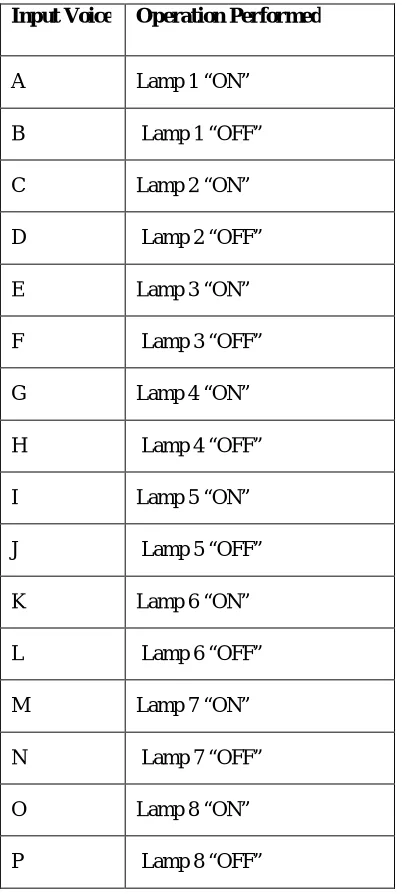
Input Voice Operation Performed
A Lamp 1 “ON” B Lamp 1 “OFF” C Lamp 2 “ON” D Lamp 2 “OFF” E Lamp 3 “ON” F Lamp 3 “OFF” G Lamp 4 “ON” H Lamp 4 “OFF” I Lamp 5 “ON” J Lamp 5 “OFF” K Lamp 6 “ON” L Lamp 6 “OFF” M Lamp 7 “ON” N Lamp 7 “OFF” O Lamp 8 “ON” P Lamp 8 “OFF”
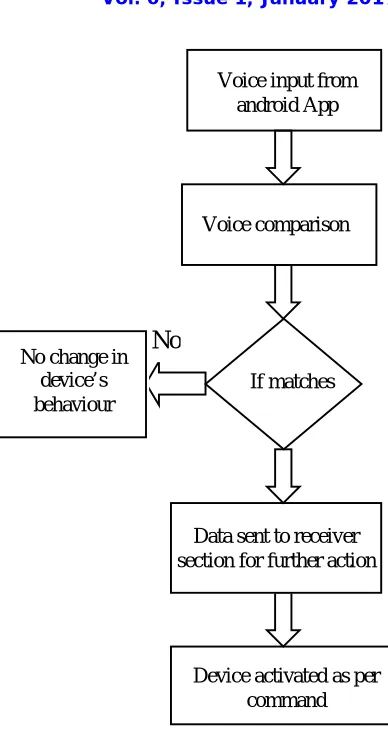
Fig 3. Data Flow for the proposed system
Voice commands are the basic input for the system to work. These commands are provided to the system using an android application. The android application forwards the command to the Bluetooth module using serial communication. This command is then forwarded to the receiver section using ZIGBEE module. As per the command the microcontroller activates the relay driver and so are the appliances controlled.
VII. CONCLUSION
The Wireless Home Automation System is an integrated system to facilitate elderly and disabled people with an easy-to-use home automation system that can be fully operated based on speech commandsBy the use of android application the user can operate devices without moving from his place and can operate devices in the range of approximate 300m because of the use of ZIGBEE.
REFERENCES
[1] Humaid AlShu’eili, Gourab Sen Gupta, Subhas Mukhopadhyay “Voice Recognition Based Wireless Home Automation System” 2011 4th International Conference on Mechatronics (ICOM), 17-19 May 2011, Kuala Lumpur, Malaysia
[2] Dhawade Pooja, Lathkar Y., Date Purushottam “ Smart Home Using Andriod Application” IJRET: International Journal of Research in
Voice input from android App
Voice comparison
If matches
Device activated as per command Data sent to receiver section for further action No change in
device’s behaviour
[3] Malik Sikandar Hayat Khiyal, Aihab Khan, and Erum Shehzadi “SMS Based Wireless Home Appliance Control System (HACS) for
Automating Appliances and Security”. Issue in Information Science and Information Technology Vol 6,, Pp 887-894, 2009.
[4] Mardiana B., Hazura H., Fauziyah S., Zahariah M., Hanim A.R., Noor Shahida M.K., "Homes Appliances Controlled Using Speech
Recognition in Wireless Network Environment," ICCTD, vol. 2, pp.285- 288, 2009 International Conference on Computer Technology and
Development, 2009
[5] Yang Li, Ji Maorang,Gao Zhenru, Zhang Weiping, Guo Tao, Mechanical Engineering Institute, Nanjing University of Science & Technology Nanjing, China, “Design Of Home Automation System based on ZigBee Wireless Sensor Network”, The 1st International Conference Science & Engineering(ICISE2009).
[6] Fuxing Yang, Chan Yuan Liu, Zhongcai Pei, Zhiyong Tang, College of Automation, Beijing University of Posts and Telecommunication, Beijing 100876, China, School of Automation Science and Electrical Engineering, Bee Hang University, Beijing 100191, China, “The Design
Of Wireless Remote Intelligent Home System Based On Zigbee And GPRS”, Proceedings of ICCTA 2011.
[7] Xiang Yang, Yuan Yi Zhang, Rong Yang Zhao, Department of Electronic and Computing, Guilin University of Technology, Guilin, P. R. China, “Study and Design of Home Intelligent System Based on Embedded Internet”, The 2008 International Conference on Embedded Software and Systems Symposia (ICESS2008).
[8] R. Gadalla, “Voice Recognition System for Massey University, Smarthouse,” M. Eng thesis, Massey University, Auckland, New Zealand, 2006.
[9] Jinn-Kwei Guo, Chun-Lin Lu, Ju-Yun Chang, Yi-Jing Li,Ya-Chi Huang, Fu-Jiun Lu and Ching-Wen Hsu, “Interactive Voice-Controller
Applied to Home Automation,” 2009 Fifth International Conference on Intelligent Information Hiding and Multimedia Signal Processing
[10] Guangming Song, Fei Ding, Weijuan Zhang and Aiguo Song, “A Wireless Power Outlet System for Smart Homes,” IEEE Transactions on Consumer Electronics, Vol. 54, No. 4, NOVEMBER 2008
[11] N. Sriskanthan and T. Karand, “Bluetooth Based Home Automation System”,Journal of Microprocessors and Microsystems, 26, 2002, 281-289.
[12] M. I. Ramli, M. H. AbdWahab andN. Ahmad, Towards Smart Home: “Control Electrical Devices Online”, International Conference on Science and Technology: Application in Industry and Education 2006
[13] G.B.Pradeep,B.SanthiChandra,M.Venkates-warao, Ad-Hoc Low Powered 802.15.1 “Protocol Based Automation System for Residence using