Review
Demand Prediction with Machine Learning Models;
State of the Art and a Systematic Review of Advances
Amir Mosavi
1,2, Sina Faizollahzadeh Ardabili
3and Shahabodin Shamshirband
4,51 School of the Built Environment, Oxford Brookes University, OX3 0BP Oxford, UK; [email protected] 2 Institute of Automation, Kando Kalman Faculty of Electrical Engineering, Obuda University, Budapest,
Hungary; [email protected]
3 Biosystem Engineering Department, University of Mohaghegh Ardabili, Ardabil 5619911367, Iran; [email protected]
4 Department for Management of Science and Technology Development, Ton Duc Thang University, Ho Chi Minh City, Vietnam; [email protected]
5 Faculty of Information Technology, Ton Duc Thang University, Ho Chi Minh City, Viet Nam;
Abstract:
Electricity demand prediction is vital for energy production management and proper
exploitation of the present resources. Recently, several novel machine learning (ML) models have
been employed for electricity demand prediction to estimate the future prospects of the energy
requirements. The main objective of this study is to review the various ML models applied for
electricity demand prediction. Through a novel search and taxonomy, the most relevant original
research articles in the field are identified and further classified according to the ML modeling
technique, perdition type, and the application area. A comprehensive review of the literature
identifies the major ML models, their applications and a discussion on the evaluation of their
performance. This paper further makes a discussion on the trend and the performance of the ML
models. As the result, this research reports an outstanding rise in the accuracy, robustness,
precision and the generalization ability of the prediction models using the hybrid and ensemble
ML algorithms.
Keywords:
demand prediction, energy systems; machine learning; artificial neural network
(ANN); support vector machines (SVM); neuro-fuzzy; ANFIS; wavelet neural network (WNN); big
data; decision tree (DT); ensemble learning; hybrid models; data science; deep learning; renewable
energies; energy informatics; prediction; forecasting; energy demand
Introduction
Electrical energy is an essential element for the sustainable development of today’s
nations in economic, environment and social aspects. The global energy consumption
has been ever increasing exponentially. Therefore, implementing energy management
can be a major step in the progress of economic development and environmental
security. As the electrical energy cannot be stored, managing an efficient balance
between electricity demand and generation is crucial (Jebaraj and Iniyan 2006).
Electricity demand forecasting aims at predicting the precise amount of this kind of
energy (Suganthi and Samuel 2012; Debnath and Mourshed 2018). Both under- and
over-estimating can have very costly consequences. The high operating cost of the
network, excess supply and network balance problems are examples of
overestimation whereas failure in delivering enough electrical energy is the most
important issue of underestimation (Palensky and Dietrich 2011).
In general, electricity demand is generated as a quantity of electricity and
distributed in a specific area over a given period (Engle, Mustafa et al. 1992).
Electricity demand forecasting is considered as one of the most important areas in the
research in the electric power industry due to its decision maker role in the
management of power grid in response to changes in the consumption of subscribers.
It is also attractive for companies related to the fields of energy generation,
transmission, and marketing. Most importantly, the nation’s gross national income,
technological development energy price and efficiency, gross output, and population
are being linked to energy demand to make the optimal decision for the future world
(Suganthi, Samuel et al. 2012; Torabi, Hashemi et al. 2018). Therefore, energy demand
modeling and management has become an important issue among policy
-
makers.
Traditional energy models for demand prediction includes Time series,
Econometric, Regression, Decomposition, and ARIMA models, and Expert systems
(Ghalehkhondabi, Ardjmand et al. 2017; Hosseini Imani, Zalzar et al. 2018). Over the
years such models have been improved using SC techniques such as Genetic
algorithm and fuzzy logic (Amasyali and El-Gohary 2018; Torabi, Mosavi et al. 2018).
In addition, the integrated models e.g. Ant Colony Optimization, Particle swarm
optimization, Bayesian vector auto regression (Azadeh, Ghaderi et al. 2007; Hong
2010; KıRan, ÖZceylan et al. 2012; Ahmad, Chen et al. 2018) along with Bottom-up
models e.g. MARKAL, TIMES G5, and LEAP (Zonooz, Nopiah et al. 2009; Shabbir and
Ahmad 2010) have become widely popular.
Recently, ML models e.g. ANNs, SVRs (Azadeh, Ghaderi et al. 2007; Ahmad,
Hassan et al. 2014; Amasyali and El-Gohary 2018) have been noticed in academic and
empirical proposes for overcoming the real-world problems. ML (Michalski, Bratko et
al. 1998) is a subset of artificial intelligence which is inspired mainly by biological
learning. ML deals with the computer programs and systems which have the
capability of experiential learning. Motivation in use of ML methods in electrical
energy demand estimation is that they can build and analyze more complex and
large-scale models in an accurate, robust and efficient manner (Tso and Yau 2007).
Building precise models with high accuracy is so important for electricity power
generation since just a 1% rise in demand prediction lapse is equal with losing out of
millions of dollars.
Methodology of review
The methodology of search and selection of relevant articles is described in figure 1.
This research work has been investigated in the prediction of electricity demand in
three different classes: single methods, hybrid methods, and ensemble methods.
Single methods are … , ensemble methods are …. And the hybrid method is…
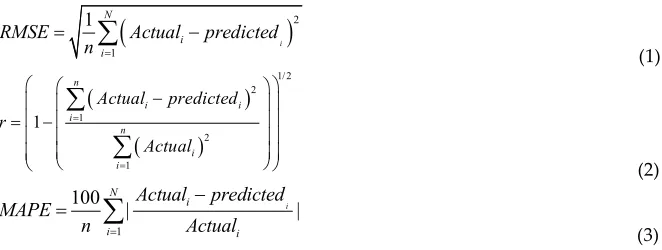
In this study, the general evaluation factors were correlation coefficient, MAPE and
RMSE as the most popular evaluation factors to indicate the accuracy and precision of
the developed models (Faizollahzadeh_Ardabili, Najafi et al. 2017; Najafi and Ardabili
2018) (Eq. 1, 2 and 3).
21
1
i N i iRMSE
Actual
predicted
n
(1)
1/ 2 2 1 2 1 1 n i i i n i i Actual predicted r Actual
(2)
1100
|
i|
N
i
i i
Actual
predicted
MAPE
n
Actual
(3)
Where, Actuali represents the target values, predictedi represents the output
values by the methods and n is the numbers of data.
Classification
ML employs advanced statistical techniques to able the computer systems to learn
based on data, without specific programming. One of the applications of ML, these
days, is predicting electricity demand. There is a number of different methods which
are used for this purpose.
Single methods
Future prediction can be developed in the presence of one single ML algorithm. In the
literature, some of the single methods like KNN, SVM, ANN, DT, and other ML
methods have been used to overcome these problems. KNN is one of the most simple
and traditional nonparametric techniques to classify sample (Tsai, Hsu et al. 2009).
SVM which is proposed by Vapnik (1998), first maps the input vector into a higher
dimensional feature space and then obtain the optimal separating hyperplane in the
higher dimensional feature space. The ANN is information processing units which to
mimic the neurons of the human brain (Haykin 1994).
Table 1 presents the latest research work has been done for electricity demand
prediction with single ML methods. The first columns show the reference, while the
second columns give us information about the model which is used for prediction. In
some cases just a single method used for this purpose, in some others one method has
been compared with some other methods to give credit for the one which outperforms
the other like (Ali and Azad 2013).
Table 1. Single ML methods
Reference Modeling Method Year Duration Historical Data Region
(Ren, Suganthan et al.
2016) RF 2016
(De Felice, Alessandri et
(Zjavka 2015) PNN 2015 Short-term (Zahedi, Azizi et al.
2013) ANFIS 2013 monthly Canada
(Ali and Azad 2013) SVR vs. LR & MLP 2013 Daily (Kheirkhah, Azadeh et
al. 2013)
ANN vs. GA & FIS
& ANFIS & FR 2013 monthly 1992-2004 Iran (Azadeh, Saberi et al.
2010) Fuzzy Regression 2010
Seasonal and
monthly 1994-2005 Iran (Adam, Elahee et al.
2011) ANN 2011 Monthly 2005-2008 Mauritius
(Çunkaş and Altun 2010) ANN 2010 Long-term 2008-2014 Turkey
(Kandananond 2011) ANN vs. ARIMA
& MLR 2001 1996-2010 Thailand
When it comes to predict future electricity demand prediction, ANN is considered as
one the most common methods. An ANN has a pliable structure that is for making
fuzzy rule. It performs weight adjustments by connecting the layers. This characteristic
of the ANN leads to be used in modeling highly complicated systems. Therefore, ANN
can be used to model a system to predict future electricity demand (Çunkaş and Altun
2010; Adam, Elahee et al. 2011; Kandananond 2011; Kheirkhah, Azadeh et al. 2013).
(Adam, Elahee et al. 2011) used the ANNs for predicting the monthly peak electricity
demand in Mauritius. The source data, which is collected from January 2005 to
December 2008, is used in this paperwork. It is reported by this paper that the
proposed model predicts the monthly peak in electricity demand accurately. (Çunkaş
and Altun 2010) implemented a model based on ANN for long-term prediction of
electricity demand in Turkey. Data, which is gathered for this purpose, is for the years
between 2008 and 2014. To conclude, it is shown that the proposed approach has the
lower percent errors. (Kandananond 2011) compared the efficiency of the different
prediction model, namely, ARIMA, ANN, and MLR. The data, which is tested in this
work, is for Thailand for the years between 1996 and 2010. Based on results, ANN
outperforms the other two models by reducing the MAPE values. In a study by
(Kheirkhah, Azadeh et al. 2013)), it is shown that the performance of the ANN can be
improved by some changes. (Kheirkhah, Azadeh et al. 2013) proposed a model based
on ANN for estimating seasonal and monthly electricity demand. In this research
work, conventional time series, ANN, PCA, DEA and data pre-processing method are
integrated with each other for electricity demand prediction. It has been also shown
that the proposed method outperforms the algorithms like GA, ANN, FIS, ANFIS, FR.
The data, which is used in this article, presents monthly consumption in Iran from
April 1992 to February 2004. (Zjavka 2015) employed a differential polynomial neural
network to predict electricity demand for a short period.
Azad 2013; De Felice, Alessandri et al. 2015) try to compare the performance of this
method with others like LR & MLP for electricity demand prediction. (De Felice,
Alessandri et al. 2015) present a way to predict mid-term electricity demand prediction
based on seasonal climate forecast. In order to predict, the writers use to different ML
approaches, namely linear regression and SVM. The electricity data, which is used in
this research, is for the time from 1990 to 2007 in Italy. By doing this research, the
writers report that they could find a relationship between temperature and electricity
demand and as a result, they claim that the anomaly of the electricity prediction in that
region is because of heat-waves over Europe and for this purpose SVM is generally
better than the linear model. In addition, (Ali and Azad 2013) use SVR for estimating
daily electricity demand for a household. they compare the efficiency of this model
with two other models, namely, linear regress and multilayer perception. They show
that SVM is the best choice for this task. The result of their study shows that ML
techniques can be used to forecast demand in a smart grid environment.
ANFIS for short, is a hybrid fuzzy-ANN method. In other word, it integrates ANN
with fuzzy logic principles in order to benefit capabilities of both method. It uses some
rules like IF_THEN that ability to learn to estimate nonlinear functions. So, ANFIS is
considered as a general model for estimation and modelling purposes. (Zahedi, Azizi
et al. 2013) estimate the electricity demand of the Ontario province of Canada by using
ANFIS. To train the model it uses the data, which is collected from the year 1976- 2005.
The proposed network which is based on ANFIS maps size parameter as input data to
electricity demand as the output variable. The best MSE for the network is 0.0016 for
the test data.
Fuzzy regression is a kind of classical regression model that has a fuzzy variation.
It uses fuzzy numbers to consider the relation between the independent and
dependent variables in a fuzzy dimension. (Azadeh, Saberi et al. 2010) for estimating
seasonal and monthly electricity demand use fuzzy regression and time series
framework for Iran and China. The user data is collected from Iran during the period
March 1994 to January 2005. The paper shows that the proposed model outperforms
other methods like GA and ANN.
research, is for the time from 1990 to 2007 in Italy. By doing this research, the writers
report that they could find a relationship between temperature and electricity demand
and as a result, they claim that the anomaly of the electricity prediction in that region is
because of heat-waves over Europe and for this purpose SVM is generally better than
the linear model. (Zjavka 2015) use a differential polynomial neural network to predict
electricity demand for a short period. (Zahedi, Azizi et al. 2013) estimate the electricity
demand of the Ontario province of Canda by using ANFIS. To train the model it uses
the data, which is collected from the year 1976- 2005. The proposed network which is
based on ANFIS maps size parameter as input data to electricity demand as the output
variable. The best MSE for the network is 0.0016 for the test data. (Azadeh, Saberi et al.
2010) for estimating seasonal and monthly electricity demand use fuzzy regression and
time series framework for Iran and China. The user data is collected from Iran during
the period March 1994 to January 2005. The paper shows that the proposed model
outperforms other methods like GA and ANN.. (Çunkaş and Altun 2010) for long-term
prediction of electricity demand in Turkey, implement a model based on ANN. The
data, which is gathered for this purpose, is for the years between 2008 and 2014. To
conclude, it is shown that the proposed approach has the lower percent errors.
(Kandananond 2011) compares the efficiency of the different prediction model,
namely, ARIMA, ANN, and MLR. The data, which is tested in this work, is for
Thailand for the years between 1996 and 2010. The writer shows that ANN
outperforms the other two models by reducing the MAPE.
Ensemble methods
Ensemble methods are those which use a set of classifiers to classify the new data by
taking a weighted vote of the prediction which is made by each classifier. These
methods can be separated into two main categories: sequential and parallel. In the
former, the base learners are generated sequentially, whereas, in the latter kind, they
can be generated in parallel. AdaBoost and RF are two examples of these two kinds of
ensemble methods respectively.
Most of the ensemble methods use a single base learner to produce homogeneous
base learners. In this case, the base learners are the same and lead to homogeneous
ensembles, though there are other types that different types of learner are used,
leading to heterogeneous ensembles. Bagging, boosting and stacking are three
different types of ensemble technique.
Table 2. Ensemble-ML methods
Reference Modeling
Method
Year Duration Historical Data Region
(Wang, Wang et al. 2018) Ensemble (bagging)
2018 Hourly 2014-2015 USA
(Shao, Gao et al. 2015) Ensemble (EEMD)
(Hassan, Khosravi et al. 2015)
Ensemble (NN)
2015 Short-term 2011-2012 Australia/USA
(Burger and Moura 2015) Ensemble 2015 Real-time 2 years USA
(Xiao-Hua, Dong-Xiao et al. 2015)
Ensemble 2015 Real-time
(Shen, Babushkin et al. 2013) Ensemble (PSF)
2013 Daily 2007-2009 Australia
(Pezzulli, Frederic et al. 2006)
Ensemble (Bayesial Hierachical)
2006 Seasonal 1986-2003 England/ Wales
(Taylor and Buizza 2003) Ensemble 2003 Daily 1997-2000
(Wang, Wang et al. 2018)
propose an EBT to predict hourly electricity demand
prediction. The historical data for this work is for an institutional building (Rinker
Hall) in the University of Florida (UF) campus from 2014 to 2015. The writers claim
that the presented method can predict the electricity demand for the test building with
improved accuracy. (Hassan, Khosravi et al. 2015) present an ensemble method, which
is constructed by 100 NN models, then the output from NN models combined by three
different aggregation algorithms. The test and train data is a dataset which is from
AEMO and New York Independent System. (Shao, Gao et al. 2015) present an EEMD
based framework for mid-term electricity demand prediction. The data, which is used
for training and testing the proposed method, is for Suzhou city from February 2004 to
January 2012. It is claimed that the proposed method outperformed the common
decomposition forecast methods.
(Burger and Moura 2015) introduce a new ensemble model for predicting
electricity demand. The proposed model performs model validation and selection by
using a gating function in real time. The time series data, which is used in this model, is
for eight building located in the Berkely campus of the University of California, which
is recorded hourly for 2 years. As a conclusion, the writer claims that the proposed
ensemble method is able to help in the production of accurate multivariate electricity
demand forecasting for the buildings. (Xiao-Hua, Dong-Xiao et al. 2015) conduct a
research on using an improved heterogeneous ensemble method for estimating
electricity demand in China. The proposed method is based on the characteristics of
the MLR model, WNN, GM (1, 1). The real-time data is used for this work is for
electricity demand in China. The writers claim that their method overcomes the defect
single assessment standard of general variable weight combination forecast model and
conquer the limitations of fixed weight combination forecast models and a result it can
achieve a better improvement in forecasting.
performance in comparison with the other five methods.
(Pezzulli, Frederic et al. 2006) present a Bayesian hierarchical model for seasonal
(winter) electricity demand prediction in Central England and Wales. The daily peak
demand data for training and testing is collected by NGT for 17 winters from 1986-1986
to 2002-2003. It is claimed by the writers, which their methods for this purpose are
extremely flexible. (Taylor and Buizza 2003)
Make a relationship between weather
ensemble predictions in electricity demand estimation. The proposed method is for
short-term which can predict 1 to 10 days ahead. The data that is used in this work is
for 22 months, which contains daily data from 1 January 1997 to 31 October 1998 for
estimating the parameters of the model and from 1 November 1998 to 30 April 2000 to
test the methods. In a conclusion, the writers claim that there is a potential use for
weather ensemble prediction to improve the accuracy and uncertainty assessment of
electricity demand prediction.
Hybrid methods
Hybrid methods are a combination of completely different techniques to increase the
performance (Tsai, 2010). This kind of methods generally consists of two functional
components. The first one takes raw data as input and generates intermediate results.
The second one will then take the intermediate results as the input and produce the
final results. The following table also has the same structure as the previous ones. It
contains information about the references which uses hybrid prediction modeling for
electricity demand. They have to combine different techniques to improve the
performance of the single methods.
Table 3. Hybrid ML methods(Ren, Suganthan et al. 2016)(Ren, Suganthan et al. 2016)
Reference Modeling Method Year Duration Historical Data Region
(Anand and Suganthi 2018)
Hybrid (ANN,GA_ PSO) 2018 Annual 1991-2015 India
(Chen, Lo et al. 2017) Hybrid (ANN,COGSA) 2017 Monthly 2006-2010 Oman
(Chen and Tan 2017) Hybrid (SVR, MWD) 2017 Hourly
(Günay 2016) Hybrid (ANN, MLR) 2016 Annual 1975-2013 Turkey (Ismail and Abdullah
2016)
Hybrid(ANN,PCR) 2016 Long-term 1995-2013 Malaysia
(Yu, Wang et al. 2015) Hybrid (ANN, PSO, GA_RFB)
2015 Short-term 1990-2013 China
(Mostafavi, Mostafavi et al. 2013)
Hybrid (GP , SA) 2013 Long-term 1986-2009 Thailand
(Velasquez Henao, RUEDA MEJIA et al. 2013)
Hybrid (SARIMA, NN) 2013 Monthly 1995-2010 Colombia
(An, Zhao et al. 2013) Hybrid ( ANN, EMD) 2013 Short-term 2011 Australia
(Wang, Wang et al. 2010)
A GA is a search method for exploring that can be applied in finding an optimal
solution in different applications. On the other hand, due to the fact that PSO falls into
a local optimum, it is not a good candidate for finding a solution in optimization issues.
By combining this two methods, an optimized result can be achieved. (Anand and
Suganthi 2018) use an ANN, which is optimized by a hybrid algorithm of GA and PSO.
This hybrid algorithm is used for improving the annual electricity demand prediction
in India. The historical data, which is used in this paper, is from 25 years from 1991 to
2015. COGSA is a method that helps to optimize the forecasting procedure. First, CO
algorithm tries to search the global search space to find global optima, then GSA as an
algorithm that search the local, tries to fine some better solutions near to the optima
which has been found by COA. This process is used to reach the benefits of exploiting
the space. (Chen, Lo et al. 2017) use the same procedure to solve the problem of
forecasting electricity demand. They train ANNs by different heuristic algorithms like
GSA and Cuckoo optimization. The resulting model is used to predict monthly
electrical demand. The data, which is used for the model, was collected from the years
2006 to 2010 in Oman. The result shows that the ANN-CO is the best fit model for the
historical data.
Pre-processing of data in an integral part of data mining. It is done to clear the
initial data from the noise, therefore the result data is efficient for data modelling. For
example Fourier transform can be used in this step. However this method has some
drawbacks like phase shift. WT can overcome these disadvantageous by providing
better temporal resolution for components which have low frequency. Also it provides
better frequency resolution for low frequency components at the same time. MWD is a
way of analysing that considers both time and frequency domain. In general, a series of
wavelets are derived from a mother wavelet by displacement and scaling on time shaft
and shift translations. The role of MWD is to find how and how much inevitably
random sections in the dataset can be reduced. (Chen and Tan 2017) propose a hybrid
model based on SVR and multi-resolution WD for predicting hourly electrical demand
prediction in the building sector. In this research work, WD is used as a pre-processing
step. The data, which is used in this paper, is collected from an electric consumption of
a mall and a hotel in China. The writers report that introducing WD, the prediction
accuracy can always be improved for the hotel, and it is not necessary for the mall.
ANN can also be combined with MLRs in order to make a hybrid method to produce
better results. It this combination, a MLR is used to be applied on the whole data to
specify that a specific descriptor variable is appropriate or not. In this combination,
then the ANN is used to construct a prediction model on the variables which have
been already specified by the MLR. The hybrid model can be used in electricity
demand prediction as it is use by (Günay 2016). In this research work, the writers show
that how they combine ANN and MLR to predict annual electricity demand in Turkey.
The data, which is used for the work is for the years between 1975 and 2013. The writer
concludes that the presented approach can be used by other countries to make a
precise prediction for the future.
prediction models is the property of the input data. The multi-collinearity among the
independent variables and the changing in the pattern of the input variables. In order
to solve this problem, the PCR are employed which is a combination of the Principle
Component analysis with linear model. The main aim for this combination is to
improve the accuracy. BPNN or the Back-Propagation Neural Network model is also a
suitable model for working with independent variable and get a good accuracy in
estimation model. In order to tackle the issues which comes from the mixed pattern
datasets, (Ismail and Abdullah 2016) use a hybrid model which a combination of linear
and nonlinear approaches. They present a new Hybrid model, which a combination of
PCR and BPNN in order to improve the accuracy rate for the electricity demand
prediction. The dataset used for this work is for Malaysia for the duration of the years
between 1995 and 2013. It is concluded by the writers that, the proposed hybrid system
is more accurate than the others, and this model can be used in modelling in the other
areas.
the paper reports that MFES improves the prediction of the electricity demand
significantly. (Wang, Wang et al. 2010) propose an improved version of BP wavelet
neural network (IBPWNN) to forecast electrical energy demand. In this study, the
annual power demand of Taiwan between the years 1985 and 2000 is used. This data is
divided to train and test data, which the data of the years 1985 to 1996 is used as
training data and the rest as the text data. It is reported by this paper that IBPWNN has
high precision and a good ability for estimating electricity demand.
Discussions
Here come the discussions on the ML methods used and on the outstanding rise in the
accuracy, robustness, precision and the generalization ability of the prediction models
using the hybrid and ensemble ML algorithms. This section provides the graphical
results related to the studies presented in the above sections. These results provide a
better comparison capability as well as a better understand about the performance of
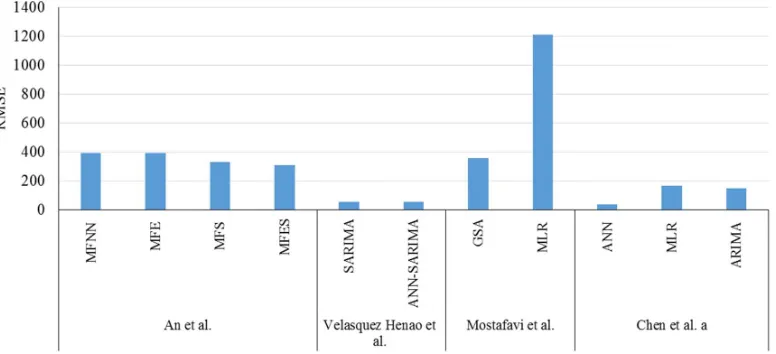
each method. Figures 1 and 2 presents the results in term of MAPE and RMSE for the
highlighted studies, respectively. In this way, the method with a low MAPE provides a
better performance compared with other methods.
b
Figure 1. MAPE values for the highlighted studies. b continues by a
Figure 2. RMSE values for the highlighted studies
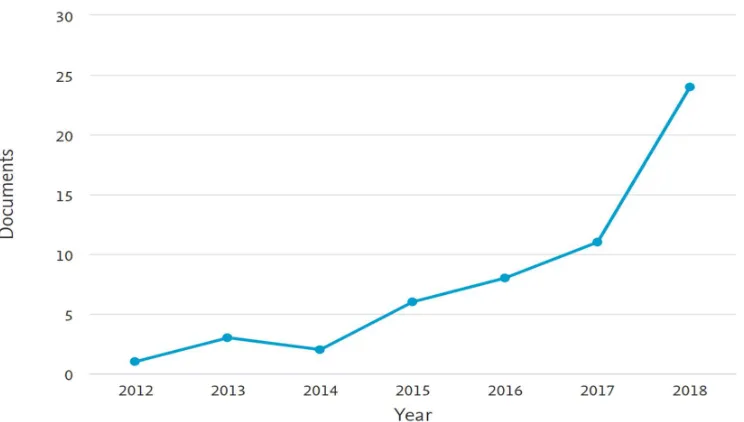
Figure 3. Number of documents on demand prediction which used machine
learning models.
Fig. 3 shows the increasing number of machine learning models for demand
prediction. Further reading include e.g., (Afrin, Nepal et al. ; Ahmad and Chen ;
Ahmad, Chen et al. ; Ahmad, Chen et al. ; Ai, Chakravorty et al. ; Chen, Tan et al. ; Cui,
Fan et al. ; Ferreira, Lee et al. ; Grolinger, L'Heureux et al. ; Guo, Wang et al. ; Jiang, Li
et al. ; Kim, Song et al. ; King, Abrahams et al. ; Kumar and Singh ; López Lázaro,
Barbero Jiménez et al. ; Marcek and Kotillova ; Muzi, De Lorenzo et al. ; Nguyen, Kieu
et al. ; Qu, Zhang et al. ; Sala-Cardoso, Delgado-Prieto et al. ; Sánchez-Oro, Duarte et al.
; Shah, Miled et al.)
Conclusion
Energy demand prediction models using ML methods have been reviewed. It is found
that today, various nations are investing in the advancement of prediction models of
ML for a detailed energy planning for their sustained development. Such models are
formed using hybrid and ensemble ML techniques. ANNs, SVRs, Neuro-fuzzy in an
integration with SC techniques yielded better prediction performance.
References
A. Mosavi, (2011). "Reconsidering the Multiple Criteria Decision Making Problems of Construction Workers Using Grapheur." ENGINSOFT Newsletter Year 8, No 4, Winter 2011.
A. Mosavi, (2015). Visual Analytics, Obuda University.
A. Mosavi, (2017). "A Hybrid Algorithm for Dynamic Resource Allocation in Cloud Computing." Acta Polytechnica Hungarica.
A. Mosavi, (2017). "Improving Client Access License for Apache Hadoop Application." Acta Polytechnica Hungarica.
A. Mosavi, (2018). "Blockchain Technology: State Of The Art And Taxonomy Of Applications."
A. Mosavi, (2018). "Classification And Reviewing Machine Learning Tools For Hydrological Prediction." A. Mosavi, (2018). "Climate Change Prediction: State Of The Art And Classification Of Artificial Intelligence
A. Mosavi, (2019). "Prediction of Hydropower Generation Using Grey Wolf Optimization Adaptive Neuro-Fuzzy Inference System." Energies.
A. Mosavi, (2019). "Prediction of remaining service life of pavement using an optimized support vector machine (case study of Semnan–Firuzkuh road)." Engineering Applications of Computational Fluid Mechanics.
Adam, N. B., M. Elahee, et al. (2011). "Forecasting of peak electricity demand in Mauritius using the non-homogeneous Gompertz diffusion process." Energy 36(12): 6763-6769.
Adejuwon, A. and A. Mosavi (2010). "Domain Driven Data Mining; Application to Business." International Journal of Computer Science Issues.
Afrin, K., B. Nepal, et al. A data-driven framework to new product demand prediction: Integrating product differentiation and transfer learning approach.
Ahmad, A., M. Hassan, et al. (2014). "A review on applications of ANN and SVM for building electrical energy consumption forecasting." Renewable and Sustainable Energy Reviews 33: 102-109.
Ahmad, T. and H. Chen Nonlinear autoregressive and random forest approaches to forecasting electricity load for utility energy management systems.
Ahmad, T., H. Chen, et al. A comprehensive overview on the data driven and large scale based approaches for forecasting of building energy demand: A review.
Ahmad, T., H. Chen, et al. (2018). "A comprehensive overview on the data driven and large scale based approaches for forecasting of building energy demand: A review." Energy and Buildings 165: 301-320. Ahmad, T., H. Chen, et al. Water source heat pump energy demand prognosticate using disparate data-mining
based approaches.
Ai, S., A. Chakravorty, et al. Household power demand prediction using evolutionary ensemble neural network pool with multiple network structures.
Ali, A. S. and S. Azad (2013). Demand forecasting in smart grid. Smart Grids, Springer: 135-150.
Amasyali, K. and N. M. El-Gohary (2018). "A review of data-driven building energy consumption prediction studies." Renewable and Sustainable Energy Reviews 81: 1192-1205.
Amir, M. (2016). Business Modeling.
An, N., W. Zhao, et al. (2013). "Using multi-output feedforward neural network with empirical mode decomposition based signal filtering for electricity demand forecasting." Energy 49: 279-288.
Anand, A. and L. Suganthi (2018). "Hybrid GA-PSO Optimization of Artificial Neural Network for Forecasting Electricity Demand." Energies 11(4): 728.
Ardabili, S. F., B. Najafi, et al. Using SVM-RSM and ELM-RSM approaches for optimizing the production process of methyl and ethyl esters.
Azadeh, A., S. F. Ghaderi, et al. (2007). "Integration of artificial neural networks and genetic algorithm to predict electrical energy consumption." Applied Mathematics and Computation 186(2): 1731-1741. Azadeh, A., M. Saberi, et al. (2010). "An integrated fuzzy regression algorithm for energy consumption
estimation with non-stationary data: a case study of Iran." Energy 35(6): 2351-2366. Baranyai, M., A. Mosavi, et al. Optimal design of electrical machines: State of the art survey.
Baranyai, M., A. Mosavi, et al. (2017). "Optimal Design of Electrical Machines: State of the Art Survey." Recent Advances in Technology Research and Education.
Burger, E. M. and S. J. Moura (2015). "Gated ensemble learning method for demand-side electricity load forecasting." Energy and Buildings 109: 23-34.
Chen, J.-F., S.-K. Lo, et al. (2017). "Forecasting monthly electricity demands: an application of neural networks trained by heuristic algorithms." Information 8(1): 31.
Chen, Y. and H. Tan (2017). "Short-term prediction of electric demand in building sector via hybrid support vector regression." Applied Energy 204: 1363-1374.
Chen, Y., H. Tan, et al. Day-ahead prediction of hourly electric demand in non-stationary operated commercial buildings: A clustering-based hybrid approach.
Choubin, B., E. Moradi, et al. An ensemble prediction of flood susceptibility using multivariate discriminant analysis, classification and regression trees, and support vector machines.
Choubin, B., E. Moradi, et al. (2019). "An Ensemble prediction of flood susceptibility using multivariate discriminant analysis, classification and regression trees, and support vector machines." Science of the Total Environment 651: 2087-2096.
Cui, B., C. Fan, et al. A hybrid building thermal modeling approach for predicting temperatures in typical, detached, two-story houses.
Darvishzadeh, A., N. Alharbi, et al. Modeling the strain impact on refractive index and optical transmission rate.
Darvishzadeh, A., N. Alharbi, et al. (2018). "Modeling the strain impact on refractive index and optical transmission rate." Physica B: Condensed Matter 543: 14-17.
De Felice, M., A. Alessandri, et al. (2015). "Seasonal climate forecasts for medium-term electricity demand forecasting." Applied Energy 137: 435-444.
Debnath, K. B. and M. Mourshed (2018). "Forecasting methods in energy planning models." Renewable and Sustainable Energy Reviews 88: 297-325.
Dehghani, M., H. Riahi-Madvar, et al. (2019). "Prediction of hydropower generation using grey wolf optimization adaptive neuro-fuzzy inference system." Energies 12(2): 289.
Dehghani, M., H. Riahi-Madvar, et al. Prediction of hydropower generation using grey Wolf optimization adaptive neuro-fuzzy inference system.
Dineva, A., A. Mosavi, et al. (2019). "Review of Soft Computing Models in Design and Control of Rotating Electrical Machines." Energies.
Engle, R. F., C. Mustafa, et al. (1992). "Modelling peak electricity demand." Journal of forecasting 11(3): 241-251. Esmaeili, M. and A. Mosavi RETRACTED ARTICLE: Variable reduction for multi-objective optimization using
data mining techniques; application to aerospace structures.
Esmaeili, M. and A. Mosavi (2010). Variable reduction for multi-objective optimization using data mining techniques; application to aerospace structures. IEEE, Computer Engineering and Technology (ICCET), 2010 2nd International Conference on , vol.5, no., pp.V5-3.
Eze, J., K. Agbo, et al. (2010). "Performance Assessment of a Solar Water Heater for Process Water Purification in Food Processing Industries." Global Journal of Researches in Engineering. 10 (3).
Faizollahzadeh Ardabili, S., B. Najafi, et al. (2018). "Using SVM-RSM and ELM-RSM approaches for optimizing the production process of methyl and ethyl esters." Energies 11(11): 2889.
Faizollahzadeh_Ardabili, S., B. Najafi, et al. (2017). "A novel enhanced exergy method in analyzing HVAC system using soft computing approaches: A case study on mushroom growing hall." Journal of Building Engineering 13: 309-318.
Fardad, K., B. Najafi, et al. Biodegradation of medicinal plants waste in an anaerobic digestion reactor for biogas production.
Fardad, K., B. Najafi, et al. (2018). "Biodegradation of Medicinal Plants Waste in an Anaerobic Digestion Reactor for Biogas Production." Computers, Materials and Continua.
Ferreira, K. J., B. H. A. Lee, et al. Analytics for an online retailer: Demand forecasting and price optimization. Foldi, E., A. Mosavi, et al. (2012). Reconsidering the Multiple Criteria Decision Making Problems of
Construction Projects; Using Advanced Visualization and Data Mining Tools. Conference of PhD Students in Computer Science, Szeged, Hungary, 2012.
Ghalandari, M., A. Ziamolki, et al. (2019). "Aeromechanical Optimization of First Row Compressor Test Stand Blades."
Ghalehkhondabi, I., E. Ardjmand, et al. (2017). "An overview of energy demand forecasting methods published in 2005–2015." Energy Systems 8(2): 411-447.
Ghazvinei, P. T., H. H. Darvishi, et al. (2018). "Sugarcane growth prediction based on meteorological parameters using extreme learning machine and artificial neural network." Engineering Applications of Computational Fluid Mechanics.
Grolinger, K., A. L'Heureux, et al. Energy forecasting for event venues: Big data and prediction accuracy. Günay, M. E. (2016). "Forecasting annual gross electricity demand by artificial neural networks using predicted
values of socio-economic indicators and climatic conditions: Case of Turkey." Energy Policy 90: 92-101.
Guo, Y., J. Wang, et al. Machine learning-based thermal response time ahead energy demand prediction for building heating systems.
Hassan, S., A. Khosravi, et al. (2015). "Examining performance of aggregation algorithms for neural network-based electricity demand forecasting." International Journal of Electrical Power & Energy Systems 64: 1098-1105.
Haykin, S. (1994). Neural networks: a comprehensive foundation, Prentice Hall PTR.
Hong, W.-C. (2010). "Application of chaotic ant swarm optimization in electric load forecasting." Energy Policy 38(10): 5830-5839.
Hosseini Imani, M., S. Zalzar, et al. (2018). "Strategic behavior of retailers for risk reduction and profit increment via distributed generators and demand response programs." Energies 11(6): 1602.
Imani, M. H., S. Zalzar, et al. Strategic Behavior of Retailers for Risk Reduction and Profit Increment via Distributed Generators and Demand Response Programs.
Imani, M. H., S. Zalzar, et al. (2018). "Strategic Behavior of Retailers for Risk Reduction and Profit Increment via Distributed Generators and Demand Response Programs." Energies 11.
Ismail, N. and S. Abdullah (2016). "Principal component regression with artificial neural network to improve prediction of electricity demand." Int. Arab J. Inf. Technol. 13(1A): 196-202.
Jebaraj, S. and S. Iniyan (2006). "A review of energy models." Renewable and Sustainable Energy Reviews 10(4): 281-311.
Jiang, P., R. Li, et al. Modeling of electricity demand forecast for power system.
Kandananond, K. (2011). "Forecasting electricity demand in Thailand with an artificial neural network approach." Energies 4(8): 1246-1257.
Karballaeezadeh, N., D. Mohammadzadeh S, et al. (2019). "Prediction of remaining service life of pavement using an optimized support vector machine (case study of Semnan–Firuzkuh road)." Engineering Applications of Computational Fluid Mechanics 13(1): 188-198.
Karimi, S., S. Shamshirband, et al. (2019). "An Algorithm for Optimizing the Size of Dixon Resultant Matrix." Computers, Materials & Continua 58(2): 567-583.
Khansari, N., A. Farrokhi, et al. (2019). "Orthotropic mode II shear test fixture: Iosipesque modification." Engineering Solid Mechanics.
Kheirkhah, A., A. Azadeh, et al. (2013). "Improved estimation of electricity demand function by using of artificial neural network, principal component analysis and data envelopment analysis." Computers & Industrial Engineering 64(1): 425-441.
Kim, S., Y. Song, et al. Development of a consecutive occupancy estimation framework for improving the energy demand prediction performance of building energy modeling tools.
King, M. A., A. S. Abrahams, et al. Ensemble methods for advanced skier days prediction.
KıRan, M. S., E. ÖZceylan, et al. (2012). "Swarm intelligence approaches to estimate electricity energy demand in Turkey." Knowledge-Based Systems 36: 93-103.
Kumar, J. and A. K. Singh An efficient machine learning approach for virtual machine resource demand prediction.
López Lázaro, J., Á. Barbero Jiménez, et al. Improving cash logistics in bank branches by coupling machine learning and robust optimization.
Marcek, D. and A. Kotillova Statistical and soft computing methods applied to high frequency data.
Michalski, R. S., I. Bratko, et al. (1998). Machine learning and data mining; methods and applications, John Wiley & Sons, Inc.
Moeini, I., M. Ahmadpour, et al. Modeling the detection efficiency in photodetectors with temperature-dependent mobility and carrier lifetime.
Moeini, I., M. Ahmadpour, et al. Modeling the time-dependent characteristics of perovskite solar cells. Moeini, I., M. Ahmadpour, et al. (2018). "Modeling the detection efficiency in photodetectors with
temperature-dependent mobility and carrier lifetime." Superlattices and Microstructures.
Moeini, I., M. Ahmadpour, et al. (2018). "Modeling the time-dependent characteristics of perovskite solar cells." Solar Energy.
Mohammadzadeh, D., S.-F. Kazemi, et al. (2019). "Evolutionary prediction model for fine-grained soils compression index using gene-expression programming." Preprints.
Mohammadzadeh, D., S.-F. Kazemi, et al. (2019). "Predicting Compression Index of Fine-Grained Soils Using Gene Expression Programming Model."
Mosavi and A. (2014). "Engineering Design and their Applications."
Mosavi, A. Application of multi-objective optimization packages in design of an evaporator coil. Mosavi, A. "Big Data Survey."
Mosavi, A. Computer design and simulation of built environment; Application to forest planning.
Mosavi, A. Hydrodynamic design and optimization: Application to design a general case for extra equipments on the submarinés hull.
Mosavi, A. The large scale system of multiple criteria decision making; pre-processing. Mosavi, A. "Predictive Analytics Using Internet Content: A Review."
Mosavi, A. "predictive decision making." Mosavi, A. "Predictive decision model,(2015)." Mosavi, A. "predictive decision modeling."
Mosavi, A. "Shaping the future of time series forecasting."
Mosavi, A. (2009). "Hydrodynamic Design and Optimization: Application to Design a General Case for Extra Equipments on the Submarine's Hull." Computer Technology and Development, 2009.
Mosavi, A. (2009). Parametric modeling of trees and using integrated CAD/CFD and optimization tools: Application to creating the optimal planting patterns for new forests. 2nd International Conference Wind Effects on Trees, Albert-Ludwigs-University of Freiburg, Germany, 2009.
Mosavi, A. (2009). Parametric modelling of trees and using integrated CAD/CFD tools: application to create a planting pattern for new forests. Wind Effects on Trees.
Mosavi, A. (2010). "Application of Data Mining in Multiobjective Optimization Problems." International Journal for Simulation and Multidisciplinary Design Optimization, 2010.
Mosavi, A. (2010). "Application of Multi-objective Optimization Packages in Design of an Evaporator Coil." World Academy of Science, Engineering and Technology 37 2010.
Mosavi, A. (2010). "Applications of Interactive Methods of MOO in Chemical Engineering Problems." Global Journals of Engineering Research, V10, 2010 10(3).
Mosavi, A. (2010). "Decision-Making in Chemical Engineering Problems." Global Journal of Engineering Science and Researches.
Mosavi, A. (2010). Interactive Methods of MOO; Application to Chemical Engineering Problems. Third International Conference on Multidisciplinary Design Optimization and Applications, June 2010, Paris, France.
Mosavi, A. (2010). "The large scale system of multiple criteria decision making; pre-processing." Large Scale Complex Systems Theory and Applications, V9, 2010.
Mosavi, A. (2010). Multiobjective optimization package of IOSO. 24th Mini EURO Conference on Continuous Optimization and Information-Based Technologies in the Financial Sector, Izmir, Turkey, 2010. (MEC-EurOPT-2010). (Mini EURO Conference EUROPT).
Mosavi, A. (2010). The Multiobjective Optimization Package of IOSO; Applications and Future Trends. Conference of PhD Students in Computer Science, Szeged, Hungary, 2010.
Mosavi, A. (2010). "Multiple criteria decision-making preprocessing using data mining tools." International Journal of Computer Science Issues, Vol.7, 2010.
Mosavi, A. (2010). "Optimization and Decision Making in Chemical Engineering Problems." Global Journal of Researches in Engineering.
Mosavi, A. (2010). "Report on given lectures of Amir Mosavi on data mining and applications." University of Debrecen, Faculty of Informatics, Debrecen, 2010.
Mosavi, A. (2011). "Computational geometry modeling, generative algorithms, application to modeling the complex geometry of textiles." Reports of the Faculty of Informatics, Scientific Computing, University of Debrecen, 2011.
Mosavi, A. (2011). "Design optimization of system-on-chip platforms, supervised by professor Oniga Istvan." Reports in Computer Science, University of Debrecen, Faculty of Informatics, 2011.
Mosavi, A. (2011). "On geometrical modeling and meshing of textile structures in texgen." University of Debrecen, Faculty of Informatics, 2011.
Mosavi, A. (2011). "A report on geometrical modeling and meshing of textile structures in texGen." University of Debrecen, Faculty of Informatics, 2011.
Mosavi, A. (2013). Brain-Computer Optimization for Solving Complicated Geometrical Decision-Making Problems. PEME VI. Ph.D.Conference, 2013. Budapest, Hungary.
Mosavi, A. (2013). Collaborative optimization. International CAE Conference, Verona, Italy, 2013., http://www.caeconference.com.
Mosavi, A. (2013). Collaborative optimization. International CAE Conference, Verona, Italy, 2013.
Mosavi, A. (2013). "Data mining for decision making in engineering optimal design." Journal of Artificial Intelligence & Data Mining, V1, 2013. (JAIDM) 1.
Mosavi, A. (2013). Decision-Making Models for Optimal Engineering Design and their Applications.
Mosavi, A. (2013). "Decision-making software architecture; the visualization and data mining assisted approach." International Journal of Information and Computer Science.
Mosavi, A. (2013). "Engineering Design and Decision-Making Models."
Mosavi, A. (2013). A MCDM Software Tool for Automating the Optimal Design Environments with an Application in Shape Optimization. International Conference on Optimization and Analysis of Structures, Tartu, Estonia, 2013., http://www.researchgate.net.
Mosavi, A. (2013). A MCDM Software Tool for the Automated Design Environments. 26th Europian Conference on Operational Research, Rome 2013. EURO - INFORMS XXVI.
Mosavi, A. (2013). "On Developing a Decision-Making Tool for General Applications to Computer Vision." International Journal of Computer Applications.
Mosavi, A. (2013). "Optimal Engineering Design." Tech. Rep. 2013. University of Debrecen, Hungary, 2013. Mosavi, A. (2013). "Visualization-based software architecture for decision making." International Journal of
Computer Science and Application.
Mosavi, A. (2014). Combination of Machine Learning and Optimization for Automated Decision-Making. Mosavi, A. (2014). "Decision-Making in Complicated Geometrical Problems." International Journal of
Computer Applications 87.
Mosavi, A. (2014). Predictive modeling techniques for multiple criteria decision analysis using a hybrid algorithm of k-means clustering and self-organizing maps, US Patent US 14/1107-8,859.
Mosavi, A. (2015). Predictive decision making.
Mosavi, A. (2015). Predictive Decision Making, Predictive Decision Model. Mosavi, A. (2016). Mobile Apps, Obuda University.
Mosavi, A. (2017). "Decision-Making and Visualization." International Journal of Information and Computer Science.
Mosavi, A. (2017). ModeFrontier for the Optimal Design of Electrical Machines. INTERNATIONAL CAE CONFERENCE AND EXHIBITION.
Mosavi, A. (2017). Reviewing the Multiobjective Optimization Package of modeFrontier in Energy Sector. INTERNATIONAL CAE CONFERENCE AND EXHIBITION.
Mosavi, A. (2018). "BLOCKCHAIN TECHNOLOGY: STATE OF THE ART AND TAXONOMY OF APPLICATIONS."
Mosavi, A. (2018). "CLASSIFICATION AND REVIEWING MACHINE LEARNING TOOLS FOR HYDROLOGICAL PREDICTION."
Mosavi, A. (2018). "CLIMATE CHANGE PREDICTION: STATE OF THE ART AND CLASSIFICATION OF ARTIFICIAL INTELLIGENCE METHODS."
Mosavi, A. (2018). "Predicting the future using web knowledge: State of the art survey. D. Luca, L. Sirghi and C. Costin." Springer Verlag 660: 341-349.
Mosavi, A. (2019). "Sustainable Business Models in Biosphere Reserves: Case of Hungary."
Mosavi, A. and A. Adeyemi (2010). On Domain Driven Data Mining and Business Intelligence. 8th Joint Conference on Mathematics and Computer Science, Komárno, Slovakia, July 14-17, 2010. (8th MaCS). Mosavi, A. and e. al (2012). Optimal Design of the NURBS Curves and Surfaces Utilizing Multiobjective
Optimization and Decision Making Algorithms of RSO. The Second Conference of PhD Students in Mathematics, Szeged, Hungary, 2012.
Mosavi, A. and e. al. (2012). Adapting the Reactive Search Optimization and Visualization Algorithms for Multiobjective Optimization Problems; Application to Geometry. Conference of PhD Students in Computer Science, Szeged, Hungary, 2012.
Mosavi, A. and e. al. (2012). Multiple criteria decision making for material selection of composites; utilizing advanced data mining visualizations and learning/intelligent optimization tools. ECCM15 - 15th EUROPEAN CONFERENCE ON COMPOSITE MATERIALS, Venice, Italy., www.eccm15.org. Mosavi, A. and e. al. (2012). Multiple Criteria Decision Making Integrated with Mechanical Modeling of
Draping for Material Selection of Textile Composites. ECCM15, 15th European Conference on Composite Materials, Italy, Venice., http://www.researchgate.net.
Mosavi, A., M. Azodinia, et al. (2011). Reconsidering the Multiple Criteria Decision Making Problems of Construction Workers With the aid of Grapheur. International ANSYS and EnginSoft Conference. Mosavi, A., Y. Bathla, et al. Predicting the future using web knowledge: State of the art survey.
Mosavi, A., Y. Bathla, et al. (2017). Predicting the Future Using Web Knowledge: State of the Art Survey. Recent Advances in Technology Research and Education, Springer Nature.
Mosavi, A., R. Benkreif, et al. Comparison of Euler-Bernoulli and Timoshenko beam equations for railway system dynamics.
Mosavi, A., R. Benkreif, et al. (2017). Comparison of Euler-Bernoulli and Timo-shenko Beam Equations for Railway System Dynamics. Recent Advances in Technology Research and Education, Springer Nature.
Mosavi, A. and A. Delavar (2016). Business Modeling,
https://www.researchgate.net/publication/294427847_Business_Modeling.
Mosavi, A. and M. Edalatifar A Hybrid Neuro-Fuzzy Algorithm for Prediction of Reference Evapotranspiration.
Mosavi, A. and B. Farhoudnia (2017). "Prediction and Decision Analysis." Taylor & Francis.
Mosavi, A., K. N. Hewage, et al. (2011). Grapheur Supports Tough Decisions within Construction Projects. International CAE Conference, 2011.
Mosavi, A. and M. Hoffmann (2010). Design of curves and surfaces by multiobjective optimization; utilizing IOSO and modeFRONTIER packages. Enginsoft international conference CAE Technologies for Industries, Italy.
Mosavi, A., M. Hoffmann, et al. (2009). Automatic multi-objective surface design optimisation using modeFRONTIER's CAD/CAE integrated system: Application to military submarine sail. EnginSoft International Conference, Bergamo, Italy, 2009.
Mosavi, A., M. Hoffmann, et al. (2012). "Grapheur for Material Selection." Joural of Simulation Based Engineering & Sciences.
Mosavi, A., M. Hoffmann, et al. (2012). "Grapheur for Material Selection." ENGINSOFT newsletter, simulation based engineering & Sciences No.4, Winter 2012.
Mosavi, A., A. Lopez, et al. (2017). Industrial Applications of Big Data: State of the Art Survey. Recent Advances in Technology Research and Education, Springer Nature.
Mosavi, A. and H. Miklós (2010). "Design of curves by multicriteria optimization; Utilizing IOSO packages." a technical report, university of Debrecen faculty of informatics, Debrecen, Hungary.
Mosavi, A., A. S. Milani, et al. Multiple criteria decision making integrated with mechanical modeling of draping for material selection of textile composites.
Mosavi, A., P. Ozturk, et al. (2018). "Flood Prediction Using Machine Learning." Water.
Mosavi, A., P. Ozturk, et al. (2018). "Flood Prediction Using Machine Learning Models: Literature Review." Mosavi, A., P. Ozturk, et al. Flood prediction using machine learning models: Literature review.
Mosavi, A. and T. Rabczuk Learning and intelligent optimization for material design innovation.
Mosavi, A. and T. Rabczuk (2017). Learning and Intelligent Optimization for Computational Materials Design Innovation.
Mosavi, A. and T. Rabczuk (2017). Learning and Intelligent Optimization for Material Design Innovation. Learning and Intelligent Optimization, Springer.
Mosavi, A. and T. Rabczuk (2017). LIONoso for Materials Design. INTERNATIONAL CAE CONFERENCE AND EXHIBITION.
Mosavi, A., T. Rabczuk, et al. Reviewing the novel machine learning tools for materials design.
Mosavi, A., T. Rabczuk, et al. (2017). Reviewing the Novel Machine Learning Tools for Materials Design. Recent Advances in Technology Research and Education, Springer Nature.
Mosavi, A., R. Rituraj, et al. (2017). "Review on the Usage of the Multiobjective Optimization Package of modeFrontier in the Energy Sector." Recent Advances in Technology Research and Education. Mosavi, A., M. Salimi, et al. (2019). "State of the Art of Machine Learning Models in Energy Systems, a
Systematic Review." Energies 12(7): 1301.
Mosavi, A., S. Shamshirband, et al. (2019). "Sensitivity Study of ANFIS Model Parameters to Predict the Pressure Gradient with Combined Input and Outputs Hydrodynamics Parameters in the Bubble Column Reactor."
Mosavi, A. and D. N. P. TIBOR (2013). "Engineering Design and Decision-Making Models."
Mosavi, A., M. Torabi, et al. (2018). "A Hybrid Clustering and Classification Technique for Forecasting Short-Term Energy Consumption."
Mosavi, A. and A. Vaezipour "TOWARDS AN APPROACH FOR EFFECTIVELY USING INTUITION IN LARGE-SCALE DECISION-MAKING PROBLEMS."
Mosavi, A. and A. Vaezipour (2012). Enterprise Decision Management with the Aid of Advanced Business Intelligence. International Conference on Computer Science, Engineering, Technology and Application (ICCSETA), Budapest, Hungary, 2012.
Mosavi, A. and A. Vaezipour (2012). "Reactive search optimization; application to multiobjective optimization problems."
Mosavi, A. and A. Vaezipour (2013). Developing Effective Tools for Predictive Analytics and Informed Decisions.
Mosavi, A. and A. R. Varkonyi-Koczy Integration of machine learning and optimization for robot learning. Mosavi, A. and A. Varkonyi (2016). "Integration of Machine Learning and Optimization for Robot Learning."
Advances in Intelligent Systems and Computing.
Mosavi, A. and A. Varkonyi (2017). "Learning in Robotics." International Journal of Computer Applications 157.
Mousavi, S., A. Mosavi, et al. (2017). "A load balancing algorithm for resource allocation in cloud computing." Recent Advances in Technology Research and Education.
Mousavi, S., A. Mosavi, et al. (2017). "Dynamic Resource Allocation in Cloud Computing." Acta Polytechnica Hungarica.
Muzi, F., M. G. De Lorenzo, et al. The impact of energy demand prediction on the automation of smart buildings management.
Najafi, B. and S. F. Ardabili (2018). "Application of ANFIS, ANN, and logistic methods in estimating biogas production from spent mushroom compost (SMC)." Resources, Conservation and Recycling 133: 169-178.
Najafi, B., S. Faizollahzadeh Ardabili, et al. (2018). "An Intelligent Artificial Neural Network-Response Surface Methodology Method for Accessing the Optimum Biodiesel and Diesel Fuel Blending Conditions in a Diesel Engine from the Viewpoint of Exergy and Energy Analysis." Energies.
Nguyen, B., T. van Do, et al. (2016). "Preface-Advances in Intelligent Systems and Computing." Nguyen, H., L. M. Kieu, et al. Deep learning methods in transportation domain: A review.
Nosratabadi, S., A. Mosavi, et al. (2019). "Sustainable Business Models: A Review." Sustainability 11: 1663. Palensky, P. and D. Dietrich (2011). "Demand side management: Demand response, intelligent energy systems,
and smart loads." IEEE transactions on industrial informatics 7(3): 381-388.
Pezzulli, S., P. Frederic, et al. (2006). "The seasonal forecast of electricity demand: A hierarchical Bayesian model with climatological weather generator." Applied Stochastic Models in Business and Industry 22(2): 113-125.
Qasem, S. N., S. Samadianfard, et al. (2019). "Estimating Daily Dew Point Temperature Using Machine Learning Algorithms." Water.
Qu, T., J. H. Zhang, et al. Demand prediction and price optimization for semi-luxury supermarket segment. Ren, Y., P. N. Suganthan, et al. (2016). "Random vector functional link network for short-term electricity load
demand forecasting." Information Sciences 367: 1078-1093.
Rezakazemi, M., A. Mosavi, et al. (2018). "ANFIS pattern for molecular membranes separation optimization." Journal of Molecular Liquids.
Sala-Cardoso, E., M. Delgado-Prieto, et al. Activity-aware HVAC power demand forecasting.
Sánchez-Oro, J., A. Duarte, et al. Robust total energy demand estimation with a hybrid Variable Neighborhood Search – Extreme Learning Machine algorithm.
Shabbir, R. and S. S. Ahmad (2010). "Monitoring urban transport air pollution and energy demand in Rawalpindi and Islamabad using leap model." Energy 35(5): 2323-2332.
Shah, S., Z. B. Miled, et al. Differential learning for outliers: A case study of water demand prediction.
Shamshirband, S., M. Babanezhad, et al. (2019). "Prediction of Flow Characteristics in the Bubble Column Reactor by the Artificial Pheromone-Based Communication of Biological Ants."
Shamshirband, S., E. Jafari Nodoushan, et al. (2019). "Ensemble models with uncertainty analysis for multi-day ahead forecasting of chlorophyll a concentration in coastal waters." Engineering Applications of Computational Fluid Mechanics 13(1): 91-101.
Shao, Z., F. Gao, et al. (2015). "A new semiparametric and EEMD based framework for mid-term electricity demand forecasting in China: Hidden characteristic extraction and probability density prediction." Renewable and Sustainable Energy Reviews 52: 876-889.
Shen, W., V. Babushkin, et al. (2013). An ensemble model for day-ahead electricity demand time series forecasting. Proceedings of the fourth international conference on Future energy systems, ACM. Suganthi, L. and A. A. Samuel (2012). "Energy models for demand forecasting—A review." Renewable and
sustainable energy reviews 16(2): 1223-1240.
Suganthi, L., A. A. J. R. Samuel, et al. (2012). "Energy models for demand forecasting—A review." 16(2): 1223-1240.
Taherei Ghazvinei, P., H. H. Darvishi, et al. Sugarcane growth prediction based on meteorological parameters using extreme learning machine and artificial neural network.
Taylor, J. W. and R. Buizza (2003). "Using weather ensemble predictions in electricity demand forecasting." International Journal of Forecasting 19(1): 57-70.
Torabi, M., S. Hashemi, et al. (2018). "A Hybrid clustering and classification technique for forecasting short-term energy consumption." Environmental Progress & Sustainable Energy.
Torabi, M., A. Mosavi, et al. A Hybrid Machine Learning Approach for Daily Prediction of Solar Radiation. Torabi, M., A. Mosavi, et al. (2018). A hybrid machine learning approach for daily prediction of solar radiation.
International Conference on Global Research and Education, Springer.
Tsai, C.-F., Y.-F. Hsu, et al. (2009). "Intrusion detection by machine learning: A review." 36(10): 11994-12000. Tso, G. K. and K. K. Yau (2007). "Predicting electricity energy consumption: A comparison of regression
analysis, decision tree and neural networks." Energy 32(9): 1761-1768. Vaezipour, A. and A. Mosavi "for life Science Industry."
Vaezipour, A. and A. Mosavi (2012). Enterprise Decision Management With the Aid of Advanced Business Intelligence and Interactive Visualization Tools. International CAE Conference, Verona, Italy, 2012. Vaezipour, A. and A. Mosavi (2012). Managing Decision Making Within Enterprise. International CAE
Conference, Verona, Italy, 2012.
Vaezipour, A. and A. Mosavi (2012). Visual analytics for materials selection of textile composites. International CAE Conference, Italy, 2012.
Vaezipour, A. and A. Mosavi (2013). An integrated visualization, analytics and simulation environment for optimal product design. Annual SAS Analytics Conference, Orlando, Florida, USA.
Vaezipour, A. and A. Mosavi (2013). LIONsolver for life science industry. International CAE Conference, Verona, Italy, 2013.
Vaezipour, A. and A. Mosavi (2013). Visual Analytics for Multi-Criteria Decision Analysis. International CAE Conference, Verona, Italy, 2013.
Vaezipour, A., A. Mosavi, et al. (2013). Visual analytics for informed-decisions. International CAE Conference, Verona, Italy, 2013.
Vaezipour, A., A. Mosavi, et al. (2013). Visual analytics and informed decisions in health and life sciences. International CAE Conference, Verona, Italy, 2013.
Vaezipour, A., A. Mosavi, et al. (2013). Machine learning integrated optimization for decision making. 26th Europian Conference on Operational Research, Rome 2013. EURO - INFORMS XXVI.
Vargas, R., A. Mosavi, et al. (2017). DEEP LEARNING: A REVIEW. Recent Advances in Technology Research and Education, Springer Nature.
Velasquez Henao, J. D., V. RUEDA MEJIA, et al. (2013). "Electricity demand forecasting using a SARIMA-multiplicative single neuron hybrid model." Dyna 80(180): 4-8.
Wang, T., H. Wang, et al. (2010). "Electricity demand forecasting based on improved wavelet neural network method." JOURNAL OF INFORMATION &COMPUTATIONAL SCIENCE 7(13): 2855-2861.
Wang, Z., Y. Wang, et al. (2018). "A novel ensemble learning approach to support building energy use prediction." Energy and Buildings 159: 109-122.
Xiao-Hua, S., N. Dong-Xiao, et al. (2015). "Forecasting Electricity Demand Using an Improved Heterogeneous Ensemble Learning Algorithm." Journal of Computational and Theoretical Nanoscience 12(12): 6154-6161.
Yaqoob, M. M., K. Fatima, et al. (2019). "AMHRP: Adaptive Multi-Hop Routing Protocol to Improve Network Lifetime for Multi-Hop Wireless Body Area Network."
Yazdankhah, F., S. Mousavi, et al. "Improving Client Access License for Apache Hadoop Application." Yu, S., K. Wang, et al. (2015). "A hybrid self-adaptive Particle Swarm Optimization–Genetic Algorithm–Radial
Basis Function model for annual electricity demand prediction." Energy Conversion and Management 91: 176-185.
Zahedi, G., S. Azizi, et al. (2013). "Electricity demand estimation using an adaptive neuro-fuzzy network: a case study from the Ontario province–Canada." Energy 49: 323-328.
Zhang, S., S. Karimi, et al. Optimization algorithm for reduction the size of Dixon resultant matrix: A case study on mechanical application.
Zjavka, L. (2015). "Short-term power demand forecasting using the differential polynomial neural network." International Journal of Computational Intelligence Systems 8(2): 297-306.