Multilingual Open Information Extraction:
Challenges and Opportunities
Daniela Barreiro Claro1,* , Marlo Souza1, , Clarissa Castellã Xavier2and Leandro Oliveira1
1 FORMAS Research Group, Computer Science Department, Federal University of Bahia; {dclaro,
msouza1}@ufba.br; [email protected]
2 FORMAS Research Group, Federal Institute of Rio Grande do Sul (IFRS); [email protected]
* Correspondence: [email protected]; Tel.: +55-71-32836336
Version May 6, 2019 submitted to Preprints
Abstract:The number of documents published on the Web in other languages than English grows 1
every year. As a consequence, the necessity of extracting useful information from different languages 2
increases, pointing out the importance of Open Information Extraction (OIE) techniques research. 3
Different OIE methods have been dealing with features from a unique language. On the other hand, 4
few approaches tackle multilingual aspects. In such approaches, multilingualism is restricted to 5
process text in different languages, not on exploring cross-linguistic resources, which results in low 6
precision due to the use of general rules. Multilingual methods have been applied to a vast amount 7
of problems in Natural Language Processing achieving satisfactory results and demonstrating that 8
knowledge acquisition for a language can be transferred to other languages to improve the quality of 9
the facts extracted. We state that a multilingual approach can enhance OIE methods, being ideal to 10
evaluate and compare OIE systems, and as a consequence, to applying it to the collected facts. In this 11
work, we discuss how the transfer knowledge between languages can increase the acquisition from 12
multilingual approaches. We provide a roadmap of the Multilingual Open IE area concerning the 13
state of the art studies. Additionally, we evaluate the transfer of knowledge to improve the quality 14
of the facts extracted in each language. Moreover, we discuss the importance of a parallel corpus to 15
evaluate and compare multilingual systems. 16
Keywords:Multilingual; Open Information Extraction; Parallel Corpus 17
1. Introduction 18
Textual data is the main form of data published in the Web, and the number of published 19
documents increases daily. As much as the Web is a valuable source of information and knowledge, 20
the sheer amount of available pages renders it impossible for a person to explore all of the available 21
information on any subject. 22
Despite the fact that movements like the Semantic Web [1] and Linked Open Data [2] have urged 23
for the publication of data on the Web in a machine-readable form, it is undeniable that the a great part 24
on the Web is in textual form. As such, it is of great importance to have methods for extracting useful 25
information from texts. 26
Information Extraction (IE), also called Text Analysis, studies computational methods for 27
identifying structured semantic information from unstructured sources such as documents or web 28
pages. Commonly, IE methods aim to identify semantic information expressed in natural languages, 29
such as discursive entities and their relations, and store it in a standard, computational-friendly, 30
representation for further usages, such as relational tuples. 31
Notwithstanding IE is a vast area of investigation, covering topics such as Named Entity 32
Recognition, Opinion Mining, traditionally, the term has been commonly employed to refer to one of 33
its central tasks, called Relation Extraction. Relation Extraction methods aim to identify facts expressed 34
in natural language which can represent semantic relations between entities. These entities have 35
numerous applications in building knowledge representation models that report relations between 36
words, like ontologies, semantic networks, and thesauri, among others. 37
According to Faderet al.[3] “typically, IE systems learn an extractor for each target relation from 38
labeled training examples”. These methods are dependent on the domain of application and their 39
adaptation to a new domain requires extensive manual labor. Moreover, this approach is not scalable 40
to corpora with a large number of target relationships or where the target relationships cannot be 41
specified in advance [4]. 42
Recently, the IE problem of domain adaptation and automatic annotation of data across domains 43
has been tackled by several researchers with the use of techniques such as distant supervision for 44
labeling data [5] or learning transferable representations between domains [6]. 45
Distant supervised methods for corpora generation employ techniques to exploit knowledge 46
bases, such as Freebase [7] or Wikidata [8], to annotate texts. While it has become a standard technique 47
annotated data generation in Information Extraction, c.f. [9–12], it is well-recognized that the produced 48
corpora contain a great deal of noise and are subjected to knowledge gaps, in which information that 49
is not available in the source knowledge base cannot be identified in the generated corpora. As such, 50
these techniques require the existence of robust knowledge bases containing annotated information on 51
the target relations. 52
As Banko et al. [13] discuss in their seminal work, however, in an open context such as that of the 53
Web as a Corpus [14], it is not feasible to enumerate all potential relations of interest for extraction. 54
For specific domains of applications, the existence of such knowledge bases is not guaranteed. In 55
fact, a common application of Information Extraction systems lies on the creation or completion of 56
knowledge bases, aiming to acquire knowledge from existing textual resources in a domain of interest 57
[15–17]. 58
On the other hand, the application of representation learning techniques for IE is also a recent 59
approach to deal with data sparsity and domain adaption in IE [6,18,19]. Representation learning, or 60
feature learning, is a set of machine learning techniques for “learning representations of the data that 61
make it easier to extract useful information when building classifiers or other predictors” [20]. Recently, 62
it has become an important area of research in the area of Machine Learning due to the improvement 63
observed in the application of machine learning techniques, particularly neural-based ones, to diverse 64
tasks in areas such as Artificial Intelligence, Natural Language Processing, Computer Vision, etc. 65
While representation learning has been applied for domain adaptation in Information Extraction, 66
so far these methods produce systems that are not robust in target domains, when compared to the 67
state of the art for domain-specific IE. Moreover, these methods do not tackle the problem of scalability 68
for IE or when the number of relations is not known before-hand, thus making them unusable in a 69
general context of the Web as a Corpus. 70
Another approach to tackle these problems have been proposed in the literature, which became 71
known as Open Information Extraction, or Open IE. Introduced in the work of Banko et al. [21], the 72
Open IE approach is a “domain-independent extraction paradigm that uses some generalized patterns 73
to extract all the potential relationships between entities” [22]. 74
It should be noted that, in contrast with traditional IE methods, Open IE approach aims to identify 75
not only a set of previously known semantic relations expressed in a textual fragment but also any 76
semantic relation among concepts, entities, events and also those expressed through attributes. Xavier 77
et al. [23] note that the notion of semantic relation under the Open IE paradigm is broader than 78
that usually employed in the IE literature. In fact, it considers not only the identification of relation 79
instances among entities in a particular domain of discourse, or concrete tuples [13], such as(Aristotle, 80
was born, Stagira), but also for relations “implying properties of general classes” [13], as in(Philosopher, 81
is author of, book). It has been argued, both by Xavier et al. [23] and Wu and Weld [24], that Open IE 82
deals with semantic relations between nominals or concepts, a broader notion than that of relations 83
Although nearly half of the Web’s content is written in English - W3Techs1estimates that around 85
54% of the 10 million most accessed websites were written in English - the percentage of contents in 86
other languages has been increasing in the last decades. As such, it is of great importance to developing 87
robust Open IE methods for different languages. 88
Multilingual methods are Natural Language Processing (NLP) methods tailored to work with 89
linguistic resources in multiple languages or to explore linguistic phenomena across different languages. 90
As Faruqui and Kuman [25] point out, multilingual methods may be useful to develop or improve the 91
performance of NLP systems in languages for which computational linguistic resources are unavailable 92
or suffer from low accuracy, by exploring the resources built for other languages. For Information 93
Extraction, multilingual methods are even more critical since content written in different languages 94
are complementary in a sense they present different facts and points of view on the same topic [26]. 95
While multilingual methods have been widely studied in the area of Natural Language Processing 96
for many tasks [27–31], similarly for Information Extraction [32–35], few methods have been proposed 97
to explore multilingual information to the problem of Open IE. This is particularly relevant since Open 98
IE aims to be applicable in a broad context such as that of the Web as a Corpus, which could greatly 99
benefit from extracting information in multiple languages. 100
In this work, we investigate the area of Multilingual Open Information Extraction, exploring 101
two of the most important systems of the state of the art for the Portuguese and English languages. 102
We conducted a systematic mapping study of the Multilingual Open IE and carried out an initial 103
experiment on parallel corpora and relation extraction systems to improve the effectiveness of Open IE 104
systems. Our results encourage the investigation of transferable methods to achieve cross-language 105
knowledge acquisition. 106
This paper is organized as follows. Section 2 presents the definitions of Open IE area, giving 107
some examples. Section 3 describes our systematic mapping study and organize our results. Section 108
4 presents an experiment to handle transferable knowledge acquisition in two languages. Section 5 109
discusses some challenges and points out some research directions, and finally, section 6 concludes our 110
work and point out some envisioning work. 111
2. Open Information Extraction 112
Open Information Extraction allows discovering new facts in a large and heterogeneous set of 113
documents [13]. There is no necessity to previously define the fact to be extracted [36]. An Open 114
IE system performs the task of extracting relationship triples (facts) in raw texts written in natural 115
language in the format: 116
triple= (arg1,rel,arg2) (1)
where,arg1 andarg2 are noun phrases that have a semantic relationship determined byrelsuch 117
as verb phrases. 118
Taking the sentence “The table is in the center of the room", the fact (The table, is in the center of, the 119
room) must be extracted without predefining the relation “is in the center of" nor the arguments “The 120
table" and “the room". Open IE has as a major strength the possibility to extract a high number of facts 121
comparing with traditional IE. However, Open IE diminish the precision of the extracted facts. Open 122
IE strengths are: i) domain independence; ii) unsupervised extraction and iii) more scalability for a 123
large amount of texts [37]. 124
The accuracy of Open IE is still low compared to the Traditional IE, since the number of invalid 125
extractions is high. An extraction is said to be invalid or incorrect when one or more elements of 126
the extracted triplett = (arg1,rel,arg2)does not correspond to the information contained in the 127
original sentence. For example, taking the sentence “A deal has been negotiated with another company", 128
the information (, ‘has been negotiated with’, ‘another company’) is an incorrect extraction because it lacks 129
the first argument (arg1) describing what has been negotiated. Similarly, in the sentence “Added tickets, 130
hotels (touristic superior/first), with coffee, tour guide, transfers and travel insurance.", the extraction (‘tour 131
guide’, ‘transfers’, ‘travel insurance’) is also an incorrect extraction, since the wordtransferin the original 132
sentence does not act as a descriptor of a relation between ‘tour guide’ and ‘travel insurance’ - being 133
misclassified as a verb in the sentence. 134
Another case occurs when the extracted triple is valid but uninformative. The extraction is said 135
to be uninformative when the semantic relation expressed by the triple does not correspond to the 136
information presented in the sentence. Considering Table1, for instance, it is simple to notice that the 137
relation extraction from lines 1 and 2, although still maintain a binary format, they are uninformative. 138
In this example, a semantic meaning presented in the extraction does not represent what is written in 139
the sentences. 140
Table 1.Uninformative relations examples[38]
Sentence Uninformative extraction
“After the defense of Bahia rebound, Maurinho kicked and scored." (defense of Bahia, rebound, Maurinho) “The star symbol of PT will frame the scenario of the candidate’s programs
Luiz Inácio Lula da Silva."
(PT, will frame, Luiz Inácio Lula da Silva)
Over the past few years, many researchers have worked on Open IE approaches, concentrating 141
their efforts on languages other than English. Moreover, some of these researches concern the 142
particularities of each language. Thus, various Open IE solutions have been developing, and new 143
challenges have either emerged. 144
2.1. Open IE with different languages 145
In the context of the English language, TextRunner [39] stands out because it was the first Open 146
IE system. After TextRunner, a new system WOE [24] has emerged. WOE operates in two modes: 147
WOEposwhich usesPart-of-Speech tagger(POS tagger) and WOEparsewhich uses a dependency parser. 148
Then a new generation of Open IE systems emerged, focusing on learning patterns that express 149
relationships. ReVerb [36] is its primary approach that uses lexical and syntactic patterns to extract 150
arguments and relations expressed by verbs in English sentences. 151
A new generation of methods began using dependency and constituency structure analysis and a 152
set of rules for detecting useful parts (clauses) in a sentence. One of the first examples of this approach 153
is DepOE [37] which uses a rule-based parser to extract multi-domain text facts. Another system that 154
is representative of this generation is OLLIE (Open Language Learning for Information Extraction) [40]. 155
Currently, Claus-IE [41] and CSD [42,43] methods may be considered the state of the art on Open 156
IE for the English language. Both use a dependency/constituency parser to extract facts, or basic 157
propositions, from textual documents based on syntactic patterns. Claus-IE stands out with the best 158
results in terms ofprecisionandrecall. More recently, we have the MinIE [44] systembased on the main 159
characteristics of Claus-IE, but intending to overcome one of the main gaps of the method: extraction 160
of so-called super-specific facts. 161
From the standpoint of the Portuguese language, the first proposed methods were: DepOE 162
[37] and ArgOE [45]. Both methods are multilingual and perform extractions for texts in English, 163
Spanish, and Galician as well as Portuguese. In addition, LSOE [46] uses morphosyntactic patterns 164
and also stands out by extracting facts in an unsupervised way. Similar to this approach is the method 165
(nicknamed, SGC_2017) [47]. SGC_2017 proposes an adaptation of the ReVerb [36] to the Portuguese 166
language and a syntactic restriction to identify nominal phrases. SGC_2017 presents an inferential 167
approach to extract new facts using a binary SVM classifier between the transitive and symmetric 168
better results than the others. Considering the new generation that use dependency parsers, we have 170
DependentIE [49]. DependentIE is a method that uses a dependency analyzer for the Portuguese 171
language. Improving the DependentIE approach, there is DPToie [50] whose results for the Portuguese 172
language currently outstands the other approaches. 173
Finally, from the standpoint of other languages, such as Chinese, German and Vietnamese, for 174
example, some methods have been recently proposed in the literature. In the Chinese language the 175
methods CORE [51] and ZORE [52] use ashallow parserwith a set of syntactic constraints to perform 176
extractions. It is worthy of notice that CORE, according to the authors, was the first Open IE system 177
for the Chinese language. On the other hand, ClausORE [53] and GCORE [54] are characterized by the 178
use of a dependency parser and an heuristic, respectively. ClausORE adopts an Open IE approach 179
for extraction of n-ary facts, while GCORE uses an Open IE approach for extracting binary facts. 180
Another method for the Chinese language is C-COERE [55] which unlike the other methods, uses 181
a semi-supervised learning approach combined with syntactic trees. For the German language, the 182
GerIE method [56] uses dependency analysis to extract facts in textual documents. For the Vietnamese 183
language, the method vnOIE [57], also based on dependency analysis and, according to the authors, is 184
the first Open IE system for this language. 185
Although some Open IE researches have been facing different languages, few initiatives have 186
emerged to Multilingual Open IE approaches. Thus, we carried a Systematic Mapping Study to 187
conduct this new Open IE direction. 188
3. Multilingual Open IE: a systematic mapping study 189
A Systematic Mapping Study (SMS) provides an overview of the scope of the area and allows 190
the discovery of research gaps, forums, relevant authors, research groups, and trends [58,59]. SMS is 191
organized into three groups of activities: planning, conducting and reporting [59]. The first group 192
aims to identify the reasons for this study, followed by the research questions and then definitions of 193
the protocol. The second group of activities organizes the selection of primary studies, the extraction, 194
and the data summarization. Finally, the third group defines the threats during the study activities. 195
Multilingual Open IE is a new research topic with the first published work, that we are aware of, in 196
2012 [37]. Although some secondary studies have been published, SMS discovers quantitative and 197
qualitative data on primary studies not yet presented in those secondary studies. While a traditional 198
review can present the bias of a group or researcher, SMS aims to determine the gaps and to observe 199
relevant aspects of the area diminishing (or eliminating) the bias vision. Our study begins with a 200
general question about the state of the art in Multilingual Open IE: 201
• Main Research Question (MRQ): What is the state-of-the-art of Multilingual Open Information 202
Extraction? 203
This MRQ is not entirely explored due to its extensive coverage. We defined a set of secondary 204
questions to help the identification of relevant aspects of Multilingual Open IE. The set of RQ is the 205
baseline of the mapping process, and each RQ is defined as follows: 206
• RQ1: What are the sources of publications in Multilingual Open IE area? 207
• RQ2: What are the types of contributions made by Multilingual Open IE studies? 208
• RQ3: What are the types of applications made by Multilingual Open IE studies? 209
• RQ4: What are the available Multilingual Open IE datasets? 210
• RQ5: What are the tools used in Multilingual Open IE systems? 211
• RQ6: How are Multilingual Open IE systems evaluated? 212
The next step in planning is to determine the search engine to retrieve the primary studies. The 213
search method to find primary studies is carried by automatically search in electronic databases through 214
a set of keywords. As discussed in [60], the term “information extraction” was avoided because of 215
search for four types of multilingual approaches which we considered to retrieve papers on this topic. 217
Thus, we remain with three relevant keywords which were combined to retrieve primary studies on 218
multilingual Open IE: 219
• "multi lingual" OR "crosslingual" OR "multilingual" OR "multi-lingual" 220
• "open information extraction" 221
• "relation extraction" 222
We performed our search into five databases: Science Direct2,IEEE Xplore3, ACM Digital Library4, 223
Scopus5, and Google Scholar6with the search strings described. 224
Our inclusion criteria recover studies that have a recent impact on this research area. Queries 225
were executed on the databases in February 2019 and we recover published papers from 2007 to 2019. 226
The exclusion criteria (F–filters) for primary studies are: 227
• F1: Remove non-English written paper. 228
• F2: Remove survey or review paper. 229
• F3: Remove paper not published in journals or conferences. 230
• F4: Remove secondary study. 231
• F5: Remove paper that has some “OpenIE” or "relation extraction" and "multilingual" terms, but 232
is not study on this topic. 233
• Duplicated: Remove one of the duplicate occurrences. 234
We choose to remove the studies written in languages other than English due to the fact that 235
English written papers have a broad audience in academic community. Texts such as MSc or Ph.D. 236
reports, technical reports, or any content which were not evaluated by a program committee were also 237
removed. Review studies (secondary studies) were removed as well, since we are concerned only with 238
primary studies. An important observation is that some studies use the terms Open IE and relation 239
extraction, but do not deal with those type of systems. In this SMS we consider either the paper which 240
performs traditional IE, with some insights about Open IE systems. This was considered because of the 241
restriction of the number of papers which cover multilingual approaches. However, almost all papers 242
which do not deal with Traditional IE nor Open IE, but refers to Named Entity, Information Retrieval 243
were removed by F5 filter. After executing the string query, the filtering step starts. The removal of 244
primary studies was conducted in two stages. In the first stage, we read the abstracts of each paper to 245
identify occurrences outside the scope of our SMS. In the second stage, with the remaining papers, 246
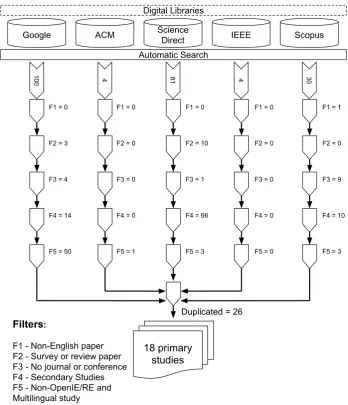
we filtered based on a paper full reading. Figure1presents the values of each filter applied to each 247
database. 248
2 http://www.sciencedirect.com
3 http://ieeexplore.ieee.org/Xplore/home.jsp 4 http://dl.acm.org
Google ACM Science
Direct IEEE Scopus
Digital Libraries
Automatic Search
100
4 81 4 30
18 primary studies Filters:
F1 - Non-English paper F2 - Survey or review paper F3 - No journal or conference F4 - Secondary Studies F5 - Non-OpenIE/RE and Multilingual study
Duplicated = 26
F1 = 0
F3 = 0 F2 = 0
F4 = 0
F5 = 0 F1 = 0
F3 = 4 F2 = 3
F4 = 14
F5 = 50
F1 = 0
F3 = 0 F2 = 0
F4 = 0
F5 = 1
F1 = 0
F3 = 1 F2 = 10
F4 = 66
F5 = 3
F1 = 1
F3 = 9 F2 = 0
F4 = 10
F5 = 3
Figure 1.Filters applied in SMS process
After performing the filter step, 18 primary studies were selected. For each primary study, we 249
try to identify each contribution. We summarize the retrieved studies by source database, without 250
considering duplicates, in Figure2. It is noteworthy that Google Scholar and Science Direct are the 251
Database
ACM Digital Library − 1.82%
Google Scholar − 45.45%
IEEE Xplore − 1.82%
Science Direct − 37.27%
Scopus − 13.64%
Figure 2.Percentage of each database in primary studies selection.
After this summarization, all duplicate occurrences were removed by the last filter step, gathering 253
a total of 18 papers. 254
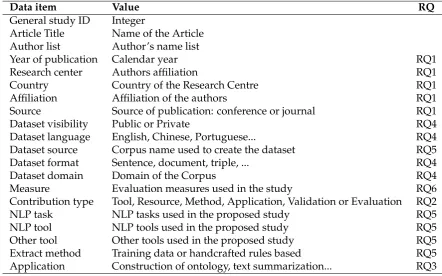
We initiate the analysis phase reading each selected paper and filling a form with such structure 255
described in Table2. 256
Table 2.Data extraction form used by our SMS.
Data item Value RQ
General study ID Integer
Article Title Name of the Article Author list Author’s name list
Year of publication Calendar year RQ1
Research center Authors affiliation RQ1
Country Country of the Research Centre RQ1
Affiliation Affiliation of the authors RQ1
Source Source of publication: conference or journal RQ1
Dataset visibility Public or Private RQ4
Dataset language English, Chinese, Portuguese... RQ4
Dataset source Corpus name used to create the dataset RQ5
Dataset format Sentence, document, triple, ... RQ4
Dataset domain Domain of the Corpus RQ4
Measure Evaluation measures used in the study RQ6
Contribution type Tool, Resource, Method, Application, Validation or Evaluation RQ2
NLP task NLP tasks used in the proposed study RQ5
NLP tool NLP tools used in the proposed study RQ5
Other tool Other tools used in the proposed study RQ5
Extract method Training data or handcrafted rules based RQ5
Application Construction of ontology, text summarization... RQ3
After obtaining the data from each selected primary study and filling the form (Table2), the next 257
step was to summarize the data to recover useful information. The objective of this step was to answer 258
3.1. Answer to RQ1: What are the sources of publications in Multilingual Open IE area? 260
Our first research question concerns a quantitative measure of the set of selected papers. In our 261
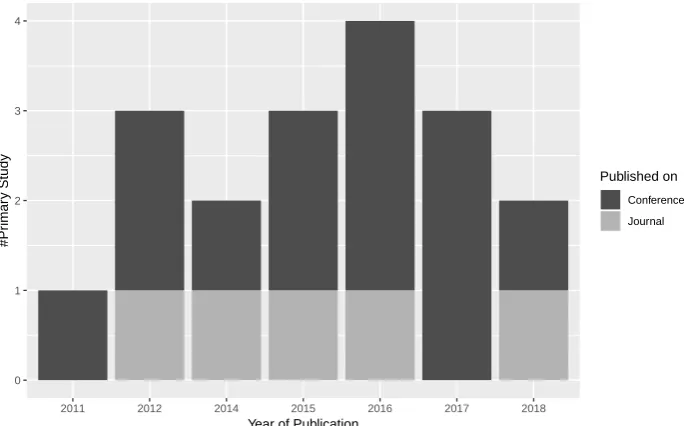
opinion, it was essential to observe the distribution of papers over the years to follow the number of 262
publications. We divided into conference and journal, to have a better overview of this topic. 263
0 1 2 3 4
2011 2012 2014 2015 2016 2017 2018
Year of Publication
#Pr
imar
y Study
Published on
Conference
Journal
Figure 3.Distribution over the years of selected primary studies per paper type (journal and conference)
As observed in Figure3, almost paper’s publication is in a conference, depicting the youngest area 264
the Multilingual Open IE topic is. Three conferences have published two papers, and all others have 265
published a sole paper, even in journal vehicle. As observed in Figure4, it is important to highlight the 266
three top conferences (EACL, NAACL, COLING) in the area of Computational Linguistics received 267
more than one paper on the topic, demonstrating its relevance to the NLP community. 268
EA CL
EMNLP
EPIA
HLT−NAA CL
COLING
ISWC
ACL
CIKM
ICT AI
IEEE ICSC
MDPI
SEPLN Semantic W
eb TALIP Journals of W
eb Semantics
Conference
Journal
Figure5depicts two countries with high number of participating authors among the 18 selected 269
studies. Both Germany and USA are publishing within this research area (Multilingual Open IE). It is 270
noteworthy that Spain has a high number of researchers working in this topic. 271
0 2 4 6
BRAZIL CHINA
GERMANY
J
AP
AN
SP
AIN USA
Country
#Researcher
Figure 5.Distribution of the countries of the researchers in primary studies.
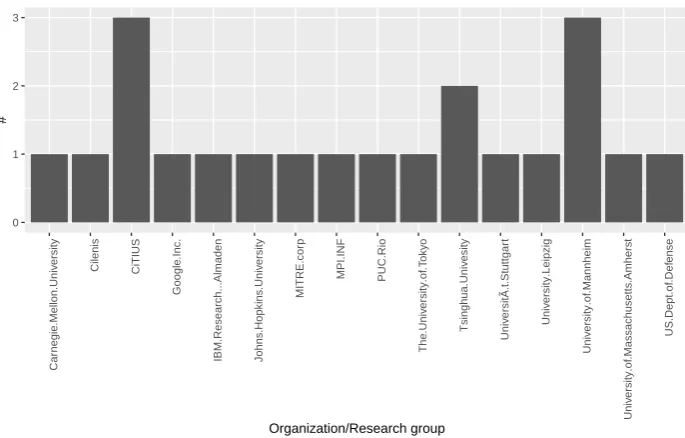
Observing organizations and research groups whose studies are in Multilingual Open IE area, 272
Figure6deserves prominence to two groups: CITIUS from the University of Santiago de Compostela 273
in Spain and the Mannheim Center for Empirical Multilingualism Research at the University of 274
Mannheim in Germany. 275
0 1 2 3
Car
negie
.Mellon.Univ
ersity
Cilenis CiTIUS
.Inc.
IBM.Research...Almaden Johns
.Hopkins
.Univ
ersity
MITRE.cor
p
MPI.INF PUC.Rio
The
.Univ
ersity.of
.T
oky
o
Tsinghua.Univ
esity
Univ
ersitÃ.t.Stuttgar
t
Univ
ersity.Leipzig
Univ
ersity.of
.Mannheim
Univ
ersity.of
.Massachusetts
.Amherst
US.Dept.of
.Def
ense
Organization/Research group
#
Figure 6.Distribution of the affiliation authors in primary studies.
Both Spain and Germany have significant impact on Multilingual Open IE area due to their 276
3.2. Answer to RQ2: What are the types of contributions made by Multilingual Open IE studies? 278
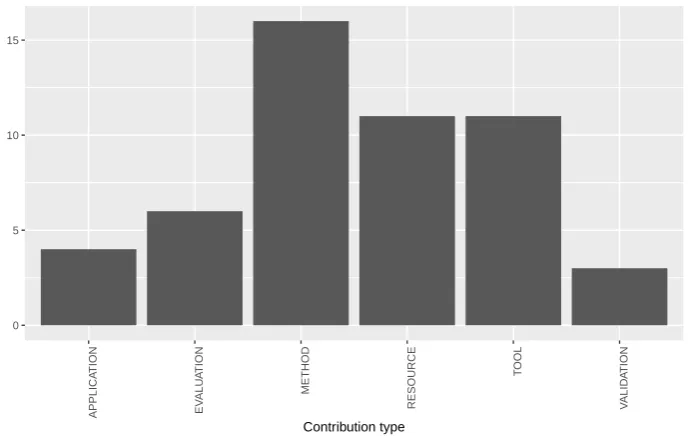
Figure7depicts the contribution types of Multilingual Open IE methods. It is noteworthy that the 279
METHODgroup corresponds to studies with novel methods or approaches to the task of “Multilingual 280
Open IE.” This kind of research tries to evolve the state of the art with new ideas comparing its work 281
with other systems, in spite of the fact that Multilingual Open IE is a young research area that lacks 282
benchmark materials. Some studies also produce contributions inRESOURCEandTOOL.RESOURCE 283
represents studies that have created datasets for evaluation or other resources for training or testing of 284
Open IE systems. There is also a relevant portion of studies that present a new approach to Multilingual 285
Open IE through aTOOL. In these studies, authors present, compare and provide an implementation 286
of their work. 287
0 5 10 15
APPLICA
TION
EV
ALU
A
TION
METHOD
RESOURCE
T
OOL
V
ALID
A
TION
Contribution type
#
Figure 7.Number of the type of contributions.
The VALIDATION corresponds to studies which evaluate the results and EVALUATION 288
corresponds to studies that evaluates new measures for Multilingual Open IE systems.APPLICATION 289
represents studies which uses a Multilingual Open IE task for some NLP Task. 290
3.3. Answer to RQ3: What are the types of applications made by Multilingual Open IE studies? 291
As observed in Figure8, most multilingual systems are applied to relation extraction tasks. Other 292
possible applications retrieved by our mapping study are: ontology construction, improving QA 293
0 2 4 6 8
F
A
CT
.CHECKING ONT
OLOGY
QA_SYSTEM
RELA
TION.EXTRA
CTION
Multilingual system Applications
#Of Pub
lication
Figure 8.Number of primary studies per type of applications.
3.4. Answer to RQ4: What are the available Multilingual Open IE datasets? 295
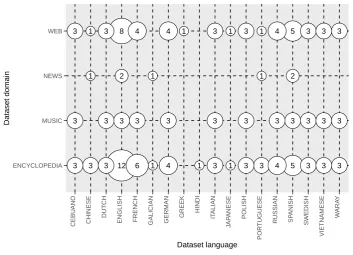
Among the datasets analyzed, we found that there was a high concentration of studies focused 296
on English texts (Figure 9). Many of these datasets are created from sentences retrieved from 297
Encyclopedias (usually Wikipedia) and the Web. 298
●
●
●
●
●
●
●
●
●
●
●
●
8
12 2
3 1
3 1
4
4 3
5
5 2
3 1
3 1
1 1
3
3 3 3
3 3
3
3 3 3
3 3 4
6 3
4
4 3
1
3
3 3 1
1
3
3 3 1
3
3 3
ENCYCLOPEDIA MUSIC NEWS WEB
CEB
U
ANO
CHINESE DUTCH ENGLISH FRENCH GALICIAN GERMAN GREEK
HINDI
IT
ALIAN
J
AP
ANESE POLISH
POR
TUGUESE R USSIAN SPANISH
SWEDISH
VIETNAMESE
W
ARA
Y
Dataset language
Dataset domain
Figure 9.Dataset Language per Domain.
Most of the studies deliver their datasets in a public manner (Figure10). The advantage of having 299
public datasets is that other researchers can access and use them to compare their approaches, which 300
●
●
4
1 2
1
3 4
PRIVATE PUBLIC
DBP
edia.Relations DOCUMENT SENTENCE
TRIPLE
Dataset format
Dataset visibility
Figure 10.Map of the dataset format and visibility from primary studies. For X axis the format file of the dataset. For Y axis the visibility of datasets.
From these datasets, it is noticeable that they were built from documents and sentences and 302
also from triples and relations. This fact can highlight that those extraction systems may vary their 303
input type, depending on the dataset format. Moreover, extracting information from sentences and 304
documents may be harder than from semi-structured data. This fact may influence the relation 305
extraction task. 306
3.5. Answer to RQ5: What are the tools used in Multilingual Open IE systems? 307
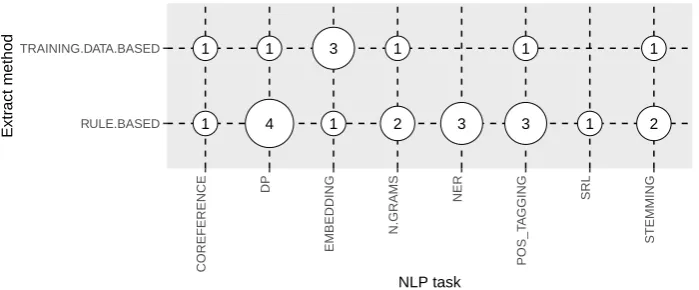
RQ5 depicts the main tools used in multilingual systems. From our mapping study, we identified 308
eight taggers. Works in [37,45,61–63] use a Dependency Parser (DP). It is worth mentioning that DPs 309
usually use a POS tagger as an auxiliary tool. In [64], a POS tagger is used without DP. Besides them, 310
works that employ other NLP tools, such as N-Grams extractors, Named Entity Recognizers (NER) 311
and Stemmers, were also identified in our mapping study. On the other hand, some authors [61,62] 312
use co-reference identification techniques to improve their Open IE system performances. We also find 313
systems that use Word Embeddings [32–35] and Semantic Role Labeling (SRL) [63]. In Figure11, we 314
observed that a POS Tagger and a DP were the most frequent combination, thus being widely used in 315
rule-based methods. On the other hand, systems based on machine learning were less frequent. 316
●
●
●
●
●
●
●
●
1
3 1
1
4 3
1
1
1
2 1
2 3
1 RULE.BASED
TRAINING.DATA.BASED
COREFERENCE
DP
EMBEDDING
N.GRAMS
NER
POS_T
A
GGING
SRL
STEMMING
NLP task
Extr
act method
The most commonly used tool/system identified from our mapping study was DepPattern (Figure 317
12). It is important to note that the three papers which carry the DepPattern were from the same 318
research group, CITIUS. Besides, we found two papers which use the CoreNLP system. Other tools 319
such as Pred Patt, Relation Factory, SyntaxNet, and Word2Vec were less frequent. 320
●
●
●
●
●
2 3 1 1 1 1 1 RULE.BASED TRAINING.DATA.BASED CORENLP DEP.P A TTERN PredP att RelationF actor y Stanf ord.NLP.P arser SyntaxNet w ord2v ec NLP tool Extr act methodFigure 12.NLP Tool per extract method.
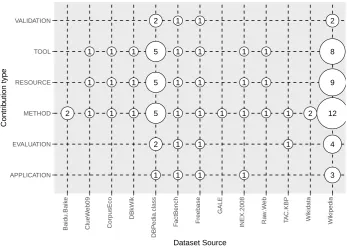
Figure13presents the identified data sources and the relationship with the type of contribution of 321
primary studies. DBPEDIA Class and Wikipedia are the most popular sources of data in the works 322 analised here. 323
●
●
●
●
●
●
●
●
●
●
●
●
●
●
●
● ●
●
●
●
●
●
●
●
●
●
●
●
●
●
●
●
●
●
●
●
●
1 1 1 8 9 12 3 2 4 1 1 1 5 5 5 1 2 2 1 1 1 1 1 1 1 1 2 1 1 1 1 1 2 1 1 1 1 1 1 1 1 1 1 1 1 APPLICATION EVALUATION METHOD RESOURCE TOOL VALIDATION Baidu.Baik e ClueW eb09 Cor pusEco DBkWik DBPedia.class FactBench Freebase
GALE INEX.2008 Ra w.W eb T A C.KBP Wikidata Wikipedia Dataset Source Contr ib ution type
Figure 13.Map of Dataset Sources and types of contribution identified. For X axis the Dataset Sources bases. For Y axis the type of contributions.
3.6. Answer to RQ6: How are Multilingual Open IE systems evaluated? 324
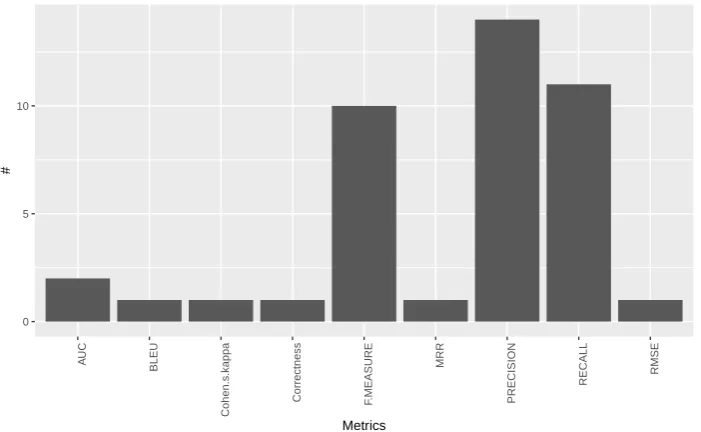
We have found nine metrics that are employed to evaluate multilingual systems (Figure14). 325
Among them, the most frequent are Precision, Recall, and F-Measure. In these cases, the most cited 326
0 5 10
A
UC
BLEU
Cohen.s
.kappa
Correctness F.MEASURE
MRR
PRECISION
RECALL RMSE
Metrics
#
Figure 14.Evaluation Metrics.
In some works, the authors employ Machine Translation tools for performing analysis of the 328
results obtained by Open IE systems. We believe that this is not a reliable approach since no machine 329
translation tool is 100% accurate. In such cases, additionally to the results, it is necessary to deduct the 330
translator error rate from the evaluation. 331
4. Some experiments on transferable knowledge in Multilingual Open IE 332
From the systematic mapping study described in the previous section, we can obtain some 333
conclusions. 334
Firstly, there is still a research gap regarding the topic of multilingual methods for Open IE, while 335
multiple Open IE methods and systems have been proposed for several different languages, c.f. [60], 336
only few of these works perform extraction on different languages. 337
Most importantly, while we identified some multilingual works on Open IE, only a small fraction 338
of these works use multilingual information to perform Open IE in a given language. Others, like [45], 339
provide several different monolingual models for each different language. 340
As we have discussed, however, it is our intuition that multilingual information can be used to 341
improve Open IE methods for a given language, since it is well known that corpora written on different 342
language present complementary facts and points of view on the same topics [26]. This intuition 343
is corroborated by previous works which observed improvement in performance in tasks such as 344
Information Retrieval [65], word analogy identification [66], dependency parsing [67,68], and sequence 345
labelling problems such as NER and chunking [69] when exploring multilingual information, such 346
as cross-lingual representations, cross-lingual word clusters, or training the methods on multilingual 347
data. 348
As such, we perform an exploratory experiment to evaluate how Open IE can benefit from 349
multilingual information. Our hypothesis in this experiment is that we can explore the variation in the 350
linguistic structure between languages to identify information in a target language. To validate this 351
hypothesis, we perform an experiment measuring the degree of complementary of the information 352
extracted by Open IE systems in different languages for a parallel corpus and how we can use the 353
extractions provided by a system in one language to improve the extractions made by a system in the 354
target language. 355
Notice that, as much as multilingual extraction has been proposed by Faruqui and Kumar [25], 356
based on cross-lingual projection of extractions, their work differs from our in the sense that we 357
Open IE. Their work, on the other hand, is based on the use of methods and systems developed for a 359
single language, English in their experiments, to obtain extraction for another language. We believe, 360
however, that the different structure and cultural aspects latent in the languages are important clues to 361
structuring the information in a text. As such, we believe that Open IE systems developed for different 362
languages identify different relations and their results are complementary. 363
4.1. Dataset 364
In our experiment, we used as input data the Portuguese-English section of the Europarl parallel 365
corpus [70]. Europarl is multilingual corpus composed of European Parliament’s debates, dating 366
back to 1996. The corpus is composed of texts in 21 languages with up to 60 million words in each 367
language. The parallel corpus is aligned by sentences linking each composing language. For the 368
Portuguese-English variant, it contains 1,960,407 sentences. 369
In this work, we randomly selected 1,000 Portuguese-English aligned sentences from the corpus 370
in order to evaluate whether we could explore multilingual resources in order to improve Open IE in a 371
target language: in our case the Portuguese language. 372
On these 1,000 sentences, we applied two Open IE systems for English and Portuguese, namely 373
Claus-IE [41], for the English language, and DPToie [50], for the Portuguese language. Both systems 374
are based on the extracting clauses based on the dependency structure of the sentence to identify basic 375
propositions in natural language sentences [37]. We choose these two systems since they are based 376
on similar methods and, in fact, DPToie was influenced by Claus-IE. After applying the systems to 377
the selected sentences, we obtained 434 relations for the English sentences and 530 relations for the 378
Portuguese language. 379
Two human judges performed a manual evaluation of the corrected and informativeness of the 380
extractions. The agreement between the judges was evaluated by Cohen’s Kappa. 381
On the extractions performed by the Claus-IE, the judges agreed on 87% of the annotations, 382
achieving a substantial agreement (κ=0.74). On the extractions performed by the DPToie, the judges 383
agreed on 91% of the annotations, achieving near perfect agreement (κ =0.83). As such, we believe 384
that the manual evaluation gives trustworthy information on the quality of the extractions that will be 385
used in our experiment. 386
From the judges’ evaluations, we selected all extractions which both judges agreed to be correct, 387
obtaining a final set of 210 extractions for the English language and 218 extractions for the Portuguese 388
language. 389
4.2. Experiment : analyzing cross-lingual extraction complementarity 390
In this experiment, we aim to evaluate how much intersection there is in the extractions performed 391
by two Open IE systems for two languages. With this, we want to evaluate how many novels 392
information extracted in one language can boost the extractions for the other. 393
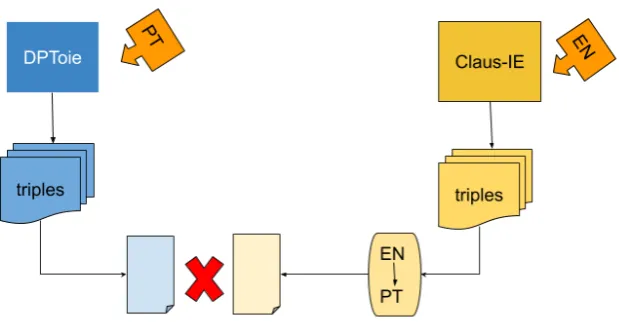
In order to compare the extractions, we have automatically translated the extracted relations from 394
the English language to Portuguese using Google Translate API and compared the resulting translated 395
extractions with the one obtained from the application of the DPToie in the Portuguese sentences 396
Figure 15.Experiment on relation extractions intersection for two languages: PT and EN
It is important to notice that due to differences in the languages syntax, not all translations resulted 398
in a valid extraction. For example, Portuguese language admits sentences without subjects, known as 399
non-existent subject, when the main verb is impersonal. As such, sentences such as: 400
“It is naturally important that food can also flow freely” 401
which have the pronoun ‘it’ as subject, can be translated to: 402
“É naturalmente importante que os produtos alimentares possam também circular livremente.” 403
containing as main verb ‘é’ (is) - in this context an impersonal verb - and, thus, does not contain a 404
subject. Naturally, the related extraction from the English (‘it’, ‘is’ , ‘important naturally that food can also 405
flow freely’) cannot be properly translated into Portuguese. 406
Since Claus-IE extracts tuples with only one argument, differently than DPToie, we only 407
maintained in the translated dataset those extractions containing both arguments. The translated set of 408
extractions contains, thus, 180 relations. 409
No intersection has been observed between the two sets, i.e. no exact match has been found 410
between the relations of the two sets. Analyzing partial matches the extractions, we observed 29 411
extractions in the translated set of relations that have the same relation descriptor to some relation in 412
the native Portuguese extractions, 34 coinciding in the first argument with some Portuguese language 413
relation, 1 coinciding in the second argument, and 9 coinciding in relation descriptor and one argument. 414
We proceed, then, with a manual evaluation of the extractions to understand how the extractions 415
differ between the extraction sets. The first thing to observe is that the parallel sentences in Portuguese 416
and English in the Europarl corpus are not exactly matched. For example, the sentence 417
“The report proposes twelve representatives for the board of the new Food Authority, two of whom would be 418
representatives of the food industry.” 419
is aligned with 420
“O senhor deputado propõe para o Conselho de Administração da Autoridade Alimentar Europeia doze 421
representantes, dois dos quais em representação da indústria alimentar.”7 422
As a result, the extraction (’o relatório’, ’propõe’, ’12 representantes. . .’) obtained from the English 423
sentence presents a mismatch with the one extracted from the Portuguese sentence (’o senhor deputado’, 424
7 “The deputy proposes twelve representatives for the Administrative Council of the European Food Authority, two of which
’propõe’, ’para o Conselho. . .’), namely on the first argument ‘o relatorio’ (the report) and ‘osenhor deputado’ 425
(the deputy), originated from the mismatch between the sentences. 426
Another reason for the low intersection between the sets of extractions is due to different 427
translations for the terms. For example, in the sentence 428
“Commissioner, you have said on many occasions. . .” 429
the pronoun ‘you’ has been translated into ‘V. Exa.’ (Your Excellency), while in the Portuguese corpus 430
the same sentence describes ’o senhor comissário’ (commissioner) as subject of the verb ‘afirmou’ (said), 431
generating the extractions (‘V. Exa.’, ‘afirmou’,. . .) and (‘o senhor’, ‘afirmou’,. . .). 432
Comparing the extractions made by Claus-IE and DPToie, however, it is observable that the 433
difference between the triples in the two systems is systematically different, both based on how the 434
information is expressed in the source language and how it is extracted/structured in the sentence. 435
For example, in the sentence 436
“Mr Whitehead has managed, in a balanced report, to expertly combine the many opinions which are around in 437
our Parliament on the establishment of a food authority.” 438
Claus-IE extracted the triple (‘Mr Whitehead’, ‘has managed’, ‘in a balanced report to combine the many 439
opinions expertly’), while DPToie extracted the triple (‘Phillip Whitehead’, ‘conseguiu’, ‘reunir de forma 440
magistral em um relatório equilibrado as muitas opiniões existentes en o nosso Parlamento’)8. 441
Moreover, there are several extractions performed by Claus-IE for which no similar valid extraction 442
has been achieved by DPToie, such as the extraction (‘Article 5’, ‘should define’, ‘the objectives of food 443
legislation’) from the sentence 444
“For example, Article 5 should clearly define the objectives of food legislation and. . .” 445
Similarly, DPToie was able to extract several triples for which Claus-IE made no corresponding 446
extraction. 447
Adjusting our analysis by the considerations above, we observed that around 20 out of 180 triples 448
extracted by Claus-IE and translated to the Portuguese language were also extracted by DPToie in 449
the source sentences directly in Portuguese, meaning that around 89% of the extractions are new, or 450
information not extracted by the DPToie system. 451
It is important to notice that the different systems can extract different information from the text 452
not necessarily because of differences in the method, but also on inherent differences in the structure 453
and use of the involved languages. As such, it is possible to observe that the length of the arguments 454
in the triples extracted by DPToie (mean length of 42 characters) is higher than of those extracted by 455
Claus-IE (mean length of 32 characters), while the lengths of relation descriptors are similar across the 456
systems (11 characters for DPToie and 10 for Claus-IE). 457
5. Challenges and Opportunities 458
From our initial experiments, we believe that exploring multilingual resources has a great potential 459
to increase performance for Open IE methods. Notably, we were able to observe that even using a 460
simple method based on translation, it was possible to increase the number of meaningful extractions 461
in a given domain. 462
While this potential is clear from our experiments, we notice a significant limitation on 463
Multilingual Open IE concerning the transfer of knowledge from one language to another. 464
Another critical issue is the evaluation process on Open IE systems. Although the most common 465
metrics used to evaluate IE systems arePrecision,Recall, andF-Measure, it is usually not feasible to 466
perform such evaluations for the task of Open IE due to the great number of extractions performed. 467
As an alternative, some works on Open IE commonly adopt an approach in which human annotators 468
analyze a small subset of sentences and determine the correct relationships to be extracted. These 469
systems are then evaluated to the overlap or the similarity of their extractions to the reference 470
annotations. 471
For multilingual methods, some works concentrate on the evaluation in one or two languages, 472
even when the proposed methods are designed to deal with more than two. In this case, they usually 473
perform a less detailed evaluation in less representative languages, like Portuguese, or even skip the 474
evaluation on these languages. In that way, we identify a gap in the evaluation and comparison of 475
results of the different Open IE systems in a broad, objective and reproducible way. 476
For this reason, the construction of a multilingual free and open gold standard is of utmost 477
importance for improving Open IE evaluations and providing more reliable results. 478
In as much as we believe that the potential of using multilingual methods and data to the problem 479
of Open IE is clear from our experiments, notice that a significant limitation on multilingual Open IE is 480
concerned with the transfer of knowledge from one language to another. 481
Despite the fact that Machine Translation has advanced in the last few years, machine translation 482
systems are not reliable, especially in an open context such as that of the Web as a Corpus. In this 483
context in which any domain-specific text can be considered as input to the system, high accuracy 484
translations are difficult to achieve, due to potential domain-specific terminology. Thus, the problem of 485
domain transfer between languages is not different in principle from the initial problem that motivates 486
the Open IE approach to Information Extraction. Therefore, we believe that different and more robust 487
methods for multilingual Open IE that do not depend solely on machine translation are necessary to 488
the development of this area. 489
6. Conclusions and Future Directions 490
In this work, we investigate approaches to the study of Multilingual Open Information Extraction. 491
To do this, we present a systematic mapping study to analyze the multilingual open information 492
extraction area and perform initial experiments on the use of multilingual resources to improve the 493
performance of Open IE systems. 494
We conclude from our experiments that exploring multilingual resources such as parallel or 495
multilingual corpora can increase the performance of Open IE systems by identifying complementary 496
information to be extracted, as pointed by [26]. As we discussed, however, the multilingual methods 497
identified in the literature are yet overly dependent on machine translation technology, which we 498
believe is not yet robust enough to be applied in a broad context such as that of the Web as a Corpus. 499
As such, new methods must be developed for the area. 500
As future directions, we notice that there is a long way to transfer relation extractions from one 501
language to another. Besides, preliminary tools such as POS taggers, chunkers, DP analyzers need to 502
be improved to single languages to be incorporated into multilingual perspectives. 503
We believe that we show in this work that the area of Multilingual Open IE is still young and 504
there is much work to do, but also that there is much potential for its applications. 505
Funding: This study was financed in part by the Coordenação de Aperfeiçoamento de Pessoal de Nivel Superior
-506
Brasil(CAPES) - Finance Code 001(https://www.capes.gov.br/)and FAPESB(http://www.fapesb.ba.gov.br/)
507
. 508
Conflicts of Interest:The authors declare no conflict of interest. The funders had no role in the study; in the 509
collection, analyses, or interpretation of data; in the writing of the manuscript, or in the decision to publish the 510
results. 511
Abbreviations 512
The following abbreviations are used in this manuscript: 513
OIE Open Information Extraction IE Information Extraction NLP Natural Language Processing POS Tagger Part-of-Speech Tagger SMS Systematic Mapping Study MRQ Main Research Question
RQ Research Question
QA Querying Answering
RDF Resource Definition Framework
DP Dependency Parser
SRL Semantic Role Labeling NER Named Entity Recognition 515
References 516
1. Berners-Lee, T.; Hendler, J.; Lassila, O.; others. The semantic web. Scientific american2001,284, 28–37. 517
2. Bizer, C.; Heath, T.; Berners-Lee, T. Linked data: The story so far. InSemantic services, interoperability and
518
web applications: emerging concepts; IGI Global, 2011; pp. 205–227. 519
3. Fader, A.; Soderland, S.; Etzioni, O. Identifying relations for open information extraction. Proceedings of 520
the Conference on Empirical Methods in Natural Language Processing. Association for Computational 521
Linguistics, 2011, pp. 1535–1545. 522
4. Etzioni, O.; Fader, A.; Christensen, J.; Soderland, S.; Mausam, M. Open information extraction: The second 523
generation. Proceedings of the Twenty-Second international joint conference on Artificial Intelligence. 524
AAAI Press, 2011, Vol. 1, pp. 3–10. 525
5. Mintz, M.; Bills, S.; Snow, R.; Jurafsky, D. Distant supervision for relation extraction without labeled data. 526
Proceedings of the Joint Conference of the 47th Annual Meeting of the ACL and the 4th International 527
Joint Conference on Natural Language Processing of the AFNLP: Volume 2-Volume 2. Association for 528
Computational Linguistics, 2009, pp. 1003–1011. 529
6. Nguyen, T.H.; Grishman, R. Employing word representations and regularization for domain adaptation 530
of relation extraction. Proceedings of the 52nd Annual Meeting of the Association for Computational 531
Linguistics (Volume 2: Short Papers), 2014, Vol. 2, pp. 68–74. 532
7. Bollacker, K.; Evans, C.; Paritosh, P.; Sturge, T.; Taylor, J. Freebase: a collaboratively created graph database 533
for structuring human knowledge. Proceedings of the 2008 ACM SIGMOD international conference on 534
Management of data. AcM, 2008, pp. 1247–1250. 535
8. Vrandeˇci´c, D.; Krötzsch, M. Wikidata: a free collaborative knowledge base2014. 536
9. Riedel, S.; Yao, L.; McCallum, A. Modeling relations and their mentions without labeled text. Joint 537
European Conference on Machine Learning and Knowledge Discovery in Databases. Springer, 2010, pp. 538
148–163. 539
10. Surdeanu, M.; Tibshirani, J.; Nallapati, R.; Manning, C.D. Multi-instance multi-label learning for relation 540
extraction. Proceedings of the 2012 joint conference on empirical methods in natural language processing 541
and computational natural language learning. Association for Computational Linguistics, 2012, pp. 542
455–465. 543
11. Krause, S.; Li, H.; Uszkoreit, H.; Xu, F. Large-scale learning of relation-extraction rules with distant 544
supervision from the web. International Semantic Web Conference. Springer, 2012, pp. 263–278. 545
12. Nguyen, T.V.T.; Moschitti, A. End-to-end relation extraction using distant supervision from external 546
semantic repositories. Proceedings of the 49th Annual Meeting of the Association for Computational 547
Linguistics: Human Language Technologies: short papers-Volume 2. Association for Computational 548
Linguistics, 2011, pp. 277–282. 549
13. Banko, M. Open Information Extraction for the Web. PhD thesis, Seattle, WA, USA, 2009. AAI3370456. 550
14. Kilgarriff, A.; Grefenstette, G. Web as corpus. Proceedings of Corpus Linguistics 2001. Corpus Linguistics. 551
Readings in a Widening Discipline, 2001, pp. 342–344. 552
15. Yangarber, R.; Grishman, R.; Tapanainen, P.; Huttunen, S. Automatic acquisition of domain knowledge 553
for information extraction. Proceedings of the 18th conference on Computational linguistics-Volume 2. 554
16. Mooney, R.J.; Bunescu, R. Mining knowledge from text using information extraction. ACM SIGKDD
556
explorations newsletter2005,7, 3–10. 557
17. Socher, R.; Chen, D.; Manning, C.D.; Ng, A. Reasoning with neural tensor networks for knowledge base 558
completion. Advances in neural information processing systems, 2013, pp. 926–934. 559
18. Plank, B.; Moschitti, A. Embedding semantic similarity in tree kernels for domain adaptation of relation 560
extraction. Proceedings of the 51st Annual Meeting of the Association for Computational Linguistics 561
(Volume 1: Long Papers), 2013, Vol. 1, pp. 1498–1507. 562
19. Nguyen, T.H.; Grishman, R. Relation extraction: Perspective from convolutional neural networks. 563
Proceedings of the 1st Workshop on Vector Space Modeling for Natural Language Processing, 2015, 564
pp. 39–48. 565
20. Bengio, Y.; Courville, A.; Vincent, P. Representation learning: A review and new perspectives. IEEE
566
transactions on pattern analysis and machine intelligence2013,35, 1798–1828. 567
21. Banko, M.; Etzioni, O.; Center, T. The Tradeoffs Between Open and Traditional Relation Extraction. ACL; 568
Association for Computational Linguistics: Stroudsburg, PA, USA, 2008; Vol. 8, pp. 28–36. 569
22. Li, H.; Bollegala, D.; Matsuo, Y.; Ishizuka, M. Using graph based method to improve bootstrapping relation 570
extraction. InComputational Linguistics and Intelligent Text Processing; Springer: Berlin, Germany, 2011; 571
Vol. 2, pp. 127–138. 572
23. Xavier, C.C.; de Lima, V.L.S.; Souza, M. Open information extraction based on lexical semantics.Journal of
573
the Brazilian Computer Society2015,21, 1–14. 574
24. Wu, F.; Weld, D.S. Open Information Extraction Using Wikipedia. Proceedings of the 48th Annual Meeting 575
of the Association for Computational Linguistics; Association for Computational Linguistics: Stroudsburg, 576
PA, USA, 2010; ACL ’10, pp. 118–127. 577
25. Faruqui, M.; Kumar, S. Multilingual Open Relation Extraction Using Cross-lingual Projection. arXiv
578
preprint arXiv:1503.064502015,abs/1503.06450, 1351–1356. 579
26. Steinberger, R. A survey of methods to ease the development of highly multilingual text mining 580
applications. Language Resources and Evaluation2012,46, 155–176. 581
27. Bel, N.; Koster, C.H.; Villegas, M. Cross-lingual text categorization. International Conference on Theory 582
and Practice of Digital Libraries. Springer, 2003, pp. 126–139. 583
28. Bering, C.; Drozdzynski, W.; Erbach, G.; Guasch, C.; Homola, P.; Lehmann, S.; Li, H.; Krieger, H.U.; 584
Piskorski, J.; Schäfer, U.; others. Corpora and evaluation tools for multilingual named entity grammar 585
development. Proceedings of Multilingual Corpora Workshop at Corpus Linguistics, 2003, pp. 42–52. 586
29. Boyd-Graber, J.; Blei, D.M. Multilingual topic models for unaligned text. Proceedings of the Twenty-Fifth 587
Conference on Uncertainty in Artificial Intelligence. AUAI Press, 2009, pp. 75–82. 588
30. Hassan, S.; Mihalcea, R. Cross-lingual semantic relatedness using encyclopedic knowledge. Proceedings 589
of the 2009 Conference on Empirical Methods in Natural Language Processing, 2009, pp. 1192–1201. 590
31. Al-Rfou, R.; Perozzi, B.; Skiena, S. Polyglot: Distributed word representations for multilingual nlp. arXiv
591
preprint arXiv:1307.16622013. 592
32. Lin, Y.; Liu, Z.; Sun, M. Neural relation extraction with multi-lingual attention. Proceedings of the 55th 593
Annual Meeting of the Association for Computational Linguistics (Volume 1: Long Papers), 2017, pp. 594
34–43. 595
33. Verga, P.; Belanger, D.; Strubell, E.; Roth, B.; McCallum, A. Multilingual relation extraction using 596
compositional universal schema.arXiv preprint arXiv:1511.063962015. 597
34. Zhang, S.; Duh, K.; Van Durme, B. Mt/ie: Cross-lingual open information extraction with neural 598
sequence-to-sequence models. Proceedings of the 15th Conference of the European Chapter of the 599
Association for Computational Linguistics: Volume 2, Short Papers, 2017, pp. 64–70. 600
35. Wang, X.; Han, X.; Lin, Y.; Liu, Z.; Sun, M. Adversarial multi-lingual neural relation extraction. Proceedings 601
of the 27th International Conference on Computational Linguistics, 2018, pp. 1156–1166. 602
36. Fader, A.; Soderland, S.; Etzioni, O. Identifying Relations for Open Information Extraction. Proceedings of 603
the Conference on Empirical Methods in Natural Language Processing; Association for Computational 604
Linguistics: Stroudsburg, PA, USA, 2011; EMNLP ’11, pp. 1535–1545. 605
37. Gamallo, P.; Garcia, M.; Fernandez-Lanza, S. Dependency-based Open Information Extraction. Proceedings 606
of the Joint Workshop on Unsupervised and Semi-Supervised Learning in NLP; Association for 607
38. Souza, E.N.P.; Claro, D.B. Extração de Relações utilizando Features Diferenciadas para Português. 609
Linguamática2014,6, 57–65. 610
39. Etzioni, O.; Banko, M.; Soderland, S.; Weld, D.S. Open information extraction from the web.Communications
611
of the ACM2008,51, 68–74. 612
40. Mausam.; Schmitz, M.; Bart, R.; Soderland, S.; Etzioni, O. Open Language Learning for Information 613
Extraction. Proceedings of the 2012 Joint Conference on Empirical Methods in Natural Language Processing 614
and Computational Natural Language Learning; Association for Computational Linguistics: Stroudsburg, 615
PA, USA, 2012; EMNLP-CoNLL ’12, pp. 523–534. 616
41. Del Corro, L.; Gemulla, R. ClausIE: Clause-based Open Information Extraction. Proceedings of the 22Nd 617
International Conference on World Wide Web; ACM: New York, NY, USA, 2013; WWW ’13, pp. 355–366. 618
doi:10.1145/2488388.2488420. 619
42. Bast, H.; Haussmann, E. Open information extraction via contextual sentence decomposition. ICSC; IEEE, 620
Semantic Computing (ICSC), 2013 IEEE Seventh International Conference on: rvine, CA, USA, 2013; pp. 621
154–159. 622
43. Bast, H.; Haussmann, E. More Informative Open Information Extraction via Simple Inference. 623
Proceedings of the 36th European Conference on IR Research on Advances in Information Retrieval 624
- Volume 8416; Springer-Verlag New York, Inc.: New York, NY, USA, 2014; ECIR 2014, pp. 585–590. 625
doi:10.1007/978-3-319-06028-6_61. 626
44. Gashteovski, K.; Gemulla, R.; Del Corro, L. MinIE: Minimizing Facts in Open Information Extraction. 627
Proceedings of the 2017 Conference on Empirical Methods in Natural Language Processing. Association 628
for Computational Linguistics, 2017, pp. 2630–2640. 629
45. Gamallo, P.; Garcia, M., Multilingual Open Information Extraction. InProgress in Artificial Intelligence: 17th
630
Portuguese Conference on Artificial Intelligence, EPIA 2015, Coimbra, Portugal, September 8-11, 2015. Proceedings; 631
Pereira, F.; Machado, P.; Costa, E.; Cardoso, A., Eds.; Springer International Publishing: Cham, 2015; pp. 632
711–722. doi:10.1007/978-3-319-23485-4_72. 633
46. Xavier, C.C.; de Lima, V.L.S.; Souza, M. Open Information Extraction based on lexical-syntactic patterns. 634
Intelligent Systems (BRACIS), 2013 Brazilian Conference on. IEEE, 2013, pp. 189–194. 635
47. Sena, C.F.L.; Glauber, R.; Claro, D.B. Inference Approach to Enhance a Portuguese Open Information 636
Extraction. Proceedings of the 19th International Conference on Enterprise Information Systems - Volume 637
1: ICEIS,; INSTICC, ScitePress: Porto, Portugal, 2017; pp. 442–451. doi:10.5220/0006338204420451. 638
48. Sena, C.F.L.; Claro, D.B. InferPortOIE: A Portuguese Open Information Extraction system with inferences. 639
Natural Language Engineering2019,25, 287–306. doi:10.1017/S135132491800044X. 640
49. de Oliveira, L.S.; Glauber, R.; Claro, D.B. DependentIE: An Open Information Extraction system on 641
Portuguese by a Dependence Analysis.Encontro Nacional de Inteligência Artificial e Computacional2017. 642
50. de Oliveira, L.S.; Claro, D.B. DptOIE: A Portuguese Open Information Extraction system based on 643
Dependency Analysis.Computer Speech and Language - under review2019. 644
51. Tseng, Y.H.; Lee, L.H.; Lin, S.Y.; Liao, B.S.; Liu, M.J.; Chen, H.H.; Etzioni, O.; Fader, A. Chinese open 645
relation extraction for knowledge acquisition. Proceedings of the 14th Conference of the European Chapter 646
of the Association for Computational Linguistics, volume 2: Short Papers, 2014, pp. 12–16. 647
52. Qiu, L.; Zhang, Y. ZORE: A Syntax-based System for Chinese Open Relation Extraction. Proceedings of 648
the 2014 Conference on Empirical Methods in Natural Language Processing (EMNLP). Association for 649
Computational Linguistics, 2014, pp. 1870–1880. doi:10.3115/v1/D14-1201. 650
53. Xu, J.; Gan, L.; Deng, L.; Wang, J.; Yan, Z. Dependency parsing based Chinese open relation extraction. 651
2015 4th International Conference on Computer Science and Network Technology (ICCSNT), 2015, Vol. 01, 652
pp. 552–556. doi:10.1109/ICCSNT.2015.7490808. 653
54. Wang, Y.; Zhou, G.; Tian, F.; Nan, Y.; Ma, J. GCORE: A Gravitation-Based Approach for Chinese Open 654
Relation. 2015 International Conference on Computer Science and Mechanical Automation (CSMA), 2015, 655
pp. 86–91. doi:10.1109/CSMA.2015.24. 656
55. Wu, X.; Wu, B. The CRFs-Based Chinese Open Entity Relation Extraction. 2017 IEEE Second International 657
Conference on Data Science in Cyberspace (DSC), 2017, pp. 405–411. doi:10.1109/DSC.2017.40. 658
56. Bassa, A.; Kroll, M.; Kern, R. GerIE-An Open Information Extraction System for the German Language. 659
57. Truong, D.; Vo, D.T.; Nguyen, U.T. Vietnamese Open Information Extraction. Proceedings of the Eighth 661
International Symposium on Information and Communication Technology; ACM: New York, NY, USA, 662
2017; SoICT 2017, pp. 135–142. doi:10.1145/3155133.3155171. 663
58. Petersen, K.; Feldt, R.; Mujtaba, S.; Mattsson, M. Systematic Mapping Studies in Software Engineering. 664
Proceedings of the 12th International Conference on Evaluation and Assessment in Software Engineering; 665
BCS Learning & Development Ltd.: Swindon, UK, 2008; EASE’08, pp. 68–77. 666
59. Petersen, K.; Vakkalanka, S.; Kuzniarz, L. Guidelines for conducting systematic mapping studies 667
in software engineering: An update. Information and Software Technology 2015, 64, 1 – 18. 668
doi:https://doi.org/10.1016/j.infsof.2015.03.007. 669
60. Glauber, R.; Claro, D.B. A Systematic Mapping Study on Open Information Extraction.Expert Systems with
670
Applications2018. doi:https://doi.org/10.1016/j.eswa.2018.06.046. 671
61. Garcia, M.; Gamallo, P. Entity-centric coreference resolution of person entities for open information 672
extraction.Procesamiento del Lenguaje Natural2014,53, 25–32. 673
62. Nunes, T.; Schwabe, D. Building Distant Supervised Relation Extractors. 2014 IEEE International 674
Conference on Semantic Computing. IEEE, 2014, pp. 44–51. 675
63. Akbik, A.; Danilevsky, M.; Kbrom, Y.; Li, Y.; Zhu, H.; others. Multilingual information extraction with 676
PolyglotIE. Proceedings of COLING 2016, the 26th International Conference on Computational Linguistics: 677
System Demonstrations, 2016, pp. 268–272. 678
64. Duc, N.T.; Bollegala, D.; Ishizuka, M. Cross-language latent relational search between japanese and english 679
languages using a web corpus. ACM Transactions on Asian Language Information Processing (TALIP)2012, 680
11, 11. 681
65. Vuli´c, I.; Moens, M.F. Monolingual and cross-lingual information retrieval models based on (bilingual) word 682
embeddings. Proceedings of the 38th international ACM SIGIR conference on research and development 683
in information retrieval. ACM, 2015, pp. 363–372. 684
66. Upadhyay, S.; Faruqui, M.; Dyer, C.; Roth, D. Cross-lingual models of word embeddings: An empirical 685
comparison. arXiv preprint arXiv:1604.004252016. 686
67. Xiao, M.; Guo, Y. Distributed word representation learning for cross-lingual dependency parsing. 687
Proceedings of the Eighteenth Conference on Computational Natural Language Learning, 2014, pp. 688
119–129. 689
68. Täckström, O.; McDonald, R.; Uszkoreit, J. Cross-lingual word clusters for direct transfer of linguistic 690
structure. Proceedings of the 2012 conference of the North American chapter of the association for 691
computational linguistics: Human language technologies. Association for Computational Linguistics, 2012, 692
pp. 477–487. 693
69. Yang, Z.; Salakhutdinov, R.; Cohen, W. Multi-task cross-lingual sequence tagging from scratch. arXiv
694
preprint arXiv:1603.062702016. 695
70. Koehn, P. Europarl: A parallel corpus for statistical machine translation. MT summit, 2005, Vol. 5, pp. 696