IJEDR1504040
International Journal of Engineering Development and Research (www.ijedr.org)278
Study on Buckling Strength of Composite Cylindrical
Shells with Cut-outs
1Neethi.B, 2Gisha George 1PG Student, 2Assistant Professor 1,2Department of Civil Engineering
1Mar Baselious Institute of Technology and Science, Nellimattom, Kerala, India
________________________________________________________________________________________________________ Abstract - The composite cylindrical shells are widely used in many structural forms in almost every engineering field and also in other applications of civil engineering. These thin shells and cylindrical panels are more prone to fail during buckling load rather than failure by material. In every airframes and missiles the cylindrical shell structures are made with composite materials having cut-outs for accessing internal components during integration. Hence there will be an invariable reduction in the strength due to the cut-outs of the composite cylindrical shell and is more and more specifically while a buckling load is acting. Since years it has been a design practice to improve the buckling strength by addition of any type of reinforcement around the cut-out. The effect of an imperfection like cut-out is that it not only introduces stress concentration but also significantly reduces the buckling strength. This paper studies the buckling strength of a composite cylindrical shell with cut-outs analytically. The study is also done with reinforcement around the cut-out. The results are compared with different cut-out shapes with and without discontinuities in the shell surface.
Index Terms - Buckling, Cut-outs, Cylindrical Shells, FEM, ANSYS, Reinforced Cut-outs
________________________________________________________________________________________________________
I.INTRODUCTION
In various fields of engineering such as civil, mechanical, aerospace and nuclear engineering fields the thin walled cylindrical shells find wider applications as primary structural members. Also in underwater, surface, air and space vehicles as well as in construction of pressure vessels, storage vessels, storage bins and liquid storage tanks stiffened and unstiffened shells made up of metallic and laminated composite materials (large diameter to thickness ratio) are extensively used. In missile and airframe, the composite cylindrical shell structures are to be provided with cut-outs for accessing internal components during integration. The contribution of these geometric imperfections due to manufacturing processes takes dominant role in increasing the instability and decreasing the buckling load of the shells. These thin cylindrical shells and panels are more prone to fail in buckling rather than material failure. Moreover due to the relatively small thickness of these structural members, buckling is often viewed as the controlling failure mode of these structures. It is therefore essential that the buckling strength of the thin shells along with knowledge of its post buckling behaviour has been the subject of many researchers in both analytical and experimental investigations. Hence the invariable reduction in the strength due to the cut-outs of the composite cylindrical shell are more and more specifically while a buckling load is acting.
For these shell elements there are many factors will leads to the elemental failure. One of them is modification of the shells structure according to requirement like in some cases it is required to make cut outs to the shells. Since years it has been a design practice to improve strength by addition of stiffener around cut-out. The effect of cut-out is that it not only introduces stress concentration but also significantly reduces buckling load. The provision of reinforcement around the cut-out will satisfactorily reduce the strength defects caused by the peripheral discontinuity. This paper gives the analytical results done using ANSYS.10 to find out the strength behaviour when a composite cylindrical shell is being subjected to surface discontinuity.
II.METHODOLOGY
Composites are somewhat more difficult to model than an isotropic material such as iron or steel. Because each layer may have different orthotropic material properties, we must exercise care when defining the properties and orientations of the various layers. In this study SHELL181 element is utilized for the modeling process in ANSYS. Element properties and definitions were obtained from previous study results for a Graphite-Epoxy Composite Material.
III.VALIDATION
IJEDR1504040
International Journal of Engineering Development and Research (www.ijedr.org)279
Results of present formulation were compared to that of Hilburger Experiment [8]. In this comparison, buckling behaviour of an orthotropic composite cylindrical shell having a deformity in the surface was studied. The layup sequence considered was quasi-isotropic [±45/0/90]s for the validation and convergence study A 1.0-in by 1.0-in square cut-out with 0.05-in-radius cylindrical shell was modelled and undergone buckling for a distributed load of 1kN increasing at definite intervals. ANSYS is used to find out the critical buckling load and the corresponding displacement. The buckling load obtained during the analytical study was almost equal with the experimental result. The delamination was obtained as equivalent to the experimental result along the deformation periphery of the shell. Inter layer shear was obtained as in the Hilburger Experiment. The stresses along the cut-out boundary were found dominating than the other areas of the specimen. The stress increment along the collapse pattern too was found comparative in the convergence study.IV.MODEL GEOMETRY AND SPECIFICATIONS
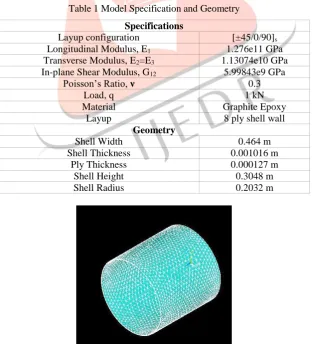
Results from the numerical study illustrating the effects of laminate orthotropy on the buckling and failure response of compression-loaded composite cylindrical shells with a cut-out with the effects of orthotropy on the overall response of compression-loaded shells is described. The analysis was applied first to a standard GFRP composite shell element. Finite Element Analysis was applied later to orthotropic laminated shell elements with circumferential discontinuity. The results provided here are also in that order. The software ANSYS was used to carry out the finite element analysis in the work. ANSYS is used to analyse the critical buckling load. Table 1 shows the analysis model geometry and its specifications followed in this study.
V.RESULTS
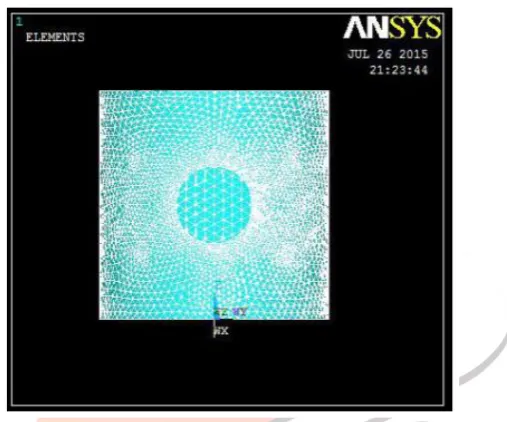
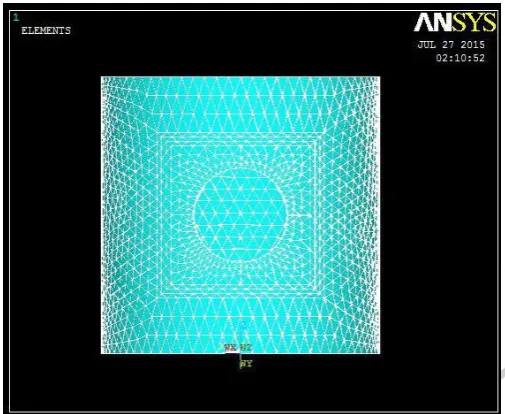
Having decided on the mesh size and validated the results, the formulation is carried out for the present problem using ANSYS software. The plane stress problem is considered as follows. The FE model is a Composite cylindrical shell with GFRP material. Layup procedure is adopted for the arrangement of the plies in specific orientation. Refined triangular meshing was adopted and linear buckling. The cut-out was developed by removing an equivalent elemental area of 0.09m2 for square, circular
and elliptical region at the mid height of one face of the shell. The model thus created is shown below with medium refined meshing as elemental triangles. The reinforcing area was created by sequentially placing 4 more another set of laminas laid towards the inward direction of the shell. A hollow square reinforcing area with 0.5m x 0.5m outer dimension and 0.4m x 0.4m inner dimension was sequenced concentrically around every discontinuity for all the cut-out shapes. That is a 10cm thick square frame of the graphite-epoxy material was eventually acting as reinforcement for the imperfection in the shell body.
Table 1 Model Specification and Geometry Specifications
Layup configuration [±45/0/90]s
Longitudinal Modulus, E1 1.276e11 GPa Transverse Modulus, E2=E3 1.13074e10 GPa In-plane Shear Modulus, G12 5.99843e9 GPa
Poisson’s Ratio, ν 0.3
Load, q 1 kN
Material Graphite Epoxy
Layup 8 ply shell wall
Geometry
Shell Width 0.464 m
Shell Thickness 0.001016 m
Ply Thickness 0.000127 m
Shell Height 0.3048 m
Shell Radius 0.2032 m
IJEDR1504040
International Journal of Engineering Development and Research (www.ijedr.org)280
Fig. 2 Model of a composite cylindrical shell with square cut-outFig. 1 Model of a composite cylindrical shell with circular cut-out
IJEDR1504040
International Journal of Engineering Development and Research (www.ijedr.org)281
Fig. 5 Model of a composite cylindrical shell with reinforced square cut-outFig. 6 Model of a composite cylindrical shell with reinforced circular cut-out
Fig. 7 Model of a composite shell with reinforced elliptical cut-out
Table 2 Comparison of Buckling Load Results
Shell Model Without cut-out With Cut-out
IJEDR1504040
International Journal of Engineering Development and Research (www.ijedr.org)282
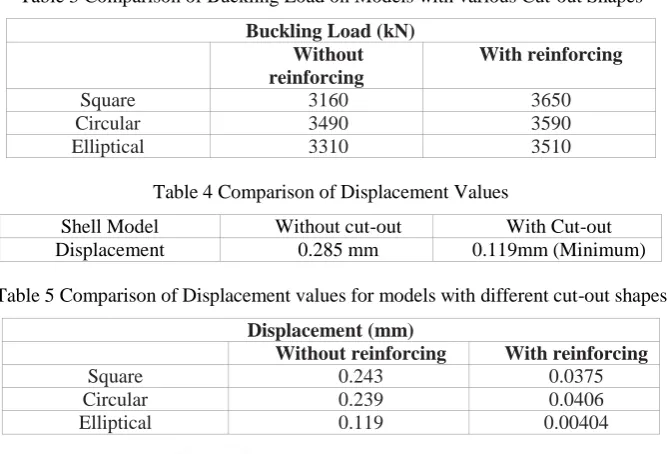
Table 3 Comparison of Buckling Load on Models with various Cut-out ShapesBuckling Load (kN) Without reinforcing
With reinforcing
Square 3160 3650
Circular 3490 3590
Elliptical 3310 3510
Table 4 Comparison of Displacement Values
Shell Model Without cut-out With Cut-out
Displacement 0.285 mm 0.119mm (Minimum)
Table 5 Comparison of Displacement values for models with different cut-out shapes Displacement (mm)
Without reinforcing With reinforcing
Square 0.243 0.0375
Circular 0.239 0.0406
Elliptical 0.119 0.00404
VI.CONCLUSIONS
From the analysis carried out by the use of ANSYS on the laminated composite cylindrical shells. As reinforcement, an additional composite area was also modelled around the cut-out for the strength study of the shell when it is subjected to a buckling load.
Since the reinforcing is made with the same material, the interlaminar behaviour will not have much change in this particular case. The result includes the comparison in the shell behaviour with and without reinforcement around the cut-out.
The following conclusions have been drawn out like
1. Buckling load is maximum for shell without any discontinuity in its geometry
2. Buckling load is maximum for shell with circular cut-out and minimum for square cut-out 3. Displacement for elliptical cut out was least and square was highest
4. The above result is repeated even for shells with reinforcing frame.
REFERENCES
[1] Anil Kumar Nagari and Venkata Narayana Yenugula, Experimental Investigation of Buckling of Laminated Composite Cylindrical Shells with & Without Cutouts Subjected To Axial Compression, IOSR Journal, Volume 11, Issue 6 Ver. II, pp 09-14, Nov- Dec 2014.
[2] Prabu B., Raviprakash A.V. and Rathinam N., Parametric study on buckling behaviour of thin stainless steel cylindrical shells for circular dent dimensional variations under uniform axial compression, IJEST Journal,Vol. 2, No. 4, 2010, pp. 134-149.
[3] Mahmoud Shariati and Masoud Mahdizadeh Rokhi, Buckling of Steel Cylindrical Shells with an Elliptical Cutout, International Journal of Steel Structures, 10(2), pp 193-205, 2010.
[4] http://portal.evs.gov.si/prijava. Faculty of Civil Engineering and Geodesy, Jamova-cesta 2, 1000 Ljubljana, pp 3422.
[5] Mahmoud Shariati, Masoud Mahdizadeh Rokhi, Numerical and experimental investigations on buckling of steel cylindrical shells with elliptical cutout subject to axial compression, Thin-Walled Structures, Elsevier, 46, pp 1251-1261, 2008.
[6] Volmir A.S., Flexible Plates and Shells (translated from Russian), Air Force Flight Dynamics Laboratory, Wright-Patterson Air Force Base, Ohio, Technical Report No. 66-216, 1967
[7] Christian A. Schenk. and Gerhart I. Schu¨eller., Buckling analysis of cylindrical shells with cutouts including random geometric imperfections. In Mang H.A., Rammerstorfer F.G., and Eberhardsteiner J., editors, Proceedings of the Fifth World Congress on Computational Mechanics (WCCM V), IACM, Vienna University of Technology, Austria, IfM Publication 2-339, ISBN 3-9501554-0-6, 2002.
[8] Mark.W.Hilburger, Buckling and Failure of Compression-loaded Composite Laminated Shells with Cutouts, NASA Langley Research Center, Hampton Virginia 23681-2199
[9] Baker, E.H., Cappelli, A.P., Kovalevski, L., Rish, F.L., and Verette, R.M., Shell Analysis Manual, NACA 912, Washington, DC, 1968.
[10] Hutchinson, J.W. and Koiter W.T., Post Buckling Theory, Appl. Mech. Rev., vol. 23, pp.1353–1366 (1970). [11] Bushnell, Computerized buckling analysis of shells, Martinus Niijhoff Publishers, 1985.
[12] Mark W. Hilburger, James H. Starnes Jr. and Anthony M. Waas, The response of composite cylindrical shells with cutouts and Subjected to internal pressure and axial compression loads, Journal of American Institute of Aeronautics and Astronautics, A98-25060, AIAA-1768, 1998
IJEDR1504040
International Journal of Engineering Development and Research (www.ijedr.org)283
[14] Samuel Kinde Kassegne and J. N. Reddy, Local Behavior of Discretely Stiffened Composite Plates and Cylindrical Shells,Reference Journal, Mechanical Engineering Department Library, Texas A&M University, USA, TX77843-3123, 2008 [15] Tossoji Ei., Philosophy of Structures, Holden Day, 1960.
[16] Brush D.O., Almroth B.O., Buckling of Bars, Plates and Shells, McGraw Hill, 1975.
[17] European Convention for Constructional Steelwork, Buckling of Steel Shells, European Recommendation, ECCS, 1988. [18] Samuel Kinde Kassegne, Reddy J.N. et al, Layerwise Theory for Discretely Stiffened Laminated Cylindrical Shells,
Reference Journal, Library of the Virginia Polytechnic Institute and State University, Blacksburg, Virginia, December, 1992. [19] Brian F. Tatting et al, Analysis and Design of Variable Stiffness Composite Cylinders, Reference Journal, Library of the
Virginia Polytechnic Institute and State University, Blacksburg, Virginia, October, 1998.
[20] Rahimi G. H., Hemmatnezhad M., and Ansari R., Prediction of Vibrational Behavior of Grid-Stiffened Cylindrical Shells, Research Article, Hindawi Publishing Corporation, Article ID 242573, 2014
[21] Rahimi G. H., Hemmatnezhad M., and Ansari R., On the free vibrations of grid-stiffened composite cylindrical shells, Acta Mechanica, vol. 225, no. 2, pp. 609–623, 2014.
[22] Krishna Prasanth K. and Muruganantham P., Design And Analysis Of A Typical Inter-Tank Structure Of A Launch Vehicle Using Integrally Stiffened Construction, International Journal of Research in Engineering & Technology (IJRET) Vol. 1, Issue 1, 21-34, June 2013
[23] Priyadarsini R. S., Kalyanaraman V. and Srinivasan S. M., Numerical and Experimental Study of Buckling of Advanced Fibre Composite Cylinders under Axial Compression, Reference Journal, Civil Engineering Department Library of Indian Institute of Technology, Madras, March, 2011.
[24] Jayaram Mohanty, Shishir Kumar Sahu and Pravat Kumar Parhi, Vibration, Buckling and Parametric Resonance Characteristics of Delaminated Composite Plates Subjected To In-Plane Periodic Loading, Research Paper, Civil Engineering Department Library of National Institute of Technology, Rourkela, December, 2012.