O R I G I N A L R E S E A R C H
Wide Stromal Mapping Using an Anterior Segment
Optical Coherence Tomography
This article was published in the following Dove Press journal: Clinical Ophthalmology
Nauman Hashmani Maria Hashmani Noureen Asghar Mahnoor Islam Sharif Hashmani
Department of Ophthalmology and Visual Sciences, Hashmanis Hospital, Karachi, Pakistan
Purpose: To quantify and assess the reproducibility of the corneal stromal thickness profiles
captured by the SD-OCT. Secondly, we correlated the zonal thicknesses to the age, gender and axial length.
Methods:We included 227 normal eyes of 227 patients with a maximum hypermetropia of
+5 and myopia of–6 diopters (D). Subjects with an intraocular pressure exceeding 22 mm Hg, evidence of cataract formation, history of ophthalmic surgery or disease were excluded. Lastly, reproducibility was evaluated in a subset of 50 participants by means of an identical scan protocol repeated by 2 different OCT operators.
Results:Stromal values were consistently thicker in the peripheral cornea (p<0.001). Age
was negatively correlated with approximately every sector of the stroma with notable exceptions of the center (r=0.117, p=0.088) and the superior inner (r=0.057, 0.409), middle (r=0.086, p=0.209) and outer locations (r=0.120, p=0.079). There was no statistical signifi -cance in most sectors when looking at the axial length, gender and K1/K2. This method was highly reproducible in terms of both the ICC and COV.
Conclusion:Corneal stromal mapping is highly reproducible and shows a negative
correla-tion to age. Addicorrela-tionally, the periphery of the stroma is consistently thicker to the center. Other variables like gender and axial length show no relationship to the corneal stroma.
Keywords:cornea, corneal stroma, OCT, AS-OCT, tomography, topography
Introduction
The anterior segment optical coherence tomography (AS-OCT) came into existence for thefirst time in 1994 based on the time-domain OCT (TD-OCT).1This technology had a resolution of 30μm and therefore it could generate corneal pachymetry maps; however, it was not optimal to delineate individual layers, like the corneal epithelium. In 2002, the spectral-domain OCT (SD-OCT) drastically increased the scan speed and resolution; this led to the introduction of automated algorithms to map the epithelium and the stroma.2
Previous research has focused on the very high-frequency digital ultrasound to carry out stromal mapping of the cornea.3A newly released and commercially avail-able algorithm for the Avanti RTVue XR (Optovue, Inc., Fremont, CA, USA) has allowed clinicians to map the central 9 mm of the corneal stroma using the SD-OCT. This is a potential non-contact alternative tool to map the cornea.
To our knowledge, there are a lack of studies on the corneal stromal thickness and its association with demographic variables. Furthermore, a dearth of informa-tion exists on the reproducibility of commercially available SD-OCT stromal map-ping, especially in the periphery of the cornea. Therefore, we aimed to create these maps in healthy eyes and correlate them with age, gender and axial length. Also, we Correspondence: Nauman Hashmani
68/B Khayaban-e-Shahbaz, DHA Phase 7, Karachi, Pakistan
Tel +92 321-2828062
Email [email protected]
Clinical Ophthalmology
Dove
press
open access to scientific and medical research
Open Access Full Text Article
Clinical Ophthalmology downloaded from https://www.dovepress.com/ by 118.70.13.36 on 24-Aug-2020
observed interobserver reproducibility of each zonal mea-surement using 9 mm maps.
Methods
Study Design and Ethical Statement
This cross-sectional study was performed in patients pre-senting to the Hashmanis Hospital, Karachi, Pakistan for routine eye checkup. All patients were administered a writ-ten informed consent. In addition, the study adhered to the Declaration of Helsinki and was approved by the Ethics Committee of the Hospital. This study is an extension of our previous study measuring the corneal epithelium4 and therefore some of the analysis presented here is similar.
Inclusion/Exclusion Criteria
We included one eye from self-reported ophthalmologically healthy patients between 20 and 75 years of age. If both eyes met the inclusion criteria, one was randomly selected. The following tests were administered to each patient before inclu-sion: auto refractometer (Topcon KR-800, Tokyo, Japan), air-puff tonometer (Reichert 7CR, Reichert, Inc., Depew, NY, USA), visual acuity via a Snellen chart, slit lamp exam with a full-dilated fundus, optical biometer (Wavelight OB-820, WaveLight, Erlangen, Germany), corneal tomography (Pentacam HR; Oculus, Wetzlar, Germany), and the commer-cially available SD-OCT (Optovue, Inc) for both posterior and anterior segment imaging. All eyes were scanned during the hours of 8:00 AM to 1:00 PM to account for diurnal variation in corneal thickness.
Patients with the following characteristics were included. A maximum hypermetropia of +5 diopters (D) and myopia of −6 D, a minimum best-corrected visual acuity (BCVA) of 0.8, a maximum IOP of 22 mmHg, no previous ophthalmic surgery or evidence of cataract formation.
Patients with evidence of vitreoretinal or corneal dis-eases like keratoconus or form fruste keratoconus, dystro-phies or dry eyes (Schirmer’s test 2 value below 5 mm) were excluded. In addition, those with an indication of visual
field loss (clinical examination), glaucoma, amblyopia, sys-temic disease, pregnancy or lactation were excluded as well. No patient was on any systemic or topical medications.
Optical Coherence Tomography Scan
Protocol
All eyes were scanned using an anterior segment SD-OCT with a commercial software that can cover the central 9 mm of the cornea. The stroma includes the bowman’s layer down
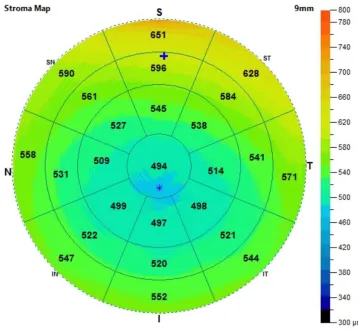
to the endothelium. The specifications of this OCT machine are as follows: a 5μm axial resolution with a 22μm beam width and a light source with a median wavelength of 840 nm.Figure 1 demonstrates a sample image of the stromal map. The zones were divided into the central (2 mm), inner (2–5 mm), middle (5–7 mm) and outer (7–9 mm).
Each eye was dilated with 1% tropicamide for a poster-ior segment examination and then, each eye was permitted to return to its original non-dilated state for an anterior segment OCT scan. All scans were checked for the quality of their scans and only those without obvious artifacts were included. Additionally, any scan with a net-like pat-tern indicating signal blockage was excluded.
Reproducibility
The interobserver reproducibility was measured using iden-tical scan protocols on one eye by two OCT technicians.
Statistical Analysis
Sample size was calculated according to the following formula Zð1α=2Þ2SD2
=d2, with an assumption of a 95% confidence interval Zð1α=2Þ¼1:96
, a margin of error of 5μm and a standard deviation of 32.5. The minimal sample came out to be 162.
The Statistical Package for the Social Sciences (SPSS v23; SPSS, Inc., Chicago, IL, USA) was used for all data analysis. Descriptive statistics (mean and standard devia-tions) were calculated for each zonal measurement and the various demographic factors. The following statistical tests were used one-way ANOVA, Pearson product moment cor-relation coefficient, partial correlation, student’st-test and a multiple regression analysis. For measuring reproducibility, the following were employed: coefficient of variation (CV) and the intraclass correlation coefficient (ICC). Statistical significance was considered when p-value was < 0.05.
Results
Patients
We included 227 patients with 118 males and 109 females. The mean age for this population was 40.0 years (20–75 years). The general characteristics are shown inTable 1.
Corneal Stromal Thickness
The data presented as mean and standard deviations of the various stromal sectors have been presented in Table 2. Stromal values were consistently thicker in the peripheral cornea (p<0.001). The outermost section of the cornea was
Clinical Ophthalmology downloaded from https://www.dovepress.com/ by 118.70.13.36 on 24-Aug-2020
between 14.8% and 28.5% thicker than the central, with the superior quadrant showing the largest value. The thinnest point was the center with a mean of 467.0 ± 31.1μm. When looking at the peripheral cornea, the thickest point was the superior quadrant with mean values of 506.3 ± 33.4 μm, 553.5 ± 35.1 μm and 600.0 ± 39.9 μm in the inner, middle and outer zones, respectively.
Keratometry
The K1 and K2 averaged 43.5 ± 1.5 and 44.2 ± 1.6, respec-tively. There was no correlation between stromal thickness and K1 (r=0.07, p=0.35) and K2 (r=0.06, p=0.36).
Gender
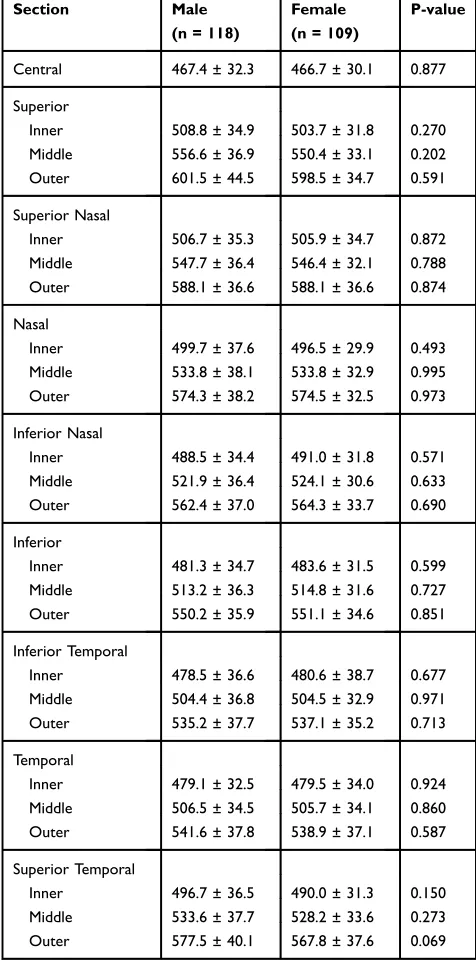
All sectors were similar between the two genders. This can be seen inTable 3. Additionally, no statistically significant difference was found among the sexes in the following variables: sphere (p=0.089), cylinder (p=0.169), spherical equivalent (p=0.071), IOP (p=0.066) and axial length (p=0.098).
Age
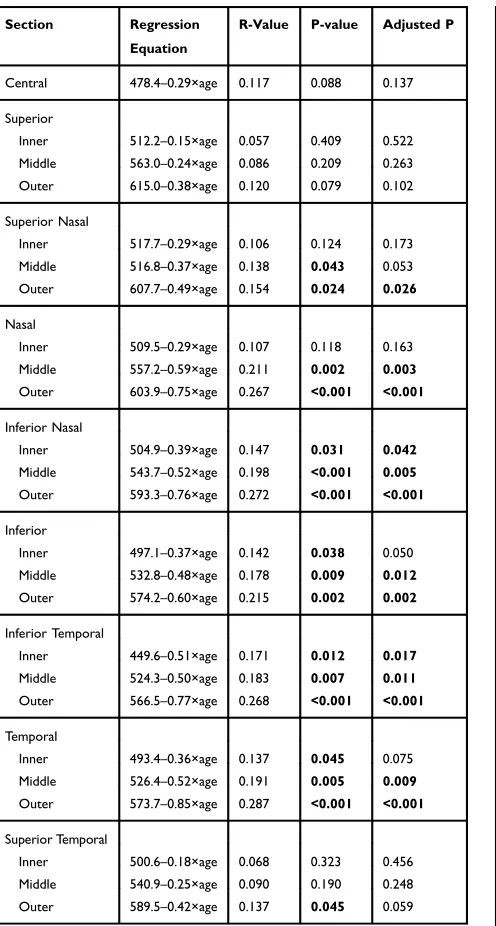
Age was negatively correlated with approximately every sector of the stroma with notable exceptions of the center (r=0.117, p=0.088) and the superior inner (r=0.057, 0.409), Figure 1A 9 mm stromal map. The zones were divided into the central (2 mm), inner (2–5 mm), middle (5–7 mm) and outer (7–9 mm).
Table 1General Characteristics
Age Group (y) Patients (n) Gender (M/F) Refractive Error (D) IOP (mmHg) Axial Length (mm)
20–29 54 28/26 −0.8 ± 1.5 14.4 ± 2.4 23.6 ± 1.1
30–39 63 22/41 −0.5 ± 1.3 15.3 ± 3.1 23.5 ± 1.0
40–49 44 27/17 0.2 ± 1.4 15.7 ± 2.9 23.4 ± 0.9
50–59 36 21/15 0.9 ± 1.4 14.9 ± 3.1 23.4 ± 0.8
60+ 30 20/10 1.0 ± 1.3 15.3 ± 3.3 23.1 ± 0.6
Total 227 118/109 −0.0 ± 1.5 15.1 ± 2.9 23.4 ± 0.9
Abbreviations:y, years; n, number; M, male; F, female; D, diopters; mmHg, millimeters of mercury; mm, millimeter.
Clinical Ophthalmology downloaded from https://www.dovepress.com/ by 118.70.13.36 on 24-Aug-2020
middle (r=0.086, p=0.209) and outer locations (r=0.120, p=0.079). Interestingly, the strength of the correlation was seen to increase from the center towards the periphery (inner location < middle location < outer location) for each relevant quadrant. The correlations of age and stro-mal thickness are displayed inTable 4.
Axial Length
Statistical significance was found in the following sectors: central (r=0.160, p=0.019), outer inferior temporal (r=0.143, p<0.001), inner (r=0.166, p=0.015), middle (r=0.150, p=0.028) and outer temporal (r=0.141, p=0.039), and inner superior temporal (r=0.168, p=0.014). The following zones fell out of statistical significance when adjusting for age: outer inferior temporal (r=0.143, p<0.001) and middle (p=0.052) and outer temporal (p=0.090). This data is represented inTable 5.
Reproducibility
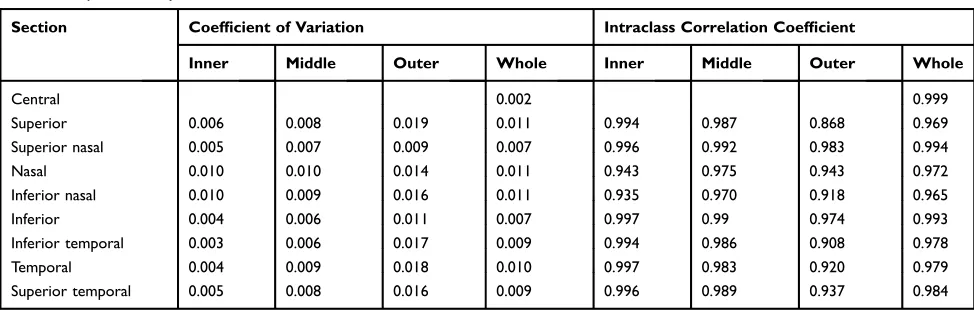
For the 50 patients included in this analysis (25 males and 25 females), the mean age was 39.0 ± 15.0 years. Excellent results were found throughout with a minimum CV of 0.002 and a maximum of 0.019. Similarly, there was a minimum ICC of 0.868 and maximum of 0.999. This is presented inTable 6.
Discussion
Corneal thickness as a unified measurement has been analyzed extensively in the literature for the purpose of delineating ocular pathologies; however, the individual layers have been explored less thoroughly. The clinical significance of stromal thickness has been recognized in its correlation with disease processes such as keratoconus5 and myopia,6 as well as its variation with surgical interventions.7 The present study aimed to independently evaluate stromal thickness in different meridians of the eye in normal individuals.
The literature includes a range of values for central stromal thickness, obtained through various techniques. Similar values were obtained through the VHF digital ultrasound3 and confocal microscopy.8–10 Another SD-OCT study reported a slightly higher central value of 482μm.7It may be safe to assume, therefore, that inter-study variations are likely not attributable to differences in measurement techniques. Therefore, geographical, genetic or simply patient variation may account for these differences.
With respect to the pattern of peripheral stromal thick-ening, previous studies with whole-corneal stromal
Table 2Thickness by Section
Section Inner Middle Outer P-value
Central 467.0 ± 31.1
Superior 506.3 ± 33.4 553.5 ± 35.1 600.0 ± 39.9 <0.001 Superior nasal 506.2 ± 34.9 547.0 ± 34.3 588.5 ± 40.0 <0.001 Nasal 498.1 ± 34.0 533.8 ± 35.5 574.4 ± 35.4 <0.001 Inferior nasal 489.7 ± 33.1 522.9 ± 33.6 563.3 ± 35.4 <0.001 Inferior 482.4 ± 33.0 514.0 ± 34.0 550.6 ± 35.1 <0.001 Inferior temporal 479.5 ± 37.5 504.4 ± 34.8 536.1 ± 36.4 <0.001 Temporal 479.2 ± 33.1 506.0 ± 34.2 540.2 ± 37.3 <0.001 Superior temporal 493.4 ± 34.1 530.9 ± 35.7 572.8 ± 39.0 <0.001
Table 3Gender Differences
Section Male
(n = 118)
Female (n = 109)
P-value
Central 467.4 ± 32.3 466.7 ± 30.1 0.877
Superior
Inner 508.8 ± 34.9 503.7 ± 31.8 0.270
Middle 556.6 ± 36.9 550.4 ± 33.1 0.202
Outer 601.5 ± 44.5 598.5 ± 34.7 0.591
Superior Nasal
Inner 506.7 ± 35.3 505.9 ± 34.7 0.872
Middle 547.7 ± 36.4 546.4 ± 32.1 0.788
Outer 588.1 ± 36.6 588.1 ± 36.6 0.874
Nasal
Inner 499.7 ± 37.6 496.5 ± 29.9 0.493
Middle 533.8 ± 38.1 533.8 ± 32.9 0.995
Outer 574.3 ± 38.2 574.5 ± 32.5 0.973
Inferior Nasal
Inner 488.5 ± 34.4 491.0 ± 31.8 0.571
Middle 521.9 ± 36.4 524.1 ± 30.6 0.633
Outer 562.4 ± 37.0 564.3 ± 33.7 0.690
Inferior
Inner 481.3 ± 34.7 483.6 ± 31.5 0.599
Middle 513.2 ± 36.3 514.8 ± 31.6 0.727
Outer 550.2 ± 35.9 551.1 ± 34.6 0.851
Inferior Temporal
Inner 478.5 ± 36.6 480.6 ± 38.7 0.677
Middle 504.4 ± 36.8 504.5 ± 32.9 0.971
Outer 535.2 ± 37.7 537.1 ± 35.2 0.713
Temporal
Inner 479.1 ± 32.5 479.5 ± 34.0 0.924
Middle 506.5 ± 34.5 505.7 ± 34.1 0.860
Outer 541.6 ± 37.8 538.9 ± 37.1 0.587
Superior Temporal
Inner 496.7 ± 36.5 490.0 ± 31.3 0.150
Middle 533.6 ± 37.7 528.2 ± 33.6 0.273
Outer 577.5 ± 40.1 567.8 ± 37.6 0.069
Abbreviation:n, number.
Clinical Ophthalmology downloaded from https://www.dovepress.com/ by 118.70.13.36 on 24-Aug-2020
mapping concur with our findings.3 Multiple mapping studies have attributed this to the structural layout of collagen fibrils in the stroma, highlighting a pattern of increasing collagen lamellae towards the periphery.11–13 It may also be interesting to note the study using the VHF digital ultrasound has reported maximum stromal thickness in the superior quadrant but with a considerably higher value (640 μm).3
Interestingly, we found the thinnest zone in our epithe-lial thickness profiles to be the superior zone; these were thicker as they approached the center.4This is the reversal of what wefind in the stroma. All previous theories trying to
explain the regional differences in epithelial thickness
pro-files focused on the outside environment or the measure-ment method.4Perhaps the epithelium is simply reacting to the stromal profiles even in the normal cornea in an attempt to smoothen out the surface of the cornea. This may be one of the reasons as evidenced by the change in epithelial thickness profiles post refractive surgery, as well.8
Our analysis noted no significant difference in stromal thickness between male and female participants, which is
Table 4Age Correlations
Section Regression
Equation
R-Value P-value Adjusted P
Central 478.4–0.29×age 0.117 0.088 0.137
Superior
Inner 512.2–0.15×age 0.057 0.409 0.522
Middle 563.0–0.24×age 0.086 0.209 0.263
Outer 615.0–0.38×age 0.120 0.079 0.102
Superior Nasal
Inner 517.7–0.29×age 0.106 0.124 0.173
Middle 516.8–0.37×age 0.138 0.043 0.053
Outer 607.7–0.49×age 0.154 0.024 0.026
Nasal
Inner 509.5–0.29×age 0.107 0.118 0.163
Middle 557.2–0.59×age 0.211 0.002 0.003
Outer 603.9–0.75×age 0.267 <0.001 <0.001 Inferior Nasal
Inner 504.9–0.39×age 0.147 0.031 0.042
Middle 543.7–0.52×age 0.198 <0.001 0.005 Outer 593.3–0.76×age 0.272 <0.001 <0.001 Inferior
Inner 497.1–0.37×age 0.142 0.038 0.050
Middle 532.8–0.48×age 0.178 0.009 0.012
Outer 574.2–0.60×age 0.215 0.002 0.002
Inferior Temporal
Inner 449.6–0.51×age 0.171 0.012 0.017
Middle 524.3–0.50×age 0.183 0.007 0.011
Outer 566.5–0.77×age 0.268 <0.001 <0.001 Temporal
Inner 493.4–0.36×age 0.137 0.045 0.075
Middle 526.4–0.52×age 0.191 0.005 0.009
Outer 573.7–0.85×age 0.287 <0.001 <0.001 Superior Temporal
Inner 500.6–0.18×age 0.068 0.323 0.456
Middle 540.9–0.25×age 0.090 0.190 0.248
Outer 589.5–0.42×age 0.137 0.045 0.059
Note:Values in bold represent statistical significance.
Table 5Axial Length Correlations
Section Regression Equation R Value P value Adjusted
P value
Central 352.2+4.88×axial length 0.160 0.019 0.029 Superior
Inner 408.3+4.16×axial length 0.127 0.064 0.076 Middle 476.4+3.28×axial length 0.095 0.165 0.206 Outer 520.6+3.37×axial length 0.086 0.210 0.280 Superior
Nasal
Inner 405.1+4.30×axial length 0.126 0.067 0.092 Middle 499.0+2.04×axial length 0.061 0.376 0.494 Outer 570.9+0.74×axial length 0.019 0.781 0.964 Nasal
Inner 405.4+3.94×axial length 0.117 0.084 0.115 Middle 469.8+2.72×axial length 0.078 0.256 0.403 Outer 544.0+1.29×axial length 0.037 0.589 0.888 Inferior Nasal
Inner 423.7+2.80×axial length 0.086 0.209 0.295 Middle 475.0+2.03×axial length 0.062 0.369 0.541 Outer 520.8+1.80×axial length 0.052 0.449 0.720 Inferior
Inner 415.5+2.84×axial length 0.088 0.202 0.283 Middle 454.0+2.55×axial length 0.076 0.265 0.390 Outer 475.2+3.20×axial length 0.093 0.175 0.291 Inferior
Temporal
Inner 406.7+3.09×axial length 0.084 0.220 0.326 Middle 422.8+3.47×axial length 0.102 0.138 0.220 Outer 416.0+5.10×axial length 0.143 <0.001 0.080 Temporal
Inner 352.2+5.04×axial length 0.166 0.015 0.024 Middle 387.8+5.03×axial length 0.150 0.028 0.052 Outer 418.8+5.16×axial length 0.141 0.039 0.090 Superior
Temporal
Inner 361.0+5.63×axial length 0.168 0.014 0.018 Middle 442.0+3.78×axial length 0.108 0.116 0.149 Outer 495.7+3.27×axial length 0.086 0.213 0.294 Note:Values in bold represent statistical significance.
Clinical Ophthalmology downloaded from https://www.dovepress.com/ by 118.70.13.36 on 24-Aug-2020
in agreement with other past studies.6,14In another study, we found males to have thicker epithelial thickness profiles.4Interestingly, we found a thicker central cornea in females using the Oculus Pentacam in a large cohort of patients.15 Baghdasaryan et al, on the other hand, found the corneal thickness to be significantly increased in male patients while epithelial thickness showed no difference.16 The dynamic nature of the cornea makes these measure-ments difficult as a large array of factors can affect the corneal thickness. This can account for the large discre-pancy in not only the literature but our own datasets.
In addition, older age was found to be correlated with a significant decrease in stromal thickness in select peripheral sectors of the cornea. In part, this may be explained by a decline in stromal keratocyte density with age.9,14 Conversely, col-lagen deposition and colcol-lagen fibril diameter have been shown to increase with age, suggesting that age-related bio-mechanical adaptations are likely to be complex and multi-layered. In terms of corneal thickness (epithelium plus stroma), available literature has described a negative17,18 as well as positive19 correlation between central corneal thickness and age. Nonetheless, it is difficult to ascertain whether these changes are due to the epithelium, stroma, or a combination of both.
Studies reporting isolated impact on stromal thickness are scarce, although Kim et al have denied any significant associa-tion between age and stromal thickness in any region of the cornea.14As opposed to this, our findings not only show a significant negative correlation in the nasal, temporal and inferior quadrants, but also an increase in the strength of this correlation from inner to outer (peripheral) segments. This further cements the idea that epidemiological or age-related changes affect the cornea heterogeneously and may preferen-tially act on the periphery as compared to the center.
In conclusion, while epithelial thickness has been mapped extensively, stromal thickness represents an understudied domain with respect to our understanding of corneal mechanisms of adaptation. In view of how the stroma appears to respond independently to patient-related characteristics, these results encourage wide stromal map-ping in larger patient populations in order to evaluate its clinical significance in the diagnosis and prognostication of ocular disease.
Limitations
There are several limitations to this study. Firstly, this study was conducted at a single center in Karachi, Pakistan and therefore only a specific subset of patients was seen. Secondly, the Optovue OCT cannot exclude the Descemet’s and the endothelium from the analysis; the stromal thick-nesses, therefore, were likely overestimated due to the inclu-sion of these 2 layers.
Funding
The research was funded by the Hashmanis Foundation.
Disclosure
Dr Sharif Hashmani reports grants from Hashmanis Foundation, during the conduct of the study. There are no other conflicts of interest to note.
References
1. Izatt JA, Hee MR, Swanson EA, et al. Micrometer-scale resolution imaging of the anterior eye in vivo with optical coherence tomography.
Arch Ophthalmol.1994;112(12):1584–1589.
2. Wojtkowski M, Leitgeb R, Kowalczyk A, Bajraszewski T, Fercher AF. In vivo human retinal imaging by fourier domain optical coher-ence tomography. J Biomed Opt. 2002;7(3):457. doi:10.1117/ 1.1482379
Table 6Reproducibility
Section Coefficient of Variation Intraclass Correlation Coefficient
Inner Middle Outer Whole Inner Middle Outer Whole
Central 0.002 0.999
Superior 0.006 0.008 0.019 0.011 0.994 0.987 0.868 0.969
Superior nasal 0.005 0.007 0.009 0.007 0.996 0.992 0.983 0.994
Nasal 0.010 0.010 0.014 0.011 0.943 0.975 0.943 0.972
Inferior nasal 0.010 0.009 0.016 0.011 0.935 0.970 0.918 0.965
Inferior 0.004 0.006 0.011 0.007 0.997 0.99 0.974 0.993
Inferior temporal 0.003 0.006 0.017 0.009 0.994 0.986 0.908 0.978
Temporal 0.004 0.009 0.018 0.010 0.997 0.983 0.920 0.979
Superior temporal 0.005 0.008 0.016 0.009 0.996 0.989 0.937 0.984
Clinical Ophthalmology downloaded from https://www.dovepress.com/ by 118.70.13.36 on 24-Aug-2020
3. Reinstein DZ, Archer TJ, Gobbe M, Silverman RH, Coleman DJ. Stromal thickness in the normal cornea: three-dimensional display with artemis very high-frequency digital ultrasound.J Refract Surg. 2009;25(9):776–786. doi:10.3928/1081597X-20090813-04
4. Hashmani N, Hashmani S, Saad CM. Wide corneal epithelial map-ping using an optical coherence tomography.Invest Ophthalmol Vis Sci.2018;59(3):1652–1658. doi:10.1167/iovs.17-23717
5. Zhou W, Stojanovic A. Comparison of corneal epithelial and stromal thickness distributions between eyes with keratoconus and healthy eyes with corneal astigmatism≥2.0 D.PLoS One.2014;9(1). 6. Kim BJ, Ryu IH, Lee JH, Kim SW. Correlation of sex and myopia
with corneal epithelial and stromal thicknesses. Cornea. 2016;35 (8):1078–1083. doi:10.1097/ICO.0000000000000850
7. Luft N, Ring MH, Dirisamer M, et al. Semiautomated SD-OCT measure-ments of corneal sublayer thickness in normal and post-SMILE eyes.
Cornea.2016;35(7):972–979. doi:10.1097/ICO.0000000000000799 8. Erie JC, Patel SV, McLaren JW, et al. Effect of myopic laser in situ
keratomileusis on epithelial and stromal thickness: a confocal micro-scopy study. Ophthalmology.2002;109(8):1447–1452. doi:10.1016/ S0161-6420(02)01106-5
9. Patel SV, McLaren JW, Hodge DO, Bourne WM. Normal human kera-tocyte density and corneal thickness measurement by using confocal microscopy in vivo.Invest Ophthalmol Vis Sci.2001;42(2):333–339. 10. Patel SV, McLaren JW, Hodge DO, Bourne WM. Confocal
micro-scopy in vivo in corneas of long-term contact lens wearers. Invest Ophthalmol Vis Sci.2002;43(4):995–1003.
11. Aghamohammadzadeh H, Newton RH, Meek KM. X-ray scattering used to map the preferred collagen orientation in the human cornea and limbus.Structure.2004;12(2):249–256. doi:10.1016/j.str.2004.01.002
12. Henriksson JT, Bron AJ, Bergmanson JPG. An explanation for the central to peripheral thickness variation in the mouse cornea.Clin Exp Ophthalmol.2012;40(2):174–181. doi:10.1111/ceo.2012.40.issue-2 13. Meek KM, Tuft SJ, Huang Y, et al. Changes in collagen orientation
and distribution in keratoconus corneas.Invest Ophthalmol Vis Sci. 2005;46(6):1948–1956. doi:10.1167/iovs.04-1253
14. Kim BJ, Ryu IH, Kim SW. Age-related differences in corneal epithe-lial thickness measurements with anterior segment optical coherence tomography. Jpn J Ophthalmol. 2016;60(5):357–364. doi:10.1007/ s10384-016-0457-x
15. Hashmani N, Hashmani S, HanfiAN, et al. Effect of age, sex, and refractive errors on central corneal thickness measured by oculus pentacaml®.Clin Ophthalmol.2017;11:1233–1238. doi:10.2147/OPTH. S141313
16. Baghdasaryan E, Tepelus TC, Marion KM, Bagherinia H, Sadda SR, Hsu HY. Evaluation of corneal epithelial thickness imaged by high definition optical coherence tomography in healthy eyes. Cornea. 2019;38(1):62–66. doi:10.1097/ICO.0000000000001745
17. Galgauskas S, Norvydaite D, Krasauskaite D, Stech S, Ašoklis RS. Age-related changes in corneal thickness and endothelial character-istics.Clin Interv Aging.2013;8:1445–1450. doi:10.2147/CIA 18. Islam QU, Saeed MK, Mehboob MA. Age related changes in corneal
morphological characteristics of healthy Pakistani eyes. Saudi J Ophthalmol.2017;31(2):86–90. doi:10.1016/j.sjopt.2017.02.009 19. Rüfer F, Schröder A, Bader C, Erb C. Age-related changes in central and
peripheral corneal thickness: determination of normal values with the Orbscan II topography system1.Cornea.2007;26(1):1–5. doi:10.1097/ 01.ico.0000240095.95067.3f
Clinical Ophthalmology
Dove
press
Publish your work in this journal
Clinical Ophthalmology is an international, peer-reviewed journal cover-ing all subspecialties within ophthalmology. Key topics include: Optometry; Visual science; Pharmacology and drug therapy in eye dis-eases; Basic Sciences; Primary and Secondary eye care; Patient Safety and Quality of Care Improvements. This journal is indexed on PubMed
Central and CAS, and is the official journal of The Society of Clinical Ophthalmology (SCO). The manuscript management system is completely online and includes a very quick and fair peer-review system, which is all easy to use. Visit http://www.dovepress.com/ testimonials.php to read real quotes from published authors.
Submit your manuscript here:https://www.dovepress.com/clinical-ophthalmology-journal
Clinical Ophthalmology downloaded from https://www.dovepress.com/ by 118.70.13.36 on 24-Aug-2020