Volume 3, No. 1, Jan-Feb 2012
International Journal of Advanced Research in Computer Science
RESEARCH PAPER
Available Online at www.ijarcs.info
ISSN No. 0976-5697
Comparative Study On IEEE 802.11 Wireless Local Area Network Securities
Keshav Jindal
A.P., Dept of CSE
BPR College of Engineering, Gohana Sonipat, India [email protected]
Surjeet Dalal*
Research Scholar
Suresh Gyan Vihar University Jaipur, India [email protected]
Vivek Jaglan
Research Scholar
Suresh Gyan Vihar University Jaipur, India [email protected]
Abstract: The IEEE 802.11 Wireless Networks gains its popularity and fame by providing the users with several advantages in accessing information. WLANs provide true mobility and flexibility to users. Another advantage of wireless technology is installation. A physical or cable connection is no longer needed because a single connection to the access point via electromagnetic waves is all that is necessary. This both decreases installation costs and allows for wireless networks to be installed in locations where previously it would have been difficult or impossible to install wiring. Such benefits and advantages bring up some security and performance problems. Various researchers have proposed several solutions to improve WLAN security and to understand the impact of the security mechanisms on the performance of the network. However, the establishment of a tradeoff between security and network performance is often neglected. The aim of our research paper is to quantify the impact of the security mechanisms on the performance of the network.
Keywords:WLAN, WEP, WPA, WPA2, WPS, Wi-Fi protected setup
I. INTRODUCTION
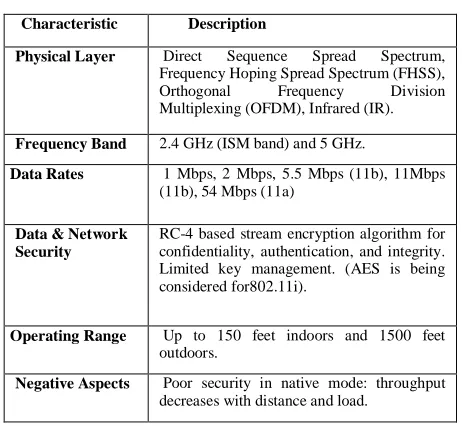
The wireless LAN technology and industry were born in the mid 1980s when radio frequency (RF) spectrum was first made available by the Federal Communications Commission (FCC). When it was first introduced to the market, growth was considerably slow. Lately, wireless LAN technology is experiencing incredible growth. In addition to the flexibility it provides to the users, one of the key reasons that allows its growth is the increased bandwidth made possible by the IEEE 802.11 standard. Table 1.1 provides some key and important characteristics of the 802.11 standard.
WLANs are based on a set of IEEE standards named 802.11. 802.11-1997, which defines WEP security algorithm, was the first standard in the 802.11 standards family released in 1997. [1] The standard was clarified in 1999 under the name 802.11-1999. [2] In the same year were released amendments IEEE 802.11a-1999 and IEEE 802.11b- 1999. The former defines wireless transmission in a rate of 54 Mbps at 5 GHz frequency, and the latter in 11 Mbps at 2,4 GHz. In 2003 were released the amendment IEEE 802.11g- 2003, which defines 54Mbps data rate at 2.4 GHz frequencFy. The amendment IEEE 802.11i-2004 was published in 2004. [9] It defines new security mechanisms for WLANs, named WPA and WPA2.
Table 1.1: Characteristics of 802.11 Wireless LANs
Characteristic Description
Physical Layer Direct Sequence Spread Spectrum, Frequency Hoping Spread Spectrum (FHSS), Orthogonal Frequency Division Multiplexing (OFDM), Infrared (IR).
Frequency Band 2.4 GHz (ISM band) and 5 GHz.
Data Rates 1 Mbps, 2 Mbps, 5.5 Mbps (11b), 11Mbps (11b), 54 Mbps (11a)
Data & Network Security
RC-4 based stream encryption algorithm for confidentiality, authentication, and integrity. Limited key management. (AES is being considered for802.11i).
Operating Range Up to 150 feet indoors and 1500 feet outdoors.
Negative Aspects Poor security in native mode: throughput decreases with distance and load.
This paper analyses security of the WLANs primarily based on four important concepts in information security: confidentiality, integrity, availability and authenticity. Confidentiality is a property of keeping information secret, so that only authorized parties are allowed to get it. Integrity means that data cannot be modified without authorization, or any unauthorized data modifications are detected.
Availability means that data is available for its users. Authenticity means that each communicating party can be sure that other parties are who they claim they are. Designing a good security technique is mostly about balancing between these properties.
II. WIRELESSLANSECURITY
Wireless Local Area Networks have gained a tremendous and incredible popularity across the computer network market over the years. However, the threats and security fears associated with them have caused some network managers and administrator to avoid installing wireless LAN, regardless of the numerous benefits that they provide. Several manufacturers understand the fears, uncertainties and doubts caused by the security problems of the Wireless Local Area Network. They realize that coming up with a security measure to make the WLAN more secure would be a great asset and source of profit for them. Thus, they invest in research with the goal of coming up with a solution that satisfies the needs of the buyers when it comes to the security of the IEEE 802.11 WLAN.
A. Goals of Wireless LAN Security:
The main goal of the wireless LAN security is to protect the privacy of the clients just to make sure that an attacker is not able to access the network without any permission and attack them. The following goals should be considered to implement effective wireless LAN security:
a. Maintain the confidentiality of data as it is stored, processed or transmitted on a wireless LAN.
b. Maintain the integrity of data as it is stored, processed or transmitted over a wireless local area network.
c. Maintain the availability of data stored on a wireless LAN, as well as the ability to process and transmit the data in a timely fashion.
d. Identify and ensure the identity of the sender and receiver of a message.
B. Wireless Security Threats and Attacks:
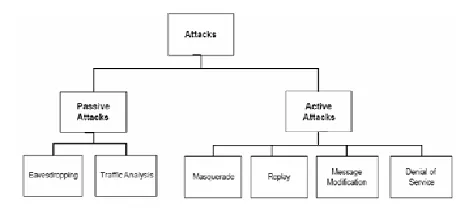
The security solutions decrease the chances or opportunities for an attacker to penetrate the WLAN but still most of them are vulnerable to attacks. The attacks that allow unauthorized users to get access to the system are divided into: active and passive attacks. Figure 1. Shows several types of attacks and security threats that can be used by an attacker to attack a wireless LAN.
Figure 1: Security Threats and Attacks
III. 802.11SECURITYISSUES
This section identifies possible threats against wireless networks by classifying them into a six groups. It is actually hard to divide the attacks into separate categories because some overlapping always exists between the definitions. The attacks are collected from [5] and [6].
A. Eavesdropping:
Because radio waves propagate in every direction, wireless data traffic can always be sniffed and recorded by anyone near the transmitting stations. Eavesdropping is a threat to information confidentiality. It can be conducted passively, and so it is impossible to know whether the wirelessly transmitted. Information is captured by an adversary.
B. Message Modification:
An adversary may not only be able to passively listening to the wireless data traffic, but it can also send messages in the network. Message modification comprises all the operations to add, modify or delete packets in the wireless network. Adding means generating completely new packets. Modifying and deleting requires that the adversary has a control of the wireless channel, because the adversary must be able to prevent the original packets from reaching their destination.
One form of message modification attack is replay attack. In this case, an adversary records a valid transferred message and sends the same message later to the wireless channel. In a replay attack, the adversary does not have to be able to decrypt the message to be able send it again.
C. Masquerading:
An adversary can try to masquerade as a valid wireless station or an access point. For example, a valid wireless station can reveal its credentials to the fraud access point when it is trying to log into the network, if the wireless station is not able to detect the deception. Session hijacking is a special type of masquerading attack: in that case, an adversary takes over a valid session after the session initiation has been made.
D. Key Management:
E. Man-in-the-Middle:
In man-in-the-middle attack an adversary infiltrates itself between a wireless station and an access point. Both of the communicating parties believe they are connected to each other, but in reality both communicate with the adversary. Man-in-the-middle attack may resemble message modification but it is considered different type of attack, because in man-in-the-middle the adversary must participate in the communication continuously.
F. Denial-of-Service:
The purpose of denial-of-service attacks or DoS attacks is to hinder communication in the wireless network. This type of attack is the most difficult to prevent, because it is always possible to jam the radio link between the parties. On the other hand, denial-of-service attacks are the easiest ones to detect, when comparing to other attacks. Roughly two types of DoS attacks exists: so called brute methods can be used, where the wireless channel is continuously disturbed by an adversary.
The other type of DoS attack exploits the flaws of wireless protocols by means of more subtle attack.
IV. WIREDEQUIVALENTPRIVACY
WEP is the first link-layer security standard of WLANs and it was included in the original IEEE 802.11 standard published in 1997. [7] It was soon found out that WEP has some major flaws in its design. In 2001 was published the first attack which was able to recover the pre-shared secret key and thus an adversary using that attack is able to decrypt all the traffic in the network. [4]. after that more and more efficient algorithms have been developed to break the encryption of WEP. At the moment the fastest ones are able to do it in less than a minute and require processor time only a few seconds.
WEP uses RC4 stream cipher for confidentiality and CRC- 32 checksum for integrity. [8] WEP works as follows: Before a connection protected by WEP can be established, a pre shared secret key has to be divided between the communicating parties. First the CRC-32 checksum is calculated and added in the end of a packet. Together they form a plaintext. The is sent through the wireless network. The initialization vector is transmitted unprotected with the packet.
A. Attacks Against Confidentiality:
WEP has several severe weaknesses and too short cipher keys are one of them. Standard WEP uses 40-bits long keys which are too short, because they can be broken by trying different key possibilities, i.e. using brute force technique. A new version of WEP with 104-bit keys has been implemented, which is more time consuming to break by brute force. Brute force techniques are not needed to break WEP, though. An attack named FMS was the first key recovery attack against WEP. [4] The attack works as follows: An adversary, who wants to get the pre-shared secret key to be able to decrypt the traffic, listens to the traffic in the wireless network and records a lot of encrypted packets. Because the first bytes of the
plaintext are predictable in most packets, the adversary can recover the first bytes of the key stream. Because the initialization vector is transmitted unprotected, the adversary knows the first 24 bits of the RC4 traffic key. Thus, the adversary has part of the input for RC4 algorithm (initialization vector) and part of the output key stream (calculated from the first plaintext bits and the cipher text). With huge amount of valid packets the adversary is able guess the rest of the RC4 traffic key. Around 5,000,000 packets is needed to recover the key with 50 % probability. The attack is slow but still practical. In addition, the attack is passive, so the adversary does not have to reveal its existence.
In 2007 completely new type of attack against WEP was published named PTW. The attack required only about 40,000 encrypted packets with 50 % success probability, which means that only a minute is needed to gather needed packets in a fast network. Still, development of better attacks against WEP has not stopped: the Kore K attack has been improved further, and in 2008 was published a modified version of the attack requiring only 25,000 packets to 50 % success rate.
B. Attacks Against Integrity:
WEP uses CRC-32 checksum to calculate a message integrity code (MIC). Its purpose is to verify that packets do not get modified in transit. CRC-32 algorithm takes as an input an arbitrary length stream of bytes (in this case a packet) and produces as an output a 32-bit length integer value (the checksum). [8] CRC-32 algorithm popular, because it is very simple and computationally light. Bare MIC protects well against random transfer errors, but it is useless when contents of packets are changed on purpose, because an adversary is able to calculate the CRC-32 checksum again for the modified packet. To protect against intentional modification, message authentication code (MAC) is a common solution in cryptography. MAC differs from MIC that it also uses a secret key as an input in the checksum algorithm. By calculating the checksum again the receiver can also verify that the checksum in the packet has been calculated by someone who knows the secret key. WEP uses RC4 cipher to protect also the calculated MIC to achieve the same properties as in MAC. [8] According to Borisov et al. WEP unfortunately fails to do so. [2] They show that an adversary, who cannot decrypt packets, is still able made any changes to a packet without invalidating the checksum. Thus, the RC4 cipher does not provide any help in preventing intentional message modification.
A. Security Improvements:
WPA defines a new security protocol, Temporal Key Integrity Protocol (TKIP), which is used to protect the content of messages in terms of confidentiality and integrity. TKIP has several improvements compared to WEP: so obvious. This change makes almost all the known key recovery attacks against WEP impossible.
b. TKIP has a 64-bit MIC named Mic Michael, which replaces the weak CRC-32 checksum used in WEP. The purpose of Michael is to detect if the message content has been changed between sender and receiver. In WEP the MIC algorithm takes as an input only the plaintext. To achieve additional level of security TKIP uses a separate MIC key as an input.
c. As a new feature, TKIP has a packet sequence counter and every packet contains a unique sequence number to indicate the packet order. The receiver monitors the sequence numbers and only allows packets to be received in order. WEP does not have this functionality, which enables simple replay attacks.
In addition, WPA uses 802.1X network access control mechanism to provide authentication and key management. In the start of the wireless connection 802.1X authenticates the parties for each other and derives a fresh master key for the both parties. The master key is used to derive two new keys: 128-bit temporal key (TK) for the key mixing function and 64-bit MIC key for Michael algorithm. The benefit is that a new key can be negotiated multiple times during the session, which considerably increases security. Rekey interval determines how ofter the negotiation process is done.
The key mixing function takes as an input the TK, transmitter’s MAC address and an initialization vector, and the function outputs a 128-bit RC4 traffic key, which is used as in WEP. Because of the implementation constraints, the freely selectable initialization vector is actually also the sequence counter incrementing by one in every packet.
B. WPA Security Analysis:
Attacks against WEP are complete, fast and in practice they work in every case. [17] Completeness means that the encryption keys can be recovered and thus all the traffic can be unencrypted by an adversary. A review of recently published scientific articles related to WLAN link-layer security techniques reveal that no single complete attack against TKIP exists. Though, there is at least one practical attack, which has managed to uncover some parts of encrypted messages. In addition, TKIP has some weak spots, which are potential sources of attacks, but no practical attacks exploiting those has been developed.
Beck and Tews (2008) devised and implemented one type of an attack against TKIP [1]. If the rekey interval is long enough, for example one hour, it is possible to decrypt last bits of a packet without knowing the encryption key. In addition, the adversary is able to send new packets with any content to the network. The idea behind the Beck and Tews attack is not new, but it is based on a chopchop attack against WEP. The Beck and Tews attack is quite slow because it requires sending
on average over one hundred packets to decrypt one byte of data. Besides, the attack can be prevented by using short rekeying times, for example two minutes should be enough for making the attack unfeasible. Also some simple changes to the operation of TKIP protocol could prevent this attack, as proposed by Beck and Tews.
TKIP has been showed to have other intrinsic deficiencies, but no practical attacks exploiting those have been developed. In addition, given two packet keys with the same initialization vector, it is possible to calculate the TK. If TK is known by an adversary, it is able to decrypt all the traffic, until the TK is renegotiated.
Michael algorithm has turned out to be invertible, which enables an adversary to calculate the secret MIC key if certain information is available. [3] To make the calculation, an adversary needs to know a single plaintext message and a corresponding MIC value. The adversary may be able to guess the plaintext value of a message in certain situation. Thus, security of Michael MIC relies on the fact that the MIC value is encrypted. Although this vulnerability challenges the protection of TKIP, no known practical attacks exploiting it have been technologies. Although the existing breaking methods are very fast, new ones are still being developed in recent years. Analysing WEP may be useful for the WLAN security research, because WPA is based on WEP and all the attacks against WEP can possibly be valid attacks against WPA. WPA provides a considerably more secure connection than WEP, but at least one attack towards it exists which has partly managed to break the protection and is also practical. It is possible that the recently found attack is just a beginning in searching for new breaking techniques for WPA. Thus, we think that this is the most important area of further study related to WLAN security. Taking into account the severity of the recently found vulnerability, WPA can still be considered adequately safe in many purposes, but in a few years it may end up in the same category of useless security algorithms with WEP.
VII. REFERENCES
[1]. ANSI/IEEE “Std 802.11 1999 Edition” 20 September 2001 P: 59-69.
[2]. Adam Stubblefield, John Ioannidis, Aviel D. Rubin “Using the Fluhrer, Martin, and Shamir Attack to Break WEP” Revision 2. 21 August 2001.
[1]. William A. Arbaugh, Narendar Shankar, Y.C. Justin Wan “Your 802.11 Wireless Network has No Clothes 30 March 2001
[2]. Anderson, Gustave, “A Secure Wireless Agent-based Testbed,” Proceedings of the Second IEEE International Information Assurance Workshop, 2004.
[3]. Baghaei, Nilufar and Hunt, Ray, “IEEE 802.11 Wireless LAN Security Performance Using Multiple Clients,” Proceedings of the 12th IEEE International Conference on Networks, 2004.
[4]. Bargh, Mortaza, “Fast Authentication Methods for Handovers Between IEEE 802.11 Wireless LANs,” Proceedings of the 2nd ACM International Workshop on Wireless Mobile Applications and Services on WLAN Hotspots, 2004.
[5]. Becker, Bernd, Eisinger, Jochen, and Winterer, Peter, “Securing Wireless Networks in a University Environment,” Proceedings of the Third IEEE International Conference on Pervasive Computing and Communications Workshops, 2005.
[6]. Carli, Marco, Neri, A., and Rossetti, A., “Integrated Security Architecture for WLAN,” Proceedings of the IEEE 10th International Conference on Telecommunications, 2003.
[7]. Chen, Jyh-Cheng, Jiang, Ming-Chia, and Liu, Yi-Wen, “Wireless LAN Security and IEEE 802.11i,” IEEE Wireless Communications, February 2005.
[8]. Chen, Jyh-Cheng, Liu, Yi-Wen, and Wang, Yu-Ping, “Design and Implementation of WIRE1x.” Proceedings of Taiwan Area Network Conference, 2003.
[9]. Edney, Jon and Arbaugh, William A., Real 802.11 Security: Wi-Fi Protected Access and 802.11i, Addison-Wesley, 2004.
[10]. Fluhrer, Scott, Mantin, Itsik, and Shamir, Adi, “Weaknesses in the Key Schedule Algorithm of RC4,” Proceedings of the 4th Annual Workshop on Selected Areas of Cryptography, 2001.
[11]. Gast, Matthew S., 802.11® Wireless Networks: The Definitive Guide (2nd Edition), O’Reilly Media, 2005.
[12]. Changhua, and Mitchell, John, “Analysis of the 802.11i 4-Way Handshake,” Proceedings of the 2004 ACM Workshop on Wireless Security, 2004.
[13]. IEEE Standard 802.11, 1999 Edition.
[14]. IEEE Standard 802.11i, 2004 Edition. Also available at
http://standards.ieee.org/getieee802/download/802.11i-2004.pdf
[15]. IEEE Standard 802.1X, 2004 Edition. Also available at http://standards.ieee.org/getieee802/download/802.1X-2004.pdf
[16]. IEEE Standard 802.11, 2007 Edition. Also available at http://standards.ieee.org/getieee802/download/802.11-2007.pdf