THE IMPACTS OF BANK MERGERS AND
ACQUISITIONS (M&As) ON BANK BEHAVIOUR
By
Duangkamol Prompitak
A THESIS SUBMITTED IN PARTIAL FULFILLMENT OF THE
REQUIREMENTS FOR THE DEGREE OF DOCTOR OF PHILOSOPHY
Department of Economics Birmingham Business School The University of Birmingham
University of Birmingham Research Archive
e-theses repository
This unpublished thesis/dissertation is copyright of the author and/or third parties. The intellectual property rights of the author or third parties in respect of this work are as defined by The Copyright Designs and Patents Act 1988 or as modified by any successor legislation.
Any use made of information contained in this thesis/dissertation must be in accordance with that legislation and must be properly acknowledged. Further distribution or reproduction in any format is prohibited without the permission of the copyright holder.
Abstract
This thesis examines the impact of bank mergers and acquisitions (M&As) on lending behaviour by commercial banks. We use the data set of large European commercial banks from 1997 to 2005. Empirical models are formulated to explain the effects of mergers on bank loan pricing behaviour, interest margin setting, credit availability and lending objectives. The analysis provides evidence that mergers have statistically significant influence on reduced lending rates, interest margins and loan supply. In addition, lending objectives for merged and non-merging banks are different, in that merge-involved banks tend to emphasise maximising their utility, while non-merging banks focus on remaining safe. These results suggest that merged banks can obtain efficiency gains through mergers and can pass these benefits to their customers in the form of lower lending rates and interest margins. In addition, diversification gains could arise from consolidations. This is because merged banks focus more on other business activities than traditional intermediary activities. As non-interest income increases in relation to interest income, banks can diversify their business activities and can reduce their non-interest costs. As a result, they can be exposed to lower risk and therefore be less risk averse than non-merging banks.
Dedication
To my dear family
Acknowledgements
First and foremost, I offer my sincerest gratitude to my supervisor, Professor David Dickinson, who has supported me throughout my thesis with his patience and knowledge. He has shared thoughtful suggestions and valuable comments on every chapter on my work. His guidance helped me throughout the research and writing of this thesis. Without him, this thesis could not have been completed. Many thanks also go to my second supervisor Mr. Nicholas Horsewood, who has given me constructive suggestions throughout the process of my study.
My sincere thanks also go to my examiners, Professor Philip Molyneux and Professor David Gowland for their time in reading my thesis and their valuable suggestions. Many thanks also go to Mr. Ralph Bailey for being the Chairperson of the examining board which organised the oral examination.
I also would like to thank the Fiscal Policy Office, The Ministry of Finance, Thailand, for giving me permission to commence this thesis in the first instance; their financial support is acknowledged.
I would like to express my thanks to my friends in Birmingham for their support and all the fun we have had over these past four years. My special thanks to my dear friend, Yixin Hou, for her unselfish and patient guidance, and her encouragement in so many ways.
Most importantly, none of this could have happened without my family. My grateful thanks go to my parents, Jumpol and Wannapon Prompitak, who always provide me with support and understanding. Special thanks go to my grandparents, Banyat and Lila Panitchaattra, who were my best counsellors. Although they are no longer with me, they are forever remembered. This thesis stands as a testament to their unconditional love and encouragement.
Finally, I would like to thank everybody who was important to the successful realisation of my thesis, as well as expressing my apology that I could not mention personally one by one.
Table of Contents
Chapter 1 Introduction 1
1.1 Overview of the thesis 3
1.2 Review of the literature 4
1.2.1 Bank lending behaviour 5
1.2.2 The impacts of bank M&As on lending behaviour 14
1.2.2.1 Price and credit availability 14
1.2.2.2 Risk-taking attitude 24
1.3 Data sources, M&A samples and econometric package used 27
1.3.1 Data sources 27
1.3.2 Sample data 28
1.3.3 The econometric package used 30
Chapter 2 The European Banking Market Structure and an Overview of Bank Mergers and Acquisitions (M&As) in the European Banking Market
31
2.1 European banking market structure 31
2.2 Overview of M&As in the European banking market 36 2.2.1 Factors facilitating European banking M&As 36
2.2.2 European banking M&A situation 38
Chapter 3 Bank Mergers and Acquisitions (M&As) and Loan Pricing Behaviour
3.1 Introduction 48 3.2 The impacts of bank M&As on loan pricing behaviour:
the empirical evidence
50
3.3 The Monti-Klein model of the banking firm 53
3.3.1 The Monti-Klein model and market competition 59
3.3.2 The Monti-Klein model and risks 63
3.4 The empirical model 67
3.5 Data 86
3.5.1 Description of the data 86
3.5.2 Data multicollinearity 88
3.6 Methodology: the panel data models 90
3.6.1 The fixed effects model 91
3.6.2 The random effects model 92
3.7 Empirical results 94
3.8 Conclusion 106
Chapter 4 Difference-in-Differences (DID) Estimation and
the Effects of Bank Mergers and Acquisitions (M&As) on Bank Lending Behaviour
108
4.1 Introduction 108
4.2 The Difference-in-Differences (DID) method 113
4.3 The empirical model 122
4.4 Data and variables 129
4.4.1 Data 129
4.4.2.1 Dependent variables 130
4.4.2.2 Explanatory variables 132
4.4.2.3 Checking for robustness 135
4.5 Empirical results 140
4.5.1 The impacts of bank M&As on loan interest rate 140 4.5.2 The impacts of bank M&As on bank margin 145 4.5.3 The impacts of bank M&As on credit availability 149
4.6 Conclusion 156
Chapter 5 Bank Mergers and Acquisitions (M&As) and Bank Lending Objectives: a Non-nested Test
159
5.1 Introduction 159
5.2 The Expected Utility Maximisation model 163
5.2.1 Literature review 163
5.2.2 The application of the Expected Utility Maximisation model to bank lending behaviour
175
5.3 The Safety First Principle 181
5.3.1 Literature review 181
5.3.2 The Principle of Safety First and a commercial bank’s portfolio behaviour
189
5.3.3 The empirical application of the Safety First model and bank lending behaviour
203
5.4 Non-nested hypothesis testing 206
5.4.1 Literature review 206
5.5 Data and variables 210
5.6 Methodology and empirical models 218
5.6.1 Assumptions in the estimations 218
5.6.2 Empirical models 219
5.6.3 Empirical models for the Non-nested hypothesis testing 223
5.7 Results 226
5.8 Conclusion 231
Chapter 6 Conclusion and remarks 233
6.1 The summary of the results of the thesis 234
6.2 Remarks 239
List of Figures
Figure 2-1 Value of European banks’ bank M&A activities, 1996-2005 41 Figure 2-2 Number of bank M&A deals undertaken by European banks,
1996-2005
42
Figure 2-3 Number of European cross-border bank M&A deals undertaken by European banks, 1996-2005
42
Figure 2-4 Value of European cross-border bank M&A activities in Western and emerging Europe, 1996-2005
45
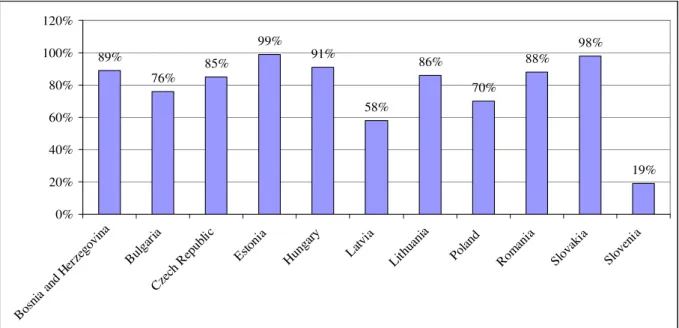
Figure 2-5 Market share of foreign-owned banks (% of all banking system assets, 2005)
46
Figure 2-6 M&A activities between EU banks and insurance firms, 2000-2005
47
Figure 4-1 A graphical representation of the effects in the DID model 117 Figure 4-2 The effects of bank M&As on loan interest rates
in the DID model
145
Figure 4-3 The effects of bank M&As on bank interest margins in the DID model
149
Figure 5-1 The graphical determination of the best σ,m combination 184
Figure 5-2 The graphical determination of the bank portfolio decision-making
List of Tables
Table 2-1 Concentration indicators in the European banking market 34 Table 2-2 Classification of EU countries by concentration levels in 1999 35
Table 3-1 Description of the variables 84
Table 3-2 Summary statistics of data 87
Table 3-3 Data correlation matrix 89
Table 3-4 The Hausman specification test 97
Table 3-5 The Breusch and Pagan Lagrangian multiplier test 99
Table 3-6 Regression results 100
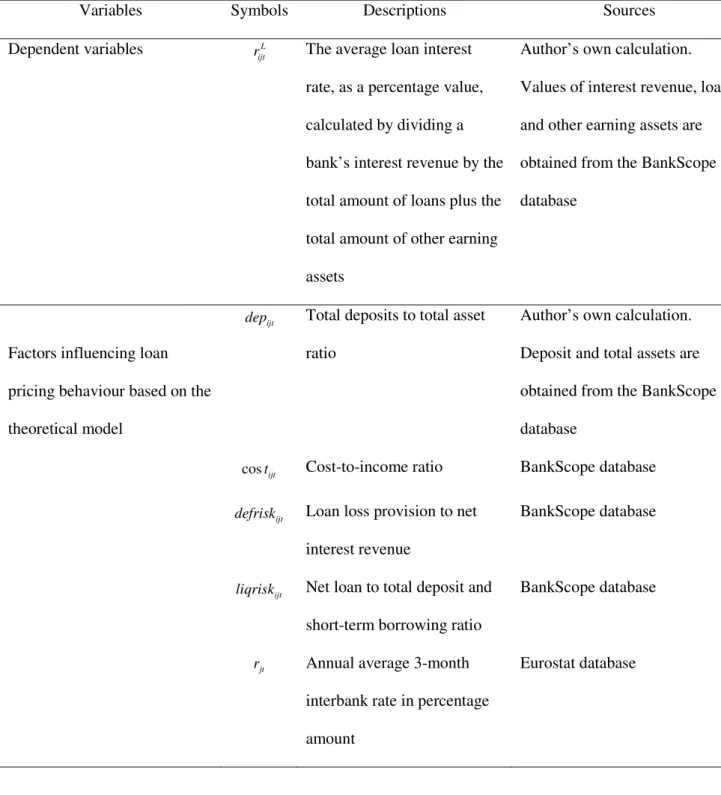
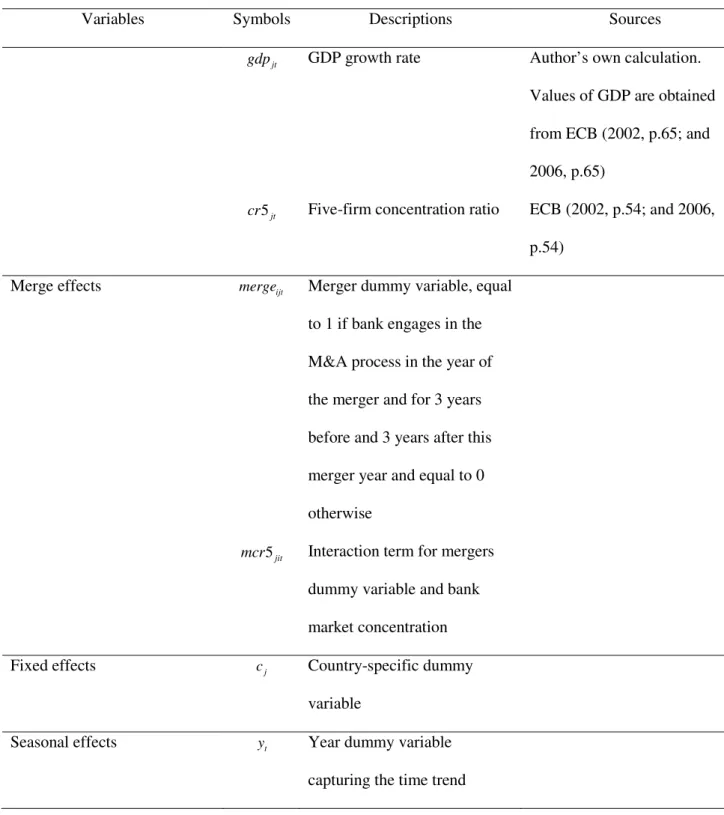
Table 4-1 Description of the variables 137
Table 4-2 The sample means of variables: 1997 as the pre-merger period and 2005 as the post-merger period
139
Table 4-3 Bank M&As and loan interest rate 144
Table 4-4 Bank M&As and bank interest margins 148
Table 4-5 Bank M&As and credit availability 150
Table 4-6 The sample means of the variables: 2001 as the pre-merger period and 2002 as the post-merger period
153
Table 4-7 Bank M&As and credit availability: 2001 as the pre-merger period and 2002 as the post-merger period
155
Table 5-1 Description of the variables 215
Table 5-2 Summary statistics of data: Merged banks 217
Table 5-4 Estimation of the Expected Utility Maximisation model: Merged banks
227
Table 5-5 Estimation of the Safety First model: Merged banks 227 Table 5-6 Estimation of the Expected Utility Maximisation model:
Non-merging banks
227
Table 5-7 Estimation of the Safety First model: Non-merging banks 228
Table 5-8 Non-nested test estimation: Merged banks 229
List of Abbreviations
ARA Absolute Risk Aversion
BIS Bank for International Settlements CR Concentration Ratio
DID Difference-In-Differences ECB European Central Bank
ESP Efficient-Structure-Performance
EU European Union
FE Fixed Effects
FIML Full Information Maximum Likelihood GDP Gross Domestic Product
HI Herfindahl Index
M&As Mergers and Acquisitions OEA Other Earning Assets OLS Ordinary Least Squares
RE Random Effects
SCP Structure-Conduct-Performance TBTF Too-Big-To-Fail
TSP Time Series Processor USD US Dollar
Chapter 1
Introduction
Commercial banks have an essential role in the economy. One of their main duties is to collect funds from excess fund sectors and lend to customers with insufficient funds. From these financial intermediary activities, they have an important role in determining the amount and distribution of credit in the economy. Since an increase in bank credit leads to increased investment and in turn to increased employment levels, changes in bank lending behaviour have a marked impact on the economic development of the country. Banks change their lending decisions in response to changes in the structure of the banking market. One of the issues arising in this context is bank mergers and acquisition (M&As). Since market structures can change as a result of mergers, bank mergers can have a significant impact on changes in bank lending behaviour.
The impact of bank mergers in the banking industry has raised concerns among policymakers as to whether bank borrowers can benefit from the consolidations. The consequences of bank M&As on the welfare of borrowers have been investigated from two perspectives: credit availability and loan pricing behaviour. Although several researchers have examined the impacts of bank M&As (comprehensive reviews of the literature are provided in the studies of Berger, Demsetz and Strahan, 1999; and DeYoung, Evanoff and Molyneux, 2009), most of them take their evidence from US bank mergers. Despite the high level of M&A activity in the European
banking markets, relatively little research has been conducted so far in this area. In addition, while future bank consolidation is likely to involve large financial institutions across nations, only a limited number of researchers have investigated the consequences of mergers between large banks.
The importance of commercial banks, the emerging trend towards large banks and the lack of evidence on the effects on large European commercial bank lending behaviour of bank M&As make it interesting to examine whether merged banks have different lending behaviour from those which are not involved in the M&A process. This thesis, therefore, aims to answer this question. The main empirical analyses will provide evidence for the most part on whether bank mergers can have any impact on loan pricing behaviour, interest margins, credit availability and lending objectives.
This chapter is organised as follows. Section 1 presents an overview of the thesis. Section 2 discusses previous studies relating to the impact of bank M&As on lending behaviour. This section starts with a general discussion of lending behaviour and goes on to supply empirical evidence of the effect of bank consolidations on banks’ decision-making about their lending policy. In addition, because changes in the attitude to risk can affect any changes in bank lending behaviour, the empirical studies examining the relationship between attitudes to risk-taking and bank mergers are also presented in this section. Section 3 describes the data sources, sample data and econometric package used in this thesis.
1.1 Overview of the thesis
The overview of the EU banking market structure and the M&A situation in EU banks during the study period are provided in Chapter 2. Chapter 3 analyses whether bank mergers tend to have a favourable impact on those who borrow from the banks involved in M&As. The chapter starts by identifying the determinants of the bank loan interest rate on the basis of the Monti-Klein (1971) model of the banking firm, in which banks can exert monopoly power. In addition, the impact of market competition on loan price is examined with reference to two alternative hypotheses: the Structure-Conduct-Performance (SCP) and the Efficient-Structure-Performance (ESP) hypotheses. After knowing the factors which influence the decision-making on the price of bank loans, the thesis empirically analyses the impact of bank M&As on the loan interest rate, when every loan interest rate determinant, on the basis of the theoretical framework, is controlled.
Chapter 4 extends the analysis of the impact of bank M&As on loan pricing behaviour by using the alternative approach, namely, the difference-in-differences (DID) estimation technique. In addition, this chapter looks at two more aspects of lending: credit availability and bank interest margins. These three lending behaviours, both before and after mergers and on the part of both merged and non-participant banks, are compared, taking the DID approach.
Chapter 5 applies two portfolio behaviour frameworks in order to examine whether bank mergers have an impact on the business objectives of banks and thus on lending behaviour. These two approaches are the Expected Utility Maximisation framework
developed by Parkin-Gray-Barrett (1970) and the Safety First Principle developed by Roy (1952). In the Expected Utility Maximisation approach, banks are assumed to focus on maximising their expected returns. However, since any profit-maximising business, including banking, confronts macroeconomic risks such as the effects of recession and microeconomic risks such as new competitive threats, minimising these risks can be one of the business objectives of a bank, as well as maximising its profit. One of the theoretical approaches explaining the behaviour of those banks which aim to minimise their risks is the Safety First model. In addition, in order to choose which model is most suitable to explain the behaviours of merged banks, the non-nested testing technique of Davidson and MacKinnon (1981) is adopted.
Chapter 6 consists of a conclusion and summary of the findings. In addition, remarks, policy recommendations and suggestions for future research are also discussed in this chapter.
1.2 Review of the literature
This section reviews the studies related to the impact of bank mergers on lending behaviour. Although there may be some other research examining the impact of bank mergers, the literature reviewed in this section is directly relevant to the main objective of this thesis, which is to analyse whether bank M&As can have some influence on the changes in the lending behaviour of merged banks. In addition, this literature also provides sufficient knowledge of the way in which bank decide their lending and how bank consolidations affect the lending decisions of merged banks.
The section includes two main parts. The first part discusses the conventional literature on lending behaviour, focusing on the factors which influence bank loan interest rates and bank interest margins. Then, the empirical evidence of the impact of bank mergers on lending behaviour is reviewed, including pricing behaviour and attitude toward risk.
1.2.1 Bank lending behaviour
One of the determinants of the bank loan interest rate is the structure of the banking market. The impact of the market structure on the bank loan interest rate is generally summarised by two opposing hypotheses. One is the Structure-Conduct-Performance (SCP) hypothesis, which suggests that banks will collude and use their market power to extract rents. The other is the Efficient-Structure-Performance (ESP) hypothesis, which suggests that concentration would increase the overall efficiency of the banking sector. In this framework, concentration is given to the faster growth of more efficient banks than of less efficient banks, or the take-over of the latter by the former. In this case, more efficient banks are expected to price their services more competitively, or, in other words, to offer more favourable prices to their customers.
Studies examining the impacts of market structure on bank loan price yield mixed results. Aspinwall (1970) investigates the relationship between market structure and bank mortgage interest rates in the US banking market in 1965. Estimating a cross-section regression analysis, the results indicate a statistically significant association between lending rates and two market structure measures: the number of lending instructions in the market and the concentration ratio. That is, the lending rate tends to
be lower when the number of institutions increases, while it tends to be higher as the market concentration increases. Besides market structure, Aspinwall also shows that other factors influence lending rates. These factors include the demand for credit, a nation’s per capita income, credit risk and bank size. Hannan (1991a) uses the data of 300 US banks during the period 1984 to 1986 to test the SCP hypothesis. Based on the Monti-Klein model of the banking firm, the results confirm the relationship between commercial loan rates and market concentration, as predicted by the SCP paradigm. That is, loan interest rates rise higher in more concentrated markets. In addition, Hannan also concludes that, if loan rates are more rigid in concentrated markets and if rates in equilibrium tend to be higher in such markets, then it follows that periods involving sharp rises in interest rates would exhibit a more distant relationship between loan rates and concentration. This is because banks in more concentrated markets adjust their rates upward more slowly than banks in less concentrated markets. In contrast, Petersen and Rajan (1995) investigate the effects of competition between banks on the loan rate and availability of credit. They find that banks with uncertain future cash flows in more concentrated banking markets charge substantially lower loan rates and provide more financing. However, they do not provide any explanation to support the ESP hypothesis. Instead, they surmise that this reduction in loan price results from the fact that banks seemingly smooth loan rates in concentrated markets and as a result provide more credit availability. On the basis of a simple Cournot model of loan pricing, Corvoisier and Gropp (2001) conclude that, in individual euro area countries during the years 1993 to 1999, the increasing bank concentration in the loan market may have resulted in less competitive pricing by banks. The impact depends on the type of product under consideration. In particular, they find the positive effects of market concentration on customer loans, mortgage
loans and short-term loans. These results support the SCP hypothesis, which suggests that higher market concentration will result in collusion. However, for long-term loans, the coefficient is statistically insignificant. De Graeve, De Jonghe and Vander Vennet (2007) adopt a heterogeneous approach and apply it to the Belgian banking market to investigate the behaviour of bank retail interest rates. They find that the banks with the largest market share set their loans least competitively. Similarly, Cerqueiro (2009) uses a sample selection model to estimate the effect of concentration on bank lending rates. The results suggest that in 1993 high bank concentration in the US had, on average, a positive relationship with loan rates. In addition, focusing on the risk effect, Boyd and De Nicolo (2005) also find that greater competition reduces loan rates. They show that, in equilibrium, the risk in bank loan portfolios increases with the level of concentration. This risk-shifting mechanism is based on the idea that banks, as concentration increases, charge higher loan rates to their customers. In turn, the higher loan rates worsen the agency problems in the credit market, since they induce firms to take more risk.
Changes in the market interest rate could have a significant impact on bank lending rates. Most of the studies focusing on this topic generally show consistently that the market interest rate and lending price have a positive relationship. This is because an increase in the money market rate raises the opportunity cost of other forms of financing, such as bonds, making lending more attractive and therefore boosts loan demand and increases the interest rate on loans. They also find that changes in the market rates are not fully reflected in the short-term bank lending rate, but the impact in the long term is higher. Examples of these studies are those of Cottarelli and Kourelis (1994), Borio and Fritz (1995), Donnay and Degryse (2001), De Bondt,
Mojon and Valla (2002) Heinemann and Schuller (2002), Gambacorta and Iannoti (2005) and Burgstaller and Scharler (2009). In addition, as presented by De Bondt, Mojon and Valla (2002), in the long run, banks tend to set their retail prices in line with their marginal costs, i.e. the funding cost of loans. Moreover, Kashyap and Stein (1997), Cecchetti (1999) and Heinemann and Schuller (2002) bring evidence that the speed of change in the lending price as a result of changed market rates also depends on the competition environment in the market. That is, with low competition, banks are slow to react, while with high competition, banks are forced to react faster – otherwise they risk losing their market share. However, this result is inconsistent with the findings of Adams and Amel (2005), who examine the relationship between banking competition and market interest rates in the US and find that, as market concentration increased, banks in such markets are slower to adjust their lending rate as a consequence of the changes in market rates. The rigidity in loan interest rate adjustment is also examined by Lago-Gonzalez and Salas-Fumas (2005). Using the data of loan interest rates charged by individual Spanish banks between 1988 and 2003, they find that the adjustment speed varies between banks of different types and sizes. That is, loan interest rate rigidity is lower among commercial banks than among saving banks and larger banks show greater interest rate rigidity than small banks. In addition, the rigidity is also greater in markets with higher population growth. De Graeve, De Jonghe and Vander Vennet (2007) find that, in the Belgian banking market, the loan prices of well capitalised and highly liquid banks are least responsive to changes in market rates. In addition, different loan types react differently to these changes in market rate. That is, corporate loans tend to adjust both more quickly and more thoroughly to changes in money market rates in relation to consumer loans.
Besides market structure and money market rates, there is some evidence of other potential factors influencing the pricing of bank loans. This comes from works by Jayaratne and Strahan (1996), Kroszner and Strahan (1999) and Garrett, Wagner and Wheelock (2005), who examine the impact of bank branching deregulation across US states and find that loan rates have substantially decreased since the deregulation. Petersen and Rajan (2002) examine the impact of distance on loan price. Their results show that, in the US, bank loan pricing behaviour sometimes depends on the distance between borrowers and lenders. In particular, borrowers located one mile from the lending bank pay less than borrowers who are close neighbours of the lending bank. Gambarcota (2004) investigates the factors influencing the price setting behaviour of Italian banks. Using data from the period 1993 to 2001 to examine cross-sectional differences in price setting behaviour, he finds that banks with a high proportion of long-term lending tend to change their prices less frequently. In addition, he also finds that macroeconomic conditions, notably government monetary policies, have a significant influence on bank loan pricing behaviour. That is, the changes in permanent income and inflation have a positive and significant effect on the interest rate in short-term lending and that this short-term rate for liquid and well-capitalised banks reacts less to a monetary policy shock. These results are consistent with the findings of Kashyap, Stein and Wilcox (1993), which state that, in the period 1964 to 1989, interest rates on loans in the US depended positively on the real GDP and inflation rate. Moreover, there is some evidence for the impacts of risks on loan interest rate. Slovin and Sushka (1984) investigate the determinants of commercial loan rates in the US banking market. Using data from the period 1952 to 1980, they find that the cyclical change and loan rate have a positive relationship. In addition, Corvoisier and Gropp (2001), Gambacorta (2004) and Hao (2004) finds the consistent
results that default risk and liquidity risk also have a positive effect on bank loan pricing behaviour.
Some studies have focused on the difference in loan pricing behaviour between banks with different types of ownership. For instance, Sapienza (2004) examines the impacts of government ownership on bank lending behaviour. Comparing the interest rates charged by Italian state-owned banks with those of Italian privately-owned banks, she finds that, in the period 1991 to 1995, state-owned banks tended to charge lower loan rates than privately owned banks did. However, she argues that the lower loan rates do not signify that state-owned banks are either more efficient, or have lower costs. In addition, state-owned banks generally favour large borrowers. This can be seen from the finding that large firms receive a greater reduction in loan rates from state-owned banks than that received by smaller borrowers. Moreover, the loan pricing behaviour of state-owned banks is also affected by the electoral results of the party affiliated to the bank. In other words, the stronger the political party in the area where the firm is borrowing, the lower the loan interest rates charged. Micco and Panizza (2006) examine whether state ownership of banks is correlated with lending behaviour. Using bank level data over the period 1995 to 2002, they find that bank responses in macroeconomic shocks differ between different types of bank. That is, changes in the loan price of state-owned banks are less responsive to macroeconomic shocks than the changes made by private banks.
Theoretical models employed in the literature for the analysis of interest margin behaviour are based on two theoretical models: the model of the banking firm developed by Monti (1972) and Klein (1971) and the dealership model developed by
Ho and Saunders (1981). Under the Monti-Klein model, banks are assumed to operate in an imperfect competitive market. The bank’s interest margin depends on its market power, intermediary costs and risks. In the dealership model, banks are assumed to be risk-averse intermediates, collecting deposits and granting loans. An important factor influencing the size of bank interest margins in this model is transaction uncertainty due to the asymmetric arrival time of the supply of deposits and the demand for loans. Another factor is market structure: in a market with an inelastic demand for loans and supply of deposits, banks tend to exercise their market power and set higher margins.
Most of the empirical studies examining bank interest margin behaviour generally provide results which support the theoretical predictions. As presented by Angbanzo (1997), who uses a sample of the US banking data between 1989 and 1993 to examine the determinants of the net interest margin, default risk, the opportunity cost of non-interest bearing reserves, leverage and management efficiency all have a positive impact on the bank interest margins. However, liquidity risks are negatively related to bank interest margins. Saunders and Schumacher (2000) investigate the impact on interest margins in European countries of the structure of bank competition over the period 1988 to 1955. They find that market structure has an important impact on bank interest margins. In addition, this effect appears to vary across countries. That is, the more segmented the banking system, the larger the monopoly power of existing banks appears to be and the higher their spreads. However, as preasented by Valverde and Fernandez (2007), who examine the determinants of bank margins in European banking markets, if market power increases as output becomes more diversified towards non-traditional activities, this diversification gains can be passed on to banks’ customer in terms of lower interest margins. Corvoisier and Gropp (2001) also
investigate the relationship between bank interest margins and market concentration. Their results suggest that, overall, concentration tends to increase interest margins. Nys (2003) analyses the determinants of bank interest margins for 12 European countries during the period 1989 to 1999. Their results indicate that default risk, administrative costs and opportunity costs have a positive relationship with the interest margins of most European banks. Maudos and Fernandez de Guevara (2004) examine the factors determining the interest margin in the banking sectors of the European Union. Using the data from the period 1993 to 2000, they find that the fall of bank interest margins is compatible with a relaxation of the competitive conditions. In the Australian banking market, Williams (2007) finds that interest margins are positively related to the degree of market concentration and operating costs. However, unlike other writers, he presents a negative relationship between credit risk and interest margins and this difference is explained by the evidence that banks are unable to price credit risk accurately. Recently, Perera, Skully and Wickramanyake (2010) investigate the impacts of market concentration on the deviation in the interest margins of South Asian banks. Using a generalised least squares method and random effect estimation technique, they find that, overall, market concentration has no significant impact. However, large banks which typically operate in the wholesale banking market have lower interest spreads than smaller banks. This can be explained by the fact that large banks may achieve greater cost savings in the loan market than their smaller counterparts can. Their cost savings may have been achieved through lower credit screening and monitoring costs, resulting from the information advantage which they gain through ongoing client relationships.
Other studies consider other potential factors influencing bank interest margins. Demirguc-Kunt and Huizinga (1998) examine the determinants of bank interest margins using bank-level data for 80 countries between 1988 and 1995. Taking macroeconomic conditions as explanatory variables, they find that bank interest margin behaviour depends on several factors, including bank characteristics, macroeconomic conditions, bank taxation, regulation of deposit insurance, overall financial structure and legal and institutional indicators. Afanasieff, Lhacer and Nakane (2001) also investigate whether macroeconomic or microeconomic factors are the most cogent factors affecting the behaviour of the spread of bank interest rates. Using monthly data for all commercial banks operating in Brazil during the period 1997 to 2000, their results indicate that macroeconomic conditions, including the nation’s inflation rate and growth in output, are the most important factors in explaining the behaviour of bank interest spreads. Brock and Rojas-Suarez (2000) apply a two-step procedure for a sample of five Latin American countries. Their results show that, overall, capital, cost and liquidity risk have positive and statistically significant effects on bank spread. Focusing on the data from four Southeast Asian countries between 1994 and 2001, Doliente (2005) finds that collateral, liquid assets, loan quality, operating expenses and capital have a significant influence on Southeast Asian bank spreads. With particular emphasis on bank ownership structure, Fungacova and Poghosyan (2009) use bank-level data covering Russia’s entire banking sector for the period 1999 to 2007 to examine the determinants of bank interest margins. Their results indicate that, when considering the categories of bank ownership, most of the traditional determinants of bank interest margins differ in their impact. For example, the impact of credit risk is significant only for domestic private banks. State-controlled and foreign-owned banks do not seem to take the credit risk
into account in their pricing strategy. In addition, there is a certain similarity across banks, despite different ownership structures, for the impact of being risk averse.
1.2.2 The impacts of bank M&As on lending behaviour
1.2.2.1 Price and credit availability
Studies examining the price effects of bank M&As can be classified into three main groups: the effects of bank mergers on deposit interest rates, on lending prices and on bank loan spreads. In the case of deposit interest rates, most of the studies which focus on US bank mergers find that bank M&As have a negative influence on the deposit interest rates of merged banks. This can be seen from the study of Prager and Hannan (1998), who analyse the price effects of bank mergers which have substantially increased the concentration of a local market. They examine the dynamic changes in deposit interest rates and find that mergers occurring in more concentrated banking markets lead to adverse changes in the short-term deposit interest rate. That is, merged banks do not pass on efficiency gains to their consumers, but instead earn increased monopoly rent and therefore offer lower deposit interest rates. In addition, the deposit rates of banks which did not operate in the markets where such mergers took place change in the same direction. However, the deposit rates of merged banks tend to be decreased by a greater percentage. The evidence of the reduction in deposit rates is consistent with the findings of Park and Pennacchi (2007), who formulate a theoretical model to investigate the setting of interest rates by large multimarket banks which have been created by cross-border mergers. Their model suggests that large banks engaging in M&As tend to reduce their retail deposit rates. In addition, their
empirical analysis of data on large US multimarket banks from 1994 to 2005 also supports the predictions of this model. One of the explanations for this finding is that of funding advantages. That is, as banks grow larger, they tend to have greater access to alternative and cheaper sources of funding, implying optimally lower retail deposit interest rates. However, Rosen (2003) argues that this explanation is not specific to banks operating in many markets. Looking at the setting of deposit interest rates by banks in the US over the period 1988 to 2000, his results show that merged banks tend to offer higher deposit interest rates on both cheque accounts and money market deposit accounts. Moreover, a market with more and larger multimarket banks generally has higher deposit interest rates. Hannan and Prager (2004) provide empirical evidence regarding the determinants of deposit interest rates offered by those US banks which engaged in M&As between 2000 and 2002. Their results also indicate that large banks offer lower deposit interest rates than their smaller counterparts. In addition, when the size of the organisation is controlled, banks operating in many local banking markets tend to set lower deposit interest rates than those operating in fewer markets. Craig and Dinger (2008) present a comprehensive empirical analysis of the impact of mergers on changes in deposit interest rates. On the basis of the cheque account interest rates offered by the US banks, their results suggest that during the period 1997 to 2004, large banks as a result of mergers tend to offer lower deposit rates in the short term, or, in other words, in the two years following the bank mergers.
Evidence of the effects of bank mergers on deposit interest rates in European banking markets is rather scarce. Focarelli and Panetta (2003) use Italian data at bank level between 1990 and 1998 to empirically analyse both the short-term and long-term
pricing effects of bank M&As. They find that merged banks obtain increased monopoly rent and exert market power by lowering their deposit rates. The largest rate reductions are made in the first years after the mergers. However, in the long run, post-merger deposit interest rates can also be positive. This is explained by the fact that cost efficiency gains through mergers can often take years to achieve. Ashton and Pham (2007) study the influence of bank mergers by focusing on the level of interest payable on retail deposits. Using data from the UK retail bank mergers between 1988 and 2004, their results indicate that merged banks tend to be more cost efficient, which leads to improved deposit interest rates for their consumers. This improvement in cost efficiency is consistent with the findings of Huizinga, Nelissen and van der Vennet (2001), Ayadi and Pujals (2005), Behr and Heid (2008) and Beccalli and Frantz (2009), who examine the impact of bank mergers on the performance of European banks; they find that consolidations create cost efficiency and this gain appears to be transferred to the banks’ clients.
Studies which examine the effects of bank mergers on loan interest rates tend to yield mixed results. As noted by Ashton and Pham (2007, p.22), different empirical findings may exist for many reasons, including differences in the market structure of the banking market under consideration. In the context of US bank mergers, Akhavein, Berger and Humphrey (1997) analyse the price effects associated with bank megamergers. Comparing the loan-pricing behaviour of merged and non-merging banks, they find that the changes on lending price which occur following consolidations are notably small and hard to predict. That is, although the loan interest rates of merged banks tend to be lower than those of non-merging banks, this difference is small and not significantly different from zero. However, they suggest
that the small price difference could reflect the efficiency gains and better diversification of loan portfolios across geographical markets which come from bank merging. Kahn, Pennacchi and Sopranzetti (2001) use US consumer loan data to examine how merged banks and rival banks operating within the same local markets change their loan prices. They find that different retail banking products are affected dissimilarly by merger actions. In particular, bank mergers tend to have a strong negative influence on automobile loan interest rates, but not on the price of personal loans. That is, personal loan rates rise in markets following a significant merger, while the automobile loan rates charged by banks engaging in domestic mergers tend to be lower. This difference in loan price setting behaviour is the result of the different capacity to manage costs in different kinds of loan. In other words, economies of scale are found in the sourcing of automobile loans, mainly because most of these loans are securitised. This makes it possible for merged banks which achieve economies of scale to pass the benefits on to their borrowers in the form of lower car loan rates. Park and Pennacchi (2007) develop a theoretical model showing that, while large banks tend to hurt retail depositors, they benefit loan customers. That is, if large multimarket banks have a significant funding advantage which is not offset by a loan operating cost disadvantage, their retail loan prices will be lower than those of their smaller rival banks, in particular, in highly concentrated markets. Using US data from large multimarket banks between 1994 and 2005, they also present the empirical evidence to support the model’s prediction. This result indicates that the greater market share of large banks tends to increase the competitiveness of small business lending. The reduction in loan interest rates is consistent with the findings of Berger, Rosen and Udell (2007), who investigate large banks’ loan pricing behaviour to small businesses as a result of bank consolidations. Their regression results suggest that,
given other control variables, banks with over 1 billion USD in total assets tend to charge lower loan interest rates than do banks which have total assets below 1 billion USD. In addition, when the market size structure variable is included in the model, loan interest rates are negatively significantly affected by the banking market size structure, but not by the size of the bank making the loan. This result suggests that, in a concentrated market where large banks have a greater share, bank mergers have no impact on the difference in loan pricing behaviour. In other words, the loan interest rates charged to small businesses by both large and small banks tend to be lower in a concentrated banking market. In contrast, Garmaise and Moskowitz (2006) who analyse the social effects of bank M&As find unfavourable price effects. They use a sample of commercial loans and mergers between large US banks to examine the relationship between bank mergers and the crime rate. They find that bank mergers have a substantial impact on the higher local market concentration which leads to an increase in loan prices. This adverse effect consequently contributes to a lowering of development and investment rates, a decline in real estate prices, greater household poverty and a greater increase in property crime in subsequent years.
In Europe, Sapienza (2002) considers data on Italian loan contracts between banks and companies from 1989 to 1995 to examine the effects of bank mergers on loan contracts. She finds that when markets are overlapping and the market shares of target banks are small, banks involved in M&As tend to lower their loan prices. This is because these banks can obtain efficiency gains from product and service diversification and can pass these benefits on to their borrowers in terms of lower lending rates. This result is similar to the results of Focarelli and Panetta (2003), who also investigate the impact of Italian bank mergers on lending terms. Using bank level
data from 1990 to 1998, they find that mergers generate efficiency which in part is passed on to consumers through reduced loan interest rates. Ashton and Pham (2007) use data of bank consolidations from 61 UK retail bank horizontal mergers between 1988 and 2004 to examine the relationship between the price and efficiency effects of bank consolidations. Following the same model as Prager and Hannan (1998), who analyse the impacts of bank M&As on deposit interest rates, they find that, although mergers generate efficiency gains, these benefits are passed on to merged banks’ consumers only in the form of higher deposit interest rates. For borrowers, consolidations tend to increase the cost of borrowing. This can be seen from the positively and statistically significant lending price charged by merged banks, which suggests that retail bank mergers have led to significant increases in loan interest rates. In the Spanish banking market, Fuentes and Sastre (1998) analyse the effects of bank consolidations on bank interest rates. Their results demonstrate that, from a short-term to medium-term perspective, bank mergers have no significant effect on loan pricing behaviour. They suggest that this is because the impact of merger operations may take more time to develop. Montoriol-Garrige (2008) investigates the impact of bank M&As on the average interest rates of firms and finds significant impacts of bank consolidations on loan interest rate. Using Spanish bank mergers data from the period 1996 to 2005, they find that consolidations have positive effects on borrowers who maintain their lending relationship with the consolidated banks. Loan interest rates decline after mergers- a decline is permanent and larger for the acquirers. In addition, these writers also provide evidence that the most beneficial mergers, from the borrowers’ point of view, are those involving two large commercial banks. Moreover, different market structures have different effects on the setting of
banks’ loan interest rates. That is, the greater increase in local banking market concentration as a result of mergers, the smaller the decline in loan interest rates.
Focusing on the informational effects of bank mergers and loan interest rates, Panetta, Schivardi and Shum (2004) find that Italian bank consolidations tend to improve the ability of merged banks to screen borrowers. In other words, mergers lead to a closer correspondence between lending prices and the risk that borrowers will default. That is, merged banks tend to charge a higher loan price to risky borrowers, while non-risky borrowers enjoy lower loan interest rates. That information improves to merged banks is contrary to the findings of Ogura and Uchida (2007). Examining the impact of Japanese bank mergers on bankers’ acquisition of soft information about borrowers, they find that bank consolidations have a negative impact on the soft information acquired by small banks. However, no significant impact is observed for large banks. That is, for small banks, the increase in organisational complexity upon mergers tends to reduce their ability to acquire soft information. In addition, they also argue that this adverse effect could be economically costly for small banks and their borrowers. Hauswald and Marquez (2006) formulate a theoretical model to investigate the interaction between a bank’s use of information acquisition and its role in promoting the efficiency of credit markets. Their model predicts that mergers enable banks to acquire proprietary information both to soften lending competition and to extend their market share. That is to say, as competition increases, banks tend to lower their loan interest rates and reduce their investment in information acquisition. This reduction in informational investment in turn leads to less efficient credit allocation and a deterioration in aggregate loan quality.
The literature focusing on the impact of bank M&As on bank interest spreads is very limited. As reported by Calomiris and Pornrojnangkool (2005), who examine the impact of the merger of Fleet and BankBoston on SME lending rates, bank mergers have the potential impact on loan spreads. These writers find that after the merger the lower pre-merger interest spreads to medium-sized mid-market borrowers in New England disappeared. However, there was no change in post-merger spreads for small-sized mid-market borrowers. Unlike them, Erel (2005) uses a loan level data set for US commercial banks between 1990 and 2000 to analyse the impacts of bank consolidations on loan spreads and finds that, on average, mergers reduce loan spreads. In addition, the decline in spreads tends to be especially large for acquirers with a greater decline of post-merger operating costs.
Most of the studies exploring the potential effects of bank M&As on credit availability focus on their impact on a specific group of borrowers, in particular, small business borrowers. In the context of the US banking market, the results are mixed. As Featherstone (1996) suggests, from examining the effects of bank mergers on agricultural loans from 1987 to 1993, in general, the agricultural loans offered by merged banks did not decrease during the three years after any consolidation. However, small banks tend to increase their agricultural credits after mergers. This increase in credit provided by small banks is consistent with the findings of Strahan and Weston (1996), who investigate the relationship between small business lending and bank mergers. By comparing the changes in merged banks’ pre- and post-merger small lending with those of non-participating banks, they find that M&As between small banks tend to increase the credit available to small borrowers. However, other types of merger have little impact. Avery and Samolyk (2004) use bank M&A data in
the US banking market between 1993 and 1997 to analyse the impact of bank mergers. They also find that mergers between small banks have a tendency to offer more small business lending in local banking markets. In contrast, Gilbert and Belongia (1988) investigate the impact of bank mergers on agricultural loans offered by large bank holding companies and indicate that consolidations between small commercial banks tend to reduce the supply of agricultural loans. This reduction in credit supply is consistent with the results of Keeton (1996), who investigates the impact of bank M&As on farm and business lending in the Federal Reserve System’s Tenth District states for the period 1986 to 1995. He finds that out-of-state acquisitions of banks owned by urban organisations tend to reduce the loans which they offer to small businesses and farmers. However, other banks competing in the same local market have a tendency to increase their small business lending. Peek and Rosengren (1997) use data from 1993 to 1996 to examine the effects of bank consolidations on the willingness of a banking organisation to lend to small customers. Their results show that consolidated banks tend to lower their small business loan portfolio share following a merger. Ahrendsen, Dixon and Luo (2003) estimate the effects of bank mergers on bank agricultural loan-to-asset ratios and also find that, in the period 1994 to 2001, bank consolidations had a negative effect on agricultural loan ratios. Francis, Hasan and Wang (2008) analyse the impact of bank consolidations on the formation of new businesses and conclude that, overall, merged banks make less credit available to new businesses.
In the Italian banking market, according to Sapienza (2002), who investigates the impact of bank mergers by using the data from the period 1989 to 1999, larger banks, as a consequence of consolidation, tend to reduce their credit to small borrowers. This
result is consistent with the findings ofBonaccorsi Di Patti and Gobbi (2003, 2007), who take a large sample of Italian corporate borrowers to examine the impact of bank M&As on relationship lending. They make the case that firms borrowing from acquirers and target banks experience a reduction in total credit, or, in other words, relationship termination as a result of mergers has a deep adverse effect on the availability of credit. In the Belgian banking market, Degryse, Masschelein and Mitchell (2006) use information from individual loan contracts to investigate the impact of bank mergers on SME lending and provide evidence of a significant decline in the amount of loans provided to small borrowers after large bank mergers. In addition, Montoriol-Garriga (2008) uses data on Spanish bank mergers from 1996 to 2005 to examine the effects of bank mergers on credit availability and finds evidence that target banks tend to reduce their loans to small borrowers.
Some studies, however, have found no significant impact of bank M&As on credit availability. These studies are, for example, Berger et al. (1998), Berger et al. (2004), Erel (2005) and Berger, Rosen and Udell (2007), who examine the changes in loan portfolios after mergers among US banks and Marsch, Schmieder and Aerssen (2007) and Mercieca, Schaeck and Wolfe (2009), who investigate the impact of bank mergers on SME lending in the countries of Europe. As suggested by the studies of Berger et al. (1998) and Berger et al. (2004), which analyse the impact of bank mergers on small business lending using US banking data, although merged banks tend to lower their small lending, this reduction is offset by the increase in credits offered by non-merging banks or by new entrants. In addition, Craig and Hardee (2007) apply information at the individual firm level in the US to judge how banking consolidation has affected small business credit; they show that, while larger banks are found to be
less likely to offer credit to small borrowers, non-banking institutions are found to make up for this reluctance. Therefore, the total supply of loans as a result of bank mergers is unchanged overall.
1.2.2.2 Risk-taking attitude
While the impact of consolidation on prices and credit availability has been widely investigated, evidence on the effects of consolidation on banks’ attitude to risk has been more limited. As suggested by De Nicolo et al. (2003, p.24-25), bank mergers can provide differential incentives for banks’ risk-taking. On the one hand, consolidations may result in diversification gains, which may reduce bank risk. On the other, consolidations may allow banks to increase their risk exposure.
The studies presenting evidence on consolidations and banks’ attitude to risk mainly focus on mergers between US banks. Some of them claim that bank M&As can reduce bank risk. Craig and Santos (1997) examine the dynamics of the risk effects caused by bank consolidations, using the sample of bank acquisition in the US from 1985 to 1991. They find that the post-acquisition risk of newly formed banking organisations is substantially lower than the pre-acquisition risk of acquiring bank holding companies (BHCs). This result indicates that bank M&As could produce less risky organisations and therefore diversification gains can be one of the motives for merging. Boyd and Graham (1988) examine the risk-reduction potential of mergers between BHCs and other financial firms by simulating cross-industry mergers. Using US data from the period 1970 to 1980, they find that diversification benefits can be obtained by some types of merger. Specifically, they find that consolidations between
BHCs and life insurance firms would probably reduce BHCs’ bankruptcy risk, while consolidations between BHCs and other financial firms would be likely to increase risk. Lown et al. (2000) examine the risk effects of the same types of merger as those of Boyd and Graham (1988). Using US data between 1984 and 1998, they also find the same results. Hughes et al. (1999) simulate different consolidation strategies of bank holding companies and find that interstate expansion in the US could lead to reduced insolvency risks. Mishra et al. (2005) apply the sample data of 30 US bank mergers to empirically examine the changes in risk for merged banks, focusing on the non-conglomerate types of merger, i.e. banks with banks. They find statistically significant evidence that non-conglomerate types of merger do indeed reduce risk for merged banks. They also suggest that diversification may be a possible motive for bank mergers. Using Italian bank merger data between 1997 and 2001, Chionsini, Foglia and Reedtz (2003) find that credit risk of merged banks is significantly reduced. This is because of diversification of idiosyncratic risk as a consequence of bank mergers.
Another group of writers presents evidence that merged banks tend to take on more risk. Chong (1991), in an event study, finds that US interstate bank mergers increase the volatility of bank stock returns. Amihud, DeLong and Saunders (2002) address the issue of cross-border mergers, covering many countries. Their results show that international mergers between 1985 and 1998 had no systematic effect on the acquiring banks’ total risk or stock price risk. One interpretation of this result is that diversification benefits are offset by the particular monitoring problems associated with foreign operations. De Nicolo et al. (2003) examine the relationship between consolidations and risk for a sample of large financial firms in the period 1995 to
2000. They find that large merged banks are motivated by moral hazard incentives and therefore exhibit a higher level of risk-taking than smaller banks do. In addition, moral hazard appears to have outweighed the risk reductions achievable through economies of scale or scope, as well as through geographical or product diversification. As Boyd and Graham suggest (1998, p.2), one of the important sources of moral hazard in the banking sector is being Too-Big-To-Fail (TBTF). This is because these banks could take excessive risks with no concern for efficient risk management since governments provide the safety nets to protect them. There is some empirical evidence to show that merged banks take on more risk because of TBTF. O’Hara and Shaw (1990) examine the impact of TBTF banks and find that those which see themselves in this category receive higher returns from investing in riskier activities than institutions to which TBTF status does not apply. They also suggest that becoming TBTF through mergers is valued by market participants and the TBTF perception exists as a motive for M&As. Kane (2000) investigates banking megamergers during the period 1991 to 1998. His findings indicate that the shareholders of the large US merged banks gain value from their increased size. He also concludes that organisations engaging in megamergers hope to become so large and complex that they will benefit from the government’s systemic-risk exception. In addition, as said by Shull and Hanweck (2001, p.137), the TBTF policy inevitably provides an incentive for large banks mergers. This is because becoming TBTF can reduce the cost of funding for large banking organisations. This argument is supported by the empirical study of Penas and Unal (2004), who propose a cross-sectional test to investigate motives for merging. They provide tests focusing on identifying the factors which determine the bond returns of merged banks. Using the US bank merger data from 1991 to 1997, they find that the main determinants of merger-related
bondholder gains are the gains associated with achieving TBTF status, diversification gains and, to a lesser degree, synergy gains. They also find that credit spreads decline significantly after the merger. They attribute this result to the benefits which banks derive from reaching or getting closer to TBTF status and from attaining a higher degree of diversification. These results provide evidence that bondholders attach a value to banks becoming TBTF through mergers and support the existence of TBTF gains in bank M&As. Rime (2005) analyses the effects of TBTF on banks’ credit ratings. Using a sample of large and small banks in 21 industrialised countries between 1999 and 2003, he suggests that giving a bank TBTF status has a significant and positive effect on its credit rating. As banks become larger, they can obtain a rating bonus for being TBTF. Using the US data from the period 1991 to 2004, Brewer III and Jagtiani (2009) test the hypothesis that banking organisations perceive benefits from reaching TBTF status and treat them as a merger motive. Their results imply that large banks obtain advantages not available to other organisations. As a result, they seek to become TBTF and obtain benefits by paying a higher merger premium.
1.3 Data sources, M&A samples and econometric package
used
1.3.1 Data sources
In this thesis, the macroeconomic data were collected from the European Central Bank and the Eurostat database. These data include the data of prices, outputs and bank market structure indicators. Banks’ information on M&As was collected from
the Bureau Van Dijk international database. Bank balance sheet and income statement data were gathered from the BankScope database, which provides in-depth comprehensive bank level statistics for the period 1997-2005. This database is useful for investigating balance sheet and income statements from an individual bank and comparing statistical data with those of peers and rival groups. However, according to Bhattacharya (2003), who examines the quality of the BankScope database by using Indian banking data, the Bankscope data has some strong selective biases. Therefore, using the BankScope data may lead to problems when they are applied to examining macro-level estimations. However, this is not a significant problem for the present thesis, since we use the BankScope data mainly for bank level information and use the data from the European Central Bank for macro level information. In addition, the details of bank market structure and bank M&A situations were gathered from relevant research studies. All of them come from reliable sources, mainly prominent journals.
1.3.2 Sample data
The sample data used in this thesis are the data for the period 1997 to 2005 of large commercial banks, with total assets greater that 100 billion USD and with their headquarters in one of the EU15 countries1. The period under scrutiny is of particular interest for three main reasons. First, it covers the upward trend to the point where the M&A activities began to decline. Second, it immediately follows the regulatory
1
The EU15 countries comprise Belgium, Denmark, Germany, Greece, Spain, France, Ireland, Italy, Luxembourg, the Netherlands, Austria, Portugal, Finland, Sweden and the UK.
changes associated with the completion of the single market programme in the EU. Finally, it also covers the period before and after the introduction of the euro.
However, it might be argued that examining large banks only was not appropriate for this thesis. The reason for doing so is that our aim is to look at the differences in lending behaviours between banks involved in M&As and non-merging banks. In addition, due to the limitations of the data, we have to restrict our data as much as possible but still obtain reliable results in answer to our main questions. We can do this by using the data from large banks. Thus, it is not necessary to expand our range and examine smaller banks.
The main merger data are the data of the M&A deals carried out by large European commercial banks during the study period. This thesis does not address the difference between mergers and acquisitions. All types of combination are referred to as bank M&As. However, during this time, most of the consolidations were acquisitions whereby one bank purchased a controlling interest in at least one firm but their assets were not integrated and they did not form any new legal entities. In addition, the M&A data do not address the difference between consolidation activities, i.e. whether a bank is a buyer or a target; or the difference in types of consolidation, i.e. whether a deal is a domestic or cross-border merger.
There are 106 large commercial banks in our sample data. 39 banks had engaged in mergers while 67 had not. The 39 merged banks were involved in 59 M&A transactions. Geographically focused, they include 19 cross-border M&As outside the EU15, 15 cross-border M&As within the EU15 and 25 domestic M&A deals. In
addition, regarding the type of consolidation, these transactions comprised 43 majority acquisitions in which the acquirers obtained more than the threshold of 49% of the voting rights and 16 minority M&A deals in which the acquirers took less than 49% of the voting rights. For both types, the acquiring bank purchases a controlling equity stake in the target bank and both banks remain legally separate entities.
1.3.3 The econometric package used
To examine the effects of bank M&As on bank lending behaviour, the econometric analysis packages used are the STATA and Time Series Processor (TSP) programs. STATA, which is a powerful program for panel data analysis, is used in Chapters 3 and 4; it also has several extensive tests and correction, such as the correction for heteroskedasticity, which is needed in the analysis in Chapter 3. In Chapter 5, the TSP program is adopted since it has an advantage in estimating non-linear simultaneous models whose errors are jointly normally distributed.
Chapter 2
The European Banking Market Structure and
an Overview of Bank Mergers and Acquisitions
(M&As) in the European Banking Market
2.1 European banking market structure
In the early 1990s, European banking markets were considered fragmented markets in which there was no clear market leader. In other words, no bank had a significant market share and thus the market was not a concentrated market. However, market structures have been changed following financial deregulation, at both international and national level, and the structure of the financial market has developed (ECB, 2002, p. 8-13). Since 1993, the markets have been more concentrated and most European countries have been dominated by only three to five large banks (Heffernan, 1996, p.102). In 2001, the five largest institutions in most EU countries controlled over 50% of the domestic banking markets (ECB, 2002, p. 16).
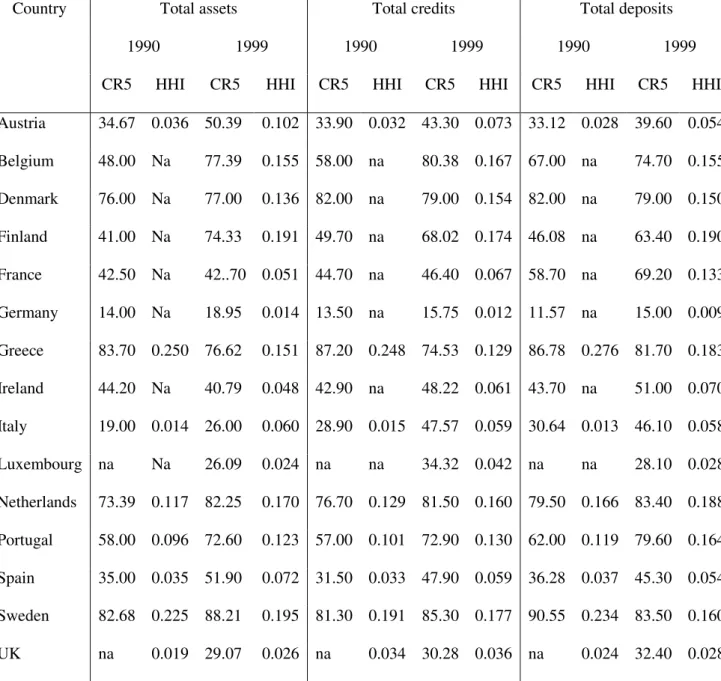
The market concentrations of the EU15 countries are presented in Table 2-1. This table demonstrates the relationship between the size of the economy and the level of concentration. That is, with the exception of Ireland and Luxembourg, the concentration levels appear to be greater in small countries, such as Greece and
Sweden, than in large countries such as Germany and the United Kingdom. Moreover, on average, both concentration indicators in 1999 were higher than those in 1990, which illustrates the increasing trend of market concentrations, or, in other words, the decreasing trend of domestic market competition in the banking systems overall.
According to Ayadi and Pujals (2005, p.50), the concentration level for each country in 1999 can be classified as shown in Table 2-22. Belgium, Denmark, Finland, Greece, the Netherlands, Portugal and Sweden are reported to be the most concentrated in assets, credits and deposits. This is because these countries are dominated by a small number of competitors. Their banking markets can be described as tight oligopolistic markets. For example, the Netherlands is dominated by only five main players, namely, ABN Amro, Rabobank, ING, SNS and Fortis. These five banks gained a 93% combi