Interactive Machine Learning
with Applications in Health Informatics
byYue Wang
A dissertation submitted in partial fulfillment of the requirements for the degree of
Doctor of Philosophy
(Computer Science and Engineering) in the University of Michigan
2018
Doctoral Committee:
Associate Professor Qiaozhu Mei, Chair Associate Professor Kevyn Collins-Thompson Assistant Professor Jia Deng
Assistant Professor Walter S. Lasecki
Yue Wang [email protected] ORCID iD: 0000-0002-0278-2347
To Tong To my parents
Acknowledgments
First and foremost, I would like to express my sincerest gratitude to my advisor, Prof. Qiaozhu Mei. During my PhD study, Qiaozhu has been a tremendous source of wisdom, enthusiasm, inspiration, and support to me. I learned a great deal from Qiaozhu, from formulating research problems to steering through the maze and trenches of hypotheses; from the pursuit of principled methods to the passion in real-world applications; from nurturing collaboration relationship to mentoring junior students. The continuous freedom, trust, and encouragement that Qiaozhu has given me over the years is perhaps the most luxurious gift that a PhD student can get in the career – a gift that I relish and value so much in retrospection.
Besides my advisor, I would also like to thank other members of my committee: Prof. Kevyn Collins-Thompson, Prof. Jia Deng, Prof. Walter Lasecki, and Prof. Kai Zheng, for their broad perspectives, insightful comments, and deep questions. This dissertation would not have been completed without their careful review and valuable feedback. I am especially indebted to Prof. Kai Zheng for introducing the exciting field of health informatics to me, for connecting me to the real needs of health domain experts, for tirelessly dedicating his precious time in critiquing and revising my work, and for his continued support to my study and career.
The University of Michigan School of Information has been an intellectual home to me. Its people-centered mission and interdisciplinary atmosphere has shaped my research taste. I benefited from interacting with many faculty members at UMSI. I should especially thank Prof. Paul Resnick for his support to my career and his many witty questions in the ReQ-ReC project. If Paul hadn’t challenged me to find a good explanation for the effectiveness of ReQ-ReC, I wouldn’t have studied the theories of
machine learning and wouldn’t have conceived the last chapter of this dissertation. Also I want to thank Prof. Ceren Budak, Prof. Daniel Romero, and Prof. David Jurgens for their constructive feedback to my work in various IAR seminars.
It is a great honor to work with my collaborators in health informatics. I want to thank Prof. Hua Xu for introducing to me the intriguing frontiers of medical natural language processing, Prof. Joyce Lee and Prof. V.G.Vinod Vydiswaran for their advice and domain expertise on patient-centered content analysis, Prof. Yunan Chen, Dr. Xinning Gui, and Dr. Yubo Kou for teaching me not just new research methodologies, but the value of a great team in a collaboration.
I want to thank my internship mentors as I am deeply influenced by their passion in solving large-scale real-world problems: Dr. Yi Chang and Dr. Dawei Yin at former Yahoo Labs; Dr. Paul Bennett, Dr. Ryen White, Dr. Eric Horvitz, Dr. Milad Shokouhi, Dr. Jin Young Kim, and Dr. Nick Craswell at Microsoft Research. I also want to thank my mentors Dr. Yan Xu and Dr. Eric Chang at Microsoft Research Asia; thank you for sparking my initial interest in text mining and machine learning, which led me onto the PhD journey.
I would like to thank my past and present comrades in the Foreseer research group for their fruitful discussions and collaborations all over the years: Yang Liu, Danny Tzu-Yu Wu, Jian Tang, Zhe Zhao, Xin Rong, Cheng Li, Sam Carton, Wei Ai, Shiyan Yan, Teng Ye, Tera Reynolds, Jiaqi Ma, Cristina Garbacea, Zhuofeng Wu, Huoran Li, Yunhao Jiao, Xuedong Li, and Sui Li. I also want to acknowledge the brilliant visiting students whom I was very fortunate to work with, for their tremendous help in my research: Ning Jiang, Qifei Dong, Jiatong Li, Gaole Meng, and Shengyi Qian.
I have received help from many friends at University of Michigan. I would like to thank my friends at both UMSI and CSE who shared laughters and braved hardships with me along my PhD journey: Daniel Xiaodan Zhou, Tao Dong, Melody Ku, Carrie Wenjing Xu, Zhe Chen, Huan Feng, Youyang Hou, Xuan Zhao, Matthew Burgess,
Daphne Chang, Ark Fangzhou Zhang, Yingzhi Liang, Yan Chen, Shiqing He, Ryan Burton, Rohail Syed, Yuncheng Shen, Fengmin Hu, Linfeng Li, Xinyan Zhao, Hao Peng, Ed Platt, Danaja Maldeniya, Tawfiq Ammari, Ruihan Wang, and my five-year roommate, Xianzheng Dou. Also I want to thank my old friends Chang Sun and Di Chen, who encouraged me to apply for the University of Michigan and shared much fun with me in Ann Arbor all these years.
Finally, I would like to thank my wife and my parents for their unfailing love and support. A special thanks to my maternal grandmother and first teacher, Xiangzhu Ma, who showed me the joy of learning when I was a child. I would not have made this far without their continuous encouragement. This dissertation is dedicated to all of them.
TABLE OF CONTENTS
Dedication . . . ii Acknowledgments . . . iii List of Figures . . . ix List of Tables . . . x Abstract . . . xi 1 Introduction . . . 11.1 The Goal and Contribution of this Dissertation . . . 6
1.1.1 Summary of Contributions . . . 8
1.2 Dissertation Outline. . . 9
2 A Review of Interactive Machine Learning . . . 11
2.1 Interactive Learning Algorithms . . . 11
2.1.1 Labeling Instances . . . 13
2.1.2 Searching for Instances . . . 13
2.1.3 Labeling Features . . . 14
2.1.4 Labeling Rationales . . . 14
2.1.5 Machine Teaching . . . 15
2.1.6 Other Modes of Interaction . . . 16
2.2 Human Factors . . . 16
3 Interactive High-Recall Retrieval . . . 18
3.1 Introduction . . . 19
3.2 Related Work . . . 22
3.3 The ReQ-ReC Framework . . . 25
3.3.1 The Double Loop Process . . . 25
3.3.2 Anatomy of the ReQ-ReC Framework. . . 28
3.4 Instantiations of ReC-ReQ . . . 32
3.4.1 Iterative Relevance Feedback. . . 32
3.4.2 Passive . . . 33
3.4.3 Unanchored Passive . . . 34
3.4.4 Active . . . 34
3.5 Experiments . . . 36 3.5.1 Data Sets . . . 36 3.5.2 Metrics . . . 38 3.5.3 Methods . . . 39 3.5.4 Parameters . . . 40 3.5.5 Overall Performance . . . 41
3.5.6 Learning Behavior Analysis . . . 44
3.6 Conclusion . . . 47
4 Medical Word Sense Disambiguation through Interactive Search and Classification . . . 48
4.1 Introduction . . . 49
4.2 Interactive WSD in ReQ-ReC Framework . . . 51
4.2.1 Sample scenario . . . 51
4.2.2 Connection to ReQ-ReC . . . 53
4.2.3 Instantiating the ReQ-ReC framework . . . 54
4.3 Experiments . . . 57 4.3.1 Data Sets . . . 57 4.3.2 Metrics . . . 58 4.3.3 Results . . . 59 4.3.4 Discussion . . . 62 4.4 Conclusion . . . 64
5 Medical Word Sense Disambiguation through Feature Labeling and Highlighting . . . 66
5.1 Introduction . . . 67
5.2 Incorporating WSD Knowledge through Feature Labeling . . . 69
5.2.1 Instance Labeling vs. Feature Determination . . . 69
5.2.2 Overall Workflow . . . 71 5.2.3 WSD Model Training . . . 72 5.2.4 Instance Selection . . . 74 5.3 Experiments . . . 75 5.3.1 Data Sets . . . 75 5.3.2 Baseline Methods . . . 76
5.3.3 Simulated Human Expert Input . . . 77
5.3.4 Metrics . . . 78
5.3.5 Results . . . 79
5.3.6 Discussion . . . 80
5.4 Conclusion . . . 82
6 A General Framework of Interactive Machine Learning . . . 86
6.1 Introduction . . . 87
6.2 A Two-Player Game . . . 90
6.2.1 Game Formulation . . . 91
6.3 A Unified Objective for Interactive Machine Learning . . . 93
6.4 Explaining Existing Algorithms . . . 95
6.4.1 Uncertainty Sampling . . . 96
6.4.2 Density-Weighted Sampling . . . 96
6.4.3 Batch-Mode Active Learning. . . 97
6.4.4 ReQuery-ReClassification (ReQ-ReC) . . . 97
6.4.5 Expected Error Reduction . . . 97
6.5 Design Implications for New Algorithms . . . 99
6.5.1 The Representativeness Term . . . 99
6.5.2 Text Classification with Query Recommendation. . . 103
6.6 Conclusion . . . 105
7 Summary and Outlook . . . 106
7.1 Summary . . . 106
7.2 Limitations . . . 111
7.3 Future Directions . . . 112
Appendices . . . 116
LIST OF FIGURES
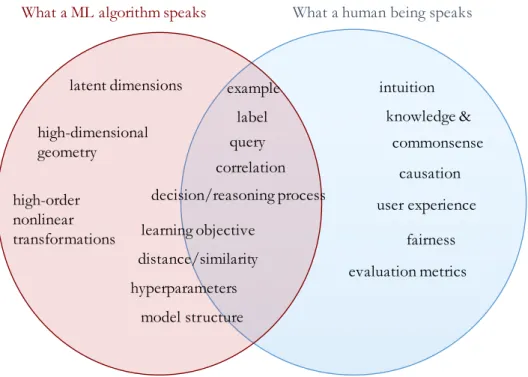
2.1 Humans and machine learning algorithms understand different languages. 12
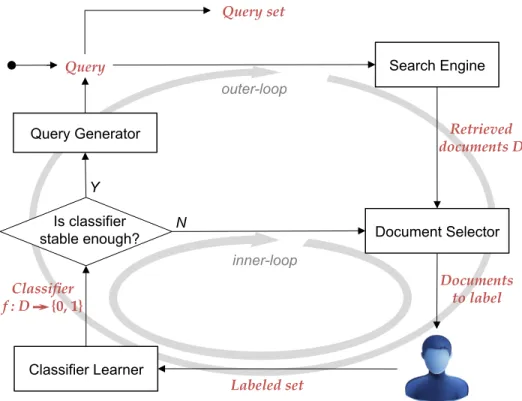
3.1 ReQ-ReC framework . . . 26
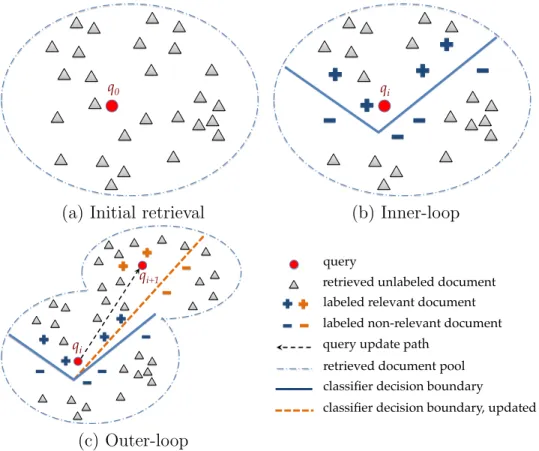
3.2 A double-loop process of search in the information space.. . . 27
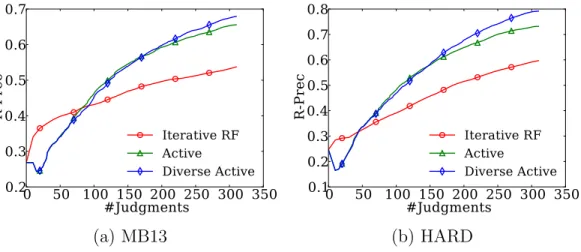
3.3 R-Precision vs. Labeling effort . . . 44
3.4 Residual Analysis . . . 46
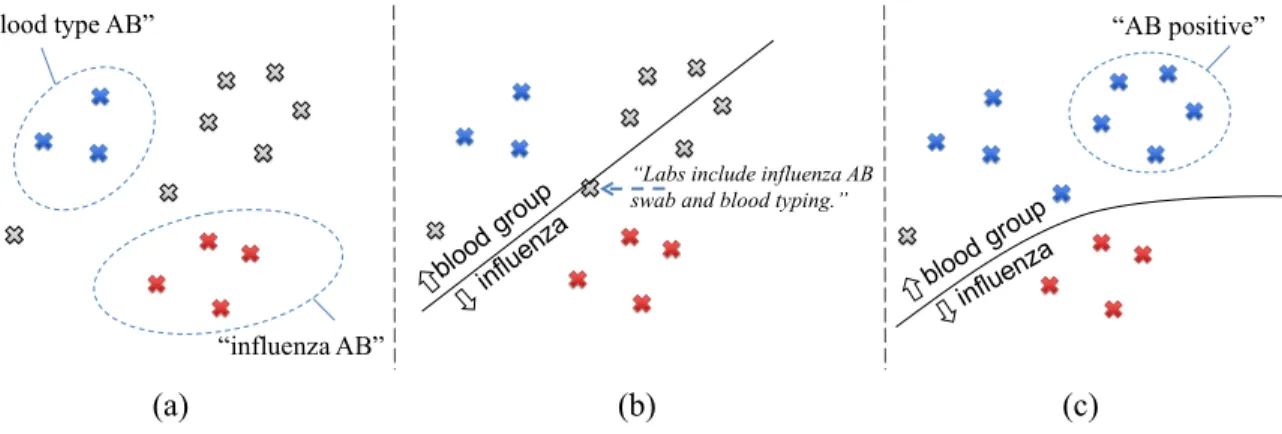
4.1 An illustrative example of the searching and labeling process of the am-biguous abbreviation “AB.” . . . 52
4.2 The ReQ-ReC framework for word sense disambiguation (WSD). . . 53
4.3 Aggregated learning curves of 198 ambiguous words in the MSH corpus. . 61
4.4 Aggregated learning curves of 74 ambiguous words in the UMN corpus. . . 61
4.5 Aggregated learning curves of 24 ambiguous words in the VUH corpus. . . 62
5.1 Interactive learning with labeled instances and features. . . 71
5.2 Aggregated learning curves of 198 ambiguous words in the MSH corpus, with drill-down analysis of “informed learning”. . . 83
5.3 Aggregated learning curves of 74 ambiguous words in the UMN corpus, with drill-down analysis of “informed learning”. . . 84
5.4 Aggregated learning curves of 24 ambiguous words in the VUH corpus, with drill-down analysis of “informed learning”. . . 85
6.1 Learning curves on the 20NewsGroup data set. Three simple uncertainty sampling methods underperform random sampling. In contrast, regularized loss maximization outperforms random sampling by an increasing large margin after querying 50 labels. . . 102
6.2 Regularized loss maximization discovers new classes faster than other meth-ods, because of its balanced exploration-exploitation strategy. . . 103
LIST OF TABLES
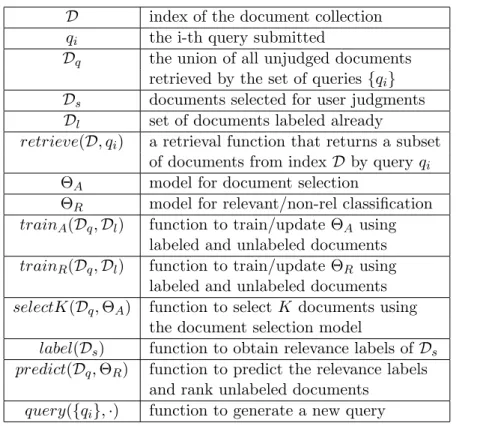
3.1 Notations of the double-loop process . . . 29
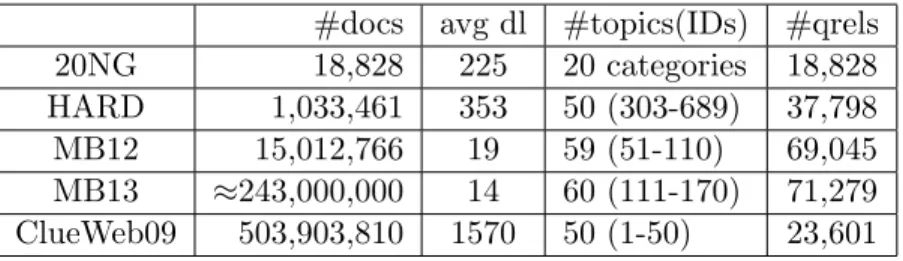
3.2 Basic information of data sets . . . 38
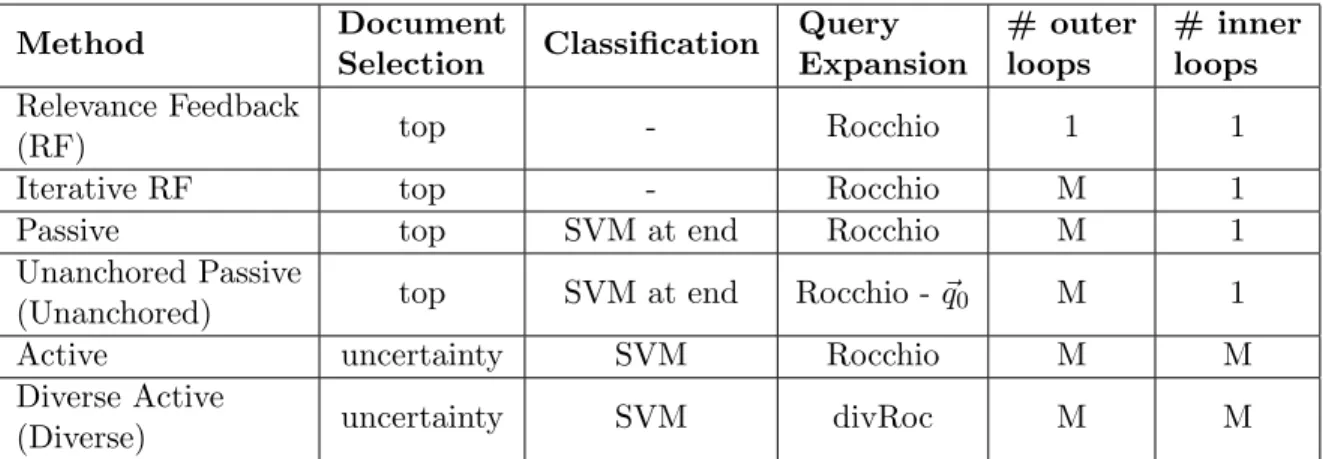
3.3 Baselines and methods included in comparison. . . 39
3.4 Parameter settings: µin Dirichlet prior;β and γ in Rocchio (α fixed as 1); Results per query: number of documents returned by a search API call. . 41
3.5 Retrieval performance of competing methods. At most 300 judgments per topic. ReQ-ReC methods significantly outperform iterative relevance feed-back. . . 42
4.1 Summary statistics of three evaluation corpora. . . 58
4.2 Average ALC scores for six learning algorithms. . . 60
5.1 Area under learning curve (ALC) scores of evaluated interactive learning algorithms. The bottom two sections are variants of Informed learning with different feature labeling (highlighting) oracles. . . 80
5.2 Average ALC scores of evaluated interactive learning algorithms across dif-ferent subsets of ambiguous words. . . 82
ABSTRACT
Recent years have witnessed unprecedented growth of health data, including mil-lions of biomedical research publications, electronic health records, patient discussions on health forums and social media, fitness tracker trajectories, and genome sequences. Information retrieval and machine learning techniques are powerful tools to unlock invaluable knowledge in these data, yet they need to be guided by human experts. Un-like training machine learning models in other domains, labeling and analyzing health data requires highly specialized expertise, and the time of medical experts is extremely limited. How can we mine big health data with little expert effort? In this disser-tation, I develop state-of-the-art interactive machine learning algorithms that bring together human intelligence and machine intelligence in health data mining tasks. By making efficient use of human expert’s domain knowledge, we can achieve high-quality solutions with minimal manual effort.
I first introduce a high-recall information retrieval framework that helps human users efficiently harvest not just one but as many relevant documents as possible from a searchable corpus. This is a common need in professional search scenarios such as medical search and literature review. Then I develop two interactive machine learning algorithms that leverage human expert’s domain knowledge to combat the curse of “cold start” in active learning, with applications in clinical natural language processing. A consistent empirical observation is that the overall learning process can be reliably accelerated by a knowledge-driven “warm start”, followed by machine-initiated active learning. As a theoretical contribution, I propose a general framework for interactive machine learning. Under this framework, a unified optimization objective explains many existing algorithms used in practice, and inspires the design of new algorithms.
CHAPTER 1
Introduction
Machine learning systems, especially deep learning systems in recent years, have achieved major breakthroughs in several research frontiers, including computer vi-sion, speech recognition, machine translation, and board game playing. In restricted settings like trivia question-answering1, the board game Go2, and speech-to-text
tran-scription for major languages [149], machine learning systems have been demonstrating impressive performance, on par with or even superior to human experts.
These recent successes have kindled enormous interest in applying machine learning techniques to solve a wide range of real-world problems. Private and public sectors like manufacturing, logistics and supply chain, marketing and customer relations, finan-cial investments, health care, public transportation, law enforcement, and education are all pursuing machine learning approaches to augment and even revolutionize their traditional practices. Machine learning has been an increasingly popular tool for an-alyzing data and harvesting knowledge in scientific fields outside of computer science, including medicine, biology, astronomy, material science, communication studies, digi-tal humanities, economics, and business. Our everyday life is surrounded by a variety of intelligent services and devices with machine learning capabilities, such as search en-gines, social network services, online retailing websites, intelligent personal assistants, fitness trackers, self-driving cars, and small autonomous aircrafts. Machine learning
1
https://en.wikipedia.org/wiki/Watson_(computer)
2
is being integrated into the work and life of people from an extensive array of back-grounds, not limited to those trained in computer science.
If we can build a computer Go program that outsmarts the best human Go player, then can we build an intelligent health care program that is superior to the best human doctors? In other words, can we replicate the recent successes of machine learning systems in critical domains, such as health care? This is a natural question as machine learning is quickly expanding its application frontiers in recent years. We hear different opinions on this question. Prof. Geoffrey Hinton believes that artificial intelligence will replace radiologists in the next five to ten years3. However, at the same time,
M.D. Anderson Cancer Center dissolved their contract with IBM Watson Health4.
Physicians can never adopt AlphaGo’s relentless try-and-error approach in treating human patients.
Why can’t the same successes of IBM Watson and AlphaGo easily happen in crit-ical domains like health care? Behind all celebrated machine learning systems is one thing in common: a massive amount of training data. Training data take the form of question-answer pairs, or labeled examples, for the machine to learn from5. In
com-puter vision, ImageNet contains over 10 million hand-annotated images, and Google’s internal data set is at least one order of magnitude larger [124]. State-of-the-art speech recognition systems are trained on hundreds of hours of transcribed utterances. Ma-chine translation data for pairs of major languages often contain millions of translated sentence pairs. Major search engines, such as Google and Bing, regularly hire thou-sands of content editors to judge the relevance of millions of query-URL pairs, in order to train and evaluate their search algorithms. Fortunately, the above annotation tasks can be performed by the general crowd, which are accessible through platforms such
3
https://www.youtube.com/watch?v=2HMPRXstSvQ
4
https://www.technologyreview.com/s/607965/a-reality-check-for-ibms-ai-ambitions/
5The training data for reinforcement learning algorithms are state-action-reward trajectories
gen-erated by the environment – real or simulated – in which the machine will operate. Generating such data is inexpensive in the case of AlphaGo (as the rules ofGo are completely known), but can be very expensive for real applications such as conversational agents and autonomous vehicles.
as Amazon Mechanical Turk6 and Figure Eight (formerly CrowdFlower)7, and can
be programmatically managed in real time [86] and with humans in the loop [113]. Crowdsourcing approaches have fueled the collection of large-scale training data for a variety of machine learning tasks, such as computer vision [30,73], speech and natural language processing [129,19, 81], and robotics [49].
However, stepping out of research laboratories into real-world scenarios, machine learning systems hardly get sufficient high-quality training data. Unlike research bench-mark data sets or highly focused industrial products, it is impossible for every real-world machine learning task to afford a large amount of labeled examples for at least the following two reasons.
• Scarce domain expertise: labeling and analyzing data in many domains can be extremely time-consuming and requires highly specialized expertise. For in-stance, labeling medical text data requires dedicated time and attention of expe-rienced physicians and nurses. In a text de-identification task [132], labeling only 310 clinical notes took a group of MIT medical researchers 568 annotator-hours. Unfortunately, these medical experts are in short supply and often occupied by more urgent duties than data annotation. Although rich knowledge exists in the experts’ head and medical knowledge bases, most machine learning algorithms can only learn from question-answer pairs. Similar difficulties happen in profes-sional scenarios such as legal, commercial, governmental, and academic domain tasks. Practitioners in these domains have pressing needs for processing increas-ingly large data sets, but they rarely have enough time for labeling examples, and their expertise is scarce. To make things even worse, data in these domains are often protected by privacy and security regulations, making it very hard to crowdsource the labeling tasks to other professionals. Therefore these domains are witnessing little adoption of machine learning techniques.
6
https://www.mturk.com/
7
• Diverse ad hoc tasks: in their working context, practitioners often need to define and solve ad hoc machine learning tasks, where no historical training data exist. For example, a physician wants to identify and analyze a cohort of pa-tients with similar symptoms of a new patient; a researcher needs to perform a comprehensive literature survey on a new research topic; a paralegal is assigned to retrieve all relevant pieces of evidence from an email collection for a new case; a social scientist who studies a group of social media users aims to code their online posts into an ad hoc set of semantic categories. In all the cases above, the user aims to sort a large number of documents into predefined categories, which should be a perfect task for machine learning classifiers. However, the high cost of labeling a large amount of training examples from scratch may discourage the practitioner to adopt a machine learning approach, as these tasks are often one-off.
How can we proceed in these scenarios, where we cannot have enough labeled data to train powerful machine learning models? This intriguing and pressing question has been calling for answers from both researchers and practitioners in recent years [2]. Many research directions are trying to solve this problem, including semi-supervised learning [167], weakly supervised learning [166], transfer learning [99], one-shot/zero-shot learning [41, 131], active learning [117], Bayesian optimization [122], and lifelong machine learning [25].
My attempt in answering this question starts with a reflection on the current re-lationship between the human and the machine in recent machine learning practices. In supervised machine learning, one often uses the metaphor that the human is the teacher and the machine is the student. If we take a closer look at the current “teacher-student” relationship between the human and the machine, then we can find it far from what we would expect. On the human teacher side, her only job is to create millions of training examples, each like an miniature exam, as the sole material to teach the
student. The machine student, on the other hand, spends all her time trying to get high scores on millions of “practice exams” (training examples), in the hope that she can achieve a high score in the “final exam” (test examples). Under this learning strat-egy, the student might indeed obtain a high score in the “final exam”, but it is very inefficient in terms of teaching efforts, or number of training examples. The teacher actually serves as a cheap labor who tirelessly provides question-answer pairs to the student. The situation is very similar to “rote learning”, where learning largely relies on brutal force.
Human learning strategies, in contrast, are much more efficient. In the process of human learning, the teacher and the student interact and collaborate with one another. Not only the teacher can ask the student questions, the student can also raise questions back to the teacher. A good teacher does not just provide answers, but also explains why an answer should be as such. To teach a concept, the teacher will break down a whole instance into smaller parts, show its key attributes, and present typical examples as well as nonexamples. A good student is not just good at answering questions, but also proactive and curious in the learning process. She knows where her understanding is solid and where it is still vague, and is able to formulate good questions to explore unknown areas to resolve uncertainty. As such, an active student can grasp the essence of a concept without having to solve a large number of problems. In the ideal case, a student comes to the class knowing how to learn. The teacher starts by showing the definition (i.e., key attributes) of a concept and a few typical examples. The student then sets out gathering relevant material to study, comes back asking clarification questions, and quickly masters the concept after a few rounds of interaction.
What makes human learning so efficient? The reflection above reveals two distinc-tive features of human learning. First, instead of solely observing input-output pairs, a human teacher decomposes an entire example into named attributes or subconcepts, and directly teaches the students which attributes are essential and which should be
ignored. Explicitly passing on knowledge this way saves a good amount of student effort, as otherwise the student has to observe a large amount of examples to figure out which attributes are important. Second, instead of passively waiting for the teacher, a good human learner knows what she knows and actively seek for material to learn what she does not know yet. Using such a meta-learning strategy, the student maximizes the information gained from every question, thus increases the chance of learning in each interaction. The two aspects – knowledge and meta-learning strategy – reinforce one another. The more knowledge a student has, the better she knows her weakness on the subject, the more targeted and sensible her questions will be, and the faster her knowledge accrues. Such a learning strategy is the major inspiration behind this dissertation.
1.1
The Goal and Contribution of this Dissertation
As discussed above, learning is naturally an interactive and continuous process. This dissertation aims to design algorithms and study principles that embody this basic idea, which we call interactive machine learning. Compared to the conventional supervised machine learning, an interactive machine learning algorithm has one or more of the following characteristics:
• It understands diverse input modalities, such as keywords, key attributes, con-textual cues, logical rules, relative preferences, knowledge base entries, related data and models, and even natural language statements about the task. This allows the human teacher to flexibly express her knowledge to the learner, which maximizes the chance of learning. This is especially useful at the early stage of learning, where the teacher needs to endow the learner with as much prior knowledge as possible, so as to reduce the teaching effort later on. To realize this subgoal, the learner needs new input channels and internal representation
methods to consolidate and learn from different learning signals.
• It communicates indiverse output modalities, such as predicted labels, confidence scores, and decision explanations for individual examples; decision boundary, clustering structure, summary statistics, and visualizations for a set of examples; and even generated examples (synthesized or retrieved) pertaining to the task. This allows the machine to clearly expose its current understanding of the task and express its current doubts in various forms, which informs the human where to target her teaching effort. To realize this subgoal, the learner needs new output channels and presentation methods to communicate different learning outcomes. • It is proactive in the learning process, not passively waiting for training materials to arrive. A typical strategy is active learning [117], where the machine learner chooses examples and asks the human teacher to label. With diverse input and output modalities, the algorithm can seek for and understand supervision signals in more flexible forms than labeled examples. In a broader sense, the machine is intelligent not only after the learning is done, but during the learning process. It is a meta-learner that knowshow to learn, and may even adjust its meta-learning strategies to improve the learning outcome, a capability known as learning to learn.
The goal of this dissertation is to design, evaluate, and understand interactive ma-chine learning algorithms that help human experts accomplish real-world data mining tasks with minimal teaching effort. On the application side, it aims to propose novel learning algorithms that delivers high-performance models using intuitive modes of in-teraction. On the theoretical side, it aims to discover the common principle underlying a variety of interactive machine learning algorithms, which can then inform the design of new ones.
spe-cial nature of health domain creates a unique challenging scenario for machine learning methods, because (1) data in the health domain are often unstructured, heteroge-neous, and large; (2) training data are in very limited supply as it is expensive and time-consuming for domain experts to label examples; (3) high-performance models are often required to ensure high-quality care; (4) the domain is known to have curated a wealth of knowledge, including systematic knowledge bases, ever-increasing literature, and physicians’ rules of thumb. Therefore the goal of interactive machine learning al-gorithms for the health domain is to allow medical domain experts to efficiently train machine learning algorithms, with minimum supervision effort and maximum reuse of medical domain knowledge.
1.1.1
Summary of Contributions
This dissertation makes the following contributions to the fields of information retrieval and machine learning.
1. A general framework for interactive high-recall retrieval. This is a versa-tile framework that integrates the strengths of relevance feedback in information retrieval (IR) and active learning (AL) for classification (Chapter 3). From an IR perspective, it provides an effective algorithmic solution to high-recall retrieval, an important and hard problem in professional IR. From an AL perspective, it extends AL algorithms to scenarios where the data collection is only accessible via a search interface, which is often the case for very large data collections. 2. Methods for warm-start active learning. Active learning works best when
the base learner already has decent performance. This is often not the case at the very beginning of the learning process, when few or no labeled examples are available, a problem known as “cold start”. This dissertation proposes a suite of algorithms to “warm-start” the active learning process by leveraging
domain knowledge through diverse input channels (Chapter 4 and 5). Empirical experiments show that a warm start at the early stage and active learning in the later stage can reliably accelerate the overall learning process.
3. A unified objective for interactive machine learning algorithms. Many supervised learning algorithms can be explained by the structural risk minimiza-tion principle, yet there lacks a common principle that unifies the myriad of interactive machine learning algorithms. This dissertation proposes a unified optimization objective that explains a variety of interactive machine learning al-gorithms (Chapter6). The unified objective not only enhances our understanding of existing interactive learning algorithms, but also informs the improvement of existing algorithms and the design of new ones.
1.2
Dissertation Outline
In Chapter 3, I describe a novel interactive high-recall retrieval framework, which we call ReQ-ReC. The goal is to help professional searchers efficiently find as many relevant documents as possible. High-recall retrieval can be useful in many cases, such as systematic literature review, patient cohort retrieval, patent search, e-discovery, and market research.
In Chapter4, I adopt an instantiation of ReQ-ReC to solve medical word sense dis-ambiguation (WSD) tasks. By inviting domain experts to search for typical examples of each word sense, the WSD model quickly gain performance at the beginning of the learning process, which reduces the overall demand of labeled examples to achieve a high WSD accuracy.
In Chapter 5, I designed a novel algorithm that directly learns from expert’s prior knowledge (distinctive features) in medical WSD tasks. It gives the WSD model a strong performance at the very beginning of learning, effectively helping the model
reach high accuracy with significantly fewer labels than baseline interactive learning methods, including classical active learning methods and the ReQ-ReC instantiation in Chapter4.
In Chapter 6, I propose a common principle underlying many interactive machine learning algorithms. It is a unified framework that depicts interactive machine learning as a two-player game, in which the data selection algorithm has a clear objective. The framework is general enough to explain many active learning algorithms as special cases. The chapter then discusses novel instantiations of the framework, including different choices of an objective term and a new query synthesis algorithm for text classification. Preliminary results show that the framework is effective in a high label noise case where uncertainty-based active learning underperforms random sampling.
I summarize the dissertation in Chapter 7, with discussions on its limitations and many research directions that naturally follow from it.
CHAPTER 2
A Review of Interactive Machine Learning
In this chapter, I conduct a review of interactive machine learning. It starts with a general discussion about possible interaction modalities between the human and the machine. To develop better interactive learning algorithms, it is important to first recognize the difference between “languages” spoken by the human and the machine, and then design interactions on top of their common language. Then it surveys a variety of algorithms for interactive machine learning, sorted by type of questions they can ask. As machine learning is increasingly used by real human users, it has attracted the attention from the human-computer interaction (HCI) community. The last part of the survey shows recent studies on machine learning from an HCI perspective.
This dissertation only considers training supervised learning models, not reinforce-ment learning agents. Note that reinforcereinforce-ment learning agents also learn by interacting with the environment, and sometimes human teachers. This is out of the scope of this dissertation.
2.1
Interactive Learning Algorithms
What types of interaction can happen between a machine learning algorithm and a human teacher? To answer this question, it is helpful to first consider what language is spoken by both the human and the machine. Their languages have overlap but are not completely the same. Figure2.1 is a Venn diagram that visualizes this relationship.
What a human being speaks What a ML algorithm speaks
hyperparameters label example model structure commonsense high-dimensional geometry correlation causation learning objective distance/similarity decision/reasoning process high-order nonlinear transformations latent dimensions user experience evaluation metrics knowledge & fairness intuition query
Figure 2.1: Humans and machine learning algorithms understand different languages. Effective interactions between the algorithm and the human being can only happen in the shared space in Figure 2.1, as well as composition of semantics therein. A normal human user does not intuitively understand “margin” in a high-dimensional space. An algorithm does not understand “causal relation” if it is not programmed to do so. To expand the modes of interaction, we can (1) make the learning algorithm more powerful (e.g. to design more flexible ways of data representation, to target at more complex learning objectives, and search across wide range of hyperparameters) and (2) find more accessible ways to reveal the inner workings of the algorithm (e.g. through information visualization techniques).
Below we consider possible types of interaction that can happen between a human teacher and a machine student, and organize learning algorithms under different types of interaction. As a simple running example to facilitate presentation, we take a simple learning text mining task: to classify news text into “sports news” or “non-sports news”. We assume that the human teacher is familiar with this task domain.
2.1.1
Labeling Instances
The most traditional and prominent type of interaction is to label existing instances, as used by a wide variety of active learning algorithms.
• Machine: What is the label of ‘Michigan Football is ranked 3rd in Big Ten in 2015-16 season’ ?
• Human: The label is ‘Sports News’.
Extensive research efforts have been devoted in this line of research. Refer to [117, 3] for systematic reviews of the area. Recent years have seen increasing applications of active learning. It solves tasks beyond classification, such as recommendation [56,63], ranking [16, 92], representation learning [162], etc. Active learning is applied to save labels for real-world, industry-scale problems, such as training search engines [157] and computational advertising [107].
2.1.2
Searching for Instances
When the training data is very sparse, there even lacksunlabeled examples for active learning algorithms to query in the first place. This situation happens at the early stage of learning, or when the class distribution is highly imbalanced (few examples for the minority but interesting class) [10, 7]. In such cases, the algorithm can ask the human to retrieve or generate an example of a class.
• Machine: Can you give me an example of ‘Sports News’ ?
• Human: ‘Jim Harbaugh is the current coach of Michigan Football.’ In text classification tasks, it is more convenient to allow the user to retrieve an example using keyword search than to write down an example from scratch. On the other hand, in image recognition tasks, it could be convenient to allow the user to sketch an example
(e.g. when the task is to classify handwritten digits 0-9). When the goal is to retrieve as much example in one class as possible (as in high-recall retrieval), the task is referred to as “active search” in literature [67,142]. Theoretical analysis has shown the power of adding a search component into active learning [14]. This line of research is intimately related to Chapters 3and 4.
2.1.3
Labeling Features
The algorithm can present a feature to the user, and ask the user to label which class is most strongly associated with that feature, if any.
• Machine: Which of the following features are indicative of the class ‘Sports News’:
football, water, tax.
• Human: football is an indicative feature; water is neutral; tax is likely a negative feature.
This direction is called active feature labeling (AFL) [87, 105, 104, 36, 147, 102]. The features can be ranked by the machine-predicted correlation with each class. In this line of work, feature importance is used as either “soft data” or prior/regularization in training machine learning models [35, 58, 65, 101]. Usually, this type of feature labeling is coupled with instance labeling, and referred to as “active dual supervision” [106, 94, 9, 118, 71]. Labeling features out of context can be ambiguous, especially when the feature is not very indicative. In such scenarios, the human should be able to answer “neutral”, “nonrelevant” or “I don’t know”.
2.1.4
Labeling Rationales
Since labeling features can be hard, it is sometimes more user-friendly to ask the human teacher to pinpoint a subpart of inside a labeled instance, showing why the instance is labeled as such.
• Machine: Please highlight the feature(s) indicating ‘Sports News’: ‘Kobe reflects on his NBA career.’.
• Human: Kobe reflects on his NBA career. (‘NBA’ is highlighted).
• Machine: In ‘Loyal fans of Kobe beef crowded the restaurant’, the fea-ture Kobeis a strong feature of ‘Sports News’. Am I right?
• Human: No. In fact, the phraseKobe beefis a negative feature of ‘Sports News’. In the first interaction above, the user highlighted the most informative word as the rationale. In the second interaction, when the machine has its own guess of rationale, the human can confirm or reject the guess. This direction is explored recently, referred to as “active learning with annotator rationales”, or “transparent active learning” [159,123,15]. This line of work heralded the research area of interpretable/explainable machine learning [78, 46, 77,17, 34].
2.1.5
Machine Teaching
As an inverse problem of machine learning, the subfield of machine teaching aims at constructing the smallest data set to train a desired machine learning model [168,
91]. Such a goal sounds very similar to that of active learning, except for an critical difference: machine teaching assumes the teacher knows the final model, including its structure and parameter values, while a teacher in an interactive machine learning setting does not know such a final model. For complex machine learning tasks in practice, there is no way even for human experts to know precise parameter values of a model.
The mixed-initiative classifier training proposal relaxes the above assumption: hu-man experts can guide learning by providing good initial training examples, and later on active learning can query examples around the decision boundary to fine-tune the
model [133]. The ReQ-ReC framework in Chapters 3 and 4 can be seen as mixed-initiative learning procedures for real-world text mining tasks.
2.1.6
Other Modes of Interaction
To reduce labeling effort, enrich teaching channels, and account for real-world concerns, researchers have been proposing new modes of interaction for machine learning. This include active learning from pairwise comparisons [44, 66], rules of thumb [109, 24], noisy oracles [32, 127], and even manipulating confusion matrices [70]. Weak super-vision signals are extracted from existing knowledge bases for information extraction tasks [59]. Different signals of supervision are then translated into loss terms or con-straints in model training.
2.2
Human Factors
As machine learning and data analytics become increasingly popular in recent years, interactive machine learning is rising as a research topic and gaining increasing atten-tion from the HCI community. While machine learning researchers focus more on the algorithm side, HCI researchers bring a holistic perspective from the human side.
HCI researchers emphasize thathumans are not oracles [4]. This is in contrast with the standard assumption made by active learning: that the human annotator always provides accurate answers to each example. A real human user can have non-uniform labeling cost [121, 119, 12], fatigue, inaccuracy, sense of achievement and frustration when observing the progress of learning, desire to have more control on what and how the algorithm learns, curiosity of understanding why the algorithm make specific decisions, and subjective perception of performance (other than the reported accuracy or F1-score). These human factors surface from recent work in human computation,
an interactive machine learning algorithm should account for quality of contributions from different annotators when querying for labels [22].
The HCI community places human users at the core of a machine learning appli-cation. Indeed, human interaction persists in the entire life cycle of machine learning: data acquisition, feature determination, class definition, objective design, annotation, hyperparameter tuning, model interpretation, and model revision as new data arrive. A human user’s decision plays the central role in each step, most of which go through an interactive process. From an HCI perspective, the goal is to design systems that enable human users to have a smooth and intuitive experience in using and under-standing machine learning algorithms. This perspective motivates us to see a bigger picture than devising better learning algorithms.
To support the full life cycle of interactive machine learning, the HCI community has been proposing general principles and advice on interface design [146, 62, 163, 77] and specific designs for visual data analytics, such as text mining [26,155], time series analysis [100], mobile application clustering [21], semantic space exploration [38], and social networks [6]. In real-world annotation tasks, the human may revise her under-standing of the task concept, which should be accommodated by the interface [76]. To facilitate the collection of labels, crowdsourcing techniques are proposed [31, 73]. To help the user better understand and manage learned machine learning models, re-searchers have been proposing interpretable and debuggable machine learning methods [77, 78, 46, 5, 17, 34]. Finally, even a well-trained machine learning model can still have blind spots if its training data were biased. The machine cannot be self-aware because it is too “confident” about its predictions. In such cases, we need to invite human users into the “machine debugging” loop and identify those blind spots [8,79].
CHAPTER 3
Interactive High-Recall Retrieval
This chapter considers a scenario where a professional searcher requires both high precision and high recall from an interactive retrieval process. Such scenarios are very common in real life, exemplified by medical search, legal search, market research, and literature review. When access to the entire data set is available, an active learning loop could be used to ask for additional relevance feedback labels in order to refine a classifier. When data is accessed via search services, however, only limited subsets of the corpus can be considered — subsets defined by queries. In that setting, relevance feedback [114] has been used in a query enhancement loop that updates a query.
We describe and demonstrate the effectiveness of ReQ-ReC (ReQuery-ReClassify), a double-loop retrieval system that combines iterative expansion of a query set with iterative refinements of a classifier. This permits a separation of concerns: the query selector’s job is to enhance recall, while the classifier’s job is to maximize precision on the items that have been retrieved by any of the queries so far. The overall process alternates between the query enhancement loop (to increase recall) and the classifier refinement loop (to increase precision). The separation allows the query enhancement process to explore larger parts of the query space. Our experiments show that this distribution of work significantly outperforms previous relevance feedback methods that rely on a single ranking function to balance precision and recall.
with Dr. Cheng Li, who contributed equally to the design, implementation, evaluation, and presentation of this study. We published the results in SIGIR 2014 as co-first authors [85]. Dr. Li has generously granted me permission to present this work as a chapter in this dissertation.
3.1
Introduction
We are witnessing an explosive growth of text data in many fields, including millions of scientific papers, billions of electronic health records, hundreds of billions of microblog posts, and trillions of Web pages. Such a large scale has created an unprecedented challenge for practitioners to collect information relevant to their daily tasks. Instead of keeping local collections of data related to these tasks, many users rely on centralized search services to retrieve relevant information. These services, such as Web search engines (e.g., Google), literature retrieval systems (e.g., PubMed), or microblog search services (e.g., Twitter search API) typically return a limited number of documents that are the most relevant to a user-issued query. These existing retrieval systems are designed to maximize the precision of top-ranked documents; they are good at finding “something relevant,” but not necessarily everything that is relevant.
We focus on scenarios where a user requires a high recall of relevant results in addition to high precision. Such scenarios are not uncommon in real life, exemplified by social search, medical search, legal search, market research, and literature review. For example: a social analyst needs to identify all the different posts in which a rumor spreads in order to reconstruct the diffusion process and measure the influence of the rumor; a physician needs to review all the patients that satisfy certain conditions to select cohorts for clinical trials; an attorney needs to find every piece of evidence related to her case from documents that are under legal hold; a scientist does not want to miss any piece of prior work that is related to his ongoing research. We denote all these
tasks generically as “high-recall” retrieval tasks.
Finding a needle in a haystack is hard; finding all the needles in a haystack is much harder. Existing retrieval systems do not naturally meet this type of information need. To conduct a comprehensive literature review using a search engine, we have to submit many alternative queries and examine all the results returned by each query. Such a process requires tremendous effort of the user to both construct variations of queries and examine the documents returned.
This high-precision and high-recall task becomes substantially harder as the col-lection grows large, making it impossible for the user to examine and label all the documents in the collection, and impractical even to label all the documents retrieved by many alternative queries. In some contexts such as e-discovery, a computer-assisted review process has been used that utilizes machine learning techniques to help the user examine the documents. Such a process typically casts high-recall retrieval as a binary classification task. At the beginning, the user is required to label a small sample of documents. A classifier trained using these labeled documents then takes over and pre-dicts labels for other documents in the collection. An active learning loop can be used to ask for additional relevance labels in order to refine the classifier. These methods, however, require that the user has access to the full collection of documents and that it is feasible to execute her classifier on all the documents.
In other scenarios, the users either do not own the collection or it is too large, so they can only access documents in the collection through an external search service. This makes it unrealistic to either examine or classify the entire collection of documents. Instead, only limited subsets of the document corpus can be considered, subsets defined by queries.
Existing retrieval systems are not tuned for high-recall retrieval on the condition of limited access to the data via search services. In most cases, a system only aims to maximize the precision in the documents that are retrieved by the current query.
Relevance feedback has been used in a query enhancement loop that updates a query. Many search engines provide services to collect explicit and/or implicit feedback from the users or to suggest alternative queries to the users. These practices typically generate a new query that replaces the old one, which is expected to improve both precision and recall. Once a new query is issued, the results retrieved by the old queries are forgotten, unless they are manually harvested by the user.
We study a novel framework of retrieval techniques that is particularly useful for high-recall retrieval. The new framework features a ReQ-ReC (ReQuery-ReClassify) process, a double-loop retrieval system that combines iterative expansion of a query set with iterative refinements of a classifier. This permits a separation of concerns, where the query generator’s job is to enhance recall while the classifier’s job is to maximize precision on the items that have been retrieved byany of the queries so far. The overall process alternates between the query expansion loop (to increase recall) and the classi-fier refinement loop (to increase precision). The separation of the two roles allows the query enhancement process to be more aggressive in exploring new parts of the docu-ment space: it can explore a non-overlapping portion of the corpus without worrying about losing the veins of good documents it had found with previous queries; it can also use queries that have lower precision because the classifier will weed out the misses in a later stage. Our experiments show that this distribution of work significantly out-performs previous relevance feedback methods that rely on a single ranking function to balance precision and recall. The new framework also introduces many opportunties to investigate more effective classifiers, query generators, and human-computer inter-active algorithms for labeling subsets, and especially to investigate what combinations work best together.
Unlike Web search engines that target users who have real-time, ad hoc informa-tion needs, the ReQ-ReC process targets users who care about the completeness of results and who are willing to spend effort to interact with the system iteratively and
judge many (but not all) retrieved documents. The process has considerable poten-tial in applications like social media analysis, scientific literature review, e-discovery, patent search, medical record search, and market investigation, where such users can be commonly found.
The rest of this chapter is organized as follows. We discuss related work in Sec-tion3.2. Section3.3 gives an overview of the ReQ-ReC double-loop framework and its key components. Section 3.4 describes several instantiations of the framework. Sec-tion3.5provides a systematic evaluation of the proposed methods. Finally, we conclude in Section 3.6.
3.2
Related Work
The ReQuery-ReClassify framework integrates and extends two well-established “human-in-the-loop” mechanisms: relevance feedback in information retrieval, and ac-tive learning in text classification.
Relevance feedback was shown long ago to be effective for improving retrieval per-formance [114]. In a feedback procedure, the retrieval system presents the top-ranked documents to the user and collects back either explicit judgments of these documents or implicit feedback implied by certain actions of the user [69, 125]. The system then learns from the collected feedback and updates the query. The new query reflects a refined understanding of the user’s information need [110, 160], which improves both precision and recall in the next round of retrieval. Even without real user judgments, retrieval performance may still benefit from simply treating the top-ranked documents as relevant, which is known as a process of pseudo relevance-feedback [18].
In a search session, relevance feedback can be executed for multiple rounds. Har-man [55] studied multiple iterations of relevance feedback, and found that retrieval performance is greatly improved by the first two to three iterations, after which the
improvements became marginal. Multiple iterations of relevance feedback have received more attention in content-based image retrieval [29, 112, 165].
In complicated search tasks, the user is often involved in a search session consisting of a series of queries, clickthroughs, and navigation actions. Session-based retrieval aims at learning from these signals in order to better understand the user’s information need, thus improving the relevance of results when the user issues the next query [125,108]. Instead of improving the performance of the next query, ReQ-ReC aims to maximize the recall of the results collectively retrieved by all the queries in the search session.
Like traditional iterative relevance feedback, the ReQ-ReC process also adopts mul-tiple iterations of user interaction. Indeed, as shown in Section 3.3, iterative relevance feedback is a special case instantiation of the ReQ-ReC framework. Instead of replac-ing the old query with a new query, however, ReQ-ReC can accumulate documents retrieved by any of the queries issued so far. By doing this, rather than optimizing both precision and recall through the choice of a single query, we place the burden of maximizing precision on a classifier, and new queries can be dedicated to improving only recall.
When it is feasible to process the entire collection of documents, the problem of high-recall retrieval can be cast as a binary classification problem where the positive class captures documents that are relevant to the information need and the negative class captures the rest. The practice of relevance feedback essentially becomes an active learning process, in which the system iteratively accumulates training examples by selecting documents and asking the user for labels [117]. This strategy is commonly used in computer-assisted reviews for e-discovery, often referred to as the process of ‘predictive coding’ [97]. Different active learning algorithms use specific strategies for selecting the documents to label, many of which attempt to maximize the learning rate of a ‘base’ classifier with limited supervision [117]. For text classification, a popular
choice of such a ‘base’ classifier is the support vector machine (SVM) [28]. Using SVM, a variety of document selection strategies have been explored. Tong and Koller [136] proposed to select documents closest to the decision hyperplane in order to rapidly shrink the version space and reduce model uncertainty. In contrast, Drucker et al. [37] selected documents with highest decision function values to avoid probing the user with too many non-relevant documents. Xu et al. [153] mixed these two strategies and achieved better retrieval performance.
Like active learning, the ReQ-ReC process also trains a binary classifier. The ma-jor difference is that ReQ-ReC does not require knowledge about the entire document collection and thus does not classify all documents. Instead, it starts from a limited subset defined by the original query and actively expands the space. This is a huge gain, as text classification and active learning are usually computationally prohibitive for modern IR collections containing a large number of documents [27]. Indeed, previ-ous studies that apply active learning to retrieval can only evaluate their approaches using moderate-scale collections (such as the 11,000-documents Reuters collections used in [37] and [153]), or only focus on the documents retrieved by one query (top 100 docu-ments in [154] and top 200 in [135]). Given its big advantage in efficiency, the ReQ-ReC process could potentially provide a new treatment for active learning, especially when the data collection is large and the positive class is very rare.
The idea of active learning has also been applied to relevance feedback for retrieval. Shen and Zhai [126] studied active feedback, where the system actively selects docu-ments and probes the user for feedback instead of passively presenting the top ranked documents. It is shown that selecting diverse top-ranked documents for labeling is desirable, since it avoids asking for labels on similar documents and thus accelerates learning. Xu et al. [154] improved this heuristic by jointly considering relevance, diver-sity, and density in selected documents. Both techniques exploit density information among top-ranked documents, and select representative ones for feedback. Recently,
Tian and Lease [135] combined uncertainty sampling (Simple Margin) and density-based sampling (Local Structure) in iterative relevance feedback to minimize user ef-fort in seeking several to many relevant documents. The difference between our work and theirs is articulated by the difference between the ReQ-ReC process and relevance feedback described above: the addition of a classifier and use of results from all queries allows more aggressive exploration of alternative queries.
3.3
The ReQ-ReC Framework
In this section, we introduce the general ReQuery-ReClassify (ReQ-ReC) framework, including its key components. Specific instantiations of the framework will be discussed in the next section. The basic idea of the framework is to distribute the burden of maximizing both the precision and recall to aset of queries and a classifier, where the queries are responsible for increasing the recall of relevant documents retrieved and the classifier is responsible for maximizing the precision of documents retrieved collectively by all of the queries in the set. The framework features a double-loop mechanism: the inner-loop classifies the retrieved documents, actively collects user feedback, and improves the classifier (ReClassify); the outer-loop generates new queries (ReQuery), issues API calls, and iteratively adds newly retrieved documents into the workset. In the rest of the chapter, we refer to the framework as “ReQ-ReC” or “double-loop” interchangeably.
3.3.1
The Double Loop Process
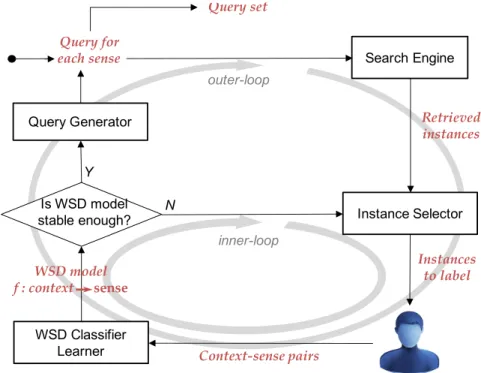
The ReQ-ReC framework can be viewed as a double-loop review process, as illustrated in Figure 3.1. The process maintains a set of queries, a pool of retrieved documents, and a binary classifier. With an initial query composed by the user, the system retrieves an initial set of documents using a search service. An inner-loop starts from there, in
Documents to label N Y Is classifier stable enough? outer-loop inner-loop Classifier f : D {0, 1} Search Engine Document Selector Classifier Learner
Query Generator Retrieved
documents D
Labeled set Query set Query
Figure 3.1: ReQ-ReC framework
which the system iteratively presents a small number of documents (e.g., 10) selected from the current pool of retrieved documents to the user and asks her to label them as either relevant or not. The classifier is consequently updated based on the accumulated judgments of the user, which is then used to reclassify the pool of documents. After a few iterations of the inner-loop, the the classifier’s predictions stabilize. At this point, the inner-loop will suspend. The system then proposes to add a new query to the query set, aiming to retrieve more relevant documents from the collection. Upon the approval—and possible edits—of the user, the system will retrieve a new set of documents using the new query, andmerge them into the pool of retrieved documents. The requery process makes up one iteration of the outer-loop of the framework. After new documents are retrieved and added into the pool, the system starts a new inner-loop and continues to update the classifier left from the last iteration. The whole review process will end when no more relevant documents can be retrieved by a new query or when the user is satisfied.
q0!
(a) Initial retrieval
qi! (b) Inner-loop qi+1! qi! (c) Outer-loop query!
retrieved unlabeled document ! labeled relevant document ! labeled non-relevant document ! query update path!
retrieved document pool! classifier decision boundary!
classifier decision boundary, updated !
Figure 3.2: A double-loop process of search in the information space. (a) Each query only retrieves its surrounding region under inspection. (b) The
inner-loop updates a classifier that refines the boundary between relevant and non-relevant documents. (c) The outer-loop expands the subspace which includes
more relevant documents.
Another way to look at the framework is to imagine a search process in the informa-tion space (e.g. a vector space of documents and queries), as illustrated in Figure3.2. The system interacts with the user as it navigates through the information space, aiming to delineate a manifold that contains as many relevant documents and as few non-relevant documents as possible. Each query can only reveal a small region of the information space that surrounds it. The “first guess” on such a manifold is, of course, the region surrounding the initial query. A classifier clarifies the boundary of the mani-fold (to maximize precision), which is iteratively refined with newly labeled data points selected from the revealed regions. To explore other regions in the space so as to ex-pand the relevant manifold (to maximize recall), the system will estimate a promising
direction and will make a new query to move in that direction into the uncharted space. This new region and all previously unveiled regions are combined as the current search space, in which the system continues to refine the boundary of the relevant manifold. The search process will end if the relevant manifold stops expanding, or if the user decides to terminate early.
From this perspective, each query contributes a new region to the search space without giving up any already discovered regions. Such a pure “expansion” of the search space will include many non-relevant documents, but the classifier is able to filter the non-relevant documents at the end and recover the true boundary of the relevant manifold. By contrast, in a relevance feedback procedure, every new query will “redefine” the search space as the region surrounding the new query. Given a good query, this region indeed contains fewer non-relevant documents than our “expanded” search space (i.e., achieves a higher precision), but it is also likely to contain fewer new relevant documents. In relevance feedback, the challenge is to find a new query that both retrieves the relevant documents from the old query and also retrieves new ones. In ReQ-ReC, the challenge is simply to find a query that retrieves new relevant documents.
3.3.2
Anatomy of the ReQ-ReC Framework
Given the high-level intuitions of the ReQ-ReC framework, we now discuss the key components in the double-loop. To facilitate the discussion, we introduce the notations in Table3.1 and summarize the framework in Algorithm1.
3.3.2.1 Search
The ReQ-ReC framework assumes neither ownership nor full access to the document collection, but instead relies on a standard search service to retrieve documents from the index. The retrieval service’s ranking function can use any reasonable retrieval model
Table 3.1: Notations of the double-loop process
D index of the document collection
qi the i-th query submitted
Dq the union of all unjudged documents
retrieved by the set of queries {qi}
Ds documents selected for user judgments
Dl set of documents labeled already
retrieve(D, qi) a retrieval function that returns a subset
of documents from indexD by queryqi
ΘA model for document selection
ΘR model for relevant/non-rel classification
trainA(Dq,Dl) function to train/update ΘAusing
labeled and unlabeled documents
trainR(Dq,Dl) function to train/update ΘR using
labeled and unlabeled documents
selectK(Dq,ΘA) function to select K documents using
the document selection model
label(Ds) function to obtain relevance labels ofDs predict(Dq,ΘR) function to predict the relevance labels
and rank unlabeled documents
query({qi},·) function to generate a new query Algorithm 1 The double-loop process
Input: Initial query q0, index of document collection D
Output: A set of labeled documents Dl and a set of unjudged documents in Dq with system predicted labels.
1: Dq ← ∅ 2: Dl ← ∅
3: repeat // outer loop
4: Dq ←retrieve(D, qi)∪ Dq
5: repeat // inner loop
6: if Dl ==∅ then 7: Ds ←selectK(Dq) 8: else 9: ΘA←trainA(Dq,Dl) 10: Ds ←selectK(ΘA,Dq) 11: end if 12: Dl ← Dl∪label(Ds) 13: Dq ← Dq− Ds 14: ΘR ←trainR(Dq,Dl) 15: predict(ΘR,Dq)
16: until meet stopping criteria for inner loop
17: qi+1 ←query({qi},Dq,Dl,ΘA,ΘR)
that takes the input of a query qi and outputs a certain number of ranked documents from the index (e.g., using a vector space model, a language modeling approach, or a boolean retrieval model). In most cases, the user has no knowledge about the algorithm that is employed by the external search service. In that case, the retrieval function is treated as a black box in the framework.
After each search process the retrieved documents will be merged into the pool of unlabeled documents Dq, which expands the workset for document selection and classification.
3.3.2.2 Document Selection
In every iteration of the inner-loop, during steps 6-10 of the algorithm the system selects K (e.g., 10) documents Ds from the pool of retrieved documents that are yet unlabeled, Dq, and asks the user for judgments. At the beginning of the double-loop process, where there are no judged documents, this process can simply return the top documents ranked by the retrieval function, select a more diverse set of documents through an unsupervised approach, or even randomly sample from Dq. Once labeled documents have been accumulated, the process is able to select documents based on an active learning strategy. Such a process aims to maximize the learning rate of the classifier and thus reduce the user’s effort on labeling documents.
3.3.2.3 Classification
Given an accumulated set of labeled documents, the classification component learns or updates a binary classifier (i.e., ΘR) at step 14 and reclassifies documents from Dq at step 15. Any reasonable classifier can be applied here.
In many high-recall retrieval tasks such as medical record search, it is important to find all patients that “match” certain conditions, but it is not necessary to rank the records identified as relevant [52]. In those cases, the labels of documents in Dq can
be directly predicted by the classifier. In cases where ranking is desired, documents inDq and Dl can be ranked/reranked using either the confidence values or the poste-rior probabilities output by the classifier, or by using an alternative machine learning method such as a regression or learning-to-rank model.
3.3.2.4 Query Expansion
When the classifier appears to be achieving a stable precision on the current workset of documents Dq, the system proceeds to expand Dq in order to increase the recall. This is done through constructing a new query (step 17) and retrieving another set of documents through the search service. Any reasonable query expansion method can be applied here, including the classical relevance feedback methods such as Rocchio’s [110] or model-based feedback [160]. Other query reformulation methods can also be applied, such as synonym expansion [139] and semantic term matching [40].
3.3.2.5 Stop Criteria
Stop criteria of the inner-loop: new labels stop being requested when either of the following conditions is met:
• The performance of the classifier converges. The system correctly predicts the user’s labels of a new batch of documents Ds and, after adding those labels, there is no evident change in the classifier’s predictions.
• The user runs out of energy or patience.
Stop criteria of the outer-loop: new queries stop being submitted when either of the following conditions is met:
• New queries no longer pick up new relevant documents. This can be assessed heuristically by running the existing classifier on a new result set, or can be
veri-fied by running the inner loop again to check whether any new positive documents are identified.
• The user runs out of energy or patience.
3.4
Instantiations of ReC-ReQ
The key components of the general ReQ-ReC framework, document selection, clas-sification, and query expansion can be instantiated in many ways. To illustrate the power of the framework, we describe five instantiations, beginning with iterative rele-vance feedback as a degenerate form and progressively substituting elements that take greater advantage of the broader framework. Section 3.5 will provide performance comparisons of these instantiations.
3.4.1
Iterative Relevance Feedback
Interestingly, an iterative relevance feedback process can be interpreted as a special case of the ReQ-ReC framework, if both the classification component and the document selection component simply adopt a ranking function that is based on the current query, qi. More specifically, define ΘR to classify a document as relevant if it is in
retrieve(D, qi), and define ΘA to always select the next highest ranked unlabeled item
from retrieve(D, qi). There is no difference in whether the results retrieved by the
previous queries are kept in the document poolDq or not, if the results are eventually ranked based on the last query,qi.
Note that many query updating methods (in the context of relevance feedback) can be applied to generate the new query at each iteration. To establish a baseline for performance comparison, we choose Rocchio’s method [110], by which the next query
is selected according to Equation3.1: ~ qi =α~q0+β 1 |Dr| X ~ dj∈Dr ~ dj −γ 1 |Dnr| X ~ dk∈Dnr ~ dk, (3.1)
where ~q0 is the original query vector, Dr and Dnr are the set of known relevant and nonrelevant documents, and α, β, and γ are parameters. The basic idea of Rocchio’s method is to learn a new query vector from documents labeled as positive or negative, and then interpolate it with the original query vector. When the parameters are well tuned, this achieves performance comparable to alternatives such as model-based feedback [160] and negative feedback [141].
3.4.2
Passive
The next two instantiations modify the relevance feedback process by introducing a separate classifier, ΘR, rather than using the retrieval function as a degenerate classifier. This classifier is involved to maximize the precision of labels for Dq. Here, keeping the documents retrieved by previous queries does make a difference, because ΘR will operate at the end to rank all of the results from all of the queries.
Any machine learning-based classifier, as well as any reasonable selection of features, can be used to identify relevant