Monetary Policy and the Performance of Deposit Money Banks -
the Nigerian Experience.
Ndugbu Michael O1. (Phd) & Okere Peter A2*. (Acib)
1. Department Of Banking and Finance, Imo State University, Owerri, Imo State Nigeria. 2. Department Of Banking and Finance ,Imo State Polytechnic Umuagwo, Imo State, Nigeria Abstract
This study investigated the impact of monetary policy on the performance of deposit money banks – the Nigerian Experience(1993-2013).Data for this study were collected from the Central Bank of Nigeria (CBN) statistical bulletin, annual reports and statement of accounts. Ordinary Least Square and co integration were used to evaluate the impact of monetary policy on the performance of deposit money banks. The Augmented Dicker Fuller (ADF) unit root test and co integration proved that the variables are stationary and a long-run relationship exist among the variables The OLS revealed that amongst all the monetary policy variables (bank deposit rate, bank lending rate, cash reserve ratio and liquidity ration) considered in the model, only bank deposit rate has significant relationship though inverse relationship. On this premise, the study recommends among others, that the Central Bank of Nigeria (CBN) should moderate the deposit rate as a tool for regulating deposit money banks operation. Again there is need to modify the monetary policy instruments to reflect and respond more rapidly and easily to local economic conditions.
Keywords: Financial Super Structure, Monetary Policy, Bank Performance.
Introduction
A solid and stable financial sector is essential to make a well functioning national economy and ensure balance liquidity within the economy. Appropriate liquidity management is essential to foster economic growth. Though, to achieve economic stability proper uses of fiscal and monetary policies are required. Despite establishing regulatory agencies and monetary policy committees, Nigerian banks have actually been deterred in creating adequate liquidity and additional credit for the sustenance of the entire economy.
The Central Bank of Nigeria (CBN) over the years, have instituted various monetary policies to regulate and develop the financial system in order to achieve major macroeconomic objectives which often conflict and result to distortion in the economy. Although, some monetary policy tools like cash reserve and capital requirements have been used to buffer the liquidity creation process of deposit money banks through deposit base and credit facilities to the public.
Monetary policy remains a critical tool in stimulating the growth and stability of financial institution in most developing economics. In Nigeria, the objectives usually include promoting monetary stability. Strengthening the external sector performance and generating a sound financial system that will support increased output and employment. Monetary policy is a major economic stabilization weapon which involves measures designed to regulate and control the volume, cost, availability and direction of money and credit in an economy to achieve some specific macro-economic policy objectives.
Monetary policy according to Anyanwu (1993:140) involves a deliberate effort by the monetary authorities (the Central Bank of Nigeria) to control the money supply and credit conditions for the purpose of achieving certain broad economic objectives.
Central bank also determines certain targets on monetary variables. Although, some objectives are consistent with each others, others are not, for example, the objectives of price stability often conflicts with the objectives of interest rate stability and high short run employment. The role of the banking industry in development process cannot be over-emphasized as they play so many functions. The most important banking industry in Nigeria is the deposit money banks. In order to make profit, deposit money banks invest customer deposits in various short term and long term investment outlet, however core of such deposits are used for loans. Hence, the more loans and advances they extend to borrowers, the more the profit they make (Solomon, 2012). Prior to 1986 direct monetary instruments such as selective credit controls administered interest and exchange rates, credit ceilings, cash reserve requirements and special deposits to regulate the banking system were employed. The fixing of interest rates at relatively low levels was done mainly to promote investment and growth. Occasionally, special deposits were imposed to reduce the amount of excess reserves and credit creating capacity of the banks.
When Central Bank actions and regulation restrict the activities and operations of profit making financial institutions such as deposit money banks, finance companies and non-financial institutions such as co-operatives, thrift institutions and pension funds, they immediately search on alternative ways of making profit. The policy constraints can also affect the level of development in the economy. The instruments of monetary policy do not affect economic activities directly; rather they work through their effects on financial markets. The
policy instruments have their initial impact on the demand for and supply of reserves held by depository institutions and consequently on availability of credit.
By manipulating these instruments, Central banks affect the rate of growth of the money supply, the level of interest rate, security prices, credit availability and liquidity creation from the commercial bank. These factors, in turn can exert monetary imbalance or shocks on the economy by influencing the level of investment, consumption, imports, exports, government spending, total output, income and price level in the economy.
One of the objectives of Central Bank of Nigeria (CBN) is to make sure that banks are not distressed. The CBN in trying to stop this menace, introduced the capitalization requirement of N25 billion for all DMB's. Banks that were not able to meet up with this requirements experienced distress. Investigation has shown that banks are still struggling to cope with the CBN's monetary policies and guidelines.
The ultimate question that calls to mind at this juncture is "How do monetary policies of the apex bank affect the performance of deposit money banks in Nigeria? This study is therefore designed to analyze monetary policy of the Central Bank of Nigeria and performance of deposit money banks. The null hypothesis to be tested in this study will be: monetary policy has no significant impact on deposit money banks in Nigeria.
The remaining part of this paper is divided into four sections. Section two covers the review of some related literature; theoretical and empirical again, the methodology is presented in section three while empirical conclusion and recommendations were presented in section four.
Synopsis of Related Literature
The responsibility for monetary policy formulation rests with the Central Bank of Nigeria (CBN). Monetary policy objective is couched in terms of maintaining price stability and promoting non-inflationary growth. The primary means adopted to achieve this objective is to set aggregate money supply targets and to rely on the open market operation (OMO) and other policy instruments to achieve the target. Monetary policy in Nigeria has relied more on indirect transmission mechanism.
Prior to the adoption of structural adjustment programme (SAP), there was limit to the capital base required of deposit money banks in Nigeria. Following the adoption of SAP the minimum capital base benchmark was increased. During this era, a minimum of N1 billion was prescribed for deposit money banks and about N500 million for merchant bank as a result of the obstinate problem of illiquidity and poor deposit management. This was however increased subsequently to N25 billion by July 2004.
Folawewo and Osinubi (2006) opined that monetary policy as a combination of measures designed to regulate the value, supply and cost of money in an economy, in consonance with the expected level of economic activity. For most economies, the objectives of monetary policy include price stability, maintenance of balance of payments equilibrium, promotion of employment and output growth, and sustainable development. These objectives are necessary for the attainment of internal and external balance, and the promotion of long-run economic growth.
There are two major control mechanisms of monetary policy used to by Central Banks at any point in time and these control mechanisms are usually referred to as tools/instruments of monetary policy and they have effects on the proximate targets. Monetary instruments can be direct or indirect. the direct instruments include aggregate credit ceilings, deposit ceiling, exchange control, restriction on the placement of public deposit, special deposits and stabilization securities while indirect instruments include Open Market Operation (OMO), cash reserve requirement, liquidity ratio, minimum discount rate and selective credit policies. Monetary policy has vital roles in the short-run i.e. it is used for counter-cyclical output stabilization, while in the long run; it is used to achieve the macro-economic goals of full employment, price stability, rapid economic growth and balance of payments equilibrium.
Macroeconomists have established the theoretical relationship between real output and monetary policy measures. According to the Keynesians school of thought, a discretionary change in money supply permanently influences real output by lowering the rate of interest and through the marginal efficiency of capital, stimulate investment and output growth (Athukorala, 1998). In contrast to Keynesian policy prescription, McKinnon (1973) and Shaw (1973) in their hypothesis of finance led growth advocated that market force induced higher interest rate, would enhance more investment by channeling saving to productive investment and stimulate real output growth such as the manufacturing sector.
Monetary policy is one of the prime economic management tools that governments use to shape economic performance. measured against fiscal policy, monetary policy is said to be quicker at resolving economic shocks (Uniamikogbo and Enoma, 2001), observes that monetary policy objectives are concerned with the management of multiple monetary targets among them price stability, promotion of growth, achieving full employment, smoothing the business cycle, preventing financial crises, stabilizing long-term interest rates and the real exchange rate. That these objectives are all not consistent with each other is obvious, as the preference of monetary policy objectives is anchored upon the weights assigned by monetary authorities or country priorities. Experience shows that emphasis is usually placed on maintaining price stability or ensuring low inflation rates.
However, there are several empirical studies on the link between monetary policy instrument and deposit money performance. These studies included various monetary tools or instruments in analyzing the impacts of macroeconomic stability in banks lending activities some of these studies are reviewed in this section. Van den Heuvel (2000) argued that monetary policy affects bank lending through two channels. they argued that by lowering reserves, contractionary monetary policy reduces the extent to which banks can accept deposits if reserve requirements are binding. The increase in reserve requirements will in turn lead banks to reduce lending if they cannot easily switch to alternative forms of finance or liquidate assets other than loan.
Younus and Aklita (2009) examined the significance of statutory liquidity requirement (SLR) as a monetary policy instrument in Bangladesh. Using descriptive analysis techniques like trend analysis and summary statistics they found that statutory liquidity requirement has experienced frequent changes and past evidence has shown that reduction is SLR produced positive impact on bank credit and investment especially prior to the 1990's. SLR and cash reserve requirement (CRR) were found to be significance tools of reducing inflation and both are scheduled for banks to used only in situation of drastic imbalance resulting from major shocks.They posited that Bangladesh bank has used open market operation (OMO's) more frequently than changes in the bank rate and SLR as instruments of monetary policy in line with its market orientation approach.
Punita and Somaiya (2006) investigated the impact of monetary policy on the profitability of banks in India between 1995 and 2000. The monetary variables are bank rate, lending rates, cash reserve ratio and statutory ratio, and each regressed on banks profitability independently. Lending rate was found to exact positive and significant influence on banks profitability, which indicates a fall in lending rates will reduce the profitability of the banks. Also bank cash reserve ratio and statutory ratio were found to have significantly affected profitability of banks negatively. Their findings were the same when lending rate, bank cash reserve ratio, statutory ratio were pooled to explain the relationship between bank profitability and monetary policy instrument in the private sector.
Ajayi and Felix (1992) investigated the effect of monetary policy instruments on banks performance between 1980 and 2008. The study revealed that monetary policies adopted during the period under review have been effective in contributing the volume of the economy. The multiple regression analysis result reveals that the monetary policies do have significant effects on the performance of banks. The study reveals the negative influence of liquidity ratio, interest rate and money supply are positively related. Based on their findings the study reveals the liquidity ratio and interest rate causes the economy ineffectiveness. Investors did not have access to the cash in other to increase their productivity due to high interest rate.
Abdurrahman (2010) empirically examined the role of monetary policy on economic activity in Sudan for the period which spanned between 1990 and 2004 found that monetary policy had little impact on economic activity during the period under consideration. Mangani (2011) assessed the effects of monetary policy in Malawi by tracing the channels of its transmission mechanism, while recognizing several factors that characterize the economy such as market imperfections, fiscal dominance and vulnerability to external shocks. Using vector autoregressive modeling, Granger-causality, and innovation accounting analyses to describe the dynamic interrelationship among monetary policy, financial variables and prices. The study established the lack of unequivocal evidence in support of a conventional channel of the monetary policy transmission mechanism, and found that the exchange rate was the most important variable in predicting prices.
Olweny and Chiluwe (2012) explores the relationship between monetary policy and private sector investment in Kenya by tracing the effects of monetary policy through the transmission mechanism to explain how investment responded to changes in monetary. the study utilize quarterly macroeconomic data from 1996 to 2009 and the methodology draws upon unit roots and co-integration testing using a vector error correction model to explore the dynamic relationship of short-run and long-run effects of the variables due to an exogenous shock. The study showed that monetary policy variables of government domestic debt and Treasury bill rate are inversely related to private sector investment, while money supply and domestic savings have positive relationship with private sector investment consistent with the IS-LM model. Based on the empirical results the study suggests that tightening of monetary policy by 1% has the effect of reducing investment by 2.63% while the opposite loose monetary policy tends to increase investment by 2.63%.
Materials and Methods
In analyzing the impact of monetary policy on Deposit Money Banks in Nigeria between 1993 and 2013 using econometric method, this study adopts and modified the empirical model used by Ajayi et al (2012). This model was used to examine the impact of monetary policy on banks profitability in Nigeria and it is specified as: CRT = α0 + α1 BR + α2 LR + α3 CRR + α4 INF + α5 EXR + U1
where CRT = is log of banks total credits, BR is Bank Rate, LR is Liquidity Ratio, CRR is Cash Reserve Ratio, INF is Inflation Rate and EXR is the Exchange Rate.
Since this study examines the impact of key monetary tools or instruments on deposit money banks' performance. Therefore, CRT will be excluded and replaced with total bank deposit which is a better proxy for
bank performance (Ezirim et al 2002). Also, exchange rate (EXR) and Inflation rate (INF) will be excluded since the aim is to determine the effect of core monetary policy tools that affect bank performance. There may be no need to include such variables.
In view of the above, our model is specified thus; TBD = α1 + α1 LR + α2 BLR + α3 CRR + α4 DER + U
Similarly,
TBD = log of banks deposit in Nigeria it is measured by the total deposit mobilized by all deposit money banks in Nigeria between 1993 and 2013;
LR = the lending Rate is the rate at which banks are willing to grant loans to their customers. DER =the deposit rate; this is that rate which banks pay interest to money deposited with them. LR = liquidity rate. Liquidity ratio is the ratio of total specified liquid assets to total current liability.
CRR = cash reserve ratio. It is the ratio of cash reserve requirement to total current liabilities,
α0 =the intercept;
α1-4 = the slop or co-efficient of the exclamatory variables; and
U = the error term.
The annual time series data from 1993 to 2013 used in this study were obtained from CBN statistical bulletin, annual reports and statement of accounts as well as the annual abstracts of statistics (various issues) published by the national bureau of statistics (NBS)
Methodology, Analysis and Findings
The study covered the period of 1993-2013. Regression analysis based on the classical linear regression model, otherwise known as Ordinary Least Square (OLS) technique is chosen by the researchers. The researchers’ choice of this technique was based not only by its computational simplicity, but also as a result of its optional properties, such as linearity, unbiasedness, minimum variance, zero mean value of the random terms (Gujaratis, 2004). In addition, the state art of econometric tools analysis were employed:
-Unit root test -Cointegration test -Granger Causality test
In order to test for unit root and the order of integration of the variables in our data set, we employed the Augumented Dickey Fuller (ADF) test. The ADF test for unit root indicates whether an individual series is stationary or not. Existence of unit roots in a series denotes non-stationarity.
Basically, ADF tests are used to test for the stationarity of the series so as to be sure that we are not analyzing inconsistent and spurious relationships. The basic idea behind cointegration is that if, in the long-run, two or more series move closely together, even though the series themselves are trended, the difference between them is constant. A lack of cointegration suggests that such variables have no long-run relationship.
In addition, the Granger causality test will be applied in this study as a means of ascertaining causality among the two variables- bank performance on one hand and monetary policy variables on the other hand. Basically Granger measures precedence and information content.
Model Specification
Since the main focus is to have a better understanding of the impact of monetary policy on bank performance in Nigeria, the thrust of this research is to thoroughly investigate the impact of monetary policy on bank performance in Nigeria. Therefore, the model for this research is specified thus;
TBD = (BDR, BLR, CRR, LQR)
………... (1). TBD = αo + α1 BDR + α2 BLR+ α3 CRR+ α4 LQR+ U………
………(2) Where;
TBD = Total bank deposits BDR= Bank deposit rate
Bank lending rate = Bank lending Rate CRR = Cash reserve ratio
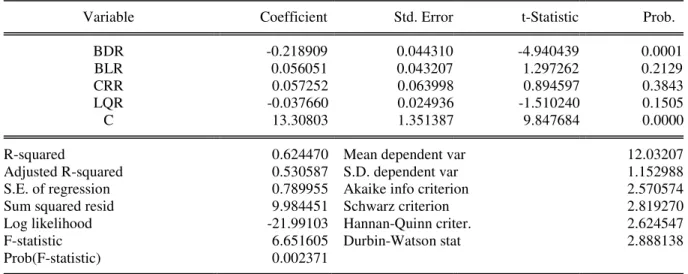
Analysis and Discussions of Results Ordinary Least Square Test Result
Sample: 1993 2013 Included observations: 21
Variable Coefficient Std. Error t-Statistic Prob.
BDR -0.218909 0.044310 -4.940439 0.0001
BLR 0.056051 0.043207 1.297262 0.2129
CRR 0.057252 0.063998 0.894597 0.3843
LQR -0.037660 0.024936 -1.510240 0.1505
C 13.30803 1.351387 9.847684 0.0000
R-squared 0.624470 Mean dependent var 12.03207
Adjusted R-squared 0.530587 S.D. dependent var 1.152988
S.E. of regression 0.789955 Akaike info criterion 2.570574
Sum squared resid 9.984451 Schwarz criterion 2.819270
Log likelihood -21.99103 Hannan-Quinn criter. 2.624547
F-statistic 6.651605 Durbin-Watson stat 2.888138
Prob(F-statistic) 0.002371
Here R2 is 0.6244 that means the dependent variable in the model can predict 62.44% of the variance in dependent variable. This is a good fit.
Specifically, R2 reveals the explanatory variables accounted for 62.44%of the variables in volume to determine the bank performance in Nigeria within the period under review. The Durbin Waston statistic (2.888) shows the absence of auto correlation which make the estimate ubiased, consistency and reliable for policy formulation. The F-statistic (6.651605) compared to p-value (0.002371) at 5%significance level reveals that the explanatory variables (bank deposit rate, bank lending rate, cash reserve ratio, and liquidity ratio) are jointly significant in explaining the variations in bank performance in Nigeria.
TBD= 13.30803-0.218909BDR+0.056051BLR+0.057252CRR-0.037660LQR
The hypothesis made by this study that states that monetary policy has no significant relationship with bank performance in Nigeria
Table 2: Test of Hypothesis
Variables t-statistic P-value Observation Decision
BDR -4.940439 0.0001 p-value< 0.05 Reject null
BLR 1.297262 0.2129 p-value>0.05 Accept null
CRR 0.063998 0.3843 p-value<0.05 Accept null
LQR 0.024936 0.1505 p-value<0.05 Accept null
This sub-section presents the result of hypothesis testing. Null hypothesis tested is that the explanatory variables (bank deposit rate, bank lending rate, cash reserve ratio, and liquidity ratio) used in the model have no significant impact on bank performance in Nigeria. If the t-statistic of any explanatory variable is less than p-value at 5% significance, such variable is said to have significant impact on bank performance, and if otherwise it has no significant impact. We observed from the above result above that only bank deposit rate (BDL) has a significant impact on the bank performance amongst the variables entered in the model
Table 3 Summary of ADF Unit Root Result
VARIABLES ADF @LEVEL McKinnon 5%
Critical Value ADF @ 1st DIFF. Order of Integration TBD -3.029970 -3.990662 1(1) BDR -3.O29970 -4.702246 1(1) BLR -5.305314 -3.020686 1(0) CRR -3.993871 -3.040391 1(0) LQR -3.029970 -4.398802 1(1)
From the table above, time series for total bank deposits (tbd), bank deposit rate (bdr), and liquidity ratio (lqr)are stationary at first difference, since the ADF at the first difference is greater than the McKinnon 5% critical values concluding that the variables are integrated of order 1 i.e. 1(1). But Bank lending rate (blr) and Cash reserve ratio(ccr) are stationary at level, since ADF value of the variable at level is greater than the McKinnon 5%critical value concluding that the variable is integrated at level i.e.1 (0).
Johansen Co integration Test Result
Trend assumption: Linear deterministic trend Series: TB BDR BLR CRR LQR
Lags interval (in first differences): 1 to 1 Unrestricted Cointegration Rank Test (Trace)
Hypothesized Trace 0.05
No. of CE(s) Eigenvalue Statistic Critical Value Prob.**
None * 0.894770 90.03281 69.81889 0.0005
At most 1 0.733167 48.25222 47.85613 0.0169
At most 2 0.582816 29.15067 22.79707 0.0402
At most 3 0.222508 5.540346 15.49471 0.7491
At most 4 0.039129 0.758378 3.841466 0.3838
Trace test indicates 3 cointegrating eqn(s) at the 0.05 level * denotes rejection of the hypothesis at the 0.05 level **MacKinnon-Haug-Michelis (1999) p-values
Unrestricted Cointegration Rank Test (Maximum Eigenvalue)
Hypothesized Max-Eigen 0.05
No. of CE(s) Eigenvalue Statistic Critical Value Prob.**
None * 0.894770 42.78059 33.87687 0.0034
At most 1 0.833167 28.10155 27.58434 0.0106
At most 2 0.782816 22.61032 22.13162 0.0112
At most 3 0.222508 4.781968 14.26460 0.7691
At most 4 0.039129 0.758378 3.841466 0.3838
Max-eigenvalue test indicates 3 cointegrating eqn(s) at the 0.05 level * denotes rejection of the hypothesis at the 0.05 level
**MacKinnon-Haug-Michelis (1999) p-values
The result from both Trace statistic and Max-eigen statistic indicate three cointegrating equations in each case. This suggests a long-run equilibrium relationship among the variables in the model. This finding is contrary to the findings of Ajayi F.O et al. (2012)
GRANGER CAUSALITY TEST
Null Hypothesis: Obs F-Statistic Prob.
BDR does not Granger Cause TB 19 0.60434 0.0101
TB does not Granger Cause BDR 1.29537 0.3047
BLR does not Granger Cause TB 19 0.17945 0.8376
TB does not Granger Cause BLR 0.48778 0.6240
CRR does not Granger Cause TB 19 0.16695 0.8479
TB does not Granger Cause CRR 1.34099 0.2932
LQR does not Granger Cause TB 19 0.65396 0.0066
TB does not Granger Cause LQR 0.36982 0.6974
BLR does not Granger Cause BDR 19 1.47314 0.2626
BDR does not Granger Cause BLR 0.45278 0.6448
CRR does not Granger Cause BDR 19 0.12878 0.8802
BDR does not Granger Cause CRR 0.22537 0.8011
LQR does not Granger Cause BDR 19 1.24402 0.3182
BDR does not Granger Cause LQR 0.52591 0.6022
CRR does not Granger Cause BLR 19 0.63190 0.5461
BLR does not Granger Cause CRR 0.86715 0.4415
LQR does not Granger Cause BLR 19 0.03081 0.9697
BLR does not Granger Cause LQR 1.39286 0.2807
LQR does not Granger Cause CRR 19 0.03152 0.9690
CRR does not Granger Cause LQR 0.76234 0.4850
From Table (5) above shows there is unidirectional causal relationship on bank deposit rate (bdr) and total bank deposits (tbd) proxy for bank performance in Nigeria. Also liquidity rate granger causes bank total deposits Summary, Conclusion and Recommendations.
The premise of this study has been the impact of monetary policy and bank performance; the Nigerian Experience. The study covers the period of 1993-2013, Johansen co integration test, granger causality test, Ordinary Least Square (OLS) and Augmented Dickey Fuller (ADF) unit root test procedure. The result emanating from the OLS shows that only the Bank Deposit Rate (BDR) has significant impact on bank performance though inversely related. The means that a one unit increase in bank deposit rate to attract customers and mop up idle cash in the system reduces the bank profit by 21% and vice verse. The F-statistic at 5%significance level reveals that the explanatory variables (bank deposit rate, bank lending rate, cash reserve ratio, and liquidity ratio) are jointly significant in explaining the variations in bank performance in Nigeria. Furthermore, the Durbin Waston statistic (2.888) shows the absence of auto correlation which make the estimate ubiased, consistency and reliable for policy formulation. The test of stationarity using ADF unit root shows that total bank deposits, bank deposit rate and liquidity ratio are stationary at first difference 1(1) order, while bank lending rate and cash reserve ratio are stationary at level 1(0) order. The test of the long-run relationship using Johansen cointegration reveals that there is a long-run relationship among the variables entered. The null hypothesis of no cointegrating vector can be rejected for all the variables used in the study and the empirical findings reinforce the conclusions about the presence of long-run relationship between bank performance bank deposit rate, bank lending rate, cash reserve ratio and liquidity ratio. Furthermore, the pair-wise Granger Causality result reveals that there is unidirectional causal relationship on bank deposit rate (bdr) and total bank deposits (tbd) proxy for bank performance in Nigeria. Also liquidity ratio granger causes bank total deposits. The implication of this reflects to potency of the variables as an important conduct in transmitting monetary policy
impulses to the banking sector in Nigeria. However, the estimated regression model indicated that Nigerian performance is more responsive to deposit rate during the period under review. Banks are unpopular because they are chief executors of government monetary policy. Thus, when this government introduces stringent financial measures to regulate the economy, bank, as the automatic executors such policies actually affect their performance (Nwankwo 1991)
However, emanating from the empirical analysis, this study proffered that the monetary authority, the Central Bank of Nigeria (CBN) should moderate the deposit rate as a tool for regulating deposit money banks operation. Monetary authority should create and implement monetary policies that favoured efficient and effective financial intermediation that will ensure financial stability in Nigeria. Furthermore, the monetary authorities should increase the tempo of enforcement of monetary policy designed to raise and foster the confidence of the economic agents’ patronage which sustain the financial superstructure.
Again, the reduction of deposit rates should be insisted to prevent banks from folding up. The reversion to the modern technique of controlling liquidity in the economy should be encouraged and this should be strictly adhered to ensure economics stability.
Finally, there is need to modify the monetary policy instruments to reflect and respond more rapidly and easily to local economic conditions.
References
Abdulrahman, B.M.A. (2010). The Role of Monetary Policy on Economic Activity in Sudan: An Empirical Investigation, 1990-2004. Journal of Human Science, Issue 44.
Anyanwu J.C(1993) Monetary Policy Management in Nigeria: Enugu,Ozone Publishers.
Ajayi ,F.O and A.A Atanda (2012) Monetary Policy and Bank Performance in Nigeria: a two-step conitegration approach.African journal of scientific research, vol 9.No 1
Ezirim,B.C& M.I.Muoghalu,(2002) Net International Bahvaviour of Financial Decisions: An Eclestic Approach.Nigerian Journal of Monetary Economics 3(2), 30-45
Folawewo, A and Osinubi, T. (2006). Monetary policy and macroeconomic instability in Nigeria: A Rational Expectation Approach. Journal of Social Science, 12(2): 93-100.
Gujaratis, D.N (2004) “The Theory of Economics, Unit State Of America, Military Academy, West Point McGraw Hill, MC Cosing Apore.
Heuvel S.J (2005) Does bank capital matter for monetary policy transmission, FRBNY economic review may 2005 pp.259-261
McKinnon, R. (1973). Money and Capital in Economic Development. Washington DC: Brooklings institutions. Mangani R.(2011) The effects of monetary Policy on prices in Malawi. University of Malawi, proceedings of Chancellor College, Department of Economic Development,Washington DC: Brooklings institutions
Nwankwo G.O (1991) Bank Management; Principles and Practice. Lagos, Malthouse Press.
Olweny, T and Chiluwe, M. (2012) The effect of Monetary Policy on Private Sector Investment in Kenya.
Journal of Applied Finance & banking, 2 (2): 239-287
Punita R. and K.J.Somaiyi (2006) Monetary Policy; Its impact on profitability of banks in India, intermediate business and economics research journal;vol 5,no.3 pp 15-19
Shaw, E. (1973). Financial Deepening in Economic Development Oxford: Oxford University Press.
Uniamikogbo, S.O and Enoma, A.I. (2001). The impact of Monetary Policy on Manufacturing sector in Nigeria. the Nigeria Economic and Financial Review, 3(2): 37-45
Younus S and m.Akhtar(2009) The SLR as a monetary Policy Instrument in Banglash. IMF occasional paper NO.234,Washington