Exploring the Job Satisfaction of Late Career Secondary Physical Education Teachers By: Russell L. Carson, Michael A. Hemphill, K. Andrew R. Richards, and Tom Templin Carson, R. L., Richards, K. A. R., Hemphill, M. A. & Templin, T. (2016). Exploring the job satisfaction of late career secondary physical education teachers. Journal of Teaching in Physical Education, 35(3), 284–289.
Accepted author manuscript version reprinted, by permission, from Journal of Teaching in
Physical Education, 2016, 35(3): 263-276, https://doi.org/10.1123/jtpe.2015-0131. © Human
Kinetics, Inc. Abstract:
As teachers move toward the end of their careers, understanding the experiences that help them derive satisfaction from their work has implications for helping them stay engaged in teaching. The purpose of this study was to qualitatively examine the job satisfaction of late career physical education teachers. Jessica, Sandy, and Bill were later career physical education teachers (17–28 years of experience) who served as participants. All three had been colleagues at Harrisburg Middle School for 13 years. Data were collected using a job satisfaction graphing technique and qualitative interviews, and were analyzed using inductive analysis and constant comparison. Data analysis resulted in three themes related to the interactions teachers experienced with people in the school: ‘the kids and control,’ ‘our administration and marginalization,’ and ‘my fellow coworkers.’ Each theme related to both positive and negative appraisals of the teachers’ work. Implications for practice and future research are noted.
Keywords: job satisfaction | workplace facets | late career teachers Article:
As teachers approach the end of their careers, many become disengaged, and may continue to rely on outdated teaching practices (Fullan, 2007; Lynn & Woods, 2010). One approach to understanding late career teacher disengagement is through teacher satisfaction (Kiliç & Yazici, 2012; Lent et al., 2011). Understanding how late career teachers derive satisfaction from their work relates to both teaching behaviors and student success, as teachers who are more satisfied tend to provide more effective instruction (Day, Sammons, Stobart, Kington, & Gu, 2007). In this study, we explore the facet satisfaction of three late career physical education (PE) using a novel qualitative data collection technique.
Job satisfaction is defined as an attitude based on the positive and negative evaluations individuals hold toward their work (Brief & Roberson, 1989). A positive appraisal is often used
to describe job satisfaction, while a negative appraisal is used to describe job dissatisfaction. Job satisfaction and dissatisfaction are not viewed as dichotomous, but rather at opposite ends on a continuum. Hence, individuals can experience satisfaction and dissatisfaction at the same time and from the same workplace elements (Skaalvik & Skaalvik, 2011). Two types of satisfaction have been recognized in the extant literature: global satisfaction and facet satisfaction. Global satisfaction asks employees how they feel about their job overall, whereas facet satisfaction asks them to reflect on certain elements of their work (e.g., pay, supervision, colleagues, clients; Skaalvik & Skaalvik, 2011). Work facets found to be satisfying to teachers are supportive administrators (Platsidou & Agaliotis, 2008), staff collegiality (Rhodes, Nevill, & Allan, 2004), positive interaction with students (Rhodes et al., 2004), and a positive school and local
community culture (Ma & MacMillan, 1999).
In contrast, teachers have identified being dissatisfied with a multitude of work facets such as low pay (Borg & Riding, 1991); large classes and limited resources (Chaplain, 1995); disengaged administration and excessive bureaucracy (Ma & MacMillan, 1999); and limited decision-making opportunities (i.e., lack of empowerment; Dormann & Kaiser, 2002). Stressors such as role conflict, role ambiguity, and role overload have also been associated with
dissatisfaction (Conley & You, 2009), as have feelings of isolation and subject marginalization (Richards, Templin, & Graber, 2014), and negative interactions with students (Platsidou & Agaliotis, 2008).
Although there is an established body of literature related to teacher satisfaction, few studies have been conducted with PE teachers. The existing literature indicates that physical educators have lower satisfaction than teachers of core-subject (Borg & Riding, 1991), but those with higher satisfaction have higher morale than those with lower satisfaction (Lent et al., 2011). PE teacher have noted facet satisfaction related to positive interactions with students and positive working conditions (Amarantidou, Mantis, & Koustelios, 2009), working in smaller schools (Reese & Johnson, 1988; Reese, Johnson, & Campbell, 1991), and job security (Koustelios, Theodorakis, & Goulimaris, 2004). Negative working conditions (Koustelios & Tsigilis, 2005), low salaries, and limited prospects for advancement (Koustelios et al., 2004) are facets that lead to dissatisfaction.
Understanding how daily experiences in schools relate to feelings of satisfaction and dissatisfaction has implications for helping late career PE teachers remain engaged and effective in their work with children (Day et al., 2007). By promoting feelings of satisfaction and limiting dissatisfaction, teachers may engage longer thus preventing late career complacency (Lynn & Woods, 2010). The purpose of this study was to develop a qualitative understanding of facet job satisfaction among late career PE teachers. Guiding questions included: 1) how do late career PE teachers describe satisfying facets of their work?, and 2) how do they describe dissatisfying facets of their work?
Participants and Procedures
Purposive sampling (Patton, 2015) identified Jessica, Sandy, and Bill as late career PE teachers who were approaching retirement. All three had been colleagues at Harrisburg Middle School for 13 years, and had between 17 and 28 years of teaching experience. Jessica and Sandy had spent their careers at Harrisburg, while Bill had taught at one other school for four years. Bill’s highest level of education was a bachelor’s degree, while both Jessica and Sandy had earned master’s degrees. Harrisburg Middle School was in a midsized city in the US Midwest that served 1040 children in grades 6–8 from a working class community, 45% of whom received free or reduced-cost lunch. The PE teachers taught eight, 45-min periods per day with a 30-min break for lunch. Most of the periods were taught individually, but they team-taught two classes each day.
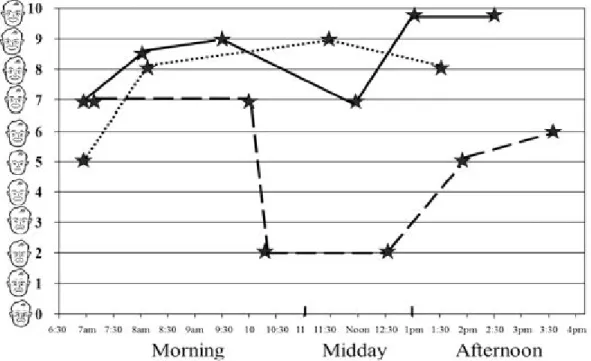
Data collection involved a teacher satisfaction graphing exercise, which was immediately followed by a 90–120 minute semi-structured interview. At the end of a school day, teachers were presented with a blank graph (see Figure 1) and asked to recall and chart their job satisfaction levels for a typical school day on the 11-point “faces” scale beginning with when they first arrived to school. The “faces” rating scale has been shown to capture the affective components of job satisfaction (Brief & Roberson, 1989), while the graphing procedure has been used to stimulate the recollection of meaningful lived experiences associated with attitudinal processes (Surra & Hughes, 1997).
Individual, semistructured interviews (Patton, 2002) were conducted after each teacher completed the graph. The interviewer used the completed graphs to prompt discussion related to the significant work facets that triggered notable variances in the teachers’ satisfaction. For instance, the interviewer asked the teachers to clarify “what was going on?” during both the sharp increases and decreases in their graphed satisfaction. Follow-up probing questions asked teachers to consider their affective and behavioral responses to each turning point. Interviews concluded with a general discussion of the teachers’ satisfaction related to working at their school. Interviews were transcribed verbatim for analysis.
Data Analysis and Trustworthiness
Data were analyzed using inductive analysis and constant comparison (Patton, 2015). Two researchers reviewed the graphs and independently coded the interviews to develop emergent themes within each individual case. Once the cases had been coded individually, the same two researchers independently conducted cross-case analysis (Patton, 2015) to identify common themes across the interviews, and then compared results. It was found that the researchers’ individual coding structures were similar, and after some discussion, they came to agreement on a common set of themes that informed the results of the study. Trustworthiness strategies were employed including member checks, researcher triangulation, and peer debriefing (Lincoln & Guba, 1985).
Results
The three late career teachers were generally satisfied with their work, which is depicted in the graph in Figure 1. Aside from one dip in Sandy’s satisfaction, all of the values were above the scale midpoint. The three themes involved both feelings of satisfaction and dissatisfaction and related to interactions with people included: “the kids and control” and “our administration and marginalization,” and “my fellow coworkers.”
“The Kids and Control”
All teachers in the study identified positive interactions with children as a facet of satisfaction. They enjoyed working with children and felt as if they were able to make a difference in their lives. However, the teachers also noted that those interactions were threatened when students acted out and they needed to regain control of their classes.
Having Fun and Making a Difference. The teachers discussed specific situations in which their interactions with children led to positive affective responses. When asked about a slight increase in her satisfaction level (from 8.5 to 9), Jessica discussed a fun class with whom she would be “interacting, joking…and laughing…having fun.” Bill illustrated how positive interactions with children impacted on his mood, “I could have a bad morning…and some kid could walk in and just make me laugh…that really makes you feel better and more excited to teach.” Student interactions were so important to Jessica that her satisfaction dropped during free periods. Discussing a downward turn in her graphed satisfaction at 10:00 a.m., Jessica explained that “there is not a class, so there is a little let down…I’m not as upbeat because I am not interacting with the children.’
Teachers also derived satisfaction from the positive impact they perceived to have on the children’s lives. Sandy noted that being a good teacher included being “positive as well as patient, organized, and aware of the students’ lives outside of school…we need to be sensitive to the situations they come from.” Bill knew a lot about students’ home lives and believed that the students responded best when they felt cared for: “other teachers will yell at a kid and I’ll say, ‘you don’t want to do that… he has real problems at home.’ You need to be in touch with these kids’ lives.” In describing the increase in her job satisfaction from 7:00–8:00 a.m., Jessica noted that “when I come in and get settled into the morning, I start to pick up a little because I know I’ll make a difference some place along the line.” Sandy added that “some of these kids don’t have a lot of support at home and I get to step in and be there for them…I can show them how much I care.”
Maintaining Control. While they attempted to foster a fun environment, the teachers noted that this was not possible without first establishing control. Jessica explained, “we like to enjoy ourselves and have fun, but it is also going to be on a controlled level.” Sandy added, “when the
kids are out of control they don’t see our fun side because they don’t let us show it…that reflects on my feelings of how I teach.” The experience of disciplining children in reaction to a loss of control was viewed as a source of dissatisfaction. Jessica’s satisfaction was lowest during what she characterized as a “negative class…you have to stay on task with them and that’s why my satisfaction drops here [down to a 7]…they just don’t get along well.”
Bill took pride in his management skills noting “when the school year starts I lay down the law…here is what I expect you to do,” but explained that sometimes he had to discipline students. He admitted that he “would rather not have to be the mediator for fights… in the middle of arguments.” Sandy agreed that the most dissatisfying part of her job was “disciplining children. I really don’t like to be the bad guy, but sometimes they don’t give me a choice.” When asked how losing control affected her, Jessica explained, “I am more curt. You can’t really joke with the kids because they can’t handle it.” Bill explained that the nature of PE, which involved teaching in gymnasia and outdoor spaces, made control challenging: “you have got to be able to handle kids… teaching PE is a hard job…to control 40 kids who are all running around for seven hours a day is not easy.”
Figure 1 - Completed teacher satisfaction graphs for Bill (dotted line), Jessica (solid line), and
Sandy (dashed line). The individual lines show each teacher’s perceived level of satisfaction according to the 11-point scale on the y-axis.
Supportive administrators are a predictor of job satisfaction among teachers (Rhodes et al., 2004). Rather than support, teachers preferred autonomy from administrative oversight and also noted the impact of marginalization on their work.
Autonomy in the Gymnasium. Jessica, Sandy, and Bill agreed that they preferred administrators to stay out of their teaching space. Sandy explained, “I think we are pretty free, we don’t have a principal who is down in our area checking on us…they trust that we are handling things.” Jessica affirmed that “[the principal] knows if we [raise an issue] it is legit because we just don’t do it… we handle things on our own.” They believed that the principal allowed them to run their “own little world” (Bill) without interference. Bill compared his autonomy with that of a
business owner: “I like being the boss, I like running things…I am the president and I run my corporation the way I want.”
When administrators did enter the PE teaching space, the teachers responded with feelings of uncertainty and dissatisfaction. For Jessica, administrator intrusion meant that there “was a problem…they don’t spend time in the gym, so when they do come down we know something is wrong.” Bill, who was the most resistant to the administrators, explained that “whenever they come around… nothing positive that comes out of their mouths.” Bill’s
frustration was fueled with what he perceived to be administrator apathy. On an occasion when he did try to talk with them about a situation “they get mad right away because they don’t want to deal with it.” As a result, he asserted that “I don’t go near the administration…I would prefer it if they didn’t come near me too.”
Marginality as a Two-Sided Coin. While the teachers valued autonomy, they also recognized that their freedom was connected to the marginal status of their subject (Richards et al., 2014). The administration was not as interested in what they were doing because they taught an ancillary or “special subject” (Jessica). If they had been teaching a core academic subject (e.g., mathematics), the administration may been more invested. Sandy explained that “I don’t think [the principal] is unsupportive, we are just not high on his list of concerns. The [state assessment] and funding are more important, so he is more tuned in with what the math and language people are doing.” Jessica added that “our principal is a good guy…but PE will never be as important as math and reading.”
While subject marginality allowed the teachers a sense of autonomy from oversight, it also drove feelings of frustration when they did not perceive a voice in school decisions. They spoke at length about issues stemming from large class sizes and the use of gym space. Related to class size, Jessica was concerned about “safety issues, and it’s hard to grade…plus, we only have so much equipment to use.” When the administrators notified Sandy that their class size would increase more, it became a serious issue (satisfaction dropped from 7 to 2): “we are going to have two classes with over 100 students…I was not very pleased… I probably didn’t give my best teaching by any means. I was mad.” The teachers also felt marginalized when school groups used the PE facilities without their consent. Jessica explained “sometimes we have the gym taken
away for an activity and we don’t really have a vote. That affects your behavior and mood.” The lack of voice made Bill feel “taken advantage of…if the band wants the gym, they get it…I feel like we should have a say in the use of our space.”
‘My Fellow Coworkers’
All three teachers benefited from having 13 years of experience together. Bill explained, “the two ladies are absolutely wonderful…we work well together and get along really well.” Explaining her positive mood in the morning (7 at 7:00 a.m.), Sandy said “having good
colleagues is definitely part of what makes me look forward to the morning…it’s nice to come here where everybody seems happy.” While they enjoyed working together, Sandy and Jessica expressed that, on occasion, they became frustrated with Bill who often left school during class to tend to personal errands. The other teacher who have to cover his classes, which made Sandy feel “dumped on, taken advantage of…it affects my mood and behavior in class…to think that somebody can get away with that.” Jessica added, “Bill skips a lot of meetings. He won’t say anything and then just not show up. It frustrates me, especially when we discuss important issues.”
Notably, the teachers’ comments related to collegiality focused almost exclusively on their relationships with one another. Although they made general comments such as “I really like the people I work with” (Jessica) and “we have some good teachers in this school” (Sandy), they did not talk at length about relationships with other teachers. This is likely because they spent most of their time in the gymnasium, isolated from the rest of the teaching staff. The gymnasium at Harrisburg Middle School was in its own wing of the school, adjacent to the cafeteria and distal to other facilities. The physical educators even used a different door to enter the building than the majority of the staff. This gives Bill’s characterization of the gym as “our own little world” a more accentuated meaning.
Conclusions and Final Thoughts
The purpose of this study was to develop a qualitative understanding of facet job satisfaction among late career PE teachers. Results highlight the highly relational characteristic of both teacher job satisfaction and dissatisfaction as all three themes related to interactions with others in the school. The three primary themes derived from the analyses—relationships with children (Rhodes et al., 2004), administrators (Platsidou & Agaliotis, 2008), and colleagues (Rhodes et al., 2004)—have been noted as important indicators of job satisfaction among teachers from a variety of subjects, including PE (Amarantidou et al., 2009; Koustelios et al., 2004).
This qualitative study contributes to the literature because it provides new insights into the mechanisms through which late career PE teachers experience satisfaction in their work. While relationships with children have shown to impact teacher satisfaction (Amarantidou
et al., 2009; Rhodes et al., 2004), the teachers in this study sought to strike a delicate balance between having fun and maintaining control. Class control was a precursor to having fun. When the teachers felt as if they were in control, they were able to enjoy themselves while teaching. However, when dealing with student misbehavior, the act of teaching lost most of its semblance of fun.
Rather than supportive administrators (Platsidou & Agaliotis, 2008), these teachers wanted autonomy from oversight, but were also frustrated with marginalization. While previous research has highlighted the negative consequences of marginalization (Richards et al., 2014), for the teachers in this study, marginality was a two-sided coin. On one hand, teaching a marginal subject allowed them freedom from the administrative involvement that often accompanies core-subject status (Valli, Croninger, & Walters, 2007), but on the other it
manifested through reduced teacher voice in decision making. These teachers wanted the best of both worlds— to be anonymous while also retraining relevance. In the US, where core subject teachers are held accountable for meeting performance standards, this may be an impossible balance to uphold. Increased relevance for PE would likely strip these teachers of the autonomy they valued so much.
Finally, while these late career teachers acknowledged advantages associated with having worked together for 13 years, they also expressed some tensions that colored their interactions. These internal struggles were likely intensified by the intimate and isolated nature of their work. As is often the case in PE (Richards et al., 2014), the teachers were segregated form the rest of their colleagues by the ancillary location of the gym and did not have opportunities to interact regularly with other teachers. This makes the collegial nature of their relationships that much more important. If they had despised working together it is likely that they would have struggled to derive satisfaction from their work.
Findings from this study present implications for research and practice. Given the important role that job satisfaction plays in helping teachers survive and thrive in their work contexts (Skaalvik & Skaalvik, 2011), it is critical that educational researchers and school administrators develop a more complete understanding of teachers’ appraisals of work facets. Based on the results of this study, we recommend that administrators remain attentive to
teachers’ need for autonomy, promote school and departmental cultures centered on collegiality and community, and help teachers retain enjoyment to work with children. However, given that research related to teachers’ job satisfaction is limited in PE literature, future studies are
warranted. Specifically, future scholars should investigate the relationship among satisfaction and teacher retention with reference to the work facets that encouraged these teachers to remain in the profession. The teacher satisfaction graphing technique introduced in this study provides one avenue for examining teacher satisfaction, and may be expanded into ecological
momentary assessment strategies (Carson, Weiss, & Templin, 2010) that ask teachers to respond to real-time questions about their mood and emotions using PDAs or smart phones.
References
Amarantidou, S., Mantis, K., & Koustelios, A. (2009). Relation between job security and job satisfaction among PE teachers in Greece. International Journal of Physical Education, 46(1), 20–23.
Borg, M.G., & Riding, R.J. (1991). Occupational stress and satisfaction in teaching. British Educational Research Journal, 17, 263–281. doi:10.1080/0141192910170306
Brief, A.P., & Roberson, L. (1989). Job attitude organization: An exploratory study. The Journal of Applied Psychology, 19, 717–727.
Carson, R.L., Weiss, H.M., & Templin, T.J. (2010). Ecological momentary assessment: A
research method for studying the daily lives of teachers. International Journal of Research & Method in Education, 33(2), 165–182. doi:10.1080/1743727X.2010.484548
Chaplain, R.P. (1995). Stress and job satisfaction: A study of English primary school teachers. Educational Psychology, 15, 473–489. doi:10.1080/0144341950150409
Conley, S., & You, S. (2009). Teacher role stress, satisfaction, commitment, and intensions to leave: A structural model. Psychological Reports, 105, 771–786.
doi:10.2466/PR0.105.3.771-786
Day, C., Sammons, P., Stobart, G., Kington, A., & Gu, Q. (2007). Teachers matter: Connecting lives, work and effectiveness. New York, NY: Mc Graw Hill.
Dormann, C., & Kaiser, D.M. (2002). Job conditions and customer satisfaction. European Journal of Work and Organizational Psychology, 11, 257–283.
doi:10.1080/13594320244000166
Fullan, M. (2007). The new meaning of educational change (4th ed.). New York, NY: Teachers College Press.
Kiliç, I., & Yazici, T. (2012). Study of job satisfaction and professional exhaustion of music teachers in fine arts and sport high schools in terms of some variables. E-Journal of New World Sciences Academy, 7(2), 182–198.
Koustelios, A., Theodorakis, N., & Goulimaris, D. (2004). Role ambiguity, role conflict, and job satisfaction among physical education teachers in Greece. International Journal of
Educational Management, 18, 87–92.
Koustelios, A., & Tsigilis, N. (2005). The relationship between burnout and job satisfaction among physical education teachers: A multivariate approach. European Physical Education Review, 11, 189–203. doi:10.1177/1356336X05052896
Lent, R.W., Nota, L., Soresi, S., Ginevra, M.C., Duffy, R.D., & Brown, S.D. (2011). Predicting the job and life satisfaction of Italian teachers: Test of a social cognitive model. Journal of Vocational Behavior, 79, 91–97. doi:10.1016/j.jvb.2010.12.006
Lincoln, Y.S., & Guba, E. (1985). Naturalistic Inquiry. New York, NY: Sage.
Lynn, S.K., & Woods, A.M. (2010). Following the yellow brick road: A teacher’s journey along the proverbial career path. Journal of Teaching in Physical Education, 29, 57–71.
Ma, X., & MacMillan, R.B. (1999). Influences of workplace conditions on teachers’ job satisfaction. The Journal of Educational Research, 93, 39–47.
doi:10.1080/00220679909597627
Patton, M.Q. (2002). Qualitative research and evaluation methods (3rd ed.). Thousand Oaks, CA: Sage.
Patton, M.Q. (2015). Qualitative research and evaluation methods (4th ed.). Thousand Oaks, CA: Sage.
Platsidou, M., & Agaliotis, I. (2008). Burnout, job satisfaction and instructional
assignment-related sources of stress in Greek special education teachers. International Journal of Disability Development and Education, 55(1), 61–76.
doi:10.1080/10349120701654613
Reese, S., & Johnson, D.J. (1988). School size and teacher job satisfaction of urban secondary school physical education teachers. Education, 108, 382–384.
Reese, S., Johnson, D.J., & Campbell, W.A. (1991). Teacher job satisfaction and teacher job stress: School size, age and teaching experience. Education, 112, 247–252.
Rhodes, C., Nevill, A., & Allan, J. (2004). Valuing and supporting teachers: A survey of teacher satisfaction, dissatisfaction, morale and retention in an English local education authority. Research in Education, 71, 67–80. doi:10.7227/RIE.71.7
Richards, K.A.R., Templin, T.J., & Graber, K. (2014). The socialization of teachers in physical education: Review and recommendations for future works. Kinesiology Review, 3, 113–134. doi:10.1123/kr.2013-0006
Skaalvik, E.M., & Skaalvik, S. (2011). Teacher job satisfaction and motivation to leave the teaching profession: Relations with school context, feeling of belonging, and emotional exhaustion. Teaching and Teacher Education, 27, 1029–1038.
doi:10.1016/j.tate.2011.04.001
Surra, C.A., & Hughes, D.K. (1997). Commitment processes in accounts of the development of premarital relationships. Journal of Marriage and the Family, 59, 5–21.
doi:10.2307/353658
Valli, L., Croninger, R.G., & Walters, K. (2007). Who (else) is the teacher? Cautionary notes on teacher accountability systems. American Journal of Education, 113, 635–662.