Graduate Theses, Dissertations, and Problem Reports
2015
The Effects of Parameter Tuning on Machine Learning
The Effects of Parameter Tuning on Machine Learning
Performance in a Software Defect Prediction Context
Performance in a Software Defect Prediction Context
Benjamin N. Province
Follow this and additional works at:
https://researchrepository.wvu.edu/etd
Recommended Citation
Recommended Citation
Province, Benjamin N., "The Effects of Parameter Tuning on Machine Learning Performance in a Software
Defect Prediction Context" (2015). Graduate Theses, Dissertations, and Problem Reports. 6457.
https://researchrepository.wvu.edu/etd/6457
This Thesis is protected by copyright and/or related rights. It has been brought to you by the The Research
Repository @ WVU with permission from the rights-holder(s). You are free to use this Thesis in any way that is
permitted by the copyright and related rights legislation that applies to your use. For other uses you must obtain
permission from the rights-holder(s) directly, unless additional rights are indicated by a Creative Commons license
in the record and/ or on the work itself. This Thesis has been accepted for inclusion in WVU Graduate Theses,
The Effects of Parameter Tuning on
Machine Learning Performance
in a Software Defect Prediction Context
Benjamin N. Province
Thesis submitted
to the Statler College of Engineering and Mineral Resources
at West Virginia University
in partial fulfillment of the requirements for the degree of
Master of Science in
Computer Science
with concentration in
Software and Knowledge Engineering
Tim Menzies, Ph.D., Chair
Katerina Goseva-Popstojanova, Ph.D.
Thirimachos Bourlai, Ph.D.
Lane Department of Computer Science and Electrical Engineering
Morgantown, West Virginia
2015
Keywords: Data Mining, Software Defect Prediction, Parameter Tuning,
Machine Learning, Cross-Version Learning, Software Engineering
ABSTRACT
The Effects of Parameter Tuning on Machine Learning
Performance in a Software Defect Prediction Context
Benjamin N. Province
Most machine learning techniques rely on a set of user-defined parameters. Changes in
the values of these parameters can greatly affect the prediction performance of the learner.
These parameters are typically either set to default values or tuned for best performance
on a particular type of data. In this thesis, the parameter-space of four machine learners is
explored in order to determine the efficacy of parameter tuning within the context of software
defect prediction.
A distinction is made between the typical within-version learning scheme and forward
learning, in which learners are trained on defect data from one software version and used to
predict defects in the following version. The efficacy of selecting parameters based on
within-version tuning and applying those parameters to forward learning is tested. This is done
by means of a cross-validated parameter-space grid search with each tuning’s performance
being compared to the performance of the default tuning given the same data.
For the Bernouli naive Bayes classifier and the random forest classifier, it is found that
parameter tuning within-version is a viable strategy for increasing forward learning
perfor-mance. For the logistic regression classifier, it is found that tuning can be effective within a
single version, but parameters learned in this manner do not necessarily perform well in the
forward learning case. For the multinomial Bayes classifier, no substantial evidence for the
efficacy of parameter tuning is found.
Acknowledgments
First, I would like to thank my advisor, Dr. Tim Menzies, his colleague Dr. Susan
Partington, the Lane Department of Computer Science and Electrical Engineering, and the
Program of Human Nutrition and Foods for employing me as a GRA for the first year and a
half of my graduate studies and thus providing me with an important source of much-needed
funding.
I would also like to thank the West Virginia Space Grant Consortium, the Jet Propulsion
Laboratory at the California Institute of Technology, and my JPL mentor Justin Lin for
making possible the summer internship which inspired me to pursue graduate studies in the
field of Computer Science as a bridge into the field of intelligent robotics. I would be remiss
not to also thank Dimitris Vassiliadis, the Colorado Space Grant Consortium, and the WVU
department of Physics and Astronomy for their support of RockSat, a program in which I
participated as an undergraduate which put me on the path towards JPL and eventually
graduate school.
I would like to thank my wife, Randy, who helps me to stay focused, and keep my nose to
the grindstone. Without her support, this thesis would have almost certainly taken another
semester to complete.
I would like to thank my parents and grandmother for encouraging my academic success
through childhood and for supplementing my undergraduate scholarships so that I could
avoid the burden of student loans.
I would like to thank my friend Andrew Duncan for his friendship and for sharing some
of his technical expertise. Any time I face a software or electronics challenge that has me
stumped, Andrew is the first person I ask for advice.
Last, but not least, I would like to thank all those who have contributed to Python,
SciPy, NumPy, SciKit-Learn, SPyDEr, Matplotlib, Ubuntu, LinuxMint, MacPorts, L
A
TEX,
and all the other free software I use. Without free and open-source software, this thesis could
not have happened, and the world would truly be a much less wonderful place.
Contents
1
Introduction
1
1.1
Motivation . . . .
1
1.2
Research Questions . . . .
3
1.3
Statement of Thesis . . . .
5
1.4
Structure of Thesis . . . .
6
2
Background
7
2.1
Simple Methods Work Well for Defect Prediction
. . . .
7
2.2
Parameter Tuning of Machine Learners . . . .
8
2.3
Parameter Tuning in Evolutionary Algorithms . . . .
9
3
Methods
10
3.1
Machine Learning Techniques . . . .
10
3.1.1
Bayesian Classification . . . .
11
3.1.2
Random Forest Classifier . . . .
14
3.1.3
Logistic Regression . . . .
14
3.2
Evaluating Machine Learning Performance . . . .
16
3.2.2
Measures of Classification Performance . . . .
18
3.3
Data . . . .
20
3.3.1
Data Sources . . . .
20
3.3.2
CKJM Metrics
. . . .
21
3.3.3
Data Selection . . . .
23
3.4
Experimental Design . . . .
25
3.4.1
Parameter Grid Search . . . .
26
3.4.2
Cross-Validation Setup . . . .
30
3.4.3
Current-Version Vs. Forward-Version Evaluation . . . .
31
3.4.4
Machine Learning Trials . . . .
32
3.5
Statistical Methods . . . .
33
3.5.1
Testing Significance with the Wilcoxon Signed Rank Test . . . .
33
3.5.2
Limiting False Discovery for Multiple Hypothesis Testing with the
Benjamini-Hochberg Procedure . . . .
36
3.5.3
Comparing Current and Forward Learning Performance . . . .
39
3.5.4
Splitting Helpful Hairs with Effect Size . . . .
40
4
Results
42
4.1
Multinomial Naive Bayes: a Negative Outcome
. . . .
42
4.2
Logistic Regression: a Mixed Outcome . . . .
45
4.3
Random Forest: a Positive Outcome
. . . .
49
4.4
Bernoulli Naive Bayes: a Very Positive Outcome . . . .
53
5
Threats to Validity
56
5.1
Construct Validity
. . . .
56
5.2
Internal Validity . . . .
57
5.3
Conclusion Validity . . . .
58
5.4
External Validity . . . .
59
6
Conclusions and Suggestions for Implimentation
60
6.1
Current-Version Tuning
. . . .
61
6.2
Forward Tuning . . . .
62
6.3
Pre-Trials: Does Tuning Work for My Learner?
. . . .
63
6.4
Tuned Learner Pooling . . . .
64
6.5
Summary of Conclusions:
Research Questions Revisited
. . . .
65
A Multinomial Naive Bayes Forward Results By Project
71
B Logistic Regression Forward Results By Project
73
C Random Forest Forward Results By Project
75
D Bernoulli Naive Bayes Forward Results By Project
77
E Multinomial Naive Bayes Forward Results By Dataset
79
F Logistic Regression Forward Results By Dataset
82
G Random Forest Forward Results By Dataset
85
H Bernoulli Naive Bayes Forward Results By Dataset
88
J Logistic Regression Current Version Results By Dataset
92
K Random Forest Current Version Results By Dataset
93
List of Figures
3.1
Confusion matrix examples and labels . . . .
18
3.2
g contours as a function of pD, pF . . . .
20
3.3
Confusion Matrix for
m
tests of significance . . . .
37
4.1
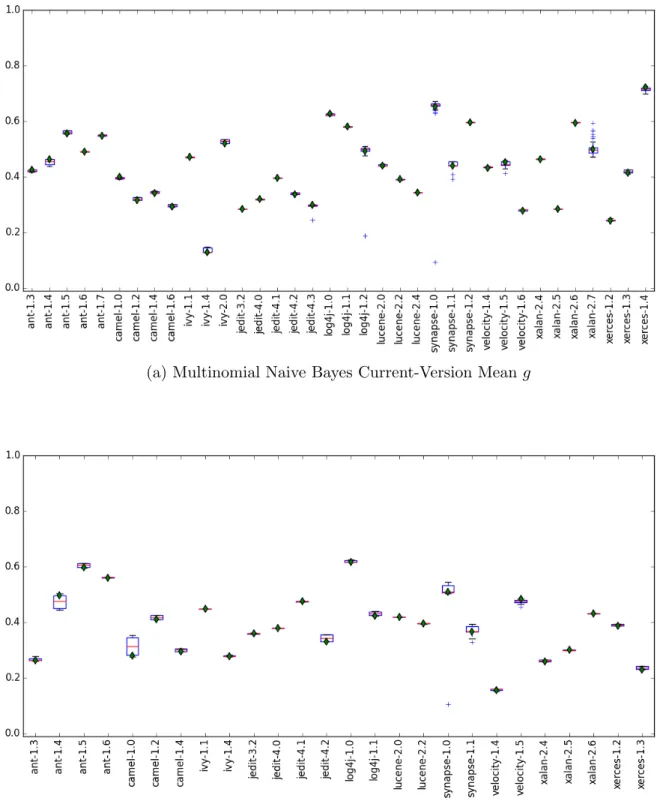
Multinomial Naive Bayes Mean
g
Box Plots . . . .
44
4.2
Histogram of Logistic Regression Current-Version Successful Tunings
. . . .
46
4.3
Logistic Regression Mean
g
Box Plots . . . .
48
4.4
Histogram of Random Forest Current-Version Successful Tunings
. . . .
50
4.5
Random Forest Mean
g
Box Plots . . . .
52
4.6
Histogram of Bernoulli Bayes Current-Version Successful Tunings . . . .
53
List of Tables
3.1
CKJM Extended Metrics [17]
. . . .
22
3.2
CKJM datasets of the PROMISE repository . . . .
24
3.3
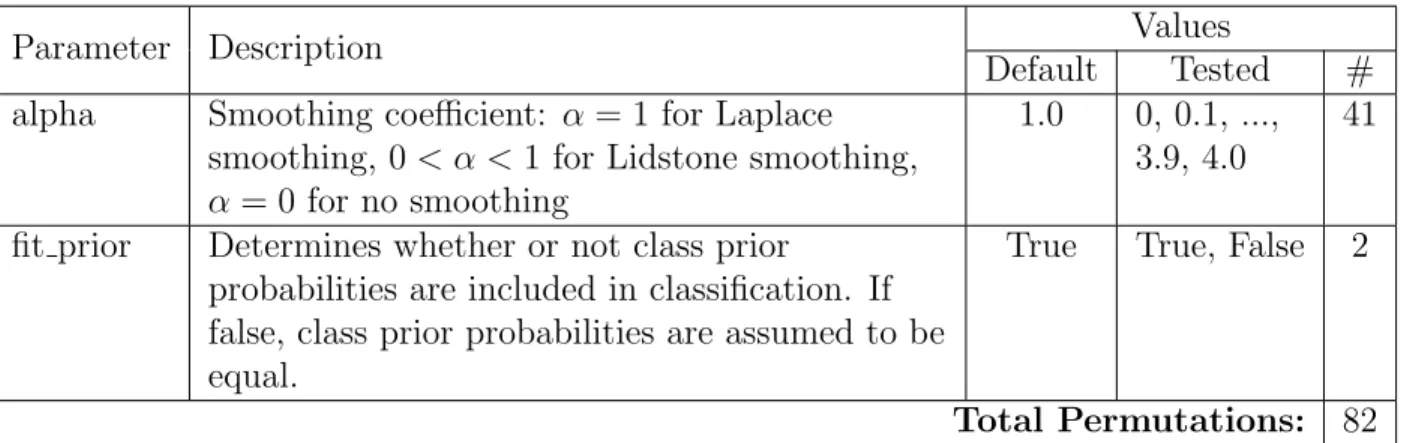
Sci-kit Learn Multinomial Naive Bayes Parameters
. . . .
27
3.4
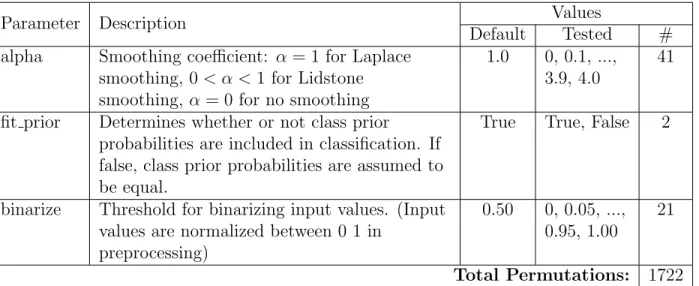
Sci-kit Learn Bernoulli Naive Bayes Parameters . . . .
28
3.5
Sci-kit Learn Logistic Regression Parameters . . . .
28
3.6
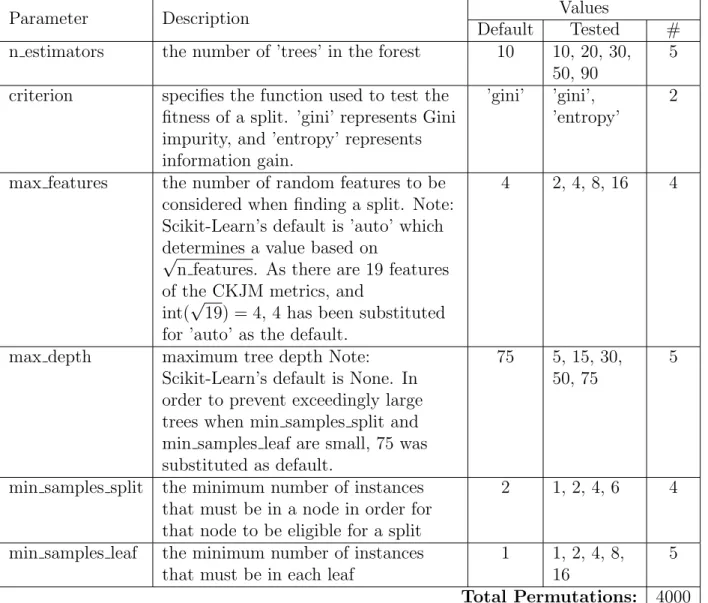
Sci-kit Learn Random Forest Parameters . . . .
29
3.7
Version-Forward Learning Outcomes
. . . .
40
3.8
Cohen ’88 Effect Sizes
. . . .
41
3.9
Version-Forward Learning Outcomes by Effect Size
. . . .
41
4.1
Version-Forward Learning Outcomes: Multinomial Naive Bayes Total Counts
43
4.2
Version-Forward Learning Outcomes: Logistic Regression Total Counts . . .
47
4.3
Version-Forward Learning Outcomes: Logistic Regression Xalan counts . . .
47
4.4
Version-Forward Learning Outcomes: Random Forest Total Counts . . . . .
50
4.5
Version-Forward Learning Outcomes: Random Forest Total Counts . . . . .
51
4.6
Version-Forward Learning Outcomes: Bernoulli Bayes Total Counts . . . . .
54
Chapter 1
Introduction
1.1
Motivation
The ultimate end-goal of the work presented in this thesis is the betterment of the quality
of future software. This is a difficult goal to approach as no single solution the software
quality problem exists. As Fred Brooks famously stated “We see no silver bullet. There
is no single development, in either technology or management technique, which by itself
promises even one order of magnitude improvement...” [7] Therefore, the only way to make
progress towards the end-goal of higher quality software is through incremental improvement
to one of a variety of issues with current development practices.
This thesis focuses on one of the major problems plaguing modern software: the
preva-lence of bugs. Although testing and validation are part of most software development cycles,
a shocking number of bugs still make their way into production software to be discovered
by the end-users. The simplistic solution the bug problem is to increase the testing effort
during development. If bugs are caught by developers before the software is released, they
can be fixed before the software is released to end-users. There are several approaches by
which bugs may be caught including extensive unit testing, code walkthroughs, and more
exhaustive testing of combinations of use cases and options.
The problem with this simplistic approach is that testing consumes resources.
Any
increase in software testing and validation effort will also lead to an increase in overall
development costs and overall development time. Therefore, the trade-off between greater
validation effort and lower development costs is a business decision. Software that has many
bugs will be unappealing, but software that comes at great cost may be equally unappealing.
For this reason, the holy grail of software validation is the development of processes by which
more bugs can be caught without an increase in effort. The real question is how to find bugs
by looking
smarter
rather than
harder
.
A data-mining approach is often used to work towards increasing software quality. In
this approach, various quantifiable statistics or metrics are extracted from the source code
of the software or from the development process. These statistics and metrics are usually
collected for several subsets of a software development project along with the number of bugs
reported for each subset. In this way, hypotheses about the relation between the software
metrics and the likelihood of a bug in the software can be constructed and evaluated. After
a correlation has been established, developers can close the loop by either altering their
development practices to avoid “bad” characteristics or by applying more testing scrutiny
to subsets of the software which exhibit “bad” characteristics.
Data-driven software defect prediction generally relies on machine learning techniques,
most of which have several parameters which can be adjusted to vary the performance of
the learning algorithm. Most machine learners have a default set of parameters which are
chosen by the learner’s creators to reflect the “best” settings for general performance. The
default parameters, however, are not necessarily the top-preforming set of parameters in all
situations. The practice of choosing parameters that lead to increased performance within
a particular domain or when applied to a particular type of data is known as parameter
tuning.
The intent of this thesis is to explore the practice of parameter tuning, determine it’s
effectiveness in a Software Engineering defect prediction context, and offer insight it’s
effec-tive application. By furthering the understanding of effeceffec-tive parameter tuning, the practice
of software defect prediction can be improved. Improved defect prediction can lead to more
informed software testing, which can contribute to an increase in the overall quality of
soft-ware.
1.2
Research Questions
1) Can within-version parameter tuning lead to increased classification performance on
soft-ware defect data when compared to default parameters?
Each machine learner in Scikit-Learn has a default value for each of its parameters.
The set of default parameter values have been chosen by the authors of Scikit-Learn or the
original developers of the algorithms as a best guess for the appropriate values. It is possible
and even probable that for a given combination of training set and test set, some other
parameter tuning will produce better results than the default tuning. The real question is
weather some parameter tunings preform
significantly
better under repeated re-sampling of
a pool of training and testing data than the default tuning. To explore this question, a
cross-validation study must be preformed and a test of statistical significance must be applied to
the performance results of each non-default tuning.
2) Is parameter tuning effective when the parameters are tuned and the classifier is trained
on data from one version of a software project but tested on the next version?
The main goal of machine learning for defect prediction is that lessons learned from
previously developed software may be applied to software that is currently in development.
Given this goal, it is curious that most defect prediction studies are conducted by sampling
both the training and testing data from the same dataset. This typically comes in the form
of a cross-validation study where training and testing data are repeatedly resampled from
data reflecting a single version of a single software project. This within-version approach to
tuning evaluation doesn’t fit the business use scenario in which tuning cannot be conducted
on as-of-yet untested versions as class-labels have not yet been established. For example,
it may be that the tunings that yield the best performance when training and testing on
version 1.1 of a software project do not preform as well when the learner is trained on data
from version 1.1 and tested on version 1.2.
3) Is the extent to which a parameter tuning out-performs the default tuning on data from
one software version indicative of it’s likelihood of success in future versions?
This question extends RQ2 by considering effect size. Assuming that tunings that do
well in one software version tend to yield helpful results when they applied to a learner that
is tested on a newer version, does the magnitude of their success matter? It may be that any
tuning which performs better than the defaults when tested on one version is likely to do so
on the next version as well. It may also be that there is some sort of effect size threshold
below which tunings should be ignored. It is important to consider “setting the bar” of how
much better than the defaults a particular tuning must to in one version to be trusted a
subsequent version.
4) Is there a set of parameter tunings that will increase learning performance ubiquitously
in the domain of software defect prediction?
This question has the potential to undo RQs 1 through 3 if it can be answered in the
affirmative. Another way of thinking about it is “If one tuning is consistently doing better
than defaults, why don’t we just change the defaults?” If the tuning experiments keep finding
a particular tuning which out-performs the defaults, then perhaps the defaults were poorly
chosen, or were not set to a value which reflects the best performance within the domain of
software defect prediction. If this is the case, then developers should be made aware of the
“new defaults” and told that implementing parameter tuning in practice is a moot point.
1.3
Statement of Thesis
The results of the research presented in this thesis can be summarized as follows:
In the context of software defect prediction, parameter tuning is an effective means of
boosting prediction performance of certain machine learning algorithms. For some of these
learners, this holds true not only when they are trained and tested on data from the same
software version, but also when they are tested on future versions not used in training.
This statement is conservatively worded to reflect the fact that parameter tuning does
not produce positive results under
all
circumstances. Based on the evidence in this thesis,
is the position of the author that on the whole, parameter tuning is a worthwhile endeavor.
As parameter tuning is not ubiquitously effective for all learners and all data, trials should
be conducted to judge its effectiveness before applying it in new situations.
1.4
Structure of Thesis
The remainder of this thesis is organized as follows:
Chapter 2: Background
provides some background information on machine learning
for software defect prediction and parameter tuning of machine learners
Chapter 3: Methods
discusses the machine learning techniques which are used in this
thesis and the means of testing and measuring their predictive performance. It also describes
the data sources used and the method of data selection. Chapter 3 also contains a description
of the design of the experimental trials and finally, descriptions of the statistical methods
employed for comparing results.
Chapter 4: Results
presents the results of this study starting with the learner that
produces the weakest evidence for the efficacy of parameter tuning and progressing to the
learner which produces the strongest evidence for the efficacy of parameter tuning.
Chapter 5: Threats to Validity
presents some observations which may pose a threat
to the validity of the results of Chapter 4 and the generalizability of the conclusions in
Chapter 6.
Chapter 6: Conclusions and Suggestions for Implementation
summarizes the
findings of this thesis and provides some suggestions for the practical implementation of
parameter tuning techniques within the context of software defect prediction.
Chapter 2
Background
2.1
Simple Methods Work Well for Defect Prediction
While training a classifier on previous examples, there may be overfitting problems for
com-plex learning schemes. It is a repeated result in Software Engineering defect prediction that
simplistic methods seem to work about as well as more complicated methods. This is why
in their 2012 review of fault prediction literature, Hall et al. concluded that “models which
perform well tend to use simple, easy to use modeling techniques like Naive Bayes or Logistic
Regression. More complex modeling techniques, such as Support Vector Machines, tend to
be used by models which perform relatively less well.“ [12] In addition, Menzies et al. have
shown that there is a ceiling effect of sorts when dealing with SE defect prediction. [21] This
means that machine learners tend to get about as good of results when training on a small
subset of the instances in the training set.
2.2
Parameter Tuning of Machine Learners
The tuning of parameters of machine learning algorithms is not a new concept. In
litera-ture, the general process of parameter tuning is sometimes referred to as “hyperparameter
optimization”. The term “hyperparameter” is used in the context of statistical model fitting
to refer to a parameter governing shape of the assumed prior distribution of data. This
distinguishes it from parameters which are internal to the model which are scaled to achieve
the best fit. In this thesis, some, but not all parameters explored fit this strict definition of
“hyperparameter”, so the more general term “parameter tuning” is used instead of
“hyper-parameter optimization”
The most commonly discussed methods of parameter tuning are grid search and random
search. Other more sophisticated methods have been proposed which intelligently search the
parameter space, choosing new sets of test parameters based on the performance of previous
trials. These methods have a few drawbacks when compared to random search and grid
search. They generally assume some continuity of performance throughout the parameter
space, which may not be true. [5] These iterative search methods are also often difficult to
parallelize.
Grid search is a simpler method of parameter optimization that is resistant to
disconti-nuities and nonlinearities provided that the grid is sufficiently fine. It is easily parallelizable
and simple to understand, but is also generally regarded as the most computationally
ex-pensive method of parameter tuning. Interestingly, Bergstra and Bengio have shown that
given the same computational time, a random search is likely to find a better-performing
parameter tuning than a grid search with the same bounds. [4] This makes random search
an attractive method of parameter tuning for practice, but for reasons of repeatability this
thesis will focus on grid search for parameter optimization.
2.3
Parameter Tuning in Evolutionary Algorithms
Aside from classification algorithms, parameter tuning is also used for other complex
algo-rithms including regression, computer vision, and evolutionary algoalgo-rithms. The literature on
tuning of evolutionary algorithms is relatively vast, possibly due to the large computation
costs associated with random or grid search of their parameter spaces. Some of these
evolu-tionary algorithm results are of particular interest here due to their use in a closely related
domain: search-based Software Engineering.
Search-based Software Engineering (SBSE) is a different type of machine learning. Where
defect prediction data mining is concerned with creating predictive models of software
de-fects, SBSE is concerned with finding optimal solutions to a given model. In other words, a
search of the model’s input space is conducted in order to find input-values corresponding
to a desired output. SBSE often relies on a genetic algorithms approach to search due to
the complexity of the models.
In 2011, Arcuri and Fraser explored the effects of parameter tuning of genetic algorithms
in a SBSE context. They found that “Different parameter settings cause very large variance
in the performance.” and that “Default parameter settings perform relatively well, but
are far from optimal on individual problem instances.”. [1] In this thesis, these conclusions
are found to be generally extensible to the software defect prediction context with a few
exceptions.
In a paper that is not software engineering specific, Smit and Eiben compared three
parameter tuning strategies for evolutionary algorithms and found that they all produced
parameter values that yielded performance superior to that of manual human-in-the-loop
tuning. [33] They also found in a survey of tuning literature that the “tunability” of
param-eters may vary from algorithm to algorithm and dataset to dataset but that “The efforts [of
tuning] are moderate and the gains in performance can be very significant.” [11]
Chapter 3
Methods
3.1
Machine Learning Techniques
Various machine learning techniques have been designed to solve the problem of
classifica-tion. In order to apply a classification technique, the features which have been extracted
from the software data must be mapped into the domain required for the learner’s inputs.
This may require pre-processing that converts numeric values into categorical values such as
high/med/low or the assignment of categorical values to integer representations depending
on the cardinality of the data and the requirements of the learning scheme.
This thesis will explore the effects of parameter tuning on three types of machine learners:
Bayesian classifiers, logistic regression, and the random forrest classifier. It is important to
understand the basics of each of these machine learning techniques before we can explore
their parameter spaces. While each of these techniques has been discussed at length and with
great depth in machine learning literature, this section merely aims to provide an overview
of each of these methods.
3.1.1
Bayesian Classification
Bayesian classification is one of the oldest, simples, and most widely used machine learning
techniques ever developed. Several variants of Bayesian classification schemes exist, but
the premise of all Bayesian classifiers is the same: the application of Bayes’ Rule. When
expressed in terms of a single datum of evidence
E
, the Bayesian probability of a single class
outcome
C
is given as
p
(
C
|
E
) =
p
(
C
)
·
p
(
E
|
C
)
p
(
E
)
(3.1)
where
p
(
C
|
E
) is the probability of particular classification given the evidence,
p
(
C
) is the
prior probability of the classification,
p
(
E
|
C
) is the likelihood of observation
E
within
train-ing examples of class
C
, and
p
(
E
) is the prior probability of the evidence. [37]
In a Bayesian classifier, the goal is not to determine the
actual probability
of a single
class, but rather to chose the
most likely
class from a set of possible classifications. In this
case, let ˆ
i
be the most likely class from the set
{
C
0
, C
1
, ..., C
n
}
given evidence
E
. Under
these conditions, the most likely class given the evidence can be expressed as
ˆ
i
= arg max
i
∈{0
,
1
,...,n
}
p
(
C
i
)
·
p
(
E
|
C
i
)
p
(
E
)
(3.2)
It should be noted that this expression assumes a single datum of evidence. In order to be
useful as a classifier, equation equation 3.2 must be modified to support a set of evidence
such that
E
=
{
E
0
, E
1
, ..., E
k
}
. This presents two challenges. Firstly, a specific combination
of evidence may not exist in training data. This means that
p
(
E
) would become zero. In
order to prevent this,
p
(
E
) can be removed from the equation because it is a constant across
for all
C
i
evaluated within the argmax. This simplification yields:
ˆ
i
= arg max
i
∈{0
,
1
,...,n
}
p
(
C
i
)
·
p
(
E
0
, ..., E
k
|
C
i
)
(3.3)
is the expansion of
p
(
E
0
, ..., E
k
|
C
i
). Under the chain rule for conditional probabilities:
p
(
E
0
, ..., E
k
|
C
i
) =
p
(
E
0
|
C
i
)
·
p
(
E
1
|
E
0
, C
i
)
·
p
(
E
2
|
E
1
, E
0
, C
i
)
·
...
·
p
(
E
k
|
E
k
−1
, ..., E
0
, C
i
) (3.4)
This is where the “naivety” of a naive Bayes classifier comes in to play. In order to simplify
equation 3.4, an assumption of independence between the evidence variables is made. If
each element of the evidence is assumed to be independent from each other element (which
may or may not hold true) then the conditions for each probability in equation 3.4 can be
reduced to
C
i
such that:
p
(
E
0
, ..., E
k
|
C
i
) =
p
(
E
0
|
C
i
)
·
p
(
E
1
|
C
i
)
·
p
(
E
2
|
C
i
)
·
...
·
p
(
E
k
|
C
i
) =
k
Y
j
=0
p
(
E
j
|
C
i
)
(3.5)
Plugging equation 3.5 into equation 3.3 yields the final simplified equation for the class
predication of a naive Bayes classifier using a discrete set of evidence. [15]
ˆ
i
= arg max
i
∈{0
,
1
,...,n
}
p
(
C
i
)
k
Y
j
=0
p
(
E
j
|
C
i
)
(3.6)
Gaussian Bayes Classifier
One way to modify the Bayesian classifier for continuous numeric features is to assume that
the distribution of values for each feature is Gaussian. In this way, the probability of each
feature value for a given class can be expressed as:
P
(
E
j
|
C
i
) =
1
p
2
πσ
2
C
·
exp
−
(
E
j
−
µ
C
)
2
2
σ
2
C
(3.7)
where
µ
C
and
σ
C
are the mean value and standard deviaiton of
E
j
seen in training instances
of class
C
i
. [35]
Multinomial Bayes Classifier
The Multinomial Bayses classifier addresses the problem of missing values through
smooth-ing. It adds a small value,
α
, to the count of each feature when computing the probability
such that all combinations of features and classes have a non-zero probability. This process
is called Laplace smoothing when
α
= 1 and Lidstone smoothing when
α <
1. The smoothed
feature values are given as:
ˆ
E
Cj
=
E
Cj
+
α
E
C
+
αn
(3.8)
where
E
Cj
is the sum of all values of feature
j
given class
C
seen in training,
E
C
is the
sum of
E
Cj
for all classes, and
n
is the number of features. Multinomial Bayes classifier is
primarily used in text mining where the features are word counts, which may be sparse. [30]
Bernoulli Bayes Classifier
The Bernoulli Bayes classifier assumes the special case that all features are binary-valued.
For numeric features, this requires a binarization pre-processing step. [35] For Bernoulli
Bayes, the probability of each feature value for a given class can be expressed as:
p
(
E
j
|
C
i
) =
E
j
:
p
(
j
|
C
i
)
¬
E
j
: 1
−
p
(
j
|
C
i
)
(3.9)
This provides a case for explicitly handling missing features, rather than ignoring them,
though the smoothing technique described for Multinomial Bayes can also be applied.
When using numerically valued data is being used with a Bernoulli Bayes classifier, it
must be pre-processed to meet the binary value assumption.
This is typically done by
normalizing each dataset attribute and then applying a binarization threshold. For this
thesis, any data which is being passed to a Bernouli Bayes classifier is normalized by shifting
and linearly scaling such that the minimum and maximum values of each attribute are 0 and
1 respectively. A binarization threshold between 0 and 1 is then used as a parameter of the
learner.
3.1.2
Random Forest Classifier
The random forest classifier is an ensemble method in which a “forest” of several decision tree
classifiers is created. At each node of each decision tree, the best feature on which to split
the tree is chosen from a random subset of available features. These best feature on which
to split the decision tree is typically selected such that a split would either minimize the
node’s Gini impurity or maximize the node’s information gain relative to all other features
available for the split. Each decision tree continues to be split until a stopping criteria such
as maximum depth or minimum training instances is reached, or the class of all training
data for a given node is homogenous. [6]
In addition to the random subsamples of the feature space at each node of each decision
tree, some random forest implementations also reduce overfitting by bootstrap sampling the
training data to be used on each tree. In this way, if there are
n
instances of training data,
each tree will be trained on
n
instances randomly sampled with replacement from the original
training data.
After a random forest has been trained, new examples can be classified by traversing
each of the individual decision trees until a leaf is reached. The majority class of the leaf
reached in each decision tree is that tree’s “vote” and the class with the most votes among
all trees in the forest is the classifier’s prediction.
3.1.3
Logistic Regression
Regression-based algorithms have the advantage of natively handling continuously defined
numeric inputs. When using a regression for classification, some allowances must be made
due to the discrete nature of the defendant variable. One clean way to handle this is by using
the logistic function as the basis for regression. The logistic function’s range is asymptotically
bounded between 0 and 1, which makes it useful for modeling probabilities. The logistic
function is given as:
σ
(
t
) =
e
t
e
t
+ 1
=
1
1 +
e
−
t
(3.10)
The probability of a boolean classification such as the presance of a software bug being
“true”,
p
(
C
|
E
), can be modeled as a logistic function given that
t
is a linear combination of
evidence and weights such that:
p
(
C
|
E
) =
σ
(
t
)
where
t
=
β
0
+
β
1
E
1
+
β
2
E
2
+
...
+
β
k
E
k
(3.11)
In this way, the classifier can be trained by finding the values of
β
0
, β
1
, ...
which best fit the
probability of C in training data. [29] In order to do this, we must consider the inverse of
logistic function: the logit function. Applying equation 3.11 to the logit function yields:
g
(
E
) =
ln
p
(
C
|
E
)
1
−
p
(
C
|
E
)
=
β
0
+
β
1
E
1
+
β
2
E
2
+
...
+
β
k
E
k
(3.12)
The
β
coefficients from equation 3.12 can be estimated from the training data using an
maximum likelihood estimator and an iterative solving technique such as Newton’s method.
[23] This can lead to overfitting issues which can be mitigated by using regularization. This
is typically done using L1 (lasso) or L2 (ridge) regularization. In both cases an extra term
reflecting the complexity of the fit is added to the loss equation for the least-squares fit. In
L1 regularization, the extra loss term is the sum of the absolute values of all
β
coefficients,
while in L2 regularization, the extra loss term is the geometric sum of all
β
coefficients,
which is equivalent to the magnitude of the
β
vector. [24] This loss term is scaled through
multiplication by a parameter of the learner called “regularization strength”.
lo-gistic regression. This transforms the minimization problem into a transposed maximization
problem which results in the same optimal coefficients. Solving the dual problem is more
computationally efficient when the evidence set is sparse, or where there are more evidence
features than there are instances in the training set. [36]
3.2
Evaluating Machine Learning Performance
The general process of evaluating the performance of a machine learner involves two datasets:
a training set and a test set. The classifier uses the training set as a pool of examples from
which to draw inference. This means that each datum within the training set must have a
class label which is know a-priori. Once a learner instance has received several examples in
the form of a training set, it is considered a
trained
classifier.
After a classifier is trained, its performance can be tested by attempting to classify
examples from the test set. The test set is passed to the learner
without
class labels, and
the learner returns the class which to which each example is most likely to belong based
on the training examples and the principles governing the classifier’s behavior. In a
real-world classification situation, the class labels of the test set may not yet be known; it is
the classifier’s job to determine the label. When evaluating the performance of a classifier,
however, the actual class labels of the test set must be known so that the classifier’s predicted
labels can be compared to the ground-truth labels.
In order to compare the performance of multiple machine learners, meaningful numeric
measures of performance must be chosen. In this case, a performance measure is any way
of assigning a number to measure how well a classifier’s predicted classes for the test set
match up with the ground-truth classes. This step is important because some measures,
such as accuracy, may not tell the whole story of performance depending on the nature of
class distributions within the test set.
Another consideration for establishing the performance of a given learner on a given
dataset is how to partition the set into training and testing sets. When preforming a single
trial with one train/test partition, the learner’s performance may be sensitive to the chosen
partition. A better way to handle this is the LOO (leave one out) method. In LOO, a
separate learning trial is conducted for each individual datum in which the selected datum
is used as a test set and the rest of the data constitutes the training set. LOO can be
impractically computationally expensive, so a subsampling method called stratified k-fold
cross-validation with repeats is employed here instead. Cross-validation will be explained
below in section 3.4.2.
3.2.1
Confusion Matrices
Before discussing classification performance measures, it is useful to discuss the concept of a
confusion matrix. Confusion matrices show the number of items of each class that a classifier
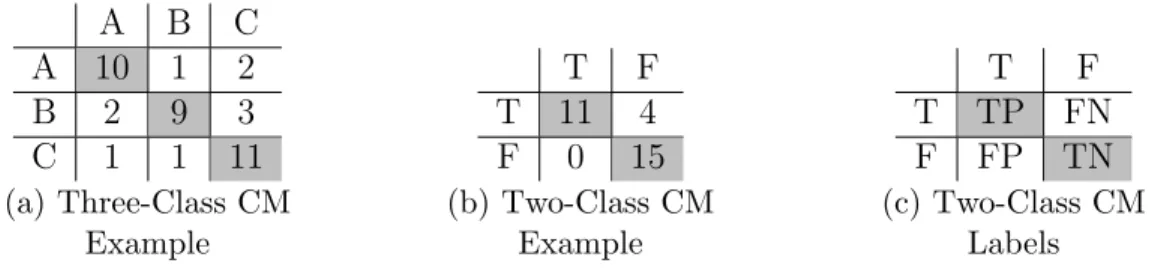
predicts to be each other class. Each row in a confusion matrix represents a true class while
each column represents a predicted class. (See Figure 3.1 for examples) In the case of 100%
accurate prediction, the confusion matrix should be a diagonal matrix as all predictions
match the ground-truth. The number of rows and columns in a confusion matrix are equal
to the number of possible classes represented, which may be any whole number of two or
greater.
For the special case of a two-class problem, in which the only possible outcomes can be
represented as positive and negative (or true and false), the confusion matrix consists of
only four squares which can be labeled TP (True Positive), FP (False Positive), TN (True
Negative), and FN (False Negative). In this category system, the terms “positive” and
“negative” refer to the predicted classification and the terms “true” and “false” indicate
whether or not the predicted classification was correct. For a visual representation of these
labels, see Figure 3.1c.
Figure 3.1:
Confusion matrix examples and labels.
Rows represent ground-truth and
columns represent predicted classes. Shaded squares represent correct predictions. TP, TN,
FP, and FN represent True Positive, True Negative, False Positive, and False Negative
re-spectively.
A
B
C
A
10
1
2
B
2
9
3
C
1
1
11
(a) Three-Class CM
Example
T
F
T
11
4
F
0
15
(b) Two-Class CM
Example
T
F
T
TP
FN
F
FP
TN
(c) Two-Class CM
Labels
Software bug detection can be represented as a two-class problem in which the presence
of a bug is considered “positive” and the absence of a bug is considered “negative”. Although
more classes could be used to represent different types of bugs or bugs which were reported
or treated in different ways, it is useful to represent the presence of a bug as a two-class
problem. Restricting the number of classes to two increases performance by reducing the
number of categories between which a classifier must differentiate and also allows the use
of performance measures such as “probability of detection” which have little meaning when
there are more than two classes.
3.2.2
Measures of Classification Performance
In order to evaluate the efficacy of machine learners, some measurements need to be applied
to the confusion matrix yielded from the testing of a trained classifier. For most machine
learning circles, the typical performance evaluation metrics are precision and recall. Within
the domain of Software Engineering defect prediction, the majority of the recent publications
favor pD (probability of detection) and pF (probability of false-alarm). This is largely due
to scaling issues with precision that arise when the testing data has positive/negative ratios
near 0 or 100%. [20]
can be expressed as the number of true positives divided by the total number of positive
cases, while pF can be expressed as the number of false positives divided by the total number
of negative cases.
pD
= recall =
# of defects correctly predicted
# of actual defects
=
T P
T P
+
F N
(3.13)
pF
=
# of false defect predictions
# of non-defective items
=
F P
F P
+
T N
(3.14)
This thesis will focus primarily on pD and pF as the chief metrics for comparing machine
learning results because they are business-intuitive for defect prediction and because they
are in line with recent publications. The goal is to have the highest possible pD and the
lowest possible pF, but there is often a trade-off between the two based on the parameters
chosen for a given classification scheme.
In order to effectively rank results it is useful to have a single metric which reflects
overall performance, but neither pD or pF is sufficient on their own. As an example, a
dummy classifier which always predicts “true” is going to have a pD of 100% but will also
have a pF of 100%. Conversely, a dummy classifier which always predicts “false” will have
a pF of 0, which is excellent, but will also score 0 on pD, making it useless. Consequently,
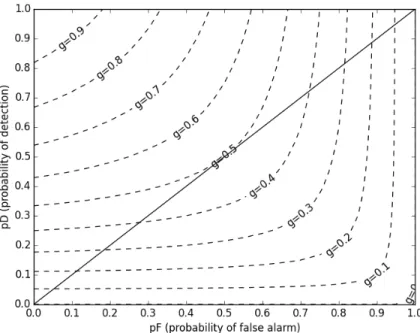
we can define a “no information” line on a pD, pF plot where pD=pF. A dummy classifier
which guesses positive
n
% of the time and negative 100
−
n
% of the time is expected to have
a performance along this line. For a visual representation of the line of no information, see
figure 3.2.
In order to reflect overall performance, a synthetic metric will be used. A typical synthetic
metric for combining precision and recall is the balance F-score which is the harmonic mean
of precision and recall. In this case, as we are focusing on pD and pF, a similar metric, g,
will be used where g defined as the harmonic mean of pD and 1-pF.
Figure 3.2:
g contours as a function of pD, pF. The solid line represents the line of no
information, the expected performance from random guess.
g
=
1
2
pD
+
1
1−
pF
=
2(
pD
)(1
−
pF
)
1 +
pD
−
pF
(3.15)
A contour plot of the values of g based on pD and pF can be seen in figure 3.2.
3.3
Data
3.3.1
Data Sources
Some companies keep records of completed software projects which may be used to learn
lessons for future development. These software companies have little incentive to release
their development data to the general public. Most Software Engineering researchers rely
on public data from various sources including the PROMISE repository [22], a engineering
project data repository supported by North Carolina State University.
The PROMISE repository includes many Software Engineering defect and effort
pre-diction datasets from previous software projects.
The software project data hosted on
PROMISE has features which are measured with a variety of different types of software
metrics. Many of these software projects have data available on PROMISE from multiple
versions.
In the interest of openness an reproducibility of results, only data publicly available on
the PROMISE dataset will be used in this thesis. In addition, to this restriction, the data
used in this thesis will also be restricted to software projects for which three or more versions
(numbered releases) are available. This will allow for the evaluation of cross-version learning.
Another necessary restriction is that the software metrics used be homogenous to ensure fair
comparison. To this end, only software projects using the CKJM object-oriented metrics
will be considered as choosing CKJM metrics allows for the largest plurality of datasets to
be included when considering the first two restrictions.
3.3.2
CKJM Metrics
CKJM (Chidamber and Kemerer Java Metrics) is a tool for tabulating the object-oriented
software metrics devised by Chidamber and Kemerer [8] for given Java classes. An updated
version of CKJM, called CKJM Extended, also tabulates several other object-oriented
soft-ware metrics on a per-class basis. [17] CKJM Extended includes Henderson-Sellers’ LCOM3
metric [13], Martin’s afferent and efferent couplings [18], Bansiya Davis’ QMOOD metrics [2],
Tang, Kao, and Chen’s coupling and complexity metrics [34], and McCabe’s cyclomatic
com-plexity measure [19] as well as the original Chidamber and Kermer metrics and lines of code
(LOC). For descriptions of all CKJM Extended metrics, see Table 3.1.
Several open source Java projects were analyzed by Jureczo and Spinellis using CKJM
Extended, and a dataset was constructed from each version of each project. [17] These
datasets consisted of the CKJM Extended metrics as well as a class variable indicating
Table 3.1:
CKJM Extended Metrics [17]
Name Description Source
Weighted methods per class (WMC)
The value of the WMC is equal to the number of methods in the class (assuming unity weights for all methods).
C&K [8]
Depth of Inheritance Tree (DIT)
The DIT metric provides for each class a measure of the inheritance levels from the object hierarchy top.
C&K [8]
Number of Children (NOC)
The NOC metric simply measures the number of immediate descendants of the class. C&K [8] Coupling
between object classes (CBO)
The CBO metric represents the number of classes coupled to a given class (efferent couplings and afferent couplings). This couplings can occur through method calls, field accesses, inheritance, method arguments, return types, and exceptions.
C&K [8]
Response for a Class (RFC)
The RFC metric measures the number of different methods that can be executed when an object of that class receives a message. Ideally, we would want to find for each method of the class, the methods that class will call, and repeat this for each called method, calculating what is called the transitive closure of the method call graph. This process can however be both expensive and quite inaccurate. Ckjm calculates a rough approximation to the response set by simply inspecting method calls within the class method bodies. The value of RFC is the sum of number of methods called within the class method bodies and the number of class methods. This simplification was also used in the Chidamber and Kemerer’s description of the metric.
C&K [8]
Lack of cohesion in methods (LCOM)
The LCOM metric counts the sets of methods in a class that are not related through the sharing of some of the class fields. The original definition of this metric (which is the one used in ckjm) considers all pairs of class methods. In some of these pairs both methods access at least one common field of the class, while in other pairs the two methods do not share any common field accesses. The lack of cohesion in methods is then calculated by subtracting from the number of method pairs that do not share a field access the number of method pairs that do.
C&K [8] Lack of cohesion in methods (LCOM3) 1a 10 P j=1 µAj −m 1−m
m- number of procedures (methods) in class
a- number of variables (attributes) in class
µ(A) - number of methods that access a variable Henderson-Sellers [13] Afferent
couplings (Ca)
The Ca metric represents the number of classes that depend upon the measured class. Martin [18] Efferent
couplings (Ce)
The Ca metric represents the number of classes that the measured class is depended upon. Martin [18] Number of
Public Methods (NPM)
The NPM metric simply counts all the methods in a class that are declared as public. The metric is known also as Class Interface Size (CIS)
QMOOD [2]
Data Access Metric (DAM)
This metric is the ratio of the number of private (protected) attributes to the total number of attributes declared in the class.
QMOOD [2] Measure of
Aggregation (MOA)
This metric measures the extent of the part-whole relationship, realized by using attributes. The metric is a count of the number of class fields whose types are user defined classes.
QMOOD [2]
Measure of Functional Abstraction (MFA)
This metric is the ratio of the number of methods inherited by a class to the total number of meth-ods accessible by the member methmeth-ods of the class. The constructors and the java.lang.Object (as parent) are ignored.
QMOOD [2]
Cohesion Among Methods of Class (CAM)
This metric computes the relatedness among methods of a class based upon the parameter list of the methods. The metric is computed using the summation of number of different types of method parameters in every method divided by a multiplication of number of different method parameter types in whole class and number of methods.
QMOOD [2]
Inheritance Coupling (IC)
This metric provides the number of parent classes to which a given class is coupled. A class is coupled to its parent class if one of its inherited methods functionally dependent on the new or redefined methods in the class.
Tang [34]
Coupling Between Methods (CBM)
The metric measures the total number of new/redefined methods to which all the inherited methods are coupled. There is a coupling when at least one of the given in the IC metric definition conditions is held.
Tang [34]
Average Method Complexity (AMC)
This metric measures the average method size for each class. Size of a method is equal to the number of Java binary codes in the method.
Tang [34]
McCabe’s cyclomatic complexity (CC)
CC is equal to number of different paths in a method plus one. Max(CC) - the greatest value of CC among methods of the investigated class
Avg(CC) - the arithmetic mean of the CC value in the investigated class
McCabe [19]
Lines of Code (LOC)
The LOC metric based on Java binary code. It is the sum of number of fields, number of methods and number of instructions in every method of the investigated class.
![Table 3.1: CKJM Extended Metrics [17]](https://thumb-us.123doks.com/thumbv2/123dok_us/9788514.2470609/32.918.116.754.224.937/table-ckjm-extended-metrics.webp)