A Holistic Model of User Experience for
Living Lab Experiential Design
Marc Pallot1, Kulwant Pawar1
1
CEC, Nottingham University Business School, UK Abstract
This paper introduces a holistic approach for describing a User eXperience (UX) model that is composed of different experience types, concepts and elements. Looking at the current UX body of knowledge, several theoretical and experimental models already exist and address various aspects of the resulting user experience when interacting with a product, such as perceived usefulness, ease of use, hedonic quality and visual attractiveness to cite just of few (Forlizzi & Ford, 2000; Morville, 2004; Mahlke, 2002; Hassenzahl et al., 2000). The resulting holistic model of UX is currently undergoing empirical experiments in three different use case domains appertaining to the Internet of Things (IoT) based services namely, wellbeing, environment and logistics. Previous results suggest that different aspects of experience are mostly independently perceived by the users while all significantly contribute to the intention to use a product/service. The iterative nature of the Living Lab experiential design and relevance of existing elements of UX as well as value co-creation are discussed. Finally, a view of the resulting holistic model is presented with a first set of preliminary conclusions.
Keywords
Living Lab, Holistic Model, Experiential Design, User Cocreation, User Experience
1
Introduction
The new era of online networked communities and increasing consciousness on the paramount importance of citizens’ participation for tackling societal issues offers an unprecedented opportunity to reconcile the relationship between people and technology. The emerging paradigm shift from traditional Industrial Design towards Experiential Design enables to focus on human experience and patterns of usage as a corner stone in the design process, which condition the potential adoption of new technologies. It implies a deep impact on the way people design new products/services.
Recently, Mike Demler2 concluded in his article entitled ‘The design-to-cost imperative and customer value’ that: “Too many companies in mature competitive industries blame customers or the tough economy for driving down prices. The lesson from the most successful companies is to continually deliver greater value. Companies should focus more on how their engineers can design for value rather than obsess over balance-sheet-driven cost-cutting strategies, in which layoffs and outsourcing are all too prevalent.”
Design engineers are increasingly pushed towards product design with high performances and low cost strategy, while this kind of approach is often insufficient to ensure product success. In contrast, the user co-creation strategy does not imply to start by designing functions but rather focus on designing for the most appropriate user experience that will ensure a high rate of product adoption.
2
2
Related Theories and Previous Work
2.1 Living Labs for engaging Users in R&DAs demonstrated by the Web 2.0 approach in empowering users, new R&D approaches are emerging where users are no longer considered as observed subjects in functional tests but rather as entities able to contribute in creating value. William Mitchell3 argued that a Living Lab represents a user-centric research methodology for sensing, prototyping, validating and refining complex solutions in multiple and evolving real life contexts. He identified several potential impact and benefits. The noticeable impacts are: the integration of the users into the development process for ensuring highly reliable market evaluation; the reduction of technology and business risks; a Living Lab is beneficial to SME, micro-organizations and start-ups, since they can share resources without so much venture capital; large companies have access to a broader base of ideas.
According to Pallot (2009), a Living Lab (LL) is currently considered as a user-centred open innovation ecosystem integrating research and innovation within a Public-Private-People partnership through an iterative Experiential Design process. It combines the focus placed on the quality of the user experience in experimenting a product or a service and the capacity of the Living Lab process to capture previous design experiences, formulated as “Experiential Knowledge”, where users are involved for creating value (Aarts & Marzano, 2003). It means that within a Living Lab, the user experience covers the entire Experiential Design process.
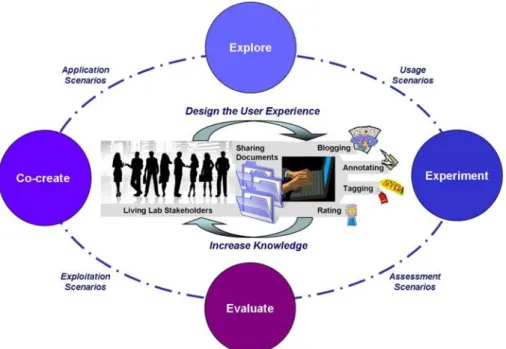
Figure 2.1: The Living Lab Iterative Experiential Design Process (Adapted from Pallot, 2009) The main goal of the LL iterative Experiential Design process is to support the design for user experience (see Figure 2.1) while sharing knowledge and crystallising the collective work of the LL stakeholders. Hence, new concepts, artefacts and solutions emerge from the resulting increase of knowledge acquired through accumulated experiences. It is not only targeted to evaluate the user experience with collected data during the experimentation but also to co-create and explore value propositions that are intended to enhance the user experience. The Social dynamics of the LL approach ensures a wide and rapid spread (viral adoption phenomenon) of innovative solutions through the socio-emotional intelligence mechanism (Goleman, 2006). The
3
experimentation and evaluation of the scenarios and artefacts are driven by users within a real life context through social, economical, educational, technological and societal perspectives. 2.2 User Experience
On the one hand, the term “experience”, according to the Oxford Dictionary, has two meanings. The first one represents the process of gaining knowledge or skill by doing and seeing things, which is reflected by the expression “learning by experience”. The second meaning is rather about notable, or even memorable, events or activities that provide an experience, which in return affects involved people in some ways (e.g. pleasant, unusual, unpleasant). On the other hand, the term “user” is illustrated as somebody who uses something. Obviously, the combination of the two terms results in the well-known expression “user experience”, which refers to a notable usage event or activity that the user memorised as a reference to this kind of situation and context in which it has occurred. Interestingly, when the usage event leads to a successful outcome then it will be repeated, while in case of a negative outcome (e.g. failure) then it will be carefully avoided. Hence, it comes back to the learning by experience and recommendations provided by experienced people.
Alben (1996) was the first to introduce user experience in the context of interactive products: “UX covers all the aspects of how people use an interactive product – the way it feels in their hands, how well they understand how it works, how they feel about it while they are using it, how well it serves their purposes, how well it fits into the context in which they are using it, and how well it contributes to the quality of their lives”.
Norman (1999) describes UX as a concept encompassing all aspects of the user’s interaction with a product: how it is perceived, learned, and used.
There also exists the following standardised description of UX provided by the International Standard Organisation (ISO 9241-210): "User Experience is a person's perceptions and responses that result from the use or anticipated use of a product, system or service". The ISO description presents UX as all users' emotions, beliefs, preferences, perceptions, physical and psychological responses, behaviours and accomplishments that occur before, during and after the use of product, system or service. It is also mentioned that the type of product/system/service, user profile and the context of use are factors that influence user experience.
Rubinoff’s (2004) provided the following description of UX in the context of website design: “The ‘user experience’ concept refers to a concept that places the end-user at the focal point of design and development efforts, as opposed to the system, its applications or its aesthetic value alone. It’s based on the general concept of user-centred design. The user experience is primarily made up of a four factors, namely branding, usability, functionality and content. Independently, none of these factors makes for a positive user experience; however, taken together, these factors constitute the main ingredients for a website’s success.”
Scapin (2012) argues, UX has become very popular, has several meanings, with a varying and complex coverage of topics and issues, and is very subjective (Komulainen, 2008) and versatile by nature. According to Kankainen (2002), the versatility of UX could be explained by the fact that a person holds previous experiences that could be altered by a new experience, hence increasing the level of expectation for the next occurrences.
Morville (2004) explains the quality of UX for a website through seven facets, namely: Useful, Usable, Desirable, Findable, Accessible, Credible, and Valuable. Hassenzahl et al (2000) argue that usability can be broadly defined as quality of use. However, they found that this broad definition neglects the contribution of perceived fun and enjoyment to user satisfaction and preferences. Therefore, they recently suggested a model taking “Hedonic Quality” and the subjective nature of “appealingness” into account. The results of an empirical study carried out by Schrepp et al (2006) show that pragmatic and hedonic qualities have an impact on
attractiveness. They concluded: “The more attractive an interface, the higher is the preference of subjects for this interface.”
Van Schaik and Ling (2008) explained that recent research into UX has identified the need for a theoretical model to build cumulative knowledge in research addressing how the overall quality or ‘goodness’ of an interactive product is formed. They built an experiment for testing and extending Hassenzahl’s model of aesthetic experience (Hassenzahl et al, 2000). Their study used an experimental design with principles of screen design, principles for organising information on a web page and experience of using a web site. The hedonic perceptions and evaluations of a web site, as well as measures of task performance, navigation behaviour and mental effort constituted the dependent variables. Measures were sensitive to manipulation of web design. Beauty was influenced by hedonic attributes (identification and stimulation), but Goodness by both hedonic and pragmatic (user-perceived usability) attributes as well as task performance and mental effort. Hedonic quality was reported as more stable with experience of web-site use than pragmatic quality and Beauty was more stable than Goodness.
2.3 Experience Design
Aarts and Marzano (2003) describe Experience Design as the practice of designing products, processes, services, events, and environments with a focus placed on the quality of the user experience and culturally relevant solutions, with less emphasis placed on increasing and improving functionality of the design.
According to Forlizzi & Ford (2000), UX in user-product interaction is mainly influenced by the User and the product within a context of use embodied with social and cultural factors. While the product influences UX through its form, features, aesthetic qualities, and usefulness, a user influences UX through emotions and feelings, values and cognitive models for hearing, seeing, and touching, and prior experiences.
Mahlke (2002) describes a user experience process model and introduces the following four dimensions to experience modelling: Perceived usefulness, Ease of use, Hedonic quality4, and Visual attractiveness. These four factors were said to explain approximately 79% of the total variance of the intention to use a website. In this study, it is noticed a lack of social aspects like communication or collaboration and the relevance of emotion and affect in the experience process. Mahlke cites Desmet (2003) for his innovative methods for measuring emotions during interactive experiences and mentions the work of Ward and Marsden (2003) and Branco et al (2005) for the use of psycho-physiological methods to record the process of affective reactions and emotional consequences. Finally, Mahlke mentions Hassenzahl (2001) for his study on the concept of judgement of appeal as an evaluative concept that is considered as another result of user experience.
Mahlke concludes by the following crucial question “How to design artefacts that cause desired perceptions of qualities, affects and emotions and lead to consequences the designer wants to achieve?” He also concluded that “Usefulness and ease to use are reasonably understood while an interactive system could be perceived hedonic or emotionally pleasing depends on still not fully understood aspects.”
In this paper, empathy5 means the ability to project oneself into a scenario and care for others. Immersive virtual environments help users to behave like in a learning environment where they can empathise with a product or a service and its features as well as other users. However, a number of questions remain, such as how the immersive/learning environment support user concentration and what are the factors that disrupt it. There are also factors that affect the way
4
Hedonism: the unrestrained pursuit of pleasure. The aspects of a user interface appealing to a person’s desire of pleasure and avoidance of boredom and discomfort. Hedonism represents the aspects that are fun, original, interesting, engaging, and cool as a positive subjective experience.
5
users empathise with the immersive/learning environment and factors that hinder the empathising process. The product or service should enable new practices and adapt to users needs. Realistic features appearing in the learning environment affect the skills to be learned (Salakari, 2007). Others, Le Marc et al (2010) discuss the link between learning experience and user experience as well as the role of immersive environments such as live environments or Living Labs where users simultaneously co-create innovative scenarios and learn how to innovate.
Empathising is impacted by the user profile and does not necessarily emerge through causal relationships. Dourish (2004) and Forlizzi & Ford (2000) argue that designers can affect the context but users are the ones who will ultimately experience it. Social interactions and social practices emerge when a product is in use as explained by Battarbee “social-user-experience” (2004) that he named co-experience for collective experience. For years, User Centred Design (UCD) or Human-Centred Design (ISO 13407, 1999) methods have underlined the importance of user experience (Battarbee, 2004; Garret, 2002; Hassenzahl, 2003).
Pallot et al., (2010) created a landscape of research and design methods involving users in R&D for getting a better understanding of the Living Lab research domain. One of the landscape dimensions shows that instead of considering users as observed subjects they should rather be considered as potential co-creators and experimenters that generate new ideas, play with them, feel, sense and interact within real scenarios and prototyped products/services. This domain landscape was tentatively used as an evaluation tool for assessing the maturity level in terms of user involvement in R&D (Salminen et al., 2011).
User experience could be considered as either product centred or person centred or even interaction centred (Battarbee, 2004). Forlizzi (2007) developed the product ecology framework (people, adaptation, and place) to accumulate the experience of use in order to enhance user experience design. Burmester and others (2010) described a method for formative evaluation of user experience, based on Hassenzahl’s user experience model (Hassenzahl, 2008; 2010), which was named “Valence method”. They discuss various existing user experience evaluation methods (Burmester et al., 2010), such as the Product Emotion Measurement Instrument (Desmet, 2003), the Layered Emotion Measurement Tool (Huisman & Van Houst, 2008), Emotion Sampling Device (Hole & Williams, 2007) and the perceived hedonic and pragmatic product qualities (Burmester & Dufner, 2006).
However, to optimise the design for better user experience it is important to understand design aspects causing a positive or negative experience as well as the reasons. The Valence method is intended to capture positive and negative feelings during the exploration of an interactive product; to elicit product design aspects causing negative or positive user experience and to obtain information on the underlying psychological reasons. This method consists of two phases: the explorative phase where users experience positive or negative feeling while using a product and the retrospective interview phase, which is a video recording of the exploration session with synchronised valence markers.
Burmester and colleagues (2010) conclude that “The retrospective interview phase generates a wealth of qualitative data on meaning related to the product design aspects and the underlying human needs. The subjective meanings in particular reveal many facets of the user experience. They enable a better understanding of the design and can serve as the starting point for design improvements. A current limitation of the method is that participants should use the product or prototype for the first time during the evaluation. In our tests, extensive previous usage resulted in a strong decrease of valence markers set. A related method may be required which employs a retrospective interview on experiences over longer usage periods. The valence method has so far been used in lab settings only. To increase ecological validity, it should be enhanced so that the valence markers can also be collected in authentic usage situations in the field.”
Hassenzahl and colleagues (2000) has proposed and tested a research model addressing ergonomic/usability and hedonic aspects as key factors for appealing products. This research
model comprises three separate layers: objective product quality (intended by the designers); subjective quality perceptions and evaluations (cognitive appraisal by the users), and behavioural and emotional consequences for the user. Authors suggested that a product is described by a large number of different quality dimensions (e.g., predictability, controllability, etc.) grouped into two distinct quality aspects: Ergonomic Quality and Hedonic Quality.
The current huge attention on UX is quite simple to understand because the more successful the user experience of a product/service, the higher the chance that people will adopt it. Undoubtedly, the arising question is: How to design a successful UX?
Interestingly, it is important to note that UX is embodied with two other concepts. The first one represents the value proposition of a product/service that users necessarily experience in a way or another. The second one is about users and there are many different types of user that are involved as stakeholders of the related product/service process. They are not necessarily all characterised as end-user6 like in the above UX description, which represents a consumer of a product or service. For example, an emergency health system, installed at the home of an elderly person, representing the service consumer, has other users involved as stakeholders along the related emergency process. These process stakeholders are, for example, firemen that have the responsibility to urgently come to the home of the elderly person in case of emergency while an operator stay in communication with the elderly person. This could also be referred as a collective experience in which users perceived the experience from a different point of view according to their role in the process.
2.4 Value Co-creation
In fact, products or services generate value on various aspects, such as economical (e.g. low-cost, luxury), technological (e.g. low-tech, high-tech), social (e.g. networking), emotional (e.g. feelings), cultural (e.g. fashion, art, entertainment), educational (e.g. knowledge, know-how), organisational (e.g. openness, distributed, global), societal (e.g. energy efficient, environmental friendly, inclusive). For example a mobile phone generates an economical value as people become reachable wherever they are and whenever is needed as they carry it, a social value due to the anytime interaction with one another and a technological value as it embeds interoperability with other mobile phones through the same communication protocol. A smart phone brings even more technological value as it can run mobile application and connects to the Internet with a Wifi spot, which implies more economical value as it gives access to web applications and resources, such as communicating for free and organisational value as it enables a global connectivity.
Sanders and Simons (2009) foresee the notion of “value” as a multidimensional concept with a range of meanings. They argue that value can refer to rank, importance, material or monetary worth, power, or usefulness. In terms of value perspectives, they consider that from a personal perspective, values refer to important aspects of life; while from a business perspective, a value chain refers to all the functions and activities an organization needs to undertake in order to create or add value to its products or services. Finally, they see “value co-creation” as referring to one or more forms of values produced through the collective creativity of people.
Monetary, use/experience and social are mentioned as three types of value in co-creative activities and relationships (Sanders & Simons, 2009): the monetary value is fuelled by the desire to make money in new ways, more efficient ways, or in ways that provide sustainable revenues over longer periods of time; the use/experience value of co-creation is fuelled by companies’ desires to transform consumers into users so that the products and services they design, produce and sell will better meet people’s wants and needs; the social value of co-creation is fuelled by
6
aspirations for longer term, humanistic, and more sustainable ways of living. Authors argue that empathy between co-creators is essential for the real work in this form of co-creation that favours more personal interactions and conversations.
However, one could argue that value co-creation is more than joint development among the providers and customers; it is the ability of the customers to create or customise their own experience using the offered product/service by providers.
3
Research Approach
A study on UX types, concepts, elements and their properties was carried out in order to enable the identification of the most appropriate ones for building a holistic model that could be then instantiated whatever is the Living Lab domain and specific use case.
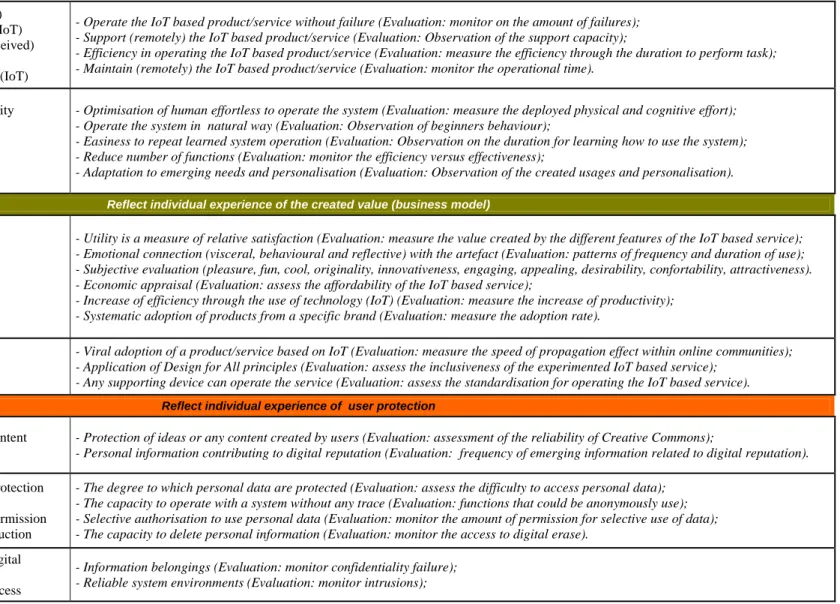
It has resulted in the identification of 10 experience types, 22 elements and about 80 properties (see Table 4.1) in a first instance that need to be refined during and after the experimentations carried out by 3 different use cases and 7 scenarios.
4
Findings
4.1 The Holistic View of User Experience
The names given to all experience types are voluntarily based on convenience for practical simplicity and understanding rather than deep scientific foundation. Most of them appear to be quite intuitive, though the legal or ethical user experience might be more surprising but interestingly making sense. In the literature, user experience is not broken down into different types such as social experience, cultural experience and perceptual experience and appears more monolithic.
Interestingly, our approach of deciphering the elements and properties of a holistic view of user experience is intended to be more precise and rigorous for evaluating the level of user experience. The various experience types, elements and properties will be explored within several experiments to be carried out in real situations. They should provide a sound basis for a validation of the holistic model and all its components.
In the same way, indications of potential evaluation (see Table 4.1) are provided for each property of all identified elements of the different types of experience.
Exp
Typ Elements Ref Properties Description and Evaluation
Reflect the experience of taking information via the senses
Sensory (Sensitivity) P1 - Vision - Auditory - Tactile - Somatosensory - Olfactory - Gustatory
- Sight, study on visual artefacts (Evaluation: eyes tracking);
- Hearing, study on sound effects (Evaluation: face expression, volume tracking); - Touch, study on haptic artefacts (Evaluation: face expression, feedback force tracking); - Proprioception, study on the sense of movement (Evaluation: body movement tracking); - Smell, study on olfactory effects (Evaluation: face expression, chemical emanation tracking); - Taste, study on gustatory effects (Evaluation: face expression tracking).
Percep tual Perceptive Appreciation (Perceptivity) P2 - Detection of invariants - Sensing affordances - Attunement of affordances
- Perception of what doesn't change across different situations (Evaluation: detected similarities).
- Properties of the environment to perceive directly and act upon (Evaluation: monitoring reflexive actions). - Persisting state of awareness of the affordances in the environment (Evaluation: detected affordances). Reflect the cognitive experience in processing information and applying knowledge
Cognitiv e Cognitive Ergonomics C1 - Cognitive artefacts - Human reliability - Human interface
- Cognitive artefacts sustaining human performance in work environments (Evaluation: monitor the flow of actions);
- Work redesign to manage cognitive workload and increase human reliability (Evaluation: measure the repeatability of actions); - Off-loading in interface (Evaluation: clarity, discriminability, conciseness, consistency, Detectability, legibility, and comprehensibility).
Reflect the experience of distributed and situated cognition Distributed
Cognition R1
- Cognitive coordination - Shared cognition
- Technological artefacts (e.g. Tagging or Blogging) supporting distributed cognition (Evaluation: monitor contributions). - Cognitive processes distributed across the members of a social group (Evaluation: monitor shared objects).
Recipr ocal Situated Cognition R2 - Shared meanings - Mutual understanding - Group consciousness
- External representations created through social interactions to express meaning (Evaluation: monitor external representations); - Understanding of one's idea (Evaluation: monitor concept mapping);
- Correlation of multiple expressions leading to comprehension (Evaluation: track rupture patterns during social interaction). Reflect the individual experience in a group
Interpersonal relationships S1
- Social Networking - Openness
- Connections among people (Evaluation: monitor ties development, intensity of dialogue, and promptness of feed back); - Diversity and absorption capacity (Evaluation: Observation of self disclosure and degree of acceptance).
Social
Social
Interaction S2
- Communication behaviour - Collaboration behaviour
- Interact with other individuals (Evaluation: monitor communication patterns and frequency)
Group
dynamics S3
- Sense of community - Collective intelligence - Influential behaviour
- Individual's belonging behaviour within a group (Evaluation: monitor purposeful behaviour);
- The aggregation of information in groups resulting in decisions (Evaluation: monitor collective decisions); - Mental leading within a group of individuals (Evaluation: Behavioural observation, amount of followers). Group
Enhancement S4
- Relationship enhancement - Rewarding
- Positive participation in collective activities (Evaluation: Observation of participation patterns);
- The fittingness and proportionality of one's responses to others (Evaluation: Observation of response patterns).
Group
Confidence S5
- Accountability - Confidence
- Account-giving relationship between individuals (Evaluation: Observation on accountability patterns);
- Consider one another as a reliable source, competence and collaborator (Evaluation: Observation of trust patterns).
Reflect the complex psycho physiological experience of an individual's state of mind
Physiological state E1 - Physiological Arousal - Emotional Perceiveness - Social Affordance - Emotional bias
- Readiness to respond (Evaluation: monitor behaviour and response level);
- Physiological Perceiveness of the emotional state of one another (Evaluation: face expression and body movement tracking); - Properties of environment (e.g. wiki and chat applications) that permit social actions (Evaluation: Behavioural observation); - Distortion in cognition and decision making due to emotional factors (Evaluation: track bias in decision).
Em otional Emotional Connection E2 - Attractiveness - Emotional Behaviour
- Pro-active behaviour (Evaluation: monitor effectiveness of engagement, intensity, complaint rate, appreciation); - Emotional reaction (Evaluation: body language, facial expression, voice tone and eyes dilatation).
Reflect individual experience within a community
Cultur al Habits and conventions Cu 1 - Folkway behaviour - Sence of community
- Informal rules for sustainable life-style (Evaluation: Observation of patterns that are repeated regularly and subconsciously); - Getting acquainted with the vocabulary and organising principles (Evaluation: adoption patterns of norms and habits).
Reflect individual experience of being helpful with others
Empa thical Caring Em 1 - Helpfulness attitude - Share feelings
- A desire to help others, recognize and share feelings experienced by others (Evaluation: observation of individual behaviour, face expression and body language tracking).
Reflect individual experience of using technological artefacts
Technologic
a
l
Innovativeness T1
- New functionalities (IoT) - Performance level (IoT) - Automation capacity (IoT) - Connectivity (IoT) - Ambient Intelligence (IoT)
- Creativity expressed by innovative product/service based on IoT (Evaluation: tracking of new functions, modalities, and artefacts); - The increase of performance level based on IoT (Evaluation: measure the technical performance);
- The automation capacity based on the use of IoT (Evaluation: measure the degree of automation); - The degree of connectivity provided by IoT (Evaluation: monitor connectivity);
Performance T2 - Reliability (IoT) - Supportability (IoT) - Efficiency (perceived) (IoT) - Maintainability (IoT)
- Operate the IoT based product/service without failure (Evaluation: monitor on the amount of failures); - Support (remotely) the IoT based product/service (Evaluation: Observation of the support capacity);
- Efficiency in operating the IoT based product/service (Evaluation: measure the efficiency through the duration to perform task); - Maintain (remotely) the IoT based product/service (Evaluation: monitor the operational time).
Friendliness T3 - Ergonomic quality - Intiutivity - Learneability - Simplicity - Flexibility
- Optimisation of human effortless to operate the system (Evaluation: measure the deployed physical and cognitive effort); - Operate the system in natural way (Evaluation: Observation of beginners behaviour);
- Easiness to repeat learned system operation (Evaluation: Observation on the duration for learning how to use the system); - Reduce number of functions (Evaluation: monitor the efficiency versus effectiveness);
- Adaptation to emerging needs and personalisation (Evaluation: Observation of the created usages and personalisation).
Reflect individual experience of the created value (business model)
Satisfaction Ec 1 - Usefulness - Affinity - Hedonic quality - Affordability - Productivity - Loyalty
- Utility is a measure of relative satisfaction (Evaluation: measure the value created by the different features of the IoT based service); - Emotional connection (visceral, behavioural and reflective) with the artefact (Evaluation: patterns of frequency and duration of use); - Subjective evaluation (pleasure, fun, cool, originality, innovativeness, engaging, appealing, desirability, confortability, attractiveness). - Economic appraisal (Evaluation: assess the affordability of the IoT based service);
- Increase of efficiency through the use of technology (IoT) (Evaluation: measure the increase of productivity); - Systematic adoption of products from a specific brand (Evaluation: measure the adoption rate).
Econo mical Inclusion Ec 2 - Disseminability - Accessibility - Availability
- Viral adoption of a product/service based on IoT (Evaluation: measure the speed of propagation effect within online communities); - Application of Design for All principles (Evaluation: assess the inclusiveness of the experimented IoT based service);
- Any supporting device can operate the service (Evaluation: assess the standardisation for operating the IoT based service). Reflect individual experience of user protection
Ownership LE 1
- User ideas & content - Personal image
- Protection of ideas or any content created by users (Evaluation: assessment of the reliability of Creative Commons);
- Personal information contributing to digital reputation (Evaluation: frequency of emerging information related to digital reputation).
Privacy LE
2
- Personal data protection - Anonymity
- Selective use permission - Own Data destruction
- The degree to which personal data are protected (Evaluation: assess the difficulty to access personal data); - The capacity to operate with a system without any trace (Evaluation: functions that could be anonymously use); - Selective authorisation to use personal data (Evaluation: monitor the amount of permission for selective use of data); - The capacity to delete personal information (Evaluation: monitor the access to digital erase).
Legal & Ethi
cal Security LE 3 - Protection of digital identity - Protection of access
- Information belongings (Evaluation: monitor confidentiality failure); - Reliable system environments (Evaluation: monitor intrusions);
4.2 An Instantiation of the Holistic Model of User Experience
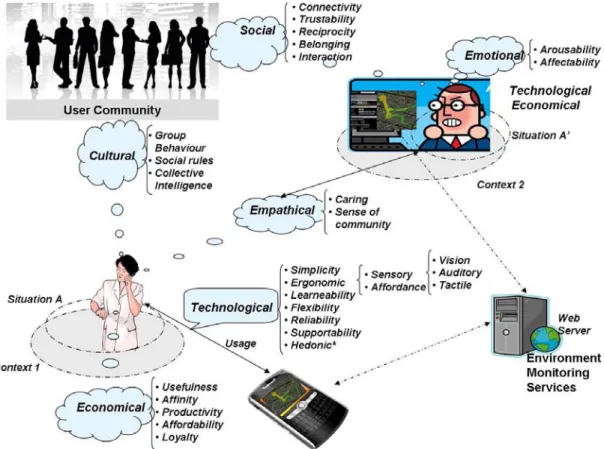
The following figure presents a limited scope of the holistic UX (Figure 4.2) with six experience types, namely: cultural, economical, emotional, empathical, social and technological. Each type is then broken down in various elements that compose the holistic model. There are some elements that are further broken down in lower granularity elements.
Figure 4.2 – An Instantiation View of User Experience (Pallot, 2012)
UX is foreseen in a systemic approach illustrated with two different users interacting through the use of a smart phone for one user and a PC for one another while being connected with a user community. Hence, the two users have a different operating context with the service while they have an almost similar situation.
5
Conclusions and Future Work
In conclusion, it seems quite logical that recent design methods, such as Experiential Design that emerged in the context of Living Labs, move towards a real engagement of user communities in co-creating value. The Experiential Design is an iterative process based on the continuous evaluation of user experience and anticipation of the potential degree of adoption. However, UX related methods have emerged within different research streams (e.g. HCI7, HCC8, Human Factors, Ergonomics, Interaction Design) and are described in various publications. Hence, it does not facilitate the disambiguation among the multiple terms used for describing the different UX elements that often have some overlapping aspect and granularity inconsistencies. The
7
http://en.wikipedia.org/wiki/Human_computer_interaction
8
current lack of comparative studies on existing UX models and elements constitutes a barrier towards a more integrative approach that could be used in a holistic model. Interestingly, this study suggests that relevant types of experience could be explored and experimented in the context of LL use cases in order to increase the current level of knowledge.
As for future work, there is a need to further explore and experiment all UX elements in order to foresee whether it is feasible to evaluate them properly and whether it is possible to partly systemise the evaluation techniques in order to speed-up the assessment of UX elements (for example: capturing facial expressions, eyes-tracking, papillary responses, skin conductance, and heart rate) as well as making it more reliable. The main idea behind the holistic model of UX is to systemise its instantiation according to the specificities of each use case experiments for capitalising and sharing the results and lesson learned whatever is their respective domain and wherever they are located.
Acknowledgments
This work was carried out in the context of the ELLIOT EU ICT Project that was partly funded by the European Commission. Authors wish to acknowledge their gratitude and appreciation to the European Commission and all partners who contributed to the identification of relevant UX elements and the elaboration of this holistic model of User Experience.
References
Alben, L. (1996). Quality of Experience: Defining the Criteria for Effective Interaction Design. Interactions 3(3), 11-15.
Aarts E. H. L. and Marzano S. (2003). The New Everyday: Views on Ambient Intelligence. 010 Publishers. p. 46. Battarbee, K. (2004). Co-experience: Understanding user experiences in social interaction. Publication series of the
University of Art and Design. Helsinki A 51. Academic dissertation. Helsinki: Yleisjäljennös –Painopörssi. Branco, P., Firth, P., Encarnao, L. M. & Bonato, P. (2005). Faces of emotion in human-computer interaction. In
CHI '05 Extended Abstracts on Human factors in computing systems (pp. 1236-1239). New York: ACM Press. Bühler, C., Stephanidis, C. (2004): European Co-operation Activities Promoting Design for All in Information
Society Technologies. In Proceedings of the 9th International Conference on Computers Helping People with Special Needs (ICCHP 2004), Paris, France, 7-9 July (pp. 80-87). Berlin Heidelberg: Springer-Verlag. Burmester, M. & Dufner, A. (2006). Designing the stimulation aspect of hedonic quality - an exploratory study. In
M. Pivec (Ed.), Affective and Emotional Aspects of Human- Computer Interaction: Emphasis on Game-Based and Innovative Learning Approaches, IOS Press.
Burmester, M., Mast, M., Jäger, K., Homans, H. (2010). Valence method for formative evaluation of user experience. In Proceedings of the 8th ACM Conference on Designing Interactive Systems (DIS '10). ACM, New York, NY, USA, 364-367. DOI=10.1145/1858171.1858239
Desmet, P. M. A. (2003). Measuring Emotions, in Blythe, M., Overbeeke, C. J., Monk, A.F. & Wright, P.C. (Eds.), Funology. From Usability to Enjoyment, Human- Computer Interaction Series, 3, Kluwer Academic
Publishers, 111-123.
Dorigo M. and Stützle T. (2004), Ant Colony Optimization, MIT Press, 2004. ISBN 0-262-04219-3 Dourish, P. (2004). Where the Action Is: the Foundations of Embodied Interaction. USA: MIT Press. Fleming, J. 1998, Web Navigation: Designing the User Experience. O’Reilly & Associates, Inc, USA. Forlizzi, J., Ford, S. (2000). The building blocks of experience: an early framework for interaction designers.
Proceedings of the 3rd conference on Designing Interactive Systems: processes, practices, methods, and techniques (DIS ’00). New York: ACM 2000, 419-423.
Garrett, J. J. (2002). The elements of user experience: User-centered design for the web. Indianapolis: New Riders Publishing.
Goleman. D. (2006). Social intelligence: the new science of human relationships. Publisher: Bantam Books. Publication Date: September 2006. ISBN-13: 9780553803525
Hassenzahl, M., Platz, A., Burmester, M., Lehner, K. (2000). Hedonic and ergonomic quality aspects determine a software's appeal, Proceedings of the SIGCHI conference on Human factors in computing systems, p.201-208, April 01-06, 2000, The Hague, The Netherlands [doi>10.1145/332040.332432]
Hassenzahl, M. (2001). The effect of perceived hedonic quality on product appealingness. International Journal of Human-Computer Interaction, 13, 4, 481-499.
Hassenzahl, M. (2003). The Thing and I: Understanding the Relationship between user and Product. In Blythe, M.A., Overbeeke, K., Monk, A.F. & Wright, P.C. (Ed.), Funology: from Usability to Enjoyment (pp. 31–42). Dordrecht: Kluwer Academic Publishers.
Hole, L. & Williams, O.M. (2007). The Emotion Sampling Device (ESD), in D. Ramduny-Ellis & D. Rachovides (Eds.), Proceedings of the 21st BCS HCI Group Conference, HCI 2007, 3-7 September 2007, British Computer Society, 177-178.
Huisman, G. & Van Hout, M. (2008). The Development of a Graphical Emotion Measurement Instrument Using Caricatured Expressions: the LEMtool, in C. Peter, E. Crane, H. Agius & L. Axelrod (eds), Emotions in HCI – Designing for People. Proceedings of the 2008 International Workshop, Fraunhofer, 2008.
ISO FDIS 9241-210 (2009). Ergonomics of human system interaction - Part 210: Human-centered design for interactive systems (formerly known as 13407). International Organization for Standardization (ISO). Kankainen, A. (2002). Thinking model and tools for understanding user experience related to information appliance
product concepts. Doctoral dissertation, Helsinki University of Technology, Finland.
Komulainen, J. Takatalo, M., Lehtonen, G., Nyman, G. (2008). Psychologically structured approach to user experience in games. In Proc. of the 5th Nordic Conference on Human-Computer interaction: Building Bridges, Lund, Sweden, October 20 - 22, 2008. NordiCHI'08, vol. 358. ACM, New York, NY, 487-490. Le Marc, C., Mathieu, P. J., Pallot, M., & Richir, S. (2009). Serious Gaming: From Learning Experience towards
User Experience.
Mahlke, S. (2002). Factors influencing the experience of website usage. In CHI ’02 Extended Abstracts on Human factors in computing systems, pp. 846-847. New York: ACM Press.
Morville, P. (2004). User experience design. Retrieved January 2012, http://semanticstudios.com/publications/semantics/000029.php
Norman, D. (1999). Invisible Computer: Why Good Products Can Fail, the Personal Computer Is So Complex and Information Appliances Are the Solution. MIT Press. 1999, ISBN 978-0262640411
Pallot, M. (2009). The Living Lab Approach: A User Centred Open Innovation Ecosystem. Webergence Blog Retrieved January 2011 http://www.cwe-projects.eu/pub/bscw.cgi/715404
Pallot, M., Trousse, B., Senach, B., & Scapin, D. (2010). Living Lab Research Landscape: From User Centred Design and User Experience towards User Cocreation. Proceedings of the Living Lab Summer School, Paris, August 2010.
Pallot, M., Le Marc, C., Richir, S., Schmidt, C., Mathieu, J.P. (2012). Innovation Gaming: An Immersive
Experience Environment Enabling Co-creation. Chapter 1, 1-24, in the Book entitled "Handbook of Research on Serious Games as Educational, Business and Research Tools", edited by Maria Manuela Cruz-Cunha, published by IGI Global, February 2012, DOI: 10.4018/978-1-4666-0149-9.
Pallot, M. (2012). A Holistic Model of User Experience. Webergence Blog Retrieved May 2012 http://www.cwe-projects.eu/pub/bscw.cgi/715404
Rubinoff, R. (2004). How to Quantify the User Experience. Retrieve January 2012 http://www.sitepoint.com/article/quantify-user-experience
Salakari, H. (2007). Learning practical skills in a virtual environment: a pedagogical model for simulator-based harvester operator training. Publication series of the Acta Universitatis Tamperensis: 1230. Academic dissertation. Tampere: Tampere University Press.
Salminen, J., Konsti-Laasko, S., Pallot, M., Trousse, B., Senach, B. (2011). Evaluating User Involvement within Living Labs through the use of a Domain Landscape. Proceedings of the 17th International Conference on Concurrent Enterprising, ICE'2011 "Innovating Products and Services for Collaborative Networks", Aachen, Germany, June 2011
Sanders, L., Simons, G. (2009). A Social Vision for Value Co-creation in Design. Open Source Business Resource. Retrieved January 2012 http://www.osbr.ca/ojs/index.php/osbr/article/view/1012/973
Scapin, D., Senach, B., Trousse,B., Pallot, M. (2012). User Experience: Buzzword or New Paradigm?. Proceedings ACHI 2012, The Fifth International Conference on Advances in Computer-Human Interactions, Valencia, Spain, January 2012.
Schrepp, M., Held, T., Laugwitz, B. (2006). The influence of hedonic quality on the attractiveness of user interfaces of business management software. Interact. Comput. 18, 5 (September 2006), 1055-1069.
Van Schaik, P., Ling, J. (2008). Modelling user experience with web sites: Usability, hedonic value, beauty and goodness Original Research Article Interacting with Computers, Volume 20, Issue 3, May 2008, Pages 419-432
Ward, R. D. & Marsden, P. H. (2003). Physiological responses to different WEB page designs. International Journal of Human-Computer Studies, 59, 199-212.