Australian
Pigmeat
Industry
Productivity
Commission
Inquiry Report
No. 35, 18 March 2005© Commonwealth of Australia 2005
ISSN 1447-1329 ISBN 1 74037 171 2
This work is subject to copyright. Apart from any use as permitted under the Copyright Act 1968, the work may be reproduced in whole or in part for study or training purposes, subject to the inclusion of an acknowledgment of the source. Reproduction for commercial use or sale requires prior written permission from the Attorney-General’s Department. Requests and inquiries concerning reproduction and rights should be addressed to the Commonwealth Copyright Administration, Attorney-General’s Department, Robert Garran Offices, National Circuit, Canberra ACT 2600.
This publication is available in hard copy or PDF format from the Productivity Commission website at www.pc.gov.au. If you require part or all of this publication in a different format, please contact Media and Publications (see below).
Publications inquiries:
Media and Publications Productivity Commission
Locked Bag 2 Collins Street East Melbourne VIC 8003 Tel: (03) 9653 2244 Fax: (03) 9653 2303 Email: [email protected] General inquiries: Tel: (03) 9653 2100 or (02) 6240 3200
An appropriate citation for this paper is:
Productivity Commission 2005, Australian Pigmeat Industry, Report no. 35, Melbourne.
The Productivity Commission
The Productivity Commission, an independent agency, is the Australian Government’s principal review and advisory body on microeconomic policy and regulation. It conducts public inquiries and research into a broad range of economic and social issues affecting the welfare of Australians.
The Commission’s independence is underpinned by an Act of Parliament. Its processes and outputs are open to public scrutiny and are driven by concern for the wellbeing of the community as a whole.
Information on the Productivity Commission, its publications and its current work program can be found on the World Wide Web at www.pc.gov.au or by contacting Media and Publications on (03) 9653 2244.
18 March 2005
Melbourne Office
Level 28, 35 Collins Street Melbourne VIC 3000
Locked Bag 2 Collins Street East Melbourne VIC 8003 Telephone 03 9653 2100 Facsimile 03 9653 2199 Canberra Office Telephone 02 6240 3200 www.pc.gov.au
The Honourable Peter Costello MP Treasurer
Parliament House
CANBERRA ACT 2600
Dear Treasurer
In accordance with Section 11 of the Productivity Commission Act 1998, I have pleasure in submitting to you the Commission’s final report into the Australian Pigmeat Industry.
Yours sincerely
Dr Neil Byron
IV TERMS OF REFERENCE
Terms of reference
I, Peter Costello, under Parts 2 and 3 of the Productivity Commission Act 1998, hereby refer for inquiry and report the competitive situation and outlook for the Australian pigmeat industry, including both production and processing.
1. In undertaking the inquiry, the Commission is to take into account:
• the structure and regional distribution of the industry;
• key factors influencing the profitability of the industry, and the extent to which these factors are short or long term influences;
• trends and factors influencing demand and supply, including imports and exports;
• the competitiveness of the industry, including competitiveness relative to international competitors, and efforts taken by the domestic industry to enhance competitiveness; and
• the impact and effectiveness of existing and recent government and industry programs.
2. I further specify that:
• the Commission report on whether the circumstances are such that government and/or industry measures (including regional measures) are necessary to enhance the competitiveness of the industry; and
• if so, what measures would be necessary and appropriate.
3. The Commission is to report within 5 months (or earlier) of receipt of this reference and is to hold hearings for the purposes of the inquiry.
4. The Government will consider the Commission’s recommendations and the Government’s response will be announced following consideration of the Commission’s report.
PETER COSTELLO [Received 31 August 2004]
CONTENTS V
Contents
Terms of reference IV
Abbreviations and explanations XI
Key points XIV
Overview XV Findings XXXIV
1 Introduction 1
1.1 Background to this inquiry 1
1.2 Conduct of the inquiry 2
1.3 Report structure 3
2 Australian markets for pigs and pigmeat 5
2.1 Pig and pigmeat products 5
2.2 Production of pigmeat 5
2.3 Consumption of pigmeat 17
2.4 Pig and pigmeat prices 19
2.5 Exports and imports 24
2.6 Profitability 32
3 Framework for assessing industry competitiveness 37
3.1 The competitiveness of businesses and industries 37
3.2 Sources of competitive advantage 38
3.3 Potential indicators of competitiveness 42
4 External factors affecting competitiveness 47
4.1 Delivered cost of imported pigmeat 47
4.2 Feed costs 52
VI CONTENTS
5 Internal factors affecting competitiveness 69
5.1 Production technology 69
5.2 Inputs 74
5.3 Risk management 80
6 Government and industry programs in Australia 83
6.1 Framework for establishing the role of government 84 6.2 Government programs to improve competitiveness and
economic efficiency in the pigmeat industry 90 6.3 Government programs to facilitate adjustment to economic
change in the pigmeat industry 101
6.4 Industry programs 112
7 Potential impediments to improving performance and
competitiveness 117
7.1 Imports and overseas assistance 117
7.2 Market access in export markets 119
7.3 Grain prices and availability 123
7.4 Access to genetic material 134
7.5 Labour costs and availability 136
7.6 Labelling laws 137
7.7 Pig size and pigmeat payment systems 140
7.8 Risk management in output and input prices 143
7.9 Access to capital 147
7.10 Animal welfare regulations 148
7.11 Other potential impediments 149
7.12 Conclusion 151
8 Measures to improve industry competitiveness 153
8.1 Industry and business measures to improve competitiveness 153 8.2 Government measures to improve competitiveness 156
8.3 Conclusion 178
CONTENTS VII
A Conduct of the inquiry 187
B Supplementary information on Australian markets for pigs and
pigmeat 191
B.1 Pigmeat supply chain 191
B.2 Pig and pigmeat prices 196
B.3 Exports and imports 197
B.4 Imported and domestic pigmeat used in secondary processing 200
C Supplementary information on world markets 205
C.1 World pigmeat production, consumption and trade 205
C.2 Country profiles 207
D Correspondence 213
E Producer support estimates 235
E.1 Components of producer support estimates 235
F Summary program information for Australia 239
F.1 Australian Pork Limited programs 240
F.2 Cooperative Research Centre for an Internationally Competitive
Pork Industry 242
F.3 Pork Industry Restructure Strategy programs 243
F.4 Export Market Development Grants 247
F.5 Tax provisions 248
F.6 Agriculture — Advancing Australia programs 252 F.7 Exceptional Circumstances drought assistance 256 Attachment I: Programs assisting pigmeat producers in Canada, the
European Union and the United States 257
I.1 Executive summary 260
I.2 International production 260
I.3 United States 263
I.4 Canada 266
I.5 European Union 268
I.6 Research, inspection, education and extension services 269
I.7 Outlook 270
I.8 Summary of specific programs 271
VIII CONTENTS
BOXES
2.1 Meat consumption and prices 18
2.2 World pig prices 22
2.3 Quarantine measures in Australia 27
2.4 Danish export prices for pigmeat 29
2.5 International trade data 30
3.1 Air freight cost advantages to Asian markets 40
3.2 Costs of production 43
3.3 Understanding pigmeat imports 45
4.1 International grain prices 53
4.2 Fundamentals of foreign industry assistance 55
4.3 The Canadian Agricultural Income Stabilisation program 58 4.4 The competitive structure of the Danish market for pigmeat 66
5.1 Risk and risk aversion 81
6.1 Estimated benefits of quality assurance and product development
projects to boost exports to the Singapore market 93 8.1 Structural adjustment in the pigmeat industry 170
C.1 The Danish pigmeat industry 210
FIGURES
2.1 Pig product supply chain 7
2.2 Pig producers and pigmeat production 9
2.3 Distribution of pig producers and breeding sows, by herd size 10
2.4 Number of pigs, by statistical local area 11
2.5 Pig farm employment, by statistical local area 12
2.6 Pig production and the environment 13
2.7 Location of 20 largest pig abattoirs 15
2.8 Turnover and employment in bacon, ham and smallgoods
manufacturing 16 2.9 Annual per person consumption of main meats sold in Australia 18
2.10 Australian retail meat prices 19
2.11 Pig contract and saleyard prices 20
2.12 Seasonal baconer contract prices 21
2.13 Retail prices of pork legs, loin chops and bacon 24
CONTENTS IX
2.15 Pigmeat imports to Australia 28
2.16 Monthly average export prices for Danish frozen boneless pigmeat 30 2.17 Australian imports of pigmeat from Canada and Denmark 31 2.18 Sales revenue, costs and income of pig producers 33
2.19 Pig-to-feed price ratio 35
4.1 Canadian and Danish pig prices 48
4.2 Value of Australian pigmeat trade (nominal) and exchange rates 50 4.3 Volume of Canadian legs imports to Australia and exchange rates 51 4.4 Volume of total Canadian pigmeat imports to Australia and
exchange rates 51
4.5 Volume of Danish middles imports to Australia and exchange rates 52
4.6 Australian grain prices 53
4.7 EU farm gate prices for pigmeat, selected countries 61
4.8 US and Danish cereal prices 64
5.1 Cumulative distribution of pig producer size, Australia and Denmark 72
5.2 Input cost shares in pig production 74
7.1 Domestic and export prices for wheat 129
B.1 Contract, wholesale and retail prices for pigs and pigmeat 197
B.2 Australian pigmeat exports 197
B.3 Australian pigmeat imports 198
C.1 World pigmeat production 205
TABLES
2.1 Distribution of pig herd 10
2.2 Profitability for surveyed pig producers 34
2.3 Estimates of profitability for bacon, ham and smallgoods
manufacturers 35 2.4 Estimates of profitability for meat processing sector 36 4.1 Producer support estimates for pigmeat in selected countries 56
4.2 PSE for Australian pigmeat 57
5.1 Pig production efficiency indicators 70
6.1 APL’s assessment of benefits of selected R&D programs 92 6.2 Key Australian Government programs affecting the pigmeat industry
X CONTENTS
6.3 Key Australian Government programs affecting the pigmeat industry
— adjustment to economic change 112
7.1 Average applied tariff rates for pigmeat in Australia’s key export
markets 121
7.2 Current grain marketing restrictions 126
8.1 Possible measures by industry and/or individual businesses 157
A.1 List of submissions 187
A.2 List of visits and meetings 188
A.3 Public hearings 189
B.1 Vertical integration of large pigmeat processors 192
B.2 Pig production 192
B.3 Pig producers and breeding sows, by herd size 193
B.4 Pig production — key statistics 194
B.5 Crop production in Australia 194
B.6 Meat processing — key statistics 195
B.7 Bacon, ham and smallgoods manufacturing — key statistics 196
B.8 Australian pigmeat exports, by destination 198
B.9 Australian pigmeat imports, by tariff code 199
B.10 Australian pigmeat imports, by origin 200
B.11 Proportion of legs used by the Australian secondary processing
sector supplied by Canada 202
B.12 Proportion of middles used by the Australian secondary processing
sector supplied by Denmark 203
C.1 Pigmeat consumption per person, by selected country 206
C.2 Major importers and exporters of pigmeat 206
E.1 OECD producer support estimates, by commodity 237 E.2 OECD producer support estimates for pigmeat, by selected country 237 I.1 Summary of programs listed in attachment I assisting pig producers
ABBREVIATIONS AND EXPLANATIONS
XI
Abbreviations and explanations
Abbreviations
ABARE Australian Bureau of Agricultural and Resource Economics ABS Australian Bureau of Statistics
AIDA Agriculture Income Disaster Assistance — Canada APIQ Australian Pork Industry Quality Program
APL Australian Pork Limited
AQIS Australian Quarantine and Inspection Service BSE bovine spongiform encephalopathy
CAIS Canadian Agricultural Income Stabilisation CAP Common Agricultural Policy — EU
CFIP Canadian Farm Income Program
CREP Conservation Reserve Enhancement Program — US CRP Conservation Reserve Program — US
DAFF Department of Agriculture, Fisheries and Forestry DFAT Department of Foreign Affairs and Trade
EC Exceptional Circumstances
EQIP Environmental Quality Incentive Program — US
EU European Union
FCC Farm Credit Canada Financing
FCIC Federal Crop Insurance Corporation — US
FIMCLA Federal Improvement and Marketing Cooperatives Guaranteed Loan Program — Canada
FIPA Federal Income Protection Act — Canada
IC Industry Commission
XII ABBREVIATIONS AND EXPLANATIONS
NISA Net Income Stabilisation Account — Canada
NSW New South Wales
PSE producer support estimate
OECD Organisation for Economic Cooperation and Development R&D research and development
TISP Transitional Industry Support Program — Canada
US United States
WTO World Trade Organization
Explanations
Billion The convention used for a billion is a thousand million (109).
Findings Findings in the body of the report are paragraphs high-lighted using italics, as here.
XIV PIGMEAT INDUSTRY
Key points
• Australia’s pig producing and processing sectors continue to experience significant
structural change.
• Over the past six years, Australia has become increasingly integrated into world
pigmeat markets, with both exports and imports generally rising strongly.
• From 1999 to 2002 most pig producers were profitable. Between mid-2002 and late
2003, however, many pig producers made financial losses and the market shares for Australian pigmeat products fell.
• Declining competitiveness between mid-2002 and late 2003 was due to lower pig
prices in competitor countries, high feed costs due to drought and an appreciating Australian dollar. Profitability improved during 2004, with some pigmeat businesses reporting profits, but imports continued to rise and exports fell.
• Australia’s main competitive advantages internationally are its ‘clean, green’ image,
disease free status and closeness to Asian markets. Australia’s main disadvantages are high feed costs and low economies of scale.
• In the long run, the international competitiveness of pigmeat businesses will be
driven by sustainable cost advantages and/or product differentiation.
• Imports of pigmeat into Australia do not benefit significantly from subsidies.
Government assistance provided to pigmeat producers in Denmark and the United States is low. Assistance to Australian pigmeat producers is comparable to these countries. Somewhat more assistance (still low) is provided to pigmeat producers in Canada.
• Governments could reduce some impediments to industry performance and to
competitiveness by, for example, seeking reductions in overseas trade barriers and reviewing the impact of single-desk grain exporting arrangements in Australia.
– Such actions are unlikely, however, to make a large improvement to the
competitiveness of pigmeat businesses or insulate the industry from such short term factors as drought and fluctuating exchange rates.
• Any increase in trade restrictions on imported frozen uncooked pigmeat would
impose costs on pigmeat consumers, retailers and manufacturers, and may not be in the long term interests of pig producers or primary processors.
• General government assistance is available to help Australian pigmeat businesses to
OVERVIEW XV
Overview
After experiencing three years of favourable returns, pig producers in Australia (and major competing countries) faced difficult economic circumstances between mid-2002 and the end of 2003. World prices fell and, in some countries (including Australia), feed costs were high. These trends were exacerbated in Australia by an appreciating dollar relative to the currencies of major competing countries. Competition on the domestic market from imported pigmeat has been strong and imports have been steadily rising since quarantine liberalisation in the mid-1990s. Exports also grew strongly after 1997-98, but declined in 2003-04.
Pig prices have been recovering in recent months, and feed prices have returned to the range experienced before the 2002-03 drought. Nevertheless, the industry is concerned about the economic sustainability of many domestic producers and processors and their longer run competitiveness.
The Productivity Commission has been asked to examine the current situation of, and outlook for, the Australian pigmeat industry. It has also been asked to consider whether any government and/or industry measures (including regional measures) are necessary to enhance the competitiveness of the industry. In undertaking the inquiry, the Commission is required to take into account:
• the structure and regional distribution of the industry
• key factors influencing the profitability of the industry, and the extent to which these factors are short or long term influences
• trends and factors influencing demand and supply, including imports and exports
• the competitiveness of the industry, including competitiveness relative to international competitors, and efforts by the domestic industry to enhance competitiveness
• the impact and effectiveness of existing and recent government and industry programs.
The focus of this inquiry differs from the inquiry undertaken by the Commission in 1998 where possible safeguard actions in regard to pigmeat imports into Australia were examined (PC 1998). In that inquiry, the Commission responded to a request from the Australian Government to assess whether safeguard action was warranted against pigmeat imports in accordance with World Trade Organization (WTO) rules. The terms of reference for this inquiry, however, do not request the
XVI PIGMEAT INDUSTRY
Commission to determine whether safeguard (or provisional safeguard) measures are warranted.
Australia’s pigmeat industry has seen major changes
Pigmeat production makes a relatively small contribution to the gross value of Australian agricultural production, accounting for around 2 per cent ($0.9 billion) of the gross value of agricultural production in 2003-04. Australia produces less than 1 per cent of world production of pigmeat, considerably less than its share of world beef and veal, and lamb and mutton production.
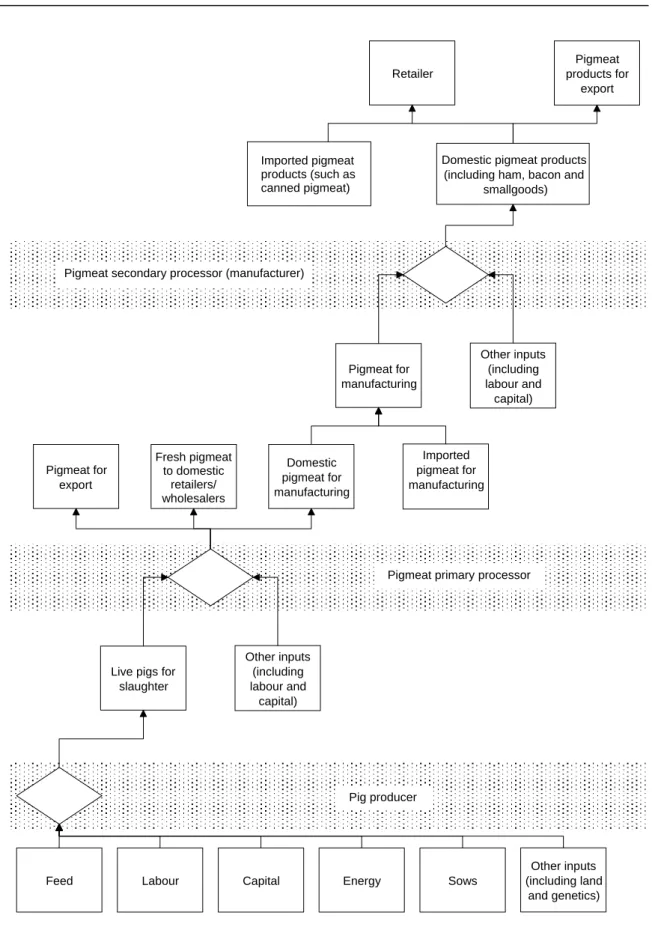
The pigmeat industry consists of three sectors: pig production, primary processing of pigmeat in abattoirs and boning rooms, and secondary processing (manufacturing). Primal cuts of meat — shoulders, middles and legs — are either sold in the fresh pigmeat market (through retail outlets and the food service industry) or used in the manufacture of bacon, ham and smallgoods. Although primal cuts are the main products, almost all of the pig is sold. Anecdotal evidence suggests 40 per cent of pigmeat consumed in Australia is fresh. Information on this share and how it has changed over time is limited.
Canada and Denmark have competed directly with Australian grown pigmeat to supply domestic manufacturers of bacon, ham and smallgoods since 1998. Because of quarantine restrictions, imports do not compete directly with Australian product in the fresh meat market. But other (non-fresh) imports may result in some displacement into the fresh market of local product that would otherwise have been used in manufacturing, thereby reducing prices. Recent changes to quarantine regulations have opened the way to allow imports from other countries. In December 2004, Australia received the first US frozen boneless pigmeat imports since the new quarantine policy was announced in May 2004.
The industry is undergoing structural change
The pigmeat production and processing sectors in Australia continue to experience major structural change, as they do in many other countries. Between 1970-71 and 2002-03, the number of pig producers declined from around 40 000 to just over 2300 (figure 1). Most of this adjustment occurred before quarantine arrangements changed in the 1990s. At the same time, annual pigmeat production increased by over 130 per cent, with steady growth between the mid-1970s and mid-1990s, which continued (albeit variably) until recently. Growth in output since the early 1990s has been due to gains in on-farm productivity from increasing the number of pigs per litter, reducing mortality rates and increasing weight gain rates and average slaughter weights. There has also been a shift towards the production of leaner pigs to meet consumer tastes.
OVERVIEW XVII
Figure 1 Producer numbers have fallen, while pigmeat production has
grown 0 5 000 10 000 15 000 20 000 25 000 30 000 35 000 40 000 45 000 197 0-71 197 3-74 197 6-77 197 9-80 198 2-83 198 5-86 198 8-89 199 1-92 199 4-95 199 7-98 200 0-01 200 3-04 No . 0 50 100 150 200 250 300 350 400 450 K ilot onne s
Producers (left axis) Production (right axis)
The primary processing sector has also undergone rationalisation. Many abattoirs have increased in size and become more specialised (some in export markets), but many have closed. Some processing plants have increased in size (although they remain small compared with plants in North America and Europe). However, underutilisation of capacity remains a problem in the sector.
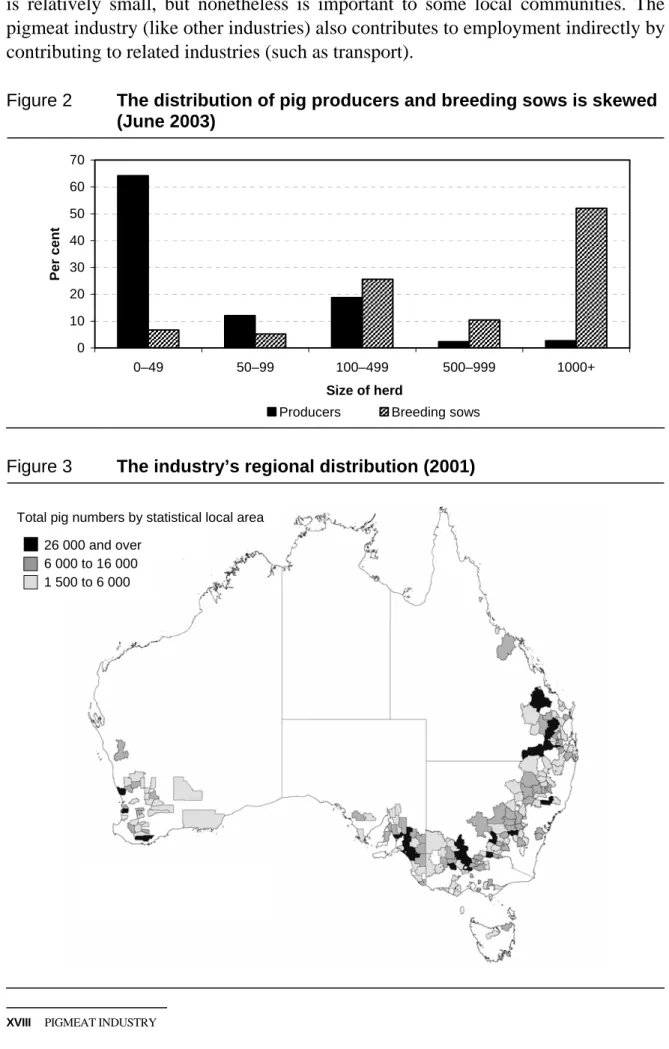
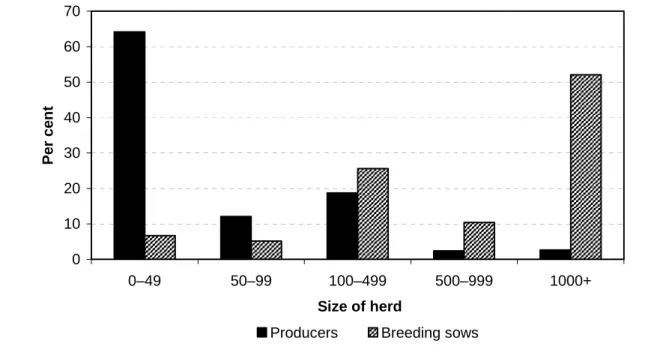
A small number of large producers now undertake a substantial proportion of Australian pig production. In 2003, the 3 per cent of producers with 1000 or more sows managed over half the breeding stock. Nevertheless, the majority of producers had small herds (with fewer than 100 sows) (figure 2). Many producers with small herds have other forms of income (such as grain production). In the past, many of these producers have entered and exited the pigmeat industry in response to market conditions. The trend towards more specialised, integrated production units, however, is reducing such opportunistic production in the pigmeat industry.
As the structure of pig production has changed (with an increasing number of larger operations), the nature and the level of risk have changed. Modern piggeries tend to be large and specialised to achieve economies of scale, which can reduce flexibility to adjust production decisions (such as the ability to use resources in other activities) in response to short term exogenous shocks in the prices of inputs and outputs.
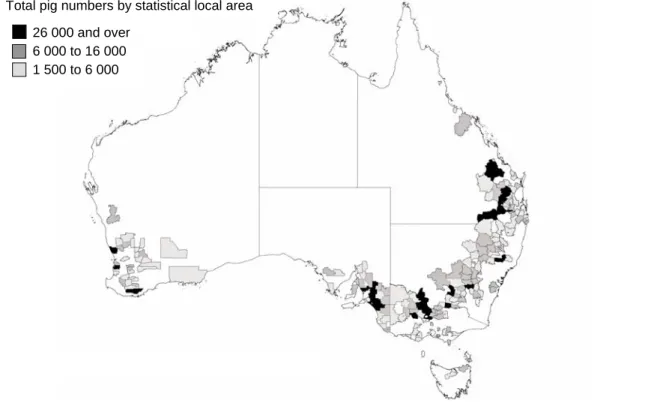
Most pigs are located within Australia’s grain producing regions, reflecting the relatively low cost of land and the reliance on grain as the major source of feed (figure 3). The concentration of pig production and processing operations varies across these regions. In most regions, however, direct employment in these sectors
XVIII PIGMEAT INDUSTRY
is relatively small, but nonetheless is important to some local communities. The pigmeat industry (like other industries) also contributes to employment indirectly by contributing to related industries (such as transport).
Figure 2 The distribution of pig producers and breeding sows is skewed
(June 2003) 0 10 20 30 40 50 60 70 0–49 50–99 100–499 500–999 1000+ Size of herd Per cent
Producers Breeding sows
Figure 3 The industry’s regional distribution (2001)
Total pig numbers by statistical local area 26 000 and over
6 000 to 16 000 1 500 to 6 000
OVERVIEW XIX The industry is increasingly integrating into world pigmeat markets
Imports were heavily restricted until July 1990, when quarantine restrictions were revised to permit imports of frozen uncooked pigmeat from Canada (and changed again in 1992 to require imports to be boned before export and processed on arrival in Australia). From November 1997, imports of uncooked pigmeat from Denmark were allowed under a similar protocol. This liberalisation of imports was not associated with a significant change in the downward trend in the number of domestic producers or the upward trend in production (figure 1), but it may well have affected the profitability of the remaining producers.
Trade in pigmeat to and from Australia has increased significantly in the past six years (albeit from a small base). Exports of pigmeat increased substantially from $56 million in 1997-98 to $195 million in 2003-04. Imports of pigmeat (although fluctuating more than exports) have also increased substantially over recent years, from $40 million in 1997-98 to $219 million in 2003-04 (figure 4).
Figure 4 Both imports and exports of pigmeat have risen greatly
0 50 100 150 200 250 300 1989-90 1992-93 1995-96 1998-99 2001-02 $ mi lli on 0 15 30 45 60 75 90 Kilo tonn e s
Value (nominal) (left axis) Volume (right axis)
Exports 0 50 100 150 200 250 300 1989-90 1992-93 1995-96 1998-99 2001-02 $ mi lli on 0 15 30 45 60 75 90 Kilo tonn e s
Value (nominal) (left axis) Volume (right axis)
Imports
From 1999 to 2001, Australian pigmeat exporters benefited from a favourable exchange rate and disease outbreaks in other exporting countries. The outbreak of Nipah virus in Malaysia (in 1999) and foot and mouth disease in Chinese Taipei (in 1999) and Europe (in 2001), for example, contributed to significant export opportunities in Asian markets such as Singapore and Japan.
Australian exports decreased by 29 per cent in value between 2001-02 and 2003-04, partly due to Europe’s recovery from foot and mouth disease and an appreciation of the Australian dollar relative to the currencies of major competitor countries (Canada, Denmark and the United States). Along with domestic pig production increasing by 3 per cent over the same period, the fall in exports meant that product that previously would have been exported was diverted to the domestic market.
XX PIGMEAT INDUSTRY
The main export markets for Australian pigmeat in 2003-04 were Singapore and Japan, which together accounted for 73 per cent of exports by value and 63 per cent by volume. Exports to Singapore are predominantly chilled carcasses, whereas exports to Japan generally are pre-packed, high value cuts such as from middles (loins and bellies).
The growth in imports has been higher than the growth in domestic consumption, indicating that the market share of imports has increased. The bulk of Australia’s imports come from Canada and Denmark (53 per cent and 42 per cent respectively by volume in 2003-04). Australia tends to import legs from Canada for manufacturing into ham, and middles from Denmark for manufacturing into bacon. Canadian legs account for about one third of the legs supplied to the Australian manufacturing sector, and Denmark supplies about one third of middles used by Australian bacon manufacturers.
Domestic prices are increasingly related to world prices
Pig prices (saleyard and contract) vary considerably across years (figure 5). As the Australian market has become more accessible to imports, and as exports from Australia have increased, prices in the domestic market are moving more closely with world prices, especially US prices. Nonetheless, Australian domestic prices of pigs are generally higher than prices in major competitor countries such as Canada and Denmark, but the extent of the price differential can vary over time, with implications for profitability. Danish prices (in Australian dollars), for example, fell relatively consistently between January 2002 and January 2004, whereas Australian prices, while trending downwards, rose and fell over the same period.
The integration of the Australian pigmeat market has resulted in imports affecting prices throughout the year. Historically, the price of legs to be made into ham on the Australian market increased in summer with seasonal demand. Australian producers now compete against pigmeat from North America where there are domestic price troughs in the Australian summer. Australian producers are also competing against Danish pigmeat producers that have little, if any, seasonal peaks or troughs. In both cases, the relatively high Australian summer prices make Australia an attractive market. Lower priced imports are effectively limiting the summer price peaks.
Between 2001-02 and 2003-04, the growth in imports and the diversion of product intended for the export market to the domestic market contributed to a decline in domestic prices received by pig producers, and lowered prices paid for pigmeat by manufacturers and consumers.
OVERVIEW XXI
Figure 5 Australian pig contract and saleyard real prices
100 150 200 250 300 350 400
Jan 1990 Jan 1992 Jan 1994 Jan 1996 Jan 1998 Jan 2000 Jan 2002 Jan 2004
C e nts per kilogr am (2003-04 d o llar s )
Baconer contract prices Porker contract prices Saleyard prices
Profitability was low between mid-2002 and the end of 2003, but is rising again
The profitability of businesses in the Australian pigmeat industry has varied over time. Many producers, after having three years of favourable returns, experienced substantial losses between mid-2002 and the end of 2003. However, profitability improved for many pig producers in 2004.
Trends in competitiveness and their drivers
A business’s competitiveness in a market depends on its ability to produce and deliver a product of a given quality for that market at a cost rivalling that of competing businesses, or to use superior marketing and brand image to gain a price premium that more than offsets any cost disadvantage.
Businesses must seek and sustain competitive advantage to remain profitable
Product differentiation and cost advantages are important forms of competitive advantage in pigmeat markets. Inquiry participants considered that the disease free status of Australian pigs is a key factor differentiating Australian pigmeat from its competitors internationally. Australia’s proximity to Asian markets provides a potential ‘delivered to market’ cost advantage to Australian exporters to these markets. Competitive disadvantages include high feed costs relative to some major
XXII PIGMEAT INDUSTRY
competitors — with producers often paying premiums for high quality grain suitable for human consumption (box 1) — and the comparatively small size of most operations. In addition, the relatively large distances between farms, feed supplies, abattoirs and domestic markets in Australia create disadvantages for many smaller pig producers. Factors external to the business — such as domestic and international government policy, disease outbreaks and exchange rate variations — can also affect competitiveness.
There is no single indicator of competitiveness, although profitability and movements in market share can provide insights. The continued survival of pigmeat businesses without significant government assistance can also demonstrate the international competitiveness of businesses.
Box 1 Feed grain is a source of competitive disadvantage
Feed costs are the largest cost item for pig producers in Australia, typically accounting for about 60 per cent of total costs. Grain makes up about 80–85 per cent of feed costs, for a typical cost share of 55 to 60 per cent. Common grains for feed in Australia are wheat, barley and sorghum.
Many of the grains produced by the Australian cropping industry are of high quality and can be used for human consumption (such as wheat for flour production), and generally are not grown for specific feed grain uses such as feed for the pig industry. In contrast, overseas pig producers, such as those in North America, have access to a feed grain industry (corn and soybean).
Unless the relative profitability of growing feed grain increases, Australian grain producers will continue to produce grain for human consumption, and the pigmeat industry will remain at a competitive disadvantage in this area. The Australian Government recently announced funding of $25.75 million for a Cooperative Research Centre for the pigmeat industry. This centre will focus on reducing feed costs, improving herd feed conversion efficiency and demonstrating the health benefits of consuming nutritionally enhanced pigmeat products.
Competitiveness declined in 2002 and 2003, but indicators were mixed in 2004
The competitiveness of many businesses in the pigmeat industry declined between mid-2002 and the end of 2003. There are mixed signals on recovery, with profitability rising but imports continuing to grow and exports declining.
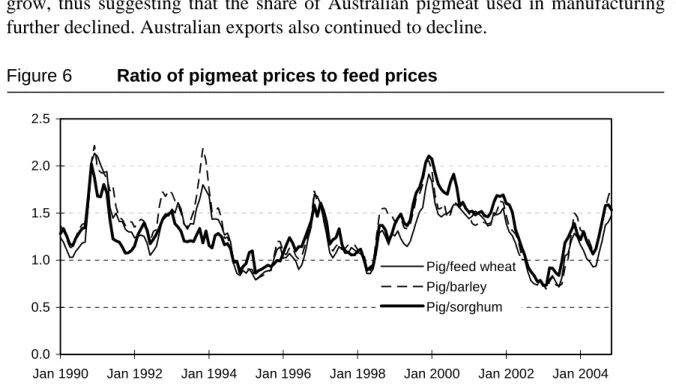
One indicator of profitability in pig production — the ratio of pig prices to feed grain prices — was substantially lower in 2002-03 when grain prices rose as a result of drought in both Australia and major overseas grain producing countries (figure 6). This indicator had improved markedly by late 2004. The share of
OVERVIEW XXIII
Australian pigmeat used in manufacturing declined between mid-2002 and the end of 2003. In addition, during 2004, the volume of imported pigmeat continued to grow, thus suggesting that the share of Australian pigmeat used in manufacturing further declined. Australian exports also continued to decline.
Figure 6 Ratio of pigmeat prices to feed prices
0.0 0.5 1.0 1.5 2.0 2.5
Jan 1990 Jan 1992 Jan 1994 Jan 1996 Jan 1998 Jan 2000 Jan 2002 Jan 2004 Pig/feed wheat
Pig/barley Pig/sorghum
Many external factors influenced the decline in competitiveness in 2003
The competitiveness and profitability of Australian pigmeat producers have been adversely affected by several factors external to pigmeat businesses, such as the lower delivered price of imported pigmeat and substantial rises in the price of feed grain between mid-2002 and the end of 2003. Feed costs are a significant share of total operating costs of pig businesses, so changes in feed prices have a significant effect on individual business competitiveness. As noted, however, feed grain prices have fallen considerably since 2003. The Australian dollar prices of pigmeat in competitor countries fell relative to Australian domestic prices between July 2001 and January 2004 as a result of increased world production (and resultant lower world prices), and an appreciation in the Australian dollar.
Current levels of government assistance are low
Levels of government assistance provided to pigmeat producers in Denmark and the United States are low and generally for programs similar to those available to Australian pigmeat producers. Somewhat more assistance (but still low) is provided to pigmeat producers in Canada — mainly as a result of the Canadian Agricultural Income Stabilisation program and provincial stabilisation schemes (box 2).
XXIV PIGMEAT INDUSTRY
Box 2 Assistance to pigmeat producers overseas
Levels of assistance to agricultural producers can be compared internationally and across agricultural industries using producer support estimates (PSEs) calculated by the OECD. The PSE is a measure of the monetary value of gross transfers from consumers and taxpayers to agricultural producers arising from policy measures that support agriculture. It comprises direct payments made to producers and an estimate of market price support. Some forms of assistance to agriculture not incorporated in PSE estimates include research and development and adjustment programs.
The PSE is low for Australia (3.59 per cent in 2003) and the United States (3.56 per cent) and somewhat higher for Canadian pigmeat producers (8.45 per cent). The PSE for pigmeat producers in the European Union (23.93 per cent on average) is much higher. This has been incorrectly interpreted by many inquiry participants as indicating that Danish pigmeat producers receive substantial assistance, thereby advantaging them in the Australian market.
The OECD estimate for the European Union should be interpreted with caution because it is not a measure of assistance within individual member countries. The OECD does not calculate PSEs for individual EU member countries.
After consulting a variety of sources and analysing the characteristics of the Danish market and support arrangements, it becomes clear that assistance to Danish pigmeat producers is relatively low:
• Farm gate prices received by Danish producers are below the EU average and
Danish processors receive higher prices, on average, on export markets than on domestic EU markets.
• Budgetary outlays by the EU and Danish governments to the Danish pigmeat
industry are low compared to the value of Danish production.
• Assistance provided by the Danish and EU governments to grain growers does not
result in lower feed costs for Danish pigmeat producers.
The available evidence indicates that the Danish pigmeat industry comprises highly efficient businesses seeking out export markets that yield the highest returns for individual cuts of pigmeat.
Assistance to pigmeat producers is also relatively low in Australia. Some industry participants questioned the estimate of assistance to Australian producers. The Organisation for Economic Cooperation and Development (OECD) estimates of assistance to Australian pigmeat producers (3.59 per cent of the value of farm gate production in 2003) includes general government programs that were also available to producers in other agricultural enterprises as well as any specific assistance to pigmeat producers.
It would be beneficial for the Australian industry to have a better understanding of the competitive position of major overseas producers that are penetrating the
OVERVIEW XXV
Australian processed market. In the Commission’s view, the reluctance of some producers to accept that overseas imports are entering on a highly competitive basis without significant levels of government assistance is inhibiting them from positively responding by making necessary adjustments at the individual business level. It might also be noted that, as in other industries, even a significant level of overseas assistance would not, in and of itself, justify matching assistance to Australian producers. It is generally not in Australia’s best interests to match industry assistance provided by other countries.
The effect of grain support arrangements are also minor
The OECD estimates that the domestic price of grain in Canada was C$9 (about 8 per cent) more than the export price as a result of wheat marketing arrangements in 2003, imposing a relatively small cost (C$18 million) on Canadian pig producers. However, the Canadian Government’s removal of assistance for grain transport has encouraged the use of grain within Canada, lowering grain prices to the benefit of Canadian pig producers and other grain users.
There are substantial budgetary transfers to grain producers in the European Union including Denmark, but this assistance does not appear to translate into lower grain prices to Danish pigmeat producers — Danish grain prices are similar to world prices for comparable grains.
Long run competitiveness is important
Variability in both feed prices and exchange rates is likely to continue, so the competitiveness of Australian pigmeat businesses will also continue to fluctuate. While Australian pig producers benefited from an increase in Australian pigmeat prices in late 2004, the unpredictability of these two factors means the medium to long term outlook remains unclear.
Since the quarantine changes of the 1990s, imports have risen relatively consistently, and the Commission can see no reason for imports to abate in the near future. The rise in imports is the result of many factors, including product differentiation (such as on the basis of quality) and the cost competitiveness of the imports.
The pigmeat industries in Canada and the United States have some cost advantages over the Australian industry, particularly lower feed and processing costs. Australian pig producers and processors are unlikely to match these relative advantages in the near future. (Nevertheless, in some Australian export markets, the Canadian and US producers are at a competitive disadvantage when pigmeat fat is
XXVI PIGMEAT INDUSTRY
yellowed from corn feeding.) The sources of Danish competitive advantage are uniformity of their product (weight, size and exact specifications) and the ability to supply large quantities. Danish businesses also appear to have an advantage in production technologies, although they face relatively more restrictive environmental regulations. Further, many Canadian, Danish and US businesses have been able to achieve economies of scale (in both pig production and meat processing) that will be difficult to match (profitably) in Australia.
Australia’s main ongoing competitive advantages in export markets are its ‘clean, green’ image, disease free status and relative closeness to Asia. Australia is unlikely to achieve cost advantages in feed and processing in the near future, and the size and regional distribution of its industry may make it difficult to achieve significant economies of scale. In the long run, the competitiveness of businesses will be driven more by fundamental comparative advantages and disadvantages inherent to individual businesses in specific locations, which may not change significantly in the short term.
Nevertheless, the resilience of some Australian pigmeat businesses should not be underestimated. Some businesses will struggle in the short to medium term, and the number of domestic producers will continue to decline as marginal businesses leave the industry. On the other hand, businesses that are well managed, efficient and well located with strong supply chains, targeting specific pigmeat markets in which they have competitive advantages, are likely to continue to prosper in the longer term.
Recent government and industry programs
The Australian, State and Territory governments continue to provide general as well as industry-specific assistance to the pigmeat industry (box 3). The industry collected $13.5 million in 2003-04 for marketing, research and development from its industry levy and received $4.6 million from the Australian Government for research and development in that year. Government funding for adjustment included $227 000 for FarmBis in 2003-04 and $3.4 million in Exceptional Circumstances funding. Eligible pigmeat producers held $21.7 million in Farm Management Deposits. The industry also received funding of over $20 million for the Pork Industry Restructure Strategy in 1998–2001.
There do not appear to be any impediments to eligible pigmeat businesses accessing these programs. Reviews of the generally available adjustment programs forming ‘Agriculture — Advancing Australia’ found the programs to have been broadly effective in facilitating adjustment. However, there appear to be few evaluations of the net benefits generated by other government programs.
OVERVIEW XXVII
Box 3 Various assistance programs are available to the Australian
pigmeat industry
Government programs
Businesses in the pigmeat industry have accessed both generally available programs and pigmeat-specific programs to invest in:
• research and development (including government support through an industry levy,
funding, extension services)
• market development (including government support through an industry levy, export
market development, funding)
• processing facilities (via the Pigmeat Processing Grants Program).
Pigmeat businesses also have been able to access programs to facilitate adjustment to economic change. These include general agriculture programs such as FarmBis, Farm Help and Farm Management Deposits, and the pigmeat industry-specific Pork Producer Exit Program.
Industry programs
Programs run by industry seek to target different aspects of the pigmeat production and supply chain, for example:
• research and development — Australian Pork Limited’s research and innovation
program, and research and development undertaken by larger pigmeat producers
• marketing — Australian Pork Limited’s domestic and export marketing program, the
Confederation of Australian Pork Exporters, and marketing undertaken by larger pigmeat producers
• quality assurance — the Australian Pork Industry Quality Program (administered by
Australian Pork Limited)
• environmental management programs — the Environmentally Sustainable Piggeries
Program (administered by Australian Pork Limited).
The industry also runs programs that attempt to target aspects of the pigmeat production and supply chain. Little information is available about the effectiveness of these programs. The benefits and costs of Australian Pork Limited’s research and development programs (funded by an industry levy and government contributions), for example, do not appear to be routinely evaluated and publicly reported. Such evaluations are essential to assess the effectiveness with which research and development programs are managed.
XXVIII PIGMEAT INDUSTRY
Potential impediments to performance and competitiveness
Inquiry participants noted potential impediments to improving performance and competitiveness, including:
• imports into Australia and assistance in overseas countries (including the impact on investor confidence)
• limited market access and/or high trade barriers in some overseas markets
• distortions affecting grain prices and availability
• difficulties in recruiting and retaining labour
• ambiguous or potentially misleading country-of-origin labelling practices
• limits on the ability of pig producers to increase returns by producing larger pigs, and issues with the current system that determines the payment for pigs
• a lack of ability to manage risk
• constraints on the access to capital.
Some of these issues are clearly not unique to the pigmeat industry. The availability and cost of labour, for example, are influenced by trends in the wider economy, particularly the strength of employment and wage levels in other industries competing for workers who could be employed in the pigmeat industry. Pigmeat businesses will be able to access capital (through debt or equity finance) if their investment proposals are sufficiently attractive. For another group of issues — such as those relating to pig size, the payment system, supply chain coordination and risk management — industry and individual businesses are best placed to deal with them.
In the case of country-of-origin labelling, existing institutions and regulatory arrangements together seem sufficient to limit misleading labelling of pigmeat products in Australia. A Victorian pilot of the HomeGrown label was launched in January 2005, but it remains unclear whether consumers would pay a premium for Australian produce.
Nonetheless, some areas remain in which governments could act to reduce impediments.
Market access is important for Australian exporters
The Australian pigmeat industry faces trade barriers overseas that can be an impediment to exports. Tariffs, quotas and other trade measures vary across export markets and also differ according to product. For example:
• Japan — a major market for Australian pigmeat exports — has a gate price system that requires importers to pay the difference between the imported value
OVERVIEW XXIX
and the gate price (where the imported value is below the gate price), and also a tariff of 4.3 per cent on fresh, chilled or frozen pigmeat
• Chinese Taipei has tariffs of 55 per cent on fresh, chilled or frozen pork bellies, and 13 per cent on other fresh, chilled or frozen pigmeat
However, there are no tariffs on exports to Singapore (the industry’s largest export market), Hong Kong and New Zealand.
It is important that the Government continues to press for reduced overseas barriers to Australian pigmeat exports, as part of its efforts within the current Doha Round and in any prospective negotiations on preferential trade arrangements.
Distortions in the domestic grain market may reduce competitiveness
Governments have been dismantling many elements of statutory marketing arrangements for grain since the mid-1980s. Some restrictions remain for wheat, barley and other feed grain. A key concern for inquiry participants is the single-desk arrangement for wheat exports (although concerns were also raised about exports of barley in South Australia). Single-desk marketing arrangements have the potential to raise domestic prices for grain, particularly during a drought, reducing the competitiveness of all domestic grain-using industries (including the pigmeat industry). Although arbitrage opportunities should limit the scope to raise domestic prices, governments should regularly review such arrangements to ensure the benefits outweigh the costs. The Commission’s discussion draft on its review of National Competition Policy reforms proposed that continuing restrictions on competition in export wheat marketing should be re-examined sooner rather than later.
Quarantine restrictions on importing grain into Australia — to manage the pest and disease risks that might affect Australia’s broadacre industries and natural flora and fauna — were also a concern of inquiry participants for two reasons:
• First, the quarantine barriers can exacerbate the effects of any domestic market power of single-desk exporters of grain. During droughts, for example, when the single-desk body for wheat is virtually the only supplier of wheat to the domestic feed industry, the import controls reinforce its market power.
• Second, the quarantine arrangements for importing grain could involve high costs (including both costs of treatment and potential increased prices for domestic users), so these arrangements should impose only the minimum requirements needed to satisfy quarantine objectives. The pigmeat industry has a continuing role to explore opportunities to import feed while meeting Australia’s quarantine requirements.
XXX PIGMEAT INDUSTRY
Inquiry participants also raised concerns about the likely effects of government support in Australia for ethanol production. Government support to encourage the expansion of the ethanol industry is likely to raise domestic prices for feed grain, adversely affecting the pigmeat and other intensive livestock industries. The impact will depend on the extent to which feed grain is used for ethanol production, and the size of the ethanol industry. Given the potential costs to other industries, governments should regularly review these arrangements to ensure the benefits outweigh the costs.
Actions to address impediments cannot offset key disadvantages
Pig production is a low margin industry and any reduction in costs at the margin is important. Nevertheless, the Commission notes that reducing impediments to competitiveness is unlikely to make such a large improvement to the competitiveness of pigmeat businesses as to offset the fundamental disadvantages of relatively high feed costs and small scale (and often fragmented) industry structure. They would also not insulate the industry from such significant forces affecting short-run competitiveness as drought and fluctuating exchange rates.
Industry and government measures to improve competitiveness
Inquiry participants suggested a number of steps that pigmeat businesses could take to improve their competitiveness. These include greater vertical and horizontal integration across the supply chain; using more long term supply contracts between pig producers and grain suppliers; improving efficiencies in production (including increasing scale); improving carcass measuring systems; value adding more before selling to retailers or exporting; and improving product choice for consumers. A number of such initiatives are already being adopted or developed and are a part of Australian Pork Limited’s proposed industry restructure plan.
These measures have some disadvantages as well as advantages, and not all would suit or benefit every business. Pig producers, processors or the industry as a whole therefore need to judge the relative merits of these industry measures, and the timing of any implementation. The Commission sees no major regulatory or market impediments to businesses making informed commercial decisions.
The regulatory environment should reflect good process
The broad regulatory environment within which pigmeat businesses operate can impede the competitiveness of the pigmeat industry, and its ability to grow and adjust. Governments across Australia are continuing to review planning and
OVERVIEW XXXI
development approval laws in response to general concerns over the formation and use of such laws, seeking to improve their efficiency and effectiveness. Changes in environmental, health or animal welfare regulations should be subject to rigorous regulation impact assessments and involve effective consultation with all affected parties to ensure they are designed to generate net benefits to the community and impose the minimum requirements necessary to achieve their objectives.
General assistance programs are available
The Commission has also received no evidence that pigmeat businesses have been unable to access the available general agricultural, business or social security assistance and a number of reviews of assistance programs have found them broadly effective in facilitating adjustment. A possible exception in terms of accessibility has been in relation to drought assistance.
Although restructuring of the pigmeat industry (with many businesses amalgamating and increasing in size) potentially reduces the accessibility or relevance of some general agricultural programs to pigmeat businesses, the need for such programs may also decline. Other generally available programs (such as social security assistance and retraining programs) may become more useful for those employed by larger, corporate businesses.
Governments should, however, regularly conduct independent reviews of generally available assistance programs to ensure they are appropriate, efficient and effective. Moreover, future reviews of drought policy could assess the impact of drought assistance on pigmeat businesses, as well as the general merits of current arrangements.
Additional adjustment assistance for pigmeat businesses?
The pigmeat industry in Australia has been undergoing significant change, like many other sectors of the economy and pigmeat competitors in other countries. In most industries, there are both expanding and contracting businesses. Simultaneous entry and exit of businesses in a single industry is also normal. Most adjustment is autonomous — that is, it is a response of businesses in the industry to changes in their environment, independent of government assistance.
The pigmeat industry is no different: some businesses are seeking more resources to invest in the industry to pursue niche markets while others are considering withdrawing their resources. Several submissions asserted that adverse changes in recent years have been ‘too much’ and that additional industry-specific adjustment assistance is justified to ensure the industry’s ongoing competitiveness and to assist
XXXII PIGMEAT INDUSTRY
some businesses to exit the industry. However, feed prices have fallen since mid-2003 and pig prices have increased since mid-2004, improving the financial position of most pigmeat businesses and easing adjustment burdens.
Some inquiry participants suggested that certain characteristics of pigmeat production may restrict structural adjustment, including the low re-sale value of assets, the short growing cycle of pig production and the industry’s difficulties in attracting skilled labour and management. The Commission has not found evidence that the characteristics of pigmeat businesses substantially impede adjustment. General assistance programs are thus likely to be appropriate mechanisms for assisting adjustment, without the need for further industry-specific assistance.
Safeguard measures are unlikely to facilitate adjustment
Several inquiry participants argued the Australian Government should take safeguard actions under WTO provisions as a special form of temporary industry adjustment assistance to provide pigmeat businesses with ‘breathing space’ from import competition and to help facilitate adjustment and structural change. The Commission has not been asked to comment on whether safeguard (or preliminary safeguard) actions are justified under WTO rules, and could not undertake a safeguards inquiry without a formal request from the Australian Government.
As observed in the Commission’s 1998 safeguards inquiry, however, regardless of whether WTO provisions would allow for safeguard measures, it is far from clear that such actions would be the most appropriate way of assisting the pigmeat industry. Trade restrictions would be a blunt and indirect way of providing assistance — with all pig producers and primary processors assisted regardless of need — and would reduce incentives for pigmeat businesses to adjust. Such restrictions are more likely to discourage change and restructuring. Restricting imports of pigmeat would also adversely affect pigmeat consumers, retailers and manufacturers. It might also detract from Australia’s capacity to seek reductions in overseas trade barriers.
Countervailing and anti-dumping duties
Countervailing duties can be imposed on agricultural imports under WTO rules if it can be demonstrated that imported products are being subsidised and that this subsidisation is causing, or threatens to cause, material injury to a domestic industry. Imports of pigmeat to Australia from Denmark and Canada, however, receive relatively low levels of assistance.
OVERVIEW XXXIII
Anti-dumping measures can be applied under WTO rules if it can be established that imports are being sold at prices below their ‘normal value’ in the country of origin and that the domestic industry is suffering, or likely to suffer, material injury as a result. Australia is generally regarded as a high price destination for pigmeat exports from Europe and North America.
Industry and government should focus on economic fundamentals
Industry adjustment is an important means by which the pigmeat industry can improve competitiveness. The entry and exit of businesses enables new investment and innovation, as well as managerial improvements.
In the Commission’s view, government measures to facilitate a competitive industry are best directed at providing an economic environment conducive to sustainable economic growth, providing ongoing support for research and development where appropriate, minimising impediments to efficiency and competitiveness, and ensuring the effective and efficient performance of government programs.
The difficulties periodically experienced by pigmeat businesses — including, most recently, between mid-2002 and the end of 2003 — relate to the continuously changing conditions of international pigmeat markets, climate and currency markets. Pigmeat businesses can readily access existing agricultural adjustment programs and general welfare programs.
In the Commission’s view, additional adjustment assistance measures (including exit packages) for pigmeat businesses are not warranted at this time. The Commission can find little justification for governments subsidising the capital expenditures of pigmeat businesses, as suggested by some inquiry participants. Nor is there a need at present for additional regional adjustment assistance.
To be successful in the longer term, Australian pigmeat businesses will need to ensure their production systems are closely linked to the needs of specialised niche markets for pigmeat cuts, and constantly seek productivity gains within those production systems. These businesses will also have to ensure effective communication of market information through the supply chain from the consumer to the pig producer. These changes are best left to individual businesses and the market place.
XXXIV PIGMEAT INQUIRY
Findings
Australian markets for pigs and pigmeat
Australia’s pig production and primary processing sectors continue to experience significant structural change, as in many other countries. Pigmeat production has increased, while the number of pig producers has declined substantially. The primary processing sector has also become more concentrated, with many abattoirs becoming more specialised.
Australia has become increasingly integrated into the world pigmeat market over the past six years, with pigmeat imports rising from $40 million to $219 million, and exports increasing from $56 million to $195 million.
Industry competitiveness
The competitiveness of a business can be difficult to measure, although profitability and market share are useful indicators. Many Australian pig producers made substantial losses during 2002-03, following three years of above average profits. Profitability improved for many pig producers in 2004. The share of imported pigmeat used by secondary processors increased between 2002 and 2004. Exports of pigmeat declined during that period.
External factors affecting competitiveness
The competitiveness of Australian pig producers in the domestic market and some international markets declined between mid-2002 and the end of 2003, largely reflecting movements in exogenous factors such as exchange rates and feed prices. There are mixed signals on recovery. Both exchange rates and feed prices moved favourably during 2004, enabling some recovery of profitability, but imports continued to grow while exports declined. Such fluctuations in competitiveness are likely to continue.
FINDING 2.1
FINDING 2.2
FINDING 3.1
FINDINGS XXXV Assistance to Canadian and European Union grain producers has not resulted in a significant reduction in prices paid for grain by Canadian and Danish pigmeat producers.
Imports of pigmeat into Australia do not benefit significantly from foreign subsidies. Government assistance provided to pigmeat producers in Denmark and the United States is low. Somewhat more assistance (but still low) is provided to pigmeat producers in Canada.
Government assistance provided to Australian pigmeat producers is also low. The types of assistance are similar to those available to producers in Denmark and the United States.
Internal factors affecting competitiveness
Continuing improvements in practices internal to a pigmeat business are important to maintain long run competitiveness with foreign competitors. In the short run, however, these internal factors are unlikely to offset such influences as large unexpected movements in feed grain prices and exchange rates.
While increased specialisation and capital intensity have allowed some pig producers to achieve economies of size and higher returns, the consequences of large unanticipated variations in prices of outputs and inputs may be greater than for less specialised producers.
Government and industry programs in Australia
The benefits and costs of Australian Pork Limited’s research and development programs do not appear to be routinely evaluated and publicly reported. Such assessments are critical to monitor the effectiveness with which research and development programs are managed.
FINDING 4.2 FINDING 4.3 FINDING 4.4 FINDING 5.1 FINDING 5.2 FINDING 6.1
XXXVI PIGMEAT INQUIRY
Businesses in the pigmeat industry have accessed generally available programs, and pigmeat-specific programs, to invest in research and development, market development, and processing facilities. There has been little evaluation of the net benefits generated by individual programs.
Potential impediments to improving performance and competitiveness
There is an ongoing role for the Australian Government to press for reduced overseas barriers to Australian pigmeat exports, as part of its efforts within the current Doha Round and in any prospective negotiations on preferential trade arrangements.
Single-desk marketing arrangements for domestic and export sales of Australian grain have the potential to raise domestic prices for grain, particularly during drought, reducing the competitiveness of all domestic grain-using industries (including the pigmeat industry).
Government support to encourage the expansion of the ethanol industry is likely to raise domestic prices for feed grain, adversely affecting the pigmeat and other intensive livestock industries. The impact will depend on the extent to which feed grain is used for ethanol production, and the size of the ethanol industry.
Governments should ensure any regulatory requirements — such as those related to quarantine, planning and development, animal welfare and environmental impacts — are the minimum necessary to achieve their objectives. However, this is unlikely to greatly alter the competitiveness of pigmeat businesses. The benefits are unlikely to be large, and could be slow to emerge. More significant factors affecting short-run competitiveness are forces such as drought and fluctuating exchange rates. FINDING 6.2 FINDING 7.1 FINDING 7.2 FINDING 7.3 FINDING 7.4
FINDINGS XXXVII
Measures to improve industry competitiveness
The Australian pigmeat industry and pigmeat businesses can pursue a range of measures to improve business competitiveness. The relative merits of any such measures are best judged by individual pig producers or processors, or by the industry as a whole.
Given the potential impacts of single-desk grain export arrangements on domestic grain-using industries, the Australian and relevant State governments should regularly review such arrangements to ensure their benefits outweigh the costs for the community as a whole.
Given the potential costs of government support for the ethanol industry, the Australian Government should regularly review that support to ensure the benefits outweigh the costs for the community as a whole.
While additional restrictions on pigmeat imports into Australia may provide short term benefits to pig producers, they would adversely affect Australian pigmeat consumers, retailers and manufacturers. They could also discourage or delay ongoing restructuring and would fail to target those in greatest need of assistance.
Additional adjustment assistance specific to the pigmeat industry is not warranted, but governments should regularly review generally available agricultural and business assistance programs and existing assistance targeted at the pigmeat industry to ensure their appropriateness, efficiency and effectiveness.
FINDING 8.1
FINDING 8.2
FINDING 8.3
FINDING 8.4
INTRODUCTION 1
1 Introduction
On 31 August 2004, the Australian Government Treasurer asked the Productivity Commission to undertake an inquiry and report on the competitive situation of, and outlook for, the Australian pigmeat industry, including both production and processing. The Treasurer also asked the Commission to report on whether government or industry measures are necessary to enhance the competitiveness of the industry and, if so, what measures would be necessary and appropriate. This report presents the Commission’s analysis and findings.
1.1
Background to this inquiry
The Australian pigmeat industry has undergone significant restructuring for many years, with the number of pig producers falling, many abattoirs closing or becoming more specialised, and processing plants increasing in size. The industry has also become increasingly vertically integrated, with ownership or long term contracts linking the supply chain, especially between pig production and processing. Following significant changes to quarantine arrangements since 1990, the industry has become increasingly integrated with world markets.
After experiencing three years of favourable returns, pig producers in Australia (and major competing countries) faced difficult economic circumstances between mid-2002 and the end of 2003. World prices fell and, in some countries (including Australia), feed costs were high. In Australia, these trends were exacerbated by an appreciating dollar relative to the currencies of major competing countries. Competition in the domestic market from imported pigmeat has been strong and imports have been rising steadily since the mid-1990s. Exports also grew strongly from 1997-98, but declined in value in 2002-03 and 2003-04. Although pig prices have been recovering in recent months, and feed prices are returning to the range experienced before the 2002-03 drought, the difficult economic circumstances have prompted concerns from the industry. Concerns have been raised, for example, about the economic sustainability of some domestic pig producers, and about how all sectors of the industry can continue to adjust and remain competitive.
This inquiry contrasts with an inquiry undertaken by the Commission in 1998 that examined possible safeguard actions in regard to pigmeat imports into Australia
2 PIGMEAT INDUSTRY
(PC 1998). In that inquiry, the Commission responded to a request from the Australian Government to assess whether safeguard action was warranted against pigmeat imports in accordance with World Trade Organization safeguard investigation procedures. Safeguard actions are emergency actions that are appropriate when increased imports are unexpected and unforeseen, and have caused (or are likely to cause) serious material injury to the domestic industry. The terms of reference for this inquiry, however, do not request the Commission to determine whether safeguard (or provisional safeguard) measures are warranted. In 1995, the former Industry Commission undertook a research study of the effects of pig