Iran J Public Health, Vol. 46, No.2, Feb 2017, pp.165-172
Review Article
Improving the Prediction of Survival in Cancer Patients by Using
Machine Learning Techniques: Experience of Gene Expression
Data: A Narrative Review
Azadeh BASHIRI, *Marjan GHAZISAEEDI, Reza SAFDARI, Leila SHAHMORADI
,Hamide EHTESHAM
Dept. of Health Information Management, School of Allied Medical Sciences, Tehran University of Medical Sciences, Tehran, Iran
*Corresponding Author: Email: [email protected]
(Received 22 Sep 2016; accepted 20 Dec 2016)
Introduction
Today, cancer is one of the major health prob-lems worldwide (1-3). Cancer research in the 21st century has become one of the most common efforts. The International Agency for Research on Cancer, based on 2002 dataset, estimated that the numbers of cancer patients are 25 million and the American Cancer Society in 2004, announced that officially cancer would replace heart disease as the main cause of death (4-6). Despite the many advances in early detection of diseases,
cancer patients have a poor prognosis and sur-vival rate for such patients are low (7-9). Correct perception of the biologic behavior of the tumor and its analysis, help to correct choice of treat-ment and has a potential to improve the conse-quences of cancer as well. Accurate estimation of prognosis and survival duration is the most im-portant part of a process of clinical decision-making in patients with malignant disease (9). The first step to making sure that cancer patients have received Abstract
Background: Today, despite the many advances in early detection of diseases, cancer patients have a poor prognosis and the survival rates in them are low. Recently, microarray technologies have been used for gathering thousands data about the gene expression level of cancer cells. These types of data are the main indicators in survival prediction of cancer. This study highlights the improvement of survival prediction based on gene expression data by using machine learning techniques in cancer patients.
Methods: This review article was conducted by searching articles between 2000 to 2016 in scientific databases and e-Journals. We used keywords such as machine learning, gene expression data, survival and cancer.
Results: Studies have shown the high accuracy and effectiveness of gene expression data in comparison with clinical data in survival prediction. Because of bewildering and high volume of such data, studies have highlighted the impor-tance of machine learning algorithms such as Artificial Neural Networks (ANN) to find out the distinctive signatures of gene expression in cancer patients. These algorithms improve the efficiency of probing and analyzing gene expres-sion in cancer profiles for survival prediction of cancer.
Conclusion: By attention to the capabilities of machine learning techniques in proteomics and genomics applications, developing clinical decision support systems based on these methods for analyzing gene expression data can prevent potential errors in survival estimation, provide appropriate and individualized treatments to patients and improve the prognosis of cancers.
proper care is to improve the ability of physicians to formulate this type of estimation (10).
The prediction of prognosis includes the vast range of decisions about different aspects of can-cer treatment (10). The gene expression profiles obtain from different tissue types (11). By com-paring the genes expressed in normal tissue and diseased tissue can bring better insight and un-derstanding of the cancer pathology and help to physicians in decision-making. Checking gene expression patterns for attributes associated with the clinical behavior are very important, because these patterns, examine prognosis and leading to the alternative approach to understand the mole-cular and physiological mechanisms (10-12). Gene expression pattern analysis offers ways to improve the diagnosis and classification of risk for many cancers (11, 12). Studies have marked the power of analytical methods than histological and clinical criteria in survival prediction. Recent-ly in artificial intelligence domain, developing clinical decision support systems based on ma-chine-learning methods to analyze gene expres-sion data has facilitated and improved the medi-cal prognosis. Studies have shown the higher ac-curacy of machine learning algorithms than re-gression models in predicting cancer survival (12, 13). Gene expression data have the potential to prevent errors caused by fatigue and impatience of oncology experts in survival estimation. Analyzing such a data by using machine-learning techniques leads to developing clinical decision support sys-tems for the correct estimation of survival time and so provides proper treatments to patients according to their survival. This achievement can prevent un-necessary surgical and treatment procedures that increase the use of human resources and time that impose unnecessary costs on patients and the health care system (8, 14, 15).
This study has highlighted the advantages of ma-chine learning techniques in survival prediction of cancer patients based on gene expression data.
Methods
This review article was conducted by searching articles between 2000 to 2016 in scientific
data-bases (SCOPUS & Pub Med & Google Scholar & IEEE) and e-Journal (science direct), and by us-ing keywords such as machine learnus-ing algo-rithms, gene expression data, survival and cancer. Non-English and unavailable full texts and also the studies that not defined as a journal article were excluded from this study.
Results
Microarray Technology and Gene Expression Data
Several genes and proteins with abnormal func-tion and expression contribute to the cancer de-velopment and its pathogenesis (9, 16, 17). Gene expression measures the level of gene activity in a tissue and thus gives information about the com-plex activities of cells. This data usually obtain by measuring the activation and function of genes during their translation. Since cancers are asso-ciated with genetic abnormalities, gene expression data can display these abnormalities. To obtain information about these abnormalities, microar-ray techniques largely have used. Microarmicroar-ray is a technology for measuring the expression and ac-tivities of dozens, hundreds or thousands of genes or proteins simultaneously on a small scale, to monitor changes in their structure and activity. The microarray process involves raw data pre-processing to gain gene expression matrix and then analysis it to show the differences and simi-larities of gene expression (7, 13, 18, 19). The ul-timate goal of this technology is discovering a new treatment or reforming previous treatments based on a combination of genetic tumors (11, 20, 21).
Predic-tion, categories are predefined and the aim is to determine which class is the target sample be-longs to (8, 16, 19).
In recent years, microarray technology has pro-vided great evolution in the biomedical sciences and considered in a vast domain of genomics analysis, such as drug discovery, identifying genes and successful clinical diagnostics. The ultimate goal of this technology in cancer is to discover new genetic markers in the diagnosis, treatment and prediction of patient outcomes based on the genetic components of the tumors (8, 16).
Survival prediction in patients with cancers
Cancer prognosis is related to three predictive facets that consist of catching cancer, cancer recurrence, and cancer survivability. The first case predicts the likelihood of developing a type of cancers before the disease occurrence. Second case trying to predict the likelihood of redevelop-ing cancer and the third case predicts outcomes after the diagnosis of the disease such as life ex-pectancy, survivability, progression and tumor drug sensitivity (22).
The survival is an interval that patients are begin-ning from one starting point until the occurrence of an event, like the period of the beginning and end of a recovery or the time of an illness diag-nosis until death (23). Survival analysis is often used to evaluate data from time-to-event in med-ical research. Often oncologists face the difficult tasks of prognosis and survival in patients with incurable malignancy. Their assessments in these cases are based on clinical experience and com-prehensive knowledge of patients. But, such pre-dictions with 20% to 60% accuracy, are largely unreliable, inaccurate and usually more optimistic. Physicians usually tend to over-estimate survival in patients with advanced cancer and sometimes, in spite of the willingness of patients to express prognosis, they refuse to tell it (23, 24). Genetic factors, size, grade and stage of the tumor and the relationship between physicians and patients are vital in survivability prediction. When physi-cians have a good understanding of their patients’ prognosis, patients likely receive less invasive care (8, 16, 25). Hence, in the medical
decision-making process, the ability of physician to formu-late a correct estimation of survival among pa-tients with advanced and incurable cancers is ne-cessary (24, 26).
Machine learning in analysis of gene expres-sion data
The levels of gene expression definitely asso-ciated with overall survival of cancer patients (9). There are a high association between gene ex-pression levels and survival and various studies have indicated the power of this type of data than clinical data and other prognostic factors (21, 27). The superiority of gene expression data was demonstrated in providing individualized and right treatments in malignant patients (28, 30-33). Analysis of gene profiles is helpful to improve the accuracy of survival estimation and histopathological classification (28).
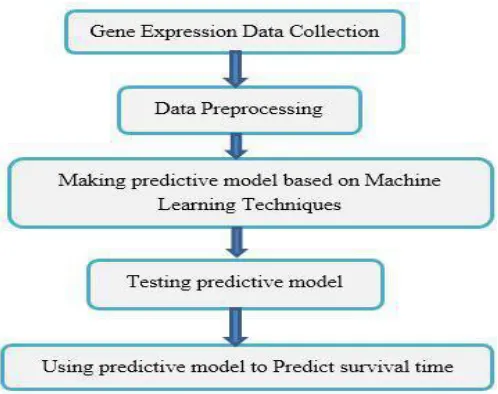
Using predictive tools is the important step in this analysis (26). Machine learning methods have the ability to develop survival predict models based on gene expression data (16). Machine learning is a subfield of computer sciences that create and check algorithms to facilitate pattern recognition, classification, and prediction. Super-vised and unsuperSuper-vised learning are two main facets of mechanization in the machine learning that have applications in biology. The examples of supervised machine learning techniques are ANN and Decision Tree and a popular unsuper-vised learning technique is clustering (34-36). In analyzing gene expression by using machine learning techniques, at first preprocessing me-thods extract and analyze gene expression data. In this step, inputs are identified. Then using ma-chine-learning algorithms, predictive models are built and tested. After, this model based on in-puts (gene expression data) can predict outin-puts (survival time) in cancer patients (8, 9, 28). Fig. 1 briefly indicates this process (9).
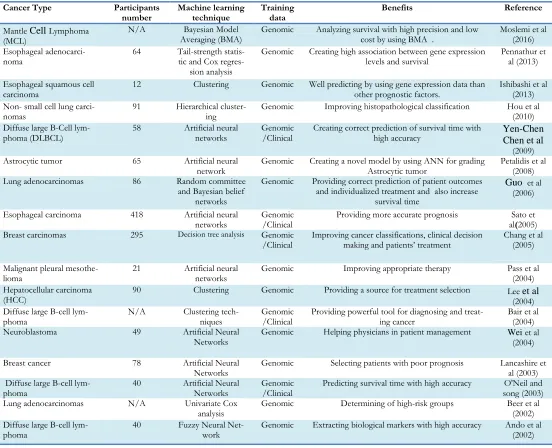
that cause by fatigue and impatience of oncology experts in survival estimation (37, 38). Predictive models that have created by using these analytical techniques and based on gene expression data can help physicians to optimize clinical decision-making, provide individualized treatment, man-age the patients, and reduce the cost puts patients under pressure and the healthcare systems. We have demonstrated each of these studies, cancer type, participants’ number, machine learning techniques have used and the obtained benefit of them (9, 12-14, 18, 21, 22, 27-33, 38-47) (Table 1).
Fig. 1:The process of analyzing gene expression data
by using machine-learning techniques (9)
Discussion
According to the cancer priority as one of the important health issues in the world that imposes mortality and costs, there is an urgent need for survival prediction strategies. One of the main goals in cancer patients is the estimation of sur-vival. It leads to better management, optimal uses of resources and providing individualized treat-ments (1, 3).
In recent years, the advent of machine learning algorithms to extract and analysis, gene expression in cancer tissues had led to use of
these techniques in detection, diagnosis, classification and prediction of cancer patients. Also the researches in biology and medicine domain have confirmed new achievements in cancer prognosis (34-36).
In analyzing gene expression data by using machine-learning techniques for survivability prediction, at first, these data are extracted and analyzed by preprocessing methods. Then, by making and testing predictive models using machine learning algorithms, survival duration can be predicted (8, 28). In this study, we highlighted the advantages of using machine-learning techniques in analyzing gene expression data in order to correct prediction of patients’ survival and histopathological classification. By investigating studies with different kinds of cancers, our findings indicated the power of gene expression data in survival prediction than other prognostic factors such as clinical data. The studies of Ishibashi et al. on patients with esophageal squamous cell carcinoma and Pennathur et al. in esophageal adenocarcinoma supported this point. According to their findings, there is a high association between gene expression levels and survival and also gene expression data provide better prediction of cancer patients (21, 27).
Some studies used the combination of genetic and clinical data in the prediction of survival. Us-ing gene expression data can provide a more ac-curate prognosis and cancer classifications as well as providing correct decision making for patients’ treatment (9, 28, 31, 40, 44) supported the effec-tiveness of gene expression data in helping physi-cians in patient management and providing a source for appropriate treatment of cancer pa-tients (32, 45). Bair et al. highlighted such a data provide powerful tool for diagnosing and treating any type of malignancy (44).
Table 1:Experiences of survival prediction by using machine learning methods and based on gene expression data on cancer patients
Chang et al. showed the improvement in classifi-cations of breast cancer by using decision tree analysis (31). Other studies mentioned the high precision and low cost of Bayesian Model tech-niques in survival prediction of Mantle Cell Lym-phoma (30). In addition, Guo et al. using the Random committee and Bayesian belief networks on Lung adenocarcinomas showed the capacity of these algorithms in the true prediction of pa-tient outcomes (42).
Among machine learning algorithms, our review of various studies has indicated the frequency usage of (ANN) with high accuracy in survival prediction for any malignancy based on gene expression data (9, 28, 32, 43, 45, 46).
However, the combination of ANN and Fuzzy logic with 93% accuracy is superior and powerful tool for extracting significant biological markers (38, 39).
Cancer Type Participants
number Machine learning technique Training data Benefits Reference
Mantle Cell Lymphoma (MCL)
N/A Bayesian Model
Averaging (BMA) Genomic Analyzing survival with high precision and low cost by using BMA . Moslemi et al (2016) Esophageal
adenocarci-noma 64 Tail-strength statis-tic and Cox regres-sion analysis
Genomic Creating high association between gene expression
levels and survival Pennathur et al (2013)
Esophageal squamous cell carcinoma
12 Clustering Genomic Well predicting by using gene expression data than other prognostic factors.
Ishibashi et al (2013) Non- small cell lung
carci-nomas 91 Hierarchical cluster-ing Genomic Improving histopathological classification Hou et al(2010) Diffuse large B-Cell
lym-phoma (DLBCL) 58 Artificial neural networks Genomic /Clinical Creating correct prediction of survival time with high accuracy Yen-Chen Chen et al (2009)
Astrocytic tumor 65 Artificial neural
network
Genomic Creating a novel model by using ANN for grading Astrocytic tumor
Petalidis et al (2008)
Lung adenocarcinomas 86 Random committee
and Bayesian belief networks
Genomic Providing correct prediction of patient outcomes and individualized treatment and also increase
survival time
Guo et al (2006)
Esophageal carcinoma 418 Artificial neural
networks Genomic /Clinical Providing more accurate prognosis alSato et (2005)
Breast carcinomas 295 Decision tree analysis Genomic
/Clinical Improving cancer classifications, clinical decision making and patients’ treatment Chang et al (2005)
Malignant pleural
mesothe-lioma 21 Artificial neural networks Genomic Improving appropriate therapy Pass et al(2004)
Hepatocellular carcinoma
(HCC) 90 Clustering Genomic Providing a source for treatment selection Lee (2004)et al
Diffuse large B-cell lym-phoma
N/A Clustering
tech-niques
Genomic /Clinical
Providing powerful tool for diagnosing and treat-ing cancer
Bairet al (2004)
Neuroblastoma 49 Artificial Neural
Networks Genomic Helping physicians in patient management Wei(2004) et al
Breast cancer 78 Artificial Neural
Networks Genomic Selecting patients with poor prognosis Lancashire et al (2003) Diffuse large B-cell
lym-phoma
40 Artificial Neural Networks
Genomic /Clinical
Predicting survival time with high accuracy O'Neil and song (2003)
Lung adenocarcinomas N/A Univariate Cox
analysis Genomic Determining of high-risk groups Beer et al(2002) Diffuse large B-cell
Conclusion
Developing clinical decision support systems based on these algorithms for analyzing gene ex-pression data can improve survival prediction and prognosis of cancer patients.
Ethical considerations
Ethical issues (Including plagiarism, Informed Consent, misconduct, data fabrication and/or falsification, double publication and/or submission, redundancy, etc.) have been completely observed by the authors.
Acknowledgements
The authors declare that there is no conflict of interest.
References
1. Bal MS, Bodal VK, Kaur J, Kaur M, Sharma S (2015). Patterns of Cancer: A Study of 500 Punjabi Patients. Asian Pac J Cancer Prev, 16(12):5107-10.
2. Ghaderzadeh M, Sadoughi F, and Ketabat A (2012). Designing a Clinical Decision Support System Based on Artificial Neural Network for Early Detection of Prostate Cancer and Differentiation from Benign Prostatic Hyperplasia. Health Inf Manage,9(4): 457-464.
3. Mehrabani D, Tabei S, Heydari S, Shamsina S, Shokrpour N, Amini M, et al (2008). Cancer occurrence in Fars Province, Southern Iran. Iran Red Crescent Med J, 10(4):314-22.
4. Field RW, Withers BL (2012). Occupational and environmental causes of lung cancer. Clin Chest Med, 33(4):681-703.
5. Twombly R (2005). Cancer surpasses heart disease as leading cause of death for all but the very elderly. J Natl Cancer Inst, 97(5):330-1. 6. Eyre H, Kahn R, Robertson RM, Clark NG,
Doyle C, Gansler T, et al (2004). Preventing cancer, cardiovascular disease, and diabetes: a common agenda for the American Cancer Society, the American Diabetes Association,
and the American Heart Association. Diabetes Care, 27(7):1812-24..
7. Xu X-c (2009). Risk factors and gene expression in esophageal cancer. Methods Mol Biol, 471:335-60..
8. Fakoor R, Ladhak F, Nazi A, Huber M (2013). Using deep learning to enhance cancer diagnosis and classification. Proceedings of the 30 th International Conference on Machine Learning, Atlanta, Georgia, USA, 2013. JMLR: W&CP volume 28.
9. Chen Y-C, Yang W-W, Chiu H-W (2009). Artificial neural network prediction for cancer survival time by gene expression data. 3rd International Conference on Bioinformatics and Biomedical Engineering, IEEE.
10. Van Vliet MH, Horlings HM, Van De Vijver MJ, Reinders MJ, Wessels LF (2012). Integration of clinical and gene expression data has a synergetic effect on predicting breast cancer outcome. PloS One,7(7):e40358.
11. Shimada Y, Sato F, Shimizu K, Tsujimoto G, Tsukada K (2009). cDNA microarray analysis of esophageal cancer: discoveries and prospects. Gen Thorac Cardiovasc Surg,57(7):347-56.
12. Kolasa M, Wojtyna R, Długosz R, Jóźwicki W (2009). Application of Artificial Neural Network to Predict Survival Time for Patients with Bladder Cancer. Computers in Medical Activity. Springer Berlin Heidelberg, pp. 113-22.
13. Spechler SJ (2013). Barrett esophagus and risk of esophageal cancer: a clinical review. JAMA, 310(6):627-36.
14. Aguirre-Gamboa R, Gomez-Rueda H, Martínez-Ledesma E, Martínez-Torteya A, Chacolla-Huaringa R, Rodriguez-Barrientos A (2013). SurvExpress: an online biomarker validation tool and database for cancer gene expression data using survival analysis. PloS One, 8(9):e74250.
15. Guo W, Jiang Y-G (2009). Current gene expression studies in esophageal carcinoma. Curr Genomics,10(8):534-9.
17. Lozano R, Naghavi M, Foreman K, Lim S, Shibuya K, Aboyans V, et al (2012). Global and regional mortality from 235 causes of death for 20 age groups in 1990 and 2010: a systematic analysis for the Global Burden of Disease Study 2010. Lancet, 380(9859):2095-2128.
18. Guyon I, Weston J, Barnhill S, Vapnik V (2002). Gene selection for cancer classification using support vector machines. Mach learn, 46(1):389-422.
19. Greenawalt DM, Duong C, Smyth GK, Ciavarella ML, Thompson NJ, Tiang T, et al (2007). Gene expression profiling of esophageal cancer: comparative analysis of Barrett's esophagus, adenocarcinoma, and squamous cell carcinoma. Int J Cancer, 120(9):1914-21.
20. Ringnér M, Peterson C (2003). Microarray-based cancer diagnosis with artificial neural networks. Biotechniques, Suppl:30-5.
21. Pennathur A, Xi L, Litle VR, Gooding WE, Krasinskas A, Landreneau RJ, et al (2013). Gene expression profiles in esophageal adenocarcinoma predict survival after resection. J Thorac Cardiovasc Surg, 145(2):505-12.
22. Cruz JA, Wishart DS (2007). Applications of machine learning in cancer prediction and prognosis. Cancer Inform, 2: 59–77.
23. Somi M, Ahmadzadeh R, Farhangh S, Mirinejhad S, Jazayeri E, Sadeghi M, et al (2012). Evaluation of Treatment and Survival Rates in Patients with Esophageal Cancer Referred to Imam Khomeini Hospital, Tabriz, Iran. Govaresh, 17(1):33-8.
24. Moghtadaei M, Golpayegani MRH, Almasganj F, Etemadi A, Akbari MR, Malekzadeh R (2014). Predicting the risk of squamous dysplasia and esophageal squamous cell carcinoma using minimum classification error method. Comput Biol Med, 45:51-7.
25. Krishnan M, Temel JS, Wright AA, Bernacki R, Selvaggi K, Balboni T (2013). Predicting life expectancy in patients with advanced incurable cancer: a review. J Support Oncol, 11(2):68-74.
26. Wang C-Y, Lee T-F, Fang C-H, Chou J-H (2012). Fuzzy logic-based prognostic score for outcome prediction in esophageal cancer. IEEE Trans Inf Technol Biomed,16(6):1224-30
27. Ishibashi Y, Hanyu N, Nakada K, Suzuki Y, Yamamoto T, Yanaga K, et al (2003). Profiling gene expression ratios of paired cancerous and normal tissue predicts relapse of esophageal squamous cell carcinoma. Cancer Res, 63(16):5159-64.
28. Sato F, Shimada Y, Selaru FM, Shibata D, Maeda M, Watanabe G, et al (2005). Prediction of survival in patients with esophageal carcinoma using artificial neural networks. Cancer,103(8):1596-605.
29. Hou J, Aerts J, Den Hamer B, Van Ijcken W, Den Bakker M, Riegman P, et al (2010). Gene expression-based classification of non-small cell lung carcinomas and survival prediction. PloS One, 5(4):e10312.
30. Guo L, Ma Y, Ward R, Castranova V, Shi X, Qian Y (2006). Constructing molecular classifiers for the accurate prognosis of lung adenocarcinoma. Clin Cancer Res, 12(11 Pt 1):3344-54.
31. Chang HY, Nuyten DS, Sneddon JB, Hastie T, Tibshirani R, Sørlie T, et al (2005). Robustness, scalability, and integration of a wound-response gene expression signature in predicting breast cancer survival. Proc Natl Acad Sci U S A, 102(10):3738-43.
32. Pass HI, Liu Z, Wali A, Bueno R, Land S, Lott D, et al (2004). Gene expression profiles predict survival and progression of pleural mesothelioma. Clin Cancer Res,10(3):849-59. 33. Lee JS, Chu IS, Heo J, Calvisi DF, Sun Z,
Roskams T, et al (2004). Classification and prediction of survival in hepatocellular carcinoma by gene expression profiling. Hepatology, 40(3):667-76.
34. Sarwat M, Ahmad A, Abdin M (2013). Stress Signaling in Plants: Genomics and Proteomics Perspective (Vol. 1). Springer Science & Business Media.
35. Mohri M, Rostamizadeh A, Talwalkar A (2013). Foundations of machine learning. MIT press. 36. Tarca AL, Carey VJ, Chen X-w, Romero R,
Drăghici S (2007). Machine learning and its applications to biology. PLoS Comput Biol, 3(6):e116.
37. Wong R, Malthaner R (2000). Esophageal cancer: a systematic review. Curr Probl Cancer, 24(6):297-373.
network system for outcome prediction and classification of 220 lymphoma patients on the basis of molecular profiling. Cancer Sci, 94(10):906-13.
39. Ando T, Suguro M, Hanai T, Kobayashi T, Honda H, Seto M (2002). Fuzzy Neural Network Applied to Gene Expression Profiling for Predicting the Prognosis of Diffuse Large B‐cell Lymphoma. Jpn J Cancer Res. 93(11):1207-12.
40. O'Neill MC, Song L (2003). Neural network analysis of lymphoma microarray data: prognosis and diagnosis near-perfect. BMC Bioinformatics, 4:13.
41. Ahmad FK, Deris S, Othman NH (2009). Toward integrated clinical and gene expression profiles for breast cancer prognosis: A review paper. Int J Biom Bioinformatics, 3(4):31-47.
42. Moslemi A, Mahjub H, Saidijam M, Poorolajal J, Soltanian AR (2016). Bayesian Survival Analysis of High-Dimensional Microarray Data for Mantle Cell Lymphoma Patients. Asian Pac J Cancer Prev, 17(1):95-100.
43. Petalidis LP, Oulas A, Backlund M, Wayland MT, Liu L, Plant K, et al (2008). Improved grading and survival prediction of human astrocytic brain tumors by artificial neural network analysis of gene expression microarray data. Mol Cancer Ther, 7(5):1013-24.
44. Bair E, Tibshirani R (2004). Semi-supervised methods to predict patient survival from gene expression data. PLoS Biol, 2(4):e108.
45. Wei JS, Greer BT, Westermann F, Steinberg SM, Son C-G, Chen Q-R, et al (2004). Prediction of clinical outcome using gene expression profiling and artificial neural networks for patients with neuroblastoma. Cancer Res, 64(19):6883-91.
46. Lancashire LJ, Powe D, Reis-Filho J, Rakha E, Lemetre C, Weigelt B, et al (2010). A validated gene expression profile for detecting clinical outcome in breast cancer using artificial neural networks. Breast Cancer Res Treat, 120(1):83-93.
47. Beer DG, Kardia SL, Huang C-C, Giordano TJ, Levin AM, Misek DE, et al (2002). Gene-expression profiles predict survival of patients with lung adenocarcinoma. Nat Med, 8(8):816-24.
48. Ng T, Chew L, Yap CW (2012). A Clinical Decision Support Tool To Predict Survival in Cancer Patients beyond 120 Days after Palliative Chemotherapy. J Palliat Med, 15(8):863-9.