Communication
1
Slight pH Fluctuations in the Gold Nanoparticle
2
Synthesis Process Influence the Performance of the
3
Citrate Reduction Method
4
Braulio Contreras-Trigo1, Víctor Díaz-García1, Enrique Guzmán-Gutierrez2, Ignacio Sanhueza3,
5
Pablo Coelho3, Sebastián Godoy3, Sergio Torres3 and Patricio Oyarzún1,*
6
1 Facultad de Ingeniería y Tecnología, Universidad San Sebastián, Lientur 1457, Concepción 4080871, Chile;
7
[email protected] (B.C.), [email protected] (V.D).
8
2 Facultad de Ciencias de la Salud, Universidad San Sebastián, Lientur 1457, Concepción 4080871, Chile;
9
[email protected] (E.G.),
10
3 Departamento de Ingeniería Eléctrica, Facultad de Ingeniería, Universidad de Concepción;
11
[email protected] (I.S.), [email protected] (P.C.), [email protected] (S.G.), [email protected]
12
(S.T.)
13
* Correspondence: [email protected]; Tel.: +56-41-2487962
14
15
Abstract: Gold nanoparticles (AuNPs) are currently under intense investigation for biomedical and
16
biotechnology applications, thanks to their ease in preparation, stability, biocompatibility, multiple
17
surface functionalities and size-dependent optical properties. The most commonly used method for
18
AuNPs synthesis in aqueous solution is the reduction of tetrachloroauric acid (HAuCl4) with
19
trisodium citrate. We observed variations in the pH and concentration of the gold colloidal
20
suspension synthesized under standard conditions, verifying a reduction in the reaction yield by
21
around 46% from pH 5.3 (2.4 nM) to pH 4.7 (1.29 nM). Citrate-capped AuNPs were characterized
22
by UV-visible spectroscopy, TEM, EDS and zeta-potential measurements, revealing a linear
23
correlation between pH and the concentration of the generated AuNPs. This result can be attributed
24
to the adverse effect of protons both on citrate oxidation and on citrate adsorption onto the gold
25
surface, which is required to form the stabilization layer. Overall, this study provides insight into
26
the effect of the pH over the synthesis performance of the method, which would be of particular
27
interest from the point of view of large-scale manufacturing processes.
28
Keywords: Gold nanoparticles; Citrate reduction method; pH-effect; concentration
29
30
1. Introduction
31
Gold nanoparticles (AuNPs) have emerged as a promising platform for a growing number of
32
biomedical and biotechnology applications in the fields of sensing [1], molecular diagnostic [2],
33
therapeutic [3] and imaging [4], owing to their stability, biocompatibility, remarkable
34
physicochemical properties and easy surface functionalization with a wide range of ligands [5, 6]. A
35
prominent optic feature of AuNPs arises from the collective oscillation of the conduction electrons in
36
the presence of an incident light, the so-called surface plasmon resonance (SPR) [7]. This phenomenon
37
causes a sharp and intense absorption band in the visible range, which can be readily tuned by
38
varying the particle size, shape and the surrounding physicochemical environment [8]. Thus,
label-39
free colorimetric sensors based on AuNPs (nanobiosensors) have been widely proposed as a
40
promising analytical for selective binding and detection of chemical and biological targets, including
41
metal ions [9], antibiotics [10], mycotoxins [11], as well as a large number of microorganisms [12].
42
43
As concerns the preparation of the colloidal gold nanoparticles, various chemical routes, including
44
the use of chemical reductants [13] and several photochemical methods based on UV irradiation [14],
45
γ-irradiation [15] and laser irradiation [16], have been widely studied for different purposes of
46
application. However, the classical “citrate reduction method” proposed by Turkevich in 1951 [17],
47
and latter modified by Frens in 1973 [18], remains the most widely employed synthesis procedure,
48
since AuNPs can be produced in a straightforward manner to obtain highly stable monodisperse
49
particles with uniform spherical shape and narrow-size distributions ranging between 10 - 20 nm in
50
diameter. This method is based on the aqueous-phase reduction of an Au3+ precursor (HAuCl4; gold
51
salt) with sodium citrate near the boiling point of the reaction mixture, which produces a stable
52
solution of metallic gold nanoparticles (colloidal gold) [19].
53
Citrate ions play a key role, since they act both as reductant, converting gold ions (Au3+) into gold
54
atoms (Au0), and as a protective agent that stabilizes the formed nanoparticles, preventing particle
55
growth and aggregation via electrostatic repulsion (citrate capped AuNPs) [20]. Thus, at high citrate
56
concentrations, smaller particles are covered and stabilized by this ion, while at low concentrations
57
particle growth continues due to incomplete coverage, leading to the formation of AuNPs with larger
58
particle size. A third role of citrate is as a mediator of the reaction mixture pH, through which it has
59
a dramatic effect on the size, polydispersity and morphology of the resulting AuNPs [21, 22]. pH
60
control on the citrate reduction method has been widely explored regarding its relationship with the
61
size distribution of the AuNPs [23]. However, up to now the correlation of this parameter with the
62
concentration of the resulting nanoparticles had not been described, which is of particular interest for
63
citrate mediated synthesis of colloidal AuNPs to meet large scale manufacturing criteria [24].
64
The acid-base behavior of the AuNPs is provided by the citrate layer, which imparts a negative charge
65
onto the colloidal particle surface. Citrate is a tricarboxylic acid (polyanion) with three pKa values
66
(pKa1=3.06, pKa2=4.74 and pKa3=5.4) [25], which participate in the following chemical equilibria:
67
68
In this study we investigated the relationship between typically occurring pH fluctuations of the
69
colloidal suspension (between 4.5 and 5.3) and the concentration of the gold nanoparticles, providing
70
valuable information regarding the synthesis performance of the method. AuNPs were characterized
71
in terms of their concentration (optical density determinations), morphology and surface charge, by
72
carrying out transmission electron microscopy (TEM) examination, scanning electron microscopy
73
with energy dispersive X-ray spectroscopy (EDS) and zeta potential analysis.
74
2. Materials and Methods
75
2.1. Preparation of gold nanoparticles (AuNPs)
76
Synthesis of AuNPs was carried out according to the procedures described according to the
77
citrate reduction method [17, 18]. Briefly, 0.0394 g of tetrachloroauric acid (HAuCl4⋅3H2O) (Merk,
78
USA) was dissolved in 100 mL of nanopure water (18 MΩ of resistance) in a two-neck round flask (1
79
mM HAuCl4). The resulting solution was heated to boiling under stirring and refluxed. Then, 10 mL
80
of a 38.8 mM trisodium citrate solution was preheated and quickly added to the boiling solution of
81
HAuCl4 under vigorous stirring. After the solution turned from pale yellow to black and to deep red,
82
it was refluxed for additional 30 min and subsequently cooled to room temperature without stirring
83
μm) and preserved in the dark at 4 °C for subsequent pH determination and characterization of the
85
AuNPs.
86
2.2. AuNP concentration
87
The concentration of gold synthesized under different pH conditions was determined by
UV-88
Vis spectroscopy using an EpochTM Microplate Spectrophotometer (Bio-Tek Instruments, Winooski,
89
VT, USA). 100 μL of each sample were transferred into the microplate wells and the absorption
90
spectra was recorded in the visible region (400 to 700 nm). The absorption maximum at the SPR band
91
(520 nm) was employed to calculate the AuNP concentration according to the Beer-Lambert law, by
92
using an extinction coefficient (ε) of 2.01x10⁸ M-1 cm-1 [26].
93
2.3. Electronic microscopy analyses
94
The morphology and size of the AuNPs was determined by transmission electron microscopy
95
with 4 Å resolution (TEM; JEOL-JEM 1200EX-II, Tokyo, Japan). Carbon-coated 100 mesh copper grids
96
were dipped into a small drop of each AuNP solution, which were subsequently retracted and
97
allowed to dry in air at room temperature. Particle sizes and frequency histograms were obtained by
98
measuring the diameter of 100 nanoparticles using the ImageJ software [27], while the percentage of
99
spherical particles was determined through visual inspection of 100 nanoparticles. In addition,
100
elemental analysis of the gold colloidal suspensions was carried out by energy-dispersive X-ray
101
analysis (EDS) using scanning electron microscopy (SEM; Etec Autoscan U-1).
102
2.4. Surface charge characterization (pZ)
103
Zeta-potential measurements of AuNPs were measured on a zeta-potentiometer (Nano-ZS90,
104
Malvern Instruments, Westboroug) at room temperature and scattering angle of 90°. A diluted
105
suspension of AuNPs (100 µL diluted to 1 mL nanopure water) were employed for the analyses. The
106
Malvern Zetasizer Software version 7.12 was employed to analyze the collected data.
107
108
109
3. Results and Discussion
110
3.1. pH effect on the concentration
111
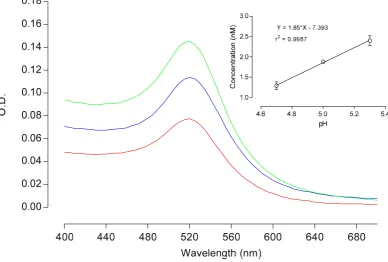
Figure 1 presents the absorption spectra of the AuNPs samples synthesized at three pH values (4.7,
112
5.0 and 5.3), showing the typical curve with a characteristic maximum at 520 nm associated to the
113
SPR band. However, differences in the absorbance values at this peak revealed that pH of the
114
synthesis medium had a relevant effect on the resulting concentration of the nanoparticles. The
115
AuNPs concentration varied in a directly proportional manner as a function of the pH (positive
116
correlation), reaching at pH 5.3 about 1.8 fold the concentration (2.4 nM) than that obtained at pH 4.7
117
(1.29 nM) (see Table 1). This correlation is highly linear in the pH range monitored (4.7 - 5.3), with a
118
correlation coefficient (r2) of 0.9987.
119
120
122
Figure 1. Absorption spectra of AuNPs obtained by the citrate reduction method at pHs 4.7 (red), 5.0
123
(blue) and 5.3 (green). At the top right corner a linear correlation curve between pH and AuNP
124
concentration is presented. O.Ds correspond to mean values calculated from independent
125
determinations (n=2).
126
127
3.2. AuNPs characterization
128
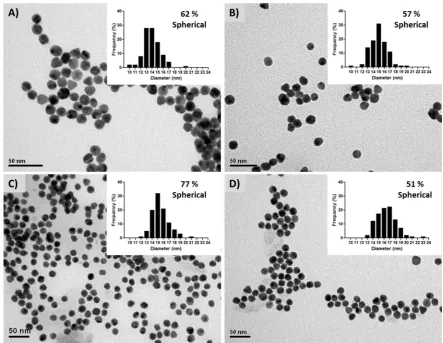
TEM analysis of the AuNPs samples proved the nanoparticles have comparable diameters between
129
13.9–15.5 nm for the tree monitored pH values, with similar morphology distribution (Figure 2; Table
130
1). The percentage of spherical nanoparticles was slightly higher at pH 5.3 (77%), in comparison with
131
that at pH 5.0 (57%) and pH 4.7 (62%), which would favor shape homogeneity of the nanoparticles.
132
By contrast, commercial AuNPs showed the least sphericity (51%). These observations are consistent
133
with the similar optical behavior exhibited by the nanoparticle suspensions, which share identical
134
wavelength associated to the SPR peak (UV-Vis spectrograms, Figure 1).
135
136
137
138
139
140
141
142
144
Figure 2. Transmission electron microphotographs of AuNPs at pH 4.7 (a), 5.0 (b) and 5.3 (c), and
145
commercial AuNPs (pH 5.0) with an average diameter of 16.42 ± 1.76 nm (d). Histograms with the
146
respective particle size distributions are included within each microphotography, showing on top
147
right corner the percentage of spherical nanoparticles.
148
In addition, energy dispersive X-ray spectrometry (EDS) elemental analysis confirmed the presence
149
of Au, C, O and Na forming part of the citrate layer adsorbed on the AuNPs (Figure 3). Sodium ions
150
play an important role in stabilizing high coverages of the gold surface by carboxylate anions [28].
151
152
Figure 3. EDS spectra of gold colloidal suspensions at pH 4.7 (a), 5.0 (b) and 5.3 (c). Higher peaks
153
correspond to the silicon from the glass supports.
154
155
156
3.3 Surface charge analysis
157
Under standard experimental conditions employed in the present study the binding of citrate ions
158
onto the surface of AuNPs occurs electrostatically through negative oxygen atoms of carboxylic
159
groups (oxyanions) at the ends of the citrate molecule [28]. Thus, at pH 4.7 (close to pKa2) similar
160
amounts of H2Cit-1 and HCit-2 implies a lesser availability of deprotonated carboxylic groups, while
161
at pH 5.3 (close to pKa3) the dominant species HCit-2 and Cit-3 would determine a greater capability
162
of citrate anions to coordinate to the metal surface.
163
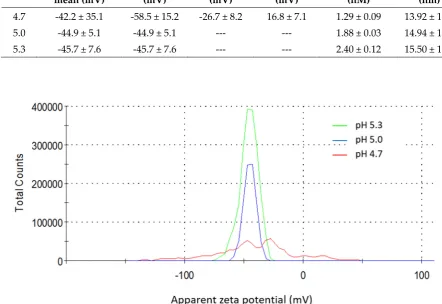
The negative charge of citrate-stabilized AuNPs was confirmed through zeta potential analysis (pZ),
164
revealing the influence of pH on the surface charge from the distribution of the pZ values (Figure 4).
165
Thus, as the monitored pH fluctuated from 4.7 to 5.3, the shape of the curves reveals a progressive
166
narrowing on the dispersion of the pZ values of the AuNPs, which accounts for a greater stabilization
167
of the nanoparticles as a consequence of the presence of mostly deprotonated citrate anions.
168
Table 1. Zeta potential, concentration and diameter of AuNPs at pHs 4.7, 5.0 and 5.3.
169
170
171
172
Figure 4. Zeta potential distribution (mV) of citrate-capped AuNPs synthesized at pHs 4.7 (red), 5.0
173
(blue) and 5.3 (green).
174
The lowest dispersion values were determined at pHs 5.0 and 5.3 (-44.9 ± 5.1 mV and -45.7 ± 7.6 mV,
175
respectively), with curves showing single and narrow peaks. Similarly, a recent study showed that a
176
pH value of 5 was optimal to produce gold nanoparticles that are highly monodisperse and spherical
177
in shape, with a detrimental effect on the size polydispersity at lower pH values [29]. By contrast, the
178
highest pZ dispersion was observed at pH 4.7 (-42.2 ± 35.1 mV), showing a flat distribution curve
179
with three minor peaks that accounts for different populations of citrate-capped AuNPs having a
180
wide range of surface charges. Importantly, the right tail of this curve mostly falls into the region of
181
pH Zeta Potential mean (mV)
Peak 1 (mV)
Peak 2 (mV)
Peak 3 (mV)
Concentration (nM)
Diameter (nm)
4.7 -42.2 ± 35.1 -58.5 ± 15.2 -26.7 ± 8.2 16.8 ± 7.1 1.29 ± 0.09 13.92 ± 1.45
positive surface charge values (minor peak at 16.87± 7.1 mV), revealing a loss on the citrate coverage
182
of the gold surface. Therefore, these results provide support to an expected lesser tendency of
183
partially protonated citrate ionic species to coordinate with the AuNPs at pH 4.7.
184
In order to understand the effect of pH on the reaction, the role of citrate (and protons) must be
185
considered both in terms of the redox reaction forming AuNPs (citrate as oxidizer), as well as from
186
the point of view of its protectant role (citrate as stabilizer). First, looking at the standard reaction
187
mechanism, the initial step of this multiple-step process is the oxidation of citrate yielding dicarboxy
188
acetone (Eq. 1). The second step consist of reduction of auric salt (Au3+) to aurous salt the (Au1+) by
189
accepting the electrons from the citrate oxidation reaction (Eq. 2), and the final step is the
190
disproportionation of aurous species to gold atoms (Au0) (Eq. 3).
191
OCOCH C OH COO → OCOCH C = O + CO + H + 2e Eq. 1
192
AuCl + 2e → AuCl + 2Cl Eq. 2
193
3AuCl → 2Au + AuCl Eq. 3
194
The formation of an intermediate pentacoordinate complex of Au3+ species with
195
dicarboxyacetone,has been proposed, which subsequently decarboxylates to give Au+ species [28].
196
However, the overall stoichiometry of the reduction reaction can be represented as:
197
2AuCl + 3 OCOCH C OH COO → 2Au + 3 OCOCH C = O + 6Cl + 3H + 3CO Eq. 4
198
In accordance with Le Chatelier’s principle, as the concentration of protons increases in the solution,
199
the tendency of citrate to oxidize decreases, as well as the availability of electron to reduce the
200
gold(III) chloride and to form AuNPs. In the second place, coordination bondings between the gold
201
surface and adsorbed molecules of citrate consist of carboxyl oxygens that contribute the electron
202
pairs forming covalent bonds [28]. The complexity of the structural arrangement of the citrate layers
203
on AuNPs has been analyzed in several recent studies, showing that citrate could coordinate to the
204
gold through several different binding modes (geometries) that are mostly dictated by one or two of
205
the terminus carboxyl groups [30-32]. However, to promote the intermolecular interactions it is
206
required for citrate to diffuse on the gold surface in a preferential fully deprotonated form, since
207
protonated carboxylate groups does not readily adsorb on gold due to electrochemical impediments
208
[33]. Accordingly, the protonation of citrate terminus sites is considered to discourage citrate binding
209
to the gold surface [31], in agreement with our observation of the detrimental effect of pH fluctuations
210
on coverage, stabilization and production of the AuNPs.
211
4. Conclusions
212
We demonstrated that under standard experimental conditions of the citrate reduction method, gold
213
nanoparticles are produced in variable concentrations, showing a pH-dependent linear correlation in
214
the range monitored between pH 4.7 and 5.3 (typical pH fluctuation). The AuNP synthesis
215
performance reduced by 46% from 2.4 nM (pH 5.3) to 1.29 nM (pH 4.7), without alteration of size and
216
morphology. The physical characterization of the nanoparticles suggests that slight fluctuations of
217
pH during synthesis can have an adverse effect on citrate oxidation, as well as on the availability of
218
negative charges from carboxylate groups required for an optimal coverage, stabilization and
219
production of the nanoparticles. Overall, these results provide insight into the effect of the pH over
220
the AuNP synthesis performance of the method, which would be of particular interest for further
221
studies optimizing the reaction conditions in large-scale manufacturing processes.
222
Acknowledgments: This study was supported by The Scientific and Technological Development Support Fund
224
of Chile (FONDEF ID16I10221) and Dirección General de Investigación Universidad San Sebastián, Chile.
225
226
Author Contributions: B.C., V.D., E.G. and P.O. conceived and designed the experiments; B.C. and V.D.
227
performed the experiments; B.C., V.D., E.G., I.S., P.C., S.G., S.T. and P.O. analyzed the data; B.C., V.D., E.G. and
228
P.O. wrote the paper.
229
230
Conflicts of Interest: The authors declare no conflict of interest.
231
References
233
1. Saha, K.; Agasti, S. S.; Kim, C.; Li, X.; Rotello, V.M. Gold nanoparticles in chemical and biological
234
sensing. Chem. Rev. 2012, 112, 2739-2779.
235
2. Radwan, S.H.; Azzazy, H.M. Gold nanoparticles for molecular diagnostics. Expert. Rev. Mol.
236
Diagn. 2009, 9, 511-524.
237
3. Akhter, S.; Ahmad, M.Z.; Ahmad, F.J.; Storm, G.; Kok, R.J. Gold nanoparticles in theranostic
238
oncology: Current state-of-the-art. Expert Opin Drug Deliv 2012, 9, 1225-1243.
239
4. Kim, D.; Oh, N.; Kim, K.; Lee, S.; Pack, C.G.; Park, J.H.; Park, Y. Label-free high-resolution 3-D
240
imaging of gold nanoparticles inside live cells using optical diffraction tomography. Methods
241
2017, 136, 160-167.
242
5. Zhang, J.; Liu, B.; Liu, H.; Zhang, X.; Tan, W. Aptamer-conjugated gold nanoparticles for
243
bioanalysis. Nanomedicine (Lond) 2013, 8, 983-993.
244
6. Jacobs, M.; Panneer Selvam, A.; Craven, J.E.; Prasad, S. Antibody-conjugated gold
nanoparticle-245
based immunosensor for ultra-sensitive detection of troponin-T. J Lab Autom 2014, 19, 546-554.
246
7. Amendola, V.; Pilot, R.; Frasconi, M.; Marago, O.M.; Iati, M.A. Surface plasmon resonance in
247
gold nanoparticles: a review. J Phys Condens Matter 2017, 29.
248
8. Kelly, K.L.; Coronado, E.; Zhao, L.L.; Schatz, G.C. The optical properties of metal nanoparticles:
249
the influence of size, shape, and dielectric environment. J Phys Chem B 2003, 107, 668–677.
250
9. Priyadarshini, E.; Pradhan, N., Metal-induced aggregation of valine capped gold nanoparticles:
251
An efficient and rapid approach for colorimetric detection of Pb2+ ions. Sci Rep 2017, 7.
252
10. Kim, Y.S.; Kim, J.H.; Kim, I.A.; Lee, S.J.; Jurng, J.; Gu, M.B. A novel colorimetric aptasensor using
253
gold nanoparticle for a highly sensitive and specific detection of oxytetracycline. Biosens
254
Bioelectron 2010, 26, 1644-1649.
255
11. Luan, Y.; Chen, Z.; Xie, G.; Chen, J.; Lu, A.; Li, C.; Fu, H.; Ma, Z.; Wang, J. Rapid visual detection
256
of aflatoxin B1 by label-free aptasensor using unmodified gold nanoparticles. J Nanosci
257
Nanotechnol 2015, 15, 1357-1361.
258
12. Li, B.; Li, X.; Dong, Y.; Wang, B.; Li, D.; Shi, Y.; Wu, Y. Colorimetric sensor array based on gold
259
nanoparticles with diverse surface charges for microorganisms identification. Anal Chem 2017,
260
89, 10639-10643.
261
13. Zhao, P.; Li, N.; Astruc, D. State of the art in gold nanoparticle synthesis. Coordination Chemistry
262
Reviews 2013, 257, 638–665.
263
14. Yang, S.; Wang, Y.; Wang, Q.; Zhang, R.; Ding, B., UV irradiation induced formation of Au
264
nanoparticles at room temperature: The case of pH values. Colloids and Surfaces A: Physicochem.
265
Eng. Aspects 2007, 301, 174–183.
266
15. Li, T.; Park, H.G.; Choi, S.H. γ-Irradiation-induced preparation of Ag and Au nanoparticles and
267
their characterizations. Mater Chem Phys 2007, 105, 325-230.
268
16. Sadrolhosseini, A.R.; Abdul Rashid, S.; Zakaria, A. Synthesis of gold nanoparticles dispersed in
269
palm oil using laser ablation technique. Journal of Nanomaterials 2017, 2017.
270
17. Turkevich, J.; Stevenson, P.; Hillier, J. A study of the nucleation and growth process in the
271
synthesis of colloidal gold. Discuss. Faraday Soc 1951, 11, 55-75.
272
18. Frens, G. Controlled nucleation for regulation of particle size in monodisperse gold suspensions.
273
Nature Physical Science 1973, 241, 20-22.
274
19. Sivaraman, S. K.; Kumar, S.; Santhanam, V. Monodisperse sub-10 nm gold nanoparticles by
275
reversing the order of addition in Turkevich method--the role of chloroauric acid. J Colloid
276
Interface Sci 2011, 361, 543-547.
277
20. Kimling, J.; Maier, M.; Okenve, B.; Kotaidis, V.; Ballot, H.; Plech, A. Turkevich method for gold
278
nanoparticle synthesis revisited. J Phys Chem B 2006, 110, 15700-15707.
279
21. Patungwasa, W.; Hodak, J. pH tunable morphology of the gold nanoparticles produced by
280
citrate reduction. Materials Chemistry and Physics 2008, 108, 45–54.
281
22. Ji, X.; Song, X.; Li, J.; Bai, Y.; Yang, W.; Peng, X. Size control of gold nanocrystals in citrate
282
23. Li, C.; Li, D.; Wan, G.; Xu, J.; Hou, W. Facile synthesis of concentrated gold nanoparticles with
284
low size-distribution in water: temperature and pH controls. Nanoscale Res Lett 2011, 6, 440.
285
24. Manimegalai, S.; Sridharan, T.; Rameshpathy, M.; Devi Rajeswari, V. Recent trends and
286
methodologies in gold nanoparticle synthesis-a prospective review on drug delivery aspect.
287
OpenNano 2017, 2, 37-46.
288
25. Weston, A.; Brown, P. HPLC and CE: Principles and Practice; Academic Press: San Diego, CA,
289
USA, 1997.
290
26. Maye, M.; Han, L.; Kariuki, N.; Ly, N.; Chan, W.; Luo, J.; Zhong, C. Gold and alloy nanoparticles
291
in solution and thin film assembly: spectrophotometric determination of molar absorptivity.
292
Anal. Chem. Acta 2003, 496, 17-27.
293
27. Rasband, W., ImageJ, U.S. National Institutes of Health, Bethesda, Maryland, USA,
294
https://imagej.nih.gov/ij/ (accessed on 17 March 2018).
295
28. Al-Johani, H.; Abou-Hamad, E.; Jedidi, A.; Widdifield, C. M.; Viger-Gravel, J.; Sangaru, S. S.;
296
Gajan, D.; Anjum, D. H.; Ould-Chikh, S.; Hedhili, M. N.; Gurinov, A.; Kelly, M. J.; El Eter, M.;
297
Cavallo, L.; Emsley, L.; Basset, J. M. The structure and binding mode of citrate in the stabilization
298
of gold nanoparticles. Nat Chem 2017, 9, 890-895.
299
29. Tyagi, H.; Kushwaha, A.; Kumar, A.; Aslam, M. A Facile pH controlled citrate-based reduction
300
method for gold nanoparticle synthesis at room temperature. Nanoscale Res Lett 2016, 11, 362.
301
30. Park, J.W.; Shumaker-Parry J.S. Structural study of citrate layers on gold nanoparticles: Role of
302
intermolecular interactions in stabilizing nanoparticles. J Am Chem Soc 2014, 136, 1907–1921.
303
31. Monti, S.; Barcaro, G.; Sementa, L.; Carravetta, V.; Ågren, H. Characterization of the adsorption
304
dynamics of trisodium citrate on gold in water solution. RSC Adv 2017, 7, 49655–49663.
305
32. Park, J.W.; Shumaker-Parry, J.S. Structural study of citrate layers on gold nanoparticles: Role of
306
intermolecular interactions in stabilizing nanoparticles. J. Am. Chem. Soc. 2014, 136, 1907–1921.
307
Paik, W.; Han S.; Shin, W.; nd Kim, Y. Adsorption of carboxylic acids on gold by anodic reaction.
308