Original Research Article
Self-reported, self-care activities among type 2 diabetic patients in rural
areas of Kancheepuram district, Tamil Nadu: a cross-sectional study
N. Kalusivalingam, Prateek Bobhate*, A. Kalaivani, R. Karnaboopathy
INTRODUCTION
Diabetes is a grave, chronic condition.1 In 2013, it was
estimated that 382 million people were diabetic and this number is expected to rise to 592 million by 2035.2
According to the reports of the International Diabetes Federation, 72.9 million Indians were diabetic in 2017, which would be expected to rise till 134.3 million by the year 2045.3 Most people with diabetes live in low- and
middle-income countries and these will experience the greatest increase in cases of diabetes over the next 22 years.4
Diabetes is of two types type 1 and type 2. In type 1 diabetes is also known as insulin-dependent diabetes. It usually begins in childhood thus also known as juvenile-onset diabetes. Type 1 diabetes is an autoimmune condition where a person’s own body attacks its own pancreas with antibodies and doesn't make insulin. In type 2 diabetes, either the pancreas isn't making enough insulin as per the body’s requirement or there is insulin resistance.5
Phase 1 of the Indian Council of Medical Research-India Diabetes (ICMR-INDIAB) study, reported the prevalence of diabetes in Tamil Naidu to be 10.4%.6 Diabetes is the
ABSTRACT
Background: Diabetes is a chronic condition. The burden of diabetes is, expected to rise to 592 million by 2035. Diabetes self-care activities can have a dramatic impact on lowering glycosylated hemoglobin levels. Hence, this study has been planned to assess the self-care activities among the type 2 diabetes patients in rural areas of Kancheepuram district, Tamil Nadu.
Methods: A cross-sectional study was conducted among type 2 diabetic patients residing in rural field practice area of Shri Sathya Sai Medical College and Research Institute, Kancheepuram district during May 2019 and June 2019. Personal interview using semi-structured questionnaire including summary of diabetes self-care activities- revised version was conducted.
Results: Majority of the study participants were female and 46.2% were above 51 years of age. Majority had diabetes mellitus for 1-5 years. Of the diabetic self-care activities 68.5% had healthy eating 2-4 times/week. About 33.2% of the participants were not indulged in physical activity as well as high-intensity exercises even for a single day; about 33% had not tested their blood sugar level for even a single time and only 1.5% had checked their feet on all days during the previous week. Higher food scores were found significantly associated with availability of family support for self-care activities (p value 0.020).
Conclusions: Of the diabetic self-care activities the healthy dietary component was followed satisfactorily but exercise, foot care and testing of blood sugar were followed poorly by the study participants.
Keywords: Diabetes mellitus, Self-care, Rural area
Department of Community Medicine, Shri Sathya Sai Medical College and Research Institute, Ammapetta, Kancheepuram, Tamil Nadu, India
Received: 12 December 2019
Accepted: 30 December 2019
*Correspondence:
Dr. Prateek Bobhate,
E-mail: [email protected]
Copyright: © the author(s), publisher and licensee Medip Academy. This is an open-access article distributed under the terms of the Creative Commons Attribution Non-Commercial License, which permits unrestricted non-commercial use, distribution, and reproduction in any medium, provided the original work is properly cited.
highest cause of mortality and various morbidities. Diabetics are at increased risks of cardiovascular and other diseases.1 Diabetes should be managed with holistic and
individualised patient care based on structured education, self-management and safe and effective glucose-lowering therapies.7 Diabetes self-care activities can have a dramatic
impact on lowering glycosylated haemoglobin levels.8
Hence, this study has been planned to assess the self-care activities among the type 2 diabetes patients in rural areas of Kancheepuram district, Tamil Nadu.
METHODS
Sembakkam is the rural field practice area of Shri Sathya Sai Medical College and Research Institute. There are three villages covered in the Sembakkam Health sub-center area namely Sembakkam, Acharavakkam and Madayathur. A community based cross-sectional study was conducted among the people residing in the above area to assess the self-care activities among the type 2 diabetes patients during the period of two months of May 2019 and June 2019. The sample population was all the diabetic patients of more than one-year duration residing in the above villages.
The sample size was calculated using the prevalence of diabetes in rural areas of Tamil Nadu as 7.8%, taking 5% of desired precision along with a 95% confidence interval.6
The sample size came out to be 116. With non-responders assuming to be 10%, the required minimum sample size was calculated as 130.
A line list of diabetic patients from the three villages was prepared from the records available in the Government PHC, Sembakkam. All the diabetic patients of more than one-year duration residing in rural areas of Kancheepuram district, Tamil Nadu were included in the study. Patients with disease duration of less than one year, patients below 18 years of age, patients above 80 years (as they could have senile forgetfulness dementia, etc.) and those not willing to participate were excluded from the study. A personal interview using a semi-structured interview schedule was conducted with the study participants.
The interview schedule comprised of two parts. Section A consisted of basic patient history (demographic details and details regarding), while section B was for summary diabetes self-care activities (SDSCA) questionnaire (revised version) on diabetes mellitus.9 The SDSCA
measure is a brief report questionnaire of diabetes self-management that includes items assessing the following aspects of the diabetes regimen: general diet, specific diet, exercise, blood-glucose testing, foot care, and smoking. Minor changes were made to the SDSCA questionnaire to suit local context i.e., instead of self-monitoring of the blood sugar level, underwent testing of blood sugar level was included.
The questionnaire was translated into Tamil and back-translated into English by a separate person. A pilot study
was conducted with 10% of sample size with the translated version of the questionnaire.
Data were entered in Microsoft excel and analysed using the SPSS version 23 software. The frequency of respondents was calculated with regard to the number of days per week they practiced self‑care activities on a scale of 0–7 for general diet, specific diet, exercise, blood-glucose testing and footcare. For smoking, it was dichotomised into smokers and non-smokers.
Diet score was calculated by adding the individual score for items of 1, 2, 3 and 4 after reversing the score of item 4. Exercise score was calculated by adding the individual score for items 5 and 6. Blood sugar tested at least one time in the previous week was taken as monitoring of blood sugar level. Checking of the foot for all the seven days of the previous week was taken as foot care.
Descriptive statistics were reported as mean (SD) for continuous variables and frequency (percentage) for categorical variables. Pearson’s Chi-square test was used
to find an association between two categorical variables. A p value <0.05 was considered as statistically significant. Ethical clearance was obtained from the institutional ethics committee of Shri Sathya Sai Medical College and Research Institute before the start of the study. Informed written consent was obtained from the study participants before conducting the interview.
RESULTS
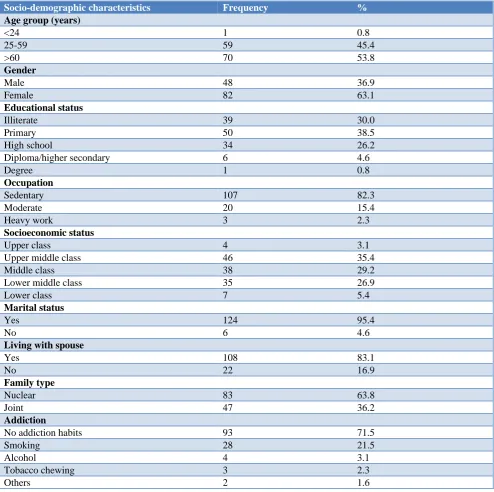
In this study the majority (63.1%) were females and 46.2% of the participants were above 51 years of age. The majority of the participants were educated until primary (38.5%) with 82.3% being sedentary workers. Most of the participants belonged to the upper-middleclass. About 96.2% were married, 69.2% were living with their spouse and 63.8% were living in a nuclear family. A majority (71.5%) had no addiction habits and 21.55 were smokers (Table 1).
The majority of the participants had diabetes mellitus form 1-5 years (90%). Among the study participants, the majority of them (56.9%) didn’t have diabetes mellitus among relatives. About 43% of the participants had a history of hypertension, followed by arthritis (26.2%). About 80.8% of the participants had taken treatment in government hospitals, followed by 18.5% in private hospitals. The majority of the participants took oral medications for diabetes (83.8%). Only 13% were on insulin. About 82.3% had received support from their family members for self-care activities (Table 2).
(61.5%). High-fat foods such as red meat or full-fat dairy products were taken only 0-1 times/week by the majority of the subjects (65.4%).
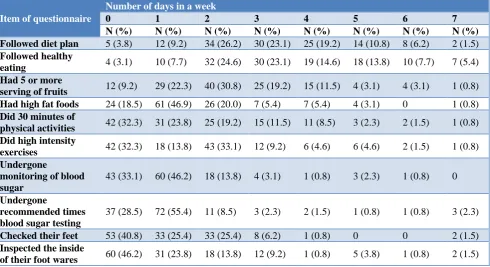
About 33.2% of the participants were not indulged in 30 minutes of physical activity as well as high-intensity exercises even for a single day during the previous week. About 33% had not tested their blood sugar level for even a single time in the previous week. Only 1.5% had checked their feet on all days during the previous week (Table 3). It was found that higher food scores were significantly associated with the age group of 25-59 years (p=0.027),
participants living in a joint family (p=0.011) and the availability of family support for self-care activities (p=0.020). No significant association was found between food scores and gender, social-economic status and the duration of diabetes (Table 4).
It was found that testing for blood sugar level at least one time during the previous week was significantly associated with treatment taken from the private sector (p=0.049). There was no association found between testing for blood sugar level at least one time during the previous week and duration of diabetes, history of diabetes among the relatives and availability of family support (Table 5).
Table 1: Distribution of study participants according to socio-demographic variables (n=130).
Socio-demographic characteristics Frequency %
Age group (years)
<24 1 0.8
25-59 59 45.4
>60 70 53.8
Gender
Male 48 36.9
Female 82 63.1
Educational status
Illiterate 39 30.0
Primary 50 38.5
High school 34 26.2
Diploma/higher secondary 6 4.6
Degree 1 0.8
Occupation
Sedentary 107 82.3
Moderate 20 15.4
Heavy work 3 2.3
Socioeconomic status
Upper class 4 3.1
Upper middle class 46 35.4
Middle class 38 29.2
Lower middle class 35 26.9
Lower class 7 5.4
Marital status
Yes 124 95.4
No 6 4.6
Living with spouse
Yes 108 83.1
No 22 16.9
Family type
Nuclear 83 63.8
Joint 47 36.2
Addiction
No addiction habits 93 71.5
Smoking 28 21.5
Alcohol 4 3.1
Tobacco chewing 3 2.3
Table 2: Distribution of study participants according to disease and treatment profile (n=130).
Characteristics Frequency %
Duration of diabetes mellitus (years)
1-5 117 90.0
6- 10 12 9.2
11-15 1 0.8
Diabetes mellitus among relatives
Yes 56 43.1
No 74 56.9
History of other illness
Hypertension 56 43.1
Arthritis 34 26.2
Heart diseases 3 2.3
Others 9 6.9
No other illness 28 21.5
Place of treatment
Government hospitals 105 80.8
Private doctors 24 18.5
No treatment 1 .8
Type of treatment
Insulin 17 13.1
Oral drugs 109 83.8
Herbal medicines 1 0.8
No medicines 3 2.3
Support from family members for self-care activities
Yes 107 82.3
No 23 17.7
Table 3: Frequency of individual responses for SDSCA questionnaire among the study participants (n=130).
Item of questionnaire
Number of days in a week
0 1 2 3 4 5 6 7
N (%) N (%) N (%) N (%) N (%) N (%) N (%) N (%)
Followed diet plan 5 (3.8) 12 (9.2) 34 (26.2) 30 (23.1) 25 (19.2) 14 (10.8) 8 (6.2) 2 (1.5)
Followed healthy
eating 4 (3.1) 10 (7.7) 32 (24.6) 30 (23.1) 19 (14.6) 18 (13.8) 10 (7.7) 7 (5.4) Had 5 or more
serving of fruits 12 (9.2) 29 (22.3) 40 (30.8) 25 (19.2) 15 (11.5) 4 (3.1) 4 (3.1) 1 (0.8) Had high fat foods 24 (18.5) 61 (46.9) 26 (20.0) 7 (5.4) 7 (5.4) 4 (3.1) 0 1 (0.8)
Did 30 minutes of
physical activities 42 (32.3) 31 (23.8) 25 (19.2) 15 (11.5) 11 (8.5) 3 (2.3) 2 (1.5) 1 (0.8) Did high intensity
exercises 42 (32.3) 18 (13.8) 43 (33.1) 12 (9.2) 6 (4.6) 6 (4.6) 2 (1.5) 1 (0.8) Undergone
monitoring of blood sugar
43 (33.1) 60 (46.2) 18 (13.8) 4 (3.1) 1 (0.8) 3 (2.3) 1 (0.8) 0
Undergone
recommended times blood sugar testing
37 (28.5) 72 (55.4) 11 (8.5) 3 (2.3) 2 (1.5) 1 (0.8) 1 (0.8) 3 (2.3)
Checked their feet 53 (40.8) 33 (25.4) 33 (25.4) 8 (6.2) 1 (0.8) 0 0 2 (1.5)
Inspected the inside
Table 4: Association between food score and characteristics of study participants (n=130).
Characteristics
Food score χ2 (p value)
Lower score Higher score
N (%) N (%)
Gender
Male 29 (22.3) 19 (14.6)
0.780 (0.465)
Female 43 (33.1) 39 (30.0)
Age group (years)
<24 1 (0.8) 0
6.108 (0.027)
25-59 26 (20.0) 33 (25.4)
>60 45 (34.6) 25 (19.2)
Socioeconomic status
Upper class 4 (3.1) 0
5.272 (0.257) Upper middle class 22 (16.9) 24 (18.5)
Middle class 23 (17.7) 15 (11.5)
Lower middle class 18 (13.8) 17 (13.1)
Lower class 5 (3.8) 2 (1.5)
Family type
Nuclear 53 (40.8) 30 (23.1)
6.667 (0.011)
Joint 19 (14.6) 28 (21.5)
Total 72 (55.4) 58 (44.6)
Family support
Yes 54 (41.5) 53 (40.8)
5.918 (0.020)
No 18 (13.8) 5 (3.8)
Total 72 (55.4) 58 (44.6)
Duration of diabetes mellitus (years)
1-5 67 (51.5) 50 (38.2)
2.267 (0.287)
6- 10 5 (3.8) 7 (5.4)
11-15 0 1 (0.8)
Table 5: Association between blood sugar testing and disease/treatment profile of the study participants (n=130).
Disease/treatment profile
Blood sugar testing
χ2 (p value)
Yes No
N (%) N (%)
Duration of diabetes mellitus (years)
1-5 38 (29.2) 79 (60.8)
1.006 (0.687)
6- 10 5 (3.8) 7 (5.4)
11-15 0 1 (0.8)
Diabetes mellitus among relatives
Yes 41 (31.5) 15 (11.5)
1.759 (0.195)
No 46 (35.4) 28 (21.5)
Place of treatment
Government hospitals 67 (51.5) 38 (29.2)
5.245 (0.049)
Private doctors 20 (15.4) 4 (3.1)
No treatment 0 1 (0.8)
Family support
Yes 74 (56.5) 33 (25.4)
1.366 (0.328)
No 13 (10.0) 10 (7.7)
DISCUSSION
This study was conducted to study the self-care activities among type 2 diabetic patients in rural areas of
participants were educated until primary (38.5%) with 82.3% being sedentary workers. Most of the participants belonged to upper-middle-class (35.4%), married (96.2%), stayed with their spouse (69.2%). About 63.8% were staying in a nuclear family similar to the census 2011 data of 70% nuclear families in India.
In this study, the majority (90%) of the participants had diabetes mellitus from 1-5 years. In other studies, it was reported as 62%, 57%and 53.6%for having a duration of diabetes of fewer than 5 years.10-12
In this study, 43% of the participants had a history of hypertension, followed by arthritis (26.2%) as comorbidities. A similar finding was observed in one study that 43.3% had also hypertension.13 In a study conducted
in Maharashtra, it was 62.3% for hypertension as comorbidity.12 In another study, it was found that 80% had
hypertension and 17.3% had arthritis.10
In the present study majority of the participants took oral medications for diabetes (83.8%) and only 13% were on insulin. Similarly, findings were noted in a study that 88% of the participants were on oral hypoglycaemic agents.10
About 82.3% had reported that they received family support for the self-care activities in this study. Good family support was found associated with better self-management practices.11 In a study conducted in Delhi, it
was reported that family support was perceived by 90% of the participants.13
In this study, 68.5% had reported healthy eating 2-4 times/week. Only 18.5% of the participants reported >5 times/week of healthy eating. It was seen that the majority of the participants followed diet plans only 2-4 times/week (62.3%) and took 5 or more serving of fruits on 2-4 days (61.5%). High-fat foods such as red meat or full-fat dairy products were taken only 0-1 times/week by the majority of the subjects (65.4%). In a study at Mangalore, it was found that 45.9% followed diet plan for all days of the week and 26.2% taken fruits on all days.14
In a study conducted in Delhi, it was reported that 30% followed the diet plan on all 7 days and 1.8 % for the specific diet.15 In a study in Vellore, it was found that good
dietary practices were present in 29% of participants.16 In
a study in Pune, it was reported that 75.4% followed the diet plan for at least five days a week and 34.8% followed in all days.12
The result of this study showed that the physical activity element of self-care activities was followed poorly by the study participants, as only 56.2% of the participants were indulge in 30 minutes of physical activity only 0-1 times/week, followed by 2-4 times/week by 39.2% of the participants. The majority of the participants were indulging in high-intensity exercises like swimming, walking, biking etc., for 0-1 times/week and 2-4 times/week. In a study in Gujarat, it was reported that only
40% were involved in physical exercise in 3 days in a week's time.17 In a study in Delhi, only 9% practiced
physical activity on all 7 days and 39.3% did not practice physical activity for even a single day.13 In the study from
Maharashtra, 29% were not practiced physical activity even for a single day.12
Results showed that 33.1% of the participants did not test their blood sugar in the past week. Similar results were observed that 92.3% and 69.5% had not tested even for a single time in other studies.12,13
Foot care was found poor among the study participants. Only 1.5% of them checked their feet on all days in the past week. It was reported as 19% and 9%in other similar studies.16,17 About 40.8% did not check their feet at least
once in the past week in this study. It was reported as 56.5% in another study.12 Footcare was the poor self-care
activity reported in a study in Vellore.16
It was found that higher food scores were significantly associated with participants living in a joint family (p=0.011) and the availability of family support for self-care activities (p=0.020). Similar findings were seen in the study that a general diet score was higher among diabetic patients who received family support.13 It was found in a
study that of all the family supportive behaviors, the more common were for the diet-related self-care activities.11
Higher food scores were significantly associated with the age group of 25-59 years. This may be due to the economically productive nature of the age group.
There was no significant association found between the exercise score and the study variables. But in one study exercise practice was found associated with income and in another study, it was associated with gender and marital status.13,16
It was found that testing for blood sugar level at least one time during the previous week was significantly associated with treatment taken from the private sector (p=0.049). There was no association found between testing for blood sugar level at least one time during the previous week and duration of diabetes, history of diabetes among the relatives and availability of family support. In a study in Delhi, blood sugar testing was found associated with younger patients and patients on insulin therapy.13 In a
study in Vellore, it was found associated with higher socioeconomic status and among the married participants.16
Strengths and limitations of this study
where family type, as well as the support from the family members for self-care activities, may be different.
CONCLUSION
This study shows that among the self-care activities, physical exercise and foot care needs improvement among the diabetic patients. The primary care health workers should emphasize on educating the diabetic patients’ education about self-care activities including life style modification. Health education programs involving family members for better self-care activities will improve the management of diabetes.
Funding: No funding sources Conflict of interest: None declared
Ethical approval: The study was approved by the Institutional Ethics Committee
REFERENCES
1. World Health Organisation (WHO). 2016. Global report on Diabetes. Available at: https://apps. who.int/iris/bitstream/handle/10665/204874/WHO_ NMH_NVI_16.3_eng.pdf;jsessionid=E4A09E7B23 62142C71E456A811F0B6A8?sequenc. Accessed on 8 December 2019.
2. Deshpande AD, Harris-Hayes M, Schootman M.
Epidemiology of diabetes and diabetes- related complications. Physical Therapy. 2008;88(11):1254-64.
3. ICMR Guidelines for management of type 2 Diabetes. 2018. Available at: https://medibulletin. com/wp-content/uploads/2018/05/ICMR.diabetes Guidelines.2018.pdf. Accessed on 8 December 2019. 4. Guariguata L, Whiting DR, Hambleton I, Beagley J, Linnenkamp U, Shaw JE. Global estimates of diabetes prevalence for 2013 and projections for 2035. Diab Res Clin Practice. 2014;103(2):137-49. 5. Alberti KG, Zimmet PZ. Definition, diagnosis and
classification of diabetes mellitus and its complications. Part 1: diagnosis and classification of diabetes mellitus. Provisional report of a WHO consultation. Diab Med. 1998;15(7):539-53.
6. Anjana RM, Pradeepa R, Deepa M, Datta M, Sudha V, Unnikrishnan R, et al. Prevalence of diabetes and prediabetes (impaired fasting glucose and/or impaired glucose tolerance) in urban and rural India: Phase I results of the Indian Council of Medical Research–INdiaDIABetes (ICMR–INDIAB) study. Diabetologia. 2011;54(12):3022-7.
7. Chatterjee S, Davies MJ. Current management of diabetes mellitus and future directions in care. Postgraduate Med J. 2015;91:612-21.
8. Shrivastava SR, Shrivastava PS, Ramasamy J. Role of self-care in management of diabetes mellitus. J Diab Metabol Disorders. 2013;12(1):14.
9. Toobert DJ, Hampson SE, Glasgow RE. The summary of diabetes self-care activities measure: results from 7 studies and a revised scale. Diabetes care. 2000;23(7):943-50.
10. Manobharathi M, Kalyani P, Arulmani A. Factors associated with therapeutic non-compliance among type 2 diabetes mellitus patients in Chidambaram, Tamilnadu, India. Int J Community Med Public Health. 2017;4(3):787-91.
11. Ravi S, Kumar S, Gopichandran V. Do supportive family behaviors promote diabetes self-management in resource limited urban settings? A cross sectional study. BMC Public Health. 2018;18(1):826.
12. Kushwaha AS, Kumari S, Kushwaha N. Self-care in diabetes: a study amongst diabetics in an urban community. Int J Community Med Public Health. 2016;3:293-8.
13. Mohandas A, Bhasin SK, Upadhyay M, Madhu SV. Diabetes self-care activities among adults 20 years and above residing in a resettlement colony in East Delhi. Indian J Public Health. 2018;62(2):104. 14. Rajasekharan D, Kulkarni V, Unnikrishnan B, Kumar
N, Holla R, Thapar R. Self-care activities among patients with diabetes attending a tertiary care hospital in Mangalore Karnataka, India. Ann Med Health Sci Res. 2015;5(1):59-64.
15. Padma K, Bele DS, Bodhare TN, Valsangkar S. Evaluation of knowledge and self-care practices in diabetic patients and their role in disease management. Natl J Community Med. 2012;3:3–6. 16. Gopichandran V, Lyndon S, Angel MK, Manayalil
BP, Blessy KR, Alex RG, et al. Diabetes self-care activities: a community-based survey in urban southern India. Natl Med J India. 2012;25(1):14-7. 17. Raithatha S1, Shankar SU, Dinesh K. Self-Care
Practices among Diabetic Patients in Anand District of Gujarat. ISRN Family Med. 2014;2014:743-1.