* To whom all correspondence should be addressed.
A New Feature Selection Techniques Using Genetics
Search and Random Search Approaches For Breast Cancer
B. Tamilvanan
1* and V. Murali Bhaskaran
21Research and Development Centre, Bharathiar University, Coimbatore-641046, Tamil Nadu, India. 2Principal, Dhirajlal Gandhi College of Technology, Salem-636290, Tamil Nadu, India.
http://dx.doi.org/10.13005/bbra/2459
(Received: 06 January 2017; accepted: 24 January 2017)
In this paper mainly deals with various classification algorithm techniques with feature extraction algorithm used to improve the predicated accuracy of the algorithm. This paper applied with correlation based feature selection as a feature evaluator and Genetics and random searching method. The results of the classification model are sensitive, specificity, precision, time, and accuracy. Finally, it concludes that the proposed CFL-NB algorithm performance is better than other classification algorithms techniques for breast cancer disease.
Keywords: Correlation-based Feature Selection, Data Mining, Genetic Algorithm, Random Search and Naive Bayes Algorithm.
Data mining techniques and application
are utilized in a wide range of fields, including
banking, gregarious science, inculcation, business
industries, bioinformatics, weather, forecasting
healthcare and sizably voluminous data. Nowadays
health care industry generates a large amount of
data about patients, disease diagnosis, etc. Some
different types of approaches to building accurate
classifications have been proposed (e.g., NB, MLP,
SMO, RF). In classification, we give a Breast Cancer
data set of example record or the input data, called
the test data set, with each record consisting of
various attributes
An attribute can be either a numerical
attribute or categorical attribute. If values of an
attributes belong to an authoritatively mandated
domain, the attribute is called numerical attribute (
e.g. Age, Menopause, Tumor-size, Inv-nodes,
Deg-Malig). A categorical attribute (e.g.Node-Capes,
Breast, Breast-Quad, Irradiat, Class). Classification
is the way toward part a dataset into totally
unrelated gatherings, called a class, based on
suitable attributes.
This paper is organized accordingly: the
relates works and depiction of the specialized parts
of the utilized information mining techniques in
section 1. The elaborates with classification
algorithms like navie bayes, multi-layer perception,
Sequential minimal optimization and random forest
in section 2.The introduction of the dataset for
Breast Cancer in section 3. The Experiment Results
and Discussion in section 4. And finally, conclude
the paper and future works.
Correlation based feature selection
Correlation based feature selection
9,10,18( 1)
cf s
ff
K r M
K k r
=
+ −
Where
Msis the significance of highlight
subset,
rcfis the normal direct correlation
coefficient between these elements and classes
and
rffis the normal straight correlation coefficient
between various elements.
Typically, CFS includes (forward choice)
or erases (in reverse determination) one element at
once. in this work we used Genetic search and
Random search algorithms for the great
results19,20.
Genetic Search Algorithm
Look strategies explore the ascribe space
to find a not too bad subset and the quality is
measured by the property subset evaluator through
CFS subset evaluator and genetic search is being
used as a request technique. The parameters of
the genetic algorithm are various generations,
people appraise and the probabilities of change
and hybrid. A person from the basic masses makes
by deciding a rundown of value records as a hunt
point. For delivering progress reports, each such
an assortment of generations can be Utilized
20, 21.
The basic genetic search procedure is
demonstrated as follows:
Step 1: Start by randomly generating an initial people Step 2:Calculate e(x) for each fellow xåR.
Step 3: Define a probability distribution p over the Fellows of R where p(x) “ e(x).
Step 4: Choose two population members x and y to produce new population members x’ and y’.
Step 5:Apply mutation to x’ and y’. Step 6:Insert x’ and y’ into P’ Step 7:If |R’| < |R|, go to step 4. Step 8:Let R ßR’.
Step 9:If there are more generations to process, go to step 2.
Step 10: Return x å P for which e(x) is highest.
Random Search Algorithm
Step 1: Set algorithm parameters È0, initial points X0 ‚” S And iteration index k = 0.
Step 2: Generate a collection of candidate points Vk+1 ‚” S according to a specific generator and associated Sampling distribution.
Step 3: Update Xk+1 based on the candidate points Vk+1,
Previous iterates, and algorithmic parameters. Also, update algorithm parameters Èk+1. Step 4: If a stopping criterion is met, stop. Otherwise Increment k and return to Step 1.
Naive bayes classification
Naive Bayes
27-30executes probabilistic
naive Bayes classifier. naive means restrictive
autonomy among traits of components. The
“naive” supposition incredibly diminishes
calculation unpredictability to a basic increase of
probabilities. The Naive Bayes handles numeric
properties utilizing directed discretization and
utilizations piece thickness estimators that will
enhance the execution It requires just little
arrangement of preparing information to create
exact parameter estimations since it requires just
the computation of the frequencies of
characteristics and property result combines in the
preparation information set
30,31Dataset
The dataset utilized as a part of this model
gathered from UCI machine learning repository
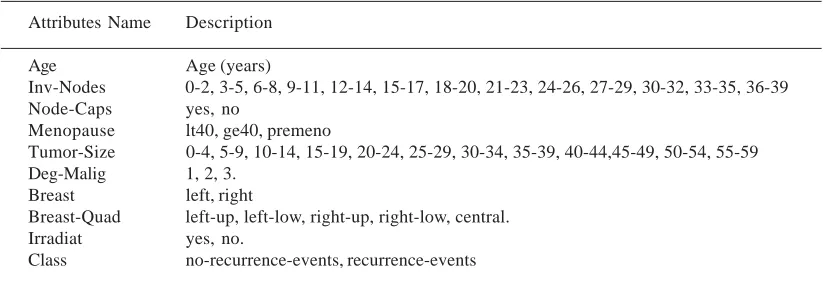
32Table 1. Dataset for Breast cancer
Attributes Name Description
Age Age (years)
Inv-Nodes 0-2, 3-5, 6-8, 9-11, 12-14, 15-17, 18-20, 21-23, 24-26, 27-29, 30-32, 33-35, 36-39
Node-Caps yes, no
Menopause lt40, ge40, premeno
Tumor-Size 0-4, 5-9, 10-14, 15-19, 20-24, 25-29, 30-34, 35-39, 40-44,45-49, 50-54, 55-59
Deg-Malig 1, 2, 3.
Breast left, right
Breast-Quad left-up, left-low, right-up, right-low, central.
Irradiat yes, no.
ought to be more exact what’s more, exact
remembering the true objective to upgrade the
judicious precision of data mining errands. The
data set may have missing (or) irrelevant attributes
and these are to be dealt with successfully by the
data mining process.
Attribute Identification
The breast cancer dataset which
comprises of 286 instances and 10 attributes with
the class expressing the life visualization yes (or)
no. appear in Table 1.
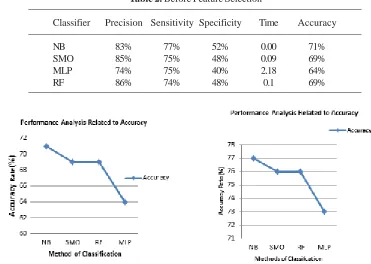
Table 2.
Before Feature Selection
Classifier
Precision Sensitivity Specificity
Time
Accuracy
NB
83%
77%
52%
0.00
71%
SMO
85%
75%
48%
0.09
69%
MLP
74%
75%
40%
2.18
64%
RF
86%
74%
48%
0.1
69%
Fig. 1. Before Feature Selection
Table 3.
After Feature Selection using Genetics Search
Classifier
Precision Sensitivity Specificity
Time
Accuracy
NB
83%
78%
54%
0.00
72%
SMO
81%
73%
41%
0.01
66%
MLP
84%
77%
53%
0.99
71%
RF
88%
74%
50%
0.03
70%
Table 4.
After Feature Selection using Random search
Classifier
Precision Sensitivity Specificity
Time
Accuracy
NB
39%
51%
82%
0.00
77%
SMO
30%
53%
80%
0.06
76%
MLP
32%
41%
80%
1.11
73%
RF
33%
52%
81%
0.13
76%
Fig. 3. After Feature Selection using Genetics Search
Table 5. Before Feature Selection based on Naive Bayes
a b Classified as
168 33 a = no-recurrence-events 48 37 b = recurrence-events
Table 6. After Feature Selection for Genetic search Based on Naive Bayes
a b Classified as
27 41 a = Yes
27 191 b = No
Table 7. After Feature Selection for Random search Based on Naive Bayes
a b Classified as
27 41 a = Yes
25 193 b = No
Methodology of proposed systems
The exploration procedure has two
stages. First one is genetics algorithm based CFS
connected to the breast cancer dataset which was
reduced to 5 from 10 and the Naive Bayes algorithm
connected for classification. The second phase of
this work utilized Random search based CFS
connected to the same data set which was reduced
to 6 from 10 and after that connected Naïve Bayes
classification algorithm for better expectation.
Experimental results and discussion
The exploratory outcomes outline the
distinctive measures that are used to evaluate the
model for characterization and desire. In this work
the specificity, precision, sensitivity and accuracy
are expounded.
Sensitivity, Accuracy, Specificity and Precision
Accuracy = (TP + TN)/(TP + TN + FP + FN) ...(1)
Sensitivity = TP/(TP + FN)
...(2)
Specificity = TN/(TN + FP)
...(3)
Precision = TP/(TP + FP)
...(4)
Fold Cross-Validation
The classification algorithm is arranged
and attempted in 10 times. The cross approval
isolates the information into 10 subgroups and each
subgroup is attempted through request oversee
worked from whatever is left of the 9 bundles. Ten
unmistakable test results are gotten for each train–
test setup and the typical result gives the test
exactness of the calculation.
Confusion Matrix
The confusion matrix
7plots what
quantities of cases have been apportioned to each
class and the parts of the lattice speak to the
amount of experiments whose genuine class is the
line and whose foreseen class is the portion. Tables
5, 6 and 7 depict the perplexity matrix that is
processed for Naive Bayes and the innate interest
based CFS-NB and sporadic chase based CFS-NB
computations.
Graph Results
Figure 3 demonstrate the precision of
different grouping calculations that was
accomplished through genetic search based CFS.
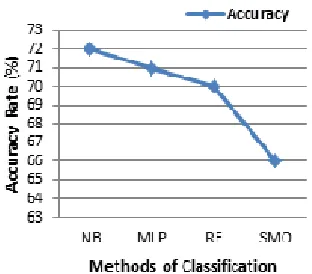
Figure 2 demonstrate the precision of different order
calculations that was accomplished through
random search based CFS.
CONCLUSION
in view of CFS with other characterization
calculations like Multilayer perceptron and
Sequential Minimal Optimization and Random
Forest. The trial result simply portrays that the
genetic search based CFS and naive bayes
execution was better contrasted and other
grouping calculations as far as time and accuracy.
REFERENCES
1. Yua Q, Tan KC, Toeh EJ, Goh KC. A hybrid evolutionary algorithm for attribute selection in data mining. Expert Systems with Applications. 2009; 36: 8616–30.
2. Kim JS, Yoon H, Park C-S, Baek JG. Algorithm learning based neural network integrating feature selection and classification. Expert Systems with Applications. 2013; 40:231–41.
3. Sahin F , Chandrasekar G. A survey on feature selection methods. Computers and Electrical Engineering. 2014; 40:16– 24.
4. Gupta M, Chandra B. An efficient statistical feature selection Approach for classification of gene expression data. Journal of Bio medical Informatics. 2011; 44:529–35.
5. Yu L, Liu H. Toward Integrating Feature Selection Algorithms for Classification and Clustering. IEEE Transactions on Knowledge and Data Engineering. 2005 Apr; 17(4). 6. Krishnakumari P, Purusothaman G. A Survey of
Data Mining Techniques on Risk Prediction: Heart Disease. Indian Journal of Science and Technology. 2015 Jun; 8(12).
7. Sumathi CP, Suganya P. A Novel Metaheuristic Data Mining Algorithm for the Detection and Classification of Parkinson Disease. Indian Journal of Science and Technology. 2015 Jul; 8(14).
8. Nasira GM, Kalaiselvi C. Prediction of Heart Diseases and Cancer in Diabetic Patients Using Data Mining Techniques. Indian Journal of Science and Technology. 2015; 8(14).
9. Smith LA,Hall MA. Feature Selection for Machine Learning: Comparing a Correlation based filter approach to the wrapper. FCAIRS Conference; 1999.
10. Hall M. Correlation-based feature selection for discrete and numeric class machine learning. Proceedings of the Seventeenth International Conference on Machine Learning; 2000. p. 359– 66.
11. Deng Y, Lu X, Peng X, Feng B, Liu Ping, Liao B. A Novel Feature Selection Method Based on Correlation-Based Feature Selection in Cancer
Recognition. Journal of computational and Theoretical nanoscience. 2014; 11(2):427– 33. 12. Kennedy J , Eberhart RC. A new optimizer using
particle swarm theory. In Proceedings of the sixth international symposium on micro machine and human science. 1995; 1:39–43.
13. Eberhart RC, Shi Y. Empirical study of particle swarm optimization. IEEE Proceedings of the 1999 Congress on Evolutionary Computation; 1999. p. 3.
14. Eberhart RC, Shi Y. Particle swarm optimization: developments, applications and resources. IEEE Proceedings of the 2001 Congress on in Evolutionary Computation. 2001; 1: 81–6. 15. Sudha S, Vijayarani S. An Efficient Clustering
Algorithm for Predicting Diseases from Hemogram Blood Test Samples. Indian Journal of Science and Technology. 2015; 8(17). 16. García-Saez G, Caballero-Ruiz E, , Balsells M,
Pons B, Morillo M, Gomez EJ, Hernando ME. Automatic Blood Glucose Classification for Gestational Diabetes with Feature Selection: Decision Trees vs. Neural Networks. XIII Mediterranean Conference on Medical and Biological Engineering and Computing, 2013 IFMBE Proceedings. 2014; 41:1370–3. 17. Gao Y, Xu J, Sun LXu T. An ensemble feature
selection technique for cancer recognition. Bio-Medical Materials and Engineering. 2014; 24:1001–8.
18. Murugan A, Sridevi T. A Novel Feature Selection Method for Effective Breast Cancer Diagnosis and Prognosis. International Journal of Computer Applications. 2014; 88(11). 19. Yi Y, Wang J, Zhou S, Kong J. An Improved
Feature Selection Based on Effective Range for classification. The Scientific World Journal; 2014. p. 1–8.
20. Yang A, Zang Y, Xiong C, Wang T, Zhang Z. Feature Selection for Data Envelopment Analysis. Knowledge Based Systems. 2014; 64:70–80.
21. Li Y, Ding S, Shi Z, Yan S. A Protein Structural Classes Prediction Method based on Predicted Secondary Structure and PST-BLAST Profile. Biochimie. 2014; 97: 60-5.
22. Kennedy J, Riccardo P, Blackwell T. Particle swarm optimization. Swarm intelligence. 2007; 1(1):33–57.
23. Kennedy J. Particle swarm optimization. Encyclopedia of Machine Learning. Springer US; 2010. p. 760–6.
from gene expression data. International Journal of Parallel, Emergent and Distributed Systems; 2014. p. 1–18.
25. Wang B, Ji Z. Identifying potential clinical syndromes of Hepatocellular carcinoma Using PSO-based hierarchical feature selection algorithm. Bio Med research international; 2014. p. 1–12.
26. Ananthanarayanan NR,Yasodha P. Analyzing Big Data to Build Knowledge Based System for Early Detection of Ovarian Cancer. Indian Journal of Science and Technology. 2015; 8(14). 27. Dumitru D. Prediction of recurrent events in breast cancer using the Naive Bayesian classification. Annals of University of Craiova Math Comp Sci Ser. 2009; 36(2):92–6. 28. Chandrasekaran RN, Nagarajan S. Design and
Implementation of Expert Clinical System for Diagnosing Diabetes using Data Mining Techniques. Indian Journal of Science and Technology. 2015; 8(8):771–6.
29. Velmurugan T, Anuradha C. A Comparative Analysis on the Evaluation of Classification Algorithms in the Prediction of Students Performance. Indian Journal of Science and Technology. 2015; 8(15).
30. Lee KH, Leung KS, Wang JF, Ng EY, Chan HL, Tsui SK,Mok TS, Tse pC, Sung JJ. Data Mining on DNA Sequences of Hepatitis B Virus. IEEE/
ACM Transactions on Computational Biology and Bioinformatics. 2011; 8(2):428–40. 31. Thangaraju P, Karthikeyan T. Analysis of
Classification Algorithms Applied to Hepatitis Patients. International Journal of Computer Applications. 2013; 62(5):25–30.
32. Available from:http://archieve.ics.uci.edu/ml/ datasets/Breast Cancer/ Accessed on: 27.05.2015.
33. Thangaraju P, Karthikeyan T. PCA-NB Algorithm to Enhance the Predictive Accuracy. International Journal of Engineering and Technology. 2014; 6(1):381–7.
34. Thangaraju P, Karthikeyan T. A Combined Approach of CFS and Naive bayes Algorithm to Enhance the Prediction Accuracy. IEEE International Conference on Control Instrumentation Communication and Computational Technologies (ICCICCT 2014); 2014 Jul.
35. Thangaraju P, Karthikeyan T. Best First and Greedy Search based CFS-Naive Bayes Classification Algorithms for Hepatitis Diagnosis, Biosciences and Biotechnology Research Asia. 2015; 12(1):983–90.