IMAGE COMPRESSION APPROACH
FOR MEDICAL PROCESSING USING
MODIFIED NEURO MODELING
S. ABDUL KHADER JILANI Research Scholar, Dravidian University, Kuppam, Andhra Pradesh, 517425, India.
Dr. S. ABDUL SATTAR
Dean of Academics, Royal Institute of Technology & Science, Chevella, RR Dist, Andhra Pradesh, India.
Abstract :
Image compression is applied to many fields such as television broadcasting, remote sensing, image storage etc. Digitized images are compressed by a technique which exploits the redundancy of the images so that the number of bits required to represent the image can be reduced with acceptable degradation of the decoded image. The degradation of the image quality is limited wrt. the application used. There are various application where accuracy is of major concern. To achieve the objective of performance improvement with respect to decoded picture quality and compression ratios, compared to existing image compression techniques, a image compression technique using hybrid neural networks combining two different learning networks called Auto-associative multi-layer perceptron and self-organizing feature map is proposed.
Keywords: Image Processing, Neural Network, Image Compression, learning algorithms.
1. Introduction
A majority of today’s Internet bandwidth is estimated to be used for images and video transmission. Recent multimedia applications for handheld and portable devices place a limit on the available wireless bandwidth. The bandwidth is limited even with new connection standards. Computer data compression is, of course, a powerful, enabling technology that plays a vital role in the information age. Among the various types of data commonly transferred over networks, image and video data comprises the bulk of the bit traffic. For example, current estimates indicate that image data take up over 40% of the volume on the Internet. The growth in demand for image and video data, with delivery limitation has kept compression technology at a major task among several compression standards. Available, the JPEG image compression standard is in wide spread of use. JPEG standard uses the Discrete Cosine Transform (DCT) as the transform, applied to 8-by-8 blocks of image data. The newer standard JPEG2000 is based on the Wavelet Transform (WT). Wavelet Transform offers multi-resolution image analysis, which appears to be well matched to the low level characteristic of human vision. The DCT is essentially unique but WT has many possible realizations. Wavelets provide a more suitable way for representing images. This is because it can represent information at a variety of scales, with local contrast changes, as well as larger scale structures and thus is a better fit for image data. Where wavelet transformation is used like a image transformation technique, the issue to compression is still an limitation. The conventional approaches such as JPEG, SPHIT etc. reduce the bit redundancy based on the coded information. As during process this compression leads to loss of information accuracy is affected. To achieve the objective of accuracy in retrieval various lossless methods were developed. This method depends on the approach used for the removal of data redundancy based on bit representation. The retrieval accuracy get effected once the selected information is not accurate. To have accurate selectivity of the coding bits, higher learning approaches such as artificial neural network could be used. These ANN approaches are accurate in making decision but are computationally effective. To achieve a faster operation in this work an image compression technique using hybrid neural networks combining two different learning networks Auto-associative multi-layer perceptron and self-organizing feature map is presented. The approach is focused for medical image processing application.
2. Image Compression
1) Loss less algorithms, and 2) Lossy algorithms.
A lossless algorithm reproduces the original exactly. Whereas, a lossy algorithm, as its name implies, loses some data. Data loss may be unacceptable in many applications. For example, text compression must be lossless because a very small difference can result in statements with totally different meanings. There are also many situations where loss may be either Unnoticeable or acceptable. But various applications requires accurate retrieval of image, wherein one such application is medical processing.
3. Medical Image Processing
In medical image processing medical images are captured and transferred over a medium to distance place for retrieving information’s. Such applications are called telemedicine application. One of telemedicine’s main attractions lies in the ability to provide specialist medical care to areas that are underserved, particularly those located remotely from major population centers. Telemedicine has the potential to improve the accessibility of people in remote areas to specialist medical care, and in turn to help fight preventable diseases. It can also have a large impact on the costs and necessity of transporting patients to regional centers. As a primary screening tool, telemedicine also has a role in identifying patients needing nonurgent treatment. In this way, the expense of sending medical teams to remote, isolated, and sparsely populated areas can be reduced. During this process the data are compressed and transferred over the channel and the algorithm used may be limited and result in loss of information which is not acceptable in case of medical processing. To achieve the objective of accurate image processing in this paper a ANN approach is developed to have better performances.
4. Artificial Neural Networks
Neural networks typically consist of simple elements operating in parallel. These elements are inspired by biological nervous systems. The network function is determined basically by the connections between elements. A neural network can be trained to perform a particular function by adjusting the values of the connections (weights) between the input and output elements. Multi-layer perceptron (MLP) is the most popular topology of neural network used in pattern recognition applications. In this study MLP is used to solve the problem. It can be visualized as having n inputs and r outputs having multiple layer in between. The weights between the layers are represented as wij in the relationship of input-output neuron of Equation as shown below.
( ) ( ) ( ) ( )
1
(
(
)
p
l l l l
j j ij ij
i
y
f v
f
w x
(1) Where l denotes the layer number (l>0), y(l)
j represents the jth neuron in the lth layer, v(l )j is the weighted sum of the neuron's inputs, (l ) xij is the ith input of the neuron (p inputs from the previous layer and a fixed bias input), (l ) wij is the connection weights of the i
th input to the neuron, f(.) is the activation function of the neuron. The
sigmoid function is usually used in MLP. Two sigmoid functions are logistic and hyperbolic tangent function defined in “Eq. (2) and (3)”.
1
( ) 0
(1 exp( )
f v a and v
av
(2)
( )
tanh( ) ( , ) 0
f v
a
bv
a b
(3) The application of neural network to choose the most appropriate wavelet is carried out in two steps. The initial process is the training process and following which a testing process is performed. The training process of a MLP usually uses a back propagation algorithm. It consists of two passes, which are the forward and the backward pass. The weights of the networks are fixed and “Eq. (2)” is continually used to get the outputs from the inputs through all the layers in the forward pass. Throughout the back pass all the weights are adjusted according to the error-correction equations as follows.
( )l
(
1)
( )l( )
( )l( )
ij ij ij
w
n
w
n
w
n
(4)
( )
( )
( )
l
ij l
ij
E
w
n
w
2
1
( )
2 j j
j
E
t y(6) where tj is the target of learning at neuron j and η is learning rate parameter. The approach of ANN is
incorporated with compression approach for better application and the implemented approach is outlined below.
5. Implementation
A new parallel structured hybrid neural network that combines the Auto-associative multi-layer perceptron and self-organizing feature map is described as follows. The self-organizing feature map categorizes the input pattern vectors into several classes using Kohonen’s algorithm. Output units of self-organizing feature map are winner-take-all, which is connected to the hidden layer units of the Auto-associative multi-layer perceptron. These take-all units give ”1” or ”0” to the hidden layer units. If the output of the winner-take-all unit is ”0”, activation of the hidden layer units is inhibited. Only hidden layer units given ”1” are activated The inhibition and activation process with the winner-take-all units selects appropriate hidden layer units to map the input pattern vectors. Hence, the hidden layer units are divided into several groups to create the different subspaces for mapping. The learning process of this hybrid neural network is realized by modified back propagation. The forward process of Auto-associative multi-layer perceptron is described as
p p
j jk k k
r
w x
(7)
( )
p p
j j l
h
f r
z
(8)
0 f
p p
i ij j j
s
v h
(9)
( )
p
i i
y
f s
(10) Where zi the output layer of self-organizing feature map, given as the output from winner-take-all units defined
as;
1 | * | | | |
0
p p l i
u x u x forall
j otherwise
z
(11) Hence, the inhibition and activation process with winner-take-all units create the subspaces on the hidden layer, because the input pattern vector belonging to same class renews the connection weights in Auto-associative multi-layer perceptron with back propagation. The modification of back propagation yields new connection weights update rules asfollows. For connection weights between an output layer and the hidden layer,
p p ij i j l
p
v
h z
(12) We obtain partial derivative from forward propagation equation as follows:
( )
j l p j l j
h
f
r
z
r
(13) The derivative causes update rules for connection weights between the input layer and the hidden layer:
p p jk j k l
p
w
x z
from input pattern vectors to hidden layer units, that is to say, plural dimensionality reductions are adaptively performed based on difference classes. In other words, the input pattern vectors are transformed to several different subspaces spanned by basis vectors obtained from each classes. Because of categorization, it is also necessary to transmit an index which specifies the subspaces to which input pattern vector belong. Consequently, the compression ratio expression realized by the neural network is modified as:
2
log ( )
b b
JQ
L
CR
H V
(15) The transmission of the index decreases the compression ratio, and therefore classes should be limited to an appropriate small number to maximize compression ratio. Forinstance, 8 by 8 sub images are categorized to four classes resulting in 0.03125 bits per pixel overhead, which is relatively small. According to the analysis of the associative multi-layer perceptron which has a linear activation function in the hidden layer, the Auto-associative multi-layer perceptron creates the optimal connection weights to transform the input pattern vectors on to the hidden layer in a sense of least mean square. The results of the proposed algorithm are presented in the following section.
6. Result Observation
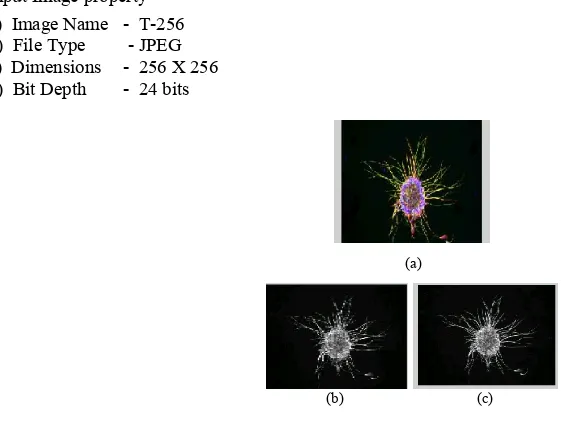
For the evaluation of the suggested approach a simulation model is developed and is been tested on various medical image samples. The images are read with various specifications and the observations were developed as shown below,
Input Image property a) Image Name - T-256 b) File Type - JPEG c) Dimensions - 256 X 256 d) Bit Depth - 24 bits
(a)
(b) (c)
Fig. 1. (a) Original Image, (b) Conventional Approach, (c) Output image after applying proposed algorithm.
Table 1. Performance comparison between conventional and ANN base approach
Compression %
Computation time (sec)
Mean square error
33 47 0.45 47 8 0.25
(a)
(b) (c)
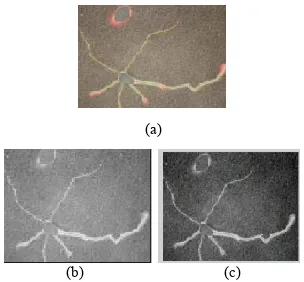
Fig. 2. (a) Original Image, (b) Conventional Approach, (c) Output image after applying proposed algorithm.
Table 2. Performance comparison between conventional and ANN base approach
Compression %
Computation time (sec)
Mean square error
35 23 0.18 67 7 0.1
7. Conclusion
This work implements an enhanced image coding system for image compression compared to the existing system. It is observed that proposed algorithm is able to achieve its good performance with a relatively simple algorithm. proposed algorithm does not require complicated bit allocation procedures like subband coding does, and it does not require prior knowledge of the image source like JPEG does (to optimize quantization tables). Using ANN also has the desirable property, resulting from its successive approximation quantization. Different topologies were applied to solve the problem. The results in each of the four network structures and their enhancements show that the serial structure gives the best results.
References
[1] J.Shapiro, “Embedded image coding using zerotrees of wavelet coefficients,” IEEE Trans. Signal Processing, vol. 41, pp.3445-3462, Dec 1993.
[2] S.Mallat and F. Falzon, “Analysis of low bit rate image transform coding,” IEEE Trans. Signal Processing, vol. 46, pp. 1027-1042, Apr. 1998.
[3] Z. Xiong, K . Ramchandran, and M. Orchad, “Space-frequency quantization for wavelet image coding,” IEEE Trans. Signal Processing, vol. 6, pp. 677-693, May 1997.
[4] E. H. Adelson, E. Simoncelli, and R. Hingorani, “Orthogonal pyramid transforms for image coding,” Proc. SPIE, vol. 845, Cambridge, MA, Oct. 1987, pp. 50-58.
[5] R. A. DeVore, B. Jawerth, and B. J. Lucier, ”Image compression through wavelet transform coding,” IEEE Trans. Informat. Theory, vol. 38, pp. 719-746, Mar. 1992.
[6] S. Mallat, “A theory for multiresolution signal decomposition: The wavelet representation,” IEEE Trans. Pattern Anal. Mach. Intell., vol. 37, pp.2091-2110, Dec.1990.
[7] G. K. Wallace, “ The JPEG Still Picture Compression Standard,” Common. ACM, vol. 34, pp. 30-44, Apr. 1991.