FREQUENCY CONTROL OF AN ISOLATED HYBRID POWER SYSTEM USING PARTICLE
SWARM OPTIMIZATION OPTIMIZED PID CONTROLLER
Israfil Hussain, Sudhanshu Ranjan, D.C Das and N. Sinha
EE. Dept. NIT Silchar, Assam, India
[email protected], [email protected], [email protected], [email protected]
ABSTRACT
The mitigation of frequency fluctuation using Particle Swarm Optimization (PSO) based controllers for an isolated hybrid power system is explored in this paper. The proposed system consists of solar photovoltaic (PV), electric water heater (EWH) and diesel engine generator (DEG) and battery energy storage system (BESS). The intermittent output power of PV and load variations cause frequency fluctuations with several adverse effects on the power system. This paper presents a methodology for maintaining system frequency within acceptable employing electric water heater as a controllable load. The generating units and EWH system are equipped with PSO based proportional–integral (PI)/ proportional–integral–derivative (PID) controllers. The solutions obtained through the optimization are capable of handling higher variations in the controllers’ gains without a significant decrease in the system performance. Also, a comparison is made between the PI and PID controllers to show the effectiveness of the proposed scheme. MATLAB/Simulink was used for simulation to verify the performance of the proposed system.
Index Terms— solar photovoltaic, electric water heater, diesel engine generator, Particle Swarm Optimization, Frequency
deviation
I.INTRODUCTION
Due to the continuous depletion of the fossil fuel, as well CO2 emissions have demanded neat and clean energy sources [1]. Renewable energy sources such as wind and solar can be used to harness the plentiful energy which can play a major role in meeting the supply-demand as well as maintaining the mother earth clean. Nowadays, small-scale, isolated hybrid power system is gaining more and more importance because in remote or in hilly areas where grid connection is not feasible due to economic or technical reason [2]. As the renewable energy sources are intermittent in nature, out power from them causes the mismatch between the supply-demand. This mismatch in active power gives rise to frequency deviations. Hence, frequency control issue in power system has become very essential to ensure reliable power supply [2-4].
Given the above, mitigation of frequency fluctua-tions in a PV-EWH-DEG-BESS based isolated hybrid power system has been investigated. An efficient control strategy together with artificial intelligence (AI) technique has been used for effectively maintaining the active power balance. Thus, the proposed strategy is expected to mitigate the oscillations which is caused due to the mismatch in the active power, so as to maintain the system frequency within an acceptable range of the proposed isolated hybrid power system [5]. Different controllers and several optimization techni-ques for tuning the parameters of the controllers have been reported in the previous works [6-14]. In hybrid system studies, PI controllers have been used for maintaining the energy balance [6-8]. The parameters of the PI controllers in [9] has been tuned by Ziegler and Nichols method. GA optimized PI/PID [10,11], Fuzzy based PI controller [12,13], and neural network based PI controller [12] are also used. Firefly algorithm is optimized PID controllers [14] were successfully emp-loyed for an interconnected power system for load frequency control.
Application of controllable loads for maintaing system frequency have been reported has been reported in [15, 16].
The present work presents a method for frequency control of the small isolated hybrid power system using
EWH. PSO algorithm has been used for obtaining the gains of the PI/ PID controllers’ parameters. The main objectives of the paper includes:
Augmenting the PSO algorithm to find the gains of PI and PID controllers of the proposed system.
Comparative analysis of the dynamic performance of PI and PID based controllers.
Study the robustness of the controllers when the system system is subjected to several uncertainties and random load fluctuations.
The paper is organized as follows. Section 2 descri-bes the configuration of the proposed system modeling in the form of transfer functions. Section 3 describes the effectiveness of EWH in the proposed system. Particle Swarm Optimization Technique is described in Section 4. Section 5 describe PID controller. The simulation results in the analysis in section 6 and section 7 descri-bes the conclusion.
II.CONFIGURATIONOFTHEPROPOSEDHYBRID
SYSTEM
The schematic diagram of the isolated hybrid power system is shown in Fig. 1. Table 1 shows the nominal parameters of the hybrid system [1- 17].
TABLE I. Nominal parameters
Component Gain (K) Time Constant (T)
Solar Photovoltaic (PV) KPV=1 TPV=1.4
Diesel Engine
Generator (DEG) KDEG=0.03 TDEG=2
Speed Governor (SG) KSG=1 TSG=0.4
Electric Water Heater
(EWH) KEWH=1 TEWH=0.1
Battery Energy Storage System (BESS)
+ +
+
P
PL
min
P _
S
Droop
1/R
+ _
Deisel Generator
LOAD
P
DEG
P
BESS
P
PV
P
e
P
f
max
P Pmin
max
P
min
P
max
P
1 PV
PV
K sT
1 DEG
DEG
K sT
1 BESS
BESS
K sT
1 E W H
E W H
K s T
PI/PID
PI/PID PI/PID
Electric Water Heater Battery Energy
Storage System
EWH
P
1
Ms D
Fig. 1 Schematic block diagram of the isolated hybrid power system
with different energy generation and storage.
A.Models of various generation subsystems
For small signal analysis, the transfer functions of the PV, DEG, and EWH can be modeled by using first order transfer functions (1 – 3). The gain and time constants of these are presented in Table I [1,10,11, 16].
( )
(1
)
PV PV
PV
K
G
s
sT
(1)( )
(1
)
EWH EWH
EWH
K
G
s
sT
(2)( )
(1
)
DEG DEG
DEG
K
G
s
sT
(3)The BESS is used in this system, which will either absorb or release energy from or to the system depen-ding upon whether there is surplus power or deficit power in the system respectively. The corresponding transfer function can be represented as (4) [11].
( )
(1
)
BESS BESS
BESS
K
G
s
sT
(4)B.Power and frequency deviation
The mismatch in active power generation (PS) and load demand (PL) is given by
e s L
P
P
P
(5)The transfer function model of power system in terms of system frequency deviation and active power mis-match can be expressed as follows:
1
( )
sys
e
f
G
s
P
Ms
D
(6)where M and D represent the equivalent inertia constant and damping constant of the said system. In this paper, M=0.1 and D=0.12 have been considered [16].
III.EFFECTOFEWHONTHEPROPOSEDSYSTEM The function of EWH in the proposed system is to maintain the active power balance in the hybrid system. Frequency deviation occurs due to the imbalance in the supply and demand. EWH play a significant role in managing this deficit along with power generating sources, thus suppressing the frequency deviations. The desired requirement is that, the supply error ∆Pe and frequency deviation ∆f should be zero. The controllers are employed to control the power consumption by
EWH which is determined by using the amount of power imbalance and the frequency deviation.
IV.PARTICLE SWARM OPTIMIZATION (PSO)
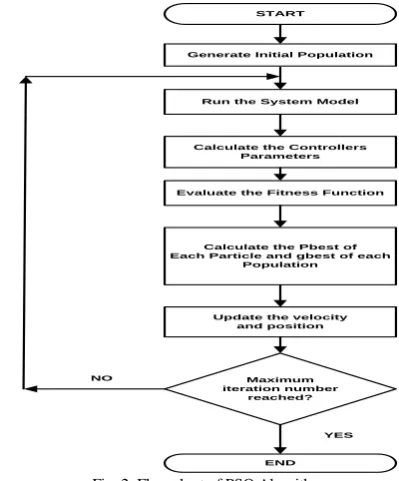
Particle Swarm Optimization is a population-based optimization technique inspired by the swarming or collaborative behavior of bird flocking and fish schoo-ling, developed by Russell Eberhart and James Kennedy in 1995 [19]. The fitness function is a particular type of objective function to find the best solution from among all feasible solutions [1, 8]. The flow chart of PSO algorithm is shown in Fig. 2.
Several works has reported the PSO [1, 5, 19-21]. In the present paper PSO is used to optimize the parameters of the PI/PID controllers. Population size: 60; ωmax = 0.91; ωmin=0.88; C1 =0.12; C2 =1.2; Iteration: 60. In this paper, we consider Integral Square Error (ISE) of frequency deviation as the objective function (fitness function) [1].
2
( )
ISE
f dt (7)The fitness function is the objective function which is minimize to obtain the optimal parameters of PI/PID controllers. Steps for PSO based controllers’ parameters optimization is explained in [22].
Generate Initial Population START
Run the System Model
Calculate the Controllers Parameters
Evaluate the Fitness Function
Calculate the Pbest of Each Particle and gbest of each
Population
Update the velocity and position
Maximum iteration number
reached?
END YES NO
Fig. 2 Flow chart of PSO Algorithm
V.PIDCONTROLLER
The PID controller is employed to enhance the dynamic performance by minimizing the frequency deviation of the system based in proportional, integral, integral and derivative terms. The derivative controller improves the transient response by adding a finite zero to the system while the integral controller reduces the steady-state error by adding a pole at the origins. The PID controller transfer function is [23]
( )
ip d
k
C s
k
k s
s
where Kp, Kd and Ki , represents the gains of coeffi-cients for the proportional, integral, and derivative terms, respectively
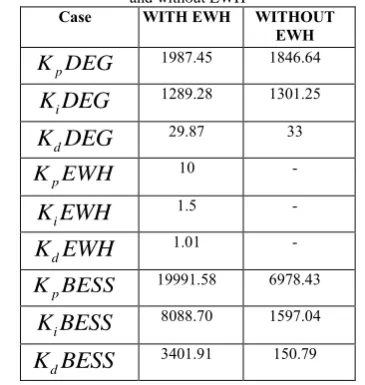
VI.SIMULATIONRESULTSANDANALYSIS Here, simulations are carried out consisting of PV-DEG-EWH-BESS system using time domain analysis. The dynamic responses of the simulations under random generation and load demand have been presented. The parameters of PI/PID controllers has been tuned using PSO technique. Table I shows the gains of PI and PID controllers obtained through PSO technique.
A.Controllable load
EWH and battery used in this system are considered as controllable loads. EWH is used to suppress the system frequency by providing active power control. BESS is used for providing power during peak time as well as acts as backup source [24].
B.Time-Domain Analysis
In this section, time-domain analysis of the proposed hybrid power system under random load and generating conditions of supply and demand conditions are carried out. There occurs fluctuation in system frequency due to the intermittent output power from solar photovoltaic and stochastic variation in load demand. This deviation in frequency is mitigated by PI/ PID controllers. The controllers adjust the output power of the generating units automatically so as to maintain the balance between the active power generation and demand.
Here, the dynamic performance of the proposed system is investigated when subjected to randomly variable characteristics in PPV and PL. Fig. 3 presents the PPV and load demand (PL).
Fig. 3 Presents the output power of PPV and load demand (PL)
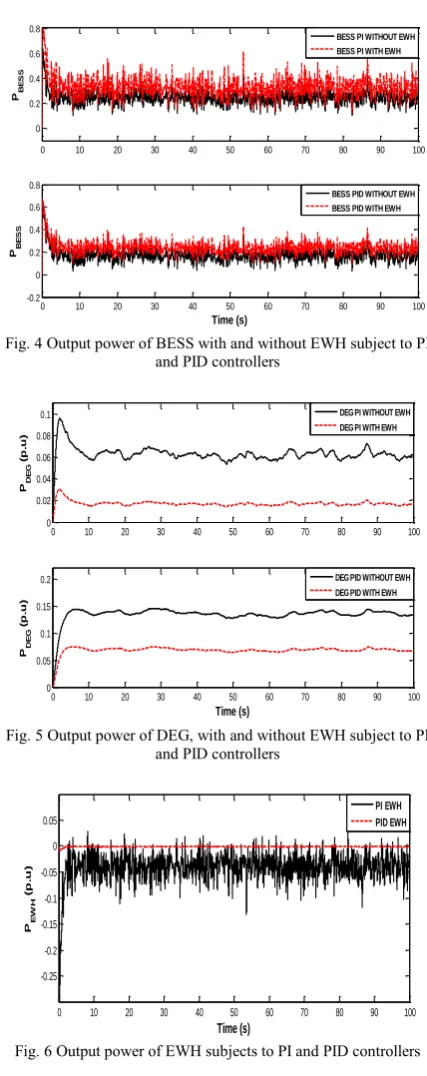
Variations in load demand and PPV cause the contro-llers to adjust the output power of the BESS, DEG and EWH so that frequency deviancy is minimized and base frequency the system is restored. Fig. 4 and Fig. 5 represents the output power of BESS and DEG with and without PI and PID controllers while Fig. 6 accounts for the power consumption of EWH with PI and PID controllers.
Fig. 4 Output power of BESS with and without EWH subject to PI and PID controllers
Fig. 5 Output power of DEG, with and without EWH subject to PI and PID controllers
Fig. 6 Output power of EWH subjects to PI and PID controllers
Fig. 7 and Fig. 8 shows the transient response of frequ-ency deviation observed with PSO optimized PI and PID controllers respectively. Fig. 9 shows the conver-gence plots of objective function value versus iteration for with PSO optimized PI and PID controllers. The gain values of PI and PID controllers that were optimized with PSO technique are given with and without EWH are presented in Table II and Table III.
0 10 20 30 40 50 60 70 80 90 100
0.36 0.38 0.4 0.42
Pp
v
(
p
.u
)
0 10 20 30 40 50 60 70 80 90 100
0.5 0.6 0.7 0.8 0.9
Time (s)
PL
(
p
.u
)
0 10 20 30 40 50 60 70 80 90 100
0 0.2 0.4 0.6 0.8
PB
E
S
S
0 10 20 30 40 50 60 70 80 90 100
-0.2 0 0.2 0.4 0.6 0.8
Time (s) PB
E
S
S
BESS PI WITHOUT EWH BESS PI WITH EWH
BESS PID WITHOUT EWH BESS PID WITH EWH
0 10 20 30 40 50 60 70 80 90 100
0 0.02 0.04 0.06 0.08 0.1
PD
E
G
(
p
.u
)
0 10 20 30 40 50 60 70 80 90 100
0 0.05 0.1 0.15 0.2
Time (s) PD
E
G
(
p
.u
)
DEG PI WITHOUT EWH DEG PI WITH EWH
DEG PID WITHOUT EWH DEG PID WITH EWH
0 10 20 30 40 50 60 70 80 90 100
-0.25 -0.2 -0.15 -0.1 -0.05 0 0.05
Time (s)
P
E
W
H
(
p
.u
)
Fig. 7 Transient response of frequency deviation observed with PSO optimized PI controller
Fig. 8 Transient response of frequency deviation observed with PSO optimized PID controller
Fig. 9 The convergence plots of objective function value versus iteration for with PSO optimized PI and PID controllers
The simulation results as shown in the above figures show that the proposed PSO based PID controller is effectively able to suppress the frequency deviation as compared to PI controller for random variations in power generation and load.
The comparative performance of the hybrid with EWH vis-a-vis without EWH as shown in Fig. 8 and Fig. 9 demonstrates that that hybrid system with EWH performs better than the hybrid system without EWH in mitigating frequency fluctuations.
TABLE II. Gain values of PSO optimized PI controller with and without EWH
Case WITH
EWH WITHOUT EWH
p
K DEG
994.41 1088i
K DEG
260.73 255p
K EWH
10.11 -i
K EWH
2 -p
K BESS
9199.68 2199.55i
K BESS
5006.01 1012.29TABLE III. Gain values of PSO optimized PID controller with and without EWH
Case WITH EWH WITHOUT EWH
p
K DEG
1987.45 1846.64i
K DEG
1289.28 1301.25d
K DEG
29.87 33p
K EWH
10 -i
K EWH
1.5 -d
K EWH
1.01 -p
K BESS
19991.58 6978.43i
K BESS
8088.70 1597.04d
K BESS
3401.91 150.79VII.CONCLUSION
The paper investigates the use of PI/PID controller for suppressing the system frequency deviation by using controllable load in an isolated hybrid power system. The duo EWH and DEG reduce the high-frequency and low-frequency component of supply error in load and generator side respectively by using the PID controller. Simulation results show that the PID controller is better than the PI controller under the nominal operating condition and gives better robustness for the large parametric uncertainty of the proposed system. There-fore, the proposed PSO optimized PID controller can ensure the real power balance condition despite varia-tions in power generated by solar PV and or change in load. Future work may be directed toward looking at analytical controller design methods for such hybrid power systems together with other meta-heuristic optimization algorithms like Ant Colony, Flower Pollination, etc.
ACKNOWLEDGMENT
Authors thank the EE Department, NIT Silchar, for providing the necessary facilities for completing this work.
REFERENCES
[1] D. C. Das, a. K. Roy, and N. Sinha, PSO based frequency controller for wind-solar-diesel hybrid energy generation/energy storage system, Proc. of Int. Conf. Energy, Autom. Signal, ICEAS, Pp. 458–463 (2011).
[2] A. M.O. Haruni, A stand-alone hybrid power system with energy storage. University of Tasmania, 2013. [3] F. Blaabjerg, Z. Chen, S. Member, and S. B. Kjaer,
Power Electronics as Efficient Interface in Disper-sed Power Generation Systems, 19(5): 1184–1194 (2004). [4] S. Vachirasricirikul and I. Ngamroo, Robust contro-ller design of heat pump and plug-in hybrid electric vehicle for frequency control in a smart microgrid based on specified-structure mixed H2/H??? control technique. Appl. Energy 88(11): 3860–3868 (2011). [5] D.C. Das, N. Sinha and A.K. Roy, Automatic
Gene-ration Control of an Organic Rankine Cycle Solar-Thermal/Wind-Diesel Hybrid Energy System. Energy Technol. 2(8): 721–731 (2014).
0 10 20 30 40 50 60 70 80 90 100
-0.5 -0.4 -0.3 -0.2 -0.1 0 0.1
Time (s)
f
(p
.u
)
0 5 10
-0.05 0 0.05
40 42 44 46 48 50 52
-0.05 0 0.05
PI WITHOUT EWH PI WITH EWH
PI WITHOUT EWH PI WITH EWH
PI WITHOUT EWH PI WITH EWH
0 10 20 30 40 50 60 70 80 90 100
-0.25 -0.2 -0.15 -0.1 -0.05 0 0.05
Time (s)
f
(p
.u
)
0 5 10
-0.02 -0.01 0 0.01
40 42 44 46 48 50 52
-0.01 -0.005 0 0.005
0.01 PID WITHOUT EWH PID WITH EWH
PID WITHOUT EWH PID WITH EWH
PID WITHOUT EWH PID WITH EWH
0 10 20 30 40 50 60 70 80 90 100
0 0.5 1 1.5
Iteration
O
b
je
c
ti
v
e
F
u
n
c
ti
o
n PI
[6] P. K. Ray, S.R. Mohanty and N. Kishor, Dynamic Load -Frequency Control of Hybrid Renewable Energy Based Power System with HVDC-Link. J. Electr. Eng. Theory Appl. 1(1): 24 - 31(2010).
[7] T. Senjyu, T. Nakaji, K. Uezato and T. Funabashi, A hybrid power system using alternative energy facilities in isolated island. IEEE Trans. energy Convers. 20(2): 406–414 (2005).
[8] B. S. Kumar, S. Mishra, S. Member and N. Senroy, AGC for distributed generation, pp. 89–94 (2008). [9] C. Elmas and T. Yigit, Genetic algorithm based on-line
tuning of a PI controller for a switched reluctance motor drive. Electr. Power Components Syst. 35(6): 675–691 (2007).
[10] D.C. Das, A.K. Roy and N. Sinha, GA based frequ-ency controller for solar thermal-diesel-wind hybrid energy generation/energy storage system. Int. J. Electr. Power Energy Syst.43(1): 262–279 (2012).
[11] D. C. Das, N. Sinha and A. K. Roy, Small signal stability analysis of dish-Stirling solar thermal based autonomous hybrid energy system. Int. J. Electr. Power Energy Syst. 63: 485–498 (2014).
[12] M. Taghizadeh, M. Hoseintabar and J. Faiz, Frequ-ency control of isolated WT/PV/SOFC/UC network with new control strategy for improving SOFC dynamic response. Int. Trans. Electr. Energy Syst.
25(9): 1748–1770 (2015).
[13] M. Taghizadeh, M. Mardaneh and M. S. Sadeghi, Fuzzy based frequency control in an isolated net-work employing parallel operated fuel cell/ultra-capacitor systems. J. Renew. Sustain. Energy 5(1): 13101 (2013). [14] S. Padhan, R. K. Sahu and S. Panda, Application of firefly algorithm for load frequency control of multi-area interconnected power system. Electr. Power Components Syst. 42(13) 1419–1430 (2014).
[15] T. Senjyu, M. Tokudome, A.Yona and T. Funabashi, A Frequency Control Approach by Decentralized Cont-rollable Loads in Small Power Systems. IEEJ Trans. Power Energy 129(9): 1074–1080 (2009).
[16] T. Senjyu, M. Tokudome, A. Yona, H. Sekine, T. Funabashi and C.-H. Kim, A frequency control appro- ach by decentralized generators and loads in power systems, Power and Energy Conference IEEE 2nd International Pp. 79–84 (2008).
[17] D.C. Das, A.K. Roy, and N. Sinha, Genetic algori-thm based pi controller for frequency control of an autonomous hybrid generation system, Procee-dings of the International MultiConference of Engineers and Computer Scientists (2011)
[18] S. Safari, M. M. Ardehali and M. J. Sirizi, Particle swarm optimization based fuzzy logic controller for autonomous green power energy system with hydrogen storage. Energy Convers. Manag. 65: 41–49 (2013). [19] M. A. Abido, Optimal design of power-system
stabili-zers using particle swarm optimization. IEEE Trans. energy Convers. 17(3): 406–413 (2002).
[20] M. Nasri, H. Nezamabadi-Pour and M. Maghfoori, A PSO-based optimum design of PID controller for a linear brushless DC motor. World Acad. Sci. Eng. Technol. 26(40): 211–215 (2007).
[21] R. C. Eberhart and J. Kennedy, A new optimizer using particle swarm theory, Proceedings of the sixth international symposium on micro machine and human science vol. 1, pp. 39–43 (1995).
[22] S. R. Mohanty, N. Kishor and P. K. Ray, Robust H-infinite loop shaping controller based on hybrid PSO and harmonic search for frequency regulation in hybrid distributed generation system. Int. J. Electr. Power Energy Syst. 60: 302–316 (20140.
[23] P. Dash, L. C. Saikia and N. Sinha, Automatic genera-tion control of multi area thermal system using Bat algorithm optimized PD–PID cascade controller. Int. J. Electr. Power Energy Syst. 68: 364 –372 (2015). [24] M. Tokudome, T.Senjyu, A. Yona and T. Funabashi,
Frequency and voltage control of isolated island power systems by decentralized controllable loads, Trans-mission & Distribution Conference & Exposition, Asia and Pacific Pp. 1–4(2009).