INTERNATIONAL RESEARCH JOURNAL OF PHARMACY
www.irjponline.com
ISSN 2230
–
8407
Research Article
DESIGN, SYNTHESIS AND CHARACTERIZATION OF NOVEL 3, 5- DINITRO PHENYL CLUBBED
AZOLES AGAINST ACTIVE AND LATENT TUBERCULOSIS
M.N.V.S.Viswanadha Murhty
*, V.Girija Sastry, M Kiran
Department of Pharmaceutical Chemistry, AU College of Pharmaceutical Sciences, Andhra University, Viskhapatnam, India
*Corresponding Author Email: [email protected]
Article Received on: 25/11/17 Approved for publication: 28/12/17
DOI: 10.7897/2230-8407.0812257
ABSTRACT
In the present study a novel series of 3,5-dinitrophenyl clubbed 1,2,4-triazoles and 1,3,4-oxadiazole derivatives have been designed, synthesized and characterized by IR,1H NMR and mass spectral analysis in order to target both active and latent tuberculosis. Synthesized compounds were evaluated
for their preliminary anti tubercular activity against mycobacterium tuberculosis H37Rv strain by Microplate Alamar blue assay and cytotoxicity.
Compounds with better selectivity index were tested against recombinant M.Tb H37Rv (pFCA-luxAB) strain by low oxygen recovery assay. Docking
studies have been designed in order to find out the “best-fit” orientation of a ligand that binds to the given protein of interest. Among all the synthesized compounds 7F, 3F and 4C are effective against both active and latent tuberculosis.
KEY WORDS: Latent tuberculosis, isocitrate lyase, lora assay, dinitro phenyl azoles, tuberculosis
INTRODUCTION
An infection with Mycobacterium tuberculosis (M.Tb) can
result in engages a balanced “symbiosis” for survival, by which 10% of infected people will develop the active disease i.e., Tuberculosis (TB) while the rest show no symptoms yet carry the long-lived M. Tb commonly, latent tuberculosis infection (LTBI). Even though the introduction of Delamanid and Bedaquiline1, 2, 3 to the repertoire of TB therapies, the majority of
current drugs are ineffective for long-term regimens due to their drug resistance mechanisms.
About one third of the world population is infected with latent tuberculosis acts as a reservoir for disease reactivation and also creates a hindrance for treatment. Unfortunately both latent and active tuberculosis exhibits different metabolic pathways. With this idea, Pharmacophores with diverse mechanism are clubbed together into a single scaffold molecules targeting both active and latent tuberculosis simultaneously.
In the light of literature, Dinitrophenyl moiety was found as a fortunate pharmacophore in encompassing inhibition of crucial enzymes i.e., Isocitrate Lyase (ICL) in glyoxylate shunt
responsible for sustaining M.Tb in chronic phase4,5 and
Isocitrate dehydrogenase (IDH) involved in citric acid cycle and also shows significant effect on non-replicating bacilli are established. ICL is a persistent and essential factor in latent phase and absence of ICL orthologs in mammals makes it an attractive target for drug discovery. An evidence of nitro group containing molecules are effective against latent tuberculosis
and also influences on M.Tb ICL6.Azoles are group of
molecules which can reach the target by transmembrane diffusion because of its lipophilic property and also inhibits sterol synthesis via sterol demethylase inhibition in a eukaryotic organism7, 8, 9. In addition to this, these show an evidence of
potential prevention in the formation of latent bacilli in mice
which are more effective than rifampicin10. Docking is for
identifying an optimized orientation between protein and ligand
such that the free energy of the overall system is minimized11.
So far enough efforts have not been made in hyphenation of these pharmacophores as a single scaffold, creates a huge interest in crafting 3,5-Dinitrophenyl clubbed azoles targeting replicating and non-replicating bacilli i.e., active and latent tuberculosis. Rational design of molecules is depicted in figure 1.
The present study illustrates the 3, 5-dinitrophenyl clubbed 1, 3, 4-triazoles and 1, 2, 4-triazoles – synthesis and their biological activity against active and latent tuberculosis.
MATERIALS AND METHODS Chemistry
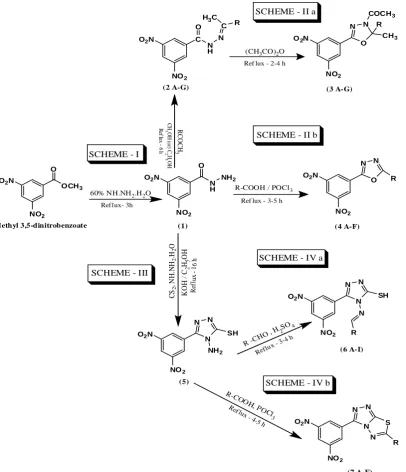
The reaction sequences employed for synthesis of target compounds are shown in general scheme of synthesis in figure 2 and their properties are depicted in table 1.
Reaction of triazole (5) was condensed with various substituted benzaldehydes in presence of catalytic amount of concentrated sulphuric acid in ethanol to afford a series of 3, 5-dinitrophenyl-4-substituted-1, 2, 4-triazole-3-thiols (6 A-L) (scheme IV a). Reaction of triazole (5) with appropriate hetero aromatic acids in presence of phosphorus oxychloride produced a series of fused triazolo thiadiazoles (7 A-F) (scheme IV b).
EXPERIMENTAL Chemical Protocols
The melting points of all the synthesized compounds were recorded on a digital melting point apparatus (EZ melt, Stanford Research Systems) and were uncorrected. Preloaded silica gel TLC plates (Silica gel 60 F254, Merck) were used for monitoring the reaction and purity of the compounds. Iodine
vapors and Sulphuric acid spray reagent (10% H2SO4/MeOH)
were used as visualizing agents.IR spectra were recorded on BRUKER FT-IR (OPUS 6.4) spectrometer using KBr disc
method and the values were expressed in cm-1.The 1H NMR
spectra of the compounds were recorded on BRUKER AVANCE 400 MHz NMR spectrometer (Topspin) chemical shifts were reported as δ values in parts per million (ppm) and were indirectly referenced to tetramethylsilane (TMS) via the solvent signal. The elemental analysis was conducted on Thermo Finnigan flash. The mass spectra were recorded on AGILENT QQQ LC-MS (ESI-MS) spectrometer (Mass hunter B.03.01).
Scheme I: General Procedure for Synthesis of 3, 5-dinitrobenzohydrazide
An equimolar ratio of methyl 3,5-dinitrobenzoate with 60% hydrazine hydrate in methanol refluxed for 3 hrs monitored by TLC yields 3,5-dinitrobenzohydrazide (1) which is starting material for the further synthesis. Then formed hydrazide was distilled by using rotavapor and kept aside for overnight. Crystals of hydrazide was obtained.
Scheme II a: General Procedure for Synthesis of 3, 5-dinitrophenyl substituted-1, 3, 4-oxadiazol-3 (2H)-yl ethanone (3 A-G)
Equimolar quantities of hydrazide (1) and different substituted ketones were refluxed in alcohol for about 4-6 hrs in the presence of few drops of glacial acetic acid. The solvent was evaporated and the product was poured onto cold water, filtered and dried. The crude solid was recrystallized in the appropriate solvent systems to give the products (2 A-G). A mixture of compound (2 A-G) (0.003 mol) and acetic anhydride (10 ml) was refluxed for 2-4 hrs. After the reaction mixture attained room temperature, excess of acetic anhydride was decomposed by water and the mixture was stirred for further 30 min. the separated product was filtered, washed with water, dried and recrystallized with methanol (3 A-G).
1-(5-(3,5-dinitrophenyl)-2,2-dimethyl-1,3,4-oxadiazol-3
(2H)-yl) ethanone (3A) : M.P (oC) :166 ; IR (KBr,Cm-1): 1302,1503
(Nitro,NO2), 1441 (C=C, Ar),1631 (C=N),1713 (C=O);1HNMR
( ,400 MHz,DMSO-d6,PPm): 9.02 (d, J = 1.6, 1H), 8.94 (d, J =
2.0, 2H), 2.36 (s, 3H), 1.40 (s, 6H). MS (m/z, M+):309.00 (M+1); Yield: 81%
1-(5-(3,5-dinitrophenyl)-2-methyl-2-phenyl-1,3,4-oxadiazol-3
(2H)-yl) ethanone (3B): M.P (oC) :156; IR (KBr,Cm-1):
1323,1520 (Nitro,NO2), 1491 (C=C, Ar),1637 (C=N),1718
(C=O) ;1HNMR ( ,400 MHz,DMSO-d
6,PPm): 9.02 (d, J = 1.6,
1H), 8.94 (d, J = 2.0, 2H), 7.08 – 6.66 (m, 5H), 2.36 (s, 3H), 1.53 (s, 3H). MS (m/z, M+):371.90 (M+1); Yield: 76%
1-(2-(4-chlorophenyl)-5-(3,5-dinitrophenyl)-2-methyl-1,3,4-oxadiazol-3(2H)-yl) ethanone
(3C): M.P (oC) :160; IR (KBr,Cm-1): 1350,1519 (Nitro,NO
2),
1498 (C=C, Ar),1656 (C=N),1707 (C=O), 693 (Ar-Cl);1HNMR
( ,400 MHz,DMSO-d6,PPm): 9.02 (d, J = 1.6, 1H), 8.94 (d, J =
2.0, 2H), 7.23(d, J=8.0, 2H), 7.12 (d, J=8.0, 2H), 2.36 (s, 3H), 1.72 (s, 3H). MS (m/z, M+):405.90 (M+1); Yield: 87%
1-(5-(3,5-dinitrophenyl)-2-methyl-2-(4-nitrophenyl)-1,3,4-oxadiazol-3 (2H)-yl) ethanone (3D): M.P (oC) :168; IR
(KBr,Cm-1): 1314,1517 (Nitro,NO
2), 1511 (C=C, Ar),1625
(C=N),1717 (C=O) ;1HNMR ( ,400 MHz,DMSO-d
6,PPm):
9.02 (d, J = 1.6, 1H), 8.94 (d, J = 2.0, 2H), 7.92(d, J= 7.8, 2H), 7.69 (d, J= 7.8, 2H), 2.36 (s, 3H), 1.96 (s, 3H). MS (m/z, M+):416.50 (M+1); Yield: 84%
1-(2-(4-bromophenyl)-5-(3,5-dinitrophenyl)-2-methyl-1,3,4-oxadiazol-3(2H)-yl) ethanone (3E): M.P (oC) :176; IR (KBr,Cm
-1): 1375,1508 (Nitro,NO
2), 1515 (C=C, Ar),1608 (C=N),1735
(C=O), 785 (Ar-Br);1HNMR ( ,400 MHz,DMSO-d
6,PPm):
9.02 (d, J = 1.6, 1H), 8.94 (d, J = 2.0, 2H), 7.21(d, J=8.0, 2H),
7.03 (d, J=8.0, 2H), 2.36 (s, 3H), 1.72 (s, 3H). MS (m/z,
M+):450.10 (M+1); Yield: 71%
1-(5-(3,5-dinitrophenyl)-2-methyl-2-p-tolyl-1,3,4-oxadiazol-3(2H)-yl) ethanone (3F) : M.P (oC) :156; IR (KBr,Cm-1):
1377,1517 (Nitro,NO2), 1510 (C=C, Ar),1608 (C=N),1717
(C=O) ; 1HNMR ( ,400 MHz,DMSO-d
6,PPm): 9.02 (d, J = 1.6,
1H), 8.94 (d, J = 2.0, 2H), 6.95(d, J=7.8, 2H), 6.77 (d, J=8.0,
2H), 2.36 (s, 3H),1.82 (s,3H), 1.51 (s, 3H). MS (m/z, M+):385.90 (M+1); Yield: 74%
1-(5-(3,5-dinitrophenyl)-2-(4-hydroxyphenyl)-2-methyl-1,3,4-oxadiazol-3(2H)-yl)ethanone(3G): M.P (oC) :164; IR (KBr,Cm
-1): 1377,1508 (Nitro,NO
2), 1517 (C=C, Ar),1621 (C=N),1718
(C=O), 3482 (Ar-OH); 1HNMR ( ,400 MHz,DMSO-d
6,PPm):
9.02 (d, J = 1.6, 1H), 8.94 (d, J = 2.0, 2H), 6.69(d, J=7.8, 2H),
6.55 (d, J=8.0, 2H), 5.09 (s, 1H), 2.36 (s, 3H), 1.53 (s, 3H) MS
(m/z, M+):387.80 (M+1); Yield: 70%
Scheme II b: General Procedure for Synthesis of 2-(3, 5-dinitrophenyl) Substituted-1,3,4-oxadiazoles (4 A-F)
An equimolar ratio of compound (1) and the appropriate aromatic acid in phosphorus oxychloride (10 ml) was refluxed for 3-5 hrs. Then the reaction mixture was slowly poured over crushed ice and kept overnight aside. The solid thus separated out was filtered, treated with dilute sodium hydroxide, washed with water and recrystallized with ethyl acetate: hexane in 2:4 (4 A-F).
2-(3,5-dinitrophenyl)-5-phenyl-1,3,4-oxadiazole (4A): M.P (oC)
:271 ; IR (KBr,Cm-1): 1324,1524 (Nitro,NO
2), 1460 (C=C,
Ar),1664 (C=N),3061 (C-H, Ar) ; 1HNMR ( ,400
MHz,DMSO-d6,PPm): 9.02 (d, J = 1.6, 1H), 8.94 (d, J = 2.0, 2H), 7.08 – 6.66
(m, 5H). MS (m/z, M+):313.0 (M+1); Yield: 80%
2-(4-chlorophenyl)-5-(3,5-dinitrophenyl)-1,3,4-oxadiazole (4B):
M.P (oC) :305; IR (KBr,Cm-1): 1322,1501 (Nitro,NO
2), 1530
(C=C, Ar),1614 (C=N),3080 (C-H, Ar), 666 (Ar-Cl) ; 1HNMR
( ,400 MHz,DMSO-d6,PPm): 9.02 (d, J = 1.6, 1H), 8.94 (d, J =
2-(3,5-dinitrophenyl)-5-(4-nitrophenyl)-1,3,4-oxadiazole (4C):
M.P (oC): 316; IR (KBr,Cm-1): 1306,1515 (Nitro,NO
2), 1533
(C=C, Ar),1691 (C=N),3060 (C-H, Ar) ; 1HNMR ( ,400
MHz,DMSO-d6,PPm): 9.02 (d, J = 1.6, 1H), 8.94 (d, J = 2.0,
2H), 7.30 (d, J = 7.8, 2H), 7.26 (d, J = 7.8, 2H). MS (m/z, M+):358.9 (M+1); Yield: 91%
2-(3,5-dinitrophenyl)-5-P-tolyl-1,3,4-oxadiazole (4D): M.P (oC)
:285; IR (KBr,Cm-1): 1314,1530 (Nitro,NO
2), 1566 (C=C,
Ar),1690 (C=N),3090 (C-H, Ar) ; 1HNMR ( ,400
MHz,DMSO-d6,PPm): 9.02 (d, J = 1.6, 1H), 8.94 (d, J = 2.0, 2H), 6.92 (d, J
= 8.0, 2H), 6.66 (d, J = 7.8, 2H),1.53 (s, J=2.2, 3H) MS (m/z,
M-):325.4 (M-1); Yield: 92%
4-(5-(3,5-dinitrophenyl)-1,3,4-oxadiazol-2-yl) phenol (4E): M.P (oC) :287; IR (KBr,Cm-1): 1311,1532 (Nitro,NO
2), 1612 (C=C,
Ar),1691 (C=N),3055 (C-H, Ar), 3316 (Ar-OH) ; 1HNMR
( ,400 MHz,DMSO-d6,PPm): 9.02 (d, J = 1.6, 1H), 8.94 (d, J =
2.0, 2H), 7.01 (d, J = 8.8, 2H), 6.84 (d, J = 8.0, 2H),5.43(s, 1H).
MS (m/z, M-):327.7 (M-1); Yield: 85%
2-(3,5-dinitrophenyl)-5-(4-methoxyphenyl)-1,3,4-oxadiazole (4F) : M.P (oC) :300; IR (KBr,Cm-1): 1310,1464 (Nitro,NO
2),
1583 (C=C, Ar),1664 (C=N),3099 (C-H, Ar), 1727 (Ar-OCH3) ;
1HNMR ( ,400 MHz,DMSO-d
6,PPm): 9.02 (d, J = 1.6, 1H),
8.94 (d, J = 2.0, 2H), 6.71 (d, J = 7.8, 2H), 6.52 (d, J = 7.8,
2H),4.2 (s, J=2, 3H). MS (m/z, M+):343.0 (M+1); Yield: 88%
Scheme III: General Procedure for Synthesis of 4-amino-5-(3, 5-dinitrophenyl)-4H-1, 2, 4-triazole-3-thiol (5)
Compound (1) (0.003 mol) and carbon disulphide (0.006 mol)
were added in a solution of potassium hydroxide (0.0067 mol) in absolute ethanol (30 ml) refluxed for about 16 hrs. To the resulting solution anhydrous ether was added and the precipitate of potassium dithiocarbazinate was collected by filtration, washed with ether and dried under vacuum. A suspension of the potassium salt, hydrazine hydrate (1.5 ml) and water (10 ml) was refluxed for 5 hrs gave a precipitate. Then filtered, washed with water and recrystallized with methanol.
4-amino-5-(3,5-dinitrophenyl)-4H-1,2,4-triazole-3-thiol (5):
M.P (oC) :231; IR (KBr,Cm-1): 1369,1541 (Nitro,NO
2), 1427
(C=C, Ar),1641 (C=N),3034 (C-H, Ar), 2561 (C-SH), 3460
(NH, str) ; 1HNMR ( ,400 MHz,DMSO-d
6,PPm): 9.02 (d, J =
1.6, 1H), 8.94 (d, J = 2.0, 2H), 4.42 (s, 1H), 4.02 (s,2H). MS
(m/z, M-):281.9(M-1); Yield: 86%
Scheme IVa: General Procedure for Synthesis of 3, 5-dinitrophenyl-4-substituted-1, 2, 4-triazole-3-thiols (6 A-L)
An equimolar ratio of compound (5) and substituted benzaldehydes with 4-5 drops of concentrated sulphuric acid in ethanol was refluxed for 3-4 hrs. The resulting solution was cooled to room temperature and the precipitated solid was filtered under suction, washed with cold ethanol and recrystallized from hot ethanol.
4-(4-bromobenzylideneamino)-5-(3,5-dinitrophenyl)-4H-1,2,4-triazole-3-thiol (6A): M.P (oC) :160; IR (KBr,Cm-1): 1338,1544
(NO2,Nitro), 1116 (C-N), 1617 (C=N),1452 (C=C, Ar), 2575
(C-SH),520 (Ar-Br); 1HNMR ( ,400 MHz,DMSO-d
6,PPm):
9.41 (s, 1H, N=CH), 9.02 (d, J = 1.6, 1H), 8.94 (d, J = 2.0, 2H), 7.26 (d, J = 8.0, 2H), 7.20 (d, J = 8.8, 2H), 4.48(s, 1H,
N=C-SH). MS (m/z, M+):449.0 (M+1); Yield: 69%
5-(3,5-dinitrophenyl)-4-(3,4,5-trimethoxybenzylideneamino)-4H-1,2,4-triazole-3-thiol (6B) : M.P (oC) :190; IR (KBr,Cm-1):
1360,1510 (NO2,Nitro), 1105 (C-N), 1625 (C=N),1450 (C=C,
Ar), 2560 (C-SH) ; 1HNMR ( ,400 MHz,DMSO-d
6,PPm): 9.73
(s, 1H, N=CH), 10.04 (d, J = 1.6, 1H), 8.94 (d, J = 2.0, 2H), 7.02 (s,2H), 4.48(s, 1H, N=C-SH), 3.83 (s, 3H), 3.67(s, 6H).
MS (m/z, M+):461.1(M+1); Yield: 86%
4-(4-aminobenzylideneamino)-5-(3,5-dinitrophenyl)-4H-1,2,4-triazole-3-thiol (6C): M.P (oC) :198; IR (KBr,Cm-1): 1382,1524
(NO2,Nitro), 1117 (C-N), 1664 (C=N),1460 (C=C, Ar), 2552
(C-SH),3122 (NH, Stretch) ; 1HNMR ( ,400
MHz,DMSO-d6,PPm): 9.38 (s, 1H, N=CH), 9.02 (d, J = 1.6, 1H), 8.94 (d, J =
2.0, 2H), 7.46 (d, J = 8.0, 2H), 7.35 (d, J = 8.0, 2H), 4.48(s, 1H,
N=C-SH), 3.32 (s, 2H, NH2). MS (m/z, M-):384.9 (M-1); Yield:
80%
4-(3,4-dimethoxybenzylideneamino)-5-(3,5-dinitrophenyl)-4H-1,2,4-triazole-3-thiol (6D): M.P (oC) :206; IR (KBr,Cm-1):
1324,1525 (NO2,Nitro), 1134 (C-N), 1679 (C=N),1441 (C=C,
Ar), 2565 (C-SH),1148 (Ar-OCH3) ; 1HNMR ( ,400
MHz,DMSO-d6,PPm): 9.91 (s, 1H, N=CH), 9.02 (d, J = 1.6,
1H), 8.94 (d, J = 2.0, 2H), 7.63 – 8.01(m, 3H), 4.48(s, 1H,
N=C-SH), 3.82 (s, 3H), 3.61(s, 3H). MS (m/z, M+):431.1 (M+1);
Yield: 75%
5-(3,5-dinitrophenyl)-4-(4-methoxybenzylideneamino)-4H-1,2,4-triazole-3-thiol(6E): M.P (oC) :214; IR (KBr,Cm-1):
1312,1508 (NO2,Nitro), 1120 (C-N), 1684 (C=N),1445 (C=C,
Ar), 2579 (C-SH),1142 (Ar-OCH3) ; 1HNMR ( ,400
MHz,DMSO-d6,PPm): 9.17 (s, 1H, N=CH), 9.02 (d, J = 1.6,
1H), 8.94 (d, J = 2.0, 2H), 7.64 (d, J = 8.0, 2H), 7.53 (d, J = 8.0, 2H), 4.48(s, 1H, N=C-SH), 3.52 (s, 3H). MS (m/z,
M+):401.8 (M+1); Yield: 82%
2-((3-(3,5-dinitrophenyl)-5-mercapto-4H-1,2,4-triazol-4-ylimino)methyl phenol (6F): M.P (oC) :240; IR (KBr,Cm-1):
1320,1516 (NO2,Nitro), 1672 (C=N),1447 (C=C, Ar), 2573
(C-SH),3350 (Ar-OH) ; 1HNMR ( ,400 MHz,DMSO-d
6,PPm):
9.68 (s, 1H, N=CH), 9.02 (d, J = 1.6, 1H), 8.94 (d, J = 2.0, 2H), 7.58 – 7.81(m, 4H), 4.59 (s, 1H), 4.48(s, 1H, N=C-SH). MS
(m/z, M+):387.7 (M+1); Yield: 81%
4-(2-chlorobenzylideneamino)-5-(3,5-dinitrophenyl)-4H-1,2,4-triazole-3-thiol (6G): M.P (oC) :170; IR (KBr,Cm-1): 1313,1558
(NO2,Nitro), 1611 (C=N),1439 (C=C, Ar), 2559 (C-SH),619
(Ar-Cl) ; 1HNMR ( ,400 MHz,DMSO-d
6,PPm): 9.76 (s, 1H,
N=CH), 9.02 (d, J = 1.6, 1H), 8.94 (d, J = 2.0, 2H), 7.63 –
7.98(m, 4H), 4.48(s, 1H, N=C-SH). MS (m/z, M+):405.5 (M+1);
Yield: 86%
4-(benzylideneamino)-5-(3,5-dinitrophenyl)-4H-1,2,4-triazole-3-thiol (6H): M.P (oC) :156; IR (KBr,Cm-1): 1370,1560
(NO2,Nitro), 1690 (C=N),1465 (C=C, Ar), 2580 (C-SH) ;
1HNMR ( ,400 MHz,DMSO-d
6,PPm): 9.38 (s, 1H, N=CH),
9.02 (d, J = 1.6, 1H), 8.94 (d, J = 2.0, 2H), 7.55 – 7.61(m, 5H),
4.48(s, 1H, N=C-SH). MS (m/z, M-):369.9 (M-1); Yield: 79%
5-(3,5-dinitrophenyl)-4-(4-methylbenzylideneamino)-4H-1,2,4-triazole-3-thiol (6I): M.P (oC) :186; IR (KBr,Cm-1): 1355,1540
(NO2,Nitro), 1685 (C=N),1460 (C=C, Ar), 2575 (C-SH),2878
(Ar-CH3) ; 1HNMR ( ,400 MHz,DMSO-d6,PPm): 9.65 (s, 1H,
N=CH), 9.02 (d, J = 1.6, 1H), 8.94 (d, J = 2.0, 2H), 7.80 (d, J = 7.8, 2H), 8.03 (d, J = 7.8, 2H), 4.48(s, 1H, N=C-SH), 2.14 (s,
3H). MS (m/z, M+):385.1 (M+1); Yield: 76%
4-((3-(3,5-dinitrophenyl)-5-mercapto-4H-1,2,4-triazol-4-ylimino)methyl)-2-methoxy phenol (6J): M.P (oC) :240; IR
(KBr,Cm-1): 1371,1519 (NO
2,Nitro), 1697 (C=N),1487 (C=C,
( ,400 MHz,DMSO-d6,PPm): 9.76 (s, 1H, N=CH), 9.02 (d, J =
1.6, 1H), 8.94 (d, J = 2.0, 2H), 7.63 – 7.75(m, 3H), 5.04 (s,
1H), 4.48(s, 1H, N=C-SH), 3.59(s, 3H).MS (m/z, M+):417.5
(M+1); Yield: 88%
4-((1H-pyrrol-2-yl)methyleneamino)-5-(3,5-dinitrophenyl)-4H-1,2,4-triazole-3-thiol (6K): M.P (oC) :232; IR (KBr,Cm-1):
1380,1538 (NO2,Nitro), 1697 (C=N),1464 (C=C, Ar), 2555
(C-SH),3120 (NH- Stretch) ; 1HNMR ( ,400
MHz,DMSO-d6,PPm): 12.16 (s, 1H, Pyr-NH), 9.23 (s, 1H, N=CH), 9.02 (d, J
= 1.6, 1H), 8.94 (d, J = 2.0, 2H), 6.12 – 7.25(m, Pyr-3H),
4.48(s, 1H, N=C-SH). MS (m/z, M-):358.9 (M-1); Yield: 83%
5-(3,5-dinitrophenyl)-4-(3-phenylallylideneamino)-4H-1,2,4-triazole-3-thiol (6L): M.P (oC) :204; IR (KBr,Cm-1): 1340,1521
(NO2,Nitro), 1685 (C=N),1513 (C=C, Ar), 2610 (C-SH),3034
(C-H, Ar) ; 1HNMR ( ,400 MHz,DMSO-d
6,PPm): 9.18 (s, 1H,
N=CH), 9.02 (d, J = 1.6, 1H), 8.94 (d, J = 2.0, 2H), 7.65 – 7.93
(m, 5H), 6.52 (d, 1H, Allyl-CH), 5.89 (d, 1H, Allyl-CH), 4.48(s,
1H, N=C-SH). MS (m/z, M+):397.0 (M+1); Yield: 89%
Scheme IV b: General Procedure for Synthesis of 3, 5-dinitrophenyl fused triazolo thiadiazoles (7 A-F)
An equimolar mixture of compound (5) and appropriate
aromatic acids in phosphorus oxychloride (10 ml) was refluxed for 4-5 hrs. Then the reaction mixture was cooled to room temperature and then gradually poured on to crushed ice with stirring. The mixture was allowed to stand overnight and the solid separated out was filtered, treated with dil. Sodium hydroxide solution and washed thoroughly with cold water. The compound so obtained was dried and recrystallized with Ethanol: DMF in 2:1.
3-(3,5-dinitrophenyl)-6-phenyl-[1,2,4] triazolo [3,4-b][1,3,4]
thiadiazole (7A): M.P (oC) :225; IR (KBr,Cm-1): 1384,1551
(NO2,Nitro), 1691 (C=N),1484 (C=C, Ar), 3031 (C-H, Ar) ;
1HNMR ( ,400 MHz,DMSO-d
6,PPm): 9.02 (d, J = 1.6, 1H),
8.94 (d, J = 2.0, 2H), 7.12-7,03 (m, Ar-5H) MS (m/z,
M+):369.10 (M+1); Yield: 85%
6-(4-chlorophenyl)-3-(3,5-dinitrophenyl)-[1,2,4] triazolo
[3,4-b][1,3,4]thiadiazole (7B): M.P (oC) :201; IR (KBr,Cm-1):
1385,1562 (NO2,Nitro), 1691 (C=N),1465 (C=C, Ar), 3031
(C-H, Ar),748 (Ar-Cl) ; 1HNMR ( ,400 MHz,DMSO-d
6,PPm):
9.02 (d, J = 1.6, 1H), 8.94 (d, J = 2.0, 2H), 7.42 (d, J = 8.8,
2H), 7.63 (d, J = 8.8, 2H). MS (m/z, M+):403.02 (M+1); Yield:
77%
3-(3,5-dinitrophenyl)-6-(4-nitrophenyl)-[1,2,4] triazolo
[3,4-b][1,3,4] thiadiazole (7C): M.P (oC) :215; IR (KBr,Cm-1):
1306,1566 (NO2,Nitro), 1685 (C=N),1530 (C=C, Ar),3051
(C-H, Ar); 1HNMR ( ,400 MHz,DMSO-d
6,PPm): 9.02 (d, J = 1.6,
1H), 8.94 (d, J = 2.0, 2H), 7.82 (d, J = 7.8, 2H), 7.79 (d, J =8.0,
2H). MS (m/z, M+):414.32 (M+1); Yield: 69%
3-(3,5-dinitrophenyl)-6-p-tolyl-[1,2,4] triazolo [3,4-b][1,3,4]
thiadiazole (7D): M.P (oC) :224; IR (KBr,Cm-1): 1321,1529
(NO2,Nitro), 1685 (C=N),1510 (C=C, Ar),3030 (C-H, Ar),2854
(Ar-CH3); 1HNMR ( ,400 MHz,DMSO-d6,PPm): 9.02 (d, J =
1.6, 1H), 8.94 (d, J = 2.0, 2H), 6.98 (d, J = 8.0, 2H), 6.74 (d, J = 7.8, 2H),1.94 (s, 3H) MS (m/z, M+):383.10 (M+1); Yield:
71%
3-(3,5-dinitrophenyl)-6-(4-methoxyphenyl)-[1,2,4] triazolo
[3,4-b][1,3,4] thiadiazole (7E): M.P (oC) :201; IR (KBr,Cm-1):
1370,1540 (NO2,Nitro), 1693 (C=N),1510 (C=C, Ar),1155
(Ar-OCH3); 1HNMR ( ,400 MHz,DMSO-d6,PPm): 9.02 (d, J = 1.6,
1H), 8.94 (d, J = 2.0, 2H), 6.80 (d, J = 8.0, 2H), 6.73 (d, J = 8.0, 2H), 3.93(s, 1H). MS (m/z, M+):399.10 (M+1); Yield: 73%
4-(3-(3,5-dinitrophenyl)- [1,2,4] triazolo [3,4-b][1,3,4]
thiadiazol-6-yl phenol (7F): M.P (oC) :223; IR (KBr,Cm-1):
1379,1525 (NO2,Nitro), 1696 (C=N),1528 (C=C, Ar), 3195
(Ar-OH); 1HNMR ( ,400 MHz,DMSO-d
6,PPm): 9.02 (d, J = 1.6,
1H), 8.94 (d, J = 2.0, 2H), 6.96 (d, J = 7.8, 2H), 6.85 (d, J = 7.8, 2H), 5.03 (s, 1H),4.02 (s,3H). MS (m/z, M+):385.10 (M+1);
Yield: 62%
BIOLOGICAL PROTOCOL
Anti Tubercular Activity
Anti tubercular activity for synthesized compounds against
H37Rv middle brook 7H9 agar with OADC medium using
Microplate Alamar Blue Assay12. 96 well plate received 100 µl
of the inoculum and serial dilution of compounds were made directly on the plate at concentration of 0.01-100 µg/ml incubated at 37oC for five days. After this time, 1:1 mixture of
Alamar blue reagent and 10% tween 80 incubated for 24 hrs. A blue color in the well was interpreted as no bacterial growth and pink color was scored as growth compared with against positive control, negative control and with standard isoniazid. MIC (µg/ml) of each compound was determined and is defined as the lowest concentration of compound which inhibits ≤ 99% of bacterial population presents at the beginning of the assay.
MTT Assay for Cell Viability
Cytotoxicity for synthesized compounds against A549 cell lines
in the presence of 10% and 0.2% PBS respectively using 3-(4,5-
dimethyl thizole-2-yl)-2,5-diphenyl tetrazolium bromide
reduction assay 13. The compounds were dissolved in DMSO at
10mM concentration and stored at -20oC. The dilutions were
made in culture medium before treatment. Selectivity index for each compound was determined.
LORA for Non-replicating M.Tb
Compounds with better selectivity indexes were tested against latent tuberculosis i.e., Non-replicating M.Tb using Low
Oxygen Recovery Assay. A recombinant M.Tb H37Rv
(pFCA-luxAB) 14 expressing luciferase and provides results of drug
activity against non-replicating M.Tb surviving under hypoxic
conditions. MIC’s was determined in micro molar concentration.
INSILICO PROTOCOL Docking Studies
Chemsktech is used to draw the ligand compounds. Auto dock
4.0 is the preliminarydocking program used in this work for the
semi-flexible protein-ligand docking studies 11.
RESULTS AND DISCUSSIONS
The IR spectra of compound (1) revealed broad stretch band at
1711 cm-1 accounting for C=O group of hydrazide moiety, a
band at 3250 cm-1 accounting for NH group of hydrazide and a
band absorption at 1525 and 1360 cm-1 two bands accounting
for nitro groups. The HNMR signals at 1.98 and 8.82
accounts for the formation of hydrazide which is confirmed by the molecular ion peak at 225.9 m/z of compound (1) found to be in conformity with its molecular formula of the assigned structure.
The IR spectra of compound (3F) revealed stretching band 1717
cm-1 accounting for C=O amide carbonyl group. Lack of
resonance of NH and NH2 and appearance of sharp singlet at
1.51 for CH3 group in the HNMR spectra of compound (3F)
assigned structure is confirmed by its molecular ion peak at 385.9 m/z confirmed the structure of compound (3F). The anti tubercular activity of the synthesized 3,5-dinitrophenyl substituted 1,3,4-oxadiazol-3(2H)-yl ethanone derivatives (3 A-G) among them compounds 3C, 3D and 3F are active against
M.Tb H37Rv strain at MIC 6.25 µg/ml.
HNMR spectra of compound (4D) has showing 5 signals out of none of the signals corresponds to NH and NH2, further the
appearance of peaks at 6.92,6.66 and 1.53 confirms the
formation of oxadiazoles ring with tolyl group. The assigned structure is confirmed further by the molecular ion peak at m/z 325.40 confirmed the structure of compound (4D) Compounds
4A, 4C, 4F are active against M.Tb H37Rv at 6.25 µg/ml and 4D
12.5 µg/ml.
Lack of resonance at 1.98 and 8.82 and appearance of singlet
at 4.42 for SH and two singlet at 4.30 for NH2 confirm the
formation of compound (5). Further confirm by its molecular ion peak at m/z 281.9 in mass spectra.
The appearance of C=N at 1664 cm-1 in the IR spectra of
compound 6C serves as a diagnostic feature for the formation of Schiff base. One proton singlet corresponds to N=CH at 9.38 and one proton singlet corresponds to N=C-SH at 4.48 from HNMR spectra. Further the assigned structure of 6C is confirmed by the molecular ion peak at m/z 384.9. Compounds
6C, 6K are active against M.Tb H37Rv at12.5 µg/ml.
The absence of peaks at 4.42 and 4.30 from the HNMR
spectra and molecular ion peak at m/z 385.1 confirms the formation of 7F. Among this series of compounds, 7C and 7D
are active against M.Tb H37Rv at12.5 µg/ml where as 7F is
active against M.Tb H37Rv at6.25 µg/ml.
The results of anti tubercular activity against M.Tb H37Rv are
illustrated in table 2. Compounds with MIC’s of ≤12.5 µg/ml were tested against A549 to determine invitro cytotoxicity (IC50)
and selective index (SI) are illustrated in table 3. From the result, it is evident that the compounds 3C,3D,3F,4A,4C,4F and 7F have shown better selective indices-16.82,16.97,19.48,16.90, 18.42,17.99 and 19.00 respectively.
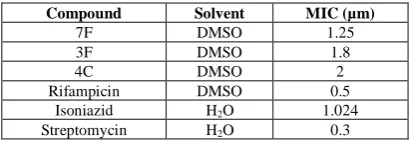
Compounds with better selectivity index were tested against non-replicating M.Tb using LORA. Among them compounds 7F, 3F and 4C shows its MIC’s (µm) as 1.25, 1.8 and 2 respectively are despite in table 4.
Docking results are illustrated in table 5. All the molecules have shown to be successfully docking inside the active site of protein (isocitrate lyase) with a binding energy ranging from -4.6 to -8.9 Kcal /mol. As per the docking results, it was revealed that Compound 3F has the best estimated -8.9 Kcal/mol of binding energy with protein.
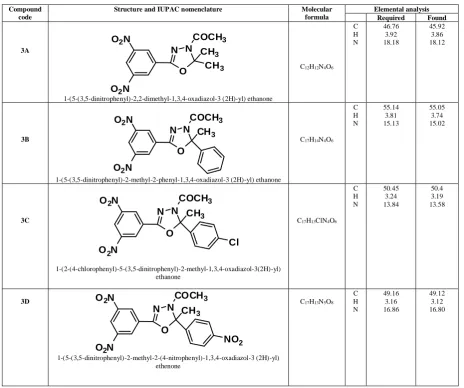
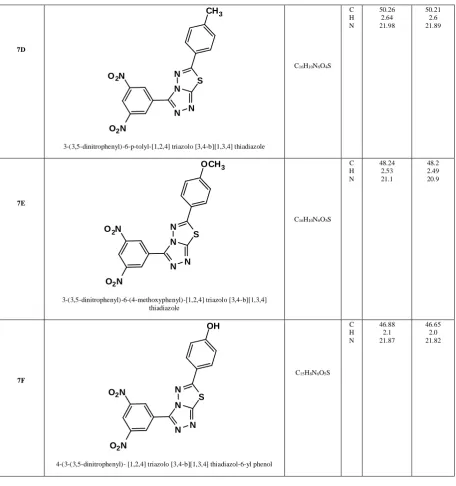
TABLE 1: ANALYTICAL AND PHYSICO-CHEMICAL DATA OF SYNTHESIZED COMPOUNDS
Compound code
Structure and IUPAC nomenclature Molecular formula
Elemental analysis Required Found
3A
O2N
O2N
O N N
COCH3
CH3
CH3
1-(5-(3,5-dinitrophenyl)-2,2-dimethyl-1,3,4-oxadiazol-3 (2H)-yl) ethanone
C12H12N4O6
C H N
46.76 3.92 18.18
45.92 3.86 18.12
3B
O2N
O2N
O N N
COCH3
CH3
1-(5-(3,5-dinitrophenyl)-2-methyl-2-phenyl-1,3,4-oxadiazol-3 (2H)-yl) ethanone
C17H14N4O6
C H N
55.14 3.81 15.13
55.05 3.74 15.02
3C
O2N
O2N
O N N
COCH3
CH3
Cl
1-(2-(4-chlorophenyl)-5-(3,5-dinitrophenyl)-2-methyl-1,3,4-oxadiazol-3(2H)-yl) ethanone
C17H13ClN4O6
C H N
50.45 3.24 13.84
50.4 3.19 13.58
3D O2N
O2N
O N N
COCH3
CH3
NO2
1-(5-(3,5-dinitrophenyl)-2-methyl-2-(4-nitrophenyl)-1,3,4-oxadiazol-3 (2H)-yl) ethenone
C17H13N5O8
C H N
49.16 3.16 16.86
3E
O2N
O2N
O N N
COCH3
CH3
Br
1-(2-(4-bromophenyl)-5-(3,5-dinitrophenyl)-2-methyl-1,3,4-oxadiazol-3(2H)-yl) ethanone
C17H13BrN4O6
C H N
45.45 2.92 12.47
45.41 2.94 12.41
3F
O2N
O2N
O N N
COCH3
CH3
CH3
1-(5-(3,5-dinitrophenyl)-2-methyl-2-p-tolyl-1,3,4-oxadiazol-3(2H)-yl) ethanone
C18H16N4O6
C H N
56.25 4.20 14.58
56.21 4.16 14.45
3G
O2N
O2N
O N N
COCH3
CH3
OH
1-(5-(3,5-dinitrophenyl)-2-(4-hydroxyphenyl)-2-methyl-1,3,4-oxadiazol-3(2H)-yl) ethanone
C17H14N4O7
C H N
52.85 3.65 14.50
52.81 3.60 14.45
4A
O2N
O2N
O N N
2-(3,5-dinitrophenyl)-5-phenyl-1,3,4-oxadiazole
C14H8N4O5
C H N
53.85 2.58 17.94
53.08 2.52 17.1
4B
O2N
O2N
O N N
Cl
2-(4-chlorophenyl)-5-(3,5-dinitrophenyl)-1,3,4-oxadiazole
C14H7ClN4O5
C H N
48.50 2.04 16.16
48.46 2.01 16.12
4C
O2N
O2N
O N N
NO2
2-(3,5-dinitrophenyl)-5-(4-nitrophenyl)-1,3,4-oxadiazole
C14H7N5O7
C H N
47.07 1.98 19.6
47.01 1.92 19.2
4D
O2N
O2N
O N N
CH3
2-(3,5-dinitrophenyl)-5-P-tolyl-1,3,4-oxadiazole
C15H10N4O5
C H N
55.22 3.09 17.17
55.12 3.02 17.11
4E
O2N
O2N
O N N
OH
4-(5-(3,5-dinitrophenyl)-1,3,4-oxadiazol-2-yl) phenol
C14H8N4O6
C H N
51.23 2.46 17.07
4F
O2N
O2N
O N N
OCH3
2-(3,5-dinitrophenyl)-5-(4-methoxyphenyl)-1,3,4-oxadiazole
C15H10N4O6
C H N
52.64 2.94 16.37
52.61 2.94 16.3
5
O2N
O2N
N N N
NH2 SH
4-amino-5-(3,5-dinitrophenyl)-4H-1,2,4-triazole-3-thiol
C8H6N6O4S
C H N
34.04 2.14 29.78
33.8 2.08 29.71
6A
O2N
O2N
N N N
N SH
Br
(E)-4-(4-bromobenzylideneamino)-5-(3,5-dinitrophenyl)-4H-1,2,4-triazole-3-thiol
C15H9BrN6O4S
C H N
40.1 2.02 18.71
39.8 1.96 18.5
6B
O2N
O2N
N N N
N SH
OCH3
H3CO OCH3
(E)-5-(3,5-dinitrophenyl)-4-(3,4,5-trimethoxybenzylideneamino)-4H-1,2,4-triazole-3-thiol
C18H16N6O7S
C H N
46.96 3.5 18.25
46.85 3.42 18.19
6C
O2N
O2N
N N N
N SH
NH2
(E)-4-(4-aminobenzylideneamino)-5-(3,5-dinitrophenyl)-4H-1,2,4-triazole-3-thiol
C15H11N7O4S
C H N
46.75 2.88 25.44
6D
O2N
O2N
N N N
N SH
OCH3 OCH3
(E)-4-(3,4-dimethoxybenzylideneamino)-5-(3,5-dinitrophenyl)-4H-1,2,4-triazole-3-thiol
C17H14N6O6S
C H N
47.44 3.28 19.53
47.41 3.22 19.49
6E
O2N
O2N
N N N
N SH
OCH3
(E)-5-(3,5-dinitrophenyl)-4-(4-methoxybenzylideneamino)-4H-1,2,4-triazole-3-thiol
C16H12N6O5S
C H N
48.00 3.02 20.99
47.85 3.00 20.71
6F
O2N
O2N
N N N
N SH
OH
(E)-2-((3-(3,5-dinitrophenyl)-5-mercapto-4H-1,2,4-triazol-4-ylimino)methyl phenol
C15H10N6O5S
C H N
46.63 2.61 21.75
46.51 2.53 21.71
6G
O2N
O2N
N N N
N SH
Cl
(E)-4-(2-chlorobenzylideneamino)-5-(3,5-dinitrophenyl)-4H-1,2,4-triazole-3-thiol
C15H9ClN6O4S
C H N
44.51 2.24 20.7
6H
O2N
O2N
N N N
N SH
(E)-4-(benzylideneamino)-5-(3,5-dinitrophenyl)-4H-1,2,4-triazole-3-thiol
C15H10N6O4S
C H N
48.65 2.72 22.69
48.58 2.68 22.61
6I
O2N
O2N
N N N
N SH
CH3
(E)-5-(3,5-dinitrophenyl)-4-(4-methylbenzylideneamino)-4H-1,2,4-triazole-3-thiol
C16H12N6O4S
C H N
50.0 3.15 21.86
49.8 3.1 21.81
6J
O2N
O2N
N N N
N SH
OH
OCH3
(E)-4-((3-(3,5-dinitrophenyl)-5-mercapto-4H-1,2,4-triazol-4-ylimino)methyl)-2-methoxy phenol
C16H12N6O6S
C H N
46.15 2.9 20.18
45.94 2.87 20.12
6K
O2N
O2N
N N N
N
SH
HN
(E)-4-((1H-pyrrol-2-yl)methyleneamino)-5-(3,5-dinitrophenyl)-4H-1,2,4-triazole-3-thiol
C13H9N7O4S
C H N
43.45 2.52 27.29
6L
O2N
O2N
N N N
N
HC
SH
CH
(E)-5-(3,5-dinitrophenyl)-4-(3-phenylallylideneamino)-4H-1,2,4-triazole-3-thiol
C17H12N6O4S
C H N
51.5 3.05 21.2
51.1 3.01 20.8
7A
O2N
O2N
N N
N S
N
3-(3,5-dinitrophenyl)-6-phenyl-[1,2,4] triazolo [3,4-b][1,3,4] thiadiazole
C15H8N6O4S
C H N
48.91 2.19 22.82
48.81 2.08 22.82
7B
O2N
O2N
N N
N S
N
Cl
6-(4-chlorophenyl)-3-(3,5-dinitrophenyl)-[1,2,4] triazolo [3,4-b][1,3,4]thiadiazole
C15H7ClN6O4S
C H N
44.73 1.75 20.87
44.69 1.74 20.77
7C
O2N
O2N
N N
N S
N
NO2
3-(3,5-dinitrophenyl)-6-(4-nitrophenyl)-[1,2,4] triazolo [3,4-b][1,3,4] thiadiazole
C15H7N7O6S
C H N
43.59 1.71 23.72
7D
O2N
O2N
N N
N S
N
CH3
3-(3,5-dinitrophenyl)-6-p-tolyl-[1,2,4] triazolo [3,4-b][1,3,4] thiadiazole
C16H10N6O4S
C H N
50.26 2.64 21.98
50.21 2.6 21.89
7E
O2N
O2N
N N
N S
N
OCH3
3-(3,5-dinitrophenyl)-6-(4-methoxyphenyl)-[1,2,4] triazolo [3,4-b][1,3,4] thiadiazole
C16H10N6O5S
C H N
48.24 2.53 21.1
48.2 2.49 20.9
7F
O2N
O2N
N N
N S
N
OH
4-(3-(3,5-dinitrophenyl)- [1,2,4] triazolo [3,4-b][1,3,4] thiadiazol-6-yl phenol
C15H8N6O5S
C H N
46.88 2.1 21.87
46.65 2.0 21.82
TABLE 2: PRELIMINARY ANTI TUBERCULAR ACTIVITY EXPRESSED IN MIC (µg/ml) Compound MIC (µg/ml) Compound MIC (µg/ml)
3A 50 6E 50
3B 25 6F 25
3C 6.25 6G 50
3D 6.25 6H 100
3E 25 6I 25
3F 6.25 6J 50
3G 50 6K 12.5
4A 6.25 6L 50
4B 25 7A 25
4C 6.25 7B 25
4D 12.5 7C 12.5
4E 25 7D 12.5
4F 6.25 7E 50
5 12.5 7F 6.25
6A 100 Rifampicin 1.6
6B 25 Isoniazid 1.6
6C 12.5 Streptomycin 6.25
TABLE 3: IC50 AND SELECTIVE INDEX FOR SELECTED COMPOUNDS
Compound A 549 cell lines IC50
(µg/ml)
Mtb H37Rv
MIC (µg/ml)
Selectivity index (IC50 / MIC)
3C 105.10 6.25 16.81
3D 106.10 6.25 16.97
3F 121.81 6.25 19.48
4A 105.67 6.25 16.90
4C 115.17 6.25 18.42
4D 108.36 12.5 8.66
4F 112.44 6.25 17.99
5 95.21 12.5 7.61
6C 119.57 12.5 9.56
6K 122.19 12.5 9.77
7C 79.05 12.5 6.32
7D 83.47 12.5 6.67
7F 118.76 6.25 19.00
TABLE 4: PRIMARY ACTIVITY AGAINST LATENT TUBERCULOSIS EXPRESSED IN MIC (µm) Compound Solvent MIC (µm)
7F DMSO 1.25
3F DMSO 1.8
4C DMSO 2
Rifampicin DMSO 0.5
Isoniazid H2O 1.024
Streptomycin H2O 0.3
TABLE 5: LIGAND BINDING ENERGIES WITH PROTEIN (ICL)
Ligand Target Binding energy (kcal/mol)
3f_mmff94_E=148.36 1F61_A_prep -8.9
7b_mmff94_E=134.64 1F61_A_prep -8.9
3c_mmff94_E=145.90 1F61_A_prep -8.8
3e_mmff94_E=146.27 1F61_A_prep -8.8
3d_mmff94_E=185.62 1F61_A_prep -8.7
3b_mmff94_E=135.17 1F61_A_prep -8.6
7f_mmff94_E=126.20 1F61_A_prep -8.5
4d_mmff94_E=105.97 1F61_A_prep -8.3
6l_mmff94_E=145.16 1F61_A_prep -8.2
4f_mmff94_E=110.14 1F61_A_prep -8.1
7a_mmff94_E=133.21 1F61_A_prep -8.1
7c_mmff94_E=173.79 1F61_A_prep -8.1
7d_mmff94_E=137.12 1F61_A_prep -8.1
Rifampicin_mmff94_E=311.44 1F61_A_prep -8.1
4a_mmff94_E=102.24 1F61_A_prep -8
4b_mmff94_E=103.02 1F61_A_prep -8
4c_mmff94_E=141.08 1F61_A_prep -8
4e_mmff94_E=94.96 1F61_A_prep -8
6i_mmff94_E=158.37 1F61_A_prep -8
3g_mmff94_E=135.24 1F61_A_prep -7.9
3a_mmff94_E=96.49 1F61_A_prep -7.7
6a_mmff94_E=156.36 1F61_A_prep -7.7
6g_mmff94_E=159.46 1F61_A_prep -7.7
7e_mmff94_E=138.83 1F61_A_prep -7.6
6e_mmff94_E=159.69 1F61_A_prep -7.5
6c_mmff94_E=146.25 1F61_A_prep -7.4
6f_mmff94_E=157.77 1F61_A_prep -7.4
6h_mmff94_E=156.59 1F61_A_prep -7.4
6k_mmff94_E=126.73 1F61_A_prep -7.4
6j_mmff94_E=163.74 1F61_A_prep -7.1
6d_mmff94_E=175.76 1F61_A_prep -7
5_mmff94_E=98.92 1F61_A_prep -6.8
6b_mmff94_E=190.17 1F61_A_prep -6.8
Isoniazid_mmff94_E=64.28 1F61_A_prep -5.9
5-Nitro-2-furoic acid derivatives
Proposed Hybrids
O2N
O2N
N N N
NH2 SH
O2N
O2N
O N N
COCH3
CH3
R
O
O2N HN
N
O
O
NO2
O2N O
O
-F F
HO
N
N N
N N
N
O2N
NO2
N H O
O
OCH3
O2N
O2N
S
O N N
CH3
NO2 O2N
OH
M.Tb ICL INHIBITORS 3-Nitropropionate
MARKETED AZOLES Fluconazole
DprE1INHIBITORS
DNB1
POTENT MOLECULE AGAINST LTBI Dinitro
phenol-ICL inhibitor
5-substituted-2-[(3,5-dinitrobenzyl) sulfanyl]-1,3,4-oxadiazoles
A B
C D
A+B+C+D = E
E
(A) Nitro group from M.Tb ICL inhibitors (B) Dinitrophenyl moiety from ICL inhibitors and DprE1 inhibitor (C) Triazole ring from marketed azoles i.e., Fluconazole (D) Oxadiazole ring and Dinitrophenyl from potent molecule against latent M.Tb clubbed to arise proposed hybrids.
Figure 1: Rational in Design of Proposed Hybrids
CONCLUSION
In this work, anti mycobacterial activity of clubbed 1,3,4-oxadiazole shows effective than clubbed 1,2,4-triazoles. Among
them
1-(5-(3,5-dinitrophenyl)-2-methyl-2-p-tolyl-1,3,4-oxadiazol-3(2H)-yl) ethenone (3F),
2-(3,5-dinitrophenyl)-5-(4-nitrophenyl)-1,3,4-oxadiazole (4C) and
4-(3-(3,5-dinitrophenyl)- [1,2,4] triazolo [3,4-b][1,3,4] thiadiazol-6-yl phenol (7F) exhibits excellent activity against H37RV strain.
Furthermore, these compound also posses’ activity against non
replicating M.Tb H37Rv (pFCA-luxAB).
The main flaw of these synthesized compounds is for its low aqueous solubility. This fastens the metabolic degradation, will be considered in further structural optimization. Moreover, several mutagencity and gene toxicity assay reveals that nitro group containing compounds have low mutagencity.
Docking studies suggests that all the compounds shows good binding energies with M.Tb ICL (isocitrate lyase) enzyme compared with standard isoniazid, rifampicin and 3-nitropropionate, cell free assay did not confirm this assumption. In the light of literature azoles inhibits specific cytochrome system in mycobacterium.
Interestingly, the investigated compounds had low toxicity against A549 cell lines and better selectivity index towards
O2N
NO2 O
OCH3
60% NH.NH2.H2O
Ref lux- 3h
O2N
NO2 O
N H
NH2 O2N
NO2 C O N H N C H3C
R R C O C H 3 C H 3O H (o r) C 2H 5O H R ef lu x -6 h
O2N
NO2 O N N COCH3 CH3 R
(CH3CO)2O
Ref lux - 2-4 h
Methyl 3,5-dinitrobenzoate (1)
(2 A-G) (3 A-G)
R-COOH / POCl3
Ref lux - 3-5 h
O2N
NO2 O N N R (4 A-F)
O2N
NO2 N N N SH NH2 C S2 ,N H .N H2 .H2 O K O H / C2 H5 O H R ef lux -16 h
O2N
NO2 N N N SH N R
O2N
NO2 N N N N S R R-CH
O, H2 SO4
Reflu x -3-4
h
R-COO H, P
OCl3 Reflux
- 4-5h
(6 A-I)
(5)
(7 A-F)
SCHEME - I
SCHEME - II a
SCHEME - II b
SCHEME - III
SCHEME - IV a
SCHEME - IV b
Figure 2 - General Scheme of Synthesis ACKNOWLEDGEMENT
The authors are gratified to authorities of AU College of pharmaceutical sciences, Visakhapatnam for providing the necessary facilities during the work and University grants commission for financial assistance.
REFERENCES
1. Gler MT, Skripconoka V, Sanchez-Garavito E, Xiao H, Cabrera-Rivero JL, Vargas-Vasquez DE et al., Delamanid for multidrug-resistant pulmonary tuberculosis. New England Journal of Medicine. 2012; 366(23):2151-60. 2. Diacon AH, Pym A, Grobusch M, Patientia R, Rustomjee R,
Page-Shipp L et al., The diarylquinoline TMC207 for multidrug-resistant tuberculosis. New England Journal of Medicine. 2009; 360(23):2397-405.
3. Kakkar AK, Dahiya N. Bedaquiline for the treatment of resistant tuberculosis: promises and pitfalls. Tuberculosis. 2014; 94(4):357-62.
4. Sharma V, Sharma S, Zu Bentrup KH, McKinney JD, Russell DG, Jacobs WR et al., The structure of isocitrate lyase, a persistence factor of Mycobacterium tuberculosis. Nature Structural & Molecular Biology. 2000; 7(8):663-8. 5. López-Boado YS, Herrero P, Gascón S, Moreno F.
Catabolite inactivation of isocitrate lyase from Saccharomyces cerevisiae. Archives of microbiology. 1987; 147(3):231-4.
6. Lee YV, Wahab HA, Choong YS. Potential inhibitors for isocitrate lyase of Mycobacterium tuberculosis and non-M.tuberculosis: A summary. BioMed research international. 2015. 2015: 1-20.
inhibitors of dTDP-rhamnose synthesis. Bioorganic & medicinal chemistry letters. 2003; 13(19):3227-30.
8. Khalaf AI, Waigh RD, Drummond AJ, Pringle B, McGroarty I, Skellern GG et al., Distamycin analogs with enhanced lipophilicity: synthesis and antimicrobial activity. Journal of medicinal chemistry. 2004; 47(8):2133-56. 9. Walczak K, Gondela A, Suwiński J. Synthesis and
antituberculosis activity of N-aryl-C-nitro azoles. European journal of medicinal chemistry. 2004 ; 39(10):849-53.
10.Ahmad Z, Sharma S, Khuller GK. In vitro and ex vivo antimycobacterial potential of azole drugs against Mycobacterium tuberculosis H37Rv. FEMS microbiology letters. 2005; 251(1):19-22.
11.Goodsell DS, Morris GM, Olson AJ. Automated docking of flexible ligands: applications of AutoDock. Journal of Molecular Recognition. 1996 ; 9(1):1-5.
12.Collins L, Franzblau SG. Microplate alamar blue assay
versus BACTEC 460 system for high-throughput screening of compounds against Mycobacteriumtuberculosis and
Mycobacteriumavium. Antimicrobial Agents and
Chemotherapy. 1997;41:1004–1009.
13.Mosmann T. Rapid colorimetric assay for cellular growth and survival: application to proliferation and cytotoxicity assays. Journal of immunological methods. 1983 ;65(1-2):55-63.
14.Cho S, Lee HS, Franzblau S. Microplate alamar blue assay (MABA) and low oxygen recovery assay (LORA) for Mycobacterium tuberculosis. Methods molecular biology. 2015:1285, 281-92.
Cite this article as:
M.N.V.S.Viswanadha Murhty et al. Design, synthesis and
characterization of novel 3, 5- dinitro phenyl clubbed azoles against active and latent tuberculosis. Int. Res. J. Pharm.
2017;8(12):104-118
http://dx.doi.org/10.7897/2230-8407.0812257
Source of support: Nil, Conflict of interest: None Declared