Forestry & Natural-Resource Sciences Last Correction: Sep. 28, 2014
MODELING A HISTORIC FOREST FIRE USING GIS AND
FARSITE
Thomas M Williams, Brian J Williams, Bo Song
College of Agriculture, Forestry and Life Sciences, Clemson University, Clemson, SC, USA
Abstract. Recent major wildfires may result from a combination of climate change and fuel buildup
due to fire exclusion policies of the last century. Are such fires unique to the forests and climate of the 21st century or are they similar to historic fires? Historic fires are recorded primarily by eye witness accounts which seldom contain information needed to examine them with modern fire management tools. The September 1, 1894 fire near Hinckley, Minnesota has well documented accounts from many survivors that allow position of the flame front to be established for a number of times throughout the fire. These accounts allowed us to calibrate a FARSITE model to represent the progression of that fire. FARSITE is a modern fire spread rate simulation model. It requires spatial layers of elevation, slope, aspect, timber type, derived layers of fuel type, canopy cover, stand height, canopy base height, canopy bulk density, duff and coarse woody debris. In this paper we will discuss how we were able to combine present GIS data, historical map data, and present ecosystem properties to provide data needed for these layers. GIS output of FARSITE spread predictions were used to match flame front position to eyewitness accounts and model parameters (primarily, wind speed and direction and fuel model spread rate adjust-ments) were altered to produce a flame front location and time that matched eyewitness location and timing.
Keywords: 19thcentury forest fire, Fire visualization, mega-fire, Hinckley MN.
1
Introduction
Over the last two decades there has been a world-wide increase in number and severity of wildland fires (Williams et al. 2010). Assessments of potential fire risk in association with future climate modes (IPCC 2007) suggest that forest fire risk will increase due to both more severe fire danger and a lengthening of fire seasons (Flannigan et al. 2013, Liu et al. 2013). In addition, across the US large regions have developed heavy fuel loads through intensive fire protection as well as low-ered rates of biomass removal (Williams 2013). There is good reason to believe forest fires, that are large, intense, and overwhelm our ability to control, may become more prevalent in the US, and possibly worldwide, in the 21st
century. Failure of control in recent fires has renewed interest in understanding “extreme fire behavior” (Pyne 1986), that is fires that vary erratically in spread rate, energy release, and atmospheric interaction (Werth et al. 2011). A number of terms used for such behavior, including “ blow up, fire storm, mass fire”, have been used to describe sudden changes in fire behavior that
have lead to a loss of control and sometimes death of fire fighters and civilians in major forest fires of the past.
Extreme fire behavior is not unique to recent major forest fires. Fires that occurred in the Lake States be-tween 1876 and 1918 were the most deadly forest fires in US history. Over 2500 people lost their lives in three fires in Pestigo, WS, 1876, Hinckley, MN, 1894, and Moose Lake- Cloquet, MN, 1918. Unfortunately, descriptions of those fires were limited to eye witness accounts that of-ten described extreme fire behavior in anthropomorphic or even religious terms. The scientific merit of informa-tion given in such accounts has been discounted simply due to the language used. However, many of these de-scriptions document incidents that are now classified as extreme fire behavior (Werth et al. 2011).
The Hinckley MN fire in particular has a wealth of eye witness information collected into three contem-porary books (Aldermark 1894; Brown 1895; Wilkin-son 1895), one book of survivor recollections (Ander-son and Ander(Ander-son-McDerrmott 1954), and three schol-arly/popular accounts (Brown 2007; Swenson 1979; Larsen 1984). From these sources it is possible to
ex-Copyright©2014 Publisher of theMathematical and Computational Forestry & Natural-Resource Sciences
tract a series of positions of the fire front during the day of Sept. 1, 1894. These observations allow a num-ber of estimates of average spread rate for differing por-tions of the fire. Alexander and Cruz (2006) surveyed spread rate of recent severe crown fires across the US and Canada and found that the maximum measured rates where slightly higher than 100 m/min. For a period of five hours and over a distance of 34 km, the Hinckley Fire observed average rate of spread was 114 m/minute (Williams et al. 2013).
The ability to predict fire spread for a set of climatic conditions and fuel loads can be useful for both haz-ard reduction and active firefighting. FARSITE (Finney 2004) is a spatially explicit model that implements the Rothermel (1972, 1983) fire spread equations in a semi-empirical model of forest fire behavior. Although FAR-SITE does not have theoretical support for fire to fire or fire-atmospheric interactions of newer spread models (Coen 2011; Kochanski et al. 2013), it is widely regarded as the most reliable model for fire suppression manage-ment as well as fire preparedness analysis. In this paper we explore the use of FARSITE to examine the Hinck-ley Fire. There were three questions that we wanted to answer:
1. Are there sufficient historical data to create the spa-tial files required to run the FARSITE model?
2. If so: can a model be created that mimics the ob-served positions of the fire recorded by eye witness accounts?
3. Are model modifications used to fit observed spread rates plausible?
2
Methods
Throughout the paper units of distance and mass have been made consistent with source materials which were primarily English units, while model outputs and gen-eral comparisons use metric units to be more compara-ble to general scientific literature. The FARSITE model can be run using either system of units. More com-plete information on FARSITE can be found online at http://www.firelab.org/project/farsite.
FARSITE simulates spread of fire for a specific geo-graphical area and for a given set of fuel and climatic conditions. Data to run the model consists of a set of spatial and non-spatial files that define the physical set-ting, fuel availability and flammability, and climatic fac-tors (Finney 2004). The physical setting is defined by three spatial files of elevation, slope, and aspect. Two spatial files of fuel availability; canopy cover and fuel model, are required to model fires spreading in fuels along the ground. Fuel model is a combination of values
needed to solve the Rothermel (1972) basic fire spread equations based on cover types. For this analysis, the fuel models developed by Scott and Burgan (2005) were used. To model crown fires spatial files of stand height, canopy base height, and canopy bulk density are also needed. Finally, spatial files of coarse woody debris and duff layer are needed to model burning after the fire front passes. In addition to the spatial data, FARSITE also requires a weather file, wind file, and optional fuel moisture adjustments and spread rate adjustments. The weather file defines air temperatures, wind speeds, and relative humidity for a period before and during the fire. The wind file allows greater definition of wind speed and direction during the fire. Fuel moisture adjustment file allows altering the initial fuel moisture of 1, 10, and 100 hour fuels. The spread rate adjustment file can be used to alter the modeled spread rate of each fuel model.
Applying the FARSITE model to the Hinckley Fire required finding and converting historical information into the data files described above. The most imtant source of spatial data was the online GIS data por-tal of the Minnesota Department of Natural Resources (MNDNR 2014). From this source the following data were obtained: digital elevation ( 30m DEM), locations of state and county boundaries, county roads for Pine., Carleton, Aiken, and Kanabec counties, state wide rail-roads, recreational trails (several abandoned railroad lines are now bike trails), lakes and rivers, county (same four) Public Land Survey township and range lines, and a witness tree layer that included tree locations and at-tributes of species and size of each tree. In addition, a map of original vegetation which had been interpreted in 1935 (Marschner 1974) was also used.
The outline of the entire area burned by the Hinckley Fire was obtained by a map in Swenson (1979), which was drawn on a state map with county lines, large lakes, rail lines as in 1894, and rivers, and location of sev-eral small towns described in eyewitness accounts (Fig-ure 1). Geography of most eyewitness accounts is de-fined by location, a small lake, and eight small towns; Quamba, Beroun, Brook Park, Mission Creek, Hinck-ley, Sandstone, Askov, and Finlayson. Fires began in the early morning of September 1, 1894 near Quamba and Beroun. The Quamba fire destroyed Brook Park at 1400h (1400 hours 2:00 PM). The Beroun fire destroyed Mission Creek at 1430h. Both fires combined and de-stroyed Hinckley at 1530h, Sandstone at 1735h, Askov and Finlayson by 1900h. The fire overtook one of the trains carrying survivors at a small lake called Skunk Lake at 1625h.
rail-Figure 1: Location of the Hinckley Fire in east central Minnesota. Inset of Pine, Kanabec, Carlton, and Aiken counties includes locations of small towns listed in the text.
roads and town locations as geographic reference (Fig-ure 1). This outline was then used as an area of interest for all spatial layers of the FARSITE model.
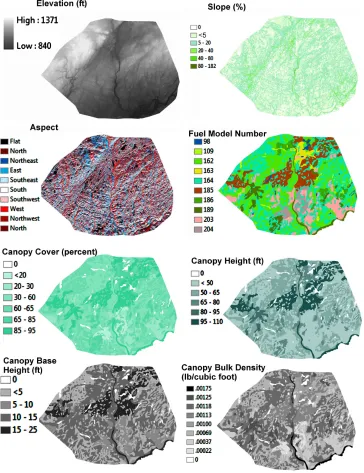
Elevation, slope, and aspect were created from the downloaded DEM using the fire outline as a feature mask (Figure 2). Marschner’s (1974) original vegeta-tion polygons were then clipped with the fire outline. To these polygons new features of canopy cover, fuel model, canopy height, canopy base height, canopy bulk density, coarse woody debris, and duff were added. All feature values were assigned based on vegetation types found in the area today and fuel models were assigned as the most nearly matching standard fuel model. Canopy bulk density was not assigned but is the default value in
FAR-SITE for each fuel model. Grid files were then created for fuel model, canopy cover, tree height, canopy base height, canopy bulk density (Figure 2), coarse woody debris, and duff (Figure 3).
Figure 2: Spatial distributions of land and tree parameters used as input to the FARSITE model of the Hinckley Fire.
drought that preceded the fire (Haines and Sando 1969). Finally, the spread rate adjustment file was modified in calibration. The spread rate adjustment file allows mul-tiplier factors from 0.001 to 20 to be applied to each fuel model. These factors were also used to calibrate the spread rates to match arrival times. Final values of spread rate adjustment are shown in Table 1 and final values of wind speed and direction are shown in Table 2.
3
Results
1-Table 1: Vegetation types. Fuel models (Scott and Burgan 1972), and multipliers used in the development of the Hinckley Fire FARSITE model. Aspen-birch is a pioneer community that occurs on both hardwood and conifer sites.
Vegetation Type Dominant Tree Species Fuel Model Multi-plier Aspen-birch
tending conifer, Pt, Pgt, Bp,Ab, Pg 162 15 tending hardwood Pgt, Pt, Bp,As,Ar, Ta 186 18
Wet prairie 109 16
White and red pine Ps, Pr, Bp
uncut 185 20
cut 203 18
Mxd pine-hardwood Ps, Pr,Qr, Ar 189 18
White pine Ps 204 18
Hardwood Ta, As,Fn,Ua 189 18
Jack pine Pb 163 18
River bottom Ar, Ua, As 189 18
Conifer bogs Ll, Pm 164 20
Water 98 1
Species abbreviations:Abies balsamea-Ab,Acer saccharum-As,Acer rubrum– Ar,Betula papyrifiera -Bp,Fraxinus nigra-Fn,Larix laricina,-LlPicea gluaca- Pg,Picea mariana- Pm, Pinus banksiana-Pb, Pinus strobus-Ps,Pinus resinosa-Pr, Populus grandidentata-Pgt,Populus tremuloides-Pt, Quercus macrocarpa-Qm,Quercus rubra-Qr,Tillia Americana-Ta,Ulmus Americana- Ua
Figure 3: Spatial distributions of surface parameters used as input to the FARSITE model of the Hinckley Fire.
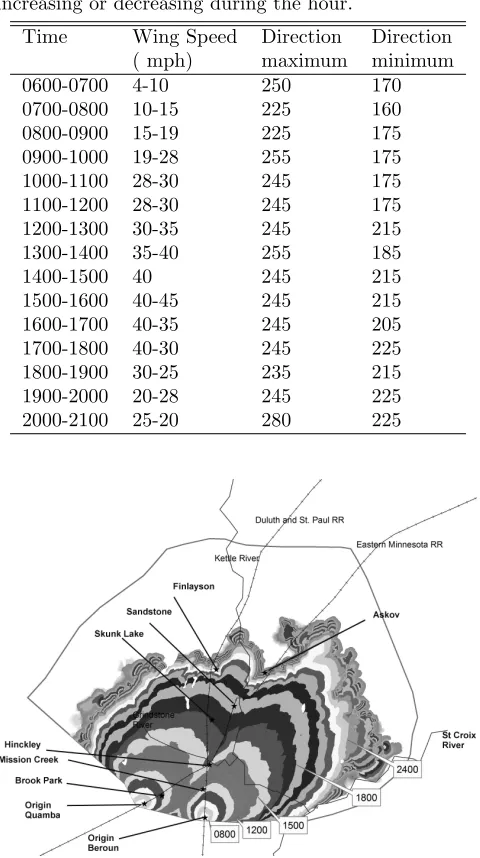
2, FARSITE output produced flame front perimeters as shown in Figure 4. Individual ignitions at Quamba and Beroun at 0600h burned to the north and east until com-bining between 1300h and 1400h just to the southeast of Hinckley. The combined fire had two distinct heads until roughly 1700h and burned rapidly during the rest of the day. The model reproduced a flame front at Hinckley, Sandstone and Skunk Lake very near the observed time and was slightly early at Mission Creek. The model was considerably early at Brook Park and late at Askov and Finlayson (Table 3).
The model also produced data that could be used to examine fire spread in a geographic manner. Consistent estimates of spread rates and area burned can be ex-tracted from the model. Linear spread rate seems mostly related to wind speed although there is a significant in-crease following the joining of the fires (Figure 5). An
interesting and perhaps most frightening aspect could be extracted from the model burn perimeters. Each perimeter presented in Figure 4 is a raster of the area burned during each hour of the fire. In the GIS, these raster areas had 30x30 m pixels so that each pixel rep-resented 900m2 on the ground, allowing an estimate of area burned. In Figure 6 those estimates are expressed as a burn rate in hectares per second.
4
Discussion
Table 2: Summary of wind data used in the final FAR-SITE model. Each hour was divided into 15 minute intervals and wind speed and direction was defined for that period. Summary shows maximum and minimum values used during the hour. Order shows if speed was increasing or decreasing during the hour.
Time Wing Speed Direction Direction ( mph) maximum minimum 0600-0700 4-10 250 170 0700-0800 10-15 225 160 0800-0900 15-19 225 175 0900-1000 19-28 255 175 1000-1100 28-30 245 175 1100-1200 28-30 245 175 1200-1300 30-35 245 215 1300-1400 35-40 255 185 1400-1500 40 245 215 1500-1600 40-45 245 215 1600-1700 40-35 245 205 1700-1800 40-30 245 225 1800-1900 30-25 235 215 1900-2000 20-28 245 225 2000-2100 25-20 280 225
Figure 4: Estimated flame front locations from the final FARSITE model.
to run the model. The original map was developed from Public Land Survey witness trees, but from pro-fessional judgment rather than modern analytic tools. This was quite evident in the witness tree data down-loaded for this paper. Although the map showed stand types as white or red pine, often these trees were com-pletely missing form witness trees in that area. However, that is not hard to understand since surveyors were
re-Table 3: Arrival times of the Hinckley Fire based on eye witness accounts and derived from model perimeter files. All times refer to Sept. 1, 1894 unless noted.
Location Arrival Time Observed
Arrival Time Modeled Brook Park 1400 1000 Mission Creek 1430 1330 Hinckley 1500 1530 Skunk Lake 1615 1600 Sandstone 1725 1800 Askov 1900 0900 Sept.2 Finlayson 1900 0200 Sept. 2
quired to use witness trees that were expected to remain for long periods after the survey was completed. Since cruisers for timber companies often accompanied those surveyors (Larson 2007) it would be pointless to expect pines to remain long after the survey. The map was also produced before the modern forest classification scheme (Erye 1990) making correlation to current data compati-ble with FARSITE (Ryan and Opperman 2013) difficult. Essentially the data used in this model is the product of profession judgment of a Minnesota trained forester in 1935 and the author, another Minnesota trained forester that lived in east central Minnesota for the first 27 years of his life.
The FARSITE model was able to produce a set of fire perimeters that mimicked the observed timing very well for the most intense and important period of the fire. It was able to predict the timing of the town of Hinckley, Sandstone and at Skunk Lake. With the exception of Brook Park, it also predicted the fire well for the period in which human fatalities occurred. The shape of the modeled fire also explains apparent very rapid spread from Hinckley to Skunk Lake (175m/min- Williams et al. 2013). The model suggests that Hinckley was burned as two heads of the combining fire burned to the north and southeast of town. By the time the town burned the northern head was already very near the track of the St. Paul to Duluth railroad on which the escape train was overtaken at Skunk Lake. The model fire also shows the Eastern Minnesota Railroad tracks between the two heads and burning late. The train on this track was able to evacuate over 800 people from the fire. The modeled fire reproduced a number of observations that were in-dependent of the calibration data used. FARSITE ap-pears to be capable of producing a retrospective model of a major forest fire.
ad-Figure 5: Model estimates of the rate of spread of the Hinckley Fire. Rates are calculated at the most distant point of each hourly FARSITE model perimeter.
Figure 6: Estimated rate of area burned during each hour of the Hinckley Fire. Rates are estimated from the fire perimeters of the FARSITE model.
justment file was used to multiply the spread rate of sev-eral fuel types to the maximum 20 times normal. Were model modifications used to fit observed spread rates plausible? Although the winds are completely specula-tive, variations in direction of 90 degrees are not unlikely in early morning and 45 mph is not completely unrea-sonable for maximum sustained winds. Eyewitness ac-counts often described cyclone winds, which then could refer to either hurricanes or tornados.
The FARSITE model we used did not include spread by spot fires, although “firebrands falling like rain” was a common comment by survivors. The FARSITE method of solving spread equations of spot fires results in an
ex-ponential increase in the number of numerical solutions required. With spot fire enabled the model would re-quire 5+ hours of computation for the spread from 0945h to 1000h. Using a computer with twice the comput-ing power encountered the same problem at 1045h. For the period the spotting model could produce perimeters, spread rate multipliers of 5-10 times normal resulted in similar perimeters to the final version (Figure 4) which used multipliers that were generally twice as large (Ta-ble 1). It seems that increasing the rate of spread of fuel models has a roughly equivalent effect as modeling spot fires.
The theoretical base of FARSITE is primarily spread-ing equations of Rothermel (1972) and does not include atmospheric interaction beyond a single estimate of wind speed. It cannot model fire induced convection nor does it include atmospheric effects of two approaching fires. Newer models include Rothernmel (1983) models of sur-face ignition and spread with atmospheric models to account fire induced wind and fire-atmospheric interac-tions that produce extreme fire behavior (Clark et al. 2004; Filippi et al. 2009; Kochanski. et al. 2013). Ap-plication of these models to the Hinckley Fire would also be an interesting exercise but would require even more speculation for the various upper and lower atmospheric data needed to parameterize these models.
5
Conclusions
We were able to obtain sufficient historical data to create a FARSITE input dataset for the 1894 Hinckley Fire. When calibrated to known locations of the fire front, FARSITE produced a model that fit the known locations of the fire during the intense burning period. Model results also explained aspects of the historical ac-count that were not used in the calibration. Calibration included adding speculative wind data and altering the spread rates normally associated with fuel models (Scott and Burgan 2005) up to 20 times the normal rate. It would seem the ability to increase the spread rate within FARSITE allows it to be used for fires which include spot fires, atmospheric interactions, and merging of fires that are not explicitly accounted for in the theoretical derivation of the FARSITE model.
Acknowledgements
paper was improved by comments of two anonymous re-viewers.
References
Aldermark, G.E., 1894. Fiery cyclone or the Hinck-ley Fire. Translation W. Johnson, Askov, Minnesota, American Publishing Company.
Alexander, M.E., Cruz, M.G., 2006. Evaluating a model for predicting active crown fire rate of spread using wildfire observations. Canadian Journal of Forest Re-search 36, 3015–3028.
Anderson, A.A., Anderson-McDermott, C., 1954. (Reprinted 1993). The Hinckley Fire. NewYork, NY. Comet Press.
Brown, C.C., 1895. A History of the great Minnesota Forest Fires, Sandstone, Mission Creek, Hinckley, Pokegama ,Skunk Lake.St. Paul MN, Brown Bros. Publishing.
Brown, D.J., 2007. Under a Flaming Sky. New York, NY, Harper Perennial.
Clark, T.L. Coen, J. and D. Lanham. 2004. Descrip-tion of a coupled atmosphere-fire model. InternaDescrip-tional Journal of Wildland Fire 13:49-63.
Coen, J.L. 2011. Some new basics of fire behavior. Fire Management Today 70: 37-42.
Eyre, F.H. (Ed.), 1980. Forest Cover Types of the United States and Canada. Society of American Foresters, Washington, DC, 148p.
Filippi, J.B., F. Bosseur, C. Mari, C. Lac, P.L. Moigne, B. Cuenot, D. Veynante, D. Cariolle, and Balbi, J. 2009. Coupled Atmosphere–Wildland Fire Modelling. Journal of Advances in Modeling Earth Systems., 1, Art.11, doi:10.3894/JAMES.2009.1.11, 2009.
Finney, M.A., 2004. FARSITE: Fire Area Simulator – Model development and evaluation. Research Paper RMRS-RP 4 Revised, Ogden Utah; USDA Forest Ser-vice, Rocky Mountain Research Station, pp. 47.
Flannigan, M., A.S. Cantin, W.J. de Grout, M. Wotton, A. Newberry, L. W. Gowan. 2013. Global wildland fire season severity in the 21stcentury. Forest Ecology and
Management 294: 54-61.
Haines, D.A., Sando, R.W., 1969. Climatic conditions preceding historically great fires in the North Central Region. Res. Pap. NC-34. St. Paul, MN: USDA Forest Service, North Central Forest Experiment Station.
Haines, D.A., Johnson, V.J., Main, W.A., 1976. An as-sessment of three measures of long-term moisture de-ficiency before critical fire periods. USDA For. Serv. Res. Pap. NC-131.
IPCC, 2007. Climate Change 2007. Fourth Assessment Report (AR4), United Nations, Intergovernmental Panel on Climate Change.
Kochanski. A.K., Jenkins, M.A.,Mandel J.,Beezley J.D.,Kruger S.K. 2013. Real time simulation of 2007 Sante Fe fire. Forest Ecology and Management 294:139-149.
Larsen, L.H., 1984. Wall of Flames: the Minnesota For-est Fire of 1894. North Dakota State University, North Dakota Institute for Regional Studies, Fargo, ND, 187p.
Larson, A., 2007. The White Pine Industry in Min-nesota: A History. University of Minnesota Press, St. Paul Minnesota, 432p.
Liu, Y., S.I. Goodwick, J.A. Stanturf. 2013. Future US wildfire potential trends projected using a dynami-cally downscaled climate change scenario. Forest Ecol-ogy and Management 294:120 135.
Marschner, F.J., 1974. The original vegetation of Min-nesota (map). United States Forest Service, North Central Forest Experiment Station, St. Paul, Min-nesota, USA. http://deli.dnr.state.mn.us/.
MNDNR. 2014. Minnesota Department of Nat-ural Resources: Data Deli. Available at: http://deli.dnr.state.mn.us/ Accessed 19 March 2014.
Pyne, S.J., Andrews, P.L., Laven, R.D., 1996. An Intro-duction to Wildland Fire, Second ed. Wiley and Sons, New York.
Rothermel, R. C. 1972. A mathematical model for pre-dicting fire spread in wildland fuels. Res. Pap. INT-115. Ogden, UT: U.S. Department of Agriculture, For-est Service, Intermountain ForFor-est and Range Experi-ment Station. 40 p.
Rothermel, R. C. 1983. How to predict the spread and in-tensity of forest and range fires. Gen. Tech. Rep.INT-143. Ogden, UT: U.S. Department of Agriculture, For-est Service, Intermountain ForFor-est and Range Experi-ment Station. 161 p.
Scott, J.L., Burgan, R.E., 2005. Standard fire behav-ior fuel models: a comprehensive set for use with Rothermel’s surface fire spread models. Technical Re-port. RMS General Technical Report 153, USDA For-est Service, Rocky Mountain Research Station.
Swenson, G.B., 1979. From the Ashes: The Story of the Hinckley Fire of 1894. North Star Press, Saint Cloud, MN, 253pp.
Werth, P.A., Potter, B.E., Clements, C.B., Finney, M.A., Goodick, S.C., Alexander, M.E.,Cruz, M.G., Forthofer, J.A., McAllister, S.A., 2011. Synthesis of knowledge of extreme fire behavior: volume 1 for fire managers. USDA Forest Service. Pacific Northwest Research Station, General Technical Report, PNW-GTR-854. 145p.
Williams, B.J., Song, B. Williams, T.M. Visualizing mega-fires of the past: A case study of the 1894 Hinck-ley Fire, east central Minnesota., USA. Forest Ecology and Management 294:107-119.
Williams J., Albright D., Hoffmann A., Eritsov A., Moore P.F., Mendes-deMorais J.C., Leonard M., SanMiguel-Ayanz J., Xanthopopulos G., van Lierop, P., 2010. Findings and implications from a coarse scale global assessment of recent selected mega-fires. 5th In-ternational Wildland Fire Conference, Sun City SA 9-13 May 2011. p 27-40. Working Paper FM/27/E, FAO, Rome, Italy.