Joshi et al. World Journal of Engineering Research and Technology
PROCESSING SQUINTED SAR RAW DATA USING RANGE
DOPPLER ALGORITHM
Vasanthkumar Joshi*1, S. Manikandan2 and H. C. Srinivasaiah3
1
PG Scholar, Bengaluru, Karnataka, India.
2
Scientist D, LRDE, Bengaluru, Karnataka, India.
3
Member IEEE, Bengaluru, Karnataka, India.
Article Received on 06/06/2017 Article Revised on 27/06/2017 Article Accepted on 18/07/2017
ABSTRACT
Synthetic aperture RADAR imaging technique is a very widely used in
imaging domain. This paper proposes the processing of point target
squinted data. This digital processing is based on the Range Doppler
Algorithm (RDA). RDA is one of the most efficient and accurate among its contemporary
algorithms. Here we deal with the scenario where there is squint introduced into data. This
paper deals with use of secondary range compression (SRC) in RDA.
INDEX TERMS: RDA, MOCO, SAR, Squint, Radar.
INTRODUCTION
SYNTHETIC aperture RADAR is very efficient technique used in mapping of targets or
earth surface. SAR is an active microwave remote sensing technology that is used to create
two-dimensional images of targets and the Earths surface through the use of radar.[1] The
mapping of targets depend on their position. The SAR technique is based on the fact that
when the radar or sensor mounted on a platform is in transit. during the transit the required
target is illuminated by multiple pulses emitted by the sensor. These pulses are emitted by the
sensor at discreet times. And these pulses get reflected by the target or reflector, according to
its reflectivity. These reflected pulses are stored in memory and used for digital processing.
The stored data is known as Raw data. The emitted pulses are generally linear FM pulses
with positive slope, i.e. frequency will be increasing linear. LFM with negative slope can also *Corresponding Author
Vasanthkumar Joshi
PG Scholar, Bengaluru, Karnataka, India.
World Journal of Engineering Research and Technology
WJERT
be used. There are two direction of interest in SAR azimuth and range where azimuth
direction is parallel to the motion of the radar platform, and it is also known as the slow time
direction. It is so called due to relatively slow velocity of radar platform with respect to pulse
velocity. The range direction is directed orthogonal to the platform motion, and parallel to the
main beam direction. This direction is also known as the fast time. But generally the RDA
assumes zero squint of the radar beam. Squint is described as the angle that the slant range
vector makes with zero Doppler plane. The zero Doppler plane is the plane containing the
sensor or radar perpendicular to the velocity vector.
Geometrical Setup
The figure 1 shows the setup of SAR geometry. As explained before the received raw data
signal will be a scaled and delayed version of the transmitted signal. The range equation for
the squinted antenna beam is given by
where R(η) is the instantaneous range vector and R is the range of closest approach. The
variables v, η, θ8 are platform velocity, instantaneous azimuth time and squint angle
respectively. The transmitted signal is given by
where T is the range dimension variable, fi is the instantaneous frequency, given by
is the range chirp rate and finally T is the pulse duration. And the
received signal is given by a two dimensional equation as the other dimension η from
This is known as SAR raw data it is as shown in figure 2. This data undergoes several steps to
form a two dimensional image.
Range Doppler Algorithm
RDA is the older one among the SAR raw data processing algorithms. The RDA is based on
Pulse compression technique. This pulse compression increases the resolution.[2] RDA has
mainly three steps namely Range compression, Range cell migration correction (RCMC) and
Azimuth compression. The algorithm is so called because of the fact that the RCMC is done
in range Doppler domain.
(a) Squinted Raw data.
(a) RDA signal flow for zero squint.
(b) RDA signal flow for high squint.
1) Range compression: The raw data signal is first compressed in range direction i.e. it is subjected to matched filtering in range dimension only, without affecting the azimuth
direction. The signal before range compression in high squint generally consists of three steps
as mentioned above but in high squint vase the final step of range IFFT is not done. Instead a
azimuth FFT is done and is subjected secondary range compression to remove the non
linearities due to squint.
2) Secondary range compression: This step is only performed when there is squint introduced in raw data, otherwise SRC can be neglected. This is because when the squint
angle increases, the range equation must be expressed in more accurate hyperbolic form. In
low squint case the there is a one-to-one relation between time and frequency. In high squint
case, there also is a one-to-one relation however there is some nonlinearities. This leads to
stronger coupling between range and azimuth parameters, which leads to mis-focusing. So we
need another type of filtering to remove this error. This filtering is known as secondary range
compression. In other words the signal is first compressed with the filter with chirp rate Kr,
next it is compressed with filter of chirp rate Km.
Hence the word secondary range compression. Here the range compression filter is given by
Implementing SRC is done ideally in range doppler domain so that the dependencies on R0
we go for implementation in two dimension frequency domain depending on the amount of
dependency on range and Doppler frequency. So here range and frequency both cannot be
accessed simultaneously, so we fix a range value R0, as here the dependency on R0 is weak
compared to that of fη.
3) Range cell migration: Range cell migration is applied after range compression step. The instantaneous range or slant range changes as the platform moves along azimuth direction.
Due to this the target has different Doppler frequency at different point of time and it
subsequently appears in multiple range bins. To correct this error RCMC is applied, RCMC is
impleented by nothing but shifting of target’s returns by required number of range bins. The
amount of shift, or migration, can be calculated for each point on the Range Doppler signal
by the equation.
Now after range compression the data is subjected to RCMC, The range cell migration that
was predicted before the RDA filtering.[7] RCM is calculated accordingly to compensate.
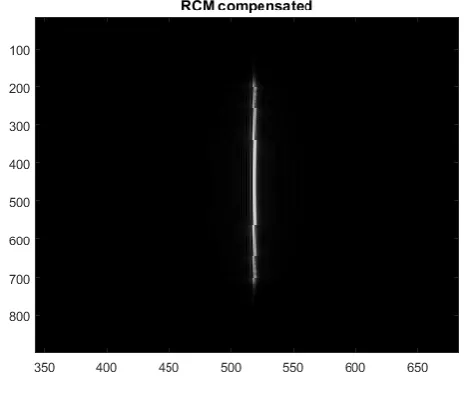
After RCMC the signal looks as shown in figure. After RCMC the signal is subjected to
azimuth compression similar to general RDA, the signal will now be positioned in a point on
the target space.
Fig. 5: RCM compensated data.
4) Azimuth Compression: After RCMC the signal is compressed in azimuth direction. Azimuth compression is same as range compression but here the conjugate template used is
multiplying the signal by the template. It is then subjected to azimuth IFFT. Another azimuth
IFFT might be required to apply in order to get a point at the desired location. From these
example images we can see that this signal processing technique will work efficiently even in
the presence of noise with the target motion error.
(a) Final point target.
(b) Final point target in gray scale.
CONCLUSION
In this paper we have worked with the target with squint in the raw data. We made slight
changes to the basic RDA to deal with squint scenario, by introducing the SRC concept.
Without SRC the RCMC will be inaccurate and the target position will be shifted from the
with a single point target but it can be extended to multiple targets by applying SRC with
high accuracy.
REFERENCES
1. Mehrdad Soumekh. Synthetic aperture radar signal processing. New York: Wiley, 1999.
2. Synthetic Aperture Radar Image formation Process: Application to a region of north
Algeria Hacene Akliouat, Youcef Smara and Lynda Bouchemakh.
3. Internet.
4. Efficient Strip-mode SAR raw data simulator ofextended scenes Including moving targets
by Liang Yang, Wei-Dong Yu, Yun-Hua Luo, and Shi-Chao Zheng.
5. Synthetic aperture radar simulation for point and extended Targets by Akintunde
Adewoye, a thesis submitted to the department of electrical and computer engineering
and the school of graduate studies of mcmaster university.
6. Synthetic aperture radar Rapid detection of range and azimuth velocities implemented in
Matlab, A Thesis presented to the Faculty of the California Polytechnic State University,
San Luis Obispo by Cheuk Yu David So, June 2013.
7. A Study on Range Cell Migration Correction in SAR Imagery and MATLAB
Implementation of Algorithms, by Anup Parashar Department of Electronics and