© 2018 IJSRST | Volume 4 | Issue6 |Print ISSN: 2395-6011 | Online ISSN: 2395-602X National Conference on Smart Computation and Technology in Conjunction with The Smart City Convergence 2018
A Comparative Study of Image Compression Techniques
Kamalesh Acharya*, Shruti Bijawat
Department of Computer Engineering, Poornima Institute of Engineering & Technology Jaipur, Rajasthan, India
ABSTRACT
The increase in the amount of images captured per day and uploaded over cloud nowadays requires much more bandwidth then previous few years. The high end enhanced image quality requires more number of bits per pixel which increase the overall size of a single image. We generally need to compress the image before storing and transmitting over the channel. In this paper we shall discuss three algorithms for image compression such as: - Block Truncation Coding (BTC), Discrete Cosine Transform (DCT) and Singular Value Decomposition (SVD). We shall compare the results by using MATLAB as tool by calculating Mean Square Error (MSE), Peak Signal to Noise Ratio (PSNR) and Compression Ratio (CR).
Keywords: Image compression, BTC, DCT, SVD, MSE, PSNR and CR.
I.
INTRODUCTION
In this super fast world people do not wish to wait for a second. Similarly in case of image transmission and uploading of image over internet where people are more obsessed about taking pictures from a DSLR whose average size of image ranges from 4-12 Megabytes (MB). A picture of such size needs a higher bandwidth of channel to transmit from one place to another instead it will have higher transmission time. Although it can be possible to transfer such size of file in just blink of eye by applying different compression algorithms to the image.
There is two type of image compression technique such as lossy image compression and lossless image compression.
The loss in term of information required to represent an image comes under lossy image compression where the compressed image losses some of the information as the bits are reduced per pixel in compression.
In lossless image compression the original image is regenerated by the compressed representation of image where there is no loss in the information is seen. Both the techniques applied depending on the requirement of the scenario.
In case of social sites and messaging application lossy image compression can be applied where as in case of official documents and banking details we require lossless image compression.
II.
LITERATURE SURVEY
in some other representation and to get it back decoding the compressed image. In the field of digital image processing, a large variety of image compression algorithms have been introduced. Some of them are efficient and being used in different field depending on their requirements. Below is the literature survey on different proposed algorithms for image compression by authors.
In [1], the author uses the adaptive interpolation for image compression and decompression which is computationally inexpensive and reduces the size of image effectively. The author also provided different compression ratios that can be applied based on original image.
In [2], the author performed a new compression technique by combining two algorithms in two step sequence where in first step he used Lempel-Ziv-Welch (LZW) algorithm and in second step the output of first step is input to the second algorithm that is Bose, Chaudhuri and Hoc-quenghem (BCH). The compression ratio was higher than other algorithms.
In [3], the author introduced two new algorithms based on Run length encoding (RLE). He proposed RLE-1 and RLE-2 which gave better result by saving bytes and increasing the compression ratio. Almost 17.88% and 17.75% better CR respectively.
In [4], the author compared five algorithms and their advantages and disadvantages among other algorithms. It was a survey paper on image compression. The compression techniques are wavelet compression, JPEG/DCT, vector quantization, fractal and genetic algorithm.
III.
ALGORITHMS
In this paper we shall be working on three algorithms to find out which one is giving better result based on the parameters as compression ratio, MSE and PSNR.
The objective is to reduce the redundant bits by eliminating them from repeating in the image. The algorithms we are working on is lossy compression algorithms.
A. Block Truncation Coding
It is a lossy image compression type of technique for greyscale and also used for colour image compression. The original image is being divided into blocks and after that quantises to reduce the gray levels by keeping the mean and standard deviation similar.
For a two level quantization the formula is given by:
(1)
Here x is the original image where as y is the compressed image block which is calculated based on the mean value.
The compressed image is then transmitted along with the mean and standard deviation to retrieve back the original values. The value of a and b is calculated as such by formula:
Where sigma is standard deviation, m is total frequency of pixel and q is the frequency of pixels greater than mean.
(3)
To reconstruct the image 0’s are replaced with a and 1’s are replaced with b.
B. Discrete Cosine Transform
In DCT the image is processed in blocks of size 8x8 of different frequencies. DCT is generally used for the process of JPEG images. It is again a lossy image compression technique where compressed block is stored in reduced space. These blocks of image are processed from left to right and top to bottom.
Steps:-
1) First, the image is split into blocks of 8x8 to process quantization.
2) Second, DCT is calculated for each block applying from left to right and top to bottom along the image.
(4)
(5)
Where p(x,y) is the pixel value of the image represented by matrix p along x and y coordinate and N is the size of the block of DCT.
3) Third, quantization is performed on each 8x8 block of image which in result compresses the size of each block.
4) Fourth, reduced image formed by these blocks are then stored in memory.
5) Fifth, decompression can be done on the compressed image to retrieve back the original image by applying inverse discrete cosine transform (IDCT).
C. Singular Value Decomposition
Image processing and signal processing is being the main field of singular value decomposition as in image processing it works as to reduce noise and image compression and in signal processing to least square fitting. The working of SVD is to decompose the maximum signal energy into few coefficients as per need.
The singular value decomposition takes a matrix A of dimension m*n and decomposes by
A = U∑VT
(6)
Where ∑ hold the singular values of A along diagonally, U and V are matrices having dimension m*m and n*n respectively and are orthogonal matrices.
It calculates eigenvalues and eigenvector by ATA for
computing SVD where eigenvector is used to structure the matrix U and singular values are calculated by taking square root of the eigenvalues.
IV.
METHODOLOGY
The algorithms of BTC, DCT and SVD are being used in MATLAB tool to compare the results of the compression techniques. Matlab is a matrix laboratory tool which is uniquely built for performing operations on matrixes.
The inbuilt libraries are very easy to use and provide a diverse range of functionality to be used by the user. An image is a 2-D matrix which holds the pixel value for each RGB for a color image where as a single value for a gray image.
A graphical user interface (GUI) is being build to visually show how the algorithms showing results by providing a 2-D image. The GUI have 3 section for each algorithm where each section hold the before and after size of original image and compressed image along with the MSE, PSNR and CR.
The traditional image of Lena is used for comparison between all the three algorithms. Also we have performed comparison of 10-15 images to find out which algorithm efficiently gives better result.
A. Block Truncation Coding
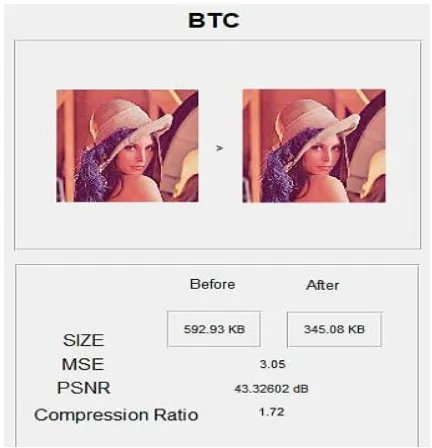
The BTC algorithm showed a compression ratio of 1.72 on the image of Lena along with the mean square error of 3.05 and peak signal to noise ratio of 43.32602 dB. The template is shown below.
Figure 1. Compressed result using BTC
We can see that the image is compressed from the size 592.93 KB is reduced by the block truncation coding to 345.08 KB.
B. Discrete Cosine Transform
The DCT algorithm showed a compression ratio of 1.56 on the image of Lena along with the mean square error of 4.26 and peak signal to noise ratio of 41.86888 dB. The template is shown below.
We can see that the image is compressed from the size 592.93 KB is reduced by the DCT to 379.57 KB.
C. Singular Value Decomposition
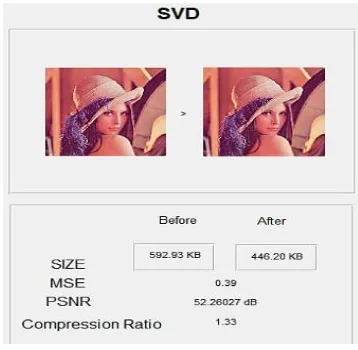
The SVD algorithm showed a compression ratio of 1.33 on the image of Lena along with the mean square error of 0.39 and peak signal to noise ratio of 52.26027 dB. The template is shown below.
Figure 3. Compressed result using SVD
We can see that the image is compressed from the size 592.93 KB is reduced by the SVD to 446.20 KB.
V.
RESULT ANALYSIS
As the result generated it is quite obvious to analyze and predict that which algorithm performs efficiently and provide good result while compressing an image during storage and transmission.
The factors by which we can define that which algorithm can be used while transmission and which algorithm can be used for storage purpose.
We can say that an image needs to be highly compressed for transmission purpose and for storage purpose we can say that an image needs to be error free such that its mean square error should be
minimum so that the compressed image holds the maximum original data.
Below is the table having data of nine images which are mostly used as sample images for image compression and analysis of image compression algorithms. The table has MSE, PSNR and CR for each algorithm BTC, DCT and SVD for each particular image.
The compression ratio (CR) of block truncation coding (BTC) is higher in all the nine images among other algorithms except the image Barbara which have the same compression ratio 2.28 with discrete cosine transform (DCT).
The image compressed by BTC is higher among other two algorithms.
Table 1.Data Obtained By Matlab
Image Algorithm MSE PSNR CR
BTC 3.82 42.34378 dB 2.13
Airplane DCT 6.49 40.04101 dB 1.72
SVD 0.36 52.65154 dB 1.57
BTC 12.02 37.36460 dB 1.45
Baboon DCT 20.33 35.08343 dB 1.18
SVD 6.15 40.27670 dB 1.04
BTC 6.09 40.31910 dB 2.28
Barbara DCT 10.46 37.96867 dB 2.28
SVD 0.61 50.30531 dB 2.25
BTC 10.13 38.11078 dB 1.81
Cameraman DCT 14.06 36.68417 dB 1.29
SVD 0.04 62.46416 dB 1.4
Lena DCT 4.26 41.86888 dB 1.56
SVD 0.39 52.26027 dB 1.33
BTC 3.45 42.78617 dB 2.11
Pepper DCT 6.16 40.27114 dB 1.77
SVD 1.25 47.20961 dB 1.64
BTC 1.38 46.76361 dB 2.22
Pepper2 DCT 2.48 44.21708 dB 1.24
SVD 0.17 55.82348 dB 1.15
BTC 5.13 41.06360 dB 1.98
Sail Boat DCT 8.85 38.69512 dB 1.61
SVD 1.63 46.05110 dB 1.48
BTC 1.69 45.89778 dB 2.11
Tiffany DCT 3.95 42.20010 dB 1.92
SVD 0.57 50.63899 dB 1.54
The compression ratio of BTC is higher than DCT and compression ratio of DCT is higher than SVD which is very clear from table 1.
If we talk about mean square error that is the error due to reduction in the information lost while compressing an image. The MSE for algorithm SVD is lesser than other two algorithms that show that this algorithm can compress an image efficiently along with lesser amount of information loss. The least value of MSE is for the image Cameraman with value 0.04 having a compression ratio of 1.4 which is not too bad.
The mean square error for SVD is least than other two and then comes the BTC algorithm which has less error than DCT.
VI.
CONCLUSION
In this modern world where people are being more smart and intelligent along with smart gadgets the data transmission really require quick actions so to provide a better experience to the user. In this paper, it is concluded that block truncation coding algorithm is efficient in term of higher compression ratio where as in term of MSE the singular value decomposition have an upper hand.
BTC can be used where there is more focus on transmission rather than what information is present in the image where as SVD can be used for the credentials, banking details and confidential documents where data loss is not tolerated.
VII.
REFERENCES[1] Sunil Bhooshan and Shipra Sharma, “Image
compression and decompression using adaptive interpolation”8th WSEAS International Conference 2008.
[2] A. Alarabeyyat, S. Al-Hashemil, T. Khdour, M.
Hjouj Btoush, S. Bani-Ahmad and R. Al-Hashemi, “Lossless image compression technique using combination
methods”http://dx.doi.org/10.4236/jsea.2012.510088 Published Online October 2012.
[3] Ali A. Al-hamid, Ahmed Yahya and Reda A.
El-Khoribi, “Optimized image compression techniques for the embedded processors” in International Journal of Hybrid Information Technology Vol.9,
No.1 (2016), pp. 319-328
http://dx.doi.org/10.14257/ijhit.2016.9.1.27.
[4] Sudha Rawat and Ajeet Kumar Verma, “Survey