
Abstract—This work proposes a novel scheme for separable reversible data hiding in encrypted images. In the first phase, a content owner en-crypts the original uncompressed image using an encryption key. Then, a data-hider may compress the least significant bits of the encrypted image using a data-hiding key to create a sparse space to accommodate some ad-ditional data. With an encrypted image containing adad-ditional data, if a re-ceiver has the data-hiding key, he can extract the additional data though he does not know the image content. If the receiver has the encryption key, he can decrypt the received data to obtain an image similar to the orig-inal one, but cannot extract the additional data. If the receiver has both the data-hiding key and the encryption key, he can extract the additional data and recover the original content without any error by exploiting the spatial correlation in natural image when the amount of additional data is not too large.
Index Terms—Image encryption, image recovery, reversible data hiding.
I. INTRODUCTION
In recent years, signal processing in the encrypted domain has attracted considerable research interest. As an effective and popular means for privacy protection, encryption converts the ordinary signal into unintelligible data, so that the traditional signal processing usu-ally takes place before encryption or after decryption. However, in some scenarios that a content owner does not trust the processing service provider, the ability to manipulate the encrypted data when keeping the plain content unrevealed is desired. For instance, when the secret data to be transmitted are encrypted, a channel provider without any knowledge of the cryptographic key may tend to compress the encrypted data due to the limited channel resource. While an encrypted binary image can be compressed with a lossless manner by finding the syndromes of low-density parity-check codes [1], a lossless compression method for encrypted gray image using pro-gressive decomposition and rate-compatible punctured turbo codes is developed in [2]. With the lossy compression method presented in [3], an encrypted gray image can be efficiently compressed by discarding the excessively rough and fine information of coefficients generated
There are also a number of works on data hiding in the encrypted domain. In a buyer–seller watermarking protocol [6], the seller of dig-ital multimedia product encrypts the original data using a public key, and then permutes and embeds an encrypted fingerprint provided by the buyer in the encrypted domain. After decryption with a private key, the buyer can obtain a watermarked product. This protocol ensures that the seller cannot know the buyer’s watermarked version while the buyer cannot know the original version. An anonymous finger-printing scheme that improves the enciphering rate by exploiting the Okamoto-Uchiyama encryption method has been proposed in [7]. By introducing the composite signal representation mechanism, both the computational overhead and the large communication bandwidth due to the homomorphic public-key encryption are also significantly re-duced [8]. In another type of joint data-hiding and encryption schemes, a part of cover data is used to carry the additional message and the rest of the data are encrypted, so that both the copyright and the privacy can be protected. For example [9], the intraprediction mode, motion vector difference and signs of DCT coefficients are encrypted, while a watermark is embedded into the amplitudes of DCT coefficients. In [10], the cover data in higher and lower bit-planes of transform domain are respectively encrypted and watermarked. In [11], the content owner encrypts the signs of host DCT coefficients and each content-user uses a different key to decrypt only a subset of the coefficients, so that a se-ries of versions containing different fingerprints are generated for the users.
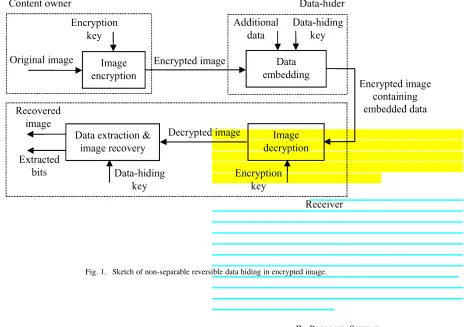
The reversible data hiding in encrypted image is investigated in [12]. Most of the work on reversible data hiding focuses on the data embedding/extracting on the plain spatial domain [13]–[17]. But, in some applications, an inferior assistant or a channel administrator hopes to append some additional message, such as the origin informa-tion, image notation or authentication data, within the encrypted image though he does not know the original image content. And it is also hopeful that the original content should be recovered without any error after image decryption and message extraction at receiver side. Refer-ence [12] presents a practical scheme satisfying the above-mentioned requirements and Fig. 1 gives the sketch. A content owner encrypts the original image using an encryption key, and a data-hider can embed additional data into the encrypted image using a data-hiding key though he does not know the original content. With an encrypted image containing additional data, a receiver may first decrypt it according to the encryption key, and then extract the embedded data and recover the original image according to the data-hiding key. In the scheme, the data extraction is not separable from the content
Ch.D.Sunil Kumar (M.Tech Student), PBRVITS, kavali,[email protected]
B.Ramesh Babu., M.Tech , Asst.Professor,CSE,PBRVITS, [email protected]
the encrypted data due to the limited channel resource. While an encrypted binary image can be compressed with a lossless manner by finding the syndromes of low-density parity-check codes [1], a lossless compression method for encrypted gray image using pro-gressive decomposition and rate-compatible punctured turbo codes is developed in [2]. With the lossy compression method presented in [3], an encrypted gray image can be efficiently compressed by discarding the excessively rough and fine information of coefficients generated
SEPARABLE REVERSIBLE INFORMATION TROUNCING IN ENCRYPTED IMAGE
[Suneel et al., 3(2),April-June, 2013] ISSN: 2277-5528
INTERNATIONAL JOURNAL OF ENGINEERING SCIENCES
&
Fig. 1. Sketch of non-separable reversible data hiding in encrypted image.
decryption. In other words, the additional data must be extracted from the decrypted image, so that the principal content of original image is revealed before data extraction, and, if someone has the data-hiding key but not the encryption key, he cannot extract any information from the encrypted image containing additional data.
This paper proposes a novel scheme for separable reversible data hiding in encrypted image. In the proposed scheme, the original image is encrypted using an encryption key and the additional data are em-bedded into the encrypted image using a data-hiding key. With an en-crypted image containing additional data, if the receiver has only the data-hiding key, he can extract the additional data though he does not know the image content. If he has only the encryption key, he can de-crypt the received data to obtain an image similar to the original one, but cannot extract the embedded additional data. If the receiver has both the data-hiding key and the encryption key, he can extract the additional data and recover the original image without any error when the amount of additional data is not too large.
II. PROPOSEDSCHEME
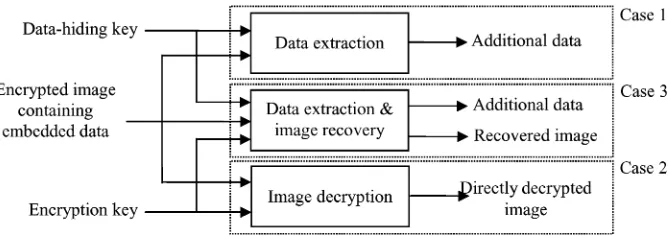
The proposed scheme is made up of image encryption, data embed-ding and data-extraction/image-recovery phases. The content owner encrypts the original uncompressed image using an encryption key to produce an encrypted image. Then, the data-hider compresses the least significant bits (LSB) of the encrypted image using a data-hiding key to create a sparse space to accommodate the additional data. At the receiver side, the data embedded in the created space can be easily re-trieved from the encrypted image containing additional data according to the data-hiding key. Since the data embedding only affects the LSB, a decryption with the encryption key can result in an image similar to the original version. When using both of the encryption and data-hiding keys, the embedded additional data can be successfully extracted and the original image can be perfectly recovered by exploiting the spatial correlation in natural image. Fig. 2 shows the three cases at the receiver side.
A. Image Encryption
Assume the original image with a size ofN12N2is in uncompressed format and each pixel with gray value falling into [0, 255] is represented by 8 bits. Denote the bits of a pixel asbi;j;0; bi;j;1; . . . ; bi;j;7where
1 i N1and1 j N2, the gray value aspi;j, and the number
of pixels asN(N = N12 N2). That implies
Fig. 2. Three cases at receiver side of the proposed separable scheme.
TABLE I
THEORETICALVALUES OFPSNR (DB) WITHRESPECT TOSANDM
and
pi;j= 7 u=0
bi;j;u1 2u: (2)
In encryption phase, the exclusive-or results of the original bits and pseudo-random bits are calculated
Bi;j;u= bi;j;u8 ri;j;u (3) where ri;j;u are determined by an encryption key using a standard stream cipher. Then,Bi;j;uare concatenated orderly as the encrypted data.
B. Data Embedding
In the data embedding phase, some parameters are embedded into a small number of encrypted pixels, and the LSB of the other encrypted pixels are compressed to create a space for accommodating the addi-tional data and the original data at the positions occupied by the param-eters. The detailed procedure is as follows.
According to a data-hiding key, the data-hider pseudo-randomly se-lectsNP encrypted pixels that will be used to carry the parameters for data hiding. Here, NP is a small positive integer, for example,
NP= 20. The other(N 0 NP)encrypted pixels are pseudo-randomly permuted and divided into a number of groups, each of which contains
Lpixels. The permutation way is also determined by the data-hiding key. For each pixel-group, collect theMleast significant bits of theL pixels, and denote them asB(k; 1); B(k; 2); . . . ; B(k; M 1 L)where
kis a group index within [1,(N 0 NP)=L] andMis a positive integer less than 5. The data-hider also generates a matrixGsized(M 1 L 0
S) 2 M 1 L, which is composed of two parts
G = [IM1L0SQ]: (4)
While the left part is an(M 1 L0S)2(M 1 L0S)identity matrix, the right partQsized(M 1 L 0 S) 2 Sis a pseudo-random binary matrix derived from the data-hiding key. Here,Sis a small positive integer. Then, embed the values of the parametersM,LandS into the LSB ofNP selected encrypted pixels. For the example ofNP = 20, the
data-hider may represent the values ofM,LandSas 2, 14 and 4 bits, respectively, and replace the LSB of selected encrypted pixels with the 20 bits.
In the following, a total of(N 0 NP) 1 S=Lbits made up ofNP original LSB of selected encrypted pixels and(N 0 NP) 1 S=L 0 NP
additional bits will be embedded into the pixel groups. For each group, calculate
B0(k; 1)
B0(k; 2)
.. .
B0(k; ML 0 S)
= G 1
B(k; 1) B(k; 2)
.. .
B(k; ML)
(5)
where the arithmetic is modulo-2. By (5),
[B(k; 1); B(k; 2); . . . ; B(k; M 1 L)] are compressed as
(M 1 L 0 S) bits, and a sparse space is therefore available for data accommodation. Let [B0(k; M 1 L 0 S + 1);
B0(k; M 1 L 0 S + 2),. . . ; B0(k; M 1 L)] of each group be the
original LSB of selected encrypted pixels and the additional data to be embedded. Then, replace the [B(k; 1); B(k; 2); . . . ; B(k; M 1 L)] with the new[B0(k; 1); B0(k; 2); . . . ; B0(k; M 1 L)], and put them into their original positions by an inverse permutation. At the same time, the (8-M) most significant bits (MSB) of encrypted pixels are kept unchanged. SinceS bits are embedded into each pixel-group, the total(N 0 Np) 1 S=Lbits can be accommodated in all groups.
Clearly, the embedding rate, a ratio between the data amount of net payload and the total number of cover pixels, is
R = ((N 0 NP) 1 S=L 0 NN P) SL: (6)
C. Data Extraction and Image Recovery
In this phase, we will consider the three cases that a receiver has only the data-hiding key, only the encryption key, and both the data-hiding and encryption keys, respectively.
With an encrypted image containing embedded data, if the receiver has only the data-hiding key, he may first obtain the values of the pa-rameters M, L and S from the LSB of theNP selected encrypted pixels. Then, the receiver permutes and divides the other(N 0 NP)
pixels into(N 0NP)=Lgroups and extracts theSembedded bits from theMLSB-planes of each group. When having the total(N 0 NP) 1
S=Lextracted bits, the receiver can divide them intoNPoriginal LSB of selected encrypted pixels and(N 0NP)1S=L0NPadditional bits. Note that because of the pseudo-random pixel selection and permuta-tion, any attacker without the data-hiding key cannot obtain the param-eter values and the pixel-groups, therefore cannot extract the embedded data. Furthermore, although the receiver having the data-hiding key can
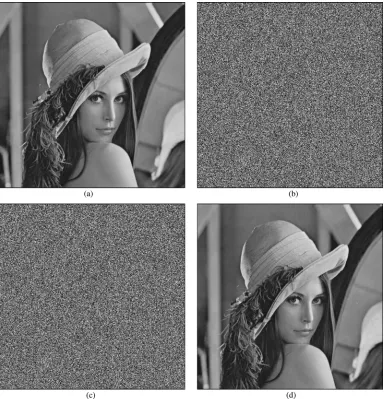
Fig. 3. (a) Original Lena, (b) its encrypted version, (c) encrypted image containing embedded data with embedding rate 0.017 bpp, and (d) directly decrypted version with PSNR 39.0 dB.
successfully extract the embedded data, he cannot get any information about the original image content.
Consider the case that the receiver has the encryption key but does not know the data-hiding key. Clearly, he cannot obtain the values of parameters and cannot extract the embedded data. However, the original image content can be roughly recovered. Denoting the bits of pixels in the encrypted image containing embedded data as
B0
i;j;0; B0i;j;1; . . . ; Bi;j;70 (1 i N1and1 j N2), the receiver
can decrypt the received data
b0
i;j;u= Bi;j;u0 8 ri;j;u (7) whereri;j;uare derived from the encryption key. The gray values of decrypted pixels are
p0i;j= 7 u=0
b0i;j;u1 2u: (8)
Since the data-embedding operation does not alter any MSB of en-crypted image, the deen-crypted MSB must be same as the original MSB.
So, the content of decrypted image is similar to that of original image. According to (5), ifB(k; M 1 L 0 S + 1) = B(k; M 1 L 0 S + 2)=
. . . = B(k; M 1 L) = 0, there is
B0(k; v) = B(k; v); v = 1; 2; . . . ; ML 0 S: (9)
The probability of this case is1=2S, and, in this case, the original(M 1
L 0 S)bits in theM LSB-planes can be correctly decrypted. Since
Sis significantly less thanM 1 L, we ignore the distortion at otherS decrypted bits. If there are nonzero bits amongB(k; M 1 L 0 S + 1),
B(k; M 1 L 0 S + 2); . . ., andB(k; M 1 L), the encrypted data in the
M LSB-planes have been changed by the data-embedding operation, so that the decrypted data in theMLSB-planes differ from the original data. Assuming that the original distribution of the data in theM LSB-planes is uniform, the distortion energy per each decrypted pixel is
DE= 202M1 2 01
=0 2 01
=0
Because the probability of this case is(2S01)=2S, the average energy of distortion is
AE= (2 S0 1)
2S 1 202M1 2 01
=0 2 01
=0
( 0 )2: (11)
Here, the distortion in theNPselected pixels is also ignored since their number is significantly less than the image sizeN. So, the value of PSNR in the directly decrypted image is
PSNR = 10 1 log10(AE): (12)
Table I gives the theoretical values of PSNR with respect toSandM. If the receiver has both the data-hiding and the encryption keys, he may aim to extract the embedded data and recover the original image. According to the data-hiding key, the values of M, L and
S, the original LSB of the NP selected encrypted pixels, and the
(N 0 NP) 1 S=L 0 NP additional bits can be extracted from the encrypted image containing embedded data. By putting theNPLSB into their original positions, the encrypted data of the NP selected pixels are retrieved, and their original gray values can be correctly decrypted using the encryption keys. In the following, we will recover the original gray values of the other(N 0 NP)pixels. Considering a pixel-group, becauseB0(k; 1); B0(k2); . . . ; B0(k; M 1 L 0 S)in (5) are given,[B(k; 1); B(k; 2); . . . ; B(k; M 1 L)]T must be one of the vectors meeting
v = B0(k; 1)B0(k; 2) 1 1 1 B0(k; ML 0 S)00 1 1 1 0T + a 1 H
(13)
whereais an arbitrary binary vector sized12S, andHis anS 2ML matrix made up of the transpose ofQand anS 2 Sidentity matrix
H = [QT I
S]: (14)
In other words, with the constraint of (5), there are 2S possible so-lutions of[B(k; 1); B(k; 2); . . . ; B(k; M 1 L)]T. For each vectorv, we attempt to put the elements in it to the original positions to get an encrypted pixel-group and then decrypt the pixel-group using the en-cryption key. Denoting the decrypted pixel-group asGkand the gray values in it asti;j, calculate the total difference between the decrypted and estimated gray values in the group
D =
(i;j)2G
jti;j0 ~pi;jj (15)
where the estimated gray values is generated from the neighbors in the directly decrypted image, by (16), as shown at the bottom of the page. Clearly, the estimated gray values in (16) are only dependent on the MSB of neighbor pixels. Thus, we have2S differentD cor-responding to the2S decrypted pixel-groupGk. Among the2S de-crypted pixel-group, there must be one that is just the original gray
values and possesses a lowDbecause of the spatial correlation in nat-ural image. So, we find the smallestDand regard the corresponding vectorvas the actual[B(k; 1); B(k; 2); . . . ; B(k; M 1 L)]Tand the decryptedti;jas the recovered content. As long as the number of pixels in a group is sufficiently large and there are not too many bits em-bedded into each group, the original content can be perfectly recovered by the spatial correlation criterion. Since the2SdifferentDmust be calculated in each group, the computation complexity of the content recovery isO(N 1 2S). On the other hand, if more neighboring pixels and a smarter prediction method are used to estimate the gray values, the performance of content recovery will be better, but the computation complexity is higher. To keep a low computation complexity, we letS be less than ten and use only the four neighboring pixels to calculate the estimated values as in (16).
III. EXPERIMENTALRESULTS
The test image Lena sized 5122512 shown in Fig. 3(a) was used as the original image in the experiment. After image encryption, the eight encrypted bits of each pixel are converted into a gray value to generate an encrypted image shown in Fig. 3(b). Then, we letM = 3,L =
128andS = 2to embed 4.42103additional bits into the encrypted image. The encrypted image containing the embedded data is shown in Fig. 3(c), and the embedding rateRis 0.017 bit per pixel (bpp). With an encrypted image containing embedded data, we could extract the additional data using the data-hiding key. If we directly decrypted the encrypted image containing embedded data using the encryption key, the value of PSNR in the decrypted image was 39.0 dB, which verifies the theoretical value 39.1 dB calculated by (12). The directly decrypted image is given as Fig. 3(d). By using both the data-hiding and the encryption keys, the embedded data could be successfully extracted and the original image could be perfectly recovered from the encrypted image containing embedded data.
Tables II and III list the embedding rates, PSNR in directly decrypted images and PSNR in recovered images when differentM,LandS were used for images Lena and Man. As analyzed in (6), the embed-ding rate is dependent onSandL, and the largerSand the smallerL correspond to a higher embedding rate. On the other hand, the smaller the values ofMandS, the quality of directly decrypted image is better since more data in encrypted image are not changed by data embedding. The “+1” in Tables II and III indicate that the original images were recovered without any error. Here, the largeM,Land the smallSare helpful to the perfect content recovery since more cover data and less possible solutions are involved in the recovery procedure. IfMandL are too small orS is too large, the recovery of original content may be unsuccessful, and the values of PSNR in recovered images are also given in Tables II and III.
Figs. 4–6 show the rate-distortion curves of the four images Lena, Man, Lake and Baboon. Here, three quality metrics were used to measure the distortion in directly decrypted image: PSNR, the Watson metric and a universal quality indexQ. While PSNR simply indicates the energy of distortion caused by data hiding, the Watson metric is designed by using characteristics of the human visual system and measures the total perceptual error, which is DCT-based and takes into account three factors: contrast sensitivity, luminance masking and contrast masking [18]. Additionally, the quality index Q works in
~pi;j= bp 0
i01;j=2Mc + bp0i+1;j=2Mc + bp0i;j01=2Mc + bp0i;j+1=2Mc
4 1 2M+ 2M01 (16)
TABLE II
EMBEDDINGRATE R, PSNR INDIRECTLY DECRYPTEDIMAGES (DB)AND PSNRIN RECOVEREDIMAGES(DB) WITHDIFFERENTPARAMETERS FORTESTIMAGELENA
TABLE III
EMBEDDINGRATE R, PSNR INDIRECTLY DECRYPTEDIMAGES (DB)AND PSNRIN RECOVEREDIMAGES(DB) WITHDIFFERENTPARAMETERS FORTESTIMAGEMAN
Fig. 4. Rate-PSNR comparison between the proposed scheme and the method in [12].
spatial domain, as a combination of correlation loss, luminance distor-tion and contrast distordistor-tion [19]. Higher PSNR, lower Watson metric or higherQmeans better quality. In these figures, while the abscissa rep-resents the embedding rate, the ordinate is the values of PSNR, Watson metric or quality indexQ. The curves are derived from differentM,
LandS under a condition that the original content can be perfectly recovered using the data-hiding and encryption keys. Since the
spa-Fig. 5. Rate-Watson metric comparison between the proposed scheme and the method in [12].
Fig. 6. Rate-Qcomparison between the proposed scheme and the method in [12].
people. When meeting the perfect recovery condition, the proposed scheme has an average 203% gain of embedded data amount with same PSNR value in directly decrypted image, or an average gain of 8.7 dB of PSNR value in directly decrypted image with same embedded data amount.
IV. CONCLUSION
In this paper, a novel scheme for separable reversible data hiding in encrypted image is proposed, which consists of image encryption, data embedding and data-extraction/image-recovery phases. In the first phase, the content owner encrypts the original uncompressed image using an encryption key. Although a data-hider does not know the original content, he can compress the least significant bits of the en-crypted image using a data-hiding key to create a sparse space to ac-commodate the additional data. With an encrypted image containing additional data, the receiver may extract the additional data using only the data-hiding key, or obtain an image similar to the original one using only the encryption key. When the receiver has both of the keys, he can extract the additional data and recover the original content without any error by exploiting the spatial correlation in natural image if the amount of additional data is not too large. If the lossless compression method in [1] or [2] is used for the encrypted image containing embedded data, the additional data can be still extracted and the original content can be also recovered since the lossless compression does not change the content of the encrypted image containing embedded data. However, the lossy compression method in [3] compatible with encrypted images gener-ated by pixel permutation is not suitable here since the encryption is performed by bit-XOR operation. In the future, a comprehensive com-bination of image encryption and data hiding compatible with lossy compression deserves further investigation.
REFERENCES
[1] M. Johnson, P. Ishwar, V. M. Prabhakaran, D. Schonberg, and K. Ramchandran, “On compressing encrypted data,”IEEE Trans. Signal Process., vol. 52, no. 10, pp. 2992–3006, Oct. 2004.
[2] W. Liu, W. Zeng, L. Dong, and Q. Yao, “Efficient compression of en-crypted grayscale images,”IEEE Trans. Image Process., vol. 19, no. 4, pp. 1097–1102, Apr. 2010.
[3] X. Zhang, “Lossy compression and iterative reconstruction for en-crypted image,”IEEE Trans. Inform. Forensics Security, vol. 6, no. 1, pp. 53–58, Feb. 2011.
[4] T. Bianchi, A. Piva, and M. Barni, “On the implementation of the dis-crete Fourier transform in the encrypted domain,”IEEE Trans. Inform. Forensics Security, vol. 4, no. 1, pp. 86–97, Feb. 2009.
[5] T. Bianchi, A. Piva, and M. Barni, “Composite signal representation for fast and storage-efficient processing of encrypted signals,”IEEE Trans. Inform. Forensics Security, vol. 5, no. 1, pp. 180–187, Feb. 2010. [6] N. Memon and P. W. Wong, “A buyer-seller watermarking protocol,”
IEEE Trans. Image Process., vol. 10, no. 4, pp. 643–649, Apr. 2001. [7] M. Kuribayashi and H. Tanaka, “Fingerprinting protocol for
im-ages based on additive homomorphic property,”IEEE Trans. Image Process., vol. 14, no. 12, pp. 2129–2139, Dec. 2005.
[8] M. Deng, T. Bianchi, A. Piva, and B. Preneel, “An efficient buyer-seller watermarking protocol based on composite signal representation,” in Proc. 11th ACM Workshop Multimedia and Security, 2009, pp. 9–18. [9] S. Lian, Z. Liu, Z. Ren, and H. Wang, “Commutative encryption and
watermarking in video compression,”IEEE Trans. Circuits Syst. Video Technol., vol. 17, no. 6, pp. 774–778, Jun. 2007.
[10] M. Cancellaro, F. Battisti, M. Carli, G. Boato, F. G. B. Natale, and A. Neri, “A commutative digital image watermarking and encryption method in the tree structured Haar transform domain,”Signal Pro-cessing: Image Commun., vol. 26, no. 1, pp. 1–12, 2011.
[11] D. Kundur and K. Karthik, “Video fingerprinting and encryption prin-ciples for digital rights management,”Proceedings IEEE, vol. 92, no. 6, pp. 918–932, Jun. 2004.
[12] X. Zhang, “Reversible data hiding in encrypted image,”IEEE Signal Process. Lett., vol. 18, no. 4, pp. 255–258, Apr. 2011.
[13] J. Tian, “Reversible data embedding using a difference expansion,” IEEE Trans. Circuits Syst. Video Technol., vol. 13, no. 8, pp. 890–896, Aug. 2003.
[14] Z. Ni, Y.-Q. Shi, N. Ansari, and W. Su, “Reversible data hiding,”IEEE Trans. Circuits Syst. Video Technol., vol. 16, no. 3, pp. 354–362, Mar. 2006.
[15] M. U. Celik, G. Sharma, A. M. Tekalp, and E. Saber, “Lossless gener-alized-LSB data embedding,”IEEE Trans. Image Process., vol. 14, no. 2, pp. 253–266, Feb. 2005.
[16] W. Hong, T.-S. Chen, Y.-P. Chang, and C.-W. Shiu, “A high capacity reversible data hiding scheme using orthogonal projection and predic-tion error modificapredic-tion,”Signal Process., vol. 90, pp. 2911–2922, 2010. [17] C.-C. Chang, C.-C. Lin, and Y.-H. Chen, “Reversible data-embedding scheme using differences between original and predicted pixel values,” IET Inform. Security, vol. 2, no. 2, pp. 35–46, 2008.
[18] A. Mayache, T. Eude, and H. Cherifi, “A comparison of image quality models and metrics based on human visual sensitivity,” inProc. Int. Conf. Image Processing (ICIP’98), Chicago, IL, 1998, vol. 3, pp. 409–413.
[19] Z. Wang and A. C. Bovik, “A universal image quality index,”IEEE Signal Process. Lett., vol. 9, no. 1, pp. 81–84, Jan. 2002.
![Fig. 5. Rate-Watson metric comparison between the proposed scheme and themethod in [12].](https://thumb-us.123doks.com/thumbv2/123dok_us/7825631.1665958/6.594.44.548.293.641/fig-rate-watson-metric-comparison-proposed-scheme-themethod.webp)
![Fig. 6. Rate-� comparison between the proposed scheme and the method in[12].](https://thumb-us.123doks.com/thumbv2/123dok_us/7825631.1665958/7.594.43.284.65.243/fig-rate-comparison-proposed-scheme-method.webp)
