Page 238
PECULIARITIES OF YOUNG DOCTORS EDUCATION AND UPBRINGING WITHIN THE CONDITIONS OF INFORMATION-ORIENTED SOCIETY DEVELOPMENT
Nina K. Gorshunova, Nikolai V. Medvedev Kursk State Medical University, Kursk, Russia
Abstract
Modern professional education provides the formation of the future competitive specialist capable of self-development. The necessity for training highly qualified specialists in a medical university, ready to make independent decisions, continuous professional development, the choice of an individual educational trajectory, capable of performing scientific research and critically interpreting their results requires the competent use of various pedagogical techniques with a predominant choice of technologies for activating mental activity, practical skills training in simulation centers. In order to determine the preferable choice of the optimal technology of education, a questionnaire was conducted for students of senior courses of the medical faculty. Graduates of a more important role attach importance to the content and practical importance of training sessions, while their younger comrades primarily pay attention to the illustrative component of the information provided.
It is established that medical students of the 5th course in the teaching process recognize the priority use of role-playing games and brainstorming. Graduate students make their choice in preference of training relevant practical skills and analyzing clinical cases. Great importance in ensuring the high quality of professional training for a modern teacher of medical university, it is necessary to use an individual approach to students, taking into account the scope of his knowledge and skills, preferences in choosing a future specialty, forming their analytical and communicative competence. Reflection of the achievements level for the university period of a modern graduate is the portfolio preparation.
Keywords: modern medical education, active teaching technologies, satisfaction with the quality of practical training, individual approach
The integration of Russian universities into the Bologna process has served as a serious incentive for reviewing the main priorities and improving the quality of specialists professional training. The mentioned changes have also touched the system of medical education, which is currently considered as the process of continuing improvement of training quality and perfection of medical specialists due to the demands of modern informative society.
The basic concept of continuing medical education is the desire to create a system of knowledge, skills and personality traits of a future physician, providing it with the opportunity for further self-education and self-improvement, easy orientation in solving complex professional and social problems, successful adaptation to constantly changing conditions of the real activity. Under these conditions the leading qualities of a modern doctor are the developed systemic thinking, which allows not only to use available information, but also to successfully find a new one, necessary for mastering various kinds of activities; stable life and professional attitude; high demand and constant readiness for professional and personal development. In addition to these key elements in training, professional self-identification plays a crucial role in the process of performing professional activity on the basis of maximal use of available abilities and individual psycho-physiological opportunities. Each stage of professional self-identification implies an individual’s awareness of certain goals and tasks correlated with the requirements, norms, own resources, motives, interests, demands and values-based orientations developed by the society.
Page 239
material and technical supplies for conducting training sessions, the level of competence and professional skills of the teaching staff, the availability of necessary study materials and scientific literature, information materials, mannequins and phantoms for the organization of simulation training, etc.
The most important tasks of professionally-oriented education and upbringing in a medical university are the formation of basics of fundamental medical culture, the development of self-identification in the profession, creative self-actualization, mastering the skills necessary for the professional and personal advancement of a future medical worker.
In the 21st century competence, independent search for knowledge and continuous skills improvement, high personal culture have become the symbols of medical education. Modern information society recognizes knowledge as one of the highest human values, and in the sphere of education a transition from extensively-informational education to the intensively-fundamental one is being conducted.
High quality of medical education can be provided due to a rational combination of traditional methods of theoretical and clinical training with innovative ones, classroom training with a wider use of remote Internet technologies, providing enough time for independent and practical work under the guidance of an experienced tutor.
An essential condition for modern higher medical education is the dynamic development of simulation training methods for the trainees to better master the skills, taking into account the existing significant difficulties concerning practical skills training of patients’ physical examination, prophylactic medical examination, emergency medical aid in the conditions of real practice.
Trainings - active practice-oriented part of education focused on specific activities for developing professional competencies. Studies in simulation centers allow to piece out significant shortage of time spent on diagnostic examination of patients, necessary for the development of practical skills as provided in the curriculum. They include the skills of physical examination and screening training, cardiopulmonary resuscitation, mastering the first aid measures: surgical, ophthalmological, oncological, neurological, etc. Assessment of the training results is carried out in general and for individual activities of each participant. As criteria for evaluating the training effectiveness recognized success - achieving the objectives of the training; efficiency - significant changes in the development of professional and personal qualities and skills training participants.
A peculiar form of students’ visual demonstration of their achieved level of practical skills and abilities in various clinical training modules is the academic competition - contest which reveals the degree of diverse competencies formation from theoretical knowledge of diseases symptoms, the organization principles of patients’ schools to independent performance of complex diagnostic and therapeutic procedures.
Interactive forms of training sessions organization, successfully applied in the educational process at medical schools, which help to activate students’ thinking are "brainstorming", roundtable discussions, master classes to demonstrate the preventive counseling techniques, etc.; focus groups, role-playing games using "simulated patient" technologies, which allow to really immerse into the atmosphere of practical activity (Belogurova 2006). An active involvement of students in these forms of group work within practical classes contributes to the development of effective team cooperation skills, professional communication, responsible attitude to work commitments.
The emphasis in clinical disciplines teaching is recommended to be placed on a wider use of problem-based learning technologies that facilitate the participants of educational process to immerse into professionally-oriented situation, imitating a real medical practice. Under the terms of a problem situation students perform an active search for additional information necessary to achieve the goal replenishing their store of actual knowledge, developing the competence of information critical analysis.
Page 240
identify the problem and its solutions, develop options out of a difficult situation. Case study - a method to apply the theoretical knowledge in solving practical problems, contributing to the development of students' independent thinking, critical skills to evaluate alternative points of view (Hutorskoy 2008).
The use of distant learning technologies in the form of listening to educational video lectures, participation in webinars, clinical analyses, professional medical consultations, preventive counseling as well, is an essential additional resource that increases the potential of medical education, ensuring its continuity, the implementation of the principle "lifelong learning".
A special role in quality improvement and deepening of theoretical knowledge is played by the involvement of medical students into research work. As a result of its implementation, important competencies necessary for a future doctor, such as a critical analysis of medical information coming from different sources, statistical processing, interpretation of their own research results, their ability to prepare a scientific publication, and present a scientific report are formed. Organization of students research work provides a wide field in the choice of topics, research methods, and the interpretation of the results to be correctly represented.
An important role in doctors training in contexts of information-oriented society is assigned to the development of critical analysis competence for professional information coming from various sources on the principles of evidence-based medicine. When administering diagnostic methods for confirming a preliminary diagnosis, students should be guided to choose among the available methods, those that have the best indicators of sensitivity, specificity and prognostic value.
Despite a rich arsenal of various educational methods and technologies at teachers and tutors’ disposal, it should be born in mind that even their masterful application in practical classes at a medical school can’t ensure high quality specialists training without competently organized independent work of students, the development of their independent aspiration to find necessary information. In this regard, one of the main tasks of education is to develop in students the skills of self-education and self-organization. It is important for students to thirst for mastering both motivational, goal-oriented, organizational and procedural, and evaluative components of independent acquisition of actual knowledge (Mukhina & Soloviev 2008).
Despite the universal development of information technologies in medicine, to solve a patient’s complex problems there is the need to ensure high quality and efficiency of professional communication, including the acquirement of older colleagues and supervisors’ progressive experience. Development of students’ communicative competence, sustainable skills to build effective relationships with patients, colleagues, management of medical institutions, the ability to successfully prevent or resolve conflict situations is a necessary condition for further professional advancement of a modern doctor. The development of active perception of patient's problems with the subsequent achievement of informed consent - the choice of the most rational behavioral tactics for solving the priority tasks of medical activity: prevention, diagnosis, treatment or rehabilitation, are of particular importance.
The main direction of educational work in the university is recognized to be education through the profession. Within the medical university specialized departments play a key role in this process, directly carrying out the professional socialization of students, especially during the period of their clinical practice. The most important component of future doctor’s upbringing is closely related to the development of healthy lifestyle stereotype as an obligatory factor of their image, which has a positive impact on the patients’ adherence to medical recommendations. To solve this problem, constant use of various means is necessary: holding educational actions, conferences, where students prepare presentations on the problems of eliminating harmful behavioral habits, being active not only in physical, but also in spiritual and cultural spheres of life, daily use of physical breaks to remove static muscle tension inhibiting effective knowledge and skills acquisition.
Page 241
of the personality are achieved through the rational use of spiritual, secular and physical culture means.
The involvement of students in volunteer assistance for people in need: orphans, lonely senior persons, patients with disabilities, etc. - plays a special role in the process of professional education. Voluntary performance of various types of medical, social, domestic and psychological assistance contribute to the bowels of compassion and mercy development, which have been recognized as professionally significant for medical workers since ancient times.
In modern conditions, the achievement of high student’s satisfaction is recognized to be the most important indicator of ensuring the required quality of future doctors' training, which can be assessed on the basis of feedback. At Kursk State Medical University anonymous questioning of students is regularly carried out to find out their satisfaction with various aspects of organization and conduction of class activities for the purpose of further improvement in the quality of the educational process. "Polyclinic therapy" and "general medical practice" are medical disciplines that provide the capture of theoretical material, professional competences and labor functions necessary for future work in the context of primary health care. At the same time, the study of outpatient therapy is aimed primarily at comprehending the foundations of patient's working capacity examination, preventive and rehabilitation technologies, palliative and medico-social care. General medical practice, in its turn, involves the assimilation of differential diagnostic and tactical procedures for patients with widespread clinical syndromes in outpatient practice: arterial hypertension, fever of unknown genesis, anemic, broncho-obstructive, etc.
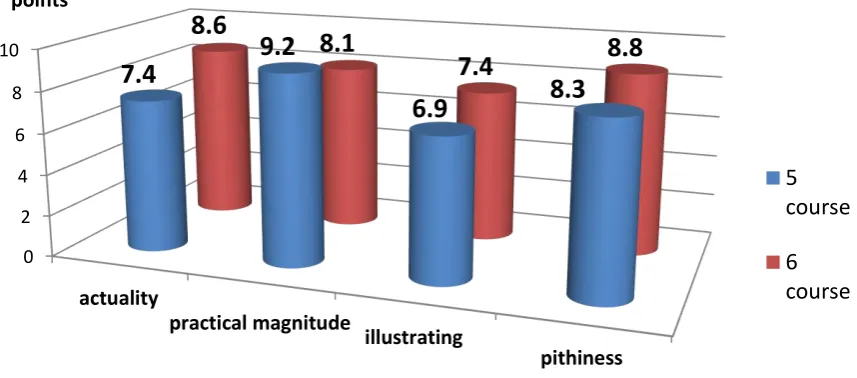
Students assess the relevance of educational and scientific information presented by a lecturer or a teacher in the practical class, its accessibility for understanding, the illustration of theoretical statements, teaching aids with drawings, diagrams, animation, additional use of videos and video fragments that clarify and facilitate the perception and assimilation of complex processes; practical importance, etc.
The results of senior medical students’ satisfaction with the quality of disciplines "polyclinic therapy" and "general practice" teaching are presented in the figure 1.
As follows from the analysis of differences in the degree of senior medical students’ satisfaction with various aspects of the educational process, it should be concluded that graduates pay more attention to the substantial part and practical importance of training sessions, while their junior colleagues focus primarily on the illustrative component of presented information.
Fig. 1. The results of senior medical students’ satisfaction (in points) with the quality of classes in "polyclinic therapy" (5th year) and "general practice" (6th year).
0 2 4 6 8 10
actuality
practical magnitude
illustrating
pithiness
7.4
9.2
6.9
8.3
8.6
8.1
7.4
8.8
5
course
6
course
Page 242
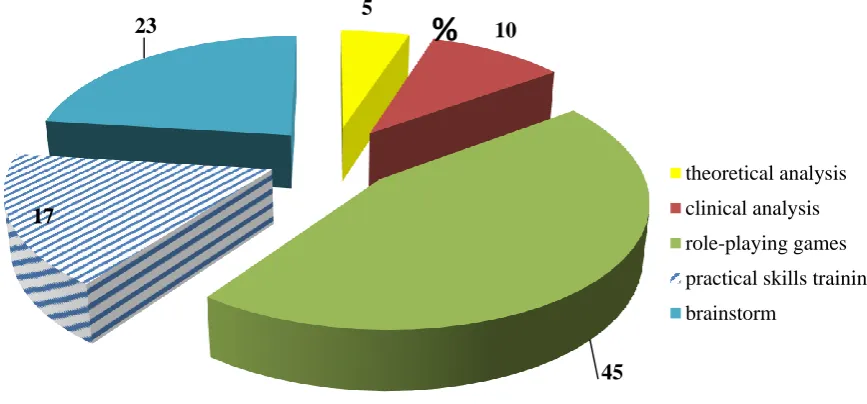
The next stage of the study included assessing the preferences of students among the most productive forms of practical training for mastering knowledge. The choice of the optimal type of classroom from the students' point of view was carried out between traditional oral analysis of the theoretical material, clinical discussion of the case from practice, organization of practical skills training, role-playing games or brainstorming in several subgroups, followed by the leader of each of them giving a justified position on the problem under discussion.
On the basis of the results shown in Figure 2, it can be concluded that the most preferred form of the 5 th year students' course was recognized as role games imitating future professional medical activities, for example, the organization of schools for patients with chronic diseases, preventive counseling for patients with risk factors, variants of interaction of the general practitioner with specialists, relatives of the patient, social workers.
Fig. 2. The preferred form of practical training for students of the 5th year of Medical faculty.
Fig. 3. The preferred form of practical training for students of the 6th year of Medical faculty. 5
10
45 17
23
%
theoretical analysis
clinical analysis
role-playing games
practical skills training
brainstorm
3
27
24 37
9
%
Page 243
For graduates of the 6th year, the choice of the optimal type of classes was made in favor of training practical skills in the centers of simulation training aimed at testing the algorithm of resuscitation, skills in the early diagnosis of cancer, visual and hearing impairment (figure 3).
Despite the significant implementation of innovative components in the structure of educational programs, the individual character of training is still relevant as it offers the tasks for students to solve them independently, taking into account the initial level of their knowledge, psychological features, specificity of future professional activity in a prospective specialty.
The objective evidence of developed professional and general cultural competencies of students is their achievements portfolio, which contains confirming documents: certificates, diplomas of participants in competitive events, scientific conferences; completed course projects, scientific publications, etc.
Thus, the rational combination of traditional teaching technologies with innovative ones, such as distant learning, the development of simulation training methods with a student-centered approach, active involvement of students into volunteer activities, maintenance of healthy lifestyle are the necessary conditions to improve the quality of medical education and upbringing of a modern doctor.
REFERENCES
1. Belogurova, V.A. 2006, Scientific organization of the educational process, Geotar-Media, Moscow.
2. Hutorskoy, A.V. 2008, Educational Innovations, Publishing Center "Academy ", Moscow.