This is the author’s version of a work that was submitted/accepted for
pub-lication in the following source:
Tang, Xiaoyu,
Xu, Yue, &
Geva, Shlomo
(2014)
Refining user and item profiles based on multidimensional data for top-n
item recommendation. In
Indrawan-Santiago, Maria, Steinbauer, Matthias, Nguyen, Hong-Quang,
Tjoa, A. Min, Khalil, Ismail, & Anderst-Kotsis, Gabriele (Eds.)
Proceedings of the 16th International Conference on Information
Integra-tion and Web-based ApplicaIntegra-tions & Services (iiWAS ’14), ACM, Hanoi,
Vietnam, pp. 310-319.
This file was downloaded from:
http://eprints.qut.edu.au/82474/
c
Copyright 2014 ACM
Notice
:
Changes introduced as a result of publishing processes such as
copy-editing and formatting may not be reflected in this document. For a
definitive version of this work, please refer to the published source:
Refining User and Item Profiles based on Multidimensional
Data for Top-N Item Recommendation
Xiaoyu Tang, Yue Xu, Shlomo Geva
Science and Engineering Faculty, Queensland University of Technology,
Brisbane, Australia
[email protected], {yue.xu, s.geva}@qut.edu.au
ABSTRACT
In recommender systems based on multidimensional data, additional metadata provides algorithms with more information for better understanding the interaction between users and items. However, most of the profiling approaches in neighbourhood-based recommendation approaches for multidimensional data merely split or project the dimensional data and lack the consideration of latent interaction between the dimensions of the data. In this paper, we propose a novel user/item profiling approach for Collaborative Filtering (CF) item recommendation on multidimensional data. We further present incremental profiling method for updating the profiles. For item recommendation, we seek to delve into different types of relations in data to understand the interaction between users and items more fully, and propose three multidimensional CF recommendation approaches for top -N item recommendations based on the proposed user/item profiles. The proposed multidimensional CF approaches are capable of incorporating not only localized relations of user-user and/or item-item neighbourhoods but also latent interaction between all dimensions of the data. Experimental results show significant improvements in terms of recommendation accuracy .
Categories and Subject Descriptors
H.3.3 [Information S earch and Retrieval]: Information filtering
General Terms
Algorithms, Performance, Experimentation.
Keywords
M ultidimensional data, neighbourhood, dimensionality reduction, collaborative filtering, recommender systems.
1.
INTRODUCTION
In recent years, the development of Web 2.0 techniques and various smart devices have created new opportunities for recommender systems, by revealing more information additional to user-item transactions. For example, Social Tagging Systems (STS) encourage users to employ user-defined keywords to help manage content in a personalized way. Recommender systems built upon STS [23] utilize social tagging to improve recommendation mechanisms. Context-Aware Recommender Systems (CARS) [3, 10] incorporate context information (e.g. time, location, weather,
etc.) into recommendation models to predict new relations more accurately. Tags and contextual information can be treated as additional dimensions to user-item matrix. Thus, the data used by these recommender systems share the property that each user-item transaction involves multiple entities other than merely a user and an item.
The top-N item recommendation task for multidimensional data has been tackled in many different ways. For the neighbourhood-based Collaborative Filtering (CF) approaches, researchers have presented various ways to utilize multidimensional data in user/item profiling and in neighbourhood formation through explicit conversion of dimensions [15, 16, 23]. For example, Liang proposed to construct user profiles by using tags so as to utilize the multiple relationships among users, items and tags for extracting the semantic meaning of each tag for users [15]. However, these approaches mostly work in ad hoc ways which leads to that they cannot be directly applied to data with more dimensions. On the other hand, they cannot take into account the latent relations in data through merely explicit relations from neighbourhood. Differently, some recent Tensor Factorization (TF) based models [10, 17, 21] model multidimensional data as tensors (i.e. multidimensional arrays) and are able to discover holistic latent relationships in data. However, pure TF-based recommendation models lack the ability to utilize localized relationships which are often the privilege of neighbourhood-based CF approaches. Furthermore, the increase of the dimensionality of data can cause serious efficiency problem for the factorization process, which largely restrict the application in practice.
Despite various recommendation models have been proposed in the categories of neighbourhood-based approaches and factorization models, they essentially only deal with parts of relations existing in data. Neighbourhood-based approaches work with user-user or item-item neighbourhood relations, while TF utilizes the global latent interaction between different dimensions. There has not been any research which incorporates all these different types of relations simultaneously in multidimensional data for makin g recommendations.
In this paper, we propose to profile users and items through conducting dimensionality reduction on multidimensional data. Based on that, incremental profiling approaches for new users and items are introduced. We further present three novel M ultidimensional Collaborative Filtering approaches for top-N item recommendation using multidimensional data. Three different levels of structures of data can be captured and utilized simultaneously by the proposed recommendation approaches. Our profiling approach first transforms data to model user and item profiles by means of observing data from the user and item dimensions respectively. Then, dimensionality reduction is conducted on transformed data for removing noises and revealing implicit relations between all dimensions. Finally, the proposed CF
approaches capture the refined localized user-user and/or item-item relations and also global latent relations between all dimensions, to generate item recommendations.
The contributions of our work are as follows:
We propose a generic multidimensional profiling method which models users and items based on holistic relations in the entire data. It is directly generalizable to profiling for entities other than users and items, and is extendable to N-dimensional data. We present two incremental profiling approaches for the proposed profiling method. This avoids costly recomputation when new data comes to the system.
We propose three multidimensional CF recommendation approaches which take advantages of not only the localized neighbourhood relations of users/items, but also holistic latent relations between all dimensions. This enables the recommendation algorithm to understand data more completely than pure TF-based CF models.
We have conducted extensive experiments to validate the effectiveness of the proposed multidimensional profiling method in top-N item recommendation task. The experimental results show that our approaches substantially improve the quality of top-N item recommendations in terms of precisions/recalls/F1 scores. The rest of this paper is organized as follows: Section 2 summarizes the related work. In Section 3 we propose a multidimensional profiling approach for representing users and items with incremental profiling methods. Based on that, we integrate the proposed profiling method into neighbourhood-based CF approaches. Experimental results are given in Section 4, which shows superior performance of the proposed recommendation models. Finally, Section 5 concludes this paper.
2.
RELATED WORK
Traditionally, most of the CF recommender systems are categorized into two families: neighbourhood-based approaches and latent factor models [2]. The neighbourhood-based CF recommender systems are usually based on nearest neighbourhood relations. Examples include user-based and item-based CF [7]. The latent factor models [13, 21] have received much attention due to its competitive performance in Netflix competition. The entities of data in these traditional CF recommender systems often include only users and items. This kind of data and the recommender systems are 2-dimensional, since each user-item transaction is only associated with two entities: user and item.
The development of information systems working with multidimensional data, such as social tagging systems and context -aware systems, have promoted the recommendation systems to incorporate data with more dimensions. Different categories of recommendation approaches have been proposed for multidimensional data scenario in recent years. M arinho et al. discussed how conventional CF can be applied for computing recommendations in multidimensional data environments through dimension projection [16]. They referred to this type of recommendation approaches as projection-based CF. The approaches which fall into this type usually project data between different dimensions in order to reduce the data spaces and predict new user-item relations. Tso-Sutter et al. proposed to extend the typical user-item matrix with tags which are taken as pseudo users and pseudo items [23]. Liang et al. proposed to construct tag-based user profiles using the multiple relationships among users, items and tags to find the semantic meaning of each tag for each user
individually [15]. Tagommenders [19] predicts users’ preferences for items based on their inferred preferences for tags. They proposed to combine tag preference inference algorithms with tag-aware recommenders and showed empirically that their approach outperforms classic CF algorithms. Although at least three dimensions of data are considered in these approaches, they are not directly generalizable to more dimensions of information. Besides, most of these approaches do not have the ability to incorporate latent multidimensional relations in data for recommendation making. These disadvantages limit their recommendation capacity. Differently, latent factor models enjoy the ability to discover latent relationships from a holistic perspective. For this category of CF models, a newly emerging stream of methods focusing on multidimensional data is tensor factorization. TF-based recommendation models formulate users, items and additional dimensions such as tags, as multidimensional matrices which are called tensors. M ultiverse Recommendation [10] is a TF-based model for context-aware item recommendation which utilizes Tucker Decomposition (TD) for rating prediction task with the user-item-context N-dimensional tensor data. Time is used as the context in this method. Rendle et al. proposed a different approach for creating the initial tensor which expresses user-item-tag relations [17]. Instead of using the 0/1 interpretation scheme, they used a so-called Post-Based Ranking Interpretation (PBRI). Symeonidis et al. introduced a unified framework which provides three types of recommendations in STS, using a 3-order tensor to model the relations of users, items, and tags [21]. M ulti-way latent semantic analysis is conducted using Higher-Order Singular Value Decomposition (HOSVD). They reported superior recommendation performance of their model for item recommendation compared to other approaches. To sum up, the TF-based CF models enjoy similar advantages of 2-dimensional latent factor models and are able to use more information from additional dimensions. However, although these approaches hold the holistic perspective of data with latent relationships discovered, they neglect the localized relations which usually are extracted by nearest neighbourhood approaches. Additionally, in real-world implementations, some other drawbacks like low computing efficiency, curse of dimensionality or lengthy training time may become severe problems as the size and dimensions of the data are large, while neighbourhood-based CF usually perform much better when these concerns matter a lot.
As aforementioned, the extraction and utilization of global latent relations and explicit user’s/item’s localized relations are the cores of most CF approaches to provide quality recommendations. However, no research has been done to incorporate all these three layers of relations for making item recommendations. Furthermore, no previous work has proposed a generalizable multidimensional method for user/item profiling and neighbourhood formation. We believe that a novel CF approach effectively utilizing multidimensional latent relations and localized explicit relations possesses an all-sided view of data relations and thus has the ability to provide recommendation of high accuracy, while still enjoy the desirable efficiency in practice. This is the focus of this paper.
3.
MULTIDIMENSIONAL
COLLABORATIVE FILTERING
In this paper, for the sake of simplicity, we will describe the proposed approaches with three dimensions: users, items and tags, as in the context of STS. In fact, tags can be replaced with other entities such as item features or categories. The profiling and recommendation approaches proposed in this section can be
generalized to data with more dimensions. We define 𝑈, 𝐼 and 𝑇 as disjoint non-empty finite sets, whose elements are users, items and tags, respectively. In this way, the data is 3-dimensional.
3.1
Multidimensional User/Item Profiling
In this section, we propose a multidimensional profiling approach for users and items. In our approach, the 3-dimensional user-item-tag data is represented as a 3-order tensor 𝒜 ∈ ℝ|𝑈|×|𝐼|×|𝑇|, in which a tensor element is represented by a 3-tuple (𝑢, 𝑖, 𝑡). In the simplest case, the value of (𝑢, 𝑖, 𝑡) is defined as:
𝑒𝑢,𝑖,𝑡= {1,0, if the transaction (𝑢, 𝑖, 𝑡) existsotherwise
For social tagging, a transaction or tag assignment (𝑢, 𝑖, 𝑡) exists if user 𝑢 collected item 𝑖 with tag 𝑡.
Generally, users’ item preferences are represented by users’ explicit ratings or implicit ratings. In the context of this paper, the item preference of a user 𝑢 to an item 𝑖, denoted as 𝑟𝑢,𝑖, is defined
as 𝑟𝑢,𝑖= 1 if 𝑢 collected 𝑖 with at least one tag, otherwise 𝑟𝑢,𝑖= 0
indicating that the user’s preference to this item is unknown. M atricization, also known as unfolding or flattening, is the process of reordering the elements of an N-order tensor into a matrix [1, 12]. Some decomposition techniques apply matricization to tensors for extracting and explaining data properties in order to understand the data structure. Illustration of a matricization operation for a 3-order tensor 𝒜 ∈ ℝ|𝑈|×|𝐼|×|𝑇| is given in Figure 1. The three modes/dimensions of the tensor 𝒜 are users (𝑈), items (𝐼) and tags (𝑇). Figure 1 shows the U-mode unfolding of the tensor 𝒜, denoted as 𝒜(𝑈)∈ ℝ|𝑈|×|𝐼||𝑇|.
Figure 1. Matricization of a 3-order tensor
Formally, in the mode-𝑛 matricization of an 3-order tensor 𝒜 ∈ ℝ𝐼1×𝐼2×𝐼3, a tensor element (𝑖
1, 𝑖2, 𝑖3) maps to a matrix element
(𝑖𝑛, 𝑗) [12], where 𝑗 = 1 + ∑3𝑘=1(𝑖𝑘− 1)𝐽𝑘 k≠n (1) and 𝐽𝑘= ∏𝑘−1𝑚=1𝐼𝑚 𝑚≠𝑛 .
Inspired by the tensor matricization, we propose to represent users and items by matricizing the tensor 𝒜 ∈ ℝ|𝑈|×|𝐼|×|𝑇| by U-mode and by I-mode. In this way, users are represented by vectors instead of matrices in which each user 𝑢 is represented by a binary vector 𝑢𝑒
⃑⃑⃑⃑ . Each element 𝑢𝑘𝑒 in 𝑢⃑⃑⃑⃑ 𝑒 corresponds to an item-tag pair (𝑖, 𝑡),
and 𝑢𝑘𝑒= 1 if 𝑒𝑢,𝑖,𝑡= 1, otherwise 𝑢𝑘𝑒= 0. Items’ representations
are similarly formed. The outcomes of the two matricization operations are two matrices: a matrix 𝒜(𝑈)∈ ℝ|𝑈|×|𝐼||𝑇| with 𝑈
mapped to row vectors and a matrix 𝒜(𝐼)∈ ℝ|𝐼|×|𝑈||𝑇| with 𝐼
mapped to row vectors. Hence, 𝒜(𝑈) can be represented as a
vector < 𝑢⃑⃑⃑⃑ ,𝑢1𝑒⃑⃑⃑⃑ ,… , 𝑢2𝑒 ⃑⃑⃑⃑⃑⃑⃑ >|𝑈|𝑒 ⊺ and 𝒜(𝐼) can be represented as a
vector < 𝑖⃑⃑⃑ , 𝑖1𝑒 ⃑⃑⃑ , … ,𝑖2𝑒 ⃑⃑⃑⃑ >𝑒|𝐼| ⊺, where 𝑢⃑⃑⃑⃑ 𝑒 and 𝑖⃑⃑⃑ 𝑒 which represent a user
and an item respectively are the following vectors: 𝑢𝑒
⃑⃑⃑⃑ =< 𝑒𝑢,𝑖1,𝑡1, 𝑒𝑢,𝑖2,𝑡1, … , 𝑒𝑢,𝑖|𝐼|,𝑡|𝑇|>
𝑖𝑒 ⃑⃑⃑ =< 𝑒𝑢
1,𝑖,𝑡1, 𝑒𝑢2,𝑖,𝑡1, … , 𝑒𝑢|𝑈|,𝑖,𝑡|𝑇|>
Compared to the tag-aware CF fusion model [23], the user and item profiles created by the matricization of tensors can essentially preserve the multidimensional semantic relations in the data. However, this also brings up new problems. First, matricization of tensors may lead to misinterpretation if the data are noisy [1]. Also, since usually the number of items and tags are quite large, tensor matricization could deteriorate the efficiency of neighbourhood formation using the U-mode and I-mode unfolding matrices 𝒜(𝑈)
and 𝒜(𝐼)as the profiles of users and items, respectively. In order to
solve these problems, we propose to conduct SVD on 𝒜(𝑈) and
𝒜(𝐼) to discover the latent factors and to reduce the representation
spaces.
We apply SVD on the matrix 𝒜(𝑈) and matrix 𝒜(𝐼) separately in
the same way. Taking 𝒜(𝑈) as an example, through factorizing the
matrix 𝒜(𝑈) via the SVD process, latent factors can be extracted
and 𝒜(𝑈) can be represented as:
𝒜(𝑈)= 𝒰|𝑈|×|𝑈|∙ 𝒮|𝑈|×|𝐼||𝑇|∙ 𝒱|𝐼||𝑇|×|𝐼||𝑇|𝑇 (2)
By preserving a certain amount of information in the data, i.e., specifying the number of factors to be retained, 𝑘𝑢≤ |𝑈|, we can
project the representations of users from the vector space ℝ|𝐼||𝑇| onto the latent factor space ℝ𝑘𝑢, so as to reduce the dimensions of
user profile representations. The space projection operation is fulfilled by the following equation:
𝒰ℱ|𝑈|×𝑘𝑢= 𝒰|𝑈|×𝑘𝑢∙ 𝒮𝑘𝑢×𝑘𝑢 (3)
where 𝒰|𝑈|×𝑘𝑢∈ ℝ
|𝑈|×𝑘𝑢 and 𝒮
𝑘𝑢×𝑘𝑢∈ ℝ
𝑘𝑢×𝑘𝑢 represent the
truncated matrices of 𝒰|𝑈|×|𝑈|and 𝒮|𝑈|×|𝐼||𝑇| respectively, given the
number of factors 𝑘𝑢. 𝒰ℱ|𝑈|×𝑘𝑢is a matrix where each row vector
represents a user’s preference measurement in the new latent factor space.
With the reduced user representations, neighbourhood formation can proceed efficiently and accurately. We will discuss this later. Similar procedure can be defined to reduce item representations by applying SVD on the 𝐼-mode unfolding matrix 𝒜(𝐼) to generate a
truncated matrix ℐℱ|𝐼|×𝑘𝑖with a given factor number 𝑘𝑖 for the item
space. The profiles of a user 𝑢 and an item 𝑖 in latent factor spaces are represented as follows:
𝑢⃑⃑⃑⃑ =< 𝑓𝑓 1𝑢, 𝑓2𝑢, … , 𝑓𝑘𝑢 𝑢> 𝑖𝑓 ⃑⃑⃑ =< 𝑓1𝑖, 𝑓 2𝑖, … , 𝑓𝑘𝑖 𝑖 >
where 𝑢⃑⃑⃑⃑ 𝑓 and 𝑖⃑⃑⃑ 𝑓 are row vectors in 𝒰ℱ|𝑈|×𝑘𝑢and ℐℱ|𝐼|×𝑘𝑖,
respectively, 1 ≤ 𝑘𝑢≤ |𝑈|, 1 ≤ 𝑘𝑖≤ |𝐼|. 𝑘𝑢 and 𝑘𝑖 are the given
numbers of factors for decomposing 𝒜(𝑈) and 𝒜(𝐼) respectively.
The extension of the multidimensional profiling approaches proposed in this section to N-dimensional data is straightforward. For the mode-𝑛 matricization of an N-order tensor 𝒜 ∈ ℝ𝐼1×𝐼2×⋯×𝐼𝑁, a tensor element (𝑖
element (𝑖𝑛, 𝑗), where 𝑗 = 1 + ∑𝑁𝑘=1(𝑖𝑘− 1)𝐽𝑘 𝑘≠𝑛 with 𝐽𝑘= ∏𝑘−1𝑚=1𝐼𝑚 𝑚≠𝑛 [12].
3.2
Incremental Profiling for Users/Items
In online recommender systems, new users, items and tags are frequently introduced into the systems. Therefore, the tensor 𝒜 which represents the social tagging data needs to be updated regularly. In order to provide accurate recommendations, the profiles of users and items often needs to be entirely recalculated from the scratch. However, this is a very resource- and time-consuming task. Incremental updating methods, which avoid the costly recomputation, have been widely used for tackling the updating task of matrix factorization. The SVD can be incrementally updated through a folding-in method [18, 21, 22] and low-rank incremental algorithms [5].
3.2.1
Profiling based on Folding-In
When the update size is small, we can use the folding-in method to profile for new users/items without affecting the existing ones. In the following, based on the folding-in method [18, 21, 22], we propose a method to incrementally create profiles for new users/items introduced to the system. We take profiling for new users for example. An analogous method can be given for profiling new items.
Assuming the numbers of items and tags are unchanged, we denote the whole new tensor with ℎ users newly added as 𝒜(|𝑈|+ℎ)×|𝐼|×|𝑇|𝑛𝑒𝑤 = (𝒜|𝑈|×|𝐼|×|𝑇|𝑜𝑙𝑑 ,𝒜ℎ×|𝐼|×|𝑇|
𝑢𝑝𝑑𝑎𝑡𝑒
), where 𝒜|𝑈|×|𝐼|×|𝑇|𝑜𝑙𝑑 is
the old tensor, 𝒜ℎ×|𝐼|×|𝑇|𝑢𝑝𝑑𝑎𝑡𝑒 is the appended part corresponding to the ℎ new users, and ℎ ≪ |𝑈|. We denote the profiles of the ℎ new users as 𝒰ℱℎ×𝑘
𝑢
𝑢𝑝𝑑𝑎𝑡𝑒
. Based on the folding-in method, we propose the follow equation to compute 𝒰ℱℎ×𝑘
𝑢 𝑢𝑝𝑑𝑎𝑡𝑒 : 𝒰ℱℎ×𝑘 𝑢 𝑢𝑝𝑑𝑎𝑡𝑒 = (𝒜ℎ×|𝐼|×|𝑇|𝑢𝑝𝑑𝑎𝑡𝑒 ) (𝑈)∙ 𝒱|𝐼||𝑇|×𝑘𝑢
Notice that in this equation we reused the truncated component matrix 𝒱|𝐼||𝑇|×𝑘𝑢.
Proof. Assume ℎ ≪ |𝑈|, then we have:
(𝒜(|𝑈|+ℎ)×|𝐼|×|𝑇|𝑛𝑒𝑤 )(𝑈)= (𝒜|𝑈|×|𝐼|×|𝑇|𝑜𝑙𝑑 , 𝒜ℎ×|𝐼|×|𝑇| 𝑢𝑝𝑑𝑎𝑡𝑒 ) (𝑈) ≈ [𝒰|𝑈|×𝑘𝑢 𝒰ℎ×𝑘𝑢 ] ∙ 𝒮𝑘𝑢×𝑘𝑢∙ 𝒱𝑘𝑢×|𝐼||𝑇| 𝑇 = [𝒰|𝑈|×𝑘𝑢∙ 𝒮𝑘𝑢×𝑘𝑢∙ 𝒱𝑘𝑢×|𝐼||𝑇| 𝑇 𝒰ℎ×𝑘𝑢∙ 𝒮𝑘𝑢×𝑘𝑢∙ 𝒱𝑘𝑢×|𝐼||𝑇| 𝑇 ] i.e., (𝒜ℎ×|𝐼|×|𝑇|𝑢𝑝𝑑𝑎𝑡𝑒 ) (𝑈)≈ 𝒰ℎ×𝑘𝑢∙ 𝒮𝑘𝑢×𝑘𝑢∙ 𝒱𝑘𝑢×|𝐼||𝑇| 𝑇 Therefore, we have 𝒰ℱℎ×𝑘 𝑢 𝑢𝑝𝑑𝑎𝑡𝑒 = (𝒜ℎ×|𝐼|×|𝑇|𝑢𝑝𝑑𝑎𝑡𝑒 ) (𝑈)∙ 𝒱|𝐼||𝑇|×𝑘𝑢
3.2.2
Profiling based on Incremental SVD
For large update sizes, the serious loss of orthogonality caused by the folding-in based method may lead the updated profiles to be less accurate. Orthogonality can be ensured by several incremental SVD updating methods, one of which was proposed by Brand [5], which we detail as follows:
Let ℳ𝑝×𝑞 be a matrix. For a 𝑟𝑎𝑛𝑘 − 𝑟 approximation based on
SVD (𝑟 < 𝑚𝑖𝑛 (𝑝, 𝑞)), we have:
ℳ𝑝×𝑞≈ 𝒰𝑝×𝑟∙ 𝒮𝑟×𝑟∙ 𝒱𝑟×𝑞𝑇
Let 𝒞𝑝×𝑐 be the matrix consisting of the new columns to be added
to the matrix ℳ𝑝×𝑞. Let ℒ = 𝒰𝑇𝒞 be the projection of 𝒞 onto the orthogonal basis of 𝒰. Let ℋ = (𝐼 − 𝒰𝒰𝑇)𝒞 = 𝒞 − 𝒰ℒ be the component of 𝒞 orthogonal to the subspace spanned by 𝒰. Let 𝒥 be an orthogonal basis of ℋ and let 𝒦 = 𝒥𝑇ℋ be the projection of 𝒞 onto the subspace orthogonal to 𝒰. Consider the following identity:
[𝒰 𝒥] [𝒮 ℒ 0 𝒦] [𝒱 0 0 𝐼] 𝑇 = [𝒰 (𝐼 − 𝒰𝒰𝑇)𝒞𝒦+] [𝒮 𝒰𝑇𝒞 0 𝒦 ] [𝒱 00 𝐼] 𝑇 = [𝒰𝒮𝒱𝑇 𝒞] = [ℳ 𝒞]
The decomposition is close to the form of SVD, and the left and right matrices are orthogonal. We denote the middle matrix as 𝒬 =
[𝒮 ℒ
0 𝒦]. To update the SVD, we need to diagonalize the middle matrix 𝒬: 𝒬 = 𝒰′𝒮′(𝒱′)𝑇 Additionally, define 𝒰′′= [𝒰 𝒥]𝒰′, 𝒮′′ = 𝒮′, 𝒱′′= [𝒱 0 0 𝐼] 𝒱 ′
each of which can be truncated to be of size 𝑟. Then, the updated SVD is,
[ℳ 𝒞] = [𝒰𝒮𝒱𝑇 𝒞] = 𝒰′′𝒮′′(𝒱′′)𝑇
The whole SVD update procedure takes 𝑂((𝑝 + 𝑞)𝑟2+ 𝑝𝑐2) time [5].
As new users come, it means (𝒜|𝑈|×|𝐼|×|𝑇|𝑜𝑙𝑑 )(𝑈) is appended with a
number of new rows. As the above Brand’s incremental SVD algorithm is designed for updating with new columns, in our case, we can simply update the SVD of the transpose of (𝒜|𝑈|×|𝐼|×|𝑇|𝑜𝑙𝑑 )(𝑈)
to get the updated user profiles. Updating the item profiles is analogous.
3.3
Multidimensional Neighbourhood-based
Collaborative Filtering
In this section, we present a user-based CF algorithm integrated with the multidimensional user profiling approach proposed in Section 3.1. The item-based CF algorithm can be similarly integrated with the proposed multidimensional item profiling approach.
The standard user-based CF algorithm [20] works with the following procedure:
First, formulate user interests into user profiles for each user. For example, Tso-Sutter et al. proposed to extend the typical user-item matrix with tags which are taken as pseudo users and pseudo items [23]. Differently, user profiles in our approach are created by the multidimensional profiling method presented in Section 3.1. Secondly, generate user neighbourhoods based on a predefined similarity measurement between any two users, such as Jaccard similarity or Cosine similarity. In our approach, since the user profiles are vectors consisting of real numbers, Cosine similarity is used and it is given as:
𝑠𝑖𝑚(𝑢𝑖, 𝑢𝑗) = 𝐶𝑜𝑠𝑖𝑛𝑒(𝑢𝑖, 𝑢𝑗) = 𝑢𝑖𝑓
⃑⃑⃑⃑⃑ ∙𝑢⃑⃑⃑⃑⃑ 𝑗𝑓
‖𝑢⃑⃑⃑⃑⃑ 𝑖𝑓‖∙‖𝑢⃑⃑⃑⃑⃑ 𝑗𝑓‖
Finally, for each target user, based on the item preferences of this user’s neighbour users, compute a preference prediction for each new item and then produce a ranked list of top -N item recommendation. The preference prediction 𝑃𝑢,𝑖𝑀𝑈𝐶𝐹 to a new item
𝑖 for a target user 𝑢 is given as:
𝑃𝑢,𝑖𝑀𝑈𝐶𝐹= ∑𝑣∈𝑁𝑢,𝑖∈𝐼𝑣(𝑟𝑣,𝑖∙ 𝑠𝑖𝑚(𝑢, 𝑣)) (5)
where 𝑁𝑢 are the neighbour users of target user 𝑢. 𝐼𝑣 is the set of
items collected by user 𝑣. 𝑟𝑣,𝑖 which is user 𝑣’s item preference for
item 𝑖 is defined in Section 3.1.
Likewise, item-based CF with multidimensional item profiling can be formulated similarly:
𝑃𝑢,𝑖𝑀𝐼𝐶𝐹= ∑𝑗∈𝐼𝑢,𝑖∈𝑁𝑗(𝑟𝑢,𝑗∙ 𝑠𝑖𝑚(𝑖, 𝑗)) (6)
where 𝑁𝑗 are the neighbour items of a collected item 𝑗 which are
new to user 𝑢. 𝐼𝑢 is the set of items collected by user 𝑢, and
𝑠𝑖𝑚(𝑖, 𝑗) is the similarity between item 𝑖 and item 𝑗.
Thereby, the two multidimensional neighbourhood-based CF approaches are proposed. They are able to use 3-dimensional user-item-tag data to profile users and items more accurately as stated in Section 3.1. In Section 4, we will empirically demonstrate the multidimensional neighbourhood-based CF approaches can show better recommendation performance than their standard counterparts.
3.4
Fusing User-based and Item-based CF for
Multidimensional Item Recommendation
As an additional dimension of transaction data beyond users and items, tags can be seen as features specific to individual transactions, i.e., they are usually related to users and items at t he same time. That is, tags (or additional features of other types) are local information for transactions. In this way, the relations in the multidimensional data seen from the aspects of users or items can be different. For example, a user collects the movie Titanic with the tag “love”; a different user collects the same movie with the tag “disaster”. This indicates a recommendation model which can appropriately utilize localized neighbourhood relations from both user and item perspectives may lead to imp rovement of recommendation quality, which forms the basis of some previous works [4, 14, 23, 24].
In the previous section, two neighbourhood-based CF approaches with multidimensional user and item profiling have been proposed. A CF fusion approach can be used to unify the power of user neighbourhoods and item neighbourhoods together for recommendation. In this section, we propose a M ultidimensional CF Fusion (M CFF) approach which fuses the two neighbourhood relations in a way similar to the tag-aware CF fusion model [23]. CF fusion for the top -N item recommendation task is done by combining the predictions of user-based and item-based CF approaches. In order to compare our M CFF approach with the tag-aware CF fusion model, following the tag-tag-aware CF fusion model, the predictions of user-based CF part and item-based CF part in our fusion approach are computed differently. For the predicting item problem in user-based CF part, recommendations are a list of items that is ranked by decreasing frequency of occurrence in the ratings of his/her neighbours. The following equation gives the preference prediction of user 𝑢 for an unused item 𝑖 by the user-based CF part in the fusion model:
𝑃𝑢,𝑖𝑀𝑈𝐶𝐹2=
|{𝑣|𝑣∈𝑁𝑢,𝑖∈𝐼𝑣}|
|𝑁𝑢| (7)
where 𝑁𝑢 are the neighbour users of target user 𝑢, and 𝐼𝑣 is the set
of items used by a neighbour user 𝑣.
For the item-based CF part, the top -N item recommendation is to compute a list of items that is ranked by decreasing sum of the similarities of neighbouring items, which have been used by user 𝑢. This preference prediction of the item-based CF part is given by Equation (6).
Since the preference predictions computed by user-based CF and item-based CF come from different computation methods, they have different scales of values. A normalization process of the preference predictions is needed to unify the recommendations from the two neighbourhood-based CF parts, which produces the final preference prediction used for top -N item recommendation ranking: 𝑃𝑢,𝑖𝑀𝐶𝐹𝐹= 𝜆 ∙ 𝑃𝑢,𝑖𝑀𝑈𝐶𝐹2 ∑ 𝑃𝑢,𝑗𝑀𝑈𝐶𝐹2 𝑗∈𝐼𝑢̃ + (1 − 𝜆) ∙ 𝑃𝑢,𝑖𝑀𝐼𝐶𝐹 ∑ 𝑃𝑢,𝑗𝑀𝐼𝐶𝐹 𝑗∈𝐼𝑢̃ (8)
where 0 ≤ 𝜆 ≤ 1, 𝐼̃𝑢 is the set of new items to be recommended to target user 𝑢. Note the neighbourhood sizes of users and items are defined by the same parameter 𝑘.
The proposed M CFF approach for multidimensional data can reasonably enhance the recommendation performance, since this approach is able to not only efficiently utilize the multidimensional semantic relations, but also bring out the recommendation power of the localized neighbourhood relations of both users and items. In addition, the application of dimensionality reduction to the unfolded matrices can dramatically reduce the dimension problem while preserving the multidimensional interaction. In fact, our empirical analysis has shown that the proposed M CFF approach provides very promising performance.
4.
EVALUATION
In this section, we present empirical analysis based on real data collected from Bibsonomy and Delicious. Experimental results show the high effectiveness of the proposed multidimensional user/item profiling approach for making recommendations. Specially, the evaluation results of M CFF approach show significantly superior performances compared to other state-of-the-art CF approaches for multidimensional data.
4.1
Datasets
We conducted experiments using datasets from Bibsonomy [11] and Delicious [25]. The Bibsonomy dataset was collected on 30 April 2007. The Delicious dataset was collected on January 2004. Following the evaluation of TF approach [21] for making recommendation in STS to make the datasets less sparse, the notion of p-core [9] was applied to the datasets. The p-core of level k means that each user, tag and item has/occurs in at least k posts. Following the evaluation of the TF approach, we use 𝑘 = 5 for both of the two datasets. The original Delicious dataset contains 2419 users, 30838 items and 10926 tags. With 𝑘 = 5, the Delicious dataset contains 216 users, 337 items, and 247 tags. The Bibsonomy dataset we obtained is already applied with 𝑘 = 5 by the dataset provider, Knowledge and Data Engineering Group [11], and it contains 116 users, 361 items and 412 tags.
4.2
Evaluation Settings
4.2.1
Recommendation Models
The following proposed approaches are to be examined in the experiments:
Multidimensional Item-based CF (MiCF). This is the item-based CF approach integrated with the multidimensional item profiles.
Multidimensional User-based CF (MuCF). This is the user-based CF approach integrated with the multidimensional user profiles.
Multidimensional CF Fusion (MCFF). This is the proposed multidimensional CF fusion approach.
In order to compare our proposed approaches against state-of-the-art recommendation algorithms as well as conventional neighbourhood-based CF approaches, we have adopted the following models as the baseline models:
Item-based CF (iCF). This is the item-based CF approach [6]. It is actually a 2-dimensional recommendation method with the implicit rating data as input.
User-based CF (uCF). This is the user-based CF approach [2]. Similar to iCF, it is also a 2-dimensional recommendation method with the implicit rating data as input. Tag-aware CF Fusion (tCFF). This is a CF fusion model which uses tags as pseudo users in item-based CF and as pseudo items in user-based CF, to extend the profiling ability of the two approaches [23].
Tensor Factorization based CF (TF). Symeonidis et al. proposed a tensor factorization based recommender framework which uses HOSVD for factorizing 3-order user-item-tag tensors [21]. They use kernel-SVD in the process to further improve the recommendation accuracy of the reconstructed tensors. Item recommendations are generated directly based on reconstructed tensors.
4.2.2
Evaluation Metrics
To evaluate the performance of top -N item recommendation, we adopt precision, recall and F1 score as the evaluation metrics [8]. We conducted a 5-fold cross validation. For each run, we randomly choose 75% observed data of each user to form the training set, and the remaining 25% are used as testing data for evaluation.
4.2.3
Algorithms’ Settings
Following are the specific settings used in the algorithms to be evaluated for the datasets.
iCF. We have varied the parameter for the item neighbourhood size from 10 to 300 with a step size of 5 for the two datasets. For the Bibsonomy dataset, the best result was achieved when the item neighbourhood size equals to 100. For the Delicious dataset, the best result was achieved when the neighbourhood size equals to 40.
uCF. For the Bibsonomy dataset, we have varied the parameter for the user neighbourhood size from 10 to 100 with a step size of 5, and the best result was achieved when the neighbourhood size equals to 30. For the Delicious dataset, we have varied the parameter for the neighbourhood size from 10 to 200 with a step size of 5, and the best result was achieved when the neighbourhood size equals to 30.
TF. We follow the approach in [21] to determine the three dimensional parameters of core tensors. For the Bibsonomy dataset, we found when the three parameters were set as 96, 60 and 274 this model achieved its best results. For the Delicious dataset,
we found when the three parameters were set as 61, 96 and 211 this model achieved its optimal results.
tCFF. For both of the two datasets, we have varied the λ parameter from 0 to 1 by an interval of 0.1 and the neighbourhood 𝑘 parameter from 10 to 300 by an interval of 5. For the Bibsonomy dataset, we have found the best λ to be 0.8 and 𝑘 to be 20. For the Delicious dataset, we have found the best λ to be 0.7 and 𝑘 to be 70.
Following are the settings for the three proposed models. MiCF. For the Bibsonomy dataset, we found the best results from this method came with factor number parameter 𝑘𝑖 as
343 and item neighbourhood size as 100. For the Delicious dataset, we found the best results from this method came with factor number parameter 𝑘𝑖 as 78 and user neighbourhood size as 70.
MuCF. For the Bibsonomy dataset, we found the best results from this method came with factor number parameter 𝑘𝑢 as
114 and user neighbourhood size as 30. For the Delicious dataset, we found the best results from this method came with factor number parameter 𝑘𝑢 as 128 and user neighbourhood size as 60.
MCFF. We have varied the λ parameter from 0 to 1 by an interval of 0.1 and the neighbourhood 𝑘 parameter from 10 to 300 by an interval of 5 for both of the two datasets. For the Bibsonomy dataset, we set the factor number parameter 𝑘𝑖 as 343
and 𝑘𝑢 as 114. We have found the best λ was 0.4 and 𝑘 was 10. For
the Delicious dataset, we set the factor number parameter 𝑘𝑖 as 78
and 𝑘𝑢 as 128. We have found the best λ to be 0.7 and 𝑘 to be 30.
4.3
Experiment Results and Discussion
In this section, we present the detailed experiment results and discuss the performance of the recommendation models in terms of precision, recall and F1 score as the evaluation metrics.
4.3.1
Multidimensional Models
In this section, we compare the proposed multidimensional CF fusion model M CFF with two state-of-the-art multidimensional CF models: TF and tCFF. Specially, in Table 1 and Table 2, we give the precisions and recalls of the three recommenders for the Bibsonomy dataset respectively. Table 3 and Table 4 show the precisions and recalls of them for the Delicious dataset.
For each top -N value in Table 1 to Table 4, largest values in each row are made bold to be more visible. The improvement of M CFF against the larger one out of TF and tCFF is given in the last column for each line.
Table 1. Precisions of the three recommendation models for Bibsonomy dataset Top-N TF tCFF MCFF Improvement (%) 1 0.137931 0.112068 0.189655 37% 2 0.133620 0.116379 0.176724 32% 3 0.123563 0.120689 0.186781 51% 4 0.107758 0.120689 0.176724 46% 5 0.106897 0.115517 0.158621 37% 6 0.097701 0.107758 0.143678 33% 7 0.093596 0.102216 0.139162 36% 8 0.089439 0.092672 0.127155 37% 9 0.083333 0.089080 0.118773 33% 10 0.079310 0.082758 0.109482 32%
Table 2. Recalls of the three recommendation models for Bibsonomy dataset Top-N TF tCFF MCFF Improvement (%) 1 0.029386 0.026598 0.043586 48% 2 0.057867 0.055901 0.078361 35% 3 0.078496 0.086119 0.127735 48% 4 0.088341 0.112434 0.150250 34% 5 0.110382 0.133640 0.171977 29% 6 0.122768 0.145023 0.181867 25% 7 0.143122 0.165190 0.202885 23% 8 0.156869 0.173811 0.211089 21% 9 0.161842 0.180211 0.222519 23% 10 0.171433 0.182537 0.225577 24%
Table 3. Precisions of the three recommendation models for Delicious dataset Top-N TF tCFF MCFF Improvement (%) 1 0.060185 0.087962 0.064815 -26% 2 0.055555 0.060185 0.071759 19% 3 0.049383 0.055556 0.063271 14% 4 0.046296 0.053240 0.059028 11% 5 0.045370 0.052778 0.055556 5% 6 0.043210 0.047839 0.051698 8% 7 0.041667 0.043650 0.048942 12% 8 0.039931 0.041667 0.048611 17% 9 0.039095 0.040637 0.045267 11% 10 0.036111 0.039351 0.043056 9%
Table 4. Recalls of the three recommendation models for Delicious dataset Top-N TF tCFF MCFF Improvement (%) 1 0.019424 0.027160 0.020634 -24% 2 0.034509 0.038760 0.047653 23% 3 0.044501 0.052114 0.061341 18% 4 0.054370 0.066890 0.073687 10% 5 0.064748 0.082688 0.087268 6% 6 0.075743 0.088154 0.094109 7% 7 0.084790 0.094230 0.103740 10% 8 0.093124 0.102312 0.116838 14% 9 0.101303 0.110299 0.122129 11% 10 0.105161 0.119326 0.126539 6% As shown in Table 1 to Table 4, basically for all top -N values, the proposed approach M CFF shows significantly superior recommendation performance compared to TF and tCFF. Although all of these three models utilize the relations between the three dimensions (users, items and tags) in the data in their own ways, compared to the other two approaches, the M CFF model makes use of not only the relationships between the three entities, but also the power of neighbourhoods. In comparison to TF, M CFF can unify the local relationships that are discovered by user-based and item-based neighbourhoods, which the TF model is incapable of. Compared to tCFF, M CFF not only better preserves the multidimensional semantic relations in the data, which means the user and item neighbourhood formation are more accurate, but also integrates them with holistic implicit relations among users, tags and items in the data through the dimensionality reduction applied on the entire data. In M CFF, different types of relations in the data
can compensate each other. It is the unification of not only both user-based and item-based neighbourhoods but also holistic latent relations that leads the proposed model M CFF to the best recommendation performance. In addition, in Table 1, we can also observe that for some high top -N values (e.g., 1, 2, 3), TF shows better precisions than tCFF. This is because as enough tags are provided in the data, TF can show better top recommendations than tCFF, due to TF’s ability to utilize the ternary relations among the users, items and tags, while tCFF discards this information. Compared to Delicious dataset, M CFF shows higher improvement for Bibsonomy dataset. This may come from the fact that there’re relatively more tags than users and items in Bibsonomy dataset, while in Delicious dataset the number of tags is smaller than the number of items. Since for both of the two datasets, we applied p -core of level k with 𝑘 = 5, this indicates more relations regarding tags can lead to further recommendation improvement of M CFF.
4.3.2
Single Neighbourhood-based CF Models
In this section, in order to evaluate the effectiveness of the proposed multidimensional profiling approach, we compare the two proposed multidimensional neighbourhood-based CF models M uCF and M iCF, with their corresponding neighbourhood-based CF approaches, uCF and iCF. Specifically, in Table 5 and Table 6, we give the precisions and recalls of the recommenders for the Bibsonomy dataset. Table 7 and Table 8 present the precisions and recalls for the Delicious dataset.Table 5. Precisions of the single neighbourhood-based CF models for Bibsonomy dataset
Top-N uCF MuCF iCF MiCF
1 0.112068 0.120689 0.086206 0.137931 2 0.103448 0.112068 0.081896 0.185344 3 0.117816 0.117816 0.080459 0.175287 4 0.116379 0.107758 0.071120 0.163793 5 0.103448 0.100000 0.074137 0.141379 6 0.094828 0.094828 0.070402 0.127873 7 0.086206 0.093596 0.065270 0.120689 8 0.081896 0.089440 0.062500 0.115301 9 0.083333 0.088123 0.059386 0.107279 10 0.083620 0.084483 0.058620 0.101724 Table 6. Recalls of the single neighbourhood-based CF models
for Bibsonomy dataset
Top-N uCF MuCF iCF MiCF
1 0.026087 0.030420 0.018813 0.029581 2 0.056409 0.049024 0.035600 0.080644 3 0.082994 0.080327 0.050214 0.115904 4 0.101750 0.089840 0.058876 0.148074 5 0.112656 0.107882 0.076505 0.160539 6 0.123729 0.117051 0.085358 0.174338 7 0.128354 0.132278 0.095928 0.190031 8 0.136575 0.141515 0.103297 0.201811 9 0.154755 0.153659 0.111193 0.213270 10 0.169037 0.161369 0.120339 0.218762 Table 7. Precisions of the single neighbourhood-based CF
models for Delicious dataset
Top-N uCF MuCF iCF MiCF
1 0.069444 0.069444 0.050925 0.046296 2 0.064814 0.064814 0.034722 0.050925
Top-N uCF MuCF iCF MiCF 4 0.048611 0.061342 0.037037 0.040509 5 0.047222 0.053703 0.037962 0.041666 6 0.043209 0.047068 0.033951 0.040123 7 0.041005 0.042328 0.031084 0.038359 8 0.039352 0.040509 0.030092 0.035301 9 0.037037 0.038065 0.029320 0.033951 10 0.036574 0.037037 0.028703 0.035185 Table 8. Recalls of the single neighbourhood-based CF models
for Delicious dataset
Top-N uCF MuCF iCF MiCF
1 0.025733 0.024035 0.013966 0.016497 2 0.043518 0.043056 0.016975 0.031177 3 0.054784 0.056565 0.028877 0.036236 4 0.061021 0.073894 0.039293 0.048769 5 0.069969 0.079732 0.054263 0.063468 6 0.076721 0.081230 0.059819 0.073421 7 0.084341 0.086014 0.063952 0.082025 8 0.093883 0.093729 0.069816 0.085754 9 0.096796 0.098256 0.077885 0.090088 10 0.106885 0.105765 0.085562 0.102087
For both precision and recall, as we can see in Table 5 to Table 8, M iCF shows superior performance than iCF consistently. This is because the multidimensional item profiling approach is able to take into consideration the additional tag information and t o utilize the 3-dimensional relationships, which leads to more refined item profiles. With this, neighbourhood formation is more accurate and thus the recommendation shows improved performance.
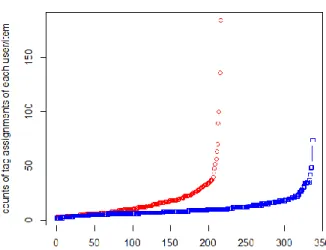
Interestingly, the comparison of M uCF against uCF is not consistent on the two datasets for precision and recall, as shown in Table 5 to Table 8. This phenomenon may be explained by the quantitative differences between users and items in the datasets. Since the unfolding matrices used in M uCF and in M iCF come from the same tensor, the information provided by these two matrices are essentially the same. Under this condition, the smaller number of users compared to items means there are larger number of non-zero elements in 𝑢⃑⃑⃑⃑ 𝑒 than in 𝑖⃑⃑⃑ 𝑒. In Figure 2 and Figure 3, we present the distributions of the counts of tag assignments (i.e., 3-tuple (𝑢, 𝑖, 𝑡)) of each user and of each item in the two datasets, which are the non-zero elements in 𝑢⃑⃑⃑⃑ 𝑒 and in 𝑖⃑⃑⃑ 𝑒. We sorted the user indices and item indices by the counts of tag assignments in ascending order to make the curves smooth. The red circles represent the counts of tag assignments of each user, and the blue squares correspond to that of items. As we can see, averagely each user has more tag assignments than each item does. Also, because the numbers of users are smaller than the items in the two datasets, the available factors in 𝑢⃑⃑⃑⃑ 𝑓 will be less than that in 𝑖⃑⃑⃑ 𝑓. This implies the reduction from 𝑢⃑⃑⃑⃑ 𝑒 to 𝑢⃑⃑⃑⃑ 𝑓 leads to potentially more information loss than that from 𝑖⃑⃑⃑ 𝑒 to 𝑖⃑⃑⃑ 𝑓. In this way, 𝑢⃑⃑⃑⃑ 𝑓 may not always provide sufficient information for each user in M uCF to generate more accurate profiles than what uCF does. On the other hand, for uCF and iCF, it is also due to the lower number of users and higher number of items, the profiles generated in uCF can be better than that generated by iCF because each user in uCF can potentially have more information for profiling. M oreover, it also increases the possibility for uCF to obtain neighbourhoods with higher quality than iCF. This results in the better performance of uCF over iCF. Similar observation was given previously by Desrosiers and
Karypis [7]. Thus, the improvement of M uCF over uCF is less effective as shown in Table 5 to Table 8.
4.3.3
Overall Comparison of All Models
Figure 4 and Figure 5 show the experimental results of all recommendation models for the Bibsonomy dataset and the Delicious dataset respectively. As shown in the two figures, the proposed CF fusion model M CFF outperforms all of the rest of the recommendation models. To sum up, the proposed multidimensional CF fusion approach can incorporate not only the strengths of both user neighbourhood and item neighbourhood but also the multidimensional latent relations, thereby it shows significant improvement compared to the rest of all other models in the experiments.
Figure 2. Distribution of the counts of tag assignments of each user/item in the Bibsonomy dataset
Figure 3. Distribution of the counts of tag assignments of each user/item in the Delicious dataset
5.
CONCLUSION AND FUTURE WORK
The increasing availability of multidimensional data and applications has provided recommender systems with new opportunities and challenges. In this paper, we proposed a multidimensional profiling approach for users and items. We provide related incremental profiling methods for new data to avoid large recomputation. Three multidimensional CF approaches based on the proposed profiles are introduced for item recommendation task. Note other dimensions in the data, e.g., tags, can also be profiled using the similar method if needed. Also, additional feature information can be easily utilized via the proposed multidimensional profiling approach. Besides, recommendation of entities other than users and items, e.g. tags, can also be done by similar strategy. Experimental studies of the proposed multidimensional CF approaches on the Bibsonomy and Delicious datasets have shown significant improvements with regards to precision, recall and F1 score, compared to other state-of-the-art recommendation models. This confirms the proposed multidimensional profiling and CF methods are effective.
For the future work, we intend to examine the integration of different types of additional features in the proposed approach, for example, time or location. Also, we want to explore the application of the proposed multidimensional profiling technique in tag recommender systems. For users who collected small numbers of
items, the multidimensional relation for them are difficult to obtain because of the lack of sufficient information, this is also a problem worth looking into. We may give special attention to these special users in order to get a higher overall recommendation performance.
6.
ACKNOWLEDGMENTS
Computational resources and services used in this work were provided by the HPC and Research Support Group, Queensland University of Technology, Brisbane, Australia.
7.
REFERENCES
[1] Acar, E. and Yener, B., 2009. Unsupervised multiway data analysis: A literature survey. Knowledge and Data Engineering, IEEE Transactions on 21, 1, 6-20.
[2] Adomavicius, G. and Tuzhilin, A., 2005. Toward the next generation of recommender systems: A survey of the state-of-the-art and possible extensions. Knowledge and Data Engineering, IEEE Transactions on 17, 6, 734-749. [3] Adomavicius, G. and Tuzhilin, A., 2011. Context-aware
recommender systems. In Recommender systems handbook Springer, 217-253.
[4] Bar, A., Rokach, L., Shani, G., Shapira, B., and Schclar, A., 2013. Improving simple collaborative filtering models using
Figure 4. F1 scores of the recommenders for the Bibsonomy dataset
ensemble methods. In Multiple Classifier Systems Springer, 1-12.
[5] Brand, M ., 2002. Incremental singular value decomposition of uncertain data with missing values. In Computer Vision— ECCV 2002 Springer, 707-720.
[6] Deshpande, M . and Karypis, G., 2004. Item-based top -n recommendation algorithms. ACM T INFORM SYST 22, 1, 143-177.
[7] Desrosiers, C. and Karypis, G., 2011. A comprehensive survey of neighborhood-based recommendation methods. In Recommender systems handbook Springer, 107-144. [8] Herlocker, J., Konstan, J., Terveen, L., and Riedl, J., 2004.
Evaluating Collaborative Filtering Recommender Systems. ACM T INFORM SYST 22, 1 (01/2004), 5-53. DOI= http://dx.doi.org/10.1145/223904.223929.
[9] Jäschke, R., M arinho, L., Hotho, A., Schmidt-Thieme, L., and Stumme, G., 2007. Tag recommendations in
folksonomies. In Knowledge Discovery in Databases: PKDD 2007 Springer, 506-514.
[10] Karatzoglou, A., Amatriain, X., Baltrunas, L., and Oliver, N., 2010. M ultiverse recommendation: n-dimensional tensor factorization for context-aware collaborative filtering. In Proceedings of the fourth ACM conference on Recommender systems ACM , 79-86. DOI=
http://dx.doi.org/10.1145/1864708.1864727.
[11] Knowledge and Data Engineering Group, University of Kassel, 2007, Benchmark Folksonomy Data from BibSonomy.
http://www.kde.cs.uni-kassel.de/bibsonomy/dumps/
[12] Kolda, T. G. and Bader, B. W., 2009. Tensor decompositions and applications. SIAM REV 51, 3, 455-500. DOI=
http://dx.doi.org/10.1137/07070111X.
[13] Koren, Y., Bell, R., and Volinsky, C., 2009. M atrix factorization techniques for recommender systems. COMPUTER 42, 8, 30-37. DOI=
http://dx.doi.org/10.1109/M C.2009.263.
[14] Lee, J.-S. and Olafsson, S., 2009. Two-way cooperative prediction for collaborative filtering recommendations. Expert Systems with Applications 36, 3, 5353-5361. [15] Liang, H., Xu, Y., Li, Y., Nayak, R., and Tao, X., 2010.
Connecting users and items with weighted tags for personalized item recommendations. In Proceedings of the Proceedings of the 21st ACM conference on Hypertext and hypermedia (Toronto, Ontario, Canada2010), ACM , 51-60. DOI= http://dx.doi.org/10.1145/1810617.1810628. [16] M arinho, L. B., Hotho, A., Jäschke, R., Nanopoulos, A.,
Rendle, S., Schmidt-Thieme, L., Stumme, G., and
Symeonidis, P., 2012. Recommender systems for social tagging systems. Springer.
[17] Rendle, S., Balby M arinho, L., Nanopoulos, A., and Schmidt-Thieme, L., 2009. Learning optimal ranking with tensor factorization for tag recommendation. In Proceedings of the 15th ACM SIGKDD international conference on knowledge discovery and data mining ACM , 727-736. [18] Sarwar, B., Karypis, G., Konstan, J., and Riedl, J., 2002.
Incremental singular value decomposition algorithms for highly scalable recommender systems. In Fifth International Conference on Computer and Information Science Citeseer, 27-28.
[19] Sen, S., Vig, J., and Riedl, J., 2009. Tagommenders: connecting users to items through tags. In Proceedings of the 18th international conference on World wide web ACM , M adrid, Spain, 671-680. DOI=
http://dx.doi.org/10.1145/1526709.1526800. [20] Su, X. and Khoshgoftaar, T. M ., 2009. A survey of
collaborative filtering techniques. LECT NOTES ARTIF INT 2009. DOI= http://dx.doi.org/10.1155/2009/421425. [21] Symeonidis, P., Nanopoulos, A., and M anolopoulos, Y.,
2010. A unified framework for providing recommendations in social tagging systems based on ternary semantic analysis. IEEE T KNOWL DATA EN 22, 2, 179-192. DOI=
http://dx.doi.org/10.1109/TKDE.2009.85.
[22] Symeonidis, P., Nanopoulos, A., Papadopoulos, A., and M anolopoulos, Y., 2006. Scalable collaborative filtering based on latent semantic indexing. In Proc. 21st Assoc. for Advancement of Artificial Intelligence (AAAI) Workshop Intelligent Techniques for Web Personalization (ITWP’06) AAAI, 1-9.
[23] Tso-Sutter, K. H. L., M arinho, L. B., and Schmidt-Thieme, L., 2008. Tag-aware recommender systems by fusion of collaborative filtering algorithms. In Proceedings of the 2008 ACM symposium on Applied computing ACM , 1995-1999. DOI= http://dx.doi.org/10.1145/1363686.1364171. [24] Wang, J., De Vries, A. P., and Reinders, M . J. T., 2006.
Unifying user-based and item-based collaborative filtering approaches by similarity fusion. In Proceedings of the 29th annual international ACM SIGIR conference on Research and development in information retrieval ACM , 501-508. DOI= http://dx.doi.org/10.1145/1148170.1148257. [25] Wetzker, R., Zimmermann, C., and Bauckhage, C., 2008.
Analyzing social bookmarking systems: A del. icio. us cookbook. In Proceedings of the ECAI 2008 Mining Social Data Workshop IOS Press, 26-30.