by
Kathy Marie Daniel Liberty University
A Dissertation Presented in Partial Fulfillment Of the Requirements for the Degree
Doctor of Education
Liberty University 2015
THE RELATIONSHIP BETWEEN MIDDLE GRADES COGNITIVE ABILITIES TEST AND HIGH SCHOOL ADVANCED PLACEMENT EXAM SCORES
by Kathy Marie Daniel
A Dissertation Presented in Partial Fulfillment Of the Requirements for the Degree
Doctor of Education
Liberty University, Lynchburg, VA 2015
APPROVED BY:
Steven McDonald, Ph.D., Committee Chair
Kimberly Lester, Ph.D., Committee Member
Jan Otter, Ph.D., Committee Member
ABSTRACT
Advanced Placement (AP) is a College Board program that offers a college-level curriculum to high school students. AP has expanded dramatically in recent years, and with noted program benefits accruing to successful participants, the issue of equity has become a concern. When identified early, students who have potential to be successful in AP courses could obtain the preparation necessary to excel academically in courses that have an impact on college admissions and outcomes. The purpose of this correlational study was to determine if a
relationship exists between 6th grade CogAT composite, verbal, and quantitative battery scores and 12th grade AP English Literature and 12th grade AP Calculus exam pass-fail scores. The setting for the study was a rural northeast Georgia school district. Utilizing archived data, a special kind of Pearson correlation, a point biserial correlation, and a logistics regression analysis were conducted. All null hypotheses were rejected indicating that a statistically significant positive relationship exists between 6th grade CogAT composite, verbal, and quantitative battery scores and 12th grade AP English Literature and 12th grade AP Calculus exam scores.
Moreover, the relationship is a predictive one. Based on study results, more informed curriculum decisions could be made for students beginning in the middle school years. Recommendations for further study include consideration of additional variables that might influence AP exam success such as gender, socioeconomic factors, giftedness, and motivation.
Keywords: Cognitive Abilities Test, Advanced Placement Exams, gifted, college performance
Dedication
I would like to dedicate this dissertation to my parents, Lewis and Helen Daniel, who wholeheartedly believed that education is a great equalizer. As low-income textile workers, neither of whom attended college, they demonstrated an unwavering dedication as they made countless sacrifices in order to provide the funds to send both my sister and me to the University of Georgia, each of us obtaining masters degrees, without the use of financial aid.
My mother’s belief in both education and a strong work ethic has influenced me throughout my 30-year career as an educator; however, more importantly, her strong belief in God’s strength has influenced every aspect of my life. Whenever I face life’s trials, the memory of my mother’s favorite saying, “this too shall pass,” gives me the determination I need to persevere.
Acknowledgements
To God the Father, I acknowledge that any accomplishments be to His glory; for without God’s grace, I would not be who I am or where I am today.
I would like to thank my children, Trevor and Jalen, for bearing with me throughout this lengthy process. They displayed patience and understanding for all those times that I had to “work on my paper” before I could do anything else.
I would like to thank my sister Janice for her continued support and encouragement in this endeavor, just as she has for every other pursuit throughout my life. I would like also like to acknowledge the contribution of my late brother-in-law, Mike, who was one of the first people who made me seriously consider pursuing this degree.
I would like to thank Mark who has supported this process by understanding when I had to choose working on my dissertation instead of doing something fun.
I would like to thank Dr. Kimberly Lester for her guidance and positive spirit. She was a great encourager.
I would like to thank Dr. Steven McDonald who served as my dissertation chair. His feedback, guidance, and patience helped keep me on track, while his quiet Godly presence was a continued assurance that this could be done. His kindness is apparent in his every word and deed.
Finally, I would like to thank Dr. Jan Otter without whom this accomplishment would not have been possible. Her dedication to helping me throughout the process stands as a testament to her positive Christian character. She began this process as my mentor but became my friend.
Table of Contents ABSTRACT ... 3 Dedication ... 4 Acknowledgements ... 5 List of Tables ... 10 List of Figures ... 11 List of Abbreviations ... 12
CHAPTER ONE: INTRODUCTION ... 13
Background ... 14
Problem Statement ... 18
Purpose Statement ... 20
Significance of the Study ... 21
Research Questions ... 23
Null Hypotheses ... 25
Identification of Variables ... 26
Definitions of Key Terms ... 26
CHAPTER TWO: REVIEW OF THE LITERATURE ... 28
Theoretical Framework ... 28
Dweck ... 29
Bandura ... 30
Sternberg ... 31
Renzulli ... 31
History of the AP Program ... 32
State and Federal AP Support ... 33
AP Participation ... 34
AP in the Public Media ... 36
Importance of Academic Rigor ... 38
AP as a Standard of Rigor ... 39
College Board Research ... 40
Independent Research ... 45
Concurring Data: AP and College Admissions ... 51
Teacher Preparation ... 54
AP as a Gifted Delivery Model ... 54
Impact of Gifted Identification on AP ... 55
Inequity of Gifted Identification ... 55
Inequity in AP Enrollment ... 58
Factors Impacting Inequity ... 61
Preparation for Success. ... 65
Testing in Gifted Identification and Academic Performance ... 66
Summary ... 68
CHAPTER THREE: METHODS ... 69
Research Design ... 70
Research Questions ... 71
Null Hypotheses ... 71
Setting ... 73
Instrumentation ... 75
Cognitive Abilities Test ... 75
Advanced Placement Exams ... 76
Procedures ... 79
Data Analysis ... 80
CHAPTER FOUR: RESULTS ... 83
Descriptive Statistics for the AP English Literature Group ... 83
Assumption Testing for the AP English Literature Group ... 85
Null Hypotheses One and Three ... 85
Null Hypotheses Two and Four ... 86
Results for the AP English Literature Group ... 88
Null Hypothesis One ... 88
Null Hypothesis Two ... 89
Null Hypothesis Three ... 89
Null Hypothesis Four ... 90
Descriptive Statistics for the AP Calculus Group ... 91
Assumption Testing for the AP Calculus Group ... 93
Null Hypotheses Five and Seven ... 93
Null Hypotheses Six and Eight ... 95
Results for the AP Calculus Group ... 97
Null Hypothesis Five ... 97
Null Hypothesis Seven ... 98
Null Hypothesis Eight ... 99
Summary ... 100
CHAPTER FIVE: DISCUSSION, CONCLUSIONS AND RECOMMENDATIONS ... 102
Study Overview ... 102
Summary of Findings ... 103
Correlation for the AP English Literature Group ... 103
Logistic Regression for the AP English Literature Group ... 104
Correlation for AP Calculus Group ... 105
Logistic regression for AP Calculus Group ... 106
Discussion ... 107
Conclusions ... 110
Implications ... 111
Limitations ... 113
Recommendations for Future Research ... 113
REFERENCES ... 115
APPENDIX A: SCHOOL DISTRICT PERMISSION ... 132
APPENDIX B: GIFTED COORDINATOR DATA COLLECTION ... 133
APPENDIX C: IRB APPROVAL ... 134
List of Tables
Table 1. Ethnicity of AP English Literature Test Takers ...83
Table 2. Score Distribution for AP English Literature Test Takers ...84
Table 3. Descriptive Statistics for CogAT Scores for the AP English Literature Group ...84
Table 4. Statistical Data for CogAT Composite and AP English Literature: Coefficients ...89
Table 5. Statistical Data for CogAT Composite and AP English Literature: Odds Ratio ...90
Table 6. Statistical Data for CogAT Verbal and AP English Literature: Coefficients ...91
Table 7. Statistical Data for CogAT Verbal and AP English Literature: Odds Ratio ...91
Table 8. Ethnicity of AP Calculus Test Takers ...92
Table 9. Score Distributions for AP Calculus Test Takers ...92
Table 10. Descriptive Statistics for CogAT Scores for the AP Calculus Group ...93
Table 11. Statistical Data for CogAT Composite and AP Calculus: Coefficients ...98
Table 12. Statistical Data for CogAT Composite and AP Calculus: Odds Ratio ...99
Table 13. Statistical Data for CogAT Quantitative and AP Calculus: Coefficients ...100
List of Figures
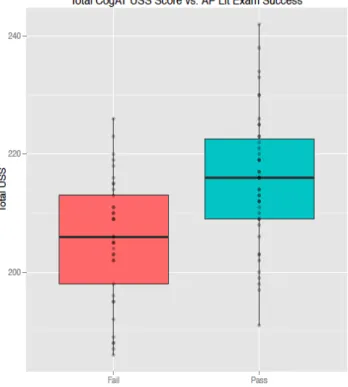
Figure 1. Assumption of normality for CogAT composite scores by AP English Literature exam success ...85 Figure 2. Boxplot visualization for CogAT composite scores by AP English Literature exam
success ...86 Figure 3. Assumption of normality for CogAT verbal battery scores by AP English Literature
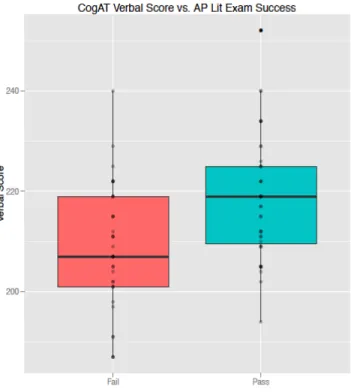
exam success ...87 Figure 4. Boxplot visualization of CogAT verbal battery scores by AP English Literature exam
success ...88 Figure 5. Assumption of normality for CogAT composite scores by AP Calculus exam
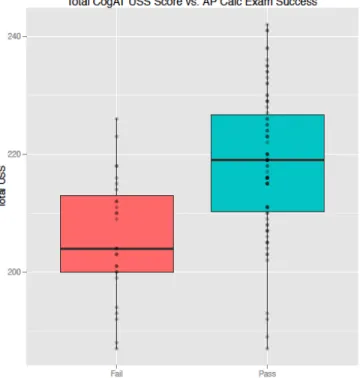
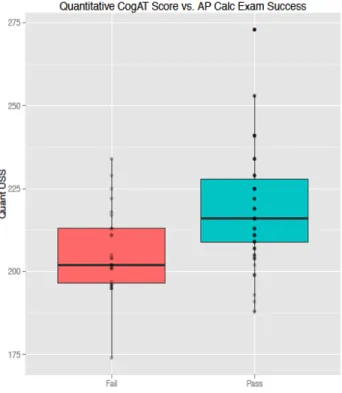
success ...94 Figure 6. Boxplot visualization for CogAT composite scores by AP Calculus exam success ...95 Figure 7. Assumption of normality for CogAT quantitative battery scores by AP Calculus exam
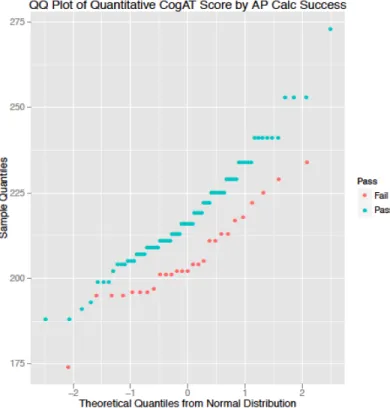
success ...96 Figure 8. Boxplot visualization for CogAT quantitative battery scores by AP Calculus exam
List of Abbreviations Advanced Placement (AP)
American College Test (ACT) Cognitive Abilities Test (CogAT)
Culturally, Linguistically, and Ethnically Diverse (CLED) Educational Testing Service (ETS)
Grade Point Average (GPA)
Helping Outstanding Pupils Educationally (HOPE) Institutional Review Board (IRB)
International Baccalaureate (IB)
National Association for College Admissions Counseling (NACAC) National Association for Gifted Children (NAGC)
Preliminary Scholastic Aptitude Test (PSAT) Scholastic Aptitude Test (SAT)
CHAPTER ONE: INTRODUCTION
The Advanced Placement (AP) program is an educational alternative that offers high ability students an opportunity to earn college credit while still in high school. Since the
program’s inception in the 1950s, it has grown to impact millions of students each year (College Board 2011c). The growing popularity of the program has generated a call for further research regarding various issues relating to AP; these problems include topics such as student
characteristics, enrollment criteria, program benefits, equity, predictors of success and other factors relating to function of AP in our educational system (Klugman, 2005; Kyburg, Hertberg-Davis, & Callahan, 2007; McBee, 2006; Peters & Mann, 2009; Yoon & Gentry, 2009). The perceived benefits of the AP program in recent years have led to a greater interest in the program from a more diverse group of students who are not necessarily gifted but who want to pursue higher education. These students are more nontraditional than those who typically are found in an advanced academic setting, based on previous AP enrollment patterns. Thus an important concern has become the continued inequity in the AP program, which has been acknowledged by the institution that administers the AP program, the College Board (College Board, 2010;
Wakelyn, 2009). One barrier to entry for nontraditional students is the use of AP as a gifted program delivery model in high schools (Hertberg-Davis & Callahan, 2008; Peters & Mann, 2009). If students do not meet eligibility requirements for being gifted identified, they are often not encouraged to take AP courses which are reserved for the gifted population. Standardized achievement and intelligence tests administered in early grades often serve as the basis for gifted identification programs and thus end up being an exclusionary element for the AP program. Examining the relationship between elements of the identification process and AP exam scores is an important springboard to discovering student characteristics indicative of future academic
success in AP courses. Identifying methods to determine potentially successful AP students while they are still in middle grades could aid in better preparation for nontraditional students to meet the challenge of a more rigorous curriculum and create greater equity in the AP program. Findings of this study could serve as a foundation for qualitative research leading to the
development of more appropriate identification methods to predict potential academic achievement.
Background
The importance of education has long been a tradition in our nation, beginning in the colonial period (Kennedy, Cohen, & Bailey, 2006). Over time, the importance of obtaining an education has only become more imperative, with the desire for a post secondary degree steadily increasing. The National Center for Educational Statistics noted that between 2000 and 2009 college matriculation across the nation increased by 34% from 13.2 million in 2000 to
approximately 17.6 million in 2009 with a projected increase to 19.6 million by 2020 (Taliaferro & DeCuir-Gunby, 2008). Ensuring that everyone has an equal opportunity for a higher
education has also become a critical issue. “Because education is perceived to be the great equalizer, the school environment must promote equity to realize equal opportunity as an outcome” (Taliaferro & DeCuir-Gunby, 2008, p. 160).
In 1900 to encourage higher education, the College Board Entrance Examination
Organization was formed with the intent of simplifying the admissions process for both colleges and students (College Board, 2011d). Current emphasis on higher education is noted at the national level where governmental policies are enacted that directly impact students, teachers, and other educational stakeholders. In the 2010 Reauthorization of the Elementary and Secondary Education Act, President Obama stated, “We will set a clear goal: Every student
should graduate from high school ready for college and a career, regardless of their income, race, ethnic or language background, or disability status” (U.S. Department of Education, 2010, p. 3). In recent years, the advantages of a college education have become even more important
(Danzier & Ratner, 2010). In 1973, males with a college education earned 33% more in entry level positions than those with a high school diploma or less. By 2007, the difference had risen to 79%. Similar findings were true for females as well, with a college education in 1973 yielding 52% more income and in 2007 yielding 92% more income (Danzier & Ratner, 2010). Because the education of our citizens impacts our society and economy, groups and organizations are often interested in sponsoring research concerning educational topics in the United States. The insurance company, Metropolitan Life, has sponsored educational research for 27 years in an effort to better utilize their grant funds. In the 2010 survey “Preparing Students for College and Careers,” 64% of the Fortune 1000 executives polled indicated their belief that the preparation for college and career requires the same readiness. Information from student surveys in the study indicated that the two subgroups of low-income and learning-challenged students placed the same importance on a college education but had lower aspirations and more concern about being adequately prepared for college (Metropolitan Life, 2010).
Methods of encouraging high school students to pursue higher education differ by state. In Georgia, where the current study took place, a new type of scholarship program was created in 1993. The Helping Outstanding Pupils Educationally (HOPE) scholarship was established to help students who have demonstrated academic ability to further their education by attending one of Georgia’s colleges, universities, or technical schools. The Georgia lottery funded program has awarded billions of dollars to millions of students as enrollment in Georgia colleges and
recipient numbers have risen from 42,796 utilizing $21.4 in 1993 to 256, 477 utilizing $748.1 million in 2010–11 (GAcollege411, 2011).
Currently, one of the most popular opportunities for high school students to experience college-level work is offered through the AP program. Beginning in 1955, the College Board furthered its commitment to higher education by acquiring the administration of the AP program as part of its goal to expand post secondary education access to high school seniors. Created by the Fund for the Advancement of Education, the AP program’s purpose was to encourage
students to complete college-level work while still in high school. Harvard, Princeton, and Yale, three of the nation’s most prestigious colleges, were a part of the initial study which culminated in the call for a process by which seniors could enter college with advanced standing college credit hours (College Board, 2003). As the program grew, it quickly became associated with high school students who were considered high ability or gifted as labeled by many school districts (Peters & Mann, 2009). In the 1990s, the AP program experienced a period of dramatic growth. Klopfenstein (2003) summarized the impetus for the growth as being due to increased competition in college admissions and promotion of higher education by states that have created incentive programs.
In the AP program today, students have an opportunity to earn college credit by taking a college-level course taught in their high school by teachers who must adhere to a College Board endorsed curriculum. At the end of the year, students take a standardized subject area test for which they could earn college credit, depending on their exam score and the policies of the college they will be attending (College Board, 2011b). Presently the AP program is the most popular high school delivery method for providing services for students who have been identified as gifted by school policy (Colangelo et al., 2010; Dixon, 2000; Herberg-Davis &
Callahan, 2008; Peters & Mann, 2009; Vanderbrook, 2006). Currently, numbers of minorities taking and succeeding in AP are increasing, but inequities still exist (College Board, 2010).
The growth of the AP program has stimulated both public speculation and scholarly research concerning its purported advantages for students, high schools, and universities. Public interest in the AP program’s meteoric rise is presented in The New York Times 2009 article “The Advanced Placement Juggernaut” (Gunther, 2009). For this article, The New York Times
contacted scholarly research authors along with a top official with the College Board for responses to questions reflecting the concerns of parents, teachers, and students about the AP program. The issues addressed in these interviews are indicative of the program’s status in recent years. In the article, the question of whether the AP program is utilized to benefit schools or benefit students is raised along with an inquiry concerning the possibility of negative program consequences for encouraging more diverse students to enroll in the rigorous courses (Gunther, 2009).
One of the interviewees Philip Sadler, director of the science education department at the Harvard-Smithsonian Center of Astrophysics, was also an editor of the 2010 book A Critical Examination of the Advanced Placement Program combining the works of multiple authors in regard to several elements of the AP program (Sadler, 2010). Calling the AP program a “juggernaut,” Sadler discusses the meteoric rise of AP and its impact (2010, p.3). The catchy reference is bolstered by data showing the growth of the AP program in recent years. Sadler explains the status of AP today by referencing changes in the program that are generating public interest, an interest that has lead some individuals to desire empirical research to support
common opinion. Fifty years ago the program served mainly highly gifted students at private high schools but now has expanded to include more nontraditional students who are not
identified as gifted. He describes the use of AP for high ability students today as a way to embellish transcripts while common opinion demonstrates the belief that the less privileged students can gain more equality in the pursuit of higher education (Gunther 2009
Kristin Klopfenstein, a researcher for the Texas Schools Project at the University of Texas and member of the Texas Christian University economics department, also served as an editor of the 2010 book A Critical Examination of Advanced Placement (Sadler, 2010). In her New York Times interview, she discusses the effect of AP on both students and schools. For schools, the AP program provides a measure for the general public to gauge the quality of the school (Gunther, 2009). Currently a formula to rank high schools uses the number of AP courses offered as a standard by which to judge the school (Morse, 2007). She notes AP courses are associated with increased rigor and thus provide more accountability for schools that seek to raise student expectations. For students, according to Klopfenstein, the AP program provides a means to demonstrate their academic ability and work ethic to prospective colleges (Gunther, 2009).
Saul Geiser, a research associate at the University of California, contributes to the article by pointing to the expansion of the AP program as a direct result of increased reliance of
universities on AP classes in their admissions decisions. Geiser takes issue with the practice of awarding bonus points to a student’s average in each AP course because this practice gives some students an unfair advantage. Minorities would be the ones at a disadvantage because they are underrepresented in AP programs (Gunther, 2009).
Problem Statement
Given the benefits of the AP program, it is important to ensure that all students have equal access to enrollment and equal opportunity to prepare for the challenge of a rigorous high
school curriculum that includes AP courses. A general problem in education is ensuring that all students are provided with educational opportunities that meet their needs. A more specific problem is the ability to identify students who could be successful in high school AP courses while these students are in middle school and can build the skills needed for success in a rigorous high school curriculum that includes AP courses. There is a lack of research addressing the identification of potentially successful AP students at an early point in their educational careers. As the most common service model for high ability students across the nation, the influence of AP is widespread and arbitrarily excluding students would be detrimental to their academic development (Peters & Mann, 2009). Peters and Mann (2009) indicate that requiring high performance on standardized tests and/or other assessments to limit participation in AP courses may prevent capable students from experiencing a more advanced level of instruction from which they may benefit academically.
An important issue in the AP program is inequity due to identification methods for gifted students that end up serving as a barrier to entry for the nontraditional student. Many methods of identification for high ability or gifted students use standardized testing as a part of the process (Gallagher, 2000). Examining standardized testing in middle grades as it compares to successful AP exam scores would yield useful information for curriculum planning and registration
advisement purposes. Identifying potentially successful students at an earlier point in their academic careers would allow for more appropriate curriculum choices to build the skills and knowledge students need to be successful in a more rigorous curriculum. The College Board recognizes the benefit of early preparation and has developed a scaffolding program for middle grades, the Springboard program, as a means to better prepare students for a rigorous curriculum, in high school. However, the only subjects that have been offered are English and mathematics
(College Board 2013c).
Using AP as a delivery model to meet the needs of students identified as gifted means that the gifted identification processes would have an impact on those students later allowed to enroll in AP courses. Yoon and Gentry (2009) call for further studies in the area of gifted program enrollment, addressing which students are being allowed into the programs and which curriculum delivery methods, such as AP, are being utilized. In spite of efforts to open the doors to AP barriers to the program have continued to exist (Wakelyn, 2009).
In a New York Times interview, Trevor Packer, the vice-president for the AP program at the College Board was questioned about the opportunity for students to enroll in AP. In regard to both schools and students, Packer’s response focused on the concern that schools are not giving qualified individuals the opportunity to enroll in AP courses (Gunther, 2009). Packer points to the problem of teacher preconceived ideas of who will be successful in these programs noting that it is often teacher opinion that leaves out minority students who have the same credentials as those who are easily allowed entry to the program (Gunther, 2009). A study by Taliaferro and DeCuir-Gunby (2008) supports Packer’s concern, suggesting that
African-Americans in particular are underrepresented in the AP program due to stereotypical viewpoints of teachers.
Purpose Statement
The purpose of this correlational study was to determine if a relationship exists between 6th grade CogAT composite, verbal, and quantitative battery scores and 12th grade AP English Literature and 12th grade AP Calculus exam pass-fail scores. For the study district, CogAT is given in 6th grade, while AP courses, which culminate in an AP exam, are offered in grades 9– 12. CogAT scores are reported as a continuous score while AP exam scores are categorical. For
this study, subjects could not be randomly assigned; rather AP student scores were divided into pass and fail groups. The pass group was based on scores usually accepted by most colleges and universities for awarding college credit; these were scores of 3, 4, or 5. The AP pass and fail groups were compared to previous testing achievement in CogAT. The AP exams selected for the study included two of those offered in the 12th grade: AP English Literature and AP
Calculus. A point biserial correlation was used to determine if a correlation existed between the variables, and a logistical regression was utilized to explore the predictive merit of CogAT scores for future AP success.
Theories that provided the foundation for this study included the following: theories of incremental intelligence (Dweck & Leggett, 1988), self-efficacy (Bandura, 1993), successful intelligence (Sternberg, 1999) and the three-ring model of giftedness (Renzulli, 2002). Examining these theories offered a possible basis for a relationship between middle school CogAT composite, verbal, and quantitative battery scores and high school Advanced Placement (AP) exam scores for students in a rural northeast Georgia school district. The first variable of interest was defined as a standardized norm referenced mental abilities test used in elementary and middle schools known as the CogAT. The second variable of interest was defined as the College Board created AP exams that are used in the determination for college credit (College Board, 2013a)
Significance of the Study
The significance of this study is to add to the body of knowledge concerning equity in the AP program and early identification of students who exhibit the potential for success in high school AP courses. Much information exists concerning the impact of the AP program
early identifiers and high ability students who could potentially be successful in AP courses. Currently, to identify students who have a high probably of being successful on AP exams, schools can use the College Board resource, AP Potential. This resource uses scores from the Preliminary Scholastic Aptitude Test (PSAT). Research has shown a moderate to strong
correlation between PSAT and AP exam scores for prediction of success in various subject areas (Ewing, Camara, & Millsap, 2006; Ewing, Camara, Millsap, & Milewski, 2007). Vaughn (2010) addressed the role of the PSAT as an identifier in a study concerning AP course taking in an urban district indicating that “…future analyses in this district and others needs to link students identified by means of PSAT scores and other measures with performance on AP exams” (p. 404). In the district for the study, the PSAT is generally given in 10th grade and does not allow for an early identification of students who could potentially be successful on AP exams.
Researchers are calling for additional studies to further explore the relationship between AP programs and various groups and types of students (Klugman, 2005; Kyburg et al., 2007; McBee, 2006; Peters & Mann, 2009; Yoon & Gentry, 2009). Lohman (2006) suggested the need for further research concerning testing for gifted identification, particularly longitudinal ones that include multiple testing and all types of students, stating that following learners over time could lead to additional information concerning how academic excellence is developed.
The current study contributed information to a gap in the literature concerning equity in the AP program and early identification of potentially successful AP students. Successful AP students are considered to be those that score a 3, 4, or 5, on a scale of 1 to 5, since these scores are accepted by most colleges for awarding college credit hours (Atkinson & Geiser, 2009; Chajewski et al., 2011; College Board, 2011b). The College Board uses the following scale to rank student performance on AP exams: 1 indicates “no recommendation,” 2 indicates “possibly
qualified,” 3 indicates “qualified,” 4 indicates “qualified,” 5 indicates “extremely well-qualified.”
As studies contribute information concerning successful AP students, researchers can begin to look for commonalities that will lead to earlier identification and better preparation of students hoping to be successful in the AP program. Since many students who enroll in these courses are not prepared (Winnebrenner, 2006), early identification of potentially successful students would allow them the opportunity to pursue a course of study leading to development of the skills and knowledge needed to experience success in the AP program and accrue the benefits that are purported to be associated with the successful performance on AP exams. As a rural school with limited AP offerings, the information gathered can be effectively used to benefit numerous educational stakeholders by yielding information that would enable the school district to assist students in planning for academic experiences that best match their intellectual needs, interests, and career plans.
Research Questions
This correlational study sought to investigate a relationship between two variables, Cognitive Abilities Test (CogAT) and Advanced Placement (AP) exams. CogAT is a
standardized norm-referenced mental abilities test (Lohman & Renzulli, 2007). AP exams are those taken at the end of an AP course and are used in the determination of possible college credit (College Board, 2012). Research has shown future academic benefits for students who are successful on AP exams. Success is considered as a score 3, 4, or 5 since most college accept these scores for awarding college credit hours (Atkinson & Geiser, 2009; Chajewski et al., 2011; College Board, 2011b). Gathering information on indicators of potentially successful AP
attending college. Examining not only the composite score, but also the verbal and quantitative battery scores in relation to AP exam scores would yield additional information on a possible relationship between the two assessments. Lohman and Lakin (2011) note that “Tests that measure both the general and specific abilities required for learning in a particular domain better predict later performance in that domain” (p. 595). Verbal reasoning skills are important for vocabulary building and reading comprehension while quantitative reasoning relies on
mathematical problem solving (Lohman & Lakin, 2011). Lohman and Renzulli (2007) suggest that the CogAT individual test batteries along with appropriate achievement scores are the best predictors of academic success in specific domains. Domains such as social studies and literature would be associated with the CogAT verbal battery score and domains relating to mathematics with the CogAT quantitative and nonverbal batteries (Lohman & Renzulli, 2007).
The following questions guided the research study:
RQ1: Is there a correlation between 6th grade CogAT composite scores and 12th grade AP English Literature exam pass-fail scores?
RQ2: Is there a correlation between 6th grade CogAT verbal battery scores and 12th grade AP English Literature exam pass-fail scores?
RQ3: Is there a correlation between increases in 6th grade CogAT composite scores and increases in 12th grade AP English Literature exam pass-fail scores?
RQ4: Is there a correlation between increases in 6th grade CogAT verbal battery scores and increases in 12th grade AP English Literature exam pass-fail scores?
RQ5: Is there a correlation between 6th grade CogAT composite scores and 12th grade AP Calculus exam pass-fail scores?
grade AP Calculus exam pass-fail scores?
RQ7: Is there a correlation between increases in 6th grade CogAT composite scores and increases in 12th grade AP Calculus exam pass-fail scores?
RQ8: Is there a correlation between increases in 6th grade CogAT quantitative battery scores and increases in 12th grade AP Calculus exam pass-fail scores?
Null Hypotheses
H01: There is no significant correlation between 6th grade CogAT composite scores and 12th grade AP English Literature exam pass-fail scores.
H02: There is no significant correlation between 6th grade CogAT verbal battery scores and 12th grade AP English Literature exam pass-fail scores.
H03: There is no significant correlation between increases in 6th grade CogAT composite scores and increases in 12th grade AP English Literature exam pass-fail scores.
H04: There is no significant correlation between increases in 6th grade CogAT verbal battery scores and increases in 12th grade AP English Literature exam pass-fail scores.
H05: There is no significant correlation between 6th grade CogAT composite scores and 12th grade AP Calculus exam pass-fail scores.
H06: There is no significant correlation between 6th grade CogAT quantitative battery scores and 12th grade AP Calculus exam pass-fail scores.
H07: There is no significant correlation between increases in 6th grade CogAT composite scores and increases in 12th grade AP Calculus exam pass-fail scores.
H08: There is no significant correlation between increases in 6th grade CogAT quantitative battery scores and increases in 12th grade AP Calculus exam pass-fail scores.
Identification of Variables Variables of interest include the following:
1. CogAT. A group administered mental abilities test battery used to assess abilities in reasoning and problem solving. The test includes verbal, quantitative, and nonverbal batteries along with a composite score as a combination of the three. Validity measures support the use of CogAT for the identification of high ability students (Lohman, Korb, & Lakin, 2008).
2. AP Exam. The AP exam is the College Board standardized examination, given in May of each year for 37 different subject areas. These exams allow students the opportunity to earn college credit for courses taken while attending high school. Students earning a 3, 4, or 5 on the exam may receive college credit from the college or university they will attend based on that institution’s AP credit acceptance guidelines. Most institutions award college credit for a 3 or better performance on the exam (College Board, 2011b).
Definitions of Key Terms
1. College Board. College Board refers to a non-profit member organization formed in
1900 as the College Entrance Examination Board. Functions of the College Board include test development and administration, educational services, and material related to the college admission process (College Board, 2011a).
2. Advanced Placement. The Advanced Placement program is under the College Board
umbrella and consists of a variety of high school subjects that offer a college-level curriculum and an opportunity to obtain college credit. AP refers to the copyrighted College Board title of Advanced Placement (College Board, 2003).
3. Gifted. In the state of Georgia, gifted identified students refer to those who have been
must have excelled in a combination of the given categories: intellectual ability, creativity, motivation, and/or academic achievement. Gifted identified students need special instruction or ancillary services to provide instruction appropriate for their ability levels. Georgia law
mandates services for the gifted (Georgia Department of Education, 2012).
4. Nontraditional students. Nontraditional students refer to those students enrolling in
AP courses who do not posses the common characteristics of a student typically enrolling in AP classes. These students usually include minorities and lower socioeconomic status (SES) students and are generally not identified as gifted by school policy criteria (College Board, 2010).
CHAPTER TWO: REVIEW OF THE LITERATURE
The review of the literature included searches in academic databases with combinations of the following key words: AP, college outcomes, gifted identification, gifted delivery model, inequity, criticisms, advantages, minorities, predictors of success, CogAT, and College Board. Results produced a plethora of articles, many of which were unrelated to the study topic. The selection of the peer reviewed scholarly articles used was based on relevance to the specific study topic. Little research was available on CogAT and in particular its use in predicting future academic success. Also lacking were studies on factors influencing success in AP courses.
Chapter 2 includes a discussion of theories that impact the identification of gifted
students and the premise underlying achievement for high ability students. The history of the AP program and its recent expansion that has been supported at both the state and federal level is discussed. The impact of popular media on parent and student perception of AP courses is documented. A review of College Board sponsored research shows that one of the primary benefits for AP participation is improved college performance for those achieving a successful score on AP exams (Atkinson & Geiser, 2009). Although independent research studies vary in their support of specific College Board claims, the general consensus is that AP is a beneficial program (Sadler, 2010). The role of gifted identification processes on AP enrollment is explained with standardized testing being a primary element in the procedures for the district being studied. The College Board notes that inequity still exists in both gifted and AP programs (College Board, 2010). The need for better preparation for the more nontraditional student is noted (Winnebrenner, 2006).
Theoretical Framework
theme for a number of theorists investigating indicators of academic success (Bandura, 1977; Bandura, 1993; Bandura & Wood, 1989; Dweck, 1986; Dweck, 2000; Dweck, 2009; Dweck & Legget, 1988; Renzulli, 2002; Sternberg, 1999; Sternberg, 2003). Seeking to determine those students who can potentially be successful in academically challenging courses can allow a more appropriate curriculum selection for them at an earlier age leading to improved preparation for such courses.
Dweck
Individuals who believe their ability to succeed academically is based on traits that can be influenced follow an incrementalist viewpoint. Carol Dweck’s early research sought to answer the question of what determines a student’s ability to persevere toward academic success when presented with challenging situations (Dweck, 1986; Dweck & Legget, 1988). Higher self-efficacy was found to predict improved performance when faced with challenges (Dweck & Leggett, 1988). As research continued, the concept of an incremental intelligence was explored, and the original question was soon applied to education in the area of motivation and behavior (Dweck, 2000). The resulting theory, implicit theory, encompasses the idea of both an entity and incremental viewpoint. With an entity perspective, an individual believes that psychological characteristics such as intelligence are fixed traits. On the other hand, those who believe in the incremental perspective believe that such traits are malleable (Dweck, 2009). Reliance on early gifted identification by standardized testing indicates an entity perspective in that the concept of giftedness is a fixed rather than malleable trait. Once students are identified as gifted, they are assumed to be gifted the rest of their academic career, and thus are able to maintain access to the available gifted curriculum. Findings from Ahmavaara and Houston (2007) suggest that students could be influenced by the results of a selection test, which if failed could lead to a belief that
intelligence is fixed. Bandura
Feelings of self-efficacy have been related to achievement (Bandura, 1993, Dweck & Leggett, 1988). In Bandura’s theory of self-efficacy, an individual’s motivation deals with the activation and persistence of a particular behavior that has a basis in cognitive activities. An individual's self-efficacy will determine the choice of activities with which to be involved; moreover, how much effort is expended is directly influenced by the degree of self-efficacy. The expectation of eventual success will influence the use of coping strategies to deal with obstacles or adverse situations, once involved in an activity (Bandura, 1977). Bandura and Wood’s (1989) study on complex learning and decision making found that those who felt their ability was based on inherent abilities showed a progressive decline in performance when met with challenging tasks. On the other hand, those who believed their performance would be based on acquired skill continued to work with diligence when presented with complex tasks. If traits can be influenced, a student’s standardized test scores may not be a good predictor of future academic success. The general expectation that gifted students have the greatest potential to excel in AP courses is evidenced by the fact that many schools use this as their primary delivery model for gifted instruction, which creates barriers for more nontraditional student entry into AP courses
(Hertberg-Davis & Callahan, 2008). In Georgia, gifted identification methods can include use of standardized testing as a primary piece of identification (Georgia Department of Education, 2012) suggesting a belief in performance based on inherent ability rather than acquired ability. For the study district, CogAT is generally used as one element of the gifted identification process.
Sternberg
Evaluations of individual competencies for various reasons is a common practice in our society; whether it is hiring, college admissions, elections to an office, admission to a particular class or any situation which calls for an elimination of some and an acceptance of others. Many of these evaluations are informal rather than formal and include some evaluation of intelligence (Sternberg, 2003). Sternberg (1999) challenged the commonly accepted intelligence theories that posited a general factor of intelligence underlying all adaptive behavior and suggested, instead, a theory of successful intelligence. Sternberg (1999) countered with the idea that intelligence operationalized as performance on an intelligence test is limited. Expansion of the concept of intelligence should include not only analytical and memory abilities, but also both practical and creative elements as well. Sternberg argues that it is not that conventional testing is invalid but that it not inclusive enough for a true prediction of an individual's intelligence. A belief in Sternberg’s theory would make it incumbent on our school leaders to provide opportunities for any students who express an interest in pursuing a rigorous curriculum. Renzulli
Renzulli, a leading authority in the area of giftedness, has developed one of the most relevant and well-known theories relating to advanced learners (Knobel & Shaughnessy, 2002). Renzulli’s three ring conception theory of giftedness involves the identification of giftedness through the recognition of specific traits possessed by successful individuals. Renzulli’s
research has demonstrated the existence of creativity, above average ability, and commitment to a task for individuals who have demonstrated accomplishment. However, Renzulli cautions that it is not appropriate to use any of these as single criteria for gifted identification (Renzulli, 2002).
Board should not be feared but rather embraced by AP educators. School districts that want to ensure equity in AP should pursue better preparation for a more diverse group of students, not just those labeled as gifted, and should endeavor to consider alternate methods of assessing for academic placement and curriculum selections.
Review of the Literature History of the AP Program
Following WWII, a sentiment developed to promote higher education for increased numbers of students. In response, the Ford Foundation along with three of our nation’s most prestigious universities, Princeton, Harvard, and Yale, led an endeavor to promote a more rigorous high school curriculum. By 1955, the program was initiated and the College Board came on as administrator naming the program the College Board Advanced Placement Program (AP) and targeting high ability students for participation. Growth of the program was steady with the 1990s seeing increased expansion in both AP and new programs related to the support of better preparing students for AP (College Board, 2003).
The AP program today influences millions of students each year and is perceived as providing benefits above simply earning college credit or placement (College Board, 2011c). The program is pervasive with over 90% of 4-year colleges in the U.S. and colleges in other countries maintaining policies referring to AP score acceptance and stating the qualifying scores to earn the student college credit, placement, or both (College Board, 2011c). With only 1,299 students participating in the first year (Willingham & Morris, 1986), the program has recently experienced phenomenal growth. In 2010, the program administered more than 3.2 million exams to high school students across the nation (College Board, 2011e). Coinciding with the AP expansion, the creation of the HOPE scholarship in the state of Georgia in 1993 allowed
increased numbers of students the financial ability to attend college (Cornwell, Mustard, & Sridhar, 2006). As a college readiness culture was being encouraged, the AP program gained funding from both state and national levels of government in support of the program’s goal of increased rigor for high school students.
State and Federal AP Support
The AP program has undergone substantial expansion since its inception in 1955, particularly in the 1990s (Keng & Dodd, 2008; Klopfenstein, 2003). The program has
increasingly garnered government support from both the federal and state levels. In the 2001 No Child Left Behind Act, support for AP was addressed through the AP Incentive Program (NCLB, 2001). In the incentive program, federal funding was offered to states that met criteria set forth by the federal government with those funds being utilized to encourage state expansion of AP programs and increase student participation (Holstead, Spradlin, McGillivray, & Burroughs, 2010). At the state level, in 2005, the National Governors’ Association Center for Best Practices launched a six state initiative called the Advanced Placement Expansion Program. This program focused on increasing participation for low-income and minority students and included the following states: Alabama, Georgia, Kentucky, Maine, Nevada, and Wisconsin (Holstead et al., 2010; Wakelyn, 2009).
Continued national support for expansion of the AP program came in 2004 when addressed as a goal in President Bush’s State of the Union Address. The 21st Century Jobs measures would include an expansion of AP in low-income schools along with larger Pell grants for those students choosing to pursue a more rigorous high school curriculum in anticipation of attending college (Bush, 2004). With federal and state support and encouragement, AP began to expand and a more diverse group of students began enrolling. The influx of nontraditional
students in the AP program led researchers to examine the effect of this enrollment. The first national survey of AP teachers was conducted with a sample of 1,024 teachers. Quantitative data was supplemented by qualitative information resulting from the inclusion of four focus groups in the states of Maryland, Utah, Wisconsin, and Texas. Findings indicated that while teachers remained pleased with the curriculum of the program, concerns existed about the impact of the expansion in other areas. With 52% of teachers stating that they would prefer to limit the program to the most able students, there was a clear concern for how students perform in AP courses. While the percentage of students achieving a score of 3 or above on all exams dropped from 62% to 58%, there was not a clear indication of the academic impact. Ninety percent of AP teachers stated their belief that the driving force behind the increased expansion had no
relationship to academic aspiration of students but rather a desire to create a better transcript and be more competitive for college admissions (Farkas & Duffet, 2009). More recently, the Obama administration has provided funding allocated to promote increased rigor in high schools, with AP being a possible alternative to achieve this goal (U.S. Department of Education, 2010). AP Participation
Advertised by popular media and fueled by an educational movement to increase college readiness, the AP program has expanded, which is indicative of the fact that students perceive they are receiving benefits from taking the courses. The College Board website states that benefits of the AP program include not only the possibility of college credit or placement, but also the opportunities to be more competitive in the admissions process and to acquire skills needed in order to be successful in college. Additionally, AP students are more likely to obtain a college degree in four years, thus obtaining a significant financial savings (College Board, 2011c). In recent years, an ongoing factor fueling the growth and popularity of AP courses in
the high school curriculum has been students’ demand based on their assumption that AP courses will provide benefits for future academic pursuits. Increasing numbers of today’s youth realize the need to pursue a higher education, and educational policies are encouraging more students to enroll in college. In response to growing numbers of applicants, colleges and universities have begun placing a greater emphasis on course rigor in their admission decisions process with AP classes being recognized as an indicator of rigor (Kyburn et al., 2007; Taliaferro & DeCuir-Gunby, 2008). With increased competition for admissions, students have begun enrolling in AP classes to create a high school transcript that will improve their likelihood of being chosen by the college of their choice (Santoli, 2002; Santos, Cabrera, & Fosnacht, 2010). High school
programs responding to state and college policies that encourage an open door to AP are
encountering a more diverse population of students. These increasing numbers of nontraditional students entering the program are those individuals that typically do not enroll in accelerated courses (College Board, 2010). These students did not follow an accelerated track as a basis for taking their high school courses and, therefore, lack a sound foundation in preparation for advanced courses (Winnebrenner, 2006).
Thus, the contentious dichotomy in AP centers on whether to have open access or to make enrollment dependent on specific criteria. Enrolling the more nontraditional student requires a greater emphasis on better preparing the student for rigorous courses to which they are unaccustomed. Concern about this new enrollment is evidenced by teachers’ responses to surveys; in one study, 52% of teachers stated that only qualified students should be allowed to take AP courses. Teachers in the same study asserted that allowing unprepared students to enroll in the course would detract from the quality of the program and, thus, would not be fair to
improvement, 63% of teachers specified that a screening process should be in place to make sure students were prepared to take the course (Farkas & Duffett, 2009).
Recent data concerning AP participation was released in the 9th annual College Board Report to the Nation for 2012. Statistics showed that 954,070 high school graduates had taken at least one AP exam with 573,472 scoring a 3 or higher on at least one AP exam. Comparing the 2012 data to the 2002 numbers of 471,404 and 305,098, respectively, shows the increasing expansion of the AP program. The numbers of graduates having attained at least a score of 3 on one exam translate into 19.5% of our nations students who attained this benchmark success. Georgia ranked in the top ten states having increased the numbers of students scoring a 3 or above on one exam by 10.1%. The top ranking state, Maryland, achieved a 13.1% increase. Despite the progress made in increasing enrollment numbers and success, low income and minority students remain underrepresented in the AP program; therefore, states need to increase efforts to identify and better prepare students for the AP classroom (College Board, 2013a). AP in the Public Media
Education is an important issue in our nation, and the media figures prominently in shaping and influencing popular opinion. Although these information sources generally do not use information based on scholarly studies, they have been very influential for the general public. Indicative of the prominence of the AP program, Jay Mathews, columnist at the Washington Post, has been ranking the most challenging schools for 15 years using a formula that takes the total number of AP and International Baccalaureate (IB) course tests offered by a school and divides this number by the total number of seniors graduating at the year’s end. This formula, the Challenge Index, was invented by Mathews in 1998 and addressed the expansion and importance of the AP program in the nation. The list ranks public schools across the nation,
including public charter schools, and provides a quality score for schools, regardless of AP exam grades. Mathews indicated that he did not include the number of students making a score of 3 or above in his formula because many schools only allow the brighter students to take AP or allow all to take the course but encourage only the brightest to take the exams. However, Mathews did include another piece of data reported on this list, which accounts for the success of the schools based on numbers of students scoring a 3 or better. This metric called Equity and Excellence calculates the percent of seniors who have earned a score of 3 on at least one exam during their high school careers. Earning a 3 on the exam is considered the standard of success because most colleges will award credit for a 3 or above. For 2012, the average success rate was 19.5. The data is used to highlight how well schools have performed in encouraging the average student to participate in advanced courses. A separate list entitled Public Elites records public charter schools or any others that only draw from top students. Schools whose population of students exceeds average Scholastic Aptitude Test (SAT) or American College Test (ACT) score for normal enrollment are not included. The data also includes information related to subsidized lunches to address the issue of equity in AP courses (Mathews, 2013).
In response to Mathew’s Challenge Index, U.S. News and World Report commissioned American Institutes for Research to develop a formula that included a more in-depth look at various criteria to evaluate America’s high schools (Morse, 2007). Although including various other criteria, their formula also included an emphasis on using AP as a means to rank schools, including participation and performance in AP and IB as measures of a school’s ability to produce college-ready students (Duhon, Kurki, Chen, & Noel, 2013). These formulas are only two examples of how AP is used to evaluate schools and how popular media can influence the American public. The AP program is a very conspicuous part of our educational system today,
which is why so many aspects of the program have elicited controversy and generated both public debate and scholarly research.
Importance of Academic Rigor
In the current educational climate, the issue of college readiness is critical, and AP is seen as the standard of rigor in high schools in pursuit of better preparing students for college (Sadler, 2010). Findings from scholarly research support the benefits of a more rigorous high school curriculum for most students (Adelmen, 2006; Long, Conger, & Iatarola, 2012). Adelmen’s (2006) study replicates a 1999 study from the National Center for Educational Statistics
concerning the effect of curriculum on college performance. The 1999 study included data from the graduating class of 1992. A change in the most recent study was the addition of criteria for the highest level of math, core lab sciences, and AP course work as indicators of rigor. Adelmen (2006) suggested that positive findings from both of these studies make an important statement about raising rigor and expectations for high school students. He indicated that stakeholders in the educational process would benefit from consideration of these study results and their support of academically preparing larger numbers of students through a rigorous curriculum. Although Adelman’s study promotes a rigorous curriculum and even includes AP as one example, he does not advocate the course in particular as a means to achieve the goal.
Long et al. (2012) demonstrate the advantages of a rigorous curriculum and the impact on college outcomes. General findings from their study include an increase in 4-year college
enrollment by 7% to 11% for those who move from taking no rigorous courses to taking at least one rigorous course in the first two years of high school. If a student enrolls in a rigorous course in any of the four years of high school, the likelihood of college attendance increases by 5% to 6%. Most relationships found in the study remain the same across all demographic groups. This
study presents strong evidence for the benefits of a rigorous curriculum and adds support for government polices that advocate educational reform that includes increased rigor through an enhanced curriculum for all students.
AP as a Standard of Rigor
The AP program has been identified as a standard of rigor in high school curriculums (Chajewski et al., 2011; Sadler, 2010). In fact, the most common methods that high schools used to meet the challenge of providing a rigorous curriculum included honors courses, AP courses, or dual enrollment. Sadler (2010) examined AP courses in relation to honors courses. The study included a compilation of surveys from 7,491 students enrolled in introductory science courses in 55 different 4-year colleges and examined course characteristics of regular and honors versus AP. Sadler found the following sequence when students were asked to rank courses from less difficult to most difficult: regular, honors, and AP. AP science courses were considered more demanding by students who put in approximately 26% more time for honors class work and 54% for AP. Sadler’s characterization of students in AP concluded with a suggestion that studies should move away from comparing AP and non-AP students to determine course effects (Sadler, 2010).
Examining the impact of school level contextual factors on student achievement, with AP exam scores as a measure of school performance, Burney’s (2010) findings demonstrated
support for Adelmen’s (2006) call for a rigorous curriculum. School level factors such as school size, senior class size, and general ability were not related to performance; however, the number of AP course offerings was related to student achievement. As a school level factor, lack of access to AP courses contributes to the underrepresentation of minorities in AP (Barnard-Brak, McGaha-Garnett, & Burley, 2011; Ford & Whiting, 2009). Studies such as Adelmen (2006) and
Burney (2010) give credence to government supported initiatives promoting a more rigorous high school curriculum. Most recently, federal initiatives under President Obama have included federal funds to promote rigor in high schools with AP noted as a possible avenue of
implementation (U.S Department of Education, 2010). College Board Research
One of the most important questions in education contemplates how schools should prepare students to meet the challenge of higher education. With rigor being recognized as a means to develop college ready students, the College Board suggests that AP is the answer. The College Board website lists benefits of the AP program as possible college credit, competitive admissions transcript, earlier degree completion, and financial savings (College Board, 2011c). Of these various benefits, one of the most discussed and debated areas deals with AP and college outcomes. As the administrator of the AP program, the College Board provides scholarly
research supporting a connection between AP and college performance. Most of the College Board studies that deal with effectiveness of the program as it relates to higher education have been conducted since the AP expansion in the 1990s and have addressed more complex
comparisons of student groups matching academics for comparison groups. These studies have also included a greater variety of comparison groups and subject areas with overall findings supporting a relationship between AP and college success (Dodd, Fitzpatrick, De Ayala, & Jennings, 2002; Hargrove, Godin, & Dodd, 2008; Morgan & Klaric, 2007; Patterson & Ewing, 2013) specifically for those scoring a 3 or higher on the exam (Dodd et al., 2002; Keng & Dodd, 2008; Mattern, Shaw, & Xiong, 2009; Murphy & Dodd, 2009; Patterson & Ewing, 2013).
AP and college outcomes. In general, students that participate in AP, and especially those that are successful on the AP exam as defined by a score of 3, 4, or 5, have been shown to
have better academic performance in college (Dodd et al., 2002; Mattern et al., 2009; Morgan & Klaric, 2007; Murphy & Dodd, 2009; Patterson, Packman, & Kobrin, 2011), and, moreover, this positive relationship exists across socioeconomic (SES) factors (Hargrove et al., 2008). In response to a concern by college professors that students within the 3 score range did not perform consistently well in subsequent courses, a College Board research study in 2002 was conducted to determine if there was a need for gradations with the 1 through 5 scores range for all AP exams. The study provided data to support better academic performance in college for both students who are successful on the AP exams and for AP versus non-AP students. To increase validity, the comparison with non-AP groups equated the groups using SAT and grade point average (GPA). Scores within the 3 range were examined to determine any effect resulting from gradation within the 3 scores. No significant difference was found for any gradation of the 3 scores or for comparison of high 2s and low 4s with any of the scores in the 3 range (Dodd et al., 2002).
A 2007 College Board research study addressing the performance of AP students in college compared students who had taken at least one AP exam to non-AP students and found that for most subjects, AP students (a) had higher averages in intermediate courses than non-AP students in introductory courses, (b) had a greater probability of graduating, and (c) tended to graduate earlier. Strengths of this study included large sample size and controls for SAT scores while limitations included not addressing SES characteristics (Morgan & Klaric, 2007).
An advantage of AP research has been the availability of large sample sizes. Mattern et al. (2009) conducted one of the largest AP sample sizes studied consisting of 196,364 students representing 110 colleges and universities across the nation. Data from the SAT Validity Study database was cross-referenced to include additional controls for SAT scores. Results from AP
courses including English Language, Biology, Calculus AB, and U.S. History were examined in the study. For the subjects studied, student scores of 3 or above on exams corresponded with three elements: (a) higher first year GPAs, (b) higher second year rate retention, and (c)
matriculation at more selective higher education institutions. The effects continued even when controlling for SAT scores although the effect size was smaller. While exam scores of 1 and 2 did not correspond with higher first year averages as compared to non-AP groups, there was a correspondence to second year retention and exclusivity of institution attended. Positive contributions of this study included a control for SAT scores and subject size leading to greater ability to generalize findings (Mattern et al., 2009).
Further research, Keng and Dodd (2008), has examined the success of the AP program by comparing college outcomes for four different groups of students for 10 different AP subject exams. These groups included the following: (1) an AP credit group which consisted of students who took the exam and received college credit (2) an AP no credit group which consisted of students who took the exam and did not receive college credit (3) a concurrent group which consisted of students who enrolled in an the corresponding college course rather than taking the AP exam, and (4) a non-AP group that did not take an AP exam and did not enroll in a college course but who were matched with the AP credit group in terms of academic ability, high school rank, and SAT/ACT score. Study findings showed that the concurrent and AP credit groups outperformed the non-AP and AP no credit groups. Moreover, AP students who had earned college credit consistently outperformed the comparison groups. The concurrent group had more hours credit but their GPA was no higher. In comparison to the AP no credit group, the non-AP group was more proficient. However this was not surprising since the non-AP group was matched with the AP credit group on academic characteristics (Keng & Dodd, 2008).
The complexity of investigating the AP impact has been recognized by the College Board, which has sponsored research that includes a greater number of variables having the potential to influence AP programs. Murphy and Dodd (2009) compared college performance of three AP groups in 10 different subjects: (a) AP students earning college credit, (b) AP students taking the exam but not earning college credit, and (c) AP students earning course credit but electing to take an introductory course anyway. Matching these groups with non-AP groups on high school GPA and SAT scores accounted for academic differences. Additional research questions added three matched research groups already enrolled in college in the same areas as the AP subjects. Although effect sizes varied, overall findings for the AP and non-AP
comparison indicated that AP student groups outperformed non-AP groups. For the 10 subjects, AP students had higher first year GPAs in the subject area of the exam they had taken. For five subject areas, AP students had a higher GPA overall not just in the subject area of the test taken. Credit earning AP students had higher first year GPAs than those not earning credit. For the comparison of AP with students enrolled in college courses, the effect was not as strong. Due to subject numbers, the sample size was smaller and GPA elements were eliminated and may have affected the outcome. Thus, the researchers suggest further studies in the area of comparisons to students enrolled in college courses (Murphy & Dodd, 2009).
AP and socioeconomic status (SES). As more nontraditional students have enrolled in AP, more attention has been focused on SES factors. To address this issue the College Board sponsored a 2008 study that included these factors. Findings from five subjects indicated that, overall, when controlling for SAT and family income, students taking both the course and exam significantly outperformed those taking the AP course only, or dual enrollment only. In general, results remained true even when gender and ethnicity were considered (Hargrove et al., 2008).
Addressing weaknesses in earlier studies, more recent College Board research from Patterson et el. (2011) included variables not previously considered. Utilizing data from a larger number of institutions increased the strength of the study, as did inclusion of matching for SAT and GPA. Other factors also considered were ethnicity, gender, parental education, high school demographics, and college demographics. Student characteristics were determined from the SAT questionnaire and included a sample size of 195,099 students entering their freshmen year in 2006. Cross-classified, multi-level modeling was utilized to account for variance in high school and college characteristics. Within the nine subject areas, ethnic groups performed lower than Caucasians in GPA with mixed results by subject and ethnic group. Significant effects were found for both demographics and parent education, and GPA showed a stronger relationship across all nine subjects. The relationship with SAT varied by subject. Across all nine subjects, the mean AP exam performance was a stronger predictor of GPA. For seven of the nine
subjects, students earning a 3 outperformed the reference group. For four of the nine groups, students earning a 2 outperformed the reference groups as well. Despite the controls and complex group configurations of this study, limitations included not being able to consider AP students who only participated in the course and did not take an exam, difficulty separating courses taken in subject areas and AP course work, and corresponding the GPA within disciplines (Patterson et al., 2011).
Paralleling the change in student demographics, College Board studies concerning AP have continued to encompass additional variables potentially affecting college outcomes. With intent to address preexisting characteristics, the use of propensity scores to match preexisting characteristics strengthened a 2013 study (Patterson & Ewing, 2013). Gender and ethnicity were also considered along with covariates GPA and PSAT. New covariates included academic