4291
GREEN SD ADOPTION USING KNOWLEDGE MANGEMENT
FACILITATION – A MOTIVATIONAL PERSPECTIVE
1MCXIN TEE, 2RUSLI ABDULLAH, 3JAMILAH DIN, 4SALFARINA ABDULLAH, 5LIMING WU
1,2,3,4 Department of Software Engineering and Information System, Faculty of Computer Science and
Information Technology, University Putra Malaysia (UPM), Serdang 43400 Selangor, Malaysia 5 College of Management, HeBei University, BaoDing 071002, China
E-mail: 1[email protected]
ABSTRACT
Attention on green computing has been growing in this decade. Green computing is generally a large field of study which is concerning study of related environmental issues on information technology (IT) and computer science relevant systems, datacenters, hardware, networks, processes, software, and architectures. Several existing researcher papers have concentrated on studying motivating factors of green computing adoption. A few of them have discovered tools to facilitate the green computing adoption. However, green computing is still a broad discipline of study. There is a need for empirical research that narrows down this field of study. Thus, this paper empirically and specifically studies on motivating factors that influencing the Green Software Development (Green SD) adoption by using Knowledge Management (KM) as facilitation tool. Green SD is one of the in-depth research topics in the broad discipline of green computing. Drawing from existing literature and using data collected from a quantitative survey of 107 software practitioners, this paper analyzed five hypotheses. PLS-SEM method was used to validate the proposed framework of this research paper, by following standard two-steps approach for PLS-SEM analysis: measurement model analysis and structural model analysis. The result shows that only ethical motivation is the significant motivating factor influences Green SD adoption among software practitioners. This paper proves that intention of software practitioners to develop nature-friendly software products is driven by their environmental concerns, sense of care and responsibility to our natural environment. Outcomes of this paper will help in enhancing researchers’ understanding on Green SD adoption and will also be valuable for diverse stakeholders who are interested in encouraging Green SD adoption. SD organizations and top management need to properly utilize their workers’ morale and concern on ecological issues for identifying green innovation and green initiatives. Theoretical and practical contributions are discussed in this paper.
Keywords: Green Software Development, Adoption, Motivating Factor, Intention, Ecological Sustainability
1. INTRODUCTION
The ecological related issue has been a specific topic interest to numerous stakeholders and it is supported by worldwide media and environmental associations [1,2]. Moreover, United Nations has introduced a state-of-the-art UN development agenda: Sustainable Development Goals that strongly demands all parties in the Earth to work together in saving our natural environment [3].
The discipline of information technology (IT) and computer science has been responding to the global ecological movement because production, use and disposal of the technologies have caused various environmental impacts to our
mother Earth [4]. A study done by [5] has presented a prediction that total carbon footprint in the discipline of IT and computer science will be being increased by around 70%, and total energy consumption in the same discipline will be being increased by almost 60% between year 2007 and year 2020. Therefore, a move to change our mind for being green is a must for today.
ISSN: www.jatit.org E-ISSN:
4292 impacts by using the IT and computer science resources efficiently and effectively with minimal negative outcome to our natural environment [7,8]. The published green computing research papers were mostly regarding hardware such as optimal power management [9] and green datacenter’s architecture design [10]. Besides that, several researchers [11,12] have concentrated on studying motivating factors of green computing adoption using empirical data. Moreover, the existing empirical research papers have discovered several tools, such as Green IT Motivation Grid [13], to facilitate the green computing adoption.
Green computing is a broad field of research in the discipline of IT and computer science. Green Software Development (Green SD) is one of the in-depth research topics in this broad field of green computing. A few recently emerging research papers such as [14,15] have highlighted Green SD, Green Software Development Life Cycle (Green SDLC) and its green best practices. Although the concept of Green SD started to emerge in year 2010 [16], whether or not motivating factors identified influence Green SD adoption has not yet been tested. Hence, this current research paper attempts to further our understanding on the determinants of intention to accept Green SD adoption. This paper investigates motivating factors in order to explain the causal relationship between software practitioners and their behavior of adopting Green SD. A motivational perspective can benefit to comprehend intentions for environmental initiatives and can predict environmentally-based behaviors of the software practitioners in software development (SD) organizations [17]. Besides, motivational perspective of Green SD adoption able to deliver beneficial insights as to what extent environmental sustainability consideration is affecting decision making process during Software Development Life Cycle (SDLC).
As mentioned earlier, the existing empirical research papers [11,12] have focused on motivating factors of green computing adoption. Furthermore, the existing papers have discovered tools, such as Green IT Motivation Grid [13], to facilitate the green computing adoption. However, to the best of the authors’ knowledge, there is no research paper specifically study on motivating factors of Green SD adoption. This research paper thus aims to empirically investigate motivating factors of the Green SD adoption, through using KM as a facilitation tool. KM is used as the facilitation tool because it have been proved by existing researchers that KM is an important tool
that is able to facilitate ecological and sustainable development by managing and sharing environmental knowledge effectively and efficiently [18,19]. The existing literature on KM implementation in ecological and sustainable development of different industries have proved that knowledge is the main and valuable asset in order to be successful in the combinatorial area of ecological, economic and social sustainable development [20,21,22].
The main research question of this paper is “what are the motivating factors that influence software practitioners in SD organizations to adopt Green SD?” In pursuing this question, this paper empirically and specifically studies on motivating factors that influencing the Green SD adoption through using KM as facilitation tool to manage and share the environmental knowledge of Green SD.
The rest of the paper is organized in seven parts. The next part presents background literature on Green SD, KM, motivating factors and hypotheses development. Third part exhibits proposed framework of this paper. Fourth part shows research methodology. Then it is followed by data analysis, results of measurement and structural model. After discussing the results in fifth part, discussion on the results will be carried out. The last part provides conclusion, contributions of this paper, limitation of this study and suggestion to future researchers.
2. LITERATURE REVIEW AND
HYPOTHESES DEVELOPMENT
Sustainability consists of different dimensions: ecological, economic and social dimensions [23]. This paper focuses only on the ecological sustainability consideration as until recently the green best practices of Green SD has only been researched from the eco-sustainability viewpoint.
2.1 Green SD
4293 lead to negative ecological impact to our natural environment. Besides, software products that have same functionality but produce in different ways may cause different level of power consumption and carbon footprint [26]. Thus, software practitioners who are directly involved in SD process should be aware of the eco-sustainability concern while producing any kind of software products.
Several existing research papers have suggested different green best practices that need to be applied by the software practitioners during SDLC process. For example, a simple green best practice that can be implemented during software design is about reusing design components that are already developed previously [27]. These green best practices (or they are named as the Green SD knowledge in this context) are important environmental knowledge that should be managed and shared efficiently among software practitioners. In this context, Green SD knowledge is defined as a type of environmental knowledge that is important for implementing during SDLC process with the aim of improving eco-sustainability of software products.
2.2 KM
KM is a cyclic process regarding to phases of accumulating knowledge from diverse sources, then storing the knowledge in an appropriate format and place, and lastly innovating the existing knowledge with the aim of generating new values to organizations [28,29]. Hence, right knowledge can become accessible to the right person at the right time and in the right place. The existing literature has explained that emphasis of KM has changed. Initially, KM gave emphasis to advanced IT technologies in order to manage and share knowledge successfully. Nowadays however emphasis of KM has shifted to concentrate more on socially embedded phenomena such as behavior of individuals who are involved in the KM process, and social norms within an organization.
In the present day, knowledge is the main component of pursuing development in knowledge economy. Knowledge that resides in the mind of experts and senior workers needs to be transformed to actionable knowledge which can be applied to the real world [30,31]. As stated by [32], actionable knowledge is crucial for initiating immediate solution to answer issues that are happening now. Thus, this is how the power of KM comes in: to manage and share knowledge efficiently for transforming the existing knowledge to become actionable knowledge and answer the right
questions with the aim of being useful in the real world and have positive effects in solving problems [33].
Power of KM can integrate available environmental knowledge to solve real-world ecological problems. With the determination of using KM approaches to harness environmental knowledge, eco-friendly and sustainable environment can be developed [34]. The existing research papers have showed that KM can be utilized in collecting, managing and sharing environmental knowledge efficiently with the aim of decreasing negative ecological impacts to our natural environment. The environmental knowledge becomes an invaluable and intangible organizational asset that needs to be managed and shared wisely. By applying KM approach to manage environmental knowledge of an organization, green competitive advantage can be attained [35]. Overall, KM has been proved by existing researchers that KM is an important tool that is able to facilitate ecological and sustainable development by managing and sharing environmental knowledge effectively and efficiently [18,19].
2.3 Motivating Factors
Several researchers have concentrated on studying motivating factors of green computing adoption using empirical data. There are different types of motivating factors which will be exhibited in the following sub-sections.
2.3.1 Competitive Motivation
In today’s world, marketplace is a highly competitive environment [36]. The society is increasingly interested in gathering knowledge about environmental policies implementation of an organization [13]. People are more considering about green business practices of organizations while they are making buying decisions. Customers are more willing to pay extra for products that are made of ecological characteristics. Hence, in the discipline of IT and computer science, organizations should have high willingness of establishing ecological differentiation in their products [37].
ISSN: www.jatit.org E-ISSN:
4294 Based on the process of literature review, published research papers have proved that competitive motivation is one of the motivating factors of green computing adoption. As mentioned earlier, green computing is a wide discipline of study. Green SD is only one of the in-depth research topics in the broad discipline of green computing. However, competitive motivation as one of the motivating factors that affect Green SD adoption particularly has not yet been tested. Based on the literature review, organizations with higher competitive motivation are more likely to develop positive attitude towards applying green best practices. Therefore, the following hypothesis is formulated in this research paper:
Hypothesis 1: Competitive motivation positively influences Green SD adoption through using KM acts as facilitation tool.
2.3.2 Ethical Motivation
Ethical motivation means the pursuit of organizational moral citizenship and socially responsible business practices. [40] has clarified that workers’ morale and their decent organizational citizenship behavior will encourage green best practices adoption in organizations. Hence, the organizations need to take advantage of their workers’ morale and concern on ecological issues with the aim of identifying green innovation and green initiatives.
In the field of IT and computer science, a sense of organizational responsibility towards ecological protection is the critical driving force for workers in IT organizations to adopt green practices and green policies [41]. Moreover, existing research papers have proved that workers with larger concern on ecological issues have bigger intention to adopt green computing [42]. Ethical motivations among workers in the IT organizations can urge organizations to achieve socially accepted norm of going green.
Based on the process of literature review, published research papers have proved that ethical motivation is one of the motivating factors of green computing adoption. Organization-wide ethical thinking on ecological issues will promote green best practices implementation. On the basis of this, the following hypothesis is formulated:
Hypothesis 2: Ethical motivation positively influences Green SD adoption through using KM acts as facilitation tool.
2.3.3 Financial Motivation
As recently IT organizations have been asking for bigger database server, greater data
processing and larger storage capability, cost to fulfill all these requirements becomes an extra challenge to the organizations [43]. Moreover, [44] and [45] have stated that high cost on IT operations and IT capitals, large expenses on preparing paper-based documents, high power consumption that leads to high electricity bills, and high transportation cost of workers motivate the IT organizations wish to adopt green in their organizational daily activities.
Organizations are financially encouraged to do ecological actions [46]. The previous research papers have proved that desire of organizations for long-term cost reduction is possibly the most significant motivating factors of practicing green computing [36]. With green initiatives, financial performance of the organizations can be optimized in terms of cost reduction through computing asset utilization, energy efficiency, and productivity improvement [47].
Based on the process of literature review, published research papers have proved that organizational strategies that practicing ecological responsibility can lead to cost reduction in the long run is the main motivating factors for organizations to adopt green practices. Thus, the following hypothesis is formulated:
Hypothesis 3: Financial motivation positively influences Green SD adoption through using KM acts as facilitation tool.
2.3.4 Managerial Motivation
Positive standpoint of managers towards eco-sustainability can initiate transformation of corporate policy that integrates green initiatives [48]. While the managers become aware of negative ecological impacts caused by the field of IT and computer science, they will more likely to develop positive attitude towards encouraging adoption of green best practices during development of IT projects [38]. Hence, the management level plays a serious role in this transformation.
The statement of environmental thought leadership fosters green computing adoption in an organization is supported by empirical research papers [38,49]. Moreover, [38] have stated that if managers assign adequate resources and money for developing green policies to handle ecological issue in the organizations, the workers will be more likely to learn and practice a variety of green activities to help reduce the negative ecological footprint.
4295 the decision makers of organizations can leverage green practices implementation to accomplish long –term ecological sustainability. On the basis of this, the following hypothesis is formulated:
Hypothesis 4: Managerial motivation positively influences Green SD adoption through using KM acts as facilitation tool.
2.3.5 Regulatory Motivation
Resources, guidelines and commands provided by government and professional associations can change organizational behavior to a more ecological-friendly manner [38]. As stated by [13], the regulations can urge organizations to apply green computing, even though they do not have strong intent to do so.
Role of government is crucial. The governmental rules and guidelines should address ecological issues seriously in today’s information society [50]. [45] has proved that most of the organizations admit that they will adopt green computing because their government imposes strict rules and guidelines concerning reduction of carbon footprint. The finding has showed that coercive pressure is efficient in motivating implementation of green best practices.
Besides the government, professional associations such as NGOs should also take various actions (e.g. awareness building activities, ecological protection measures) to educate the organizations in protecting our natural environment [51]. [46] have proved that information campaigns about ecological awareness that are organized by the NGOs truly can influence organizational behavior in embracing green computing.
Based on the process of literature review, published research papers have proved that regulatory motivation is one of the motivating factors of green computing adoption. Enforceable rules, guidelines and measures can positively influence green computing adoption even if the organizations are lacking of strong intent to actively apply green computing [43]. Based on the literature review, regulatory motivation can lead to positive attitude of organizations to adopt green best practices. Thus, the following hypothesis is formulated:
Hypothesis 5: Regulatory motivation positively influences Green SD adoption through using KM acts as facilitation tool.
3. PROPOSED FRAMEWORK
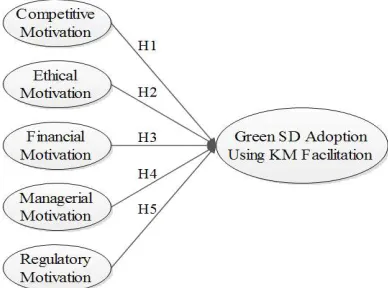
Proposed framework of this research paper is provided in Figure 1. The framework consists of
[image:5.612.320.514.333.477.2]six variables, based on the hypotheses that are explained in previous section. Objective of this paper is to empirically and specifically study on motivating factors that influencing the Green SD adoption through using KM as facilitation tool to manage and share the environmental knowledge of Green SD. Process of literature review in the previous section has proved that KM is an important tool that is able to facilitate ecological and sustainable development by managing and sharing environmental knowledge effectively and efficiently, with the aim of promoting ecological awareness among relevant parties. Hence, KM is used as a tool to facilitate the Green SD adoption. In particular, this proposed framework will explore relationships between five independent variables (competitive motivation, ethical motivation, financial motivation, managerial motivation and regulatory motivation) and Green SD adoption through using KM acts as facilitation tool.
Figure 1 Proposed Hypotheses Framework
4. RESEARCH METHODOLOGY
A primary study was carried out in order to propose a hypotheses framework in this research paper. Then, a quantitative questionnaire survey was performed with the aim of validating the proposed framework.
4.1 Measurement
The measures of this research paper are summarized in Table 1.
Table 1 Measurement Items with Citation
Item (adapted Citation
from) Green SD Adoption through KM Facilitation
ISSN: www.jatit.org E-ISSN:
4296
KMG2 Green SD knowledge is important to be managed in order to achieve environmental sustainability. KMG3 Well-managed knowledge encourages practitioners Green SD
to apply them into practice.
KMG4
Well-managed Green SD
knowledge helps organisation in
developing environmentally
friendly software products.
Competitive Motivation
CE1 Customers’ attitudes towards eco-friendly software. [45]
CE2 Competitors’ actions. environmental
[13,41] CE3 Market incentives in Green SD.
CE4 Green supply chain management policy by providers. [13]
Ethical Motivation
EE1 Corporate social responsibility. [13,41] EE2 Importance of creating a sustainable community. [47]
EE3 Green movement globally. [43]
EE4 Rising considerations from the public. of environmental [13] EE5 Understanding of positive impact on the environment. [45]
Financial Motivation
FE1 Cost-saving in data processing.
[43] FE2 Cost-saving in storage capability.
FE3 Cost-saving in desktop energy consumption.
[13,41] FE4 Cost-efficiency organisation’s ICT infrastructure. in using
FE5 Cost-efficiency in greening SD industry in the long run. [13]
Managerial Motivation
ME1 Top necessary equipment and support. management provides [45]
ME2 Organisation’s strategy. sustainability [13,41] ME3 Desire of organisation in green innovation decisions. [12] ME4 Leaders explicitly encourage us to spread practices that save energy. [45]
Regulatory Motivation
RE1 Regulations on greenhouse gas in SD industry. [13,41] RE2 Regulations on carbon footprint in SD industry. [45] RE3 Regulations on energy efficiency in SD industry.
[13,41] RE4 Regulations on discarding e-waste disposal in SD industry.
RE5 Incentives offered by government. [13] RE6 Encouragement from industry associations. [13,41]
4.2 Data Collection and Response Rate
Sample for the survey was extracted from SD organizations in Malaysia. Due to the circumstance that the aimed population is comparatively small and broadly distributed in Malaysia, thus the survey of this research paper was carried out using both online-based version (Google Forms) and hardcopy version (face-to-face) of questionnaire set. This research paper is intended to study motivating factors of Green SD adoption, hence target respondents of the quantitative survey were software practitioners who were directly participating in the process of SDLC, for example software programmers, project leaders, designers, helpdesks, maintainers, and system analysts.
[image:6.612.325.510.420.686.2]To make sure ideal sample size and in expectation of non-responses, the questionnaire set (hardcopy or online-based questionnaire set) was sent to about 300 target respondents. 114 responses were collected within three months. Seven of the questionnaires collected were unusable due to the incomplete answers. Thus, a total of 107 usable responses generated a response rate of 35.67%. Demographic characteristics of the respondents are summarized in Table 2.
4297
5. DATA ANALYSIS AND RESULTS
Structural equations modeling with partial least squares (PLS-SEM) method was used to validate the proposed framework of this research paper, by following guidelines provided by [53]. This method is remarkably suitable for examining the subsequent relationship between an independent variable and a dependent variable, and this validation method does not contain assumptions about homogeneity in variance and covariance of the variable [49]. This study followed standard two-steps approach for PLS-SEM analysis: measurement model analysis and structural model analysis.
5.1 Measurement Model Analysis
Objective of measurement model analysis is to emphasize on finding relationships between items and variables, and also the correlational relationships between the variables. Measurement model analysis was conducted prior to the structural model analysis so that the research paper was then able to proceed to specify relationships between the concepts and observable variables.
There are three assessments in measurement model analysis: construct reliability assessment, convergent validity assessment and discriminant validity assessment.
5.1.1 Construct Reliability Assessment
[image:7.612.322.509.221.631.2]Variables of a framework are considered as reliable if values of items for composite reliability are greater than 0.70, which indicates sufficient internal consistency [53]. The construct reliability assessment is summarized in Table 3, which shows that all variables have sufficient internal consistency.
Table 3 Construct Reliability Assessment
5.1.2 Convergent Validity Assessment
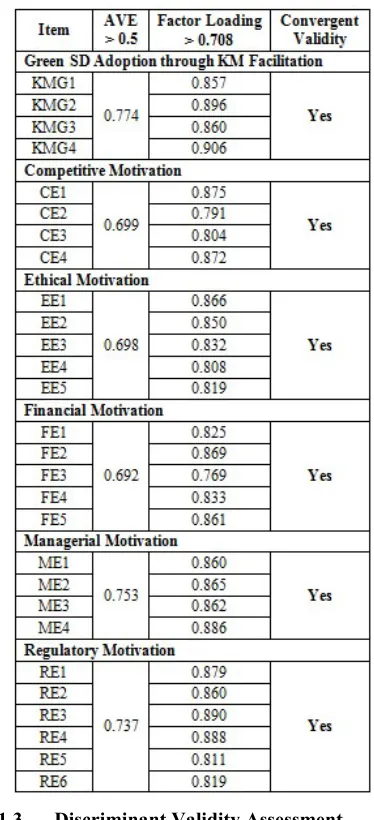
Convergent validity is concerning an item correlates positively with other items of the same variable. Factor loading of each item should be equivalent to or greater than accepted threshold of 0.708, which indicates sufficient internal consistency [53]. The convergent validity assessment is summarized in Table 4, which clearly shows that all variables achieve convergent validity.
Table 4 Convergent Validity Assessment
5.1.3 Discriminant Validity Assessment
[image:7.612.105.286.548.703.2]ISSN: www.jatit.org E-ISSN:
[image:8.612.312.521.79.303.2]
4298 summarized in Table 5, which clearly shows that all variables are truly dissimilar from one another.
Table 5 Discriminant Validity Assessment
5.2 Structural Model Analysis
The main purpose of performing structural model analysis was to validate the causal relationships that were specified by the proposed hypotheses framework in this research papers. This research paper adopted latent model perspective with reflective items with the aim of analyzing relationships between the independent and dependent variables.
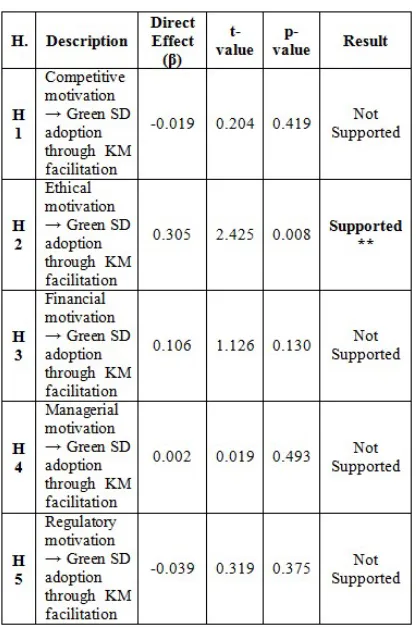
[image:8.612.94.303.143.491.2]Assessment of structural path coefficient was performed to investigate possible causal relationship between variables. 500 sample bootstrapping method was performed with the aim of evaluating the structural model and estimating significant level of the path coefficients. The level of statistical significant level of the structural path coefficient is determined through t-value > 1.96 and p-value < 0.05 [53]. Figure 2 exhibits that only ethical motivation (H2) has significant positive impact on Green SD adoption using KM facilitation (β=0.305, t-value=2.425, p-value=0.008).
Figure 2 Results of Structural Model Analysis
Results of hypotheses testing of this research paper are summarized in Table 6.
[image:8.612.315.523.376.691.2]4299
6. DISCUSSION
The prior researchers have concentrated on studying motivating factors of green computing adoption using empirical data, and have discovered tools to facilitate the green computing adoption. On the other hand, KM has been proved by the prior researchers that KM is an important tool that is able to facilitate ecological and sustainable development. Results of this research paper are novel and different from the prior research papers. The main reason is this paper studies on motivating factors of Green SD adoption through using KM as facilitation tool to collect, manage, and share environmental knowledge of Green SD in the SD organizations. Green SD is one of the in-depth research topics in this broad field of green computing. This research paper fills in the current research gap by studying the Green SD specifically. The empirical analysis of this paper shows ethical motivation is the only motivating factor that significantly contributes to motivate software practitioners in adopting Green SD.
Ethical motivation is empirically proved in this paper that is significant in motivating software practitioners to adopt Green SD through using KM facilitation. Software practitioners are more likely to adopt Green SD if they are aware of negative ecological impacts created during SD process. Result of this research paper shows that sense of care and responsibility to protect our natural environment is the main reason that software practitioners are willing to adopt Green SD. This statement is supported by existing similar research papers, such as [40] who has stated that morale of workers will stimulate adoption of green practices in an organization.
Besides ethical motivation, the other motivating factors (competitive motivation, financial motivation, managerial motivation and regulatory motivation) are not found to be significant motivating factors in influencing software practitioners to adopt Green SD.
Perceived success of competitors and customers does not change attitude of software practitioners towards Green SD adoption. One possible explanation might be concept of green technologies and sustainable growth in the field of IT and computer science is a relatively recent phenomenon [49], especially sampling frame of this research paper is in Malaysia, a developing country.
Financial motivation also shows no significant influence on motivating software practitioners to adopt Green SD. The reason might
also be the fact of green and sustainable development is a relatively recent trend. Cost-effectiveness on promoting green is still an uncertain concern that needs to be confronted by the organizations [54] . Besides, the current established cost accounting method is lacking of flexibility to evaluate qualitative ecological measures of an organization [55].
On the other hand, managerial motivation shows no significant influence on motivating software practitioners to adopt Green SD. One plausible explanation might be inconsistent top management support from small and medium-sized SD organizations which will influence organizational decisions greatly in managing ecological impacts and contributing to sustainable development [56].
Regulatory motivation also shows no significant influence on motivating software practitioners to adopt Green SD. One plausible explanation might be this research paper is conducted in the context of Malaysia, a developing country. Since there are no relevant ecological legislations enforced by the Malaysian government, therefore for now, software practitioners and SD organizations will not be influenced by regulatory motivation. The more developed the country, the more concern given by the government to resolve environmental issues [57].
7. CONCLUSION
The field of IT and computer science causes negative impacts to our natural environment. As ecological issues have been growing to a significant problem in the world, ecological sustainability thus should also be put at the top of development agenda in the field of IT and computer science. Therefore, the research area of green computing arises.
Green computing is a broad discipline of research in the field of IT and computer science. Green SD is one of the in-depth research topics in green computing. Green SD is concerning production of nature-friendly software products with the aim of minimizing negative ecological impacts to our natural environment.
ISSN: www.jatit.org E-ISSN:
4300 yet been tested. Hence, this research paper attempts to further our understanding on motivating factors of Green SD adoption, by using KM to act as facilitation tool. The reason of applying KM as tool to facilitate the Green SD adoption is the power of KM in harnessing Green SD knowledge. KM has been proved by existing researchers that KM is an important tool that is able to facilitate ecological and sustainable development by managing and sharing environmental knowledge effectively and efficiently.
A motivational perspective can benefit to comprehend intentions for environmental initiatives and can predict environmentally-based behaviors of the software practitioners in SD organizations. PLS-SEM method was used to validate the proposed framework of this research paper, by following standard two-steps approach for PLS-SEM analysis: measurement model analysis and structural model analysis. Finding of this research paper presents that ethical motivation is empirically proved that have direct and significant effect in motivating software practitioners to adopt Green SD through using KM facilitation in SD organizations. The finding shows that intention of software practitioners to develop nature-friendly software products is driven by their environmental concerns, sense of care and responsibility to our natural environment.
This research paper has a few of implications for research field and practice. From a theoretical point of view, outcomes of this paper will help in enhancing understanding of researchers and academics on motivating factors of Green SD adoption. Besides that, this paper contributes to the emergence of a cumulative attention in Green SD research. From a practical point of view, this research paper will be valuable for diverse stakeholders who are interested in encouraging Green SD adoption in organizations. This paper proves that ethical motivation is the strong motivating factor of Green SD adoption. Therefore, the SD organizations and top management need to properly utilize their workers’ morale and concern on ecological issues for identifying green innovation and green initiatives in order to gain benefits for the organizations.
Despite usefulness of this research paper, there are still some limitations of this research that open avenue for future researchers. First, the sampling frame was sourced from only one country. Second, this research paper is only able to describe motivating factors of software practitioners at one point of time. Further, this research collected responses based on convenient sampling method,
which may not be absolutely representative of the population. Future researchers could focus on a specific SD organization by using probability sampling, such as random sampling or systematic sampling, to collect more reliable responses. Hence, all software practitioners in the particular SD organization have equal chance of being selected. Sampling error could be calculated and possible bias could be excluded. Moreover, this paper only analyzed relationships between motivating factors and Green SD adoption, and it did not explore relationships of them with KM facilitation in detail. In future, influence of KM acts as a facilitation tool to promote Green SD adoption should be further examined. Additionally, a post-survey will be
REFRENCES:
[1] Calero C, Piattini M, “Chapter 1 introduction to green in software engineering”, In: Calero C, Piattini M. Green in Software
Engineering, Switzerland: Springer, 2015,
pp. 3-27.
[2] Esfahani MD, Rahman AA, Zakaria NH, “The status quo and the prospect of green IT and green IS: a systematic literature review”,
Journal of Soft Computing and Decision
Support Systems, Vol. 2, No. 1, 2015, pp.
18-24.
[3] “Sustainable development goals”, [Internet]. 2015 [cited 2015 November 22], Available from:
http://www.undp.org/content/undp/en/home/ mdgoverview/post-2015-development-agenda.html
[4] Murugesan S., “Harnessing green IT: principles and practices”, IT Pro, 2008 January/February 24.
[5] Ericsson, “Ericsson energy and carbon report on the impact of the networked society”, Stockholm: Ericsson; 2013.
[6] Agarwal S, Bhaumik A, Chakrabarty S, Nath A, “Trends and awareness in green computing initiatives: a comprehensive study”, International Journal of Advance Research in Computer Science and
Management Studies, Vol. 3, No. 4, 2015,
pp. 1-10.
[7] Kharchenko V, Gorbenko A, Phillips C, Sklyar V., “Green computing and communications in critical application domains: challenges and solutions”, Green and Safe Computing and Communication,
4301 [8] Li Q, Zhou M., “The survey and future
evolution of green computing”, IEEE/ACM International Conference on Green
Computing and Communications, 2011, pp.
230-233.
[9] Niyato D, Chaisiri S, Lee BS., “Optimal power management for server farm to support green computing”, 9th IEEE/ACM International Symposium on Cluster
Computing and the Grid, Shanghai, 2009,
pp. 84-91.
[10] Kurp P., “Communication of the ACM. Green Computing, Are You Ready for a Personal Energy Meter?”, 2008, October:11. [11] Mihai O, Seitz V, Rizkallah E, Khamas E.,
“Attitudes toward green computing in transition economics: a romanian perspective”, Ideas in Marketing: Finding
the New and Polishing the Old, 2015, pp.
772-778.
[12] Khor KS, Thurasamy R, Ahmad NH, Abdul Halim H, Lo MC, “Bridging the gap of green IT/ IS and sustainable consumption”, Global
Business Review, Vol. 16, No. 4, 2015, pp.
571-593.
[13]Molla A., “The extent of green IT adoption and its driving and inhibiting factors: an exploratory study”, Journal of Information
Science and Technology, Vol. 6, No. 4,
2009.
[14]Afzal S, Saleem MF, Jan F, Ahmad M., “A review on green software development in a cloud environment regarding software development Life cycle: (SDLC) perspective”. International Journal of
Computer Trends and Technology, Vol. 4,
No. 9, 2013, pp. 3054-3058.
[15] Chauhan NS, Saxena A., “A green software development life cycle for cloud computing”, IT Pro, 2013, pp. 28-34. [16] Abdullah R, Abdullah S, Din J, Tee M., “A
systematic literature review of green sofware development in collaborative knowledge management environment”, International Journal of Advanced Computer Technology,
Vol. 4, No. 1, 2015, pp. 63-80.
[17] Bansal P, Roth K., “Why companies go green: a model of ecological responsiveness”, Academy of Management
Journal, Vol. 43, No. 4, 2000, pp. 717-736.
[18] Kivits RA, Furneaux C., “BIM: enabling sustainability and asset management through knowledge management”, The Scientific
World Journal, 2013, pp. 1-14.
[19] Ruhanen L., “Progressing the sustainability debate: a knowledge management approach”, Current Issues in Tourism, Vol. 11, No. 5, 2008, pp. 429-455.
[20] Martinez-Martinez A, Cegarra-Navarro JG, Garcia-Perez A., “Environmental knowledge management: a long-term enabler of tourism development”, Tourism Management, Vol. 50, 2015, pp. 281-291.
[21] Stanovcic T, Pekovic S, Bouziri A., “The effect of knowledge management on environmental innovation”, Baltic Journal of
Management. 2015;10(4):413-431.
[22] Reed MS, Stringer LC, Fazey I, Evely AC, Kruijsen JHJ. "Five principles for the practice of knowledge exchange in environmental management". Journal of
Environmental Management, 2014, pp.
337-345.
[23] Chitchyan R, Noppen J, Groher I., “Sustainability in Software Product Lines: Report on Discussion Panel”, SPLC 2014,
2015.
[24] Penzenstadler B, Femmer H, “A generic model for sustainability with process- and product-specific instances”, First Intl. Workshop on Green In Software Engineering and Green By Software
Engineering, 2013.
[25] Naumann S, Dick M, Kern E, Johann T, “The GREENSOFT model: a reference model for green and sustainable software and its engineering”, Sustainable
Computing: Informatics and System, 2011,
pp. 294-304.
[26] Capra E, Formenti G, Francalanci C, Gallazzi S., “The impact of MIS software on IT energy consumption”, 18th European Conference on Information Systems,
Pretoria, South Africa, 2010.
[27] Guzman GRd, Piattini M, Perez-Castillo R., “Green software maintenance”. In: Calero C, Piattini M. Green in Software Engineering,
Switzerland: Springer, 2015. pp. 205-229. [28] Lu R, Liu J., “The research of the
knowledge management technology in the education”, International Symposium on
Knowledge Acquisition and Modeling, 2008,
pp. 551-554.
ISSN: www.jatit.org E-ISSN:
4302 [30] Narducci J., “What's actionable
knowledge?” [Internet]. 2002 [cited 2014
May 26]. Available from:
http://www.NarducciEnterprises.com . [31] Argyris C., “Actionable knowledge: design
causality in the service of consequential theory”, The Journal of Applied Behavioral
Science, Vol. 32, No. 4, 1996, pp. 390-406.
[32] Lubitz Dv., “Teams of leaders concept (ToL) and e-business operations”, In:
Encyclopedia of E-Business Development and Management in the Global Economy,
Denmark: MedSMART Inc., USA and Bieda Poco Dargante Inst., 2010.
[33] Posner L., “Actionable knowledge: putting research to work for school community action”. [Internet]. 2009 [cited 2014 May
26]. Available from:
http://www.idra.org/IDRA_Newsletter/Augu st_2009_Actionable_Knowledge/Actionable _Knowledge/ .
[34] Tseng ML., “Using a hybird MCDM model to evaluate firm environmental knowledge management in uncertainty”, Applied Soft
Computing, 2011, pp. 1340-1352.
[35] Lee AHI, Chen HH, Chen S., “Suitable organization forms for knowledge management to attain sustainable competitive advantage in the renewable energy industry”, Energy, 2015, pp. 1057-1064.
[36] Mann H, Grant G, Mann IJS., “Green IT: an implementation framework”, AMCIS 2009
Proceedings, 2009, pp. 1-11.
[37] Loeser F, Erek K, Schmidt NH, Zarnekow R, Kolbe M., “Aligning green IT with environmental strategies: development of a conceptual framework that leverages sustainability and firm competitiveness”,
AMCIS 2011 Proceedings, Michigan, 2011
pp. 1-9.
[38] Molla A, Cooper V., “Greening data centres: the motivation, expectancy and ability drivers”, Tel Aviv, 2014. pp. 1-14. [39] Lei CF, Ngai EWT, “A research agenda on
managerial intention to green IT adoption: from norm activation perspective”, PACIS
2014 Proceedings, 2014.
[40]Olson EG., “Creating an enterprise-level green strategy”, The Journal of Business
Strategy. Vol. 29, No. 2, 2008, pp. 22-30.
[41]Molla A, Abareshi A., “Green IT adoption: a motivational perspective”. PACIS 2011
Proceedings, 2011, pp. 1-14.
[42] Kranz J, Picot A., “Why are consumers going green? The role of environmental concerns in private green-IS adoption”, ECIS
2011 Proceedings, 2011.
[43] Molla A., “GITAM: a model for the adoption of green IT”, ACIS 2008
Proceedings, Christchurch, 2008, pp.
658-668.
[44] Chou DC, Chou AY., “Awareness of green IT and its value model”, Computer
Standards & Interfaces, 2012, pp. 447-451.
[45] Syzdykbayeva D., “Analytical study on adoption of green computing by Malaysian organizations”, Universiti Teknologi Malaysia, 2009.
[46] Wati Y, Koo C, Chung N., “Intention to use green IT/IS: a model of multiple factors”,
IEEE Conference on Commerce and
Enterprise Computing, 2011. pp. 428-435.
[47] Jain RP, Benbunan-Fich R, Mohan K. “Assessing green IT initiatives using the balanced scorecard”, IT Pro, 2011 January/ February, pp. 26-32.
[48] Yunus S, Jailani SFAK, Hairuddin H, Kassim ES., “Green IT adoption towards environmental sustainability: the moderating role of top management enforcement”, 3rd International Conference on Research and
Innovation in Information Systems, 2013, pp.
242-244.
[49] Gholami R, Sulaiman A, Ramayah TB, Molla A., “Senior management perception on green information systems adoption and environmental performance: Results from a field survey”, Information and Management.
Vol. 50, No 7, 2013, pp. 431-438.
[50] Zhang J, Liang Xj., “Promoting green ICT in China: a framework based on innovation system approaches”, Telecommunications
Policy, 2012, pp. 997-1013.
[51] Noor M. “Environmental law and policy practices in Malaysia: an empirical study”,
Australian Journal of Basic and Applied
Sciences, Vol. 5, No. 9, pp. 1248-1260.
[52] Yuan M. “An integrated knowledge management framework for managing sustainability knowledge in the Australian infrastructure sector”, 2011.
4303 structural equation modeling (PLS-SEM)”, Sage, 2014.
[54] Ageron B, Gunasekaran A, Spalanzani A., “Sustainable supply management: an empirical study”, International Journal
Production Economics, 2012, pp.168-182.
[55] Govindan K, Kaliyan M, Kannan D, Haq AN., “Barriers analysis for green supply chain management implementation in Indian industries using analytic hierarchy process”,
International Journal Production
Economics, 2014, pp. 555-568.
[56] Hillary R. “Environmental management systems and the smaller enterprise”, Journal
of Cleaner Production, 2004, pp. 561-569.
[57] Loganathan N, Shahbaz M, Taha R. “The link between green taxation and economic growth on CO2 emissions: fresh evidence from Malaysia”, Renewable and Sustainable