2224
AN EFFICIENT DELAY AWARE QUALITY RELATION
BASED ROUTING TREE ON WIRELESS NETWORK
P.RAJU1, DR C.CHANDRA SEKAR2
1
P.hD Research Scholar, Department of computer science, Research and Development centre
Bharathiyar University and
Assistant Professor, Cherran arts and Science College, Kangayem, Tiruppur, Tamilnadu, India. 2
Associate professor, Dept of computer Science,
Periyar University, Salem, Tamilnadu, India 1
[email protected],[email protected]
ABSTRACT
Wireless network combine different types of nodes and vector path to perform information processing with active node variance. The wireless node is additionally positioned to carry out routing with multiple base stations, and routing work is taken as an upcoming research work. Many reliable routing approaches are widely used in many resource limited applications, since it improves data delivery rate and reduces the average delay. However, they lack quality of routing and increases the delay time. In this paper, we propose a Menger connectivity graph based on minimum hop, called Delay Aware Quality Relation based Routing Tree (DAQR-RT). DAQR-RT provides the quality routing tree on wireless network. DAQR utilizes the active window conception to record the quality relationship using previous routing data information in wireless network. The previous routing information (i.e., historical information) is designed with the objective of reducing the delayed time rate efficiently in proposed DAQR-RT. Delay Aware Quality Relation constructs the recognized routing tree in wireless network. Besides, Active window conception previous information quality is captured and estimates the before constructing the recognized routing decision tree for effective broadcasting of information. Finally, the quality relationship in DAQR-RT mechanism uses a Menger connectivity graph based on minimum hop count field which resulting in avoids the poor connectivity and reducing the possibility of retransmissions while broadcasting. Simulations results are conducted to measure the efficiency of proposed DAQR-RT in wireless network through data transmission rate, size of the data block, delay rate, throughput and reduces retransmission during broadcasting. In the performance evaluation, we show that the Delay Aware Routing Tree algorithm achieves comparable performance to the state-of-the-art methods. Experimental analysis shows that DAQR-RT is able to reduce the delay time while broadcasting by 25.62% and reduce the retransmission rate by 37.5% compared to the state-of-the-art works.
Keywords
:
Wireless Network, Menger Connectivity, Delay Aware Quality Relation, Routing Tree, Active Window1. INTRODUCTION
A wireless network consists of closely located static nodes with one stationary base station. In wireless networks, the sensor nodes collect and transmit the information to base station occasionally. Wireless network detects and report the events of the physical world. In most of the cases, nodes are batteries powered with inadequate energy resources. The wireless data are composed at the base station which consumes more energy when they maintain the different node activity. Significant efforts were
made to improve the routing protocols for efficient broadcasting in wireless network.
2225 [3] to reduce the delay time using Multi-Lateration based localization. Though, localization embedded into actual transmissions of pay- load information with enhanced communication overhead. Another method [4] reduced the packet delay using Enhanced Real Time with Load Distribution (ERTLD) algorithm. However, energy required for packet transmission remained unaddressed. In [5], energy optimization method was introduced based on the Dijkstra’s algorithm. However, energy-efficient communication and sensor deployment issue was not considered.
Each sensor node in the sensor network only detects events according to the sensing range. A Coverage Inference Protocol (CIP) [6] was introduced to reduce the communication and computational overhead. But, the other potential application of the CIP was not investigated. A Polynomial Time (PT) [7] algorithm was designed to improve the transmission rate. However, link failures were not considered. In [8], Heuristic scheme was considered to reduce the monitoring location improving the throughput. However, it lacked efficient routing protocol. To solve this routing issue, in [9], an algorithm called Distributed Carrier Sense Updated (DCSU) was designed in the context of topology control. However, an overall network throughput remained unaddressed. Single hop and multi hop chain cluster was designed in [10] aiming to improve rate of throughput with limited overhead. Though, computational complexity is high.
One of the challenging issues to be solved in WSNs is to meet end-to-end delay requirement under wireless interferences of WSNs. In [11], a Time Division Multiple Access scheduling was introduced with the objective of providing fair bandwidth and delay time. However, the TDMA reduces the scheduling length. A survey on energy efficient routing protocol was presented in [12]. However, network lifetime is reduced. To reduce the delay time during routing in WSN, edge labeling function with recovery algorithm [13] was designed aiming at reducing the cycle time. However, data transmission rate with respect to delay time was not concentrated. To reduce end-to-end delay, data transmission using distributed scheme [14] was introduced resulting in the improvement of life span and reducing the hop count. A fault tolerant [15] sensor network was
designed using Max-Flow Min-Cut theorem to improve the rate of throughput. However, the time taken to predict the fault is more.
One of the most interesting topics in the field of wireless networks is the quality-of-service (QoS) aware routing protocol. A Multi-objective QoS routing protocol was designed in [16] aiming at improving the data delivery ratio and reducing the delay time using heuristic neighbor selection mechanism. However, security with respect to QoS remained unsolved. In [17], Ant-based Routing protocol was designed with the view of improving the security and also ensured high data delivery. But, the computation and memory was higher. In [18], a survey of routing protocols was discussed. Though, network lifetime is reduced while satisfying the QoS requirements of different applications. Opportunistic routing in [19] provided insight into successful packet delivery form the source to destination reducing the average delay. However, Opportunistic routing minimizes throughput and latency using duty-cycled network. Randomized multi path route generation was designed in [20] to improve the end-to-end data delivery rate. Though data delivery was ensured but at the cost of delay time.
Based on the above mentioned methods and techniques, an efficient Delay Aware Quality Relation based Routing Tree (DAQR-RT) is designed with the objective of reducing the delay rate and retransmission during broadcasting. The main contribution of the proposed DAQR-RT includes the following. We explore the potential of Active Window Conception to verify the quality relationship using previous routing data information which in turns reduces the delay time using DAQR-RT. Active window conception previous information quality is captured and evaluates before constructing the recognized routing decision tree for effective broadcasting information in wireless network. Finally, Retransmissions while broadcasting is reduced in quality relationship by applying Menger connectivity graph based on minimum hop count field to avoid poor connectivity that helps to reduce poor connectivity. In addition, we conduct extensive simulations to study the performance of the proposed framework to prove the effectiveness of our design through delay time, throughput and retransmission rate.
2226 considered involved in Delay Aware Quality Relation based Routing Tree. Section 3 describes the evaluation with experimental setup and simulation results and discussion is included in Section 4. Section 5 concludes the paper.
2. DELAY AWARE QUALITY
RELATION BASED ROUTING TREE This section describes the Delay Aware Quality Relation based Routing Tree (DAQR-RT) framework through three different stages (i) Design of Active Window Conception, (ii) Integration with Routing Tree and (iii) Construction of Menger connectivity graph. The block diagram of DAQR-RT framework is shown in figure 1.
Figure 1 Block Diagram of Delay Aware Quality Relation Based Routing Tree
The Block diagram of Delay Aware Quality Relation based Routing Tree for the proposed Delay Aware Routing Tree algorithm is shown in figure 1. The main objective of DAWR-RT framework is the efficient and effective broadcasting of information in wireless networks. The DAWR-RT framework is divided into three stages namely(i) active window conception to obtain historical information
aiming to minimize the delay time, (ii) integration with routing tree by applying delay aware routing tree algorithm to increase the rate of throughput and (iii) construction Menger connectivity graph to reduce retransmission while broadcasting.
Delay Aware Quality Relation based Routing Tree is designed in such a way that efficient selection of path for data packet transmission is performed on the basis of previous routing information (i.e.,) historical information once minimum hop field is established. This helps to easily evaluate the delayed time rate and so called as the proposed framework, Delay Aware Quality Relation.
To start with, Active Window Conception ( , ) is designed to successfully measure the path quality relation in 2.1. In 2.2, a connectivity graph based on minimum hop count field is created aiming at minimizing the possibility of retransmission with broadcasting and to avoid poor connectivity. Finally 2.3, constructs the recognized routing tree in wireless network for effective broadcasting of information, improving the throughput level.
2.1 Design of Active Window Conception (Minimizes Delay Time)
The first stage in Delay Aware Quality Relation based Routing Tree is the design of Active Window Conception (AWC). Let us consider a stream of Data Packets with a Deadline, Data Packets meeting the Deadline with an active window length. The formulation is then given as below
, , (1)
From (1), ‘ ’ represents the stream of Data Packets to flow with a Deadline ‘ ’ and ‘ ’ the data packets meeting the deadline out of active window length ‘ ’. Then the AWC obtains the historical information of data packet according to the formulation as
given below
, (2) From (2), the historical information ‘ ’ is obtained in such a way that if ‘ ’ Data Packets meeting the deadline out of active window length ‘ ’ Data Packets in wireless network flow successfully, then delayed time rate can be measured. As a result, Delay Aware Quality Relation is established.
Length Deadline
Jobs
Active Window Conception
Obtain historical
Integration with routing
tree
Delay aware
routing tree
Menger connectivity graph
2227 The idea behind Delay Aware Quality Relation is closer the Data Packet to a failure condition. A failure condition is said to occur when the Data Packet’s , requirement is lapsed. The lapse is the state when more than
, deadline limit misses within the active window length ‘ ’.
The total number of deadline limit misses in Delay Aware Quality Relation based Routing Tree is the distance between the failure state and the current state. The evaluation of this distance (i.e., quality relationship factor) in DAQR-RT framework is performed using the historical information of flow of data packet stream. The evaluation of Quality Relationship Factor is measured as given below
∑! "#
$ (3) From (3), ‘ ’, the Quality Relationship Factor is obtained on the basis of historical information ‘ ’over length ‘ ’. The ‘%’ is a Boolean function over the total successful transmission
‘&’. For example, using historical information of
‘110001’, there are only two successive
successful transmission with ‘%’ defined as Boolean state given as below
‘%’ 1,
) 1, *+ 1, *, 1, … * .+ 1
0, /0 (4)
In the proposed DAQR-RT framework, the ‘ ’ stream of data packets constitutes ‘ ’ bits that are arranged from the most current task assigned to the oldest job. Using Delay Aware Quality Relation, the information of deadline for each bit is kept in the memory using the ‘1
0’, as deadline is missed or ‘1 1’, as deadline is met. In the DAQR-RT framework, each new arrival data packet transfers all the bits towards left. Figure 2 shows the flow of data packet transmission. Given with the current state,
‘11100110’, ‘ 8’, then ‘ 5’.
Figure 2 Flow Of Data Packet Transmission
The leftmost bits exits from the word and is no longer considered, while the rightmost bit is considered to be ‘1’ if the task of the corresponding data packet has met its deadline. Then ‘ ’ represents the corresponding entry for ‘ ’ Data Packet in the link history, i.e., ‘1’ if the deadline is met or ‘0’ if the deadline is missed.
So using the current window in DAQR-RT framework ‘ ’, ‘ ’ = ‘ ’. Then the Delay Aware Quality Relation is given as below
4 5!
6 (5)
The value of DAQR is updated by the L sequence. The quality relation value is then obtained from the value ‘ 4 ’. As a result, the analysis of previous routing information using the historical information therefore easily measures the delayed time rate. With these time rate, the delay rate observed for data packet transmission is reduced in a significant manner using the DAQR-RT framework
2.2 Integration with Routing Tree (Increases Throughput)
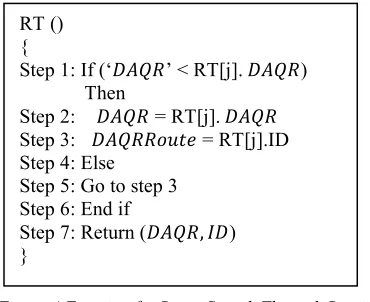
The second stage in Delay Aware Quality Relation based Routing Tree is the integration of routing tree with Delay Aware Quality Relation. Delay Aware Quality Relation based Routing Tree is used to construct the recognized routing tree in wireless network. The effective construction of Routing Tree and integrating it with the Delay Aware Quality Relation improves the rate of throughput. The Delay Aware Routing Tree algorithm is shown in Figure 3 and Figure 4 respectively through delay aware quality maintenance table and the function, routing tree.
1
1 1 0 0 1 1 0
1
1 0 0 1 1 0 1
2228
Figure 3 Delay Aware Routing Tree Algorithm
[image:5.612.92.298.78.361.2]The delay aware quality maintenance table maintains the updated information through relation table. For each data packets with deadline and total length, the delay aware quality maintenance table initially selects the path and transmits the data packet. Followed by it, the historical information about each data packet is maintained and updated according to the function call made in figure 4.
Figure 4 Function for Route Search Through Routing Tree
Figure 4 shows the function involved in the efficient search of route through routing tree. From the above figure 4, in the proposed
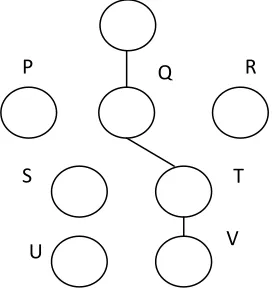
framework, the delay aware quality routing table has additional entry of neighbor node's quality. The algorithm searches for the node with the highest quality and its id. If the node has higher quality than that of the current node, then that node is considered as the parent node. Otherwise the current node is considered as the parent node. Figure 5 shows the construction of delay aware quality routing tree.
Figure 5 Construction Of Delay Aware Quality Routing Table
Let us consider the parent node as node ‘A’ and its quality is 150. The parent node’s forwarding node set includes ‘P’, ‘Q’ and ‘R’. The forwarding node set of node ‘Q’ includes ‘S’ and ‘T’. When the parent node ‘A’ has data packet to send to the sink, the parent node selects from the neighbor nodes with high quality. In the example given in the above figure, the parent node ‘A’ selects the node ‘Q’ which has the highest quality compared to ’P’ and ‘R’. So the node ‘Q’ is selected for forwarding the data packet. In a similar manner, the proposed framework DAQR-RT, selects the next highest quality node from the neighboring node of ‘Q’. Ultimately, the choice is ‘T’ and then ‘V’ respectively. Thus the data packets in the network through which it can be forwarded becomes less and results in the effective broadcasting of information or throughput in wireless network.
2.3 Construction of Menger Connectivity Graph (Reduces Retransmissions While Broadcasting)
Finally, the third stage in Delay Aware Quality Relation based Routing Tree is the construction of Menger connectivity graph. The Initialize: Data Packets ‘ ’, Deadline
‘ ’, Length ‘ ’, 4
Output: Delay aware quality maintained table Step 1: Begin
Step 2: For each Data Packets ‘ ’, ‘ ’, ‘ ’
Step 3: Select the path and transmit the data packet
Step 4: Obtain historical information of data packet using ()
Step 5: Update the information in the relation table
Step 6: If ( ) is successfully transmitted then
Step 7: Shift all bits in left-ward direction by adding 1 rightmost bit
Step 8: Call RT (Q,id) Step 9: Else
Step 9: Perform shift and add 0 to the rightmost bit
Step 10: End Step 11: End
RT () {
Step 1: If (‘ 4 ’ < RT[j]. 4 ) Then
Step 2: 4 = RT[j]. 4 Step 3: 4 7 = RT[j].ID Step 4: Else
Step 5: Go to step 3 Step 6: End if
Step 7: Return ( 4 , ) }
Q
1Parent node
P
7R
10S
5T
7U
6V
10 [image:5.612.343.516.218.366.2] [image:5.612.94.279.518.669.2]2229 proposed framework DAQR-RT creates a Menger connectivity graph based on minimum hop count field to avoid poor connectivity and reduce the possibility of retransmissions while broadcasting. The Menger connectivity graph in DAQR-RT framework removes minimum number of data packets to disconnect the remaining data packets from each other, aiming at reducing the retransmissions while broadcasting.
Let us consider a graph ‘8’ with vertices ‘ ’ and ‘ ’, then the set of paths between ‘ ’ and ‘ ’ is said to be independent if no two of the data packets share a vertex other than ‘ ’ and ‘ ’ themselves. This Menger connectivity graph in DAQR-RT framework is constructed based on minimum hop count field. Hop count field in DAQR-RT framework refers to the number of intermediate nodes in wireless network. In the proposed framework, minimum hop count field is considered. The minimum hop count field between ‘ ’ and ‘ ’ is written as
9 : ,
9 ; < : 7 = > , 9 < : 7 = > ?
(6)
[image:6.612.317.520.340.555.2]From (6), the minimum hop count field is measured by comparing the minimum hop count of vertices ‘a’ and ‘b’. The minimum hop count is then obtained that helps in reducing poor connectivity and therefore reduces the retransmission level while rebroadcasting.
Figure 6 Menger Connectivity Graph With Vertex P, R, S And V Disconnected
Figure 6 shows the Menger connectivity graph for figure with vertex ‘P’, ‘R’, ‘S’ and ‘V’ disconnected. The vertices ‘P’, ‘R’, ‘S’ and ‘U’ are disconnected based on the quality and
minimum hop count field. As a result, poor connectivity is avoided and this helps in reducing the possibility of retransmissions while broadcasting.
3. EXPERIMENTAL SETUP
In this section we evaluate performance of DAQR-RT via simulation. DAQR-RT has been compared to Data Routing for In-Network Aggregation (DRINA) [1], an aggregation-based routing for wireless sensor network and Reputation-based Routing (RR) [2] for DTN. The simulation parameter used for creating the routing tree is given below (table 1). The nodes in DAQR-RT are positioned in uniform topology. The area to be placed is divided into grid of equal size and the node is placed randomly inside the grid.
Table 1 Simulation Parameters
Parameters Values
Network area 1000 m * 1000 m
Number of nodes 10,20,30,40,50,60,70
Number of data packets i.e., number of data block
5,10,15,20,25,30,35
Size of data block (i.e., packet)
7 – 49 bytes
Range of
communication
25 M
Speed of node 0 – 7 m/s
Simulation time 2000 s
Number of runs 7
The network consists of 70 nodes, placed in a random manner in the wireless network that generates traffic for every 6 m/s. The sink node collects the data packets of range 5 – 35 and forwards the data to the PC with each data packet size differing from 100 KB to 512 KB. The simulation time varies from 1000 simulation seconds to 2000 simulation seconds and the following metrics like delay time, throughput rate, retransmission while broadcasting with respect to nodes and data packets are measured.
4. DISCUSSION
P
Q
R
S
T
[image:6.612.106.243.494.640.2]2230 The objective of experimental work is to build a framework to perform Delay Aware Quality Relation based Routing Tree on wireless network providing quality routing tree. Simulations are conducted to improve the data transmission rate and reduce the delay time and the result analysis of DAQR-RT is provided in this section and compared with DRINA [1] and RR [2]. Experiment is conducted on factors such as delay time, throughput, retransmission rate and number of data packets.
4.1 Delay Time Analysis
In this section to check the efficiency of DAQR-RT framework, metric delay time efficiency is evaluated and compared with the state-of-the-art works, DRINA [1] and RR [2]. The time consumed in determining the routing information i.e., obtaining the historical information of data packet is said to be the delay time. Therefore, delay time is defined as the time required in obtaining the data packets with their corresponding data block size and is formulated as given below.
@ A @ B C D E ) FG
H
I+
(7)
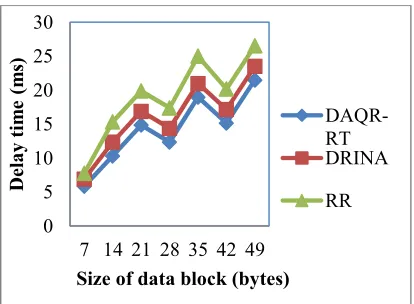
[image:7.612.318.525.206.358.2]From (7), the delay time is observed which is measured in terms of milliseconds (ms). To deliver with a detailed performance, in Table 2 we apply Delay Aware Routing Tree algorithm to obtain the delay time and comparison is made with two other existing methods, DRINA and RR respectively. Lower delay time results in the improvement of the framework.
Table 2 Comparison of Delay Time
Size of data block (bytes)
Delay time (ms)
DAQR-RT
DRINA RR
7 5.85 6.90 7.75
14 10.31 12.34 15.34 21 14.85 16.88 19.88 28 12.35 14.38 17.38 35 18.97 20.99 24.99 42 15.13 17.16 20.16 49 21.48 23.51 26.51
A comparative analysis for delay time with respect to different data block size
performed with the existing DRINA and RR is shown in Figure 7. The increasing data block size in the range of 7 bytes to 49 bytes is considered for experimental purpose for wireless network is shown in Figure 7. As illustrated in figure, comparatively while considering increasing data block size, the delay time also increases, though betterment achieved using the proposed framework DAQR-RT.
Figure 7 Impact of Delay Time
The measurement of delay time is comparatively reduced using the DAQR-RT framework when compared to two other existing methods [1] [2]. This improvement in delay time is because of the application of Active Window Conception that uses historical information of data packet meeting the deadline out of active window length. The Quality Relationship Factor obtained based on the Boolean function helps in reducing the delay time by 15.15% compared to DRINA and improved by 36.09% compared to RR respectively.
4.2 Throughput Analysis
The experimental results in previous section have indicated that DAQR-RT framework is more efficient than DRINA and RR respectively. In this section we compared DAQR-RT framework with, DRINA [1] and RR [2] to illustrate the effectiveness of delay aware routing tree algorithm in terms of effective throughput improvement. The throughput improvement in DAQR-RT framework is measured on the basis of successful receipt of data packets. It is measured in terms of data packets per second (pps) and is formulated as given below
0 5 10 15 20 25 30
7 14 21 28 35 42 49
D
el
a
y
t
im
e
(m
s)
Size of data block (bytes)
DAQR-RT DRINA
[image:7.612.85.285.564.699.2]2231
@ J→ L (8)
`From (8), ‘ J’ represents the data packets sent whereas ‘ L’ denotes the data packets dropped. Higher the rate of throughput, more efficient the method is said to be.
[image:8.612.84.298.316.476.2]In order to measure the throughput rate, the number of packets sent and the packets dropped is used to identify the throughput rate in wireless network. Higher the rate of throughput, more efficient the framework is said to be. The comparison of throughput rate is provided in table 3 with respect to different number of data packets in the range of 5 – 35 observation. With increase in the number of data packets being made, the throughput also increases though not observed in a linear manner.
Table 3 Comparison of Throughput
Number of data packets
Throughput (pps) DAQR-RT DRINA RR
5 4 3 1
10 7 4 2
15 12 9 7
20 16 13 11
25 11 8 6
30 23 20 18
35 28 25 23
[image:8.612.314.532.530.664.2]The second evaluation metric considered for evaluating the effectiveness of the framework DAQR-RT is the rate of throughput with respect to the number of data packets. An elaborate comparison is made with the existing two state-of-the-art works.
Figure 8 Impact 0f Throughputs
[image:8.612.84.287.534.681.2]As shown in Figure 8, the throughput rate is improved using the proposed DAQR-RT framework. With the application of routing tree, the rate of throughput is improved in the proposed DAQR-RT framework. By applying Delay Aware Routing Tree algorithm, the delay aware quality maintenance table maintains the updated information with the help of the relation table. This integration of routing tree with Delay Aware Quality Relation in DAQR-RT framework results in the improvement of throughput rate by 26.78% compared to DRINA. Besides, an additional entry of neighbor node's quality in delay aware quality routing table results in the effective broadcasting of information or throughput in wireless network. The integration of both of these prove to provide better performance or throughput rate by 46.42% compared to RR respectively.
4.3 Retransmission Rate
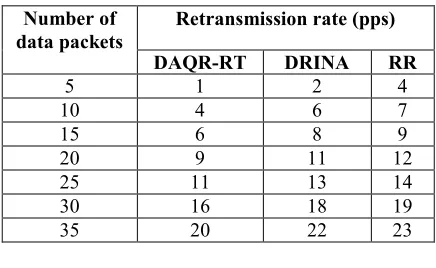
Retransmission rate is the amount of packets being retransmitted with the probability of either being damaged or lost. The retransmission rate is determined using the difference between the data packets sent and data packets received. It is measured in terms of packets per second (pps). Retransmission rate is formulated as given below.
JM N (9)
From (9), the retransmission rate is determined using ‘ J’ the data packet sent and ‘ N’ the data packet received.
Table 4 Comparison of Retransmission Rate
Number of data packets
Retransmission rate (pps) DAQR-RT DRINA RR
5 1 2 4
10 4 6 7
15 6 8 9
20 9 11 12
25 11 13 14
30 16 18 19
35 20 22 23
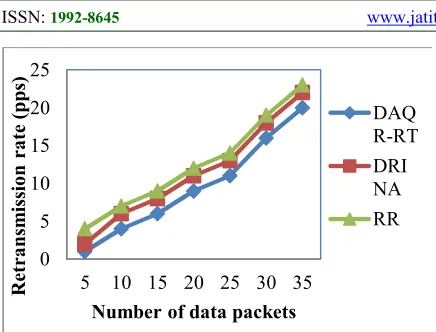
The retransmission rate using DAQR-RT framework is provided in an elaborate manner in table 3 with different number of data packets and applied in NS2.
0 5 10 15 20 25 30
5 10 15 20 25 30 35
DAQR-RT
DRINA
2232
Figure 9 Impact Of Retransmission Rate
Figure 9 shows the retransmission rate while broadcasting with respect to 5 – 35 data packets for experimental purposes. As depicted in the figure with the increase in the number of data packets, the retransmission rate while broadcasting is also increased. But when compared to the state-of-the-art works, the retransmission rate is reduced in the proposed framework DAQR-RT. The retransmission rate while broadcasting is reduced owing to the fact that the proposed framework uses the Menger connectivity graph to avoid poor connectivity and reduce the possibility of retransmissions while broadcasting. Furthermore, based on the quality and minimum hop count field, using the Menger connectivity graph, the retransmission rate while broadcasting is reduced by 30% compared to DRINA and 45% compared to RR respectively.
5. CONCLUSION
In this work, an effective Delay Aware Quality Relation based Routing Tree (DAQR-RT) framework is studied to provide quality routing tree and reduce the delay time in wireless network during broadcasting. The goal of our DAQR-RT framework on wireless network is to improve the data transmission rate by significantly reducing the retransmission rate while broadcasting which is fairly relevant to wireless network applications which significantly contribute to the relevance. To do this, we first designed a Delay Aware Quality Relation based Routing Tree to minimize delay time on wireless network during broadcasting using the historical information of the data packets based on quality relationship factor. Then, based on this measure, we proposed a Delay Aware Routing Tree algorithm which
reflects the function for route search for effective throughput measure according to the data packets and block size of each data packets. In addition, we also obtained Menger connectivity graph with the objective of avoiding poor connectivity and also minimize the probability of retransmissions while broadcasting. Through the experiments using NS2, we observed that DAQR-RT framework provided higher throughput, reduced retransmission and delay time for different number of packets with different block sizes. The results show that DAQR-RT framework offers better performance with an improvement of throughput by 36.6% compared to DRINA and RR respectively.
REFERENCES
[1] Leandro Aparecido Villas., Azzedine Boukerche., Heitor Soares Ramos., Horacio A.B. Fernandes de Oliveira., Regina Borges de Araujo., and Antonio Alfredo Ferreira Loureiro., “DRINA: A Lightweight and Reliable Routing Approach for In-Network Aggregation in Wireless Sensor Networks,” IEEE Transactions On Computers, Vol. 62, No. 4, April 2013
[2] Gianluca Dini., Angelica Lo Duca., “Towards a reputation-based routing protocol to contrast blackholes in a delay tolerant network,” Ad Hoc Networks., Elsevier Journal, 2012
[3] Wei Cheng, Nan Zhang, Xiuzhen Cheng, Min Song, Dechang Chenm,” Time-Bounded Essential Localization for Wireless Sensor Networks”, IEEE Transactions On Networking, Volume: 21, Issue: 2 , Apr 2013 [4] Adel Ali Ahmed,” An enhanced real-time
routing protocol with load distribution for mobile wireless sensor networks”, Computer Networks, Elsevier, Feb 2013
[5] Xue Wang, Junjie Ma, Sheng Wang, and Daowei Bi,” Distributed Energy Optimization for Target Tracking in Wireless Sensor Networks”, IEEE Transactions On Mobile Computing, vol. 9, no. 1, Jan 2009 [6] Chi Zhang, Yanchao Zhang, and Yuguang
Fang,” A Coverage Inference Protocol for Wireless Sensor Networks”,IEEE Transactions On Mobile Computing, VOL. 9, no. 6, June 2010
[7] Abishek Gopalan, Srinivasan Ramasubramanian,” On Identifying Additive Link Metrics Using Linearly Independent 0
5 10 15 20 25
5 10 15 20 25 30 35
R
et
ra
n
sm
is
si
o
n
r
a
te
(
p
p
s)
Number of data packets
[image:9.612.90.308.70.236.2]2233 Cycles and Paths”, Volume: 20, Issue: 3, June 2012
[8] Sangman Cho and Srinivasan Ramasubramanian,” Localizing Link Failures in All-Optical Networks Using Monitoring Tours”, Computer Networks, Elsevier, Vol 58, 15 Jan 2014
[9] Kyung-Joon Park, LaeYoung Kim, and Jennifer C. Hou,” Adaptive Physical Carrier Sense in Topology-Controlled Wireless Networks”,IEEE Transactions On Mobile Computing, vol. 9, no. 1, Jan 2009
[10] David Starobinski, and Weiyao Xiao,” Asymptotically Optimal Data Dissemination in Multichannel Wireless Sensor Networks: Single Radios Suffice”, IEEE/ACM Transactions On Networking, vol. 18, no. 3, June 2010
[11] Kshama D. Pandya, Tejas Vasavda,” Data Collection In Tree-based Wireless Sensor Network using TDMA Scheduling”, International Journal of Advanced Research in Computer Science and Software Engineering, Vol 4, Issue 3, March 2014 [12] Kaushik N. Gotefode, Dr. Kishor R. Kolhe,”
A Survey on Energy Efficient Hierarchical Routing Protocol in Wireless Sensor Network”, International Journal of Allied Practice, Research and Review, July 2012 [13] Yao Liang, Rui Liu,” Routing Topology
Inference for Wireless Sensor Networks”, ACM SIGCOMM Computer Communication Review, Vol 43, No 2, April 2013
[14] Esther M. Arkin, Alon Efrat, Joseph S. B. Mitchella, Valentin Polishchuk, Srinivasan Ramasubramanian, Swaminathan Sankararaman, Javad Taheri,” Data Transmission and Base-Station Placement for Optimizing the Lifetime of Wireless Sensor Networks”, Elsevier, Sep 2011
[15] Jonathan L. Bredin, Erik D. Demaine, Mohammad Taghi Hajiaghayi and Daniela Rus,” Deploying Sensor Networks With Guaranteed Fault Tolerance”,IEEE/ACM Transactions On Networking, vol. 18, No. 1, Feb 2010
[16] Hind Alwan and Anjali Agarwal,” MQoSR: A Multiobjective QoS Routing Protocol for Wireless Sensor Networks”, Hindawi Publishing Corporation ISRN Sensor Networks Vol 2013
[17] Nabil Ali Alrajeh, Mohamad Souheil Alabed, and Mohamed Shaaban Elwahiby,” Secure Ant-Based Routing Protocol for
Wireless Sensor Network”, Hindawi Publishing Corporation International Journal of Distributed Sensor Networks Vol 2013,
[18] Mohammed Abazeed, Norshiela Faisal, Suleiman Zubair, and Adel Ali,” Routing Protocols for Wireless Multimedia Sensor Network: A Survey”, Hindawi Publishing Corporation Journal of Sensors Vol 2013 [19] Euhanna Ghadimi, Olaf Landsiedel, Pablo