© 2015, IRJET.NET- All Rights Reserved
Page 517
OPTIMIZATION OF LONGITUDINAL FIN PROFILE FOR DOUBLE PIPE HEAT
EXCHANGER
MONICA J. INDHE
1, V.W.BHATKAR
21
M.E. Mechanical (Heat Power), G.S. Moze College Of Engg. Balewadi,Pune, Maharashtra,India
2
Assistant Professor, Department of Mechanical Engineering, M.M. College of Engineering, Pune,
Maharashtra,India
ABSTRACT
In the present study the performance of the heat transfer process in a given heat exchanger is determined for longitudinal fin profiles (rectangular). The performance of a double pipe heat exchanger is analyzed in two parts that is optimization and experimentation. In the part of optimization numerical analysis performed by Matlab program. This program will serve to optimize the fin height so as to obtain maximum possible heat transfer without any wastage of material at a given length and inlet conditions. Also all the performance parameter such as efficiency, pressure drop, effectiveness, heat transfer coefficient, outlet temperature of both fluid, overall heat transfer coefficient studied same time for all possible fin height.
In second part experimentation is carried out in a counter flow double pipe heat exchanger for varied mass flow rate which ranges from 0.0168 kg/s to 0.0126 kg/s. Experimental results and analytical result shows for optimum height is effectiveness increase up to 23% and heat transfer is enhanced by 26% than unfinned pipe .Also in case of varying mass flow rate for 0.0126 kg/s give good effectiveness and heat transfer than 0.0126 kg/s mass flow rate
Keywords: Fin height, optimization, double pipe heat exchanger, longitudinal fin, effectiveness.
I. INTRODUCTION
Heat exchangers are used to transfer that energy from high temperature liquid to low temperature. Temperature of
incoming and outgoing fluid is important . As per requirement heat exchangers raise or lower the temperature of these fluids
by transferring heat to or from the fluid.
Double pipe heat exchangers are simplest devices in which fluid separated by cylindrical wall. Application of double pipe heat
exchanger is in high temperature and high pressure .as compared other exchanger they required space but they are fairly
cheap. Hence for the given design and length of the heat exchanger heat transfer enhancement in a double pipe heat exchanger
is possibly achieved by several methods. These techniques are divided into active and passive techniques. Active methods
involve internal parameter optimization. Another method is the passive method in which stimulation by external power such
as surface coating, surface roughness and extended surfaces.
Several papers have studied and concluded that proper fin selection can help in obtaining substantial increase in the values of
heat transfer coefficients and effectiveness of a heat exchanger. This also demonstrates the fact that Fins provide a
thermodynamic advantage. Thereby designing a heat exchanger at the optimum fin height can lead to reducing capital costs
and increasing savings. Also providing cheap materials for the fin and expensive durable materials for thinner pipes can
© 2015, IRJET.NET- All Rights Reserved
Page 518
II. LITERATURE REVIEW.Finned-tube heat exchangers are common devices; however, their performance characteristics are complicated.
Optimization causes lowering the fin mass by means of changing the shape of the fin also improving in mass reduction, flow
direction which causes enhancement in the temperature changes on the fin contact surfaces. Hence it is important to pay
attention on optimization. Hence a comparison study of heat transfer characteristics using different configurations of fins is
very essential.
Wilson[1] Experimental study on the air side performance of compact slit fin-and-tube heat exchangers was carried out.
Performed an experimental work in which he developed a graphical method of calculating the water-side heat transfer
coefficient as a function of water velocity. Experimental results comparison shows that interrupted surface gives better result
than plain surfaces. Wang et al. [2] performed a experimental study of eight finned-tube heat exchangers. There is a systematic
variation of parameters that define the heat exchangers studied. This study is similar to the variation of parameters in the
present study. The louver height and major louver pitch are not known. Wang et al. concluded that the effect of fin pitch on
heat transfer performance is negligible for four-row coils having Re > 1,000 and that for Re < 1,000 heat transfer performance
is highly dependent on fin pitch.
Deepali [3]in this study heat transfer enhances due to the twisted wire brush inserts. This technique also enhances pressure
drop. Due to the twisted wire in tube turbulence created and swirl flow generated, the convective heat transfer obtained more
than plain tube. Zukauskas and Ulinskas [4] developed correlations for the pressure drop of a staggered bank of bare tubes (no
fins) in cross flow. These correlations give pressure drop as a function of geometry over a range of Reynolds numbers.
Geometric parameters included in the analysis are: tube diameter, transverse tube spacing, longitudinal tube spacing, and
number of tube rows. Zukauskas and Ulinskas discuss several possible variations that influence the pressure drop, including
1. Wall to bulk viscosity.
2. Property variations through the bank of tubes.
3. Acceleration pressure drop arising from temperature rise.
Webb and Gray [5] find out correlations between heat transfer coefficient and fin friction factor from own experimental data
as well as other sources. Sixteen heat exchanger configurations were used for experimentation. That experimental data used to
develop the heat transfer coefficient correlation; the resulting RMS error is 7.3%. Similarly, data from 18 heat exchanger.
configurations were used to develop the fin friction factor correlation; the resulting RMS error is 7.8%. A multiple regression
technique was used with inputs being geometric quantities: transverse tube spacing, longitudinal tube spacing, tube diameter,
number of tube rows, and fin spacing. Entrance and exit pressure drops were not included in the fin friction factor. The
application of this correlation to compare with the coils in the present study stretches the limits of this correlation; the St/D
parameter is 2.63 in the present study compared to the applicable 1.97 – 2.55 range. All other parameters are within their
respective ranges.
© 2015, IRJET.NET- All Rights Reserved
Page 519
1. For this optimization of fin height obtained from numerical analysis. In optimization for Numerical analysis a Matlab
program was created .This program calculate all the parameter for different height within a fraction of second
which avoided complexity of calculations. Program based on theories of transient heat transfer in double-pipe heat
exchangers were explained and followed by literature correlations. This program will serve to optimize the fin height
fin so as to obtain maximum possible heat transfer without any wastage of material at a given length and inlet
conditions. Also all the performance parameter such as efficiency, pressure drop, effectiveness, heat transfer
coefficient, outlet temp. of both fluid, overall heat transfer coefficient studied for all fin height .
2. In second part experimental set up is developed as per specification in analysis. Experimentation carried
out in a counter flow double pipe heat exchanger for optimized fin height for varied mass flow conditions from 0.0168
kg/s to 0.0126 . Analytical and experimental results of heat transfer are compared.
III.NUMERICAL SCHEME
The double pipe heat exchanger selected is a counter flow heat exchanger. Hence, the correlations for LMTD and for counterflow heat exchangers derived holds true. Asper the definition the mean temperature difference can be given by LMTD, thus
Therefore the heat transfer equation reduces to
In terms of the inlet and outlet temperatures the heat transfer Q can be written as
(Eq.2)
Where suffixes h and c stand for hot and cold fluids and i and o indicate inlet and outlet conditions respectively. But main problem is the outlet conditions are unknown, so the above method cannot be directly applied. So we use the –NTU method used here. In the £ –NTU method, the effectiveness is given by
(Eq.3)
© 2015, IRJET.NET- All Rights Reserved
Page 520
(Eq.4)
Kw is the tube wall thermal conductivity .The tube resistance term can be determined for the case of steady state conduction through the walls of a symmetric cylinder. The overall heat transfer coefficient Uo is defined on the outside surface area of the (plain) pipe Ao. For double pipe configuration heat transfer area can be put as
where L is the length of the tube surface and d is the corresponding diameter (do for outer and di for inner surface giving Ao and Ai respectively). This reduces the Eq.4
(Eq.5)
• First, calculations are carried out with properties at the mean bulk temperature on each side whereOn the basis of result obtained the wall temperature at each end can be calculated by temperature drop from the hot stream and temperature rise in the cold stream. At the hot fluid inlet wall temperature may be approximately calculated as
(Eq.6)
And at the cold fluid inlet the wall temperature is calculated as(Eq.7)
Here the wall resistance is divided into two (may be equal) parts and added to film and fouling resistance of each side to get Rcold and Rhot. With these wall temperatures on both the ends the mean wall temperature can be calculated and then the properties can evaluated at the mean film temperature given by
© 2015, IRJET.NET- All Rights Reserved
Page 521
• If iteration is to be avoided we can assume that both U and T vary linearlywithin the heat exchanger. This gives an average heat transfer coefficient Um as(Eq.9)
Here the suffixes 1 and 2 refer to the ends of the heat exchanger.For shell side heat transfer coefficient the equation for heat transfer coefficient in annulus has to be used. For turbulent flow the same correlation can be used for tube flow only the diameter should be replaced by equivalent diameter, de. Here, one important distinction has to be made between thermal and hydraulic performance. The fluid friction for the annular space takes place at both the inner wall of the outer tube (shell) and outer wall of the inner tube, whereas, heat transfer takes place at the outer surface of the inner tube. Thus, for evaluating the heat transfer coefficient of the annular side, the equivalent diameter is calculated as
(Eq.10)
For fluid flow and the definition of the Reynolds Number, the hydraulic diameter should be used which is given by(Eq.11)
where, o indicates outer surface of inner tube and ko is the thermal conductivity of the fluid in the annulus. However, the above quantities are for unfinned units only. For finned construction the
details are given in design section later.
DESIGN OF LONGITUDINALLY FINNED DOUBLE PIPEHEAT EXCHANGERS:
Now let us define the previously defined quantities for finned construction.
© 2015, IRJET.NET- All Rights Reserved
Page 522
Thermal Equivalent Diameter,where, NFA is the Net Flow Area for fluid flow in the annulus and Wp is the Wetted Perimeter. These parameters are given by
(Eq.12)
A typical finned tube with the geometrical parameters is shown in following fig.
Table1: - Thermal Deign Data Table
Tube Outside Dia. (mm) No. Of. Fin
25.4 20
48.3 36
60.3 40
73 48
Here we assume that heat transfer coefficient constant for entire fin length. Biot number is very small along thickness hence it can consider it one dimensional, the fin efficiency can be calculated as,
(Eq.14)
The total area Atot is given by
Where, total fin surface area =
= unfinned bare tube area= (Eq.15)
The total fin efficiency of the finned surface neglecting heat transfer from the fin tip is given by
(Eq.16)
Since the total efficiency affects the fin surface as well as the fouling surface, the fouled surface heat transfer coefficient can be given by
(Eq.17)
© 2015, IRJET.NET- All Rights Reserved
Page 523
(Eq.18)Thus, the total finned surface efficiency acts as a correlation factor to Ufs based on the total area. Thus, the overall heat transfer coefficient can be calculated as
(Eq.19)
Now the design of a double pipe unit can be carried out based on the above equations .All the thermal data were determined at unfinned condition as well as at all possible fin heights in 1mm steps in computer program, developed using Matlab perform this design.
IV.OPTIMZATION USING MATLAB PROGRAM.
Based on theory of previous section a computer program is written in MATLAB R2010. This program evaluate performance of all type longitudinally finned double pipe heat exchanger for given inlet condition. The Uo, Heat Transfer, NTU, effectiveness and outlet temperatures of hot and cold fluids at unfinned stage, and at all possible fin heights are displayed in a tabular form.
© 2015, IRJET.NET- All Rights Reserved
Page 524
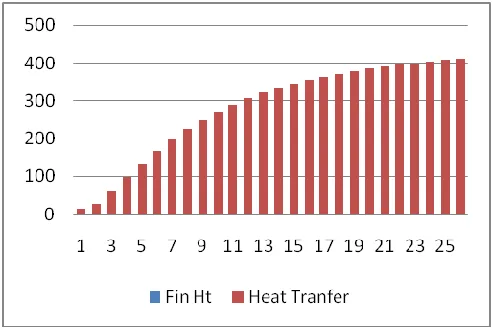
Chart 1: Variation of effectiveness for different fin htBeyond particular point graph become almost horizontal i.e. optimum height get at 15 mm. To confirm this again graph is plotted fin height against heat transfer. The graph shows increase in heat transfer falls to almost zero at a particular fin height .So beyond this point increasing fin height results more in wastage of material and thus more cost than in increase of heat transfer. Therefore this point fixed as the optimum fin height.
Chart 2: Variation of heat transfer for different fin ht Other parameter also verified as well as studied by using computer program
A double pipe heat exchanger with rectangular longitudinal fins having base width of the fin was 1mm (18 degrees) kept constant throughout the study. Analysis was done using fin heights from 0mm to 25mm were placed circumferentially around the thickness of the inner tube which remained constant throughout the study. Experimentation was carried out for various mass flow rates temperature distribution at the outlet for fin height = 15mm heat exchanger is shown in Fig .
Chart 3: variation of temp. difference for different fin height V. Experimental set up and experimentation
[image:8.612.183.429.187.352.2]© 2015, IRJET.NET- All Rights Reserved
Page 525
exchanger are mentioned in Tab. 1. Temperatures of the fluid can be measured using thermocouples with digital display. Flow rates of hot and cold water can be measured by rotometers connected to the pipes. The inlet temperature of the hot fluid was maintained at 63ºc and the cold fluid at 30 ºc. Experiments were conducted for counter flow arrangement at various mass flow rates of hot water (mch) ranging from 0.0168kg/s to 0.0126 kg. Outlet temperatures of the hot water and cold water were noted each times. This experimental process was repeated. These experimental results were then compared with the inlet and outlet temperatures found in the theoretical analysis of the problem. This obtained from MATLAB program.Fig 1 : Experimental set up of double pipe heat exchanger Table 2 : Specification of double pipe heat exchanger
S. No. Specification Dimension (mm)
1 Inner diameter 12.5
2 Thickness of the inner
tube
1
3 Inner diameter of the
outer tube
40
4 Length of the heat
exchanger
700
5 Fin Height 15
6 Fin thickness 1
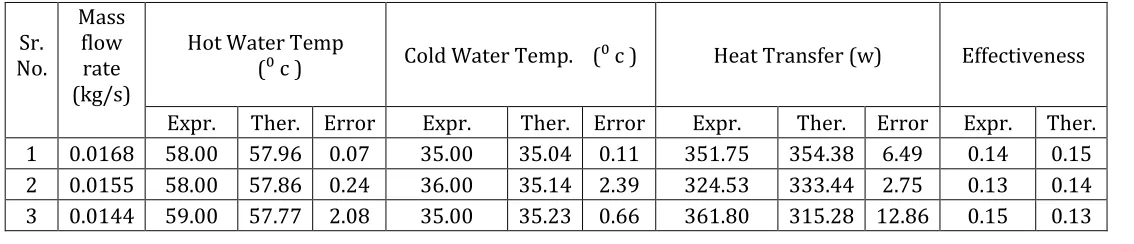
Table 3: Comparison of experimental and computer program result for optimum fin height 15 mm
Sr.
No.
Mass
flow
rate
(kg/s)
Hot Water Temp
(⁰ c )
Cold Water Temp. (⁰ c )
Heat Transfer (w)
Effectiveness
Expr.
Ther. Error
Expr.
Ther. Error
Expr.
Ther.
Error
Expr.
Ther.
[image:9.612.28.595.581.703.2]© 2015, IRJET.NET- All Rights Reserved
Page 526
4
0.0134
58.00
57.68 0.55
35.00
35.12 0.34
280.56
299.08
6.60
0.11
0.12
5
0.0126
59.00
57.60 2.37
35.00
35.40 1.14
316.58
284.60 10.10
0.13
0.12
VI.RESULT AND DISCUSSION
Comparison of analytical and experimental value of hot and cold water temperatures, heat transfer, and effectiveness
is shown in Table 7.2. For varying mass flow rate from 0.0168 to 0.0126 kg/s.Heat transfer rate increase with increase in mass
flow rate. There is a difference between the heat transfer from the analysis and the experimental data. Effectiveness of system
also increase with mass flow rate. It reveals that average error in heat transfer for varying mass flow rate is 7.75%. It is not
known what has caused this discrepancy; it could be due the oversimplification of the model, un convergence, experimental
error
.
Chart 4: Massflow Rate Vs. Heat Transfer
© 2015, IRJET.NET- All Rights Reserved
Page 527
1. Hot and cold water outlet temperature are compared. Error in hot water temp is upto 1.06 % and incase of cold water
it is upto 0.92 %. Which is in acceptable limit. One more conclusion is that hot water temperature decrease with
increase in mass flow rate. This is because increase in mass flow rate increase turbulence which help in increase in
heat transfer rate.
Chart 6: Mass Flow Rate Vs. Output Hot Fluid Temp.
7.5 Recommendations:
The experimental system was the limiting factor on the accuracy and range of the data in several ways. These are: the
maximum water flow rate, the maximum power to the heater and the airflow rate range. The system should be improved to
eliminate these limiting factors by employing the following recommendations:
1. Pump must be having high power which would improve the accuracy of heat transfer coefficient by reducing the
thermal resistance.
2. The heating power should be decreased. Increasing the heating capacity would lower the
effectiveness. Lowering effectiveness would result in lowering the sensitivity of NTU .
Now that the experimental system and data reduction methods are in place, the system has the capacity to increase
the knowledge base of present heat exchanger data and theory. Heat exchangers with defining parameters outside the
parametric range of common correlations should be tested and correlated .Independent experimental studies of this type
would assist the heat exchanger designer in improving performance of finned-tube heat exchangers.
VII. CONCLUSION
In present study built an experimental system and developed methodology for measuring the all the parameter to every
possible fin height without complication for finned tube heat exchangers. From above discussion Optimization Program and
experimentation result hold small difference but it holds appropriate good relation. This small model validate the MATLAB
program so it can used for other double heat pipe exchanger by changing data from heat transfer data book. So performance of
heat exchanger at different height can analyzed easily, also all the parameter studied simultaneously without complication.
© 2015, IRJET.NET- All Rights Reserved
Page 528
Results reveled that rectangular finned configurations show an overall improvement in the thermal characteristics.For optimum height effectiveness increase up to 23% and heat transfer is enhanced by 26% than unfinned pipe. For better
performance mass flow rate should be kept high. For mass flow rate 0.0168 kg/s effectiveness is 15 % whereas for 0.0126
kg/s it is 12 %. Heat transfer compared at 0.0126 kg/s to 0.0168 kg/s. it also increased up to 31%. Also average error in heat
transfer is 7.72 % which is in acceptable limit. Hence it can be conclude that with the help of the Optimization Program and
experimentation that we have been able to optimized Fin height for increases the rate of heat transfer. There is an optimum
value of fin height above which further increase in height does not aid the heat transfer process considerably. With the help of
the MATLAB R2010 program we have been able to successfully determine this value of optimum fin height for particular input
conditions and fin thickness. Heat transfer coefficients and effectiveness enhanced when fins were provided. It shows that Fins
provide a thermodynamic advantage. Also optimum fin height can lead to reducing capital costs and increasing savings. Other
alternative is use cheap materials for the fin and expensive durable materials for thinner pipes. This alternative helps in
increase in Heat Exchanger Life span and save capital costs.
REFERENCES.
[1], C.C., Lee, W.S., Sheu, W.J., 2001, A comparative study of compact enhanced fin-and-tube heat exchangers, International Journal of Heat and Mass transfer, vol. 44: p.3565-3573.
[2] Heat Exchanger Design Handbook, Marcel Dekker 2003. P 1-158.
[3]Wolverine Tube Heat Transfer Data Book, www.wlv.com/products/databook/.
[4]DOUBLE-PIPE HEAT EXCHANGER by Jeffrey B. Williams ,Dong-Hoon Han Jeffrey B. Williams
[5] Condensate Accumulation ,Effects on the Air-Side Thermal ,Performance of Slit-Fin Surfaces,University of Illinois ,Mechanical & Industrial Engineering Dept. ,1206 West Green StreetUrbana. IL 61801 ,JAN 2000.
[6]L. Zhang, W. Du, et al. Fluid flow characteristics for shell side of double-pipe heat exchanger with helical fins and pin fins. Experimental Thermal and Fluid Science, 2012, 36: 30–43.
[7]Heat Exchanger Design Handbook, Marcel Dekker 2003. P 1-158.
[8]J.P.Holman, 2002, Heat transfer, Tata-McGraw-Hill Publications.
[9] Incropera, F.P.; and DeWitt, D.P. (2002). Fundamentals Of heat and mass Transfer. (5th Ed.), Wiley, New York. [10]Stephen Schneider, December 2000, Water Heat exchanger Optimization for Space
[11]Sundar L. S. and Sarma K. V., “Turbulent heat transfer and friction factor of Al2O3 nanofluid in a circular tube with twisted tape inserts”,
International Communications in Heat and Mass transfer 53, pp.1409-1416, 2010.