© 2018, IRJET | Impact Factor value: 6.171 | ISO 9001:2008 Certified Journal | Page 4910
EXPERIMENTAL INVESTIGATION OF LASER TECHNIQUE TO
OPTIMIZATION OF LASER PROCESSING PARAMETER
Kumavat M.M.
1, Deshmukh A.P.
2, Matsagar P.B.
3, Pagar A.B.
4, Raut R.R.
51
Assistant Professor, Mech. Engg. Department, SND COE & RC Yeola, Savitribai Phule, Pune University(Pune),
Maharashtra, India
2,3,4,5
UG Student(Mechanical Design), SND COE & RC Yeola, Savitribai Phule Pune University(Pune),
Maharashtra, India
---***---Abstract -
The project is about optimization of sheet metal cutting parameter of a laser machine. Several optimization techniques used for the determination of optimum laser cutting condition have been critically examined. This works aim that the effect of laser machine processing parameters, such as the laser power, cutting speed, and gas pressure, focal on measured surface roughness for the laser cutting of stainless steel & mild steel sheet.The main objective was to identify the most common process parameters and cut quality characteristics. Taguchi method stresses the importance of studying the response variation using the signal–to–noise (S/N) ratio, resulting in minimization of quality characteristic variation due to uncontrollable parameter. The performance of laser cutting process mainly depends on laser parameters. It shows that by proper control of the cutting parameter, good quality cuts are possible at high cutting rates. Therefore, it is important to investigate the impact of cutting parameters on quality of cut.
Key words
:
CO2, Laser, Optimization, Process parameters,Software Minitab17, Taguchi Method.
1.
INTRODUCTION
Sheet metal of stainless steel and mild steel are the project material on which we perform the practical in order to study the effect of variation of the parameters.
Following is the study:
1. Keeping thickness of sheet metal constant.
2. Then laser power constant.
3. Effect of different gas used in laser cutting and there function.
4. Effect of focal point on cutting parameters.
5. Effect on surface roughness.
1.1. Laser
[image:1.595.338.527.229.380.2]Laser (Light Amplification by Stimulated Emission of Radiation)is a coherent and amplified beam of electro-magnetic radiation
Fig. 1.1 Laser Machine
1.2. Laser Cutting Process
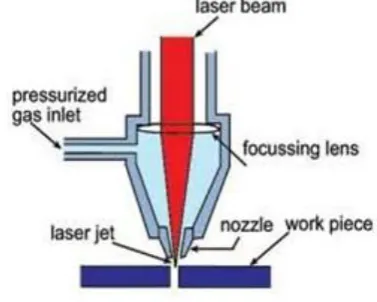
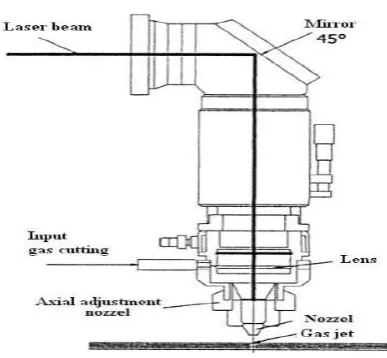
Laser cutting is a common manufacturing process employed to cut many types of materials. Materials which may be cut included ferrous metal, non ferrous metal, stone, plastic, rubber and ceramic. Laser cutting works by coordinating a high power beat laser at a particular area on the material to be cut. The vitality shaft is consumed into the surface of the material and the vitality of the laser is changed over into the warmth, which dissolve or vaporize the material. Also gas is engaged or blown into the slicing district to oust or overwhelm the liquid dissolve and vapor from cutting way.
There are a few favorable position of laser cutting over mechanical cutting, since the cut is performed by the laser bar, there is no physical contact with the material hence sullies can't enter or insert into the material. Laser cutting can create brilliant cut, complex cut, cut a few section at the same time ,deliver clean bleeding edge which require insignificant completing and also low edge stack amid cutting which will lessen contortion
© 2018, IRJET | Impact Factor value: 6.171 | ISO 9001:2008 Certified Journal | Page 4911 Figure no. 1.2: Laser Machine
Laser is an effective wellspring of light having unprecedented properties which are not found in the typical light sources like tungsten lights, mercury lights, and so forth. The interesting property of laser is that its light waves travel long separations with e almost no dissimilarity.
If there should be an occurrence of a regular wellspring of light, the light is discharged in a scatter of e isolate waves that cross out each other indiscriminately and subsequently can travel short separations as it were.
A relationship can be made with a circumstance where an expansive number of rocks are tossed it into a pool in the meantime. Every rock produces its very own rush. Since the rocks are tossed indiscriminately, the waves created by every one of the stones cross out each other and therefore they travel a short separation as it were. Then again, if the stones are tossed into a pool one by one at a similar place and furthermore at consistent interims of time, the waves along these lines produced reinforce each other and travel long separations. For this situation, the waves are said to movement intelligently. In laser, the light waves are precisely in advance with each other and accordingly have a settled stage relationship.
Figure no. 1.3 Experimental Setup of 3D Laser Cutting Machine
1.3 Problem Statements
Limit Surface unpleasantness of sheet influenced by process parameters. Streamlining is finished by utilizing "Taguchi technique", with the guide of Minitab programming.
1.4 Objective
There are 2 fundamental targets in this examination:
[a] To decide the improve parameters in cutting procedure.
[b] To break down the parameters by utilizing Taguchi Method.
[c] To investigation of the Laser Beam Cutting (LBC) on Acrylic Sheet.
[d] To locate the best parameters that can create the finest and most nature of cutting quality on Acrylic sheet by examination.
1.5 Scope of Study
The extent of study is separated in three segments:
(a) Process parameters, (b) Sheet metal cutting and, (c) Taguchi strategy.
1.6 Taguchi Designs
Genichi Taguchi, a Japanese specialist, proposed a few ways to deal with test plans that are once in a while called "Taguchi Methods." Taguchi proposed a few ways to deal with test outlines called Taguchi technique. This technique uses an orthogonal exhibit, which is a type of fragmentary factorial outline containing an agent set of all conceivable blend of trial conditions. Utilizing Taguchi technique, an adjusted examination of levels of the procedure parameters and critical diminishment in the aggregate number of required recreations can both be accomplished.
Utilization of T.M. is gone for the accompanying goals:
1.To set up the best or the ideal condition for an items or a procedure.
2.To gauge the commitment of individual parameters. 3.To gauge the reaction under the ideal conditions. 1.7 RESEARCH METHODOLOGY
Parameters to be optimized,
List of Parameters Description Laser Power = MS 1400 Watt ,SS
2400 Watt
© 2018, IRJET | Impact Factor value: 6.171 | ISO 9001:2008 Certified Journal | Page 4912 Type and Pressure of
Assist Gas
= MS (Oxygen-10 bar),SS (Nitrogen-10
bar)
Material Thickness = MS (0.5-8 mm), SS (0.5-20 mm) Mode of Operation = MS/SS(CW) Cutting Angle = 00, 20, 40, 60
Nozzle Gap
= 1mm, 2.5 mm, 4.5mm, 6.0mm
2. EXPERIMENTAL WORK
2.1 RELATION BETWEEN CUTTING SPEED AND LASER POWER
a) Cutting speed: - sheet metal cut speed by a laser in mm/min.
b) Laser power: - power assisted by laser to penetrate and cut the sheet in watt.
2.1.1 EXPERIMENT NO. 1
Table No.1 General Data of Process Parameter
Material thickness
(mm) 2 4 6 8
Gas pressure
(bar) 10 10 7 7
Laser power
(watt) 700 800 800 900
Cutting speed (mm/min)
3000 1800 1000 800
2.1.2 EXPERIMENT NO. 2
At constant thickness, to check other process parameter such as Laser Power and cutting Speed.
a) Material – Mild Steel b) Assist gas pressure – 10 Kpa
2.1.2.1. For 2mm Thickness of Sheet Table no. 2
Laser Power(watt) Cutting Speed(mm/min)
400 800
500 1000
600 1500
700 2500
800 3000
2.1.2.2. For 3mm Thickness of Sheet
Table no. 3
Laser Power(watt) Cutting Speed(mm/min)
400 600
500 800
600 1000
700 2000
800 2500
2.1.2.3. For 4 mm Thickness of Sheet
Table no. 4
Laser Power(watt) Cutting Speed(mm/min)
500 300
600 500
700 800-900
800 1000-1200
900 1500(MAX.)
Thus from above we come to know that, if we increased Laser Power then increase cutting speed at constant thickness
2.1.3 EXPERIMENT NO. 3
a) For Stainless Steel Material
For constant laser power variation of cutting speed with respect to thickness of sheet
2.1.3.1For 400 watt power Table no. 5
Thickness(mm) Cutting Speed (mm/min)
2 1500
4 800
6 200-250
2.1.3.2.For 500 watt power Table no. 6
Thickness(mm) Cutting Speed (mm/min)
2 2000
4 1200
© 2018, IRJET | Impact Factor value: 6.171 | ISO 9001:2008 Certified Journal | Page 4913 2.1.3.3. For 700 Watt Power
Table no. 7
Thickness(mm) Cutting Speed (mm/min)
2 3000
4 1400
6 1000
b) For mild steel material :
2.1.3.4. For 400 Watt Laser Power
Table no. 8
Thickness(mm) Cutting Speed (mm/min)
2 800
4 300
6 50-90
2.1.3.5. For 500 watt power
Table no. 9
Thickness(mm) Cutting Speed (mm/min)
2 1000
4 300
6 100-150
2.1.3.6. For 700 watt power Table no. 10
Thickness(mm) Cutting Speed (mm/min)
2 2500
4 2000
6 800
From above experiment we come to know that cutting speed decreases with increase in material thickness at constant power supply
3. METHODOLOGY
3.1.1 Experimental Plan and Details:
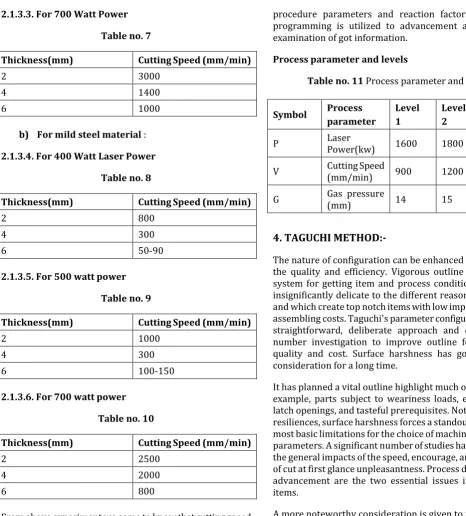
In this investigation, three machining parameters were chosen as control factors, and every parameter was intended to have three levels, signified 1, 2, and 3 (Table 1). The trial configuration was by a L'9 cluster in view of Taguchi strategy, while utilizing the Taguchi orthogonal exhibit would extraordinarily diminish the quantity of analyses. An arrangement of analyses planned utilizing the Taguchi strategy was led to examine the connection between the
procedure parameters and reaction factor. Minitab 17 programming is utilized to advancement and graphical examination of got information.
[image:4.595.35.502.71.588.2]Process parameter and levels
Table no. 11 Process parameter and levels
4. TAGUCHI
METHOD:-The nature of configuration can be enhanced by enhancing the quality and efficiency. Vigorous outline is a building system for getting item and process condition, which are insignificantly delicate to the different reasons for variety, and which create top notch items with low improvement and assembling costs. Taguchi's parameter configuration offers a straightforward, deliberate approach and can diminish number investigation to improve outline for execution, quality and cost. Surface harshness has gotten genuine consideration for a long time.
It has planned a vital outline highlight much of the time, for example, parts subject to weariness loads, exactness fits, latch openings, and tasteful prerequisites. Notwithstanding resiliences, surface harshness forces a standout amongst the most basic limitations for the choice of machines and cutting parameters. A significant number of studies have researched the general impacts of the speed, encourage, and profundity of cut at first glance unpleasantness. Process displaying and advancement are the two essential issues in assembling items.
A more noteworthy consideration is given to precision and surface unpleasantness of item by the business nowadays. Surface complete has been a standout amongst the most imperative contemplations in deciding the machining capacity of materials. Surface harshness and dimensional exactness are the vital elements required to foresee machining exhibitions of any machining tasks.
Enhancement of machining parameters builds the utility for machining financial matters, as well as expands the item quality as it were. In this unique circumstance, an exertion has been made to assess the surface harshness utilizing exploratory information. Since turning is the essential activity in the vast majority of the creation forms in the business, surface complete of turned parts has more noteworthy impact on the nature of the item. Surface Symbol Process
parameter
Level 1
Level 2
Level 3
P Laser Power(kw) 1600 1800 2000
V Cutting Speed (mm/min) 900 1200 1500
© 2018, IRJET | Impact Factor value: 6.171 | ISO 9001:2008 Certified Journal | Page 4914 complete in turning has been observed to be affected in
differing sums by various factors, for example, sustain rate, work material qualities, work hardness, shaky developed edge, cutting velocity, profundity of cut, cutting time, apparatus nose range and device forefront edges,
4.1.Taguchi Orthogonal Array:
In the event that there is an analysis having 3 factors which have four esteems, at that point add up to number of test is 81. At that point aftereffects of all analysis will give 100 exact outcomes. In contrast with above technique the Taguchi orthogonal cluster make rundown of nine tests in a specific request which cover all components.
4.2. Experimentation: -
The entire experimentation is separated into various advances. Every one of the means are talked about in detail underneath:
4.2.1 Maximum Limits of Operating Parameters There are three machining parameters i.e. laser control, cutting pace, gas weight. Distinctive investigations are finished by differing one parameter and keeping other two settled so most extreme estimation of every parameter was acquired. Working reach is found by testing with to plaser power and taking the lower levels of other parameters. A blend of every one of the three parameters is found past which device or occupation falls flat.
4.2.2Experiment Performed:-
Examinations are performed by the chosen outline of test parameter as appeared in Table. Machining time is noted by stopwatch and estimated last surface complete of all occupations.
4.2.3. Observation
In the run nine experiments are performed and surface finish is calculated. This is given in below table no.12AQ
Sr.no
Laser Power (kw)
Cutting speed (mm/min)
Gas pressure (bar)
1 1600 1000 0.5
2 1600 800 0.6
3 1600 600 0.7
4 1800 1000 0.5
5 1800 800 0.6
6 1800 600 0.7
7 2000 1000 0.5
8 2000 800 0.6
9 2000 600 0.7
5. STUDY ON EFFECT OF GAS USED IN LASER BEAM
MACHINE AND SELECTION OF FOCAL POINT
5.1 Gas Study
a) N2 gives preferred surface complete over O2 [2].
b) N2 is utilized to cut stainless steel sheet on the grounds that N2 give white slice because of its purity[2].
c) O2 is utilized to cut mellow steel sheet [2].
d) (CO2(12%)+He(64%)+ N2(24%)) used to make laser for cutting reason [2].
(O2 , N2) used to make weight. N2 used to make laser is unadulterated N2[2].
5.2 Focal Point
a) The profundity of infiltration is relative to measure of energy yet additionally rely upon area of point of convergence [4].
b) For M.S. sheet central is sure i.e. over the sheet metal, while for S.S sheet central is negative i.e. beneath or center of the metal sheet[4, 5].
6.RESULT
Sr. No.
Laser
Power Cutting speed Gas pressure Surface roughen -ss
S/N Ratio
1 1600 1000 0.5 2.116 -7.458
2 1600 800 0.6 2.032 -6.158
3 1600 600 0.7 2.357 -6.667
4 1800 1000 0.5 1.952 -6.584
5 1800 800 0.6 2.667 -7.436
6 1800 600 0.7 1.958 -6188
7 2000 1000 0.5 2.791 -8.293
8 2000 800 0.6 2.225 -7.694
9 2000 600 0.7 1.882 -5.493
7. ADVANTAGES
1.No Direct Contact With Workpiece
2.Driliing Of Micro Hole Is Possible
3.No Effect On Properties Of Workpiece
4.No Burr And Chip Formation
© 2018, IRJET | Impact Factor value: 6.171 | ISO 9001:2008 Certified Journal | Page 4915
8. SUMMARY
In this venture, playing out the test on Laser Beam Machine, we can locate the ideal machining parameter which influences the surface complete of the work piece. And furthermore the impacts of machining parameters on S-N proportion i.e. flag to commotion proportion.
In this investigation, the Gray social based Taguchi strategy was connected for the different execution qualities of cutting activities. A dim social examination of the surface unpleasantness acquired from the Taguchi technique diminished from the various execution qualities to a solitary execution trademark which is known as the dim social review. Hence, the streamlining of the muddled different execution qualities of the procedures can be enormously improved utilizing the Gray social based Taguchi technique. With this work we came to know considered that the cutting parameters like focal point, cutting velocity and laser control extraordinarily influences on laser cutting task, which by implication influences the - 9surface unpleasantness esteems. It is additionally demonstrated that the execution qualities of the cutting tasks, such as the surface harshness might be improved by utilizing this strategy.
Affirmation
We accept the open door to express our profound feeling of appreciation and entire hearted on account of our regarded guides Prof. Kumavat M.M., for priceless direction, motivation and consolation throughout the work. We are enormously in wrangled to them in steering us at whatever point we confront challenges in our work.
REFERENCES
1] International Journal of Engineering Research and Applications Vol. 2, Issue 2,Mar-Apr 2012, pp.1190-1196,“Optimization of High Power CO2 Laser Machining Centre’s Machining Parameters by Experimental Analysis”, Prof. Dhaval P. Patel, Mrugesh B. Khatri / , www.ijera.com
2] International Journal For Technological Research In Engineering, vol.1 issue:2, March-2015“LITERATURE SURVEY ON LASER CUTTING MACHINE PROCESS PARAMETER” NAIMESH R. KADIYA, Department of Mechanical Engineering, Indus Institute of Technology and Engineering, Rancharda, Ahmedabad, Gujarat, India
3] Nonconventional Technologies Review., “APPLICATION OF THE TAGUCHI METHOD FOR OPTIMIZATION OF LASER CUTTING: A REVIEW” Romania, December, [email protected]
4] International Journal of Advanced Mechanical Engineering. “MULTI-OBJECTIVE OPTIMIZATION OF LASER BEAM MACHINING PROCESS PARAMETERS” ISSN 2250-3234 Volume 4, Number 3 (2017), pp. 257-262, P.J. Pawar and G.B. Rayate , PG student, K.K.Wagh
Institute of Engineering Education and Research, Nasik, Maharashtra, INDIA.
5]International Journal For Technological Research In Engineering Volume 1, Issue 5, January – 2017 ISSN (Online) : 2347 – 4718 “OPTIMIZATION OF INPUT PARAMETERS ON SURFACE ROUGHNESS DURING LASER CUTTING - A REVIEW” Vipul K Shah, Mr. Hardik J Patel ,Sardar Patel Institute of Technology U V Patel College of Engineering Gujarat, India.
6] International Journal Of Computational Engineering Research (ijceronline.com) Vol. 2 Issue. 5 “CONTROL PARAMETERS OPTIMIZATION OF LASER BEAM MACHINING”, Ruben Phipon1, B.B.Pradhan, Mechanical Engineering Department, SMIT, Sikkim, India
7] B.D.Prajapati, R.J.Patel, and B.C.Khatri. Parametric Investigation of CO2 Laser Cutting of Mild Steel and Hardox-400 Material. IJETAE, 3(4):204–208, 2013.
8] Mayank N Media and Prof. Davao M Patel. Effect of Focal length of surface roughness of 1 mm thin Brass sheet by using assists gas CO2. IJIRSET, pages 4539– 4543, 2013.
9] K.A. Ghany and M.Newishy. Cutting of 12mm thick austenitic stainless steel sheet using pulsed and CW ND: YAG laser. JMPT, pages 438–447, 2005.
10] A.Riveiro et al. The Role of the Assist Gas Nature in Laser Cutting of Aluminium Alloys. Physics Procedia, pages 548–554, 2011.
11] P.S.Chaudhary, and Prof.Patel. Parametric effect fiber laser cutting on surface roughness in 5 mm thick mild steel sheet
12] Avanish Kumar Dubey,and Vinod Yadava Optimization of kerf quality during pulsed laser cutting of aluminium alloy sheet.Journal of materials processing technology, pages 412–418, 2008.
13] Dipesh Patel, and Prof. R.J.Patel. Parametric Analysis of Ytterbium: fiber laser cutting process. 2010.
14] Introduction to Laser Material Processing by Columbia University.
15]P.K.Mishra,Non-Conventional Machining. Narosa Publication House, pages 147–159,2005.
16] IJSRD - International Journal for Scientific Research & Development| Vol. 3, Issue 04, 2015 | ISSN (online): 2321-0613
17] Daniel Teixidor, Optimization of process parameters for pulsed laser milling of micro- channels on AISI H13
tool steel journal
© 2018, IRJET | Impact Factor value: 6.171 | ISO 9001:2008 Certified Journal | Page 4916 18]Dubey,A.K.,Yadava V. Laser Beam Machining A
Review. International Journal of machine Tools And manufacture 2008;48[6]:609-628
19]VDI Guideline .Digital Factory-Fundamentals(VDI 4499-Part 1).2008.Berlin:Beuth
20]Han, J.,Kamber, M.,Pei, J.Data Mining: Concepts and Techniques 3rd ed.;Morgan Kaufmann Publisher Inc.;2011.
BIOGRAPHIES
Prof. Kumavat Mukesh Manilal. [email protected] BE Mechanical
SRES COE Kopargaon (PUNE) ME Design
SND COE & RC Yeola (PUNE)
Abhinay Prabhakar Deshmukh. SND COE & RC Yeola,
BE-Mechanical
Prashant Bhausaheb Matasager. SND COE & RC Yeola,
BE-Mechanical
Amol Babasaheb Pagar. SND COE & RC Yeola, BE-Mechanical