© 2017, IRJET | Impact Factor value: 5.181 | ISO 9001:2008 Certified Journal | Page 1884
Design and Implementation of DMC for Memory Reliability
Enhancement
Hema
1, Rekha S
2, Dr. A.M Bhavikatti
31
Fourth SEM M. Tech Appa Institute of Engineering and Technology Kalaburagi, Karnataka, India
2Assoc. Professor Appa Institutes of Engineering and Technology Kalaburagi, Karnataka, India
3
HOD & Professor BKIT Bhalki, Karnataka, India
---***---Abstract -
Demand for high accurate detection andcorrection of data in memory brings motivation for this work. In this modern era flow of data has increased to a higher extent which is creating the corruption of required data. Errors created by self-generator machines have less control from the human beings and also it’s very difficult to monitor such a huge data. If one could achieve high accurate data correction then a capacity of memory integration on chip can be increased to fill the gap between the technology and semiconductor industry. The scope for DMC exists because of its less area and more accurate error detection. Along with that scope exists for ERT because it determines the area without actually encoding and decoding
Key Words: DMC (decimal matrix code), ERT (error reuse technique), Multiple Bit Upsets (MCUs), Error Correction Code (ECC), Punctured Difference Set (PDS).
1. INTRODUCTION
The CMOS technology has scaled down to nano scale which is making more transistors on a chip. As the number of electronic components increased and error rate in memories also increased due to ionizing effects from atmosphere. In memory single bit error is a major problem and Multiple Bit Upsets (MCUs) has turned into a bigger problem than the single bit error.Was used for over the year to correct the single bit errors in the memories. To manage MCUs Reed – Solomon codes, Punctured Difference Set (PDS) and Bose-Chaudri-Hocquenghem codes have been used till now. In these converted codes encoding and decoding are more complex and requires more power, more area and large delay. The technique of interleaving has been used in MCUs to improve memory cells in physical arrangement on the boards. In Content Addressable Memory (CAM) interleaving cannot be used because of tight coupling in between the cells.
To assure the MCUs, with respect to single-error rectification and two fold locations the Built-In Current Sensors are used. To effectively rectify the MCUs error the new method, Two Dimensional Matrix Code (MCs) is used, which divides the long data into the various sub data’s. In Hamming codes a bit to every line is secured and in equality code every segment is secured. After identifying these two errors in Hamming codes the vertical syndrome in MC have capacity of correcting errors up to 2bits. In a methodology that gives number of calculation with respect to Hamming
code has considered to be in programming level and it also utilizes expansion of number qualities to distinguish and right delicate errors. Comparatively recent study as given a hint that these demonstrated methodology has less delay comparing to other methodologies.
1.1 PROBLEM DEFINITION
A modern literature survey conveys that scope for high reliability and high accurate error correction and detection exists using Decimal Matrix Code [1], [2], [3] and [4]. The technique of making less number of the redundant bits and the maintaining the reliability of the planned task is a challenging work as taking into account of fast accessing over a large data.
An attempt has been made to detect and correct more errors by completely understanding the fundamental concepts of DMC. The main objective is to:
Maintain higher reliability of memory.
Fault-tolerant memory protected with DMC can be simulated by using Xilinx.
Comparing the area, delay, power with different papers.
Finding power and area using cadence.
1.2 OVERVIEW OF PREVIOUS WORKS
© 2017, IRJET | Impact Factor value: 5.181 | ISO 9001:2008 Certified Journal | Page 1885 that it’s out in the open, the determination of the generated
code may be examined by the specific circuit, to get the finest result.
2. DESIGNS AND IMPLEMENTATION
DMC is planned to guarantee dependability of Multi bit upsets with lessened execution overheads. To recognize the right mistakes in the circuit a 32-bit of encoding and decoding is proposed in my project work. Various system architecture and methodologies are discussed.
2.1 System Design
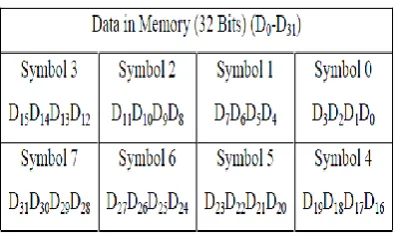
[image:2.595.359.512.232.294.2]Proposed work incorporates gap of image and organization of basic thoughts are achieved, that N-bit data is shared out to K image length of multiple-bits. The expression can be written as (N=K × m) where (K=K1 × K2, lines and segments). As shown in Table 4.1, a 32- bit code is divided into 8 sub symbols and again in that 4-bit are chosen simultaneously. Here while detecting and correcting maximum number of errors the check bits are different for all the K-bits generated. By properly selecting the values of K and m, the maximum bits can be corrected.
Table -1Logical Organization of 32-bit data
2.2 Proposed DMC
[image:2.595.63.262.406.525.2]The planned task is of error controlling scheme is portrayed in Figure 1 the data bits (D) are first given to the encoder. Output of the DMC encoder is Horizontal (H) and Vertical bits (V). These values are stored in the memory temporarily. The SRAM extra added redundancy tallied to that of information data during read operation. Then decoder gives the data bits which are corrected.
Fig-1Proposed design schematic for fault-tolerant DMC
2.3 Planned Diagram of Fault-Tolerant Memory
As shown in the Figure 2, encoder which takes data bit d as input. Output of the DMC encoder is Horizontal (H) and Vertical bits (V). These values are stored in the memory temporarily. The SRAM redundant bits are compared with the information bits while read operation. Then decoder gives the data bits which are corrected that mean while read operations the errors can be corrected. This is an advantage of DMC with high performance and high fault-tolerant capacity, ERT technique is used to optimize the area.
Fig-2 Block Diagram of DMC for fault-tolerant
2.4Planned Decimal Matrix Code Encoder
This depicts the, gap image and organize matrix thoughts are achieved, that is the data N-bit is divided into K image of length m-bits. The expression can be written as (N=K × m) where (K=K1 × K2, lines and segments). It’s not necessary to change design to implementing the idea of project main schematic. Let us take 32-bit data and explain the DMC scheme. Total 32 bits are divided into 8 parts of size 4 bits. From D0 to D31 are 32 information bits, check bits are 10 Horizontal (Ho-H9) and 16 vertical bits. The detection and correction ability depends on the how we choose the values of k and m. trade-off occurs in choosing these values for maximum performance.
Fig-3 Applied schematic fault tolerant
[image:2.595.308.543.505.592.2]© 2017, IRJET | Impact Factor value: 5.181 | ISO 9001:2008 Certified Journal | Page 1886 Equally for the horizontal dismissedH14H13H12H11H10
and H19H18H17H16H15,
For the we have by XOR of data bits.
Using the above equations (1) to (4), encoding is formed with the help of Decimal and Binary operations.
2.5 Planned Decoder for DMC
To acquire a data is remedied the translating procedure has to needed. Case in point, to begin with, they got repetitive bits H4H3H2H1H0 and V'0−V'3 are obtained from available data. Even disorder horizontal bits ∆H4H3H2H1H0 and straight down disorder bits S3 − S0 are ascertained as takes.
Furthermore, correspondingly to other rest vertical disorder bits, here “−"signifies decimal whole number deduction. At the point when these values _H4H3H2H1H0 and S3 − S0 are equivalent to the value zero. At the point when these values _H4H3H2H1H0, S3 − S0 becomes nonzero, the incited mistakes can be distinguished and situated for image 0, afterward those errors can be removed easily.
Fig-4 32-bits DMC.
Fig-5 Design of 32-bit encoder for DMC using adders and XOR gates
Fig-6 A 32-bit decoder for DMC using ERT
Fig.-7 Restrictions of error in Binary operations
2.6 Bound of Binary Error Detection
In this planned twofold fault discovery method, in spite of the fact that it obliges low repetitive bits, its slip recognition capacity is constrained. The principle purpose behind this is that its error discovery component is in view of binary. We show the points of confinement of this basic paired slip recognition utilizing a straightforward illustration. Figure 7 shows Binary bits (B3 to B0) which are unique and data bits (C0 and C1) are redundant bits.
Fig.-8 Benefit locating glitches
© 2017, IRJET | Impact Factor value: 5.181 | ISO 9001:2008 Certified Journal | Page 1887
Fig.-9 Adjustment of MCUs with DMC.
Sort 1 is a solitary mistake, sort 2 is not following an continuo’s sequence slip in dual successive images, sort 3 is a sequential mistake in dual continuous images, sort 4 is similar to sort 2 with two discontinuous images, back to back slip in four successive images seen in 5.
These outcomes imply that mistake bit values B2 and B0 were incorrectly viewed as the first bits because of that errors bits are not revised. From the above example it’s clear that an even order error cannot be identified in binary operation.
2.7 Decimal Error Detection Benefits
Previously it has been demonstrated as error location taking into account parallel calculation can just distinguish a limited number of errors. In any case, when these decimal calculations are utilized for distinguish errors, then these errors can be identified such that unraveling error can be stayed away from. The reason for this operation component of calculation is not the same as that of paired. The location method of decimal error discovery utilizing the proposed structure indicated as a part of Fig. 2 is completely depicted in Fig. 6. As a matter of first importance, the flat excess H4H3H2H1H0 are of first data bits in images 0 and 2 as per 1
At the point in MCUs happen to be image 0, image 2, then the bits in image 0 surprise to "1111" from the "1100"(D3D2D1D0= 1111) then bits in image 2 may be miracle to "0111" from "0110" (D11D10D9D8= 0111). Amid the disentangling migration, got flat repetitive H4H3H2H1H0 are initially processed.
Decimal integer subtraction gives H4H3H2H1H0 syndrome bits .
The decimal estimation of _H4H3H2H1H0 are not zero which speaks to the errors are recognized and situated to image 0 or image 2. Therefore, the exact area these flopped bits are situated to utilizing the vertical disorder bits S3 − S0 or S11 − S8. At long last, every one of these errors can be amended by (7). Thusly, in light of decimal calculation, the proposed system has higher resilience ability for ensuring memory against M
Accordingly this is conceivable to single and decimal slips and also any other sorts of numerous errors per line could be revised to proposed strategy regardless of whether errors are back to back or inconsecutive. As shown in the Figure 9.
Fig.-10 Mistake Find cannot be modified by DMC.
© 2017, IRJET | Impact Factor value: 5.181 | ISO 9001:2008 Certified Journal | Page 1888 1) Information bits in symbols with decimal integer.
0 and 2 are equal to 2m –1 and
2) Every bits in symbols 0 and 2 are troubled.
Accepting that these 2 components have been accomplished, by encoding and disentangling procedures of DMC, H4H3H2H1H0, and are registered, as takes after:
H4H3H2H1H0 are obtained
The above results shows that in symbol 0 and 2 no errors occurred and memory would grieve a disappointment though, type is unusual. E.g. when m = 4, then likelihood of the decoding errors is:
Fig-11 Time Difference security code with J(S)
The Figure 11 shows the plot of 8 upsets in data, from this it can be concluded that memory usually contains very small amount of regular order of errors and into a space of these errors length is not more than 3 bits, it’s not big dispute.
2.8 Results and Discussion
Fig.-11 DCM Encoding Output
Fig.-12 DCM Decoding output
Fig.-13DCM Detecting output
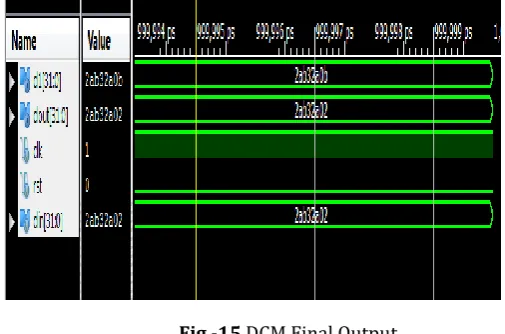
© 2017, IRJET | Impact Factor value: 5.181 | ISO 9001:2008 Certified Journal | Page 1889 Fig.-15 DCM Final Output
Fig.-16 RTL Schematic
Fig.-17 Vertex5 Hardware output
Table -2: Error Correction capability
2.9 Applications
This can easily incorporated in VLSI design system.
This is highly preferable for the applications of security basis.
Flip flops and registers used are basically deals in lowering energy.
This will preferably detects data signals having glitches and correcting the signals.
Gives more reliable result, this idea is more efficient in defense to maintain encryption of data.
3. CONCLUSIONS
Error rectification codes are utilized to enhance the memory insurance and make the memory error free. It utilized to distinguish a event of error furthermore corrected. The proposed DMC system achieves in detecting and correcting the errors very efficiently using the decimal algorithm method. In comparing to previous works the Enhanced DMC have the capability to correct errors up to 5 bits. The proposed system shows that it has superior protection level comparing to the large multiple cell upsets in the memory cells.
ACKNOWLEDGEMENT
I am graceful to my guide for supporting me in my project and my presentation, suggesting in every mistake done by me
REFERENCES
[1].Jing Guo, Liyi Xiao, Zhigang Mao and Qiang Zhao, “Enhanced Memory Reliability Against Multiple Cell Upsets Using Decimal Matrix Code,” IEEE TRANSACTIONS ON VERY LARGE SCALE INTEGRATION (VLSI) SYSTEMS, VOL. 22, NO. 1, pp. 127-135, JANUARY 2014
[2].Riaz Naseer and Jeff Draper, “Parallel Double Error Correcting Code Design to Mitigate Multi-Bit Upsets in SRAMs,” 978-1-4244-2361-3/08/$25.00 ©2008 IEEE. Abbreviation
[3].T.Maheswari and Mr.P.Sukumar, “Error Detection and Correction in SRAM Cell Using Decimal Matrix Code,” IOSR Journal of VLSI and Signal Processing (IOSR-JVSP) Volume 5, Issue 1, Ver.II (Jan – Feb. 2015), PP 09-14
[4].Juan Antonio Maestro, Pedro Reviriego, Sanghyeon Baeg, Shijie Wen, Richard Wong, “Soft error tolerant Content Addressable Memories (CAMs) using error Types of
applied ECC
no. of
Information bits
no. of redundant bits
error correction capability proposed
DMC 32 36 5
matrix
code 32 28 2
hamming
© 2017, IRJET | Impact Factor value: 5.181 | ISO 9001:2008 Certified Journal | Page 1890 detection code and duplication,” @2013 Elsevier
B.V.
[5].Gustavo Neuberger, Fernanda Gusmao de lima, kastensmidt and Ricardo Reis, “An Automatic Technique for Optimizing Reed – Solomon Codes to Improve Fault Tolerance in Memories,” IEEE Design & Test of Computers, Copublished by the IEEE CS and the IEEE CASS @2005 IEEE
[6].K.Madhuri, V.Thrimurthulu, “Implementation of Decimal Matrix Code for Correcting Cell Upsets in Static Random Access Memories,” International Journal of Electrical and Data Communication, ISSN: 2320 – 2084, Volume-2, Issue-10, Oct-2014
[7].Sanghyeon Baeg, Pedro Reviriego, Juan Antonio Maestro, Shijie and Richard Wong, “Analysis of a Multiple Cell Upset Failure Model for Memories”
[8].Sandeep M D and Rajashekhargouda C. Patil, “An Approach to Reduce Number of Redundant Bits used To Overcome Cell Upsets in Memory using Decimal Matrix Code,” Proc. Of Int. Conf. on Recent Trends in Signal Processing, Image Processing and VLSI, ICrtSIV, ACEEE,2014
[9].Costas Argyrides, Stephania Loizidou and Dhiraj K. Pradhan, “Area Reliability Trade – Off in Improved Reed Muller Coding,” SAMOS 2008, LNCS 5114, pp. 116-125, 2008 Springer – Verlag Berlin Heidelberg 2008