© 2017, IRJET | Impact Factor value: 5.181 | ISO 9001:2008 Certified Journal
A Study on Identification of Key Factors in Resource Management
System and Relevance of Computer Applications in Resource
Management System
Sanyal Rajan
1, Divya K.K
2, Binu P
31
M-tech Student, Dept. of Civil Engineering, Sree Narayana Gurukulam College of Engineering, Kerala, India
2Assistant professor, Dept. of Civil Engineering, Sree Narayana Gurukulam College of Engineering, Kerala, India
3Associate professor, Dept. of Civil Engineering, Sree Narayana Gurukulam College of Engineering, Kerala, India
---***---Abstract –
Nowadays, construction projects are more complicated than before. Many tasks must be correctly controlled if a project is to run smoothly, on time, and in the project budget. The completion of construction projects requires effective management of construction resources. The basic objective of the resource management is to supply and support the field operations so that established time objective can be met and costs can be within the construction budget. Manpower, equipment and materials are important to project resources that require close management attention. The aim of the study is to analyse the key factors of resources management. This study also aims to analyse the benefits and obstacles of using computer applications in the construction resource management. A total of 28 construction companies were selected for the study. An open-ended questionnaire which consist of 84 questions with regard to the resource management system and 17 questions with regard to the benefits and obstacle of resource management software usage was designed, validated, and distributed among Site Engineers, Project Managers, and owner of company who are directly involved in the activities of the construction project.The result of the questionnaire survey outlined the level of usage of computer application software in resource management, the benefits derived from using the software, which include their ability to facilitate efficient management of resources, provide access to stored data within the limited possible time, as well as accurate way of managing construction resources, which have resulted in the positive impact toward the productive performance of construction companies. The study shows that most contracting companies are interested in using some techniques of managing construction resources such as building an archive for previous projects about the management of resources and save the effort, time and reducing errors. Statistical Package for Social Science (SPSS) Software was used for data analysis. Key Words: labour, material, equipment, key factors, resource management.
1. INTRODUCTION
Construction Industry is one of the most booming industries in the whole world. This industry is mainly an urban-based one which is concerned with preparation as well as the construction of real estate properties. The more the resources provided from within the national economy, the higher the factor of the extent of self-reliance. The increasing complexity of infrastructure projects and the environment within which they are constructed place greater demand on construction managers to deliver projects on time, within the planned budget and with high quality.
their availability, assigns the resources to projects as needed and utilises reporting and dashboard features to measure equipment utilization.
2. MATERIALS AND METHODOLOGY
This chapter includes the methodology used in this research. It provides the information about the research strategy, research design, population, sample size, various approaches to data collection and data analysis. It also identifies the questionnaire design, pilot study, validity content, and reliability.
2.1 Research Strategy
Research strategy can be defined as the way in which the research objectives can be questioned (Naoum, 2007). The explanation of mass behavior often requires mass attitude data that can only be obtained by a survey (Weisberg and Bowen, 1977). The people who provide information to the researchers are referred to as subjects, study participants, or respondents in quantitative research or as study participants or informants in qualitative research (Polit and Hungler, 1999). There are two types of research strategies, namely, .quantitative research and qualitative research. (Naoum, 2007). Data may take the form of narrative information (qualitative data) or numerical values (quantitative data), (Polit and Hungler, 1999). Quantitative research is objective in nature. It is defined as an inquiry into a social human problem, based on testing a hypothesis or a theory composed of variables, measured with members, and analysis with statistical procedures (Naoum, 2007). Quantitative researchers focus on the relationship between the independent variables and dependant variables (Polit and Hungler, 1999). Quantitative research is an objective measurement of the problem. In this study, the questionnaire of this study is designed to get the factual information about local practices of contractors in managing construction resource in building projects as well as the opinions of contractors about these practices.
2.2 Research Design
The purpose of this research is to explore the current practices of construction resources management of building projects and analyse the benefits and obstacles of using computerised packages in the construction resource management. A structured questionnaire with closed personal interviews is used together in this research. The structured questionnaire is probably the most widely used data collection technique for conducting surveys. Questionnaires have been widely used for descriptive and analytical surveys in order to find out facts, opinions and views (Naoum, 2007).
2
.3 Limitation of the Study
The study is only limited to some Construction companies in Ernakulam India, and consider only first class and second class contracting companies.
2.4 Questionnaire Design
The data used for the purpose of this research work were gathered from the respondents, the respondents were mostly site engineers, project managers, owner of company, who have much experience about resource management system used for construction project. In this research, few methods of data collection were used including observation, documentations, interviews and questionnaire and documentary analysis. The good design of the questionnaire is a key to obtain good results and warranting a high rate of return. The questionnaire consist of four sections namely
Section A: General information (company profile)
Section B: Construction materials management in construction projects
Section C:Construction labors management in construction projects
Section D:Construction equipment management in construction projects.
Section E:Computer applications in resources management systems in construction projects
2.5 Validity Test
After preparing the questionnaire in its initial form, the researcher presents it to five experts to examine its validity. The five experts are two lecturers in a University, two contractors and one expert in construction management field. The experts generally manifest comforting complacence toward the questionnaire. However, they provide the researcher with some comments and suggestions which are taken into consideration while modifying the questionnaire structure.
3 DATA ANALYSIS AND RESULTS
The data were analyzed on the basis of Mean score and frequency analysis in SPSS.
3.1 General Information
© 2017, IRJET | Impact Factor value: 5.181 | ISO 9001:2008 Certified Journal
respondents executed projects with a value of more than 2 crores. 25% of contracting companies executed projects with a value between 1.1 to 2 crore, and 5% of contractors executed projects with a value of less than 50 lakhs. This indicates that most of executed projects are of bigger size.
3.2 Construction Materials Management in
Construction Projects
The result demonstrates that “materials are timely available site with the right quantity” and “improving follow up and monitoring construction material” are the factors which have bigger effect in the case of benefits of implementation of material management system. The results also show that the problems which have more conscious on its importance “Materials are not available with required quantity”, “late delivery to the site “and “Materials are not available”.
3.3 Construction Labors Management in
Construction Projects
The result demonstrates that majority of contracting companies believe that the most important factors which have a big effect on increasing the productivity of the workers are the “workers participation in organising the company as well as caring about their personal status”, “good management of the workers” and “worker participation in decision making”. The result also demonstrates the greatest percentage of factors which affecting the reduction of labor productivity “that is not satisfied with the workers” and the lowest was to “personal problem of the workers”.
3.4 Construction Equipment Management in
Construction Projects
The result demonstrates that the most influential factors which related to the equipment on the duration and cost of the project are “the availability of construction equipment in the market”, “the quality of construction equipment’ and “life time of construction equipment”.
3.5 Computer Applications in Resources
Management Systems in Construction Projects
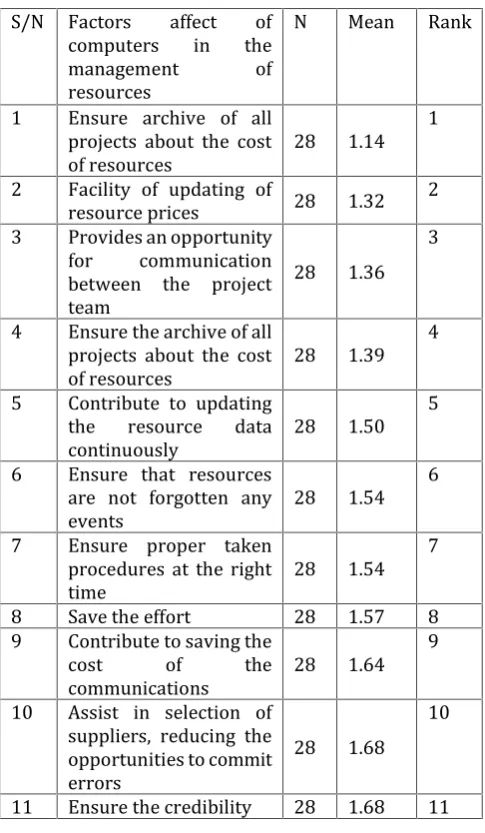
Table 1 shows the benefits obtained by using computerized in the management of resources. The results indicate that most of contractors surveyed believe that using of computer software will be very beneficial in general. These benefits are
Building archive for previous projects about the cost of resources.
Save the effort and minimizing errors.
Building general prices database.
[image:3.595.313.556.142.559.2] Fast cost and saving time.
Table-1: Benefits of using software packages and the important of computer use in the management of resources
S/N Factors affect of computers in the management of resources
N Mean Rank
1 Ensure archive of all projects about the cost
of resources 28 1.14 1
2 Facility of updating of
resource prices 28 1.32 2 3 Provides an opportunity
for communication between the project team
28 1.36 3
4 Ensure the archive of all projects about the cost
of resources 28 1.39 4
5 Contribute to updating the resource data
continuously 28 1.50 5
6 Ensure that resources are not forgotten any
events 28 1.54
6
7 Ensure proper taken procedures at the right
time 28 1.54
7
8 Save the effort 28 1.57 8 9 Contribute to saving the
cost of the
communications 28 1.64 9
10 Assist in selection of suppliers, reducing the opportunities to commit errors
28 1.68 10
11 Ensure the credibility 28 1.68 11
Table- 2:Obstacles that are facing the local companies in using construction resources management software
S/N Obstacle N Mean Rank
1 The high cost computer
programs 28 1.14 1
2 Shortage of user friendly computer
program 28 1.43
2
3 No understanding for importance of
computer program 28 1.61 3
4 Difficulty of dealing with available
programs 28 1.61
4
5 The need for training
on computer program 28 2.14 5 6 Shortage of qualified
persons in using
computer program 28 2.50 6
6. CONCLUSIONS
In this study, following are the conclusions;
The selected contracting companies are involved in building works.
Most of contractors believe that using of computer software will be very beneficial in general. These benefits are, building archive for previous projects about the cost of resources, save the effort, time and minimizing errors and fast cost and saving time.
The majority of contractors consider the “high cost computer programs” is the most important obstacle that affects the using of computerized resources management packages. Respondents think that “Shortage of user friendly computer programs’ by the contractor has big effect on using computerized resources management packages.
Many problems can be reduced when contractors implement construction materials management systems such as materials not available, late delivery to the site and deliver materials with wrong quantities
There are many factors that affecting on the increasing of labor productivity like workers participation in organising the company as well as caring about their personal status, worker participation in decision making and good management of the workers.
There are many factors which related to equipment and impact on the cost of the project like availability of construction equipment in the market and the quality of construction equipment.
REFERENCES
[1] Adnane Belout and Clothilde Gauvreau (2004), Factors
Influencing Project Success: The Impact of Human Resource Management, International Journal of Project Management, 22, 1–11.
[2] Ar. Ravish Kumar and Dr. F. Rajak (2015), Computer
Aided Construction Management, International Journal on Recent and Innovation Trends in Computing and Communication, ISSN: 2321-8169, 3, Issue: 2 019– 023.
[3] Aynur Kazaz and Serdar Ulubeyli (2004),A Different
Approach to Construction Labour in Turkey: Comparitive Productivity Analysis, Building and Environment, 39, 93 – 100.
[4] Do Ba Khang and Yin Mon Myint(1999), Time, Cost and
Quality Trade-Off in Project Management: A Case Study, International Journal of Project Management 17, No. 4, 249-256.
[5] Ismail Abdul Rahman, Aftab Hameed Memon and Ahmad
Tarmizi Abd. Karim (2013), Relationship between Factors of Construction Resources Affecting Project Cost, Modern Applied Science, 7, No. 1, ISSN 1913-1852.
[6] K SwarnaKumari and J Vikranth,M.E (2012), A Study On
Resource Planning In Highway Construction Projects. International Journal of Engineering Research and Applications (IJERA), ISSN: 2248-9622, 2, Issue4, 1960-1967.
[7] Kees van Hee, Alexander Serebrenik, Natalia Sidorova,
Marc Voorhoeve and Jan van der Wall (2007), Scheduling-Free Resource Management, Data & Knowledge Engineering, 61, 59–75.
[8] Khyomesh V. Patel and Prof. Chetna M. Vyas (2011),
Construction Materials Management on Project Sites, National Conference on Recent Trends in Engineering & Technology- Gujarat India.
[9] Mohan R. Manavazhi and Dinesh K. Adhikari (2002),
Material and Equipment Procurement Delays in Highway Projects in Nepal, International Journal of Project Management, 20,627–632.
[10] Moonseo Park (2005), Model-based dynamic resource
management for construction project, Automation in Construction, 14, 585– 598.
[11] Qian Shi, Xue Ding, Jian Zuo and George Zillante (2016),
Mobile Internet based construction supply chain management: A critical review, Automation in Construction. Elsevier. [Online} 0926-5805. Available:http://dx.doi.org/10.1016/j.autcon.2016.08.0 20
[12] S.K. Nagaraju and B. Sivakonda Reddy (2012), Resource
Management in Construction Projects – a Case StudyIRACST – Engineering Science and Technology: An International Journal (ESTIJ), ISSN: 2250-3498, 2, No.4.
[13] Saad Al-jibouri (2002), Effects of Resource Management
Regimes on Project Schedule, International Journal of Project Management, 20, 271–277.
[14] Shu-Shun Liu and Chang Hung Wang (2008),
© 2017, IRJET | Impact Factor value: 5.181 | ISO 9001:2008 Certified Journal
profit maximization considering cash flow, Automation in Construction, 17, 966–974.
[15] S. Prakash Chandar, Aminu Tijjani and N. Ganapathy
Ramasamy (2005), A study of the constraints affecting the proper utilization of computer application software in resource management in chennai construction companies, International Journal of Research in Engineering and Technology, ISSN: 2319-1163
[16] Naoum, S. (2007). Dissertation research and writing for